Disclosure: As an Amazon Associate, ilcastellomenu.com earns from qualifying purchases. Prices and availability change; check Amazon for the latest.
Where to buy
Shopping for the best motherboards for intel 9th gen? Check the latest price, availability and delivery on Amazon for the linked picks below. Orders are placed on Amazon.
- GIGABYTE Z390 AORUS PRO Wi-Fi — Check on Amazon
- ASUS ROG Strix Z390-E Gaming — flagship legacy Intel tier (prose-only); check current options and availability at reputable retailers.
- ASUS TUF H370-Pro Gaming (Wi-Fi) — mid-range legacy Intel tier (prose-only); check current options and availability at reputable retailers.
- MSI B365M Pro-VDH — budget legacy Intel tier (prose-only); check current options and availability at reputable retailers.
- ASUS Prime Z390-A — mid-range legacy Intel tier (prose-only); check current options and availability at reputable retailers.
- ASUS TUF Z390-Plus Gaming (Wi-Fi) — mid-range legacy Intel tier (prose-only); check current options and availability at reputable retailers.
Read the full guide ↓
Finding the best motherboards for intel 9th gen starts with a truth this category hides in plain sight: the processor chooses the board, not the other way round. Your Intel 9th Gen Core (Coffee Lake Refresh) fixes the socket (Intel LGA1151 (300-series)), the memory generation and the chipset tiers that make sense, and every recommendation in this guide respects those lines exactly. Boards that merely share a socket but not official support for this chip have been left out, however often they appear in other lists. If you are comparing notes elsewhere, you may also find our guide to Best Motherboards For R5 3600 useful for the neighbouring case.
A good motherboard choice is mostly about fit and honesty: the right socket, a chipset that unlocks what your processor can actually do, enough storage and USB for the drives and devices you own, and power delivery sized for the chip rather than for a marketing slide. The picks below span the sensible tiers for this processor, from the board that simply completes the build to the one that leaves every upgrade door open.
One honesty note before the picks: 9th Gen chips run natively on 300-series boards; B365 was released partly to give them a low-cost native home. Z370 boards also work after a BIOS update. Locked 9th Gen chips belong on the B365 and H370 picks; K-series chips need the Z390 picks to overclock. One pick carries a verified dp link in this round.
Below you will find six picks with badges that reflect real differences, the criteria used to choose them, a full comparison table, a buying guide that explains each deciding specification in plain language, a step-by-step setup walkthrough, the mistakes that waste the most money in this category, and answers to the questions buyers ask most. Nothing here carries a fixed price or a fixed score, because both change; what does not change is whether a board fits your processor and your plans.
In this guide
Quick Picks
| Badge | Pick | Why it stands out | Link |
|---|---|---|---|
| Best Overall | GIGABYTE Z390 AORUS PRO Wi-Fi | A serious multi-phase digital VRM with finned heatsinks was designed for overclocked 8-core chips like the Core i9-9900K, so a 9700K or 8600K is… | Check on Amazon |
| Best Premium | ASUS ROG Strix Z390-E Gaming | ROG BIOS polish and fan control are the best in the Z390 class for overclocking a 9700K or 9900K | Prose-only pick — see notes below |
| Best for Locked Chips | ASUS TUF H370-Pro Gaming (Wi-Fi) | H370 adds USB 3.1 Gen 2 and a second M.2 over B360 while staying locked-chip friendly | Prose-only pick — see notes below |
| Best Budget Replacement | MSI B365M Pro-VDH | Native 8th Gen support with four DIMM slots at the lowest sensible cost | Prose-only pick — see notes below |
| Best for Work and Play | ASUS Prime Z390-A | Prime stability and memory-layout tuning suit a work-and-play 9700K or 8600K system | Prose-only pick — see notes below |
| Best Value Z390 | ASUS TUF Z390-Plus Gaming (Wi-Fi) | TUF durability and full overclocking support at a step below ROG pricing | Prose-only pick — see notes below |
How These Picks Were Chosen
The first filter was hard compatibility, applied without exceptions: socket match, official CPU support for Intel 9th Gen Core (Coffee Lake Refresh) on the manufacturer’s support list, and the correct memory generation. For 8th and 9th Gen Intel Core processors the chipset ladder runs Z390 at the top, then H370, B365 and B360, then H310. Only Z390 (and Z370 with an updated BIOS) allows CPU overclocking and fast memory speeds. The locked chipsets cap memory at the platform limit and exist for locked processors, where they are the honest value choice. All of them share the same physical socket, which is exactly why chipset choice matters more than socket fit alone.
Surviving boards were then compared on the things that decide ownership rather than unboxing: power-delivery design and heatsinking relative to this processor’s sustained load, M.2 and PCIe layout including lane sharing, networking generation, BIOS quality and recovery features, and the manufacturer’s support-page depth. Reader experience with the neighbouring platform in Ddr4 Vs Ddr5 Motherboard informed the reliability weighting, because a board is a five-year purchase, not a launch-day one.
What was rejected matters as much. Boards with a correct socket but no official support for this processor were excluded and the reason is stated in the guide. Boards whose voltage regulation is known to be marginal for this chip class were excluded even when their feature lists looked generous. Discontinued flagships were kept only where they remain genuinely buyable and genuinely suitable, and they are flagged as remaining-stock or used-market choices wherever that is the honest description.
The 6 Best Motherboards for Intel 9th Gen

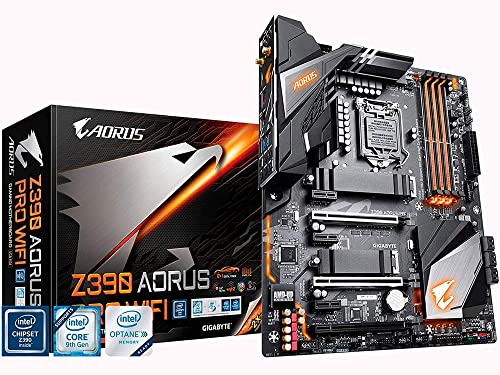
GIGABYTE Z390 AORUS PRO Wi-Fi (Best Overall)
For Intel 9th Gen Core (Coffee Lake Refresh), the GIGABYTE Z390 AORUS PRO Wi-Fi is the pick that needs the fewest apologies. Its Z390 foundation and ATX layout cover the essentials properly, and its strengths map directly onto what this class of build actually does all day.
See the GIGABYTE Z390 AORUS PRO Wi-Fi on Amazon for current availability and delivery options.
Strengths
- A serious multi-phase digital VRM with finned heatsinks was designed for overclocked 8-core chips like the Core i9-9900K, so a 9700K or 8600K is well within its comfort zone
- Dual M.2 slots with heatsinks cover fast boot and game drives without adapters
- Onboard Wi-Fi, quality audio shielding and RGB Fusion headers make it a complete flagship-era board with nothing essential missing
Trade-offs
- The LGA1151 platform is finished: no CPU upgrade path beyond 9th Gen, so this is a board for completing or keeping an existing build
- PCIe 3.0 only; current graphics cards work fully in practice for gaming, but Gen4 NVMe drives run at Gen3 speeds
- Early production stock shipped with BIOS versions aimed at 8th Gen chips, so confirm the BIOS supports your 9th Gen CPU or update it first
Key specs
- Socket: Intel LGA1151 for 8th and 9th Gen Core
- Chipset: Intel Z390
- Form factor: ATX
- Memory: 4x DDR4 DIMM
- Storage: 2x M.2 slots with Thermal Guard heatsinks
- Networking: onboard Intel AC Wi-Fi
- Lighting: RGB Fusion support
Treat this as a considered, keep-it-for-years foundation for Intel 9th Gen Core (Coffee Lake Refresh) rather than a stopgap. It rewards a careful first setup (current BIOS, correct memory slots, sensible fan curves) with a system that simply stays fast and quiet, and it leaves the most useful doors open if the build’s ambitions grow.
Best for: Intel 9th Gen Core (Coffee Lake Refresh) builders who want the strongest all-round balance of power delivery, features and long-term support / Not suited for: builders whose processor, case or plans fall outside the LGA1151 (300-series) Z390 platform described above
ASUS ROG Strix Z390-E Gaming (Best Premium)
The ASUS ROG Strix Z390-E Gaming is here because it solves the specific problems Intel 9th Gen Core (Coffee Lake Refresh) builds run into: power, cooling headroom and connectivity, in that order. As a Z390 ATX board it is not the cheapest way to make this processor boot, but it is one of the most convincing ways to make it thrive.
This pick is covered prose-only in this round: no verified US Amazon listing was available to link, so check reputable retailers and the used market under the exact model name, and verify revision and included accessories before buying.
Strengths
- ROG BIOS polish and fan control are the best in the Z390 class for overclocking a 9700K or 9900K
- Strong power delivery with proper cooling for sustained K-series loads
- Onboard Wi-Fi and SupremeFX-class audio complete the flagship checklist
Trade-offs
- Premium pricing follows it in remaining stock and used listings
- PCIe 3.0 platform with no forward CPU path beyond 9th Gen
- Confirm BIOS version for 9th Gen chips on early stock
Key specs
- Socket: Intel LGA1151 for 8th and 9th Gen Core
- Chipset: Intel Z390
- Form factor: ATX
- Memory: 4x DDR4 DIMM
- Networking: onboard Wi-Fi
- Storage: 2x M.2 slots
In practice this is the board for an Intel 9th Gen Core (Coffee Lake Refresh) system that will be used hard and kept for years: fit it, update the BIOS, set the memory profile and fan curves once, and it disappears into the background of the build, which is the highest compliment a motherboard can earn. Builders who know they will add drives, cards or a faster sibling processor later will appreciate the headroom it keeps in reserve.
Best for: Intel 9th Gen Core (Coffee Lake Refresh) builders who want the premium pick in this line-up / Not suited for: builders whose processor, case or plans fall outside the LGA1151 (300-series) Z390 platform described above
ASUS TUF H370-Pro Gaming (Wi-Fi) (Best for Locked Chips)
The ASUS TUF H370-Pro Gaming (Wi-Fi) earns its badge by matching Intel 9th Gen Core (Coffee Lake Refresh) where it counts. Built on the H370 chipset in ATX form, it treats this processor as a first-class citizen rather than an entry on a support list, and the details below explain where that shows up in daily use.
This pick is covered prose-only in this round: no verified US Amazon listing was available to link, so check reputable retailers and the used market under the exact model name, and verify revision and included accessories before buying.
Strengths
- H370 adds USB 3.1 Gen 2 and a second M.2 over B360 while staying locked-chip friendly
- TUF build quality suits a long-service 8400 or 8700 non-K system
- Dual M.2 gives a cleaner storage upgrade path than B360 rivals
Trade-offs
- No overclocking of CPU or memory beyond platform limits
- Priced close to Z390 boards in the used market, where Z390 adds flexibility
- Confirm the Wi-Fi variant; the base model omits it
Key specs
- Socket: Intel LGA1151 for 8th and 9th Gen Core
- Chipset: Intel H370
- Form factor: ATX
- Memory: 4x DDR4 DIMM
- Storage: 2x M.2 slots
- Networking: Wi-Fi on the Wi-Fi variant (check exact model)
Day to day, what you notice is what does not happen: no throttling surprises in long sessions, no missing header when the case or a new drive arrives, no BIOS fight when memory is upgraded. That boring reliability is the product. For an Intel 9th Gen Core (Coffee Lake Refresh) build expected to serve through several upgrades of everything around it, this board is the steady foundation those upgrades deserve.
Best for: Intel 9th Gen Core (Coffee Lake Refresh) builders who want a board optimised for locked chips / Not suited for: builders whose processor, case or plans fall outside the LGA1151 (300-series) H370 platform described above
MSI B365M Pro-VDH (Best Budget Replacement)
For Intel 9th Gen Core (Coffee Lake Refresh), the MSI B365M Pro-VDH is the pick that needs the fewest apologies. Its B365 foundation and Micro-ATX layout cover the essentials properly, and its strengths map directly onto what this class of build actually does all day.
This pick is covered prose-only in this round: no verified US Amazon listing was available to link, so check reputable retailers and the used market under the exact model name, and verify revision and included accessories before buying.
Strengths
- Native 8th Gen support with four DIMM slots at the lowest sensible cost
- Triple display outputs suit an 8400 office or media build using integrated graphics
- Compact and simple, ideal for repairs and small cases
Trade-offs
- Locked chipset with capped memory speeds, correct for an 8400 but nothing more
- Basic VRM; not an upgrade base for a 9900K
- No onboard Wi-Fi and a minimal rear panel
Key specs
- Socket: Intel LGA1151 for 8th and 9th Gen Core
- Chipset: Intel B365
- Form factor: Micro-ATX
- Memory: 4x DDR4 DIMM
- Storage: M.2 slot plus SATA 6Gb/s ports
- Display outputs: HDMI, DVI and VGA (for CPUs with integrated graphics)
Treat this as a considered, keep-it-for-years foundation for Intel 9th Gen Core (Coffee Lake Refresh) rather than a stopgap. It rewards a careful first setup (current BIOS, correct memory slots, sensible fan curves) with a system that simply stays fast and quiet, and it leaves the most useful doors open if the build’s ambitions grow.
Best for: Intel 9th Gen Core (Coffee Lake Refresh) builders who want the budget replacement pick in this line-up / Not suited for: builders whose processor, case or plans fall outside the LGA1151 (300-series) B365 platform described above
ASUS Prime Z390-A (Best for Work and Play)
The ASUS Prime Z390-A is here because it solves the specific problems Intel 9th Gen Core (Coffee Lake Refresh) builds run into: power, cooling headroom and connectivity, in that order. As a Z390 ATX board it is not the cheapest way to make this processor boot, but it is one of the most convincing ways to make it thrive.
This pick is covered prose-only in this round: no verified US Amazon listing was available to link, so check reputable retailers and the used market under the exact model name, and verify revision and included accessories before buying.
Strengths
- Prime stability and memory-layout tuning suit a work-and-play 9700K or 8600K system
- Clean white-accent design suits non-RGB builds
- Full overclocking support with an approachable BIOS
Trade-offs
- No onboard Wi-Fi and a restrained feature set versus ROG models
- Power delivery is a tier below flagship Z390 boards for extreme overclocks
- Platform is end-of-life; buy to complete a build
Key specs
- Socket: Intel LGA1151 for 8th and 9th Gen Core
- Chipset: Intel Z390
- Form factor: ATX
- Memory: 4x DDR4 DIMM with OptiMem design
- Storage: 2x M.2 slots
- USB: USB 3.1 Gen 2 Type-C
In practice this is the board for an Intel 9th Gen Core (Coffee Lake Refresh) system that will be used hard and kept for years: fit it, update the BIOS, set the memory profile and fan curves once, and it disappears into the background of the build, which is the highest compliment a motherboard can earn. Builders who know they will add drives, cards or a faster sibling processor later will appreciate the headroom it keeps in reserve.
Best for: Intel 9th Gen Core (Coffee Lake Refresh) builders who want a board optimised for work and play / Not suited for: builders whose processor, case or plans fall outside the LGA1151 (300-series) Z390 platform described above
ASUS TUF Z390-Plus Gaming (Wi-Fi) (Best Value Z390)
The ASUS TUF Z390-Plus Gaming (Wi-Fi) earns its badge by matching Intel 9th Gen Core (Coffee Lake Refresh) where it counts. Built on the Z390 chipset in ATX form, it treats this processor as a first-class citizen rather than an entry on a support list, and the details below explain where that shows up in daily use.
This pick is covered prose-only in this round: no verified US Amazon listing was available to link, so check reputable retailers and the used market under the exact model name, and verify revision and included accessories before buying.
Strengths
- TUF durability and full overclocking support at a step below ROG pricing
- Sensible fan control and a forgiving BIOS for a first overclocking build
- Dual M.2 covers the standard fast-storage layout
Trade-offs
- Power delivery is a tier below the AORUS Pro and Strix E for extreme 9900K overclocks
- Variant naming is confusing; the non-Wi-Fi version omits wireless entirely
- No forward upgrade path beyond 9th Gen Core
Key specs
- Socket: Intel LGA1151 for 8th and 9th Gen Core
- Chipset: Intel Z390
- Form factor: ATX
- Memory: 4x DDR4 DIMM
- Storage: 2x M.2 slots
- Networking: Wi-Fi on the Wi-Fi variant (check exact model)
Day to day, what you notice is what does not happen: no throttling surprises in long sessions, no missing header when the case or a new drive arrives, no BIOS fight when memory is upgraded. That boring reliability is the product. For an Intel 9th Gen Core (Coffee Lake Refresh) build expected to serve through several upgrades of everything around it, this board is the steady foundation those upgrades deserve.
Best for: Intel 9th Gen Core (Coffee Lake Refresh) builders who want the value z390 pick in this line-up / Not suited for: builders whose processor, case or plans fall outside the LGA1151 (300-series) Z390 platform described above
Comparison Table
Six boards, one processor family. Use this table to check the structural facts (socket, chipset, size, memory and networking) before reading any single-board verdict, and remember that the price column is a live check rather than a printed figure, because board pricing moves too much to print honestly. If two rows look identical here, the difference lives in power delivery and BIOS quality, which is what the individual reviews above are for. Builders weighing a platform change entirely can cross-check the options in Best Motherboards For Ryzen 9 5900x.
| Pick | Socket | Chipset | Form factor | Memory | Networking | Price |
|---|---|---|---|---|---|---|
| GIGABYTE Z390 AORUS PRO Wi-Fi | LGA1151 (300-series) | Z390 | ATX | DDR4 | Wi-Fi | Check price on Amazon |
| ASUS ROG Strix Z390-E Gaming | LGA1151 (300-series) | Z390 | ATX | DDR4 | Wi-Fi | Check price on Amazon |
| ASUS TUF H370-Pro Gaming (Wi-Fi) | LGA1151 (300-series) | H370 | ATX | DDR4 | Wi-Fi | Check price on Amazon |
| MSI B365M Pro-VDH | LGA1151 (300-series) | B365 | Micro-ATX | DDR4 | Wired LAN | Check price on Amazon |
| ASUS Prime Z390-A | LGA1151 (300-series) | Z390 | ATX | DDR4 | Wired LAN | Check price on Amazon |
| ASUS TUF Z390-Plus Gaming (Wi-Fi) | LGA1151 (300-series) | Z390 | ATX | DDR4 | Wi-Fi | Check price on Amazon |
How to Choose the Right Motherboard
Socket and chipset come first
The socket decides which processors physically fit, and the chipset decides what those processors are allowed to do: overclocking, memory speeds, PCIe generation and how many fast devices run at once. Always shop in that order. Confirm the exact processor model, match its socket, then choose the chipset tier that unlocks the features you will actually use. A premium chipset under a locked processor buys nothing, and a budget chipset under an unlocked processor quietly caps it.
Power delivery (VRM) sizing
The voltage regulator module turns power-supply output into the precise, high-current feed a modern processor demands. Under sustained load a weak or unheatsinked VRM runs hot and the board protects itself by throttling the CPU, which looks like a slow processor but is really a cheap board. Match the board to the chip: mainstream boards for mainstream 65W-class chips, heatsinked mid-range designs for eight-core parts, and flagship power stages for high-core-count or overclocked processors. Heatsink size you can see matters more than phase counts you cannot verify.
Memory type, slots and speed
Memory support is fixed by the board, not the processor alone. Check three things: the memory generation the board takes (DDR4 and DDR5 are not interchangeable and their slots are keyed differently), the number of DIMM slots (four slots keep upgrades cheap, two slots force full-kit replacements), and the rated speed with the processor you own, since achievable memory speed depends on the CPU’s memory controller as much as the board. Two sticks are easier to run at high speed than four on almost every platform in this guide. If you are still deciding between platforms, the comparison in Best Motherboards For Amd Ryzen 9 3950x shows how the same decision plays out for a neighbouring processor.
PCIe slots, lanes and spacing
The primary x16 slot takes the graphics card, but the details decide the build: its PCIe generation sets the ceiling for card and riser bandwidth, its position decides whether a thick cooler swallows the slot below, and the chipset’s lane budget decides what still works when every M.2 and add-in card is fitted. Read the manual’s lane-sharing table before buying around a capture card, a second NVMe adapter or a sound card; the table, not the spec headline, describes the board you will actually build on.
Storage: M.2 count and SATA
Plan storage as a layout, not a slot count. One PCIe 4.0 M.2 slot is enough for a fast boot and game drive in most builds; creators and workstation users should count total M.2 slots and check which share bandwidth with SATA ports or the second PCIe slot. SATA remains the cheap capacity tier for archives and backups. Heatsinks on M.2 slots matter for sustained transfers (video ingest, dataset copies) far more than for game loads.
Networking: LAN speed and Wi-Fi generation
Wired 2.5G Ethernet is the single most useful networking upgrade of this hardware generation for homes with fast fibre or a NAS, and it costs nothing in latency or stability. Wi-Fi 6 and 6E suit rooms without an Ethernet run, with 6E adding the 6 GHz band where a matching router exists. For a desk that already has Ethernet, onboard Wi-Fi is a convenience for later room changes, not a reason to pay a tier more today.
Form factor and case fit
ATX boards give the most slots, headers and spacing. Micro-ATX keeps four memory slots on most models here and fits smaller cases, at the cost of expansion room once a thick graphics card is fitted. Mini-ITX is a specialist choice with two memory slots and one expansion slot. Measure the case’s supported sizes rather than trusting its marketing class, and remember that E-ATX boards in the workstation sections need cases with the width and standoff positions to match.
How Do You Set Up a Motherboard for Intel 9th Gen Core (Coffee Lake Refresh)?
Setup follows the same safe order on every platform in this guide: verify, bench-test, build, configure. The steps below assume a standard tower build; the troubleshooting list after them covers the failures this order is designed to prevent, including the platform-specific one flagged in Best Motherboards For Video Editing for builders comparing installation across categories.
- Check compatibility before anything is opened: Confirm your Intel 9th Gen Core (Coffee Lake Refresh) appears on the board’s CPU support list at a BIOS version you can reach, confirm the memory generation matches the board variant you bought, and download the current BIOS, chipset driver and manual to a phone or second machine. This ten-minute step prevents nearly every first-build failure described in the mistakes section.
- Bench-test outside the case: Place the board on its box, fit the processor, cooler and one memory stick in the recommended slot, connect the power supply’s 24-pin and CPU power cables, and power on by shorting the front-panel power pins briefly with a screwdriver tip. You want a BIOS screen and the correct BIOS version displayed. Only a passing bench test earns the board a place in the case.
- Install the processor and cooler: Seat the processor: on Intel LGA platforms the pins live in the socket, so keep the socket cover on until the moment of installation, align the chip by its notches and corner mark, lower it straight down, and close the load plate without touching the pin field. Save the socket cover; warranty service may ask for it. Apply thermal paste per your cooler’s instructions, mount the cooler evenly in a cross pattern, and connect its fan or pump to the CPU fan or pump header named in the manual.
- Fit memory in the correct slots: Use the manual’s population table, not guesswork: two sticks go in the specified pair of slots (commonly the second and fourth from the processor on dual-channel boards), and quad-channel platforms have their own specified four slots. Seat each stick until both latches click. Wrong slots still boot, but at reduced bandwidth or speed.
- Mount the board in the case: Fit the I/O shield if the board has a separate one, verify the case standoffs match the board’s mounting holes exactly (remove extras), lower the board onto the standoffs, and fit M.2 drives now, while access is easy. Connect front-panel wires, front USB and HD audio, following the manual’s header diagram.
- Connect storage, graphics and power: Install the graphics card in the primary x16 slot until its latch clicks, connect its power cables directly from the power supply (no adapters), fit remaining drives, and route the 24-pin and CPU power cables so they are fully seated at both ends. A half-seated CPU power cable is the most common cause of a build that fans-spin but never posts.
- First boot, BIOS update and memory profile: Enter the BIOS, confirm the processor and full memory capacity are detected, update the BIOS if your support-list check said it is required, then enable the memory profile (XMP on Intel and most AMD boards, DOCP on some ASUS AMD boards) and set fan curves to a quiet profile. Save, reboot, and confirm the memory runs at its rated speed.
- Install the operating system and drivers in order: Install the OS, then the chipset driver, storage and network drivers, graphics driver, and only then vendor utilities. Reboot between the chipset and graphics steps. This order keeps device detection sane and makes any problem attributable to the last thing installed.
- Maintain it like you mean it: Every few months: clear dust from VRM heatsinks, M.2 heatsinks and fan filters, confirm fans still spin freely, and check for a BIOS update only if it fixes something you experience or adds support you need. Keep a note of your BIOS version and settings; a CMOS reset during a future upgrade is a two-minute job with notes and a guessing game without them.
Quick troubleshooting
- Problem: no display and a CPU debug light → the BIOS likely predates your processor; update it with the board’s no-CPU flash feature or an older supported chip.
- Problem: build posts but shows half the installed memory → a stick is not fully seated or sits in the wrong slot; reseat using the manual’s population table.
- Problem: an M.2 drive does not appear → check whether that slot needs a specific processor generation, whether it is set to the right mode (NVMe versus SATA), and what the lane-sharing table says it disables or is disabled by.
- Problem: processor runs hot and slow under load → check cooler mounting pressure and paste, then confirm case intake airflow reaches the VRM area; throttling is cooling or power delivery, never a mystery.
- Problem: front USB-C port does nothing → the case cable likely has no matching header on the board, or the header is disabled when another slot is populated; the manual’s sharing table decides.
Common Mistakes
Reusing an old power supply without checking connectors
High-end boards may want an additional 4-pin or 8-pin CPU power connector, and high-core-count builds under load are unforgiving of ageing power supplies. Check the board’s power connectors against the PSU’s cables, and treat a decade-old PSU under a flagship CPU as a false economy.
Overbuying chipset for a locked processor
A locked processor cannot use CPU overclocking no matter how expensive the board is, and its memory speed may be capped by platform rules as well. That money buys more real performance as storage, memory capacity or a better graphics card. The upgrade-path exception (buying the flagship chipset today for an unlocked chip tomorrow) is legitimate only if the upgrade is genuinely planned.
Buying by socket alone
The socket fitting is the start of compatibility, not the end. Chipset generation decides CPU support within the same socket on both AMD and Intel platforms, and this guide’s excluded combinations (such as Ryzen 2000 on B550) exist precisely because socket-only shopping fails. Always confirm the exact processor on the board’s CPU support list.
Ignoring slot spacing with thick graphics cards
Modern graphics cards routinely occupy the space of the slot below the one they plug into. On compact boards that can eliminate the only slot available for a capture card, sound card or extra NVMe adapter. Sketch the slot layout with the card’s real thickness before committing to a Micro-ATX build with add-in plans.
Assuming all M.2 slots are equal
M.2 slots differ in PCIe generation, in whether they support SATA drives, and in what they disable when populated. A Gen4 drive in a Gen3 slot runs at Gen3 speed, and a populated slot can silently switch off SATA ports or drop a PCIe slot to fewer lanes. The manual’s sharing table is five minutes of reading that prevents a weekend of confusion.
Mixing memory generations in the plan
DDR4 and DDR5 boards are different products with physically different slots. Every build plan should name its memory generation once and check every part against it: board, kit and (for platforms that offer both) the exact board variant. Sellers list DDR4 and DDR5 variants under near-identical names, and returns are the usual teacher.
Going Deeper: Ownership Details That Matter Later
Lane sharing deserves a second look because it explains most ‘my drive disappeared’ forum threads. Chipsets have a fixed pool of high-speed lanes, and board designers route them to slots and ports through switches. Populating one connector can reroute lanes away from another. None of this is a defect; it is physics and cost. The practical habit is simple: decide your final device list (graphics card, NVMe drives, capture or network cards), then check the board manual’s configuration table for exactly that list before purchase, not after assembly.
Standoff discipline prevents the most expensive beginner mistake in PC building: an extra case standoff left under the board where no mounting hole exists, pressing against traces and solder points. Count the board’s mounting holes, fit exactly that many standoffs in exactly those positions, and remove any pre-installed extras the case shipped with for other form factors. Two minutes with a nut driver is cheaper than any board in this guide.
BIOS maturity is a real, if unglamorous, buying criterion. A platform that has been on sale for years has a BIOS that has met every memory kit and processor stepping it will ever see, with fixes already shipped. A brand-new platform’s early BIOS versions are where memory compatibility lists are shortest and update cadence matters most. Builders who value a boring first boot over launch-day novelty are not being timid; they are pricing their own time correctly, and several picks in this guide earn their place partly on that maturity.
Memory slot population rules catch out experienced builders on the larger platforms in this guide. Quad-channel boards only deliver quad-channel bandwidth with sticks in the specified four slots, and the manual’s population table (not symmetry or guesswork) defines them. On dual-channel boards, two sticks belong in the second and fourth slots from the CPU on most layouts. Wrong population rarely stops a boot; it quietly halves memory bandwidth or caps achievable speed, which is worse, because nothing looks broken.
Electrostatic care is unglamorous and effective: build on a hard surface, touch the case’s bare metal before handling the board, keep the board on its anti-static bag or box until mounting, and handle it by its edges. Modern components are tougher than folklore suggests, but the platforms in this guide include boards that cannot be replaced at retail anymore, which raises the stakes of casual handling accordingly.
Finally, keep the paperwork. Screenshot or save the BIOS version your board shipped with, the memory kit’s exact model code, and the CPU support list entry for your processor. If the system misbehaves in two years, that small archive turns a guessing game into a diagnosis, and it makes any warranty or resale conversation straightforward. Several boards in this guide are old enough that their support pages will not stay online forever; your own copies will.
The I/O shield sounds trivial until it is forgotten. Boards with pre-installed shields remove the classic build error of discovering the shield after the board is screwed down, and they also seal the rear gap against dust and interference. On boards with a separate shield, fit it before the board, check its grounding tabs are not bent into the ports, and press the board home until the rear connectors sit flush. It is the smallest part of the build and the one most often done twice.
VRM thermals interact with case airflow in ways spec sheets never mention. A board with generous heatsinks in a case with no intake airflow will still run hot under a sustained all-core load, because the heatsink has no cool air to give its heat to. Conversely, a mid-range board with a direct intake fan often outlasts a flagship in a sealed case. When a shortlist in this guide prefers a stronger VRM for a high-core chip, it assumes at least competent case airflow; fix the airflow first and several tiers of board become viable.
Final Recommendation
For best overall in a Intel 9th Gen Core (Coffee Lake Refresh) build, choose the GIGABYTE Z390 AORUS PRO Wi-Fi. For best premium in a Intel 9th Gen Core (Coffee Lake Refresh) build, choose the ASUS ROG Strix Z390-E Gaming. For best for locked chips in a Intel 9th Gen Core (Coffee Lake Refresh) build, choose the ASUS TUF H370-Pro Gaming (Wi-Fi). For best budget replacement in a Intel 9th Gen Core (Coffee Lake Refresh) build, choose the MSI B365M Pro-VDH. For best for work and play in a Intel 9th Gen Core (Coffee Lake Refresh) build, choose the ASUS Prime Z390-A. For best value z390 in a Intel 9th Gen Core (Coffee Lake Refresh) build, choose the ASUS TUF Z390-Plus Gaming (Wi-Fi). If forced to name one default for most readers, it is the first pick in this guide, because it balances power delivery, features and support depth for Intel 9th Gen Core (Coffee Lake Refresh) without asking flagship money for features this processor cannot use. Whichever you choose, run the compatibility checks in the setup section before ordering: in this category, ten minutes of verification is worth more than any single feature. Readers still torn between platforms will find the neighbouring case laid out in Best Motherboards For Ryzen 3.
Frequently Asked Questions
Can I overclock on a B360 or H370 board instead of Z390?
No. On this platform only Z-series chipsets allow CPU multiplier overclocking, and the locked chipsets also cap memory speed. For a locked processor that is a fair trade and this guide recommends those boards for exactly those chips. For a K-series processor, a locked board leaves its defining feature unused.
Will this motherboard work with my existing power supply?
In most cases yes, provided the power supply has the 24-pin main connector plus the 8-pin (or 4+4 pin) CPU connector the board expects, and enough wattage for the processor and graphics card combined. High-end boards may offer an additional CPU power connector for extreme overclocking; for standard use the primary connector is sufficient. With an older power supply, check connector availability before ordering, not wattage alone.
Do I need to update the BIOS before installing my processor?
Sometimes. Boards manufactured after a processor launches ship with a supporting BIOS; older stock may not. Check the board’s CPU support list, which names the minimum BIOS version for your exact chip. If an update is needed and the board offers a no-CPU flash feature (Q-Flash Plus, BIOS Flashback or Flash BIOS Button), a USB stick is all it takes. Without that feature, the update needs an older supported processor fitted first.
How much memory should I pair with Intel 9th Gen Core (Coffee Lake Refresh)?
For gaming and general use, 16GB in two sticks is the working minimum and 32GB is the comfortable recommendation that keeps a system responsive for years. Content creation, virtual machines and large datasets justify 64GB or more where the platform allows. Whatever the capacity, two sticks in the manual’s recommended slots is the configuration most likely to run at full rated speed without manual tuning.
Is a more expensive motherboard faster?
Not directly. At the same settings, processors perform within a small margin across boards, because the board does not do the computing. What money buys is the ability to sustain performance (power delivery and cooling), to tune it (overclocking chipsets and BIOS depth), and to connect more (storage, USB, networking). Buy the board whose limits you would actually reach, which for most builds is a tier below the flagship.
Can I reuse my current memory and drives?
Drives, yes: SATA and NVMe drives move between boards freely, though a fresh Windows installation is recommended when changing platforms. Memory, only if the generation matches. DDR4 and DDR5 are physically incompatible, and several platforms in this guide exist in both variants under similar names, so confirm the exact board model against your kit before ordering.