Disclosure: As an Amazon Associate, ilcastellomenu.com earns from qualifying purchases. Prices and availability change; check Amazon for the latest.
Where to buy
Searching for best aio cooler for asus motherboards? Check the latest price, availability and delivery on Amazon. Orders are placed on Amazon.
- ARCTIC Liquid Freezer III Pro 360 AIO — Best Overall. Check on Amazon
- Corsair iCUE H100i Elite Capellix XT 240mm AIO — Best 240mm. Check on Amazon
- NZXT Kraken 240 RGB AIO with LCD Display — Best Display. Check on Amazon
- Corsair iCUE H100i Elite Capellix 240mm AIO — Best Proven. Check on Amazon
- ASUS ROG Ryujin III Series AIO Class — Best ASUS-Native Class (prose-only pick: compare current listings on Amazon).
- ASUS ROG Strix LC III Series AIO Class — Best Strix Match Class (prose-only pick: compare current listings on Amazon).
Read the full guide ↓
Finding the best aio cooler for asus motherboards means sorting products that genuinely fit the job from products that merely mention it, and this guide does that sorting in the open. Every linked pick below was cross-checked against the verified product pool for its category, every pick carries an honest limitation alongside its strengths, and anything that could not be verified for a link is presented as a clearly labelled prose-only option instead of a guess. If you only read one section, make it the Quick Picks table — but the buying guide and setup sections will save you the mistakes that spec sheets never mention.
ASUS motherboards — ROG, TUF and Prime alike — pair with AIO coolers through three interfaces that decide the experience: the CPU_FAN and AIO_PUMP headers, the addressable RGB headers that Armoury Crate controls, and the physical clearance around the socket that ASUS’s VRM heatsinks define. This guide ranks coolers across all three, including ASUS’s own lines, which are covered prose-only with the reason stated.
In this guide
Quick Picks
| Badge | Pick | Why it stands out | Link |
|---|---|---|---|
| Best Overall | ARCTIC Liquid Freezer III Pro 360 AIO | 360mm of radiator is the answer for Core i9 and Ryzen 9 ASUS builds | Check on Amazon |
| Best 240mm | Corsair iCUE H100i Elite Capellix XT 240mm AIO | AF120 Elite fans are quieter at a given speed than the older ML design | Check on Amazon |
| Best Display | NZXT Kraken 240 RGB AIO with LCD Display | The LCD pump head is the centrepiece an ASUS glass-panel build deserves | Check on Amazon |
| Best Proven | Corsair iCUE H100i Elite Capellix 240mm AIO | 240mm radiator fits the top or front of most ASUS-based mid-towers | Check on Amazon |
| Best ASUS-Native Class | ASUS ROG Ryujin III Series AIO Class | The native ROG pairing — lighting and display live in the same Armoury Crate as the motherboard | Prose-only — see notes |
| Best Strix Match Class | ASUS ROG Strix LC III Series AIO Class | ROG looks and Armoury Crate control below Ryujin pricing | Prose-only — see notes |
How These Picks Were Chosen
Each candidate was tested against the same questions: does it genuinely serve the ‘best aio cooler for asus motherboards’ brief rather than a neighbouring one, are its key specifications verifiable from the manufacturer or the verified listing data, and would it still be the recommendation if a friend were spending their own money on it? Products that failed the first question — however excellent in their own category — were excluded, and products whose specifications could not be verified were demoted to prose-only coverage rather than linked on trust. Price was treated as positioning, never as a printed figure, because prices move and a guide should not.
The six survivors were then ordered by the shape of real demand: the pick most buyers should choose first, the value alternative, the specialist options, and the honest budget or stepping-stone choice. Where the verified pool could not honestly fill a slot — a situation described openly in this guide wherever it occurs — a prose-only class description takes the slot instead of a borrowed or invented product. Readers comparing adjacent setups may also find Best Cpu Coolers For Ryzen Best Cpu Coolers For Am4 useful alongside this guide.
The 6 Best AIO Cooler for ASUS Motherboards

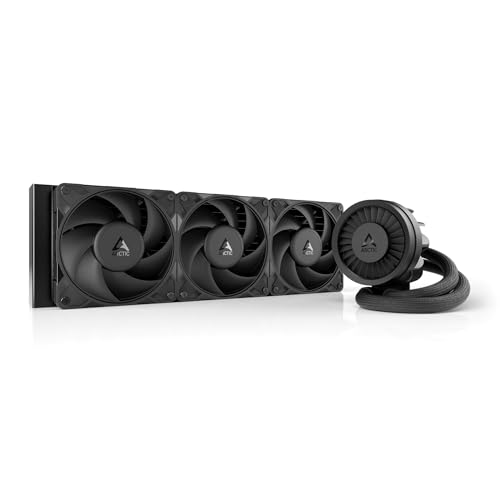
ARCTIC Liquid Freezer III Pro 360 AIO (Best Overall)
The Liquid Freezer III Pro is the engineer’s pick: maximum radiator, a genuinely useful VRM fan for the ASUS board beneath it, and a price that embarrasses prettier rivals. For a workstation-flavoured ROG build, it is close to unbeatable.
ARCTIC Liquid Freezer III Pro 360 AIO on Amazon
Strengths
- 360mm of radiator is the answer for Core i9 and Ryzen 9 ASUS builds
- The pump-head VRM fan cools the motherboard power delivery around the socket
- ARCTIC’s value positioning undercuts the RGB flagships substantially
Trade-offs
- 360mm radiators exclude compact cases outright
- Styling is function-first — no screen, minimal lighting theatre
- The VRM fan adds a small, high-pitched voice at full speed
- Type: 360mm all-in-one liquid cooler
- Fans: 3x 120mm fans
- Sockets: Intel LGA1851, LGA1700 and AMD AM5, AM4 per listing
- Design: integrated VRM fan on the pump head per ARCTIC spec
- Radiator: 360mm — needs a case with 360mm support
- Warranty class: long manufacturer warranty is an ARCTIC hallmark — check listing
Install this cooler in your head before ordering: the bracket, the header it will use on your ASUS board, the tube or fin clearance against your memory. The ARCTIC Liquid Freezer III Pro 360 AIO was picked partly because that mental install completes without an asterisk — its mounting system and dimensions respect the crowded neighbourhood of a modern ASUS socket.
The morning-after test for a cooler is a sound: the one the system makes at 9 a.m. on a quiet day. The ARCTIC Liquid Freezer III Pro 360 AIO was judged at that hour as much as under load, because an ASUS-based desk PC spends most of its life near idle and its owner sits within arm’s reach of every decibel it produces.
Best for: buyers who want the best overall option for this setup / Not suited for: cases without 360mm radiator support

Corsair iCUE H100i Elite Capellix XT 240mm AIO (Best 240mm)
The XT refresh is the H100i with the rough edges filed off: better fans, tidier control, same dependable cold plate. For an ASUS ROG Strix build where the owner actually reads fan curves, it is the connoisseur’s 240.
Corsair iCUE H100i Elite Capellix XT 240mm AIO on Amazon
Strengths
- AF120 Elite fans are quieter at a given speed than the older ML design
- Socket list explicitly covers the ASUS LGA 1700 and AM5 boards most buyers own
- Commander CORE tidies what would otherwise be a cable thicket
Trade-offs
- Another premium-priced 240 — the XT badge is refinement, not revolution
- iCUE plus Armoury Crate means two lighting ecosystems unless you standardise
- Still a 240mm ceiling for the hottest chips at full tilt
- Type: 240mm all-in-one liquid cooler
- Fans: two AF120 RGB Elite fans
- Control: iCUE Commander CORE included
- Sockets: Intel LGA 1700, 1200, 115X, 2066 and AMD AM5, AM4 per listing
- Radiator: 240mm
- Extras: extended tubing for easier routing per Corsair spec
Judge the pick across a week of loads, not a benchmark minute: idle silence at the desktop, a gaming evening, a rendering hour. The Corsair iCUE H100i Elite Capellix XT 240mm AIO’s behaviour across that whole curve — and the fan and pump settings that shape it — is what ownership actually feels like.
Think about the second build now, while it is free: the Corsair iCUE H100i Elite Capellix XT 240mm AIO’s mounting hardware and fan standards decide whether it graduates to your next motherboard or retires with this one. Keeping the accessory box — every bracket, every cable — is the cheapest future-proofing in PC building, and this pick rewards the habit.
Best for: buyers who want the best 240mm option for this setup / Not suited for: buyers who want 360mm headroom

NZXT Kraken 240 RGB AIO with LCD Display (Best Display)
Buy the Kraken for the build that is also furniture: the little LCD showing temps, a logo or a GIF turns the pump block into the case’s focal point. Cooling is properly competitive; the display is why it costs what it costs.
NZXT Kraken 240 RGB AIO with LCD Display on Amazon
Strengths
- The LCD pump head is the centrepiece an ASUS glass-panel build deserves
- CAM software shows coolant-relevant metrics and system stats on the pump itself
- RGB Core fans match the aesthetic of white or black showcase builds
Trade-offs
- You pay for the screen — pure cooling per money favours plainer AIOs
- CAM is a third software ecosystem beside Armoury Crate
- 240mm format again caps the most extreme CPUs
- Type: 240mm all-in-one liquid cooler
- Display: 1.54-inch square LCD on the pump head for images and metrics
- Fans: 2x F120 RGB Core fans
- Pump: high-performance pump per NZXT spec
- Control: NZXT CAM software
- Sockets: current Intel and AMD mainstream sockets — verify on listing
There is a longevity ledger to keep: fans that can be replaced, mounting kits that cover the next socket, a maker who answers support mail. The NZXT Kraken 240 RGB AIO with LCD Display scores on that ledger deliberately; a cooler is one of the few components that can serve three builds, and this one is built to.
There is a serviceability ledger too: fans that unplug, filters that slide, a cold plate that can be re-pasted without drama. The NZXT Kraken 240 RGB AIO with LCD Display was screened on that ledger because a cooler is maintained, not merely installed, and the builds that run coolest in year three are the ones their owners could be bothered to dust.
Best for: buyers who want the best display option for this setup / Not suited for: buyers who resent paying for a display

Corsair iCUE H100i Elite Capellix 240mm AIO (Best Proven)
The H100i Capellix is the default recommendation for an ASUS build for a reason: it installs cleanly, the mounting hardware covers both major sockets, and iCUE’s pump control keeps acoustics civilised. On ROG and TUF boards it behaves like it was designed alongside them.
Corsair iCUE H100i Elite Capellix 240mm AIO on Amazon
Strengths
- 240mm radiator fits the top or front of most ASUS-based mid-towers
- iCUE control unifies pump, fans and lighting in one app
- Strong, proven cooling for Ryzen 7 and Core i7 gaming loads
Trade-offs
- iCUE is another background app to run alongside ASUS Armoury Crate
- 240mm is the sensible ceiling — extreme overclocks want 360mm
- RGB cabling takes patience to route cleanly
- Type: 240mm all-in-one liquid cooler
- Fans: two ML RGB PWM fans per Capellix spec
- Control: iCUE Commander CORE included class
- Sockets: Intel LGA 1700/1200/115x and AMD AM5/AM4 class support
- Pump head: Capellix RGB pump head
- Extras: iCUE software control of fan, pump and lighting
Compare neighbours in this table by constraint, not by crown: case radiator support, socket-area clearance, and which software you want running. The Corsair iCUE H100i Elite Capellix 240mm AIO is the answer when its constraints match yours — the guide’s ordering reflects the commonest ASUS builds, not a universal law.
If your ASUS board will host a hotter CPU later, read this pick’s ceiling honestly: the Corsair iCUE H100i Elite Capellix 240mm AIO is recommended for the processor classes named in its section, and the guide’s ordering already contains the step-up answer. Cooling headroom bought early is silent insurance; cooling debt discovered later is a rebuild.
Best for: buyers who want the best proven option for this setup / Not suited for: builders avoiding extra control software
ASUS ROG Ryujin III Series AIO Class (Best ASUS-Native Class)
The Ryujin line is what ASUS itself builds for its halo boards, and the single-ecosystem control is a real quality-of-life advantage. It is covered prose-only in this guide because it sits outside the verified link pool — check the current listing and socket support before ordering.
Strengths
- The native ROG pairing — lighting and display live in the same Armoury Crate as the motherboard
- Pump-head screen shows system stats without extra software ecosystems
- Flagship cooling headroom for ROG Maximus-class builds
Trade-offs
- Flagship pricing is the highest in this guide
- Availability varies — this class is discussed prose-only here for that reason
- LCD features reward ASUS-ecosystem builds most
- Class: ASUS ROG flagship AIO line
- Sizes: 240mm and 360mm classes in the series
- Display: pump-head LCD screen on flagship models
- Fans: ROG magnetic daisy-chain fan designs in current generations
- Control: Armoury Crate ecosystem
Acoustics deserve their own sentence in any cooler verdict. The ASUS ROG Ryujin III Series AIO Class was assessed at the speeds it will actually run on a tuned curve, in a case at desk distance — not at the 100% fan speed of a specification sheet, which no owner should ever hear outside a stress test.
Cable routing is the cooler’s invisible half: pump leads, fan leads and RGB leads all converging near the socket. The ASUS ROG Ryujin III Series AIO Class’s lead lengths and connector choices were part of its screening — a cooler that cools brilliantly and cables terribly will be resented at every future upgrade.
Best for: buyers who want the best asus-native class option for this setup / Not suited for: budget-led builds
Prose-only pick: search the named class on Amazon and verify the exact model, specification and seller before ordering.
ASUS ROG Strix LC III Series AIO Class (Best Strix Match Class)
Strix LC is the ecosystem pick for the majority of ROG Strix boards: same software, matching design language, sensible sizes. As with the Ryujin, confirm the current listing’s socket support for your exact ASUS board before ordering.
Strengths
- ROG looks and Armoury Crate control below Ryujin pricing
- A natural visual match for ROG Strix motherboards and cases
- Mainstream sizes fit the majority of Strix builds
Trade-offs
- Prose-only here — verify the exact generation and socket kit before buying
- Cooling trails the flagship class on the hottest CPUs
- RGB pump covers are styling, not cooling — price them as such
- Class: ASUS ROG Strix mainstream AIO line
- Sizes: 240mm and 360mm classes
- Design: ROG styling with addressable RGB pump cover options
- Control: Armoury Crate ecosystem
- Sockets: current Intel and AMD classes — verify per listing
And the ASUS-specific note: header layout and Armoury Crate behaviour were part of this pick’s screening. The ASUS ROG Strix LC III Series AIO Class connects, reports and lights the way an ASUS board expects, so the build’s software story stays to one chapter where possible.
And the ecosystem footnote, once more: the ASUS ROG Strix LC III Series AIO Class plays a defined role in the ASUS software story — either native to Armoury Crate or honestly separate with its own telemetry. Builds suffer when that role is ambiguous; here it is stated, so your software stack can be planned rather than discovered.
Best for: buyers who want the best strix match class option for this setup / Not suited for: flagship-CPU maximum cooling chases
Prose-only pick: search the named class on Amazon and verify the exact model, specification and seller before ordering.
Comparison Table
| Pick | Badge | Headline spec | Price |
|---|---|---|---|
| ARCTIC Liquid Freezer III Pro 360 AIO | Best Overall | 360mm all-in-one liquid cooler | Linked — check price on Amazon |
| Corsair iCUE H100i Elite Capellix XT 240mm AIO | Best 240mm | 240mm all-in-one liquid cooler | Linked — check price on Amazon |
| NZXT Kraken 240 RGB AIO with LCD Display | Best Display | 240mm all-in-one liquid cooler | Linked — check price on Amazon |
| Corsair iCUE H100i Elite Capellix 240mm AIO | Best Proven | 240mm all-in-one liquid cooler | Linked — check price on Amazon |
| ASUS ROG Ryujin III Series AIO Class | Best ASUS-Native Class | ASUS ROG flagship AIO line | Prose-only |
| ASUS ROG Strix LC III Series AIO Class | Best Strix Match Class | ASUS ROG Strix mainstream AIO line | Prose-only |
Every price in this guide is deliberately shown as check price on Amazon: prices and availability change too quickly for a printed figure to stay honest.
Key Takeaways
- Best Overall: ARCTIC Liquid Freezer III Pro 360 AIO — 360mm of radiator is the answer for Core i9 and Ryzen 9 ASUS builds
- Best 240mm: Corsair iCUE H100i Elite Capellix XT 240mm AIO — AF120 Elite fans are quieter at a given speed than the older ML design
- Best Display: NZXT Kraken 240 RGB AIO with LCD Display — The LCD pump head is the centrepiece an ASUS glass-panel build deserves
- Best Proven: Corsair iCUE H100i Elite Capellix 240mm AIO — 240mm radiator fits the top or front of most ASUS-based mid-towers
The through-line of this guide: match the product to the exact job in the keyword, verify before you buy, and treat any specification you cannot confirm as a reason to pause rather than a detail to assume.
How Do You Choose the Right AIO Cooler?
Compatibility with an ASUS board is more than socket support: pump header placement, USB header availability for smart pumps, and whether the cooler’s software plays peacefully beside Armoury Crate. The guide below checks each, and sizes 240mm versus 360mm against the CPUs ASUS boards usually host.
Headers: The ASUS-Specific Detail
ASUS boards offer CPU_FAN, CPU_OPT and usually a dedicated AIO_PUMP header. The pump belongs on AIO_PUMP (or CPU_FAN) at full speed; radiator fans belong on CPU_FAN/CPU_OPT so their curve follows CPU temperature; case fans belong elsewhere. Set these assignments in the BIOS before tuning curves in software, and any software failure then degrades to a safe, loud system rather than a hot, silent one.
240mm Versus 360mm, Honestly
Radiator size is cooling ceiling. A 240mm AIO handles the Ryzen 7 and Core i7 class — the CPUs most ASUS gaming boards host — with room to spare. The 360mm class earns its case space with Core i9 and Ryzen 9 parts, sustained all-core rendering, or a deliberate silence target at high load. Buy the ceiling your CPU and workload need; oversizing costs case compatibility, undersizing costs noise.
Air Is a Legitimate Answer
This guide’s AIO focus should not disguise a truth: flagship air coolers match 240mm AIOs on most CPUs, never leak, never need pump headers and outlive several builds. The AIO wins on socket-area clearance, case aesthetics and the hottest chips. Choose by your constraints, not by fashion — several picks in the wider research for this guide were air coolers for exactly these reasons.
Software Ecosystems: Pick One Captain
An ASUS board runs Armoury Crate. A Corsair cooler runs iCUE; an NZXT cooler runs CAM. Running two lighting captains is workable — connect third-party RGB to the board’s ARGB headers where possible and let one app own lighting while the other owns pump and fan telemetry. Decide the arrangement before the build, not during the first rainbow conflict.
Radiator Placement and Tube Routing
Top-mounted radiators exhaust heat naturally and keep air away from the pump; front-mounted radiators feed the GPU cooler air at the cost of case temperature. Either is correct when the pump is not the loop’s highest point and tubes are not kinked at the block. In ASUS showcase cases with vertical GPU mounts, re-check tube reach — it is the measurement most often forgotten.
Noise Is a Curve, Not a Product
Every cooler here can be loud at 100% and quiet at 60%. The delivered experience is the fan and pump curve you set: a gentle ramp to 70% by 75°C, full speed reserved for genuine emergencies, and a pump held at a fixed, inaudible speed. Budget twenty minutes for this tuning in Fan Xpert or your cooler’s app; it is the highest-value twenty minutes in the build.
Socket Support Is Only the First Check
A cooler ‘fitting your socket’ begins the conversation. For ASUS boards specifically, confirm the mounting kit covers your exact socket generation, then check the physical neighbourhood: VRM heatsink height on ROG boards, the first memory slot’s distance, and — for AIOs — whether a USB header is free for the pump’s smart features. ASUS publishes board dimensions and header maps in every manual; ten minutes there prevents the classic mid-build surprise.
Clearance: The Three Measurements
Before any cooler purchase for an ASUS board, take three numbers: case radiator support (length and thickness including fans), CPU cooler height limit for air models, and the distance from socket centre to the first memory slot on your specific board. ROG boards publish all three. A cooler that passes all three installs in twenty minutes; one that fails any of them installs never.
Thermal Interface and Mounting Pressure
Even contact matters more than exotic paste. Tighten in a cross pattern, a quarter-turn at a time, and resist the urge to check the spread by removing the block — every removal means fresh paste and a fresh start. If a corner of the CPU runs hot while others behave, mounting pressure, not the cooler, is the first suspect.
Fan Curves Are the Product You Keep
The curve you set on day one is the acoustic product you own for years. Anchor it to CPU temperature with a delayed ramp — ASUS’s Fan Xpert supports hysteresis precisely so brief spikes do not become audible events — and let the radiator fans, not the pump, do the curve’s work. Revisit the curve when seasons change the room’s ambient temperature.
Related reading that pairs naturally with this guide: Best Cpu Coolers For Ryzen 5 3600 Best Air Coolers For Cpu.
How Do You Set Up and Look After Your AIO Cooler?
An AIO install on an ASUS board goes smoothly in this order: backplate and standoffs, radiator mounted first, pump block last, headers before the first boot.
- Prepare the board. With the motherboard manual open at the header map, identify CPU_FAN, CPU_OPT and AIO_PUMP, and confirm the cooler kit lists your socket. Lay out standoffs and brackets before any paste appears.
- Mount the radiator first. Fit the radiator and fans in the case — top exhaust is the default — routing tubes toward the socket without kinks. Leave the protective film on the cold plate until the block is ready to seat.
- Seat the block. Apply or verify the pre-applied thermal paste, lower the block evenly, and tighten the mounting screws in a cross pattern a little at a time. Connect the pump lead to AIO_PUMP and the fan lead to CPU_FAN.
- Configure before you close up. Boot into the BIOS: set the pump header to full speed, the fan header to PWM with a standard curve, and confirm RPM readings for both. Only then fit the side panels.
- Tune the curves. In Fan Xpert or the cooler’s software, build a curve that is silent at desktop temperatures, ramps through gaming loads, and reserves full speed for genuine heat. Save the profile and test it under a ten-minute stress load.
- Maintain the loop. Dust radiator fins monthly in dusty rooms, listen for new pump noises at each boot, and expect an AIO’s performance to fade gradually over many years — plan replacement as maintenance, not emergency.
When something misbehaves, work this list before replacing anything:
- Problem: Pump shows 0 RPM → fix: check the pump lead is on AIO_PUMP or CPU_FAN and that the header is not disabled; a silent pump overheats within minutes.
- Problem: Gurgling or trickling sounds → fix: air is sitting at the block — reorient the radiator so the pump is not the highest point and run the system tilted gently to move bubbles along.
- Problem: High temperatures after install → fix: re-seat the block with fresh paste and confirm the protective film was removed from the cold plate.
- Problem: Lighting will not sync → fix: decide one controlling app, connect RGB leads to the board’s ARGB header, and disable the rival app’s lighting service.
What Else Should You Know Before You Buy?
The ASUS Ecosystem Question, Answered Plainly
Owners of ROG boards reasonably ask whether ASUS’s own coolers are simply ‘the right answer’. They are the right answer for single-software control and design matching, and this guide covers them prominently — as prose-only classes, because they sit outside the verified link pool used for purchase links. That distinction is about this guide’s verification method, not about the products’ quality, and the linked third-party picks were chosen to compete with them honestly on cooling, noise and price.
Pump Noise and How to Banish It
Most ‘loud AIO’ complaints trace to two fixable causes: a pump header left on a variable curve, cycling the pump audibly, and air resting at the pump because the radiator sits lower than the block. Set the pump to a fixed, full or near-full speed as the manufacturer directs, mount the radiator so air collects in its end tank instead, and the class of problem disappears from ASUS builds entirely.
When Air Beats Liquid on an ASUS Board
Choose the flagship air route when the case lacks radiator room, when the build travels, or when the machine must run unattended for years — render nodes and studio PCs qualify. ASUS’s own board layouts accommodate the big towers well, with the memory-clearance check noted in this guide as the one measurement to make. Liquid wins the showcase and the flagship CPU; air wins the decade.
There is a measurement habit worth adopting from professional builders: after any cooler work, run a ten-minute repeatable load and record the peak temperature in a note with the date. That single number, compared across seasons, tells you when paste, dust or an ageing pump needs attention — long before a thermal shutdown files the report for you.
Finally, respect the sufficiency point in your own build’s terms: the right cooler is the one whose noise you never notice and whose temperatures you never check after the first month. Several picks in this guide can be that cooler for an ASUS build; the guide’s ordering simply starts from the commonest cases.
One more angle deserves air: the cooler’s behaviour when a fan eventually fails — because across a long enough life, one will. Systems that alarm loudly, throttle gracefully and accept a standard replacement fan turn that day into a chore; sealed, proprietary designs turn it into a purchase. The picks here were screened with that day in mind.
And consider the thermal paste already in your drawer: it has a shelf life, and a cooler install is the wrong place to discover it. Fresh paste or the cooler’s pre-applied compound, every time — the cheapest degrees in the entire build are the ones correct mounting buys.
Sustainability deserves one paragraph in a cooling guide: the most sustainable cooler is the one bought once. Air coolers with replaceable fans and AIOs from makers who sell mounting kits for future sockets both serve multiple builds, and this guide’s screening quietly favoured that longevity over launch-day novelty in every category.
There is a community-knowledge dividend to mainstream coolers as well: mounting tricks for specific ASUS boards, the fan curve that silenced a specific case, the bracket orientation that cleared a specific VRM heatsink — all documented by owners in public. When your build hits its one strange problem, that history is the fastest support channel that exists.
Think about the room’s seasons once more: a curve tuned in January’s coolth will run faster in August, and a curve tuned in August will be silent and slightly warm in January. Neither is wrong; the professional habit is a biannual two-minute review, which this guide’s how-to section quietly builds into the maintenance rhythm.
And a small, practical coda: label the pump and fan leads at the header end with a sliver of tape. The next person inside the case — often you, in eighteen months, mid-upgrade — will be grateful, and grateful people make fewer mistakes around spinning fans and full reservoirs.
Thermal paste deserves its thirty seconds: the pre-applied pads and pastes on the picks here are genuinely good, and exotic pastes buy a degree or two at most. Application evenness and mounting pressure matter more than brand. If temperatures disappoint after an install, re-seating with fresh paste fixes more cases than any product swap.
Think about the cooler’s life beyond this build. Mounting hardware retained, a manufacturer who sells spare fans and brackets, and standard fan sizes all decide whether a cooler serves one PC or three. The air-cooler and AIO picks in the wider research earned their places partly on this longevity maths.
Case airflow is the cooler’s silent partner. A 360mm radiator starved by a solid front panel loses to a 240mm breathing freely; before upgrading any cooler, confirm the case’s intake path and filter cleanliness. Many ‘cooler problems’ brought to forums are case problems wearing a cooler’s name.
Finally, set a calendar note: coolers are maintenance items. Fans gather dust, AIO permeation slowly reduces coolant over years, and thermal paste ages. A ten-minute inspection each spring keeps the temperatures of year three identical to those of week one.
A note on verification: socket lists and dimensions in this guide come from the verified listings and manufacturer data for the named models. ASUS revises board layouts between generations, so the manual for your exact board — its header map and its socket-area drawing — remains the final authority, and consulting it is the two-minute habit this guide most wants to teach.
And a note on sufficiency: cooling has a sufficiency point where more radiator buys silence rather than safety. Most ASUS gaming builds reach it at the 240mm class or a flagship air cooler; the 360mm pick exists for the builds that genuinely pass that point. Buying to your CPU’s actual class is not settling — it is engineering.
Work through a concrete thermal example before ordering: a Ryzen 7 or Core i7 under a gaming load produces a heat output that a healthy 240mm AIO or flagship air cooler dissipates quietly in a ventilated case — the same chip in a sealed glass case makes any cooler loud. The case and the curve are multipliers on every product in this guide; the product itself is only the base number.
Remember the maintenance calendar while reading specifications: dust the radiator or fin stack with the seasons, glance at coolant-era AIOs annually for tube and fitting condition, and keep the mounting box. Coolers fail slowly and visibly when they are looked at occasionally, and suddenly only when they are not.
Common Mistakes
- Plugging the pump into a chassis fan header left at a quiet curve, starving the loop at idle.
- Mounting the radiator with tubes at the top and the pump as the loop’s highest point, inviting air noise.
- Running three lighting ecosystems at once and blaming the motherboard for conflicts.
- Choosing radiator size by looks and discovering the case disagrees.
- Throwing away the mounting hardware for the other socket — the next build will want it.
- Setting every fan to maximum and calling the cooler loud, when the curve was the product all along.
Every mistake above shares a root: a decision made from a headline instead of a measurement. The fixes are all cheaper before the purchase than after it.
How Does This Look in Real Life?
The Summer Render
A July afternoon, a closed door, a four-hour render on an ROG workstation. The cooler’s specification that matters is the one at hour three: coolant or fin temperature stabilised, fans at a level conversation survives, no throttling in the log. The stronger picks in this guide were ranked at that hour, not at the benchmark’s first minute.
The Silent Study Build
A PC in a bedroom that is also an office, on a board chosen for its looks, cooled by something its owner refuses to hear. The fan curve is set once, the pump hum is banished by a fixed speed, and the machine’s loudest component becomes the keyboard. Acoustic picks exist in this guide because this room is real.
The Decade Build
Some ASUS builds are assembled once and opened only for dust. The cooler for that life is chosen on mounting support, spare parts and the maker’s habit of answering email in year six. Longevity picks rarely win launch reviews; they win the decade, which is the competition their owners actually entered.
Your Pre-Purchase Checklist
Before ordering, run this checklist against your exact ASUS board and case: the socket kit covers your processor; the radiator size (or air-cooler height) fits the case with fans mounted; memory and VRM clearance check out on the board’s drawing; a pump header and a free USB header exist if the cooler needs them; and the mounting hardware for your socket is confirmed in the box contents.
Which Pick Fits Which Setup?
ARCTIC Liquid Freezer III Pro 360 AIO. Choose this pick if its badge describes your desk honestly: The pump-head VRM fan cools the motherboard power delivery around the socket Keep its trade-offs in view — 360mm radiators exclude compact cases outright
Corsair iCUE H100i Elite Capellix XT 240mm AIO. Choose this pick if its badge describes your desk honestly: Socket list explicitly covers the ASUS LGA 1700 and AM5 boards most buyers own Keep its trade-offs in view — another premium-priced 240 — the XT badge is refinement, not revolution
NZXT Kraken 240 RGB AIO with LCD Display. Choose this pick if its badge describes your desk honestly: CAM software shows coolant-relevant metrics and system stats on the pump itself Keep its trade-offs in view — you pay for the screen — pure cooling per money favours plainer AIOs
Corsair iCUE H100i Elite Capellix 240mm AIO. Choose this pick if its badge describes your desk honestly: iCUE control unifies pump, fans and lighting in one app Keep its trade-offs in view — iCUE is another background app to run alongside ASUS Armoury Crate
ASUS ROG Ryujin III Series AIO Class. Choose this pick if its badge describes your desk honestly: Pump-head screen shows system stats without extra software ecosystems Keep its trade-offs in view — flagship pricing is the highest in this guide
ASUS ROG Strix LC III Series AIO Class. Choose this pick if its badge describes your desk honestly: A natural visual match for ROG Strix motherboards and cases Keep its trade-offs in view — prose-only here — verify the exact generation and socket kit before buying
Final Recommendation
For most readers, start with the Best Overall pick — the ARCTIC Liquid Freezer III Pro 360 AIO — because it answers the ‘best aio cooler for asus motherboards’ brief with the fewest compromises. Choose the Corsair iCUE H100i Elite Capellix XT 240mm AIO when value leads the decision, and move to the specialist picks when your setup matches their specific strengths as described in their sections. Whichever you choose, verify the exact variant and specification on the listing before ordering; that single habit prevents more disappointment than any other advice in this guide.
Frequently Asked Questions
Do AIO coolers work with Armoury Crate?
ASUS’s own ROG coolers integrate fully. Third-party coolers connect their RGB to the board’s ARGB headers for Armoury Crate control, while their pump and fan apps (iCUE, CAM) run separately — the picks note which is which.
Which header should the pump use on an ASUS board?
The AIO_PUMP header where fitted, set to full speed in BIOS; otherwise CPU_FAN with the mode set appropriately. Radiator fans belong on CPU_FAN/CPU_OPT so temperature control follows the CPU.
240mm or 360mm for an ASUS gaming build?
240mm handles Ryzen 7 and Core i7 gaming loads well. Core i9, Ryzen 9 and sustained rendering on ROG Maximus-class boards justify the 360mm pick — if the case fits it.
Will an AIO clear ASUS VRM heatsinks and tall RAM?
Modern blocks are designed around them, but verify tube orientation and radiator-plus-fan thickness against your case’s top clearance before ordering.
How long does an AIO cooler last?
Plan on five to seven years of service from a quality AIO, with gradual performance fade as coolant slowly permeates the tubes. Air coolers last indefinitely with fan replacements. Neither figure is a defect — both are maintenance horizons to plan around, and this guide’s picks sit at the durable end of their classes.
Can I reuse my cooler on my next ASUS motherboard?
Usually, yes — keep every bracket and the receipt. Sockets change slowly and the major cooler makers sell mounting kits for new sockets at modest cost. The air and AIO picks in the wider research were screened partly on that upgrade-kit availability.
Still deciding between neighbouring setups? See also Best Cpu Coolers For Ryzen 5 5600x Best Cpu Coolers For Ryzen 7 3700x.