ilcastellomenu.com is reader-supported. When you buy through links on our site, we may earn an affiliate commission.
Where to Buy
Buy at this level from sellers with honest returns, because a small budget deserves more protection, not less — a disappointing camera at this price is a larger share of a life than a disappointing flagship. Amazon stocks everything below. If you are choosing the best cameras for 150 dollars, begin with the good news: this tier has stopped being a junk tier. A decade ago it bought cameras that embarrassed their owners; today it buys a complete action kit, a beloved instant camera, and home cameras with colour night vision that would have seemed miraculous at any price not long ago. The trick is knowing which kind of camera your hundred and fifty is actually for.
That is the organising principle of this guide. At this level, specialisation is not a preference but a law: the money buys one job done properly — filming action, printing keepsakes, or watching a home — and attempts at all three end in a drawer. The six picks divide cleanly by job, and the happiest buyers are the ones who name their job before they name their camera.
One accounting warning runs through the guide: at this tier, the box is rarely the whole cost. Film, subscriptions and mounts all ask for their share, and each pick is judged on its honest first-year cost rather than its ticket. A camera that is cheap to buy and expensive to own is not a budget camera; it is a subscription wearing a camera’s clothes.
At this level, marketplace sellers vary wildly in support; prefer the listings backed by the maker’s own storefront or a retailer whose returns you have used before. The saving from the mysterious listing is real but small, and the cost when the app or the unit disappoints is the whole purchase.
Seasonal timing flatters this tier more than any other: the supported models here are discounted so regularly that a patient buyer can often fund the first accessories from the saving. Patience, once again, is a feature of the buyer rather than the camera — and at this level it is worth a film pack or a second battery, which is to say, worth real photography.
Key Takeaways
- At this level, buy one job done properly: action, instant prints, or home watching.
- Judge by first-year cost — film, subscriptions and mounts included — not the ticket.
- Complete kits beat bare cameras; missing accessories are how cheap gets expensive.
- Colour night vision and local recording have made budget home cameras genuinely good.
- Instant film’s per-shot cost is a feature for teaching deliberation, if the budget agrees it in advance.
In this guide
Quick Picks
| Camera | Badge | Why it earns its place |
|---|---|---|
| AKASO Brave 7 LE | Best camera at this level overall | A complete action kit — camera, housing, mounts, spare battery — that genuinely lives at this tier. |
| Fujifilm Instax Mini 12 | Best instant camera at this level | The print-making favourite whose camera lives at this tier — though its film is the real budget line. |
| Polaroid Go Generation 2 | Best pocket instant camera | Miniature Polaroid prints from the smallest body in the class — the instant camera that goes everywhere. |
| Wyze Cam v4 | Best home camera at this level | A remarkably capable home security camera whose price leaves room for a second angle. |
| Blink Mini 2 | Best simple indoor watcher | A tiny plug-in camera for pets, nurseries and front-room peace of mind. |
| TP-Link Tapo C210 | Best pan-and-tilt home camera | A motorised camera that follows the room — nursery, pets and living spaces covered from one corner. |
How Did We Choose Cameras at This Price?
We applied a completeness audit to every candidate: what does the owner still need to buy before the camera does its advertised job? Cameras that failed the audit — bare bodies needing cases, mounts or plans before their first outing — were demoted regardless of specification, because at this tier the audit is the review. The picks that remain either include their essentials or state their running costs so plainly that the buyer can consent to them.
Reliability evidence weighed unusually heavily. A budget camera that dies in month three is the most expensive camera in any guide, so we favoured models with deep owner communities, replaceable batteries where relevant, and makers who still answer for their products. Anonymous specification-sheet marvels were excluded on principle.
Finally, each pick had to be the best answer to a real, nameable need at this level — not a diluted version of a premium desire. The action kit films; the instant cameras print; the home cameras watch. A reader who finds their need in that sentence will find their camera in this guide.
We also listened for the sound of a tier maturing: owners of these cameras discuss technique — angles, placements, film discipline — rather than defects. Communities argue about results when equipment stops being the bottleneck, and at this level, for these six, it largely has. That conversational shift is the most reliable quality signal a budget guide can report.
Longevity of the archive closed the argument for several picks. A camera’s output should be readable in ten years by ordinary means — standard files, physical prints, footage in common formats — and the six here all pass that test, which the more exotic budget novelties conspicuously did not.
Which Cameras Deserve a Hundred and Fifty?
Three jobs, six cameras. Choose the job first; the ranking inside it will take care of itself.
A word about expectations before the verdicts: none of these cameras will be mistaken for a professional instrument, and none needs to be. Each was chosen because, within its job, its results make its owners nod rather than apologise — and at this level, the nod is the whole quality standard that matters.
Each verdict ends with the honest failure, because at this price the failure is part of the purchase and deserves to be chosen rather than discovered.

AKASO Brave 7 LE — Best camera at this level overall
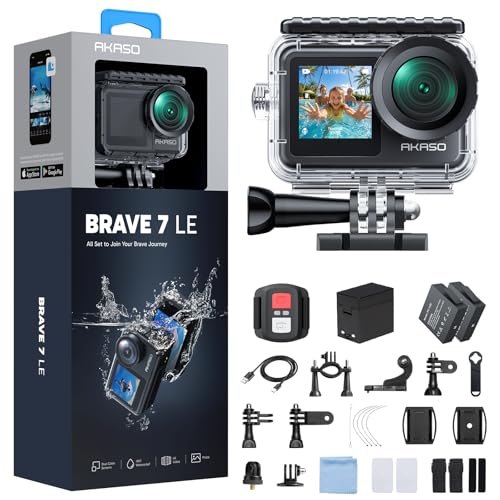
At a hundred and fifty, most cameras are a compromise with a lens attached; the Brave 7 LE is the exception that proves a complete purchase still exists at this level. The kit philosophy is everything: waterproof housing, mounts and a spare battery ride along, so the camera can be used for its actual purposes — bikes, pools, holidays, the dog’s perspective — from the first weekend without an accessory queue. Cheap cameras usually become expensive through their missing pieces; this one’s pieces are in the box.
Footage in daylight is cheerful and detailed enough for the family archive and the social clip, with stabilisation that smooths the walking and riding material this camera exists to capture. The front screen, a feature rivals reserve for premium models, makes self-framing and kid-filmed narration simple. In dim light the small sensor softens and noise arrives, as it does for everything at this level; the Brave’s honesty is that it never promised otherwise.
As the guide’s anchor recommendation, its argument is total cost and total readiness. A family can buy it, use it everywhere for years, lend it to teenagers, and lose remarkably little if the worst happens. At this tier, that combination — capability, completeness, and a price that permits actual use — is what best means.
Its mounts make it the household’s documentary utility: on the pram, the sledge, the dog’s harness and the dashboard in a single year. Equipment that documents everything gets documented value from, and this camera’s annual archive per pound spent is difficult for anything else in the guide to approach.
Children graduate through it instructively — first as subjects, then as operators, then as editors of their own small films. A camera cheap enough to hand down the age ladder teaches at every rung, which is a kind of longevity no specification measures.
Its spare batteries being cheap transforms its usability more than any menu feature: owners simply never ration shots. Abundance of power is a creative condition, and this kit manufactures it.
Second-hand examples circulate cheaply because owners upgrade to flagship action cameras and sell honest gear. A used Brave as a second angle or a child’s camera is one of the tier’s quiet bargains.
Its voice control and remote options, rare at this level, serve the solo rider and the family tripod shot alike — small features that remove the sprint-back-to-position from group filming.
- Video: 4K with electronic stabilisation
- Screens: front and rear
- Waterproofing: housing included in kit
- Power: removable batteries, spares affordable
- Mounting: standard action ecosystem
Strengths
- Complete kit, no accessory ambush
- Front screen for self-filming
- Cheap enough to use fearlessly
Trade-offs
- Dim-light footage softens
- Touchscreen dislikes wet gloves
- App is functional, not delightful
Best for: families, holiday filming, young riders and anyone wanting one camera for wet and bumpy life.
Not suited for: low-light specialists or photographers wanting stills with real depth.

Fujifilm Instax Mini 12 — Best instant camera at this level
The Instax Mini 12’s camera body sits comfortably in this guide’s territory, and what it buys is photography as an object: point, press, and a small print develops in the hand. For parties, family gatherings, school friends and grandparents, that physical photograph does what no file at any price does — it gets kept, pinned, traded and treasured on the day it was made. Automatic exposure means the first pack of film is a success rather than a tuition fee.
The honest accounting belongs in every recommendation of it: the camera is the cheap part. Film is priced per shot and a keen user consumes it joyfully, so the household should treat the camera as the start of a modest, predictable running cost — a pack at a time — rather than a one-off purchase. Many owners consider that cost structure a virtue in disguise, since a frame that costs something gets thought about, and thought-about frames are how photographers are made.
Within this budget’s spirit — a complete, joyful photographic purchase — it earns its place as the pick for people rather than places. If the photographs you imagine are faces at gatherings, kept in wallets and on walls, no digital camera at this level will make you as happy as this one will.
Its prints solve the digital family’s oldest problem — the photographs that live and die on phones — by existing physically from birth. Albums of Instax prints are already the surviving record of many families’ last five years, outlasting three handsets in the process.
The camera’s colour choices are social technology: a bright body gets noticed, borrowed and enjoyed at gatherings, which is precisely the behaviour its prints thrive on. Shy cameras make shy archives; this one is an extrovert by design.
Weddings and parties have adopted it as the guest camera — passed hand to hand, its prints becoming the unofficial favours. A camera that thrives in strangers’ hands has passed the hardest usability test there is.
Its film is sold everywhere from pharmacies to station kiosks, which matters at midnight before a party. Consumables you can buy anywhere are a feature; consumables you must order are a schedule.
It photographs happiness honestly: the exposure system forgives the chaotic light of kitchens and gardens where celebrations actually happen, so the prints look like the day felt.
- Format: instant prints, credit-card size
- Exposure: fully automatic with selfie mirror
- Power: AA batteries
- Body: light, rounded, several colours
- Running cost: film packs, bought as needed
Strengths
- Prints are keepsakes on the day
- No settings to learn or ruin
- Wonderful for parties and family
Trade-offs
- Film cost is forever
- No zoom, no digital file
- Image quality is charm over detail
Best for: party people, grandparents, tweens and anyone whose photographs are for keeping physically.
Not suited for: high-volume shooters or video makers.

Polaroid Go Generation 2 — Best pocket instant camera
The Polaroid Go takes the instant idea and shrinks it until portability stops being a consideration: it fits pockets and small bags that no other real camera in this guide fits, and its miniature classic-framed prints have a collectible, jewel-like charm. For the user whose photography is a diary — a print a day, a wall of small moments — it is the most wearable camera here.
Operation stays near-automatic, with a double-exposure mode for the playful and a rechargeable battery for households done with buying cells. Its film costs more per photograph than its Instax rival’s, and the prints are smaller, which is the honest trade for the aura and the size. Owners divide predictably: those who wanted the smallest camera are delighted; those who wanted the cheapest prints should have bought the Instax.
Judged at this tier as a complete purchase, it suits the deliberate diarist rather than the party-volume shooter. One small print a day, kept in an album or a wall grid, is a practice with a distinguished history — and this is the most charming instrument available for practising it at this level.
Its prints reward slowness in a way that suits diarists and travellers: one frame, chosen, kept. In an age of ten thousand forgotten phone images, a hundred kept prints is the archive with the higher survival rate and, arguably, the higher hit rate of meaning.
The double-exposure mode gives its small prints an art-project dimension that keeps older children and adults engaged long after novelty fades. Toys are abandoned when their tricks run out; this one’s tricks are combinatorial.
Travel journals pair with it naturally: one print taped beside one paragraph, daily. The analogue diary is a small renaissance, and this is its most portable instrument.
Its frames fit the small-grid aesthetic of modern scrapbooking, and craft shops stock its accessories accordingly. A camera with a craft ecosystem around it gets used by crafters — a constituency that finishes projects.
Its tiny prints in a wallet or phone case are this format’s quiet superpower — the photograph that is physically carried, and therefore actually looked at, daily.
- Format: miniature instant film, classic frame
- Body: smallest in class
- Features: double exposure, selfie mirror
- Power: rechargeable internal battery
- Style: several colours, wrist strap
Strengths
- Truly pocketable instant camera
- Prints have jewel-like charm
- Creative double-exposure play
Trade-offs
- Film costs more per shot
- Prints are tiny by design
- Battery must be charged
Best for: diarists, travellers and style-led users who shoot a few prints deliberately.
Not suited for: party hosts shooting prints in volume.

Wyze Cam v4 — Best home camera at this level
Not every camera at this level is for making memories; some are for keeping the home they happen in. The Wyze Cam v4 is the budget security camera against which others at this tier are measured: colour night vision that embarrasses cameras several times its price, a spotlight and siren for deterrence, and local recording options that respect owners who prefer their footage on their own card rather than in someone’s cloud.
At this budget, its arithmetic is the story — a household can cover the front door and the back garden for the price of one premium rival, and coverage, in security, is quality. The camera’s weather resistance takes it outdoors under eaves, its app handles the multi-camera household gracefully, and its person and vehicle detection features have matured into genuinely useful filtering rather than notification spam.
The considerations are ecosystem ones: some advanced features live behind an optional subscription, and privacy-minded owners should configure local recording and settings deliberately rather than accepting defaults. Configured with that half-hour of care, it is the most security a small budget can buy, and for many households at this tier, security is the camera they actually need.
Its spotlight changes the psychology of a doorway: a light that answers motion deters more callers than a lens that merely records them. Security is partly theatre, and this camera performs its theatre convincingly at a community-theatre budget.
For landlords, carers and anyone watching a second property, its multi-camera economics are the real feature — coverage scales at a price where scaling is usually the first casualty. Systems are bought at the second camera, and this one’s second camera is painless.
Its time-lapse and event features give it a second life documenting builds, gardens and weather — the security camera as household chronicler. Second lives are where budget cameras repay their owners longest.
For small businesses — the café counter, the workshop door — its economics scale from home to livelihood without a new system to learn. Tools that cross that boundary earn their drawer space twice.
Pet owners use its detection to settle the household’s oldest argument — what the dog does all day — which is surveillance in its most benevolent and entertaining form.
- Role: indoor and sheltered outdoor monitoring
- Night vision: colour, with spotlight
- Recording: local card option plus cloud plans
- Detection: person and vehicle alerts
- Weather resistance: suitable under cover outdoors
Strengths
- Two-camera coverage fits this budget
- Colour night vision is superb for the tier
- Local recording respects privacy choices
Trade-offs
- Best features partly subscription-based
- App ecosystem requires an account
- Not a camera for making memories
Best for: renters and homeowners wanting real coverage of doors and gardens on a small budget.
Not suited for: photographers, or households wanting zero apps and accounts involved.

Blink Mini 2 — Best simple indoor watcher
The Blink Mini 2 is the home camera for people who want one room watched without a project. It plugs in, joins the home network, and starts keeping an eye on the pet, the nursery, the front room or the elderly relative’s hallway with a simplicity that respects non-technical households. Its small size and wide view suit the corners these jobs live in, and its two-way talk turns a camera into a household intercom — reassuring a dog, answering a child, startling a cat off a counter.
Within the Blink and Alexa household it integrates politely, and its night vision covers the darkened-room duties it was bought for. The honest caveat is the subscription: cloud clip storage and the richest features live behind Blink’s plan, so owners should price the year, not the box, and decide whether local alternatives elsewhere in this guide suit them better.
As a single-room answer at this level, though, its virtues are the right ones: tiny, simple, and cheap enough that adding a second for the nursery is a shrug rather than a decision. Peace of mind, at this tier, is mostly coverage of the one room you worry about — and this covers it without drama.
Its two-way talk has an unadvertised domestic career as the household intercom — calling children to dinner, checking on a sleeping baby, negotiating with a cat. Features that find second jobs are the ones still in use in year three.
In rentals and student houses it shines: plug in, watch the door or the bike store, unplug and take it when you leave. Security that moves house with its owner is security a young household actually maintains.
Elderly households value its intercom manners for check-ins that feel like visits rather than surveillance. Framing matters in family technology, and this camera frames gently.
Its night vision covers the garage-to-garden door and the baby’s room with the same indifference, which is what a household sentinel should offer: competence without commentary.
Its setup simplicity makes it the camera adult children install for their parents, remotely manageable and rarely demanding. Technology that respects the least technical person in the family is designed, not dumbed down.
- Role: indoor monitoring, plug-in power
- View: wide angle for whole rooms
- Audio: two-way talk built in
- Night vision: infrared for dark rooms
- Ecosystem: works within Blink and Alexa homes
Strengths
- Five-minute setup for non-technical homes
- Two-way talk doubles as intercom
- Small enough for any shelf or corner
Trade-offs
- Cloud clips need a subscription
- Indoor only by design
- No local storage option
Best for: pet owners, nurseries and simple one-room monitoring in Alexa households.
Not suited for: outdoor coverage or subscription-free purists.

TP-Link Tapo C210 — Best pan-and-tilt home camera
The Tapo C210 solves the fixed camera’s oldest frustration — the action happening just out of frame — by moving. Its pan-and-tilt head sweeps a whole room, tracks motion across it, and returns to guard position, which makes one camera do the work of two in nurseries, living rooms and pet territories. For a household at this budget, that mechanical generosity is worth more than any resolution headline.
Tapo’s local recording to a memory card is the privacy-conscious owner’s favourite feature at this tier: footage can live in the camera rather than a cloud, with the app providing viewing rather than custody. Night vision, two-way talk and sound detection for crying babies round out a feature set that reads like a camera twice its price having an identity crisis.
It is an indoor, app-centred device, and owners should expect the account setup and notifications tuning that all such cameras involve. Tuned once, it becomes the household’s quiet sentinel — the camera grandparents check, pet owners rely on, and parents of new babies describe, accurately, as sleep purchased at a very fair price.
Its motion tracking gives pet owners the specific joy of the followed cat — a camera that pans after the animal like a tiny documentary crew. Beneath the comedy is a real capability: incidents get framed rather than missed, which is what the camera was bought for.
Baby monitoring is its other quiet profession: cry detection, night vision and a pan that finds the cot from anywhere in the room. Parents comparing it with dedicated baby monitors consistently conclude the generalist does the job at a fraction of the specialist’s price.
Its privacy mode — lens turned away, recording off — answers the fair objection to a camera in a living room with a physical gesture. Trust features like that decide whether a home camera stays plugged in.
Open-plan flats are its showcase: one corner unit genuinely replaces the two fixed cameras the floor plan seemed to demand, and the saving funds the card and the second room’s solution.
Its scheduled privacy and patrol routines let a household automate its own boundaries — watching by night, resting by day — which is the mature relationship with a home camera: governed, not merely installed.
- Movement: motorised pan and tilt with tracking
- Recording: local card storage supported
- Audio: two-way talk, baby-cry detection
- Night vision: infrared, room-scale
- Role: indoor whole-room coverage
Strengths
- One camera covers a whole room
- Local recording avoids subscriptions
- Baby and pet features are thoughtful
Trade-offs
- Indoor use only
- Moving head is a mechanical part
- App account and setup required
Best for: nurseries, pet rooms and open-plan homes wanting one-camera coverage.
Not suited for: outdoor mounting or app-free households.
How Do the Six Compare Side by Side?
The essentials compressed. The first-year cost column of your imagination matters more than any row here — each verdict names it.
If you are torn between two rows, decide by the failure you would rather explain: a grainy night clip, a film bill, or a subscription. Every camera here fails in its own courteous way, and choosing your preferred failure is a surprisingly reliable way to choose your favourite camera.
| Camera | Type | Standout strength | Watch out for |
|---|---|---|---|
| AKASO Brave 7 LE | Action camera kit | Completeness for the money | Low-light softness |
| Fujifilm Instax Mini 12 | Instant film camera | Physical prints, zero learning curve | Film is a continuing cost |
| Polaroid Go Generation 2 | Instant film camera, miniature | Portability and character | Smallest prints, pricier film |
| Wyze Cam v4 | Home security camera | Home monitoring value | Ecosystem and subscriptions to consider |
| Blink Mini 2 | Indoor security camera | Simplicity and size | Subscription for cloud clips |
| TP-Link Tapo C210 | Pan-and-tilt security camera | Room coverage from one device | App account required |
What Should You Check Before Buying Any Camera at This Level?
Check the ecosystem’s pulse. At this tier, makers abandon products with a shrug, and a camera whose app stops updating becomes a paperweight with a lens. Favour brands with visible, continuing support and large owner communities — the picks here all qualify — because community knowledge is the warranty that outlasts the printed one.
Check the storage and power story. Cameras that record to standard cards and run on replaceable batteries survive their owners’ enthusiasm cycles; cameras with sealed batteries and proprietary everything age in dog years. For home cameras, decide the cloud question before purchase: local recording, subscription, or a deliberate mixture — and configure it on day one rather than drifting into defaults someone else chose.
Check the returns window and use it as a test lab. A budget camera should prove itself in your light, on your network, at your child’s birthday, within the window — and a seller who makes that easy is worth a small premium over one who does not. At this tier, fit is everything and specifications are approximations; the window is where the truth gets measured.
And keep the receipt’s proportion in mind. The accessories that complete these cameras — the second film pack, the bigger card, the spare battery — are small sums that protect the whole purchase. Budget them from the start, and a hundred and fifty becomes a working system rather than a promising box.
For home cameras specifically, place before you purchase: walk the house with your phone’s camera at the intended mounting height and check the view, the light at night and the Wi-Fi strength in that corner. Ten minutes of rehearsal prevents the two classic disappointments — the camera that sees the wrong half of the room and the camera that drops off the network — more reliably than any specification.
Consider the gift dimension, because many cameras at this level are bought for someone else. The complete kit, the consumables included, the setup done before wrapping — these courtesies decide whether a gifted camera starts its life as joy or as homework. At this tier, the giver’s half-hour of preparation is worth more than any upgrade the same money could buy, and it is the one upgrade that is never in the box.
And photograph with it alongside the recipient once. The shared first outing — the ride, the party, the doorway installed together — transfers the small knowledge that manuals bury and creates the first archive the camera exists to extend. Cameras given with company get used; cameras given with only wrapping get admired.
One more check, for the home cameras: your network. These devices live on the household Wi-Fi, and a camera placed beyond its reliable reach will disappoint in ways that look like product faults. A mesh node or a better position is sometimes the true purchase hiding inside a camera decision — diagnose the corner before blaming the camera, and the tier’s reputation stays as good as it deserves to be.
How Do You Get the Best From a Very Cheap Camera?
Feed it light. Every camera at this level is built around a small sensor, and small sensors repay light more honestly than any setting can. Film the action in daylight, place the home camera where its night vision is helped rather than fought, and let the instant cameras work in the bright social conditions they were tuned for. Working with a cheap camera’s strengths instead of against its limits is the entire craft at this tier, and it is a craft that transfers upward for life.
Keep it ready. The budget camera’s superpower is presence — it is cheap enough to live in the bag, the car, the hallway — so keep batteries charged, cards emptied and the camera where the life is. A mediocre camera at the moment beats a magnificent one in a cupboard, and at this price, presence is the feature you actually bought.
Maintain it like it matters, because it does: clean lenses, dry storage, firmware updated, mounts checked. Cheap cameras die of neglect more than of defects, and the owner who treats a small camera with a professional’s habits routinely gets professional years out of it — the quiet arbitrage at the heart of this whole guide.
For the instant cameras, one habit transforms results: wait for the expression. Film’s small cost teaches it naturally, but even digital shooters at this level benefit from the discipline of the deliberate frame — compose, breathe, wait for the face to arrive, then shoot once. Cheap cameras reward patience exactly as expensive ones do; the lesson is free at this tier and priceless later.
Label everything. A small label with the purchase date on the camera, the card rotation written on the case, the film stock dated in the fridge door — tiny administrations that prevent the classic budget-camera losses: the mystery card, the expired film, the battery of unknown age. Organisation is the cheapest upgrade in photography, and it starts at this tier as well as any.
And share the results promptly, in whatever form the camera makes: the print handed over, the clip sent to the family chat, the door camera’s funny pet moment forwarded. Prompt sharing is what turns a purchase into a household institution, and institutions get maintained, funded and replaced with affection when their time comes.
Why Has the Bottom of the Camera Market Become Respectable?
Because the expensive parts got cheap. Sensors, stabilisation algorithms and night-vision processing that once justified premium prices have commoditised, and the benefits pooled at the bottom of the market first — a small camera no longer needs to apologise for existing. What remains expensive is what was always expensive: optics, ecosystems and trust. This guide’s picks are precisely the cameras that spend their small budgets on those durable things rather than on headline numbers.
The home camera revolution inside this tier deserves its own sentence. Colour night vision, person detection and local recording were professional security features within living memory; their arrival at this level has quietly changed what ordinary households can watch over — an elderly parent’s hallway, a first flat’s doorway, a rescue dog’s first night. Technology is often announced at the top of markets and felt at the bottom, and few places feel it more warmly than here.
Respectability has a shadow, though: the tier is also flooded with abandoned apps and anonymous brands. The respectability belongs to the supported, the reviewed and the owned-by-thousands — which is why this guide’s completeness and ecosystem audits matter more at this price than at any other. Cheap and supported is a bargain; cheap and orphaned is landfill with a lens.
The action camera’s journey tells the same story in miniature: a category invented at premium prices for professionals is now, at this level, a complete kit a family buys with the weekly shop’s change of scale. Democratisation is an overused word, but a waterproof 4K camera with two screens at this tier is what it looks like when it is true.
How Should a Family Choose Between Filming, Printing and Watching?
By auditing last year rather than imagining next year. Count the photographs and clips the household actually made and wished it had made better: the tally will lean overwhelmingly toward one of the three jobs. Families consistently discover they are a filming family with a printing hobby, or a printing family that needs one door watched — and the budget follows that evidence more honestly than it follows aspiration.
If the audit ties, sequence rather than split. Buy the job with the deadline — the holiday, the new baby, the new flat — and let the others wait for birthdays and next year’s budget. A small budget split three ways buys three disappointments; the same budget sequenced buys three successes in three seasons, each complete and each enjoyed. Patience is a budgeting tool, and at this level it is the most powerful one available.
And involve the users. The teenager’s action camera, the grandparent’s instant camera and the household’s door camera succeed in proportion to how much their actual users wanted them. A camera chosen by committee for nobody in particular serves nobody in particular — the audit’s final lesson, and the cheapest to apply.
There is a dignity argument for sequencing, too. A household that buys its door camera this season, its holiday camera next and its print camera at Christmas has three celebrations instead of one compromise — and each purchase arrives when a real occasion will baptise it. Budgets are calendars as much as amounts, and small budgets benefit most from being spent in rhythm with life.
What Does Local Recording Mean, and Why Does It Matter at This Price?
Local recording means the home camera writes its footage to a memory card inside itself, in your house, under your control — rather than only to a company’s cloud, under a subscription. At this tier it matters three ways. It removes the recurring cost that turns a cheap camera into an expensive habit. It keeps intimate footage — nurseries, hallways, living rooms — physically in the home it depicts. And it keeps the camera useful if the maker’s servers or your subscription lapse, which orphaned-cloud cameras in this price range have taught many households to fear.
The trade is convenience: cloud footage survives a stolen camera and is viewable from anywhere without thought, while local footage demands a card, a capacity decision and occasional housekeeping. Many owners run both deliberately — local for the record, cloud alerts for the phone — and the picks in this guide were chosen partly for permitting that choice rather than imposing one.
Whichever way you configure it, configure it. The default settings of a home camera are a decision made by a marketing department; the considered settings are a decision made by the household whose home it is. Twenty minutes on day one is the whole price of the difference.
The card itself deserves a sentence of respect: buy name-brand, buy from authorised sellers, and treat impossibly cheap large cards as the counterfeits they usually are. A security or family archive is only as real as its storage, and storage is the one component where the cheapest option is reliably the most expensive mistake in this entire guide.
How Do You Spot the Budget Cameras to Avoid?
By their paperwork. No named maker behind the app, no update history, no owner community, specifications that shout resolutions the sample footage whispers — these are the tells. The orphan camera’s life cycle is depressingly standard: a dazzling first month, a neglected app, a server quietly retired, and a lens staring at nothing. Every pick in this guide was chosen to be on the other side of that story: named, supported, and owned by enough people that its problems have public solutions.
Reviews deserve the same suspicion at this tier as anywhere: weight the long-term owner reports over the launch-week unboxings, because budget cameras reveal themselves in month four — the battery, the app, the mount that fatigued. A camera with a thousand patient owners and a boring reputation is, at this price, a thrilling find.
Finally, beware the bundle that is mostly box. Straps, cloths and novelty filters pad out listings while the essentials — the second battery, the fast card, the housing — remain absent. Read bundles as shopping lists and ask the only question that matters: what in this box will I still be using in a year? Buy the bundle whose answer is almost everything.
Trust, at this tier, is also measurable in a maker’s behaviour after the sale: firmware notes that fix real complaints, replacement batteries still sold years later, an app whose reviews the maker visibly answers. Read a little of that record before buying and you are reading the camera’s future — the only specification that decides whether a bargain stays one.
What Mistakes Do Buyers Make at This Price?
Buying the specification instead of the job is the first: the nominal high-resolution camera from a maker nobody can find, whose footage dissolves in real light. Second is ignoring the running costs until they arrive — the instant camera whose film nobody budgeted, the security camera whose clips live behind a plan nobody priced. Third is expecting one camera to cover action, prints and the home; at this level that camera does not exist, and pretending otherwise manufactures disappointment.
A fourth mistake is skipping the boring setup: home cameras left on default passwords and settings, action cameras never updated, instant cameras loaded wrong. Twenty minutes of deliberate setup is the difference between a budget camera that serves for years and one that becomes a cautionary tale, and it costs nothing but the twenty minutes.
Fifth: leaving the protective habits for later. The action camera’s housing seal checked never, the home camera’s password changed never, the instant camera stored in a hot car — small neglects that end small cameras. Later is not a maintenance schedule; the five minutes at setup are.
Sixth: judging the tier by its worst citizens. The anonymous end of this market is genuinely poor, and its failures prejudice buyers against a level whose supported, reviewed citizens — the six here — are honestly good. Discriminate by maker and community rather than by price alone, and the tier’s real bargains become visible.
And the smallest mistake with the longest shadow: never backing up the digital picks’ footage. The action camera’s card is not an archive; copy the season’s clips to the household’s storage while the season is still warm, and the cheapest camera in this guide will have produced the family’s most durable treasure.
Final Recommendation
The AKASO Brave 7 LE is this budget’s best all-round purchase — a complete kit that films real life immediately. The Instax Mini 12 and Polaroid Go own the print-making joy, at family and diary scales respectively. The Wyze Cam v4, Blink Mini 2 and Tapo C210 divide the home between them: coverage, simplicity and the moving eye. Name your job, audit the year’s cost, complete the kit — and a hundred and fifty, spent with that much honesty, buys a camera that earns its keep for years.
Small budgets, spent honestly, have a way of producing the most-used cameras in any household — the ones that were there. Be there is the whole strategy at this level, and these six are very good at being there.
Choose this week, while the season the camera is for is still in front of you. Budget cameras earn their legend in the present tense.
That is the whole promise of the tier, kept.
Buy the job, complete the kit, and go and make the pictures only this season will offer.
Related guides
Frequently Asked Questions
Can a camera at this price take genuinely good photographs?
In its own terms, yes. The instant cameras make prints people treasure, the action camera films daylight beautifully, and the home cameras see in colour at night. What this tier cannot do is everything at once, or much in dim light with fine detail. Judged by the job each was bought for, these are good cameras; judged by a flagship’s job description, everything is a disappointment, including most flagships.
Is the instant camera’s film cost worth it?
For the right user, the film is the product: each print is a physical keepsake made on the day, and the per-shot cost teaches a deliberation digital shooters often lack. The families who regret instant cameras are the ones surprised by the running cost; the ones who budget a pack at a time describe it as the best-value joy in the house. Consent to the arithmetic in advance and it stays joyful.
Do budget home cameras respect privacy?
They can, if configured deliberately. The Wyze and Tapo picks here support local recording to a card, which keeps footage in your home; all of them deserve a strong password, updated firmware and a thoughtful decision about cloud features. Privacy at this tier is a setup choice rather than a purchase tier — make the choice consciously on day one.
Action camera or instant camera for a family holiday?
The action camera documents the holiday — the swims, rides and walks — and survives all of them. The instant camera commemorates it — the prints on the fridge by Sunday. Families who can only choose one should count last year’s holiday photographs: if they are mostly clips and scenes, take the action camera; if they are mostly faces and gatherings, take the instant.
How long will a camera at this level last?
The action and instant cameras here routinely serve for years — their mechanisms are simple and their batteries replaceable or rechargeable. Home cameras last as long as their makers support the apps, which is why this guide favoured living ecosystems. Treat any of them decently and the honest answer is: longer than the phone you bought the same year.
Is it worth spending slightly more for the next tier up?
Sometimes — and the companion guide to cameras at the next step up exists for exactly that comparison. The honest rule: step up when a named feature you will use weekly lives there — better low-light video, a viewfinder, a system mount. Step up for a specification you cannot name a use for, and you have simply donated to a manufacturer. This tier’s picks are complete for their jobs; buy the step only for a new job.
What is the single best first purchase to pair with a budget camera?
Whichever consumable its job consumes: film for the instant cameras, a fast name-brand card for the action and home cameras, and the mount or placement the chosen job actually needs. The pattern is the lesson of this whole tier — complete the specific kit in front of you rather than accessorising in general, and a small budget behaves like a larger one.
Related Guides
Keep exploring with best cameras for 200 dollars best cameras for 12 year olds best camera video cameras under 300.


