Disclosure: As an Amazon Associate, ilcastellomenu.com earns from qualifying purchases. Links on this page are affiliate links; they cost you nothing extra. Prices and availability change often, so check the current Amazon listing before you buy.
This projector screen review takes one clear position: a projector screen is not an accessory you add at the end of a home cinema build, it is the surface the whole system is judged by, and choosing the right type matters more than chasing any single headline feature. Over the sections below, this review looks at what a projector screen actually does, how the main designs differ in real rooms, where each design earns its money, and where each one honestly falls short. You will find the picks presented in prose, a buying-guide layer to help you choose, a how-to layer covering setup and care, and direct answers to the questions buyers ask most. If you only read one section, read the verdict: a flat, well-mounted screen in the right size for your seating will satisfy you for years, while the wrong format in the wrong room will annoy you every single night.
Key Takeaways:
- Format first: fixed, manual, motorised and floor-rising screens suit different rooms, and format decides your experience more than brand does.
- Flatness and a proper black border are the two qualities you will notice in every session, long after novelty features are forgotten.
- The room is half the system — light control, seating distance and solid mounting matter as much as the screen itself.
- Mount into studs or joists, anchor heavy housings properly, and leave motorised wiring to someone experienced.
- Buy the size your seating distance supports, not the largest size your wall can physically hold.
Projector Screen Review: The Short Verdict
When a surface reflects light evenly across the seating area, people sitting off to the side see a picture that stays close to what the centre seat sees. Texture is a quiet trade-off: a very fine texture can hide small imperfections, while a rougher finish may sparkle slightly under bright scenes. Colour neutrality matters more than most first-time buyers expect, since a surface that leans warm or cool will push every film and game in that direction. A smooth, even surface keeps fine detail intact, because tiny wrinkles and texture can soften edges and make text look slightly fuzzy. Hotspotting is the bright patch that can appear in the middle of some screens, and it usually shows up when the surface reflects too much light straight back at the viewer.
If your viewing is mostly evening viewing, a simpler matte surface usually serves you well and keeps the budget focused on size and mounting. Some specialised surfaces are designed to reject light coming from above or the sides, and they make the most sense in rooms that cannot be darkened. Ambient light is the single biggest enemy of a projected picture, and no screen choice can fully rescue a room that stays bright all day. Light that falls directly on the screen is far more damaging than light behind the seating, so room layout deserves attention before you buy. Closing curtains and moving one lamp often improves the picture more than upgrading any single piece of hardware in the chain.
Consider the cost of your time as well: a screen that stays flat and clean asks almost nothing of you, while a fussy one charges attention forever. Resale and reuse favour standard formats and sizes, another small reason to stay mainstream unless you have a specific reason not to. If the budget is tight, a simpler screen in the right size usually beats a fancier screen in the wrong size, every single time. Money spent on features you will not use, such as a motor in a dedicated room where the screen never retracts, is where budgets quietly leak away. A screen is also one of the few parts of a home cinema that does not become obsolete quickly, which strengthens the case for buying a good one once.
Who it suits: anyone running a projector regularly — film households, sports fans, gamers and presenters — who wants a picture that looks finished rather than improvised. Who should skip it: anyone projecting only occasionally onto a decent wall, or anyone whose room is so bright that a television would honestly serve them better.
In this guide
What a Projector Screen Is and Where It Fits
Colour neutrality matters more than most first-time buyers expect, since a surface that leans warm or cool will push every film and game in that direction. A well-made surface also helps black levels, because light that is controlled properly does not bounce around the room and wash out dark scenes. If you watch a lot of subtitled films or play games with small interface text, surface smoothness becomes one of the most practical things to judge. Hotspotting is the bright patch that can appear in the middle of some screens, and it usually shows up when the surface reflects too much light straight back at the viewer. Over time, a good surface should stay flat and consistent, and that long-term flatness is often what separates a satisfying screen from a frustrating one.
Tensioned designs, whether fixed or motorised, use cords or tabs to keep the material flat, and that flatness is their main reason to exist. Manual pull-down screens roll into a housing when not in use, trading a little long-term flatness for a room that can return to normal in seconds. Fixed frame screens hold the material under constant tension on a rigid frame, which is why they tend to stay the flattest of all the common designs. Portable and tripod designs serve occasional use, classrooms and garden evenings, and they accept more compromise in flatness for that flexibility.
A rug, curtains and soft furniture all help twice over, calming both the light in the room and the sound of the film. Ventilation and projector fan noise belong in the room plan as well, since a quiet room makes a modest system feel far more premium. Dark wall and ceiling colours near the screen reduce reflections that bounce back and lift black levels during bright scenes. The room is half the system, and treating it as part of the purchase leads to better decisions than shopping for the screen in isolation.
Presentations and photos ask for accurate colour and sharp text, which brings surface smoothness back to the top of the list. Mixed households should weight the decision toward the content watched most often, not the content that sounds most impressive. Sport rewards brightness, size and a picture that stays clear for a group spread across a wide sofa or several chairs. Films reward contrast and black level above all, so dark scenes are the honest test of any screen and room combination.
Over time, a good surface should stay flat and consistent, and that long-term flatness is often what separates a satisfying screen from a frustrating one. A well-made surface also helps black levels, because light that is controlled properly does not bounce around the room and wash out dark scenes. Texture is a quiet trade-off: a very fine texture can hide small imperfections, while a rougher finish may sparkle slightly under bright scenes. If you watch a lot of subtitled films or play games with small interface text, surface smoothness becomes one of the most practical things to judge.
Tensioned designs, whether fixed or motorised, use cords or tabs to keep the material flat, and that flatness is their main reason to exist. Painted wall solutions remove the hardware entirely, but they give up the black border and the controlled surface that make a real screen look finished. Fixed frame screens hold the material under constant tension on a rigid frame, which is why they tend to stay the flattest of all the common designs. Motorised screens add a remote-controlled drop and a cleaner daily routine, at the cost of a heavier housing and a power connection to plan for. Portable and tripod designs serve occasional use, classrooms and garden evenings, and they accept more compromise in flatness for that flexibility.
The Main Designs in This Review
The four designs below are the reference points for this review. Each is presented in prose only, with a marker for the publishing pipeline, because the honest differences between them are differences of format and fit rather than of any single specification.
Elite Screens Sable Frame B2 — fixed frame
The Sable Frame B2 from Elite Screens is this cluster’s dedicated-room benchmark: a fixed frame that holds the viewing material under constant tension, surrounded by a black frame that gives the picture the finished, cinema-like edge a roll-up screen cannot match. It sits in the mid tier, and its argument is flatness. Because the material never rolls, it never learns to curl, and slow pans, subtitles and game interfaces all benefit from that geometric honesty. Assembly is a real project — the frame goes together on the floor, the material attaches around it, and the finished screen hangs like a large picture — and it stays on the wall permanently, which is precisely the point in a dedicated room and precisely the problem in a shared one. It also needs wall space you are willing to give up for good, and two people to hang safely. For a room whose main job is films and games, this is the design most owners describe as the end of their screen search, and it is the pick here for viewers who value the picture over flexibility. Verify the exact configuration on the current listing before you buy.
Best for: viewers whose room and routine match a fixed frame design. Not suited for: buyers whose mounting, space or budget points firmly at a different format. This pick is presented in prose only, so compare configurations on the current listing and choose by fit rather than by headline.

Elite Screens Manual B — manual pull-down
The Manual B line from Elite Screens represents the classic manual pull-down idea done in a mainstream, widely available form: a spring-roller housing you mount on a wall or ceiling, a handle you pull down when it is time to watch, and a surface that rolls away when the room needs to be a room again. In prose terms it sits in the entry tier of this cluster, and its appeal is simplicity. There is no motor to wire, no remote to lose, and the daily routine is a few seconds of pulling and latching. The honest trade-offs of the type apply in full: a manual screen depends on gentle handling to stay flat over the years, the drop length is set by the housing position rather than fine adjustment, and the picture rewards a controlled, even pull rather than a yank. For a first screen in a bedroom, a classroom-style space or a living room that cannot commit to a fixed frame, this is the shape of product most buyers are picturing, and it earns its place here as the straightforward, low-commitment option. Check the current listing for the exact configuration before you buy, and treat any size or surface detail as confirmed only by that listing.
Best for: viewers whose room and routine match a manual pull-down design. Not suited for: buyers whose mounting, space or budget points firmly at a different format. This pick is presented in prose only, so compare configurations on the current listing and choose by fit rather than by headline.

Elite Screens Spectrum — motorised drop-down
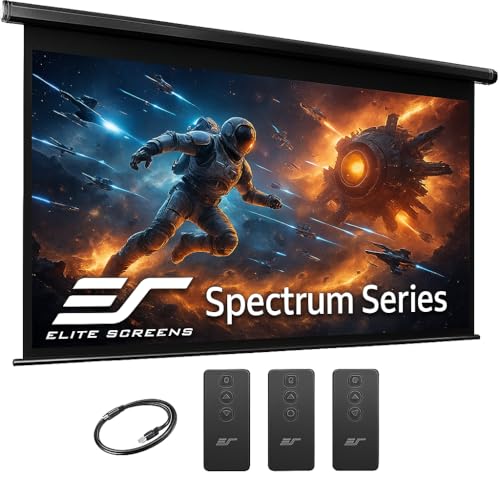
The Spectrum line from Elite Screens is the motorised counterpart to the manual idea: a powered housing that lowers and raises the surface at the press of a remote, giving a shared room a genuinely tidy trick — cinema when you want it, clean wall when you do not. It sits in the mid tier of this cluster. The motor brings real everyday convenience and a consistent, even roll that is kind to the material, and the housing suits wall or ceiling mounting in rooms that are planned rather than improvised. The trade-offs are equally real. A motorised screen is heavier, so its fixings must go into studs or joists or proper heavy-duty anchors, and it needs power, which means planning an outlet or having someone experienced handle the wiring. It also asks for a clear drop path and a little patience, since a powered drop is not instant. For households that will raise and lower the screen daily, that routine is exactly what the money buys, and it is the option here that best fits a living room with a regular movie habit. Confirm the exact configuration on the current listing before ordering.
Best for: viewers whose room and routine match a motorised drop-down design. Not suited for: buyers whose mounting, space or budget points firmly at a different format. This pick is presented in prose only, so compare configurations on the current listing and choose by fit rather than by headline.
VIVIDSTORM S PRO — floor-rising motorised tensioned
The S PRO from VIVIDSTORM is the most distinctive design in this cluster: a floor-rising, motorised, tensioned screen that stands low in the room when closed and rises into place when it is time to watch. It sits in the premium tier here, and it solves a specific problem elegantly — rooms where wall and ceiling mounting are impossible or forbidden, including many rentals, rooms with awkward walls, and spaces where a laser projector sits on low furniture in front of the screen. The tensioned design fights the waves that plain roll materials can develop, and the rising format keeps the wall completely free. The trade-offs are commitment and care: it is a substantial piece of furniture in its own right, it needs floor space and power, its rising path must stay clear, and it deserves the same respect as any motorised equipment. For the buyer whose room rules out every mounted option, though, it is not a compromise but the enabling purchase, and it is the pick here for mounting-restricted rooms. Confirm details on the current listing before ordering.
Best for: viewers whose room and routine match a floor-rising motorised tensioned design. Not suited for: buyers whose mounting, space or budget points firmly at a different format. This pick is presented in prose only, so compare configurations on the current listing and choose by fit rather than by headline.
Design, Build and Everyday Handling
Temperature and humidity swings in a room can encourage curl, so a screen near a radiator or a damp external wall deserves extra thought. Waves and edge curl are the natural enemies of roll-up designs, and they tend to appear gradually rather than all at once. A fixed frame avoids most of the problem by never rolling the material at all, which is one reason dedicated rooms favour it. Tensioning systems exist precisely to fight that slow curl, pulling the material evenly so the picture stays geometrically honest.
Motorised screens add a remote-controlled drop and a cleaner daily routine, at the cost of a heavier housing and a power connection to plan for. Floor-rising screens rise from a housing that sits low in the room, which suits renters and rooms where ceiling or wall mounting is not allowed. Fixed frame screens hold the material under constant tension on a rigid frame, which is why they tend to stay the flattest of all the common designs. Portable and tripod designs serve occasional use, classrooms and garden evenings, and they accept more compromise in flatness for that flexibility.
Keep food, drinks and sticky hands away from the surface, since stains on a screen are very difficult to remove without leaving a mark. Store a portable screen in its case, dry and away from sharp objects, and it will reward that small care with years of flat, clean pictures. If the screen develops a wave or a fault, consult the maker’s guidance before attempting home remedies involving heat or weights, which often make things worse. Check fixings and brackets once in a while, especially after the first weeks, because a housing that settles slightly can be re-levelled easily if caught early. Roll screens last longer when they are raised and lowered smoothly rather than snapped, and when they are not left half-dropped for weeks at a time.
The screen housing or frame must fix into something solid, so locating the structure behind the plaster is a step that should never be skipped. Cables should be test-run before final fixing, because discovering a short cable after the housing is mounted is a classic and avoidable frustration. Accurate measuring before drilling is the whole secret of a clean installation, and it is far easier than correcting holes afterwards. Working with a second person makes almost every stage safer and more accurate, from lifting the housing to checking the picture from the seating.
A fixed frame avoids most of the problem by never rolling the material at all, which is one reason dedicated rooms favour it. Waves and edge curl are the natural enemies of roll-up designs, and they tend to appear gradually rather than all at once. How a screen is stored matters: a roll screen left down for long periods and one raised daily can age in noticeably different ways. When you compare designs, ask yourself how much a slight wave would bother you in the content you watch most, because that answer varies a lot by viewer. Flatness sounds like a small detail until you see a slow camera pan cross a wavy screen, where straight lines bend and the illusion breaks.
Performance in Real Use
Films and Dark Scenes
Everyday television and streaming sit in between, and they are where most screens spend most of their hours in real homes. Mixed households should weight the decision toward the content watched most often, not the content that sounds most impressive. Films reward contrast and black level above all, so dark scenes are the honest test of any screen and room combination. Presentations and photos ask for accurate colour and sharp text, which brings surface smoothness back to the top of the list. Sport rewards brightness, size and a picture that stays clear for a group spread across a wide sofa or several chairs.
Over time, a good surface should stay flat and consistent, and that long-term flatness is often what separates a satisfying screen from a frustrating one. A well-made surface also helps black levels, because light that is controlled properly does not bounce around the room and wash out dark scenes. If you watch a lot of subtitled films or play games with small interface text, surface smoothness becomes one of the most practical things to judge. The border around the viewing area is part of the surface story too, because a deep black frame makes the image look richer by comparison. When a surface reflects light evenly across the seating area, people sitting off to the side see a picture that stays close to what the centre seat sees.
Ambient light is the single biggest enemy of a projected picture, and no screen choice can fully rescue a room that stays bright all day. If your viewing is mostly evening viewing, a simpler matte surface usually serves you well and keeps the budget focused on size and mounting. Daytime sports and casual viewing are more forgiving than dark films, which is worth remembering when you judge how much light control you really need. A screen chosen for a dark, dedicated room can prioritise contrast and colour, while a living-room screen has to work harder against lamps and windows. Think about the worst lighting you will regularly watch in, not the best, because that honest picture is the one your screen has to handle.
Sport and Group Viewing
Mixed households should weight the decision toward the content watched most often, not the content that sounds most impressive. Everyday television and streaming sit in between, and they are where most screens spend most of their hours in real homes. Presentations and photos ask for accurate colour and sharp text, which brings surface smoothness back to the top of the list. Sport rewards brightness, size and a picture that stays clear for a group spread across a wide sofa or several chairs. Films reward contrast and black level above all, so dark scenes are the honest test of any screen and room combination.
If the room doubles as a living space, a screen that disappears when not in use protects both the decor and the household peace. Ventilation and projector fan noise belong in the room plan as well, since a quiet room makes a modest system feel far more premium. A rug, curtains and soft furniture all help twice over, calming both the light in the room and the sound of the film. Dark wall and ceiling colours near the screen reduce reflections that bounce back and lift black levels during bright scenes. The room is half the system, and treating it as part of the purchase leads to better decisions than shopping for the screen in isolation.
Hotspotting is the bright patch that can appear in the middle of some screens, and it usually shows up when the surface reflects too much light straight back at the viewer. When a surface reflects light evenly across the seating area, people sitting off to the side see a picture that stays close to what the centre seat sees. The border around the viewing area is part of the surface story too, because a deep black frame makes the image look richer by comparison. A well-made surface also helps black levels, because light that is controlled properly does not bounce around the room and wash out dark scenes. Texture is a quiet trade-off: a very fine texture can hide small imperfections, while a rougher finish may sparkle slightly under bright scenes.
Gaming Sessions
A matte, neutral surface keeps colours consistent across genres, from dark horror titles to bright racing games. Comfort matters in long sessions, so screen height and size deserve the same care for a gaming setup as for a cinema room. For gaming, the screen’s job is to stay flat, neutral and big enough that interface text stays readable from your actual seat. Fast camera movement in games exposes waves and texture more than films do, which pushes gaming rooms toward tensioned or fixed designs. Because the screen adds no input delay of its own, gamers can judge screens purely on picture quality and room fit.
A fixed frame avoids most of the problem by never rolling the material at all, which is one reason dedicated rooms favour it. Waves and edge curl are the natural enemies of roll-up designs, and they tend to appear gradually rather than all at once. Flatness sounds like a small detail until you see a slow camera pan cross a wavy screen, where straight lines bend and the illusion breaks. How a screen is stored matters: a roll screen left down for long periods and one raised daily can age in noticeably different ways. When you compare designs, ask yourself how much a slight wave would bother you in the content you watch most, because that answer varies a lot by viewer.
If you plan to upgrade the projector later, choose a screen size and format that will still suit a typical replacement, rather than one tied to a single model. Gaming adds its own pairing note, because the screen itself adds no meaningful delay, so any lag you feel comes from the projector and its processing settings. Lens position matters too: a projector that sits far off centre forces keystone correction, and that correction always costs some sharpness. Throw distance decides where the projector can sit for a given image size, so confirm the pairing on paper before any mounting hardware goes up. A screen and a projector work as a pair, and a mismatch between them wastes the strengths of both.
Everyday Television and Presentations
Everyday television and streaming sit in between, and they are where most screens spend most of their hours in real homes. Mixed households should weight the decision toward the content watched most often, not the content that sounds most impressive. Sport rewards brightness, size and a picture that stays clear for a group spread across a wide sofa or several chairs. Films reward contrast and black level above all, so dark scenes are the honest test of any screen and room combination. Presentations and photos ask for accurate colour and sharp text, which brings surface smoothness back to the top of the list.
A brighter projector gives you more freedom in screen choice, while a modest projector benefits from a surface and room that waste less light. Throw distance decides where the projector can sit for a given image size, so confirm the pairing on paper before any mounting hardware goes up. If you plan to upgrade the projector later, choose a screen size and format that will still suit a typical replacement, rather than one tied to a single model. A screen and a projector work as a pair, and a mismatch between them wastes the strengths of both.
Strengths and Trade-Offs
Strengths
- A dedicated surface gives a smoother, more consistent picture than a bare wall, with controlled reflection and a proper black border around the image.
- The sense of scale is the real product: films, sport and games feel like events rather than programmes when the picture is genuinely large.
- A screen usually outlives several projectors, so one careful purchase improves every future upgrade you make to the system.
- Modern formats cover almost every room, from fixed frames for dedicated spaces to screens that vanish completely in shared living rooms.
Trade-offs
- The room still decides the result: ambient light, wall colour and seating distance can limit even an excellent screen.
- Large screens are large objects, and mounting, delivery and wall space all need honest planning before you order.
- Roll-up designs can develop waves or edge curl over time, especially with rough handling or difficult room conditions.
- Motorised models add weight, power requirements and moving parts that a simple fixed or manual design never has to think about.
Resale and reuse favour standard formats and sizes, another small reason to stay mainstream unless you have a specific reason not to. Value in a screen is mostly about how many years of better pictures it delivers, because a screen usually outlives the projector paired with it. A screen is also one of the few parts of a home cinema that does not become obsolete quickly, which strengthens the case for buying a good one once. Money spent on flatness, a good border and a sound mounting is rarely wasted, since those are the qualities you notice every single session. Consider the cost of your time as well: a screen that stays flat and clean asks almost nothing of you, while a fussy one charges attention forever. Money spent on features you will not use, such as a motor in a dedicated room where the screen never retracts, is where budgets quietly leak away.
Projecting onto a painted wall costs the least and can look surprisingly decent, but it lacks the border, flatness control and surface consistency of a real screen. Keeping an existing screen and upgrading the projector instead is sometimes the smarter order of operations, especially if the current surface is still flat and clean. For occasional use, a portable screen you store away may beat a permanent installation that dominates a shared room all week. A television is the obvious alternative, and it wins on brightness and simplicity while giving up the sheer scale that makes projection special.
How It Compares With the Alternatives
Ambient-light rooms sometimes suit a large television better than any screen, and recognising that honestly is part of shopping well. Projecting onto a painted wall costs the least and can look surprisingly decent, but it lacks the border, flatness control and surface consistency of a real screen. Keeping an existing screen and upgrading the projector instead is sometimes the smarter order of operations, especially if the current surface is still flat and clean. A television is the obvious alternative, and it wins on brightness and simplicity while giving up the sheer scale that makes projection special. For occasional use, a portable screen you store away may beat a permanent installation that dominates a shared room all week. A smaller, better screen is a legitimate alternative to a larger, weaker one, and many viewers who try both prefer the smaller picture with better contrast.
The border around the viewing area is part of the surface story too, because a deep black frame makes the image look richer by comparison. A well-made surface also helps black levels, because light that is controlled properly does not bounce around the room and wash out dark scenes. When a surface reflects light evenly across the seating area, people sitting off to the side see a picture that stays close to what the centre seat sees. If you watch a lot of subtitled films or play games with small interface text, surface smoothness becomes one of the most practical things to judge. Texture is a quiet trade-off: a very fine texture can hide small imperfections, while a rougher finish may sparkle slightly under bright scenes. Colour neutrality matters more than most first-time buyers expect, since a surface that leans warm or cool will push every film and game in that direction.
A bare wall is free and always available, but gives up flatness control, the black border and surface consistency. A large television is brighter and simpler, but cannot match projection for scale at anything like the same sense of occasion. A smaller premium screen trades size for contrast and finish, while a larger basic screen trades finish for scale — and the right side of that trade depends entirely on your room and your seating.
Who Should Buy a Projector Screen, and Who Should Skip It
Money spent on features you will not use, such as a motor in a dedicated room where the screen never retracts, is where budgets quietly leak away. Value in a screen is mostly about how many years of better pictures it delivers, because a screen usually outlives the projector paired with it. A screen is also one of the few parts of a home cinema that does not become obsolete quickly, which strengthens the case for buying a good one once. Resale and reuse favour standard formats and sizes, another small reason to stay mainstream unless you have a specific reason not to. Consider the cost of your time as well: a screen that stays flat and clean asks almost nothing of you, while a fussy one charges attention forever.
Mounting the screen too high is a quiet comfort killer, because a picture your neck has to look up at stops feeling cinematic very quickly. Ignoring the black border and frame quality leads to a picture that looks less rich than it should, even with a good projector behind it. The most common mistake is buying the screen before measuring the room, then discovering the size, throw or mounting simply do not agree. Skipping the tape-outline test and the stud check saves an hour on day one and can cost a weekend of corrections later.
If the room doubles as a living space, a screen that disappears when not in use protects both the decor and the household peace. A rug, curtains and soft furniture all help twice over, calming both the light in the room and the sound of the film. The room is half the system, and treating it as part of the purchase leads to better decisions than shopping for the screen in isolation. Think about where people walk during a film, because a screen position that crosses a busy doorway invites shadows and interruptions. Cable routes are easier to plan before the screen goes up, and a tidy route avoids the trailing wires that spoil an otherwise clean install.
Before you buy, run this checklist honestly: measure the wall and the seating distance; confirm the projector throw for the size you want; check what the wall is made of and where the studs or joists run; decide how the screen will be powered if it is motorised; plan speaker positions; and live with a tape outline of the image for a few days. Buyers who do those six things almost never regret the purchase.
Setup, Care and Maintenance Essentials
Cables should be test-run before final fixing, because discovering a short cable after the housing is mounted is a classic and avoidable frustration. Level on the housing does not guarantee level on the image, because the projector alignment has the final say and needs its own careful adjustment. The screen housing or frame must fix into something solid, so locating the structure behind the plaster is a step that should never be skipped. Keep the projector and screen manuals together after the install, since drop limits, cleaning notes and adjustment points are easy to forget months later.
Electrical work for a motorised screen, such as adding an outlet or hardwiring, should be handled by someone experienced with mains wiring. Where studs do not line up with the bracket positions, use proper heavy-duty wall anchors rated for the load and follow their instructions exactly. Use a stable ladder that reaches the work comfortably, keep three points of contact, and never lean out sideways to reach a bracket. Keep the area below the screen clear while you work, and check that the drop path is free of furniture, lights and curious pets before the first test run. Two people should lift a long housing into place, since a solo lift at arm’s length above head height is how screens and people both get hurt.
Roll screens last longer when they are raised and lowered smoothly rather than snapped, and when they are not left half-dropped for weeks at a time. If the screen develops a wave or a fault, consult the maker’s guidance before attempting home remedies involving heat or weights, which often make things worse. Dust settles on a screen surface quietly, and a gentle clean with a soft, dry microfibre cloth is usually all that regular care requires. Check fixings and brackets once in a while, especially after the first weeks, because a housing that settles slightly can be re-levelled easily if caught early. Keep food, drinks and sticky hands away from the surface, since stains on a screen are very difficult to remove without leaving a mark.
Cables should be test-run before final fixing, because discovering a short cable after the housing is mounted is a classic and avoidable frustration. Accurate measuring before drilling is the whole secret of a clean installation, and it is far easier than correcting holes afterwards. Dry-fitting and marking everything in pencil first lets you spot a mistake while it is still free to fix. Keep the projector and screen manuals together after the install, since drop limits, cleaning notes and adjustment points are easy to forget months later.
Frequently Asked Questions
Do I really need a screen, or is a wall enough?
Hotspotting is the bright patch that can appear in the middle of some screens, and it usually shows up when the surface reflects too much light straight back at the viewer. A well-made surface also helps black levels, because light that is controlled properly does not bounce around the room and wash out dark scenes. The surface is the part of a projector screen that actually does the optical work, turning scattered projector light into a picture your eyes can read comfortably. The border around the viewing area is part of the surface story too, because a deep black frame makes the image look richer by comparison. A smooth, even surface keeps fine detail intact, because tiny wrinkles and texture can soften edges and make text look slightly fuzzy. Texture is a quiet trade-off: a very fine texture can hide small imperfections, while a rougher finish may sparkle slightly under bright scenes.
Which screen format is best for a living room?
Think about where people walk during a film, because a screen position that crosses a busy doorway invites shadows and interruptions. Cable routes are easier to plan before the screen goes up, and a tidy route avoids the trailing wires that spoil an otherwise clean install. The room is half the system, and treating it as part of the purchase leads to better decisions than shopping for the screen in isolation. If the room doubles as a living space, a screen that disappears when not in use protects both the decor and the household peace. Ventilation and projector fan noise belong in the room plan as well, since a quiet room makes a modest system feel far more premium.
How big should my projector screen be?
A simple tape outline on the wall for a few days is one of the most reliable sizing tools there is, and it costs nothing but patience. A picture that is too large forces your eyes to travel constantly, which can turn an action film into a tiring experience instead of an absorbing one. Choosing a size starts with seating distance rather than wall space, because the biggest screen that fits is not always the most comfortable to watch. A picture that is too small, on the other hand, loses the sense of scale that makes projection feel different from a television in the first place. Leave room for speakers and furniture when you measure, because a screen that crowds everything else out creates new problems while solving one. Measure the wall, the seating position and the projector throw together, since those three numbers decide which sizes are even possible in your room.
Will a screen help in a bright room?
Over time, a good surface should stay flat and consistent, and that long-term flatness is often what separates a satisfying screen from a frustrating one. Hotspotting is the bright patch that can appear in the middle of some screens, and it usually shows up when the surface reflects too much light straight back at the viewer. A smooth, even surface keeps fine detail intact, because tiny wrinkles and texture can soften edges and make text look slightly fuzzy. If you watch a lot of subtitled films or play games with small interface text, surface smoothness becomes one of the most practical things to judge. Texture is a quiet trade-off: a very fine texture can hide small imperfections, while a rougher finish may sparkle slightly under bright scenes.
How long should a good projector screen last?
If the screen develops a wave or a fault, consult the maker’s guidance before attempting home remedies involving heat or weights, which often make things worse. Roll screens last longer when they are raised and lowered smoothly rather than snapped, and when they are not left half-dropped for weeks at a time. Dust settles on a screen surface quietly, and a gentle clean with a soft, dry microfibre cloth is usually all that regular care requires. Check fixings and brackets once in a while, especially after the first weeks, because a housing that settles slightly can be re-levelled easily if caught early. Store a portable screen in its case, dry and away from sharp objects, and it will reward that small care with years of flat, clean pictures.
Can a screen improve a modest projector?
A smooth, even surface keeps fine detail intact, because tiny wrinkles and texture can soften edges and make text look slightly fuzzy. Texture is a quiet trade-off: a very fine texture can hide small imperfections, while a rougher finish may sparkle slightly under bright scenes. The surface is the part of a projector screen that actually does the optical work, turning scattered projector light into a picture your eyes can read comfortably. If you watch a lot of subtitled films or play games with small interface text, surface smoothness becomes one of the most practical things to judge. Colour neutrality matters more than most first-time buyers expect, since a surface that leans warm or cool will push every film and game in that direction. Over time, a good surface should stay flat and consistent, and that long-term flatness is often what separates a satisfying screen from a frustrating one.
Related Guides
Keep researching with these guides: projector screen reviews; projector screen buying guide; projector screen pros and cons; is a projector screen worth it; monitors for movies; monitors for film editing; monitors for home use; monitors for video editing.