ilcastellomenu.com is reader-supported. When you buy through links on our site, we may earn an affiliate commission.
Where to Buy
Alaska is not one trip; it is five trips wearing the same parka. In a single week you might photograph a brown bear fishing a salmon stream in horizontal rain, a glacier calving under a sky that never fully darkens, a bald eagle quartering a harbour, and the northern lights rippling over a frozen lake at two in the morning. Choosing the best cameras for an Alaska trip means choosing which of those Alaskas matters most to you — because the camera that shrugs off a downpour at a bear-viewing platform is not automatically the camera that renders the aurora’s curtains faithfully, and the one you will happily carry up a tundra ridge is rarely the one with the finest sensor.
Weather is the first filter, and it is not a metaphor. Coastal Alaska is one of the wettest inhabited regions on earth; the Inside Passage towns measure rain in metres. Even in the drier interior, a trip will hand you drizzle, spray from a boat deck, glacier wind full of grit, and temperatures that make batteries lie about their charge. So this list weights sealing, toughness, and cold behaviour as heavily as image quality. A camera you are afraid to take out of the dry bag photographs nothing, and Alaska punishes hesitation — the whale surfaces once, the bear stands up once, the light breaks once.
Wildlife is the second filter. Alaska’s animals are the headline act, and they keep a respectful distance that only telephoto reach can bridge. That pushes the list toward systems with sensible long lenses and toward compacts with honest zoom, because a bear at a hundred metres through a standard lens is a brown comma in a green paragraph. At the same time, Alaska’s landscapes are so large that they humble wide lenses too — the mountains do not fit, and photographers learn to shoot details, layers, and weather instead of postcards. The six picks below divide those jobs deliberately: reach cameras, weather cameras, night cameras, and one or two that simply refuse to be left behind.
Finally, a word about the traveller rather than the camera. Alaska trips are active — small boats, floatplanes with strict weight limits, hikes that begin at sea level and argue upward. Every gram of camera kit is a gram carried, and every system decision echoes through the whole packing list. Several picks here exist because they collapse a kit into something a person will actually bring on the zodiac, the trail, and the dogsled. In Alaska, the best camera is the one that is present, dry, charged, and ready in the three seconds the state gives you.
A note on how to use this list, because Alaska itineraries differ more than camera line-ups do. Read the badges as assignments rather than rankings: the weatherproof system, the wet-day compact, the night-and-wildlife body, the adventure witness, the landscape instrument, and the pocket filmmaker are six different jobs, and your trip probably needs two of them done well rather than one done expensively. Match the picks to your actual days — count the boat days, the trail days, the night-sky chances — and the right combination usually announces itself. Travellers who choose by itinerary come home with pictures; travellers who choose by prestige come home with luggage.
Key Takeaways
- In Alaska, weather sealing is not a luxury feature — coastal rain will find an unsealed camera within days.
- Wildlife sets the lens agenda: plan for real telephoto reach or accept animals as scenery.
- Cold drains batteries roughly twice as fast as you expect; spares carried warm are a system, not an accessory.
- Summer’s midnight sun and winter’s aurora demand opposite strengths — pick for your season.
- The OM SYSTEM OM-5 Mark II is the best single-system answer for most Alaska itineraries.
In this guide
Quick Picks
| Pick | Badge | Why it earns its place |
|---|---|---|
| OM SYSTEM OM-5 Mark II | Best Weatherproof System | Serious weather sealing and a light, long-reaching lens system that suits boats, trails, and bear platforms alike. |
| OM SYSTEM Tough TG-7 | Best Rugged Compact | Waterproof, crushproof, and unbothered by rain or spray — the camera that goes kayaking when the others stay dry-bagged. |
| Canon EOS R6 Mark II | Best for Wildlife and Night | Full-frame low-light strength for aurora and dawn wildlife, with tracking that holds eagles against bright water. |
| GoPro HERO13 Black | Best for Adventure Video | The waterproof witness for rafting, dog sledding, and flightseeing — small enough to mount anywhere and forget. |
| Fujifilm X-T5 | Best for Landscapes | High resolution and beloved colour for glacier light, tundra detail, and the long subarctic evenings. |
| DJI Osmo Pocket 3 | Best Pocket Filmmaker | Gimbal-smooth walking footage of towns, trails, and ship decks from a device the size of a chocolate bar. |
One more honesty note before the individual reviews: every camera here will disappoint somebody, and we have written the disappointment into each pick’s trade-offs rather than footnoting it. The rugged compact will not satisfy a pixel-peeper; the full-frame body will not forgive a weight limit. Alaska rewards travellers who choose with their eyes open, so read the “Not suited for” lines as seriously as the badges — on a trip this far from the camera shop, the wrong camera is the only one you have.
How We Chose These Picks
We assessed candidates against an Alaska itinerary rather than a studio chart. Sealing came first: manufacturer weather-resistance claims, port and dial design, and whether the system offers sealed lenses at the focal lengths a traveller actually uses. Second, reach per gram — Alaska’s wildlife rewards telephoto, but floatplane weight limits punish heavy glass, so systems whose smaller sensors stretch lenses scored highly. Third, cold and power behaviour: battery endurance, USB charging options for off-grid lodges, and controls that still work in gloves. Fourth, night performance for aurora season. Cameras that are superb in temperate studios but fragile, heavy, or short-reached in the field were set aside, however fine their sensors.
What Does Alaska’s Weather Actually Do to Cameras?
Start with rain that does not fall so much as occupy the air. In the Inside Passage, a day of drizzle wets everything not actively defended; lens cloths saturate, rear screens fog, and a camera carried openly needs sealing that works at every dial and door, not just in the brochure. Spray is the second assailant — a whale-watching boat throws salt water over the bow rail exactly when the humpback surfaces beside it, and the photographers still shooting are the ones whose cameras treat spray as weather rather than emergency. Glacier environments add wind-driven grit, which is unkind to extending zoom barrels and exposed sensor swaps; changing lenses on a windy moraine is a small act of vandalism against your own equipment, which argues for zoom flexibility over a bag of primes.
Cold is the quieter adversary. Lithium batteries deliver their charge reluctantly as temperatures fall, so a battery that promises a full day in Oregon may surrender by lunch at a frozen lake in February. The counters are habits, not purchases: rotate batteries from an inside pocket, keep the camera under your shell between shots on the coldest days, and never trust the gauge’s first bad news — a warmed battery often revives. Condensation completes the quartet: bring a cold camera into a warm, humid lodge and moisture forms inside as well as out, so the old photographer’s trick of sealing the camera in a bag before entering is worth the thirty seconds it takes. Every pick below was chosen with these four assailants in mind.
How Much Reach Do You Need for Bears, Eagles, and Whales?
More than your instincts suggest, and less than the brochures fear. At bear-viewing platforms and on guided river walks, fifty to a hundred metres is a typical working distance, and a lens reaching the equivalent of 400mm or beyond turns that distance into frame-filling portraits rather than environmental hints. Eagles and sea otters work closer; whales are a lottery of the boat captain’s approach rules, which keep a legal and ethical distance that again rewards reach. The practical consequence: sensor formats that multiply focal length — Micro Four Thirds most dramatically, APS-C usefully — let a traveller carry wildlife reach in a lens that fits a daypack, while full-frame shooters should budget honestly for longer, heavier glass or accept cropping as part of the plan.
Reach is not only about animals. Alaska’s scenery compresses beautifully at telephoto lengths: layered ridgelines in blue haze, a glacier’s fractured face, fishing boats against a wall of spruce. Travellers who bring only a wide lens come home with grand, empty vistas; travellers who also bring reach come home with the state in layers. If your budget forces one lens beyond the standard zoom, make it the telephoto — Alaska will use it every single day.

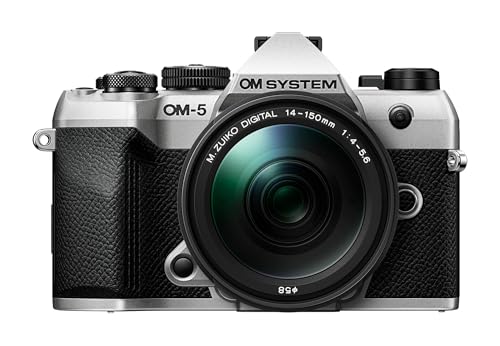
OM SYSTEM OM-5 Mark II — Best Weatherproof System
If one camera system seems designed by people who read Alaska’s weather reports, it is this one. The OM-5 Mark II pairs a compact, confidently weather-sealed body with the Micro Four Thirds lens catalogue, whose defining trick is reach without bulk: telephoto zooms that would be expedition gear on full frame become daypack items here, because the smaller sensor doubles their effective framing. On a bear platform in the rain, that means a sealed body and a sealed long lens, both light enough that you are still holding them at hour three — which is when the sow finally brings the cubs to the river.
The sealing deserves its own paragraph because it is the system’s founding virtue: the OM line’s weather resistance is the one travellers test involuntarily and report back on with relief. Add strong in-body stabilisation — genuinely useful on a rocking boat deck and for handheld dusk shots at the harbour — and computational helpers like handheld high-resolution modes for tripod-less landscape detail, and the camera starts to look like a field tool rather than a studio instrument wearing a raincoat.
Trade-offs follow from the sensor’s size. In deep darkness — aurora at high ISO, a wolf at last light — the smaller sensor concedes ground to the full-frame pick on this list, and subject-background separation at portrait distances is more modest. The menu system also asks for an evening’s familiarisation. But judged as an Alaska system — sealed, light, long-reaching, stabilised — the OM-5 Mark II is the most complete answer we can give a traveller who wants one camera to do the whole state.
- Sensor: Micro Four Thirds, about 20 megapixels
- Mount: Micro Four Thirds — compact, long-reaching zooms
- Sealing: high-grade weather resistance across body and many lenses
- Stabilisation: strong in-body system for boats and dusk
- Size: among the lightest interchangeable-lens kits here
Strengths
- Weather sealing you can trust through a week of coastal rain
- Telephoto reach at half the weight of full-frame equivalents
- Stabilisation that earns its keep on boats and trails
Trade-offs
- Smaller sensor trails full frame in the darkest conditions
- Menus reward an evening of setup before the trip
- Background blur is gentler than larger formats offer
Best for: one-system travellers mixing wildlife, weather, and hiking. Not suited for: dedicated aurora chasers who want maximum night performance.

OM SYSTEM Tough TG-7 — Best Rugged Compact
Every Alaska group has a moment when the expensive cameras go into dry bags — the kayak launch, the zodiac ride through chop, the fish-cleaning dock, the sideways rain at the glacier face — and the TG-7 is the camera that stays out for exactly those moments. It is waterproof to real depths, shrugs off drops and crushing, works in freezing temperatures, and treats spray as a rinse. Travellers consistently report that their favourite Alaska frames, the unposed wet ones, came from the tough compact they were not afraid to use.
Within its rugged brief it is a thoughtful photographic tool rather than a toy. The lens is bright for its class, which helps in the gloom under spruce canopy and in boat cabins; the microscope modes open up the tidepool and wildflower world that Alaska hides at ankle height; and GPS and sensor logging suit travellers who geotag their journeys. Video is capable, the controls are glove-tolerant, and the whole thing rinses clean under a tap at the lodge — a maintenance routine no mirrorless camera will ever accept.
The compromises are those of every small-sensor compact: image quality is honest rather than luxurious, zoom reach is modest for wildlife, and low-light work is a negotiation. Nobody should take a TG-7 as their only camera for a once-in-a-decade wildlife trip. But as the second camera — the wet camera, the kayak camera, the one handed to a teenager without a flinch — it has no peer on this list, and many travellers find it becomes the first camera they reach for more often than pride predicted.
- Sensor: compact 1/2.3-inch class, about 12 megapixels
- Build: waterproof, shockproof, crushproof, freezeproof design
- Lens: bright fixed zoom with macro and microscope modes
- Logging: GPS and environmental sensors for trip records
- Controls: chunky, usable with gloves and wet hands
Strengths
- Shoots in rain, spray, and surf that sideline every other pick
- Rinses clean; survives drops that end holidays for other cameras
- Macro modes reveal Alaska’s small worlds — tidepools, tundra flowers
Trade-offs
- Small sensor limits low-light and fine-detail ambitions
- Zoom reach is far too short for primary wildlife work
- Fixed screen and compact controls suit snapshots over deliberation
Best for: kayakers, anglers, boat days, and as the trip’s fearless second camera. Not suited for: anyone’s sole camera on a wildlife-first itinerary.

Canon EOS R6 Mark II — Best for Wildlife and Night
The R6 Mark II is the pick for travellers whose Alaska is defined by two extremes: animals in dim forest light and the aurora overhead. Its full-frame sensor keeps high-ISO files clean in the blue gloom beneath the spruce canopy, where bears and moose actually live, and that same sensitivity is what an aurora camera needs when the lights are faint and the exposure must stay short enough to hold the curtains’ structure. Canon’s subject detection finds animals and birds with the calm assurance of a system refined over generations, and the burst performance covers a fishing bear’s lunge from first splash to salmon.
As a travel body it is a known, mature quantity: weather sealing appropriate to the class, a deep and comfortable grip for cold hands, dual card slots for the paranoid (a virtue on a trip you cannot reshoot), and an RF lens catalogue that runs from featherweight travel zooms to serious wildlife glass. In-body stabilisation cooperates with lens stabilisation for the slow handheld work that boat decks and boardwalks demand, and the video side is strong enough that many travellers will leave a dedicated video camera home.
The honest costs: full-frame telephoto reach is neither cheap nor light, and this body will test a floatplane weight allowance in a way the OM system never will. The sensor’s resolution is ample rather than lavish, so heavy cropping into distant wildlife is less forgiving than on higher-resolution rivals. And in the wettest coastal work you will still baby it more than the TG-7 or the OM-5. But for the traveller who wants one serious camera that owns both the bear stream at dawn and the aurora at midnight, the R6 Mark II is the confident choice.
- Sensor: full-frame CMOS, about 24 megapixels
- Mount: Canon RF, deep telephoto catalogue
- Autofocus: animal and bird subject detection
- Cards: dual slots for on-trip backup
- Low light: excellent high-ISO discipline for aurora work
Strengths
- Owns the trip’s two hardest jobs — dim wildlife and night sky
- Tracking and burst depth built for fishing bears and eagles
- Dual slots and mature handling suit an unrepeatable trip
Trade-offs
- Full-frame telephoto glass strains weight limits and budgets
- Resolution is moderate; deep crops are less forgiving
- Needs more weather coddling than the sealed OM picks
Best for: wildlife-first travellers and aurora-season visitors. Not suited for: strict weight-limit itineraries built around floatplanes.

GoPro HERO13 Black — Best for Adventure Video
Some Alaska moments cannot be photographed from behind a viewfinder because you are in them: the raft hitting the glacial rapid, the sled dogs bursting from the start line, the bush plane lifting off a gravel bar with the mountains wheeling beyond the window. The HERO13 Black is the camera for those moments — waterproof without a housing, stabilised to an almost implausible smoothness, mountable to a chest strap, a helmet, a paddle, or a boat rail, and tough enough that its survival is never the trip’s worry. Set it running and be in your own Alaska story instead of directing it.
The current generation’s flexibility suits travel: interchangeable lens mods for ultra-wide or macro views, strong battery options for cold days, and slow-motion rates that turn a calving glacier’s splash or a sled team’s start into cinema. As a stills camera it is a blunt instrument, and we would not pretend otherwise; as a witness it is unmatched. Many travellers pair it with a stills system and find the GoPro’s footage becomes the trip’s most-rewatched souvenir.
Plan around its appetites: it eats batteries and cards on active days, wants its lens wiped of spray constantly, and its tiny touchscreen is no friend to thick gloves — voice control and the quick-capture button become your interface in real cold. None of that dents its role. For the adventure half of an Alaska itinerary, nothing else on this list can go where it goes.
- Type: waterproof action camera
- Stabilisation: advanced electronic smoothing for rough motion
- Lenses: interchangeable mod system for different fields of view
- Mounts: full GoPro ecosystem — chest, helmet, rail, pole
- Stills: available, but video is the mission
Strengths
- Goes rafting, sledding, and flightseeing without protection or worry
- Stabilisation turns chaotic motion into watchable footage
- Mounts anywhere, freeing your hands for the experience
Trade-offs
- Stills quality is a souvenir, not a portfolio piece
- Battery and card consumption on active days is heavy
- Tiny screen and controls fight against thick gloves
Best for: adventure travellers who want to be in the footage. Not suited for: stills photographers or wildlife reach of any kind.

Fujifilm X-T5 — Best for Landscapes
Alaska’s landscapes reward patience and resolution in equal measure, and the X-T5 brings both in a body that still travels politely. Its high-resolution APS-C sensor holds the detail of a glacier’s fractured face and the tundra’s autumn filigree, while Fujifilm’s film-simulation colour gives the subarctic light — long, low, and golden for hours in summer — a rendering that needs little coaxing in the edit. Photographers who shoot for the wall rather than the feed will find this the most satisfying stills camera on the list.
The traditional dial layout turns out to be a cold-weather virtue: shutter speed, ISO, and exposure compensation sit on physical dials you can work by feel in gloves, without spelunking through menus with numb fingers. The body is weather-resistant, the tilting screen serves tripod work at awkward moraine angles, and the X-mount offers a fine line of compact primes for travellers who walk far. In-body stabilisation steadies the blue-hour handheld shots that Alaska’s long twilights invite.
Where it yields: continuous tracking of fast wildlife is a step behind the Canon’s calm, and the longest X-mount telephotos are significant purchases, so this is a landscape-first system that visits wildlife rather than living there. Battery life on very cold days asks for the usual warm-pocket discipline. But for the traveller whose Alaska is light on land — Denali’s alpenglow, the fjords’ layered blues, tundra colour — the X-T5 is the connoisseur’s instrument.
- Sensor: APS-C X-Trans CMOS, about 40 megapixels
- Mount: Fujifilm X, strong compact prime range
- Controls: physical dials operable in gloves
- Colour: film simulations tuned for landscape light
- Build: weather-resistant with tilting screen
Strengths
- Resolution that does justice to glaciers and tundra detail
- Dials you can work by feel with gloves on
- Colour rendering that flatters the long northern light
Trade-offs
- Wildlife tracking is capable, not class-leading
- Long telephoto options are a serious spend
- Cold-day battery discipline is required
Best for: landscape photographers and slow, deliberate travellers. Not suited for: action-wildlife specialists who live on tracking.

DJI Osmo Pocket 3 — Best Pocket Filmmaker
The Osmo Pocket 3 answers a question every Alaska traveller asks by day three: how do I film the walking, talking, moving parts of this trip — the boardwalk towns, the ship’s deck at sailaway, the trail to the glacier viewpoint — without a rig that turns me into a film crew? Its answer is a camera on a motorised gimbal the size of a candy bar, which irons walking footage into a glide, flips to vertical for sharing, and tracks a face or a subject with a tap. It lives in a coat pocket, deploys in seconds, and is so unobtrusive that fellow travellers forget it is filming.
The image quality from its one-inch-class sensor embarrasses phones in the dim interiors of saloons and ship cabins, and its low-light manners suit Alaska’s long twilight strolls. Audio, the usual weakness of pocket devices, is a strength here thanks to its microphone options — dock-town ambience and guide commentary come home intelligible. For vloggers and family historians, it can plausibly be the only video camera on the trip.
Its limits are structural: no real zoom, so wildlife is scenery rather than subject; a delicate gimbal that wants its case and a moment’s care in rain; and stills that are an afterthought. Treat it as the trip’s cinematographer rather than its photographer and it is flawless casting. Paired with any stills pick on this list, it completes an Alaska kit that weighs less than the boots you will be wearing.
- Type: pocket camera with built-in 3-axis gimbal
- Sensor: 1-inch class, strong in low light
- Screen: rotating touchscreen for vertical and horizontal work
- Audio: quality built-in and wireless microphone options
- Size: coat-pocket, deploys in seconds
Strengths
- Gimbal glide for walking footage no phone can match
- Pocketable enough to be present for unplanned moments
- Audio quality that respects guides, music, and ambience
Trade-offs
- No meaningful zoom for wildlife or distant detail
- Gimbal mechanism wants care in rain and rough handling
- Stills are a convenience feature, not a strength
Best for: vloggers, family historians, and cruise travellers. Not suited for: wildlife stills or anyone needing telephoto video.
Does a Cruise Itinerary Change What You Should Bring?
Yes, in ways that flatter the lighter picks. A cruise-based Alaska trip is a sequence of short, intense shore days: a morning whale watch, an afternoon in a rainforest port, an evening sailaway past the glaciers. You are rarely more than a few hours from the ship’s warmth, dry room, and power sockets, which relaxes the battery and backup discipline slightly — but the shore excursions themselves concentrate every Alaskan challenge into half-days, and the ship’s rail becomes a primary shooting position. From a moving deck, stabilisation and shutter speed are your friends; from a small excursion boat, sealing is. Cruise travellers consistently overpack camera bodies and underpack weather protection, because the ship feels like a hotel while the excursions are pure Alaska.
Land-based itineraries invert the emphasis. Lodges, road trips, and the Alaska Railroad give you longer at each subject and more dawn and dusk access — the park road in Denali at first light is a different planet from the midday tour — but they also strand you further from resupply, making batteries, cards, and backups a genuine system rather than a habit. Weight discipline matters more too, because your kit travels in your own hands between train, shuttle, and trail. The OM-5 II and X-T5 kits shine here; the R6 Mark II earns its weight when the itinerary includes aurora nights or serious bear days. Either way, choose for the excursions and the edges of the day, not for the comfortable middle — the middle photographs itself with anything.
How Do You Shoot Well From Boats, Bush Planes, and Moving Trains?
Moving platforms reward a specific technique. On boats, shutter speed is king: the deck’s motion adds blur that stabilisation can only partly forgive, so work faster than your instincts suggest, brace against a rail or bulkhead rather than standing free, and keep the camera on a strap — a camera overboard in glacier water is a camera in another geological era. Keep a cloth in hand for spray and wipe the front element far more often than vanity suggests; half the soft whale photos ever taken are portraits of a salt droplet. In bush planes, the windows are small, curved, and rarely clean, so shoot through an openable window or door when the pilot allows, press a lens hood gently toward the glass to kill reflections when you must shoot through it, and embrace high shutter speeds against engine vibration. A polariser, so useful on water glare from a deck, becomes a liability through aircraft acrylic, which it can turn into rainbow artefacts.
On the train and park shuttles, the discipline is anticipation: the conductor and driver announce wildlife, the whole vehicle leans toward one side, and the photographers who get the frame are those whose cameras were already awake, at a sensible shutter speed, with the telephoto mounted rather than admired in the bag. This is the deepest argument for the lighter systems on this list — the camera already in your hands when the moose steps out is the best camera in Alaska, whatever its sensor size. Readiness is a specification. Buy and carry accordingly.
What Are the Ethics of Photographing Alaska’s Wildlife?
Alaska’s wildlife photography runs on a simple contract: the animal’s day matters more than your frame. Distances set by guides, rangers, and boat operators are not bureaucratic timidity; they are calibrated to habituated animals’ tolerance, and a photographer who pressures a bear off a fishing spot has stolen from the bear, the other watchers, and the next decade of that animal’s trust. Let the lens close distance. Never bait, call in, or crowd wildlife for a photograph, keep food discipline absolute in bear country, and treat a turned back or a moved-off animal as the end of the session rather than a challenge. Nesting birds and denning animals deserve even wider berths, and drones are prohibited in the national parks and unwelcome around wildlife almost everywhere.
There is a positive side to the contract: photographers who behave well become the wildlife’s best advocates, and Alaska’s guides talk with real warmth about the guests whose patience let an animal choose to come closer on its own terms — the shots that result, of a relaxed animal behaving naturally, are the ones that fill frames and win hearts anyway. Every camera on this list gives you the reach to honour the contract without sacrificing the picture. That is not a coincidence; it is a selection criterion we would defend anywhere, and Alaska is where it matters most.
Which Alaska Pick Fits Which Traveller? A Head-to-Head Look
| Camera | Type | Weather story | Wildlife reach | Night sky | Choose it if… |
|---|---|---|---|---|---|
| OM SYSTEM OM-5 Mark II | Mirrorless system | Excellent sealing | Excellent, light lenses | Capable | you want one system for everything |
| OM SYSTEM Tough TG-7 | Rugged compact | Waterproof outright | Minimal | Limited | your trip is wet and active |
| Canon EOS R6 Mark II | Full-frame mirrorless | Good sealing | Excellent with long glass | Excellent | bears at dawn and aurora both call |
| GoPro HERO13 Black | Action camera | Waterproof outright | None | Limited | you are in the adventure |
| Fujifilm X-T5 | APS-C mirrorless | Weather-resistant | Good with investment | Good | landscapes are the mission |
| DJI Osmo Pocket 3 | Pocket gimbal | Needs care | None | Good for video | you film the journey itself |
The honest way to read this table is as a pairing chart. Few Alaska travellers should take exactly one camera; the classic combinations are a system camera plus the TG-7 for wet days, or a stills body plus the Pocket 3 for the moving story. The R6 Mark II and OM-5 II are the two plausible solo acts — choose between them by whether your trip leans toward night and wildlife drama or toward weather, weight, and reach.
What Should Your Alaska Camera Kit Include Beyond the Camera?
Build the supporting kit with the same seriousness as the body choice, because Alaska’s failures are logistical. Batteries: at least two spares per camera, rotated through an inside pocket, plus a charger that runs from USB so lodge, boat, and vehicle power all work. Memory: more than your instincts say, in fast cards, with a nightly backup ritual to a second device — a trip like this is not reshootable, and a card failure on day six is a tragedy with a known prevention. Protection: a dry bag sized to your kit for boat days, a simple rain cover even for sealed bodies, lens cloths in every pocket because spray is constant, and a blower for glacier grit. Comfort: a strap or harness that spreads a telephoto’s weight across a full day, and gloves with a fold-back or touchscreen-friendly finger, because the camera you cannot operate in the cold is luggage.
Two additions separate prepared travellers from hopeful ones. A lightweight tripod transforms aurora nights and glacier overlooks alike — the aurora cannot be handheld into greatness, whatever the stabilisation promises. And a small pair of binoculars changes the wildlife day entirely: you will spot with glass and shoot with the camera, rather than burning the encounter by scanning through a telephoto. Neither is glamorous. Both will appear in more of your favourite Alaska memories than any menu setting.
How Do You Photograph the Northern Lights With These Cameras?
Aurora photography is a tripod discipline. Set the camera on a firm tripod, focus on a bright star or distant light at manual focus and then leave focus alone, and work with a wide, fast lens if your system offers one. Start around a few seconds of exposure at a high ISO and review the histogram and the sharpness of the stars — the lights move, and exposures that run too long smear their curtains into fog, so shorter and noisier beats longer and blurred. The R6 Mark II’s sensor is the most forgiving here; the X-T5 and OM-5 II both produce fine aurora work with this discipline, and the Pocket 3’s night modes can surprise you for video of strong displays.
Dress the photographer as carefully as the camera: the aurora performs at the coldest hours, and a frozen photographer quits before the sky does. Batteries go in the warm pocket between sequences, the tripod’s leg locks get worked before they stiffen, and a headlamp with a red mode preserves everyone’s night vision at a shared viewpoint. Finally, put the camera down for part of every display. The lights are the rare subject that punishes total documentation; see one properly with your own eyes, then photograph the next.
What Mistakes Do First-Time Alaska Travellers Make With Their Cameras?
The canonical mistake is bringing a wonderful camera and a standard zoom, then watching a bear fish at a distance that makes it a brown smudge — Alaska is a telephoto destination wearing a wide-angle postcard’s clothes. Second is underestimating the rain: not the dramatic storm but the four-day drizzle that creeps into unsealed dials and fogs an unprotected rear element. Third is battery optimism in the cold, cured by spares and pockets. Fourth is changing lenses in glacier wind, trading a dusty sensor for the whole trip against one marginally better focal length. And fifth, quietly commonest of all: spending the entire trip behind the camera. Alaska is enormous and brief. Build the kit, learn it before you go, and then let it serve the trip rather than consume it.
How Should You Prepare the Camera — and Yourself — Before You Go?
The single most valuable Alaska camera accessory is a fortnight of practice at home. Learn your camera’s wildlife settings until they are reflexes: the subject-detection mode, the back-button or touch focus habits, the quick route to exposure compensation when a white bird crosses dark water. Set up a custom mode for animals (fast shutter, tracking, burst) and one for landscape (aperture priority, low ISO, single shot) so the camera changes personality at a dial’s turn rather than a menu’s spelunk. Photograph your local herons, gulls, and squirrels with the exact kit you will travel with; Alaska will not pause while you learn, and every fumble rehearsed at home is a frame saved in the field.
Prepare the logistics too. Format cards in camera, label batteries so rotation is visible at a glance, pack the charger and a multi-port USB adapter for the lodge’s single free socket, and run one complete backup drill — shoot, offload, verify, format — before departure rather than improvising it on night one. Photographers lose more Alaska images to untested workflows than to weather, cold, and bears combined. The state will provide the wonders on schedule; your preparation decides whether they survive the journey home.
What Is the Midnight Sun Really Like to Photograph?
Summer visitors underestimate the strangeness of a night that never arrives. In June, much of Alaska lives in a permanent golden hour that slides around the horizon — sunset bleeds into sunrise across hours of amber light, and the photographic consequence is glorious and exhausting in equal measure. The light is at its best when you should be asleep; itineraries bend around it, and the photographers who nap at midday and shoot at midnight come home with the state’s most flattering portraits. Your camera needs nothing special for the midnight sun — every pick here drinks that light happily — but your scheduling does: protect the late evenings, forgive yourself the slow mornings, and remember that in midsummer Alaska, “night photography” means a tripod for the colours, not the darkness.
Shoulder seasons split the difference and reward the flexible: May and September bring darker nights for the season’s first and last aurora, quieter trails, and weather with opinions. Winter is the aurora’s home season and the cold’s examination hall, where the battery and glove disciplines in this guide stop being advice and become the difference between shooting and watching. Whichever season you choose, the camera decision follows the same logic — sealing for the coast, reach for the animals, sensitivity for the dark — and the picks above were sorted by exactly those three questions.
Which Alaska Subjects Deserve Your Best Effort Each Day?
A little triage sharpens an Alaska trip wonderfully, because the state offers more subjects than any traveller can honour equally. Bears are the marquee act and the most schedule-bound — viewing is by tour, tide, and salmon run — so give them your freshest batteries, your longest lens, and your fullest attention when the window opens. Whales and sea life come second: unpredictable, boat-bound, and decided in seconds, which argues for the camera being awake and set before the naturalist finishes the sentence that starts with “blow at two o’clock.” Eagles, by contrast, are Alaska’s generous regulars — harbours, fish docks, and river mouths offer daily practice at every range, and they are where a traveller should refine telephoto technique early in the trip, while the stakes are low and the subjects are patient.
Landscapes ask for the opposite rhythm: slow, tripod-friendly, and timed to the long light rather than the animal clock. The travellers who come home happiest usually run both rhythms deliberately — wildlife settings and long glass for the day’s excursions, landscape discipline for the evenings — rather than letting one style colonise the whole trip. The six picks were chosen to make that double life easy: every system here can be dressed for animals by day and for the land by night, and the compacts exist so that the in-between moments, which Alaska supplies generously, are never missed for want of a camera in hand.
What About Photographing Glaciers Specifically?
Glaciers defeat auto exposure with a smile: a wall of blue-white ice in northern light is exactly the subject that makes meters under-read and cameras produce grey, dingy frames of a scene your eyes saw as luminous. The fixes are old and reliable — a deliberate dose of positive exposure compensation, exposure bracketing for the frames that matter, and a willingness to shoot the glacier’s details (crevasses, meltwater streams, the impossible blue of fresh-calved ice) rather than only its postcard entirety. Calving, when it comes, is a burst-mode event announced by a rifle-crack sound seconds before the fall; keep the camera ready and the buffer empty when you hear it. Every pick here can do glacier work well; the photographer’s exposure discipline, not the sensor, is the variable that decides the results.
Final Recommendation
For most travellers, the OM SYSTEM OM-5 Mark II with a standard zoom and a compact telephoto is the Alaska answer: sealed against the weather the state actually serves, light enough for its trails and weight limits, and long-reaching enough for its animals. Add the Tough TG-7 if your itinerary is wet — and most are — or step to the Canon EOS R6 Mark II if your heart is set on bears in dim light and the aurora in winter. Choose the X-T5 for a landscape-led journey, and let the GoPro and the Pocket 3 fight for the second-camera slot based on whether your memories move by adventure or by walking. Whatever you choose, buy it early enough to learn it at home; Alaska is no place for a first date with a menu system.
Frequently Asked Questions
Can I just take my phone to Alaska?
Your phone will handle towns, meals, and midday scenery beautifully, and modern phones are tougher than travellers assume. It will fail you at the three moments Alaska is famous for: wildlife at distance, weather you cannot shoot in, and the aurora. If those moments are the point of your trip — and for most visitors they are — a dedicated camera is not an indulgence but the difference between witnessing and recording. Many travellers do both: phone for the diary, camera for the wonders.
How many batteries should I bring?
Plan on cold and activity roughly doubling your normal consumption: two spares per camera is the working minimum, three for winter aurora trips where the camera sits in deep cold for hours. Carry the day’s spare in an inside pocket, rotate them, and recharge nightly from whatever power the lodge offers. A battery that reads empty in the cold often recovers when warmed, so rotate before you despair.
Is it worth renting a long lens instead of buying one?
For a once-in-a-decade trip, renting serious telephoto glass for your existing system is one of the smartest spends in travel photography — you get expedition reach for the fortnight without owning it for the decade. Rent early, insure it, and practise with it at home before departure, because a rented 600mm-class lens has handling habits of its own. If you travel for wildlife yearly, the maths flips toward buying.
What about bears — is it safe to photograph them?
Alaska’s bear viewing is overwhelmingly done with professional guides, at established platforms, or from boats, at distances the bears are habituated to and the rules enforce. Your job is to follow the guide’s instructions exactly, keep food discipline absolute, and let the telephoto lens close the distance so your feet never try to. The cameras on this list were chosen partly so that no traveller needs to be closer than the rules allow to come home with the frame.
Will my camera survive the cold on a winter trip?
The cameras themselves are tougher than their batteries. Mechanical and electronic systems on this list operate in deep cold; what fails first is battery voltage, screen responsiveness, and the photographer’s fingers. Warm-rotated batteries, a camera sheltered under your shell between sequences, and condensation discipline when re-entering warm rooms will carry any of these picks through an Alaskan winter day. The TG-7 is the extreme case, rated for freezing work outright.
Do I need a tripod, or is stabilisation enough?
Stabilisation covers handheld daylight and dusk remarkably far, and on boats a tripod is useless anyway. But the aurora, glacier-blue-hour landscapes, and any long-exposure water work still belong to the tripod. A light travel tripod earns its luggage space on any Alaska trip that includes a night sky or a landscape photographer; pure summer wildlife travellers moving fast can leave it home with a clear conscience.
How do I keep my lens clear in rain and sea spray?
Accept that the front element will get wet and plan the wiping, not the prevention: a clean, dry microfibre cloth in a sealed pocket, rotated for a fresh one when it saturates, and a lens hood worn always, because a deep hood keeps a surprising share of rain and spray off the glass. A simple rain cover over body and lens handles the worst of it, and a chamois is the boat photographer’s traditional friend. What not to do is wipe with a sleeve, a glove, or a paper tissue — grit in glacier country turns a casual wipe into a scratch. Check the element before every important sequence; the softest wildlife frames are usually just the wettest.
Should I insure my camera gear for an Alaska trip?
For a serious kit on a trip this unrepeatable, yes — a rider on your household policy or a specialist travel policy costs little against the value of the gear and the remoteness of the setting, where a dropped camera is not replaced by a shop on the next street. Photograph your serial numbers before departure, keep the records in your phone, and read the policy’s water and unattended-vehicle clauses, because boats and rental cars are where claims are born. Insurance will not save the photographs, but paired with nightly backups it removes money from the list of things that can ruin the trip.
Related Guides
Round out your travel kit reading with our guide to the best cameras for adventure travels, our roundup of the best addon cameras for traveling, and our picks of the best affordable cameras for wildlife photography.


