ilcastellomenu.com is reader-supported. When you buy through links on our site, we may earn an affiliate commission.
Where to Buy
Every camera below is a current entry-level or enthusiast model from Canon, Nikon, Sony or Fujifilm, sold through the usual camera retailers, and each sits in our verified pool with a proper product link. They are all interchangeable-lens cameras — deliberately — because learning photography means learning what lenses do, and a camera you can grow lenses on is a teacher that stays useful for years.
The best cameras for begining photographers are not the simplest cameras, and they are not the most powerful ones either. They are the cameras that teach. A first camera should make your first hundred photographs easy and your thousandth photograph better — automatic enough that a complete beginner succeeds on day one, honest enough that the controls reveal themselves as your curiosity wakes up, and part of a lens system that lets the camera grow at the speed of its owner rather than being replaced by it.
This guide takes the general road on purpose. Our site already covers beginner cameras chosen for video, and beginner photography bundled with software; this page is for the beginner as such — the person who wants to learn photography itself: light, lenses, exposure, composition, the whole craft — and wants one camera to learn it on. The six picks are all mirrorless cameras with interchangeable lenses, spread across four makers, because that is where photography is learned in this decade and where a first purchase can become a ten-year companion.
What separates them is teaching style. Canon’s pair tutor you with guidance and warmth. Nikon’s pair offer the classic photographer’s layout at two prices. Sony’s entry is the video-leaning all-rounder for beginners whose photography shares a life with filming. And Fujifilm’s X-T5 is the beautiful over-qualification — the camera for the beginner who already knows they are serious. We will match each to its student, then lay out the learning path itself: the settings to master in order, the first lens to add, and the mistakes that waste a first camera’s teaching.
Key Takeaways
- A first camera should be automatic on day one and manual by month six — guided modes that teach, then controls that hand over.
- Interchangeable lenses are the curriculum: what lenses do is most of photography, so buy into a system you can grow.
- The kit zoom teaches framing; the first fast prime teaches light and depth — plan for both, in that order.
- Ergonomics are a learning feature: a camera that feels right gets carried, and carried cameras teach faster than specifications.
- Every pick here holds its value as a second camera later — a beginner camera done right is never wasted money.
In this guide
Quick Picks
| Pick | Badge | Why it is here |
|---|---|---|
| Canon EOS R50 | Best first camera for most beginners | Guided, friendly and warm in colour, with a full professional system waiting behind the training wheels. |
| Nikon Z50 II | Best for the keen learner | A photographer’s layout, a proper viewfinder and Nikon’s lovely colour in a body that takes learning seriously. |
| Sony ZV-E10 II | Best if video shares the dream | A creator-first camera whose stills are strong and whose filming tools lead the class for beginners. |
| Nikon Z30 | Best small and simple starter | The Z50’s family in a tinier, screen-based body for beginners who travel light and film as they go. |
| Canon EOS R10 | Best for action-curious beginners | Faster, grippier and more serious — for the beginner whose subjects move: kids, dogs, sports, wildlife. |
| Fujifilm X-T5 | Best buy-once beginner camera | Analogue dials that teach exposure by touch and film colour that makes early photographs beautiful. |
How Did We Choose These Cameras for Begining Photographers?
Our first filter was pedagogical: does the camera help a beginner understand what just happened? Guided modes that explain, live previews that show exposure changes before the shot, and menus written in human language all scored heavily — because a beginner’s scarcest resource is not money but the motivation that survives the first confusing month. Cameras that merely automate, hiding everything, produce owners who plateau; cameras that teach produce photographers.
Second, growth. Every pick mounts lenses from a living system with affordable next steps — a fast prime, a telephoto for the school play and the garden birds — because the moment a beginner outgrows a fixed-lens camera, the purchase becomes a sunk cost instead of a foundation. All six here can carry an owner from first photograph to serious hobby without a change of brand, mount or habits.
We also asked a question beginners rarely think to ask and always benefit from: what does this camera’s owner community look like? A first camera with a million fellow learners — forums full of people at your exact stage, tutorials pitched at your exact problems — is worth real money in morale. All four makers here bring that crowd; the Canon and Sony beginner lines bring it in its largest, most welcoming form, and we counted it as a feature, because hobbies are social even when they are practised alone.
Third, the physical apprenticeship: a viewfinder you can learn to compose through in bright light, dials your fingers can find, and a size you will actually carry to the places beginners photograph — family, streets, holidays, the dog. We also kept one eye on value across the whole first year, not the sticker: the true beginner budget is camera plus kit lens plus, soon, one prime, and we judged each system by what that honest bundle costs and delivers.

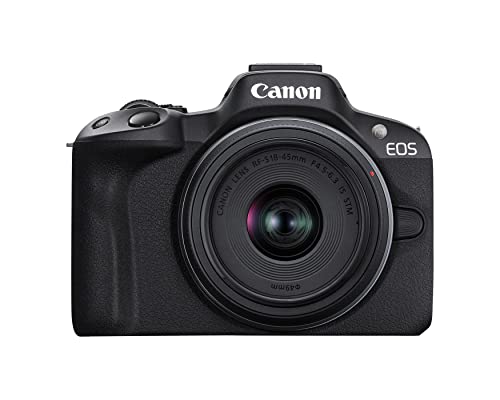
Canon EOS R50 — Best first camera for most beginners
The R50 is the first camera we recommend to most beginners because it understands the assignment: be kind first, be deep later. Its guided interface explains settings in plain language with little visual demonstrations — what a wider aperture does to a background, what a slower shutter does to movement — so the automatic modes are secretly lessons. Its Creative Assist lets a beginner choose ‘brighter’ or ‘background more blurred’ and then shows them the real settings behind the choice, which is the single best teaching trick in modern cameras: vocabulary arrives attached to experience.
The photography underneath the kindness is fully real. Canon’s colour makes people look like themselves on a good day, the autofocus finds faces and eyes without being asked, and the sensor and processor are shared bloodline with cameras far up the range. The kit zoom covers the beginner’s world — rooms, streets, holidays, the cat — competently, and the system’s inexpensive fast prime is the famous second step that turns snapshots into photographs and beginners into enthusiasts, usually within one birthday or Christmas of the camera itself.
Growth is the R50’s structural advantage: Canon’s RF mount is the professional system, so every lens bought for this little body fits the flagship you might own in a decade, and every habit transfers. The body’s own limits are the honest class limits — modest weather sealing, a simplified control set, a battery that rewards carrying a spare — and they arrive, conveniently, at about the time a growing photographer is ready to hear about the R10 above it in this very guide.
As a gift it is nearly unarguable: light, pretty, unintimidating, and incapable of making its owner feel foolish. As a self-purchase it is the start of a system rather than a gadget. For the beginner who wants to learn photography without being lectured by their equipment, this is the front door.
A note on its screen and size for the beginner’s real life: the body is light enough for a whole day at a family event without the shoulder ache that teaches beginners to leave cameras at home, and its articulating screen opens the high-and-low angles — over the crowd, down at the child’s eye level — where beginner photographs stop looking like everyone else’s. Small mercies, compounded daily, are what a first camera is for.
Buy the kit, shoot everything for a season, then buy the fast prime. That two-step has launched more photographers than any course ever written.
- Format: APS-C mirrorless, interchangeable lenses
- Teaching: guided interface and Creative Assist
- Colour: Canon’s warm, flattering rendering
- Autofocus: automatic face and eye detection
- Growth: Canon RF system, affordable fast prime
Strengths
- Teaches while it automates — lessons built into the modes
- Canon colour makes first photographs encouraging
- A foundation in a full professional system
Trade-offs
- Simplified controls once you advance
- Light weather sealing
- Battery life rewards a spare
Best for: a complete beginner, or a gift for one, who wants to learn properly.
Not suited for: a beginner whose first love is fast action or harsh weather.

Nikon Z50 II — Best for the keen learner
The Z50 II is the beginner camera for the beginner who has already read three articles like this one. Where the R50 tutors with guidance, the Nikon teaches with layout: a proper photographer’s body with a deep grip, twin control dials, a bright viewfinder you compose through like generations of photographers before you, and direct access to the settings that constitute the craft. It assumes its owner wants to learn, and it respects that ambition from the first weekend.
Nikon’s colour is the quiet argument — natural, slightly reserved, with skin tones photographers describe as honest — and the files reward the learner who starts editing, because there is depth in them to discover. The autofocus is modern and willing, tracking eyes and subjects with a calm that lets a beginner concentrate on composition rather than machinery, and the video side is strong enough that the camera does not apologise to the filming-curious either.
The system’s teaching path is well lit: the kit zooms are genuinely good, Nikon’s affordable primes are small and lovely, and the Z mount above this body contains some of the finest cameras made, so the apprenticeship has a visible horizon. The body itself is the keen learner’s bargain — more viewfinder, more dials, more weather resistance than its price suggests — bought at the cost of a slightly less hand-holding interface than Canon’s. Beginners who need the hand-holding should take the R50 without a flicker of shame; beginners who find guidance menus faintly patronising will feel at home here within an hour.
It is also, not incidentally, the pick for the beginner returning to photography after a film-era youth: the layout will feel like a homecoming, and the craft they remember is all still here, electrified.
Choose it if ‘beginner’ describes your experience but not your intentions.
Its battery and build deserve a learner’s footnote: it feels like equipment rather than a gadget, survives the knocks of a first year in student bags and car boots, and its battery life is the class’s calmer end — one less anxiety while the others are being learned. Beginners underestimate how much trust a camera earns by simply always being ready; the Z50 II earns it.
- Format: APS-C mirrorless, interchangeable lenses
- Handling: twin dials, deep grip, bright viewfinder
- Colour: Nikon’s natural, honest rendering
- Autofocus: modern subject and eye tracking
- Growth: Nikon Z system with fine affordable primes
Strengths
- A real photographer’s layout from day one
- Viewfinder and grip reward deliberate learning
- Files with depth for the editing-curious
Trade-offs
- Less guided hand-holding than the Canon
- Slightly larger to carry than the smallest picks
- Menu depth can daunt the truly casual
Best for: a keen beginner who wants to learn the craft’s classic way.
Not suited for: a casual beginner who wants the camera to explain everything.

Sony ZV-E10 II — Best if video shares the dream
Many modern beginners do not separate photography from filming — the camera is for the family’s photographs and the channel’s videos, the holiday album and the holiday film. The ZV-E10 II is built for exactly that beginner. Its stills are properly strong — a fine sensor, Sony’s formidable autofocus, colour that has become accurate and kind — and its video tools are the class’s best teaching set: product showcase focus, background blur at a button, and a screen and layout designed for a person who is simultaneously the subject and the crew.
The learning path it offers is the creator’s path. A beginner here learns exposure through filming’s honest feedback — you see focus, light and framing continuously, not after the fact — and the stills education rides along. Sony’s lens catalogue is the beginner’s friend in a specific way: third-party makers offer excellent, affordable primes and zoos for this mount, so the growth steps that Canon and Nikon price carefully are here available at student budgets, which matters more to real beginners than any specification on this page.
Its compromises are photographic in flavour. There is no viewfinder — composition is by screen, which filming natives find natural and traditional learners find like writing without lines — and the body is a creator’s rectangle rather than a photographer’s grip. Stills-first beginners should honestly weigh the R50 and Z50 II before this one; the ZV-E10 II’s stills are excellent but its soul is motion.
For the beginner whose camera will live on a small tripod as often as in a hand, whose photographs and films are one practice, it is the obvious foundation — and its autofocus will spoil you for every camera you touch afterwards.
Its stills deserve one more sentence against the assumption that a video-first camera photographs as an afterthought: the sensor and processor are the same generation as Sony’s stills-led bodies, and the photographs — sharp, clean, confidently focused — would headline a lesser camera’s entire sales pitch. The ZV-E10 II does not ask its owner to choose a craft; it asks them to choose a screen position.
Buy it with the kit lens, learn both crafts for a season, and let your own ratio of stills to video tell you which lens comes second.
- Format: APS-C mirrorless, interchangeable lenses
- Screen: fully articulating, creator layout
- Focus: class-leading face, eye and product focus
- Video: beginner-friendly creator toolset
- Growth: Sony E system with affordable third-party lenses
Strengths
- Best beginner video tools in this line-up
- Autofocus that removes a whole beginner anxiety
- Lens growth at genuinely student prices
Trade-offs
- No viewfinder — screen-only composition
- Creator-shaped body, less of a photographer’s grip
- Stills-first learners may prefer a traditional layout
Best for: a beginner whose photography and filming are one hobby.
Not suited for: a stills purist who composes through a viewfinder.

Nikon Z30 — Best small and simple starter
The Z30 is the Z50 II’s little sibling with a different theory of beginning: smaller, simpler, screen-based, and aimed at the beginner whose photography happens on the move — travel, friends, food, the city — with filming woven through it. It keeps the family virtues, Nikon’s sensor quality and colour and the same Z-mount future, and sheds the viewfinder and some dials in exchange for a body that disappears into a jacket pocket with its small kit zoom and asks nothing of its owner but to be carried.
That disappearance is a teaching feature. Beginners learn at the speed of their carrying, and the Z30’s size means it is present for the unplanned photographs — the market at dawn, the friend’s expression, the street corner in rain-light — that constitute a first portfolio. Its screen-based operation will feel native to anyone raised on phones, its video is properly capable for the vlog-adjacent beginner, and its stills are real Nikon stills, with the depth to reward the first experiments in editing.
The trades are the size’s price. No viewfinder means bright midday composition is a screen-squinting exercise; the single dial slows the manual learning the Z50 II accelerates; and the small battery is a day-trip heart, with spares advised for travel days. Beginners should choose between the siblings by temperament with unusual honesty: the Z30 for the beginner who values presence over apparatus, the Z50 II for the one who values apparatus as part of the pleasure.
As a travel-first or second-household beginner camera — the one that lives with a student, a young traveller, a new parent — it is the easiest Nikon to love, and its photographs will embarrass nobody’s album.
Its microphone and headphone arrangements, inherited from its creator brief, give the filming beginner room to grow into proper audio — the upgrade every young filmmaker discovers they need by their third video — without a camera change. Small futures like that, noticed at purchase time, are what separate a starter camera from a stopping camera.
It also makes the line-up’s best ‘beginner camera as gift for a teenager’ case: phone-native, pocketable, and with a real system quietly waiting when the hobby bites.
- Format: APS-C mirrorless, interchangeable lenses
- Size: pocketable with its compact kit zoom
- Screen: articulating, phone-native operation
- Colour: Nikon rendering, same family depth
- Growth: full Nikon Z lens system
Strengths
- Small enough to be carried everywhere, daily
- Phone-native handling for the screen generation
- Real Nikon image quality in miniature
Trade-offs
- No viewfinder for bright-light composition
- Single dial slows manual learning
- Small battery — spares for long days
Best for: a mobile, travel-first beginner who films as well as photographs.
Not suited for: a learner who wants the classic dial-and-viewfinder apprenticeship.

Canon EOS R10 — Best for action-curious beginners
Some beginners know their subjects from the start: children at full sprint, dogs at fuller sprint, school sports, garden birds, the local football team. For them the R10 is the beginner camera, because it brings the one thing the friendlier picks ration — speed. Its burst shooting, autofocus tracking and deeper grip are borrowed from Canon’s serious sports lineage, scaled into a body a beginner can afford and carry, and they convert the beginner’s most heartbreaking category — the almost-in-focus action shot — into a keeper rate that keeps motivation alive.
The teaching is the R50’s family teaching at a higher tempo: the same Canon colour and guidance DNA, but with twin-dial control and a proper joystick-era layout that grows with the student’s hands. The system’s telephoto steps are the action beginner’s curriculum — an affordable long zoom turns the R10 into a school-sports and wildlife instrument that would have been a professional’s kit within living memory, and learning to use it is a complete photographic education in itself.
What it gives up against its siblings is mostly gentleness and price. It costs more than the R50, its body is a handful more, and its talents are wasted on a beginner whose world is portraits and holidays — that beginner should save the difference and buy the R50 and its prime sooner. The R10 buyer is buying insurance against motion, and should be sure motion is actually in their photographic future before paying the premium.
For the right beginner, though, it is the camera that prevents the classic second purchase: the frustrated upgrade six months in, when the friendly camera cannot follow the footballer. Buy once, at the tempo of your subjects.
If your camera roll is already full of blurred children and disappearing dogs, the R10 is your beginning, and a very capable one.
One more of its beginner virtues is stamina: the bigger body carries a bigger battery and a grip that survives a whole tournament or a day at the reserve without the hand fatigue that quietly shortens beginner outings. Action photography is mostly waiting, and a camera built for the waiting is a camera that is still raised when the moment finally runs through the frame.
- Format: APS-C mirrorless, interchangeable lenses
- Speed: fast bursts and serious subject tracking
- Handling: deeper grip, fuller control layout
- Colour: Canon rendering, family guidance included
- Growth: Canon RF system including affordable telephotos
Strengths
- Action ability the friendlier picks cannot match
- Prevents the frustrated six-month upgrade
- Canon colour and teaching in a faster body
Trade-offs
- Costs more than the R50 — wasted if subjects are still
- Larger in the bag and the hand
- Talents tempt beginners to overspend early
Best for: a beginner whose subjects run, fly or play sport.
Not suited for: a portrait-and-holiday beginner, who should take the R50.

Fujifilm X-T5 — Best buy-once beginner camera
The X-T5 is the connoisseur’s answer to the beginner question, included for the beginner who is certain — the one who has borrowed cameras, read the books, and wants to buy once and learn deeply. Its argument is tactile: shutter speed, ISO and exposure compensation are physical dials on the body’s top plate, so exposure — the craft’s core — is learned by the fingers, visibly, with the camera switched off. No beginner camera teaches the exposure triangle more honestly, because none other wears it on its sleeve.
The photographs accelerate the learning with encouragement. Fujifilm’s film simulations give a beginner’s early work a finished, beautiful colour character that makes practice feel like production, and the high-resolution sensor rewards improving technique with visibly improving detail — a feedback loop of quality that keeps students shooting. The lens system is a curriculum of small, characterful primes, each one a lesson in a focal length, at prices and sizes that suit a learner’s shelf.
Honesty requires the caveats. It is the most expensive pick here by a distance, its resolution punishes sloppy technique that kinder sensors forgive, and its autofocus, while fine for most life, is not the action machine the R10 is. A beginner unsure of their commitment should not start here; the R50 exists precisely for the uncertain, and there is no shame in the on-ramp. But for the beginner who is sure, every cheaper camera is a toll paid on the way to this one.
It is also the pick that most changes its owner’s behaviour in the direction of art: the dials slow you down, the film looks make you see in finished photographs, and the object itself — beautiful, mechanical-feeling — invites the daily carry that is the real curriculum.
Buy it if you are beginning a vocation, not sampling a hobby.
A practical reassurance for the committed beginner eyeing its price: the X-T5’s lenses hold the system’s character in small, relatively affordable primes, so the decade-long cost of the Fujifilm path is gentler than the body’s ticket suggests. You are buying the expensive half first and the kind half gradually — a defensible shape for a serious student’s budget.
- Format: APS-C mirrorless, interchangeable lenses
- Handling: full analogue exposure dials
- Colour: Fujifilm film simulations
- Sensor: high resolution that rewards technique
- Growth: Fujifilm X system of characterful primes
Strengths
- Teaches exposure by touch like nothing else here
- Film colour makes early work genuinely beautiful
- Buy-once quality for the committed beginner
Trade-offs
- The price of two starter cameras
- Resolution exposes beginner technique
- Autofocus not built for serious action
Best for: a committed beginner buying once and learning deeply.
Not suited for: an uncertain beginner sampling the hobby.
How Do the Six Beginner Cameras Compare Side by Side?
| Pick | Key specification | Standout trait | Watch out for |
|---|---|---|---|
| Canon EOS R50 | Guided APS-C system | Kindest teaching | Simplified controls later |
| Nikon Z50 II | Dials-and-viewfinder APS-C | Keen learner’s layout | Less hand-holding |
| Sony ZV-E10 II | Creator APS-C system | Video-plus-stills path | No viewfinder |
| Nikon Z30 | Pocketable APS-C system | Presence everywhere | Screen-only, one dial |
| Canon EOS R10 | Fast APS-C system | Action from day one | Premium for speed |
| Fujifilm X-T5 | Analogue APS-C system | Deepest teaching, film look | Price and resolution’s honesty |
The table is really six answers to one question: how do you learn best? By being guided (R50), by handling real controls (Z50 II, X-T5), by filming (ZV-E10 II, Z30), or by chasing moving subjects (R10). Beginners mis-buy most often by choosing the camera of the photographer they admire rather than the student they are — the honest self-assessment is worth more than any single feature compared here.
The second reading is financial shape. The R50 and Z30 minimise the first payment and defer learning costs to the prime lens you will want in season two. The Z50 II and R10 balance body and growth. The X-T5 front-loads everything into a body that needs nothing but lenses for a decade. All three shapes are rational; match the shape to your certainty, and the camera will feel like a bargain whichever you choose.
What Should a Beginner Learn First? A Sensible Order of Lessons
Lesson one is seeing, not settings: for the first month, shoot in full automatic with any pick here and spend your attention entirely on where you stand, what you include, and when the light is kind. Composition learned early is permanent; settings learned early are trivia until composition gives them purpose. The beginners who improve fastest are recognisable by their feet — they move — long before they are recognisable by their menus.
Lesson two is aperture, because it is the setting with a visible personality: background blur for portraits, depth for landscapes. The fast prime you will buy makes this lesson physical, and Creative Assist-style guidance on the Canon, or the X-T5’s dial, makes it legible. Lesson three is shutter speed — freezing the dog, blurring the waterfall on purpose — and lesson four, ISO, is mostly learning what your camera forgives, which the modern sensors here forgive generously.
Lesson five is light itself, the subject the first four were secretly about. By now the camera has become transparent — which is the entire goal of the beginner year — and the photographer is reading windows, weather and hours like a sailor. Every camera on this page can carry a student through all five lessons without once being the limiting factor, which is the real definition of a good beginner camera.
Kit Lens or Fast Prime: What Should a Beginner Shoot With?
Start with the kit zoom, and distrust anyone who says otherwise. Its range is a survey course in focal lengths: a season of shooting at its wide end, its middle and its long end teaches you — in your own photographs, not in theory — which distances your eye prefers. That knowledge is the most valuable thing a beginner owns, because every later purchase depends on it, and it can only be learned by the zoom’s honest tour.
Then buy the fast prime at the focal length your season kept choosing. Its gifts are the second semester: backgrounds that melt, evenings that become photographable, a sharpness that shows you what your sensor can do, and the fruitful discipline of zooming with your feet. On the Canon and Nikon systems this lens is famously affordable; on Sony’s, third-party makers make it more so; on Fujifilm’s, the primes are the system’s jewels and priced like small ones.
The mistake is reversing the order, or skipping the survey: a prime bought blind teaches one lesson expensively, and a kit zoom kept forever teaches breadth without depth. Zoom first for knowledge, prime second for beauty — the sequence is the syllabus.
How Do You Avoid the Beginner’s Upgrade Trap?
The trap has a shape: a first camera bought without a system, outgrown in a year, sold at a loss, replaced by the camera that should have been bought first — with the year’s lens purchases stranded on the wrong mount. Every pick in this guide is armour against it, because all six sit inside living systems with visible futures. The remaining discipline is the buyer’s: choose the mount as carefully as the body, because you are marrying the lens catalogue, not dating the camera.
The second trap is subtler: upgrading the body when the limit is a lens, a skill or a light. A beginner who finds their photographs dull usually needs the fast prime, the dawn alarm or the composition month — not a new sensor. Bodies here were chosen to have headroom precisely so that the honest answer to ‘should I upgrade?’ is ‘not yet’ for several years, and the money can go where photographs actually improve.
When the upgrade finally is right — sealing for the weather photographer, speed for the action convert, resolution for the printer — it will announce itself as a specific frustration with a name, not a general itch. Buy for named frustrations only, and a beginner’s kit grows like a tree instead of churning like a wardrobe.
What Accessories Does a Beginner Actually Need?
Fewer than the shop hopes. A second battery, because beginner days are long and enthusiasm should not end at 4 p.m. A card reader and the habit of copying photographs the same day, because the archive is the hobby’s memory. A comfortable strap or wrist loop that makes carrying pleasant, because carried cameras teach. And a small bag that fits the camera with one lens — the configuration you will actually take — rather than a rucksack for a system you do not yet own.
Defer the rest with confidence. Tripods matter when your subjects start including night skies and waterfalls-as-silk; filters matter later still; the flash, the grip, the cage are solutions auditioning for problems you may never have. The beginner budget’s best second spend, after the camera kit itself, is not an accessory at all — it is the fast prime of the previous section, or a train ticket to somewhere photogenic.
One free accessory outranks all purchased ones: a printed photograph of your own, framed, where you live. It converts the hobby from a feed into a practice, and every camera here is good enough to earn that frame within its first month.
How Long Should a Beginner Keep Their First Camera?
Years — and the picks here were chosen so that answer is practical rather than sentimental. A modern mirrorless sensor’s quality is not the constraint on a developing photographer for a long time; composition, light and lenses are, and all three improve while the body stays. The visible milestones of outgrowing are specific: you need sealing because your photography goes out in storms; you need speed because your subjects compete; you need a second card slot because people now pay you. Until a milestone arrives, the first camera is not a limitation — it is the instrument your eye was trained on, and familiarity is itself a photographic skill.
Many photographers keep the beginner body permanently as the second camera — the one that travels, lends and risks — which is why this guide weighted build and system sense even at the lowest prices. The R50 beside a future flagship, the Z30 as the travel body, the Z50 II as the spare: a good first camera retires upward into usefulness, not into a drawer.
So buy the first camera as if you will keep it for a decade, because with any of these six, you very plausibly will — and choose the one whose company you will enjoy for that long.
How Do You Practise Photography Deliberately as a Beginner?
Practice has a structure, and it is not ‘shoot more’, though that helps. Give each outing one assignment small enough to complete: today only doorways, today only the colour red, today only photographs taken kneeling. Constraints are the beginner’s private tutor — they convert wandering into seeing, and a month of small assignments produces a portfolio that a year of wandering does not. Every camera here supports the habit equally; the assignment is the equipment.
Review like a professional, kindly. Once a week, look at everything, mark the three frames that nearly work, and write one sentence about what each is missing — nearer, simpler, later in the day. That sentence is next week’s assignment being born. Beginners who review improve at twice the rate of beginners who only shoot, because the camera’s lessons are delivered in the review, not the taking.
And share early, in a small circle that answers honestly. A photograph that exists only on your card teaches you nothing about communication, which is photography’s point. The finished-file colour of these cameras — Canon’s warmth, Nikon’s honesty, Fujifilm’s film looks — means a beginner’s shared work can look intentional from the first month, which keeps the sharing, and therefore the learning, alive.
What Subjects Teach Beginners the Fastest?
Portraits of willing people teach light and mercy — faces show every error and reward every kindness of positioning. Street photography teaches timing and courage, and the small bodies here — the Z30, the R50 — are its natural instruments. Landscape teaches patience and the tripod-less arts of dawn alarms and weather reading, where the X-T5’s dials and resolution shine a student’s effort back at them encouragingly.
Family life teaches the most valuable lesson of all: anticipation. Children and dogs — the R10’s constituency — reward the photographer who pre-focuses the scene and waits inside it, and that waiting, learned at home, transfers to every genre there is. Still life and food, the quiet subjects, teach arrangement and window light at a pace that suits the methodical, and any pick here serves them.
The meta-lesson is that subjects are interchangeable and seeing is not. A beginner who photographs one subject deeply for a season — the dog, the allotment, the same street — will out-learn the beginner who samples everything, because depth is where a camera stops being equipment and becomes eyes. Choose the subject you love; the camera has already been chosen to keep up.
How Should a Beginner Handle Editing Without Drowning in It?
Editing is the darkroom’s heir and the beginner’s swamp — powerful, pleasurable and capable of eating the hobby. The beginner’s discipline is proportion: for the first season, edit like a chef seasons, not like a surgeon operates. The cameras’ own colour is your foundation — that is why this guide chose for colour — and the beginner’s edit is four moves: straighten, crop with intent, set the exposure of the important thing, and stop.
Shoot raw plus JPEG if your curiosity is waking, and let the JPEG be the photograph of record while the raw file is the classroom: reprocess the JPEG’s near-misses and watch what the file held that the camera’s choices did not use. That comparison, repeated monthly, teaches both editing and exposing in one exercise, and it costs nothing but an evening.
Resist the preset economy until your eye has opinions. A preset applied to a hundred photographs teaches your photographs to resemble a stranger’s; the same hundred photographs edited by your own four moves teach them to resemble yours. Style, when it comes, should be a summary of your decisions — and beginners who edit little but deliberately arrive there sooner than the slider-rich.
Should a Beginner Buy New or Used?
Used cameras are the beginner market’s open secret: last generation’s bodies, bought from reputable dealers with a warranty, teach exactly as well as this year’s and free budget for the prime lens that matters more. The discipline is to buy the mount, not the bargain — a used body inside the system you intend to keep is a saving; a cheap body on an abandoned mount is the upgrade trap wearing a discount. All six systems here have healthy used shelves beneath them, which is a further, quiet reason they are the six.
New buys its own virtues: warranty, the current autofocus generation — which genuinely is a beginner’s friend — and the guided interfaces that older bodies lack. The R50’s teaching layer, in particular, is a new-camera argument: its predecessors automated without explaining. Judge by which you need more, the tutor or the saving, and buy from dealers who grade honestly either way.
Whichever route, inspect the same things: shutter count where knowable, a sensor free of damage, every dial and port working, and a return window long enough for a weekend’s honest shooting. A beginner’s first camera should arrive as a promise, not a project.
What Mistakes Do Begining Photographers Make When Buying?
Buying a fixed-lens camera to ‘keep it simple’. Simplicity that cannot grow becomes a dead end with a receipt; every pick here is simple on day one and deep by year two, which is the only simplicity worth buying.
Choosing by megapixels. Beginners cannot spend resolution; they can only spend light, lenses and lessons. The differences that will shape your first year are teaching interface, lens path and how the camera feels in your hand.
Skipping the viewfinder question. Screen-only cameras suit phone-native beginners beautifully — until bright sunlight, when composition becomes guesswork. Decide honestly how you will compose at noon in July before choosing between the siblings here.
Buying the body and starving the lens. A starter body with its kit zoom and, soon, one fast prime will out-photograph a flagship body with a kit zoom for most beginner subjects. Budget the pair, not the box.
Treating the first camera as disposable. A beginner body chosen inside a real system becomes the travel camera, the spare, the one you lend your own beginner one day. Buy it like it matters, because for about a decade, it will.
Learning settings before seeing. A month of automatic shooting with full attention on standing, framing and light teaches more than a month of manual-mode fumbling. The camera will wait; the eye is the first instrument to train.
Final Recommendation
For most beginners, start with the Canon EOS R50: it teaches kindly, photographs warmly, and opens the door to a professional system at a student’s price. The Nikon Z50 II is the keen learner’s alternative — the classic layout, honestly taught — and the little Z30 its pocketable sibling for beginners whose photography travels. The Sony ZV-E10 II serves the beginner whose stills and films are one practice, the Canon R10 the one whose subjects move, and the Fujifilm X-T5 the beginner who is buying once, deeply, beautifully.
One sentence of parting advice that outranks the whole table: the beginner camera you will love is the one whose first hundred photographs you take this month, not next season. Buy promptly, from this list or any honest one, and begin — the craft rewards the started far more than the perfectly equipped.
Whichever you choose, the curriculum is the same and it is not in the box: a month of seeing, a season with the zoom, a prime when your eye asks for it, and light chased weekly. The camera’s job is to stay out of that education’s way while quietly enabling all of it — and each of these six, in its own dialect, does exactly that.
Frequently Asked Questions
I am a complete beginner — which one should I just buy?
The Canon EOS R50 with its kit lens. It explains itself as you use it, makes encouraging photographs from the first afternoon, and grows into a professional system when you do. If you know your subjects will be sport and wildlife, take the R10 instead; if filming matters as much as photographs, the ZV-E10 II. But the unqualified answer for the unqualified beginner is the R50.
Do I need a viewfinder as a beginner?
It helps more than beginners expect: a viewfinder composes in bright light where screens wash out, steadies the camera against your face, and teaches framing without distractions. The Z50 II, R50, R10 and X-T5 provide one. The screen-only Z30 and ZV-E10 II suit phone-native beginners and filmmakers — choose by how you will actually compose, especially outdoors at noon.
Should a beginner shoot in manual mode straight away?
No — and the belief that real photographers start in manual has ended more hobbies than bad cameras have. Start automatic, learn seeing, then take over one setting at a time: aperture first, then shutter, then ISO, with the camera’s live preview showing you each effect. The X-T5’s dials make this graduation tactile; the Canon’s guided modes narrate it. Either way, manual is a destination reached in months, not a door you must enter on day one.
Is a phone good enough instead of a beginner camera?
For photographs that live on phones, modern phones are remarkable — but they cannot teach photography, because they hide the craft behind computation, and they cannot grow lenses. A beginner camera is bought for the education as much as the images: interchangeable lenses, real controls, honest files. If the goal is learning the craft — the premise of this guide — the phone is the notebook, not the teacher.
How much should a beginner spend in total for the first year?
Think in bundles: camera with kit lens now, one fast prime within the year, a spare battery and a bag — that bundle, in any system here, is the honest first-year budget, and it matters more than the split between items. Spending the whole budget on a body alone leaves the curriculum unfunded; the R50-plus-prime path will teach more photography than a flagship body with only its kit zoom, for less money. Reserve a small final slice for printing: a beginner who prints monthly learns framing and exposure from paper faster than from any screen, and the prints are the year’s real return on the whole budget.
What should I do during the first month if I feel overwhelmed by all the settings?
Give the month a structure gentle enough that you actually keep it. In the first week, leave the camera in its most assisted mode and spend your attention entirely on where you stand, what you include at the edges, and when the light changes across a familiar street or garden. During the second week, keep that same routine but take control of one choice only, such as deciding where to focus, and review each session for that decision alone rather than judging every frame as a whole. The third week can introduce aperture through a repeated subject, perhaps a plant by a window or a friend seated in the same chair, so the changing background becomes obvious without new locations confusing the lesson. Reserve the final week for printing or at least enlarging a handful of favourites and writing one honest sentence under each about what you would repeat and what you would move away from. Keep sessions short, return to places you already know, and let repetition do the teaching that menu diving cannot. Confidence in photography rarely arrives as a sudden understanding of the manual; it accumulates as a small stack of decisions you recognise as your own. If a particular week collapses under work or family demands, shrink the assignment rather than abandoning it: one doorway, one subject, ten deliberate frames. Momentum matters more than volume at this stage, because the beginner who keeps returning, even briefly, starts noticing recurring mistakes and recurring strengths. Those patterns, once visible, tell you exactly which single lesson deserves the following week, turning a vague feeling of being overwhelmed into a short, personal syllabus written by your own photographs.
Related Guides
Keep exploring with best cameras for beginner cinematography and best cameras for beginners with flip screen and best cameras for beginning family photographer.


