ilcastellomenu.com is reader-supported. When you buy through links on our site, we may earn an affiliate commission.
Where to Buy
Dawn over a flooded marsh asks more of a camera than almost any other kind of fieldwork. The best cameras for shooting waterfowl must find a teal’s eye through reeds at eighty metres, keep tracking while a flock of pintails wheels against a grey sky, shrug off drizzle rolling in off the estuary, and stay quiet and patient through the long, cold minutes when nothing at all appears to be happening. Then, in four frantic seconds, everything happens at once.
Waterfowl work splits neatly into two camps. Hide and blind photographers sit still, work at first and last light, and prize clean high-sensitivity files plus long telephoto reach above everything else. Walk-up and decoy-field shooters move more, carry their kit across mud and stubble, and need weather sealing, fast bursts and autofocus that locks onto a bird’s head rather than the nearest cattail.
Six bodies below cover both camps honestly. Two full-frame flagships-in-spirit anchor the low-light end, two crop-sensor bodies multiply telephoto reach without demanding a second mortgage in glass, one Micro Four Thirds outfit shrinks the whole marsh kit into a single shoulder bag, and one high-resolution APS-C camera rewards the patient hide worker with files that crop beautifully when the birds keep their distance.
Links in the Quick Picks table and beside each detailed review lead to Amazon listings for the exact models named. Read the sections on reach and on cold-weather battery discipline before ordering, because with waterfowl the lens plan and the power plan matter nearly as much as the body itself.
Key Takeaways
- Canon’s EOS R6 Mark II leads this list for dawn and dusk work, pairing bird-aware autofocus with full-frame files that stay calm as light fades over the marsh.
- Sony’s Alpha 7 IV counters with dense, crop-friendly resolution and a mature telephoto catalogue for shooters who frame loosely and refine later.
- Fujifilm’s X-T5 packs forty-megapixel detail into a dials-first body that hide photographers operate by feel through gloves.
- OM SYSTEM’s OM-5 Mark II doubles effective reach through its crop factor, turning modest telephotos into serious waterfowl glass.
- Canon’s EOS R10 is the accessible entry point: genuine bird detection and fast bursts without flagship weight or cost.
- Panasonic’s LUMIX S5II brings class-leading stabilisation for the walk-up shooter who handholds at the field’s edge.
In this guide
Quick Picks
| Camera | Badge | Why it earns its place |
|---|---|---|
| Canon EOS R6 Mark II | Best for dawn and dusk | Bird-aware focusing and composed full-frame files when marsh light is at its thinnest. |
| Sony Alpha 7 IV | Best for cropping later | Generous resolution and a deep telephoto lens shelf for distant flocks. |
| Fujifilm X-T5 | Best dials-and-gloves body | High-resolution APS-C detail with tactile controls for hide work. |
| OM SYSTEM OM-5 Mark II | Best reach per kilo | Crop-factor reach and sealing in a kit that crosses muddy fields easily. |
| Canon EOS R10 | Best first waterfowl body | Real bird detection and brisk bursts at an entry weight and price class. |
| Panasonic LUMIX S5II | Best handheld stabilisation | Steady handholding for shooters who work standing at the field margin. |
How Did We Choose Cameras for Waterfowl Work?
Autofocus behaviour against clutter decided the first cut. A drake mallard crossing open water is easy; the same bird threading through reed stems, decoys and its own flock is the examination every body here had to pass. We favoured systems with dedicated bird or animal eye detection, customisable tracking sensitivity that can be told to ignore foreground grass, and viewfinders bright enough to follow a crossing target at dawn without the image dissolving into lag.
Reach economics formed the second filter. Waterfowl rarely volunteer to be close, so a body’s sensor format shapes the entire budget: crop formats stretch each millimetre of lens further, while full-frame bodies repay their shorter effective reach with cleaner files at the sensitivities marsh light demands. Neither answer is wrong; the six picks deliberately span both philosophies so the reader can choose a system rather than a compromise.
Finally we weighed the unglamorous field virtues: sealing against drizzle and marsh spray, battery behaviour on frosty mornings, burst depth for a flock’s four-second landing flare, and whether the controls can be worked by a photographer wearing thin gloves inside a hide. A camera that is brilliant in a studio and miserable in a November blind did not survive this list.
Why Does Effective Reach Matter More Than Raw Megapixels Here?
Pixels only help after the bird fills enough of them. A distant goose rendered on a few hundred pixels across will look soft no matter how grand the sensor’s headline count, because feather detail, eye shine and bill texture live in those few hundred pixels and nowhere else. Effective reach — the combination of lens focal length and sensor crop — decides how many pixels the bird actually receives, which is why a modest crop body behind a sensible telephoto so often out-resolves a flagship left shooting through too little glass.
Cropping in post is the honest second lever, and resolution buys cropping room. The higher-resolution picks below let a photographer frame wide for a flock’s unpredictable lift-off, then extract a composed single-bird portrait from the middle of the frame during editing. That workflow suits waterfowl’s chaos: you cannot reposition a hide mid-flush, but you can decide afterwards which bird in the frame was the picture.
Balance, though, is the marsh photographer’s real skill. Chasing reach alone leads to heat shimmer over sun-warmed mud, handshake magnified into mush, and files so tightly framed that a wingbeat clips the edge. The strongest waterfowl portfolios mix both approaches — enough lens to be close, enough resolution to forgive — and the bodies ranked here were chosen because each supports one side of that bargain exceptionally well.
What Are the Best Cameras for Shooting Waterfowl?
Six bodies, two sensor philosophies, one shared talent: finding a bird in bad light and staying locked on while it decides what to do next.

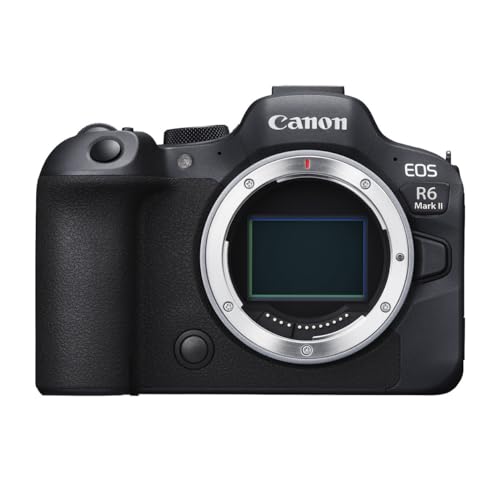
Canon EOS R6 Mark II — Best for dawn and dusk
Most waterfowl photographs that matter are attempted in light a meter would describe as insufficient. Geese leave the roost before sunrise; ducks pour into flooded timber as the evening collapses; the marsh’s whole drama is scheduled at the day’s dim edges. The R6 Mark II is built precisely for that schedule. Its full-frame sensor holds feather detail and colour separation at sensitivities where crop bodies begin to smear, and Canon’s animal detection finds a bird’s eye through the kind of reed clutter that defeats lesser tracking systems.
Canon’s RF telephoto shelf completes the argument. Long, comparatively light zooms and primes exist at several commitment levels, and the body’s in-body stabilisation cooperates with lens stabilisation to keep a handheld frame usable while you track a crossing flock from a hide’s narrow window. The electronic shutter’s speed lets a landing flare be harvested frame by frame, so the single instant when wings, water and light agree can be selected later at leisure rather than prayed for in the moment.
Honesty requires noting the arithmetic of reach: full frame gives back no free millimetres, so this body asks its owner to invest in genuinely long glass for small or wary species. Its resolution, while ample for cropping, trails the Sony below. What it returns for those concessions is confidence at the hours when waterfowl photography actually happens — and in this genre, the camera still working beautifully at last light is worth more than any specification measured at noon.
- Format: full-frame mirrorless, RF mount
- Detection: animal and bird eye autofocus
- Bursts: very fast electronic shutter shooting
- Sealing: weather-resistant body
- Role: low-light marsh and hide work
Strengths
- Composed files in near darkness
- Tracking that ignores foreground reeds
- Deep, sensible telephoto lens shelf
Trade-offs
- No crop-factor reach bonus
- Long glass investment is unavoidable
- Resolution trails the Sony rival
Picture a January hide on a tidal creek: frost on the lens hood, a skein of brent geese arguing its way down the channel, light the colour of pewter. This Canon keeps firing calm, clean frames while the photographer simply follows — that composure, repeated across a season, is what separates a portfolio from a pile of near misses.
Fieldcraft veterans add a quieter compliment. The shutter can be silenced completely, and in a hide where a mechanical clack lifts every head on the pool, silent shooting is not a luxury but a form of good manners toward both birds and neighbouring photographers.
Best for: dawn, dusk and hide photographers who shoot in the marsh’s worst light. Not suited for: small-bird specialists unwilling to buy long full-frame glass

Sony Alpha 7 IV — Best for cropping later
Sony’s approach to the waterfowl problem begins with abundance: abundant resolution to crop from, an abundant lens catalogue to reach with, and an autofocus system whose bird eye mode has been refined across several generations of wildlife shooters. The Alpha 7 IV suits the photographer whose subjects refuse all choreography — wild flocks on big water, flight lines crossing at unpredictable ranges — because its files tolerate being framed generously in the field and composed decisively at the desk.
Real-time tracking holds a chosen bird through the visual chaos of a rising flock with a stubbornness that still startles photographers raised on older systems. Pair the body with one of Sony’s long zooms and the combination covers the marsh’s standard distances; pair it with a teleconverter and the reach extends toward genuinely wary species on open estuaries. The viewfinder and rear screen both serve the tracking task well, and the body’s custom buttons let a hide worker park bird detection, sensitivity and burst mode under separate fingertips.
The compromises are ergonomic and financial rather than optical. Sony’s menu depth rewards an afternoon of setup before the season rather than improvisation inside a cold hide, and the best long glass in this system is a serious purchase. Burst depth, while strong, is not the Canon’s equal for the longest landing sequences. None of that diminishes the central bargain: a flexible, crop-happy full-frame body around which a waterfowl kit can grow for a decade.
- Format: full-frame mirrorless, E mount
- Resolution: high, crop-friendly files
- Detection: bird eye autofocus, real-time tracking
- Lenses: extensive telephoto and converter options
- Role: big-water flocks and flexible framing
Strengths
- Crops hold up at exhibition sizes
- Tracking survives flock chaos
- Lens catalogue answers every range
Trade-offs
- Menus demand pre-season homework
- Premium long glass costs dearly
- Burst buffer below the Canon
On a reservoir at first light, wigeon pour past a point in loose, shifting companies — too fast and too various for tight framing. The Sony shooter fires wide, trusts the tracking, and spends the evening choosing portraits from plenty. Abundance, handled well, is a legitimate artistic strategy, and no body here embodies it more completely.
Its video credentials deserve a footnote for the growing number of marsh naturalists who film as well as photograph: strong 4K recording turns a morning’s hide session into both a stills portfolio and a short behaviour film, from the same chair, with the same lens.
Best for: photographers who frame wide in chaos and compose by cropping. Not suited for: minimalists who want a camera mastered in one evening

Fujifilm X-T5 — Best dials-and-gloves body
Hide photography is a tactile discipline. The photographer sits for hours in a cramped, dim box, working by touch while eyes stay on the water, and Fujifilm’s dial-led design speaks that language fluently. Shutter speed, sensitivity and exposure compensation sit on physical dials with engraved values, so adjustments happen by fingertip memory — through thin gloves, in near darkness, without a menu ever lighting up the hide’s interior like a phone screen at a funeral.
Beneath the retro manners sits thoroughly modern reach arithmetic. The APS-C sensor’s crop stretches a 400mm-class lens into genuinely long waterfowl territory, and the forty-megapixel file behind it records feather barbs and bill serrations that reward the patient worker whose birds eventually drift within range. Subject detection covering birds arrived in this generation of Fujifilm bodies, and combined with the system’s light, sharp telephoto zooms it makes a marsh kit that one person can carry across a mile of sea wall without resentment.
Two cautions belong in the record. Tracking through the very worst reed clutter still trails the Canon and Sony leaders, and the smaller sensor asks for discipline at dusk — expose carefully, because there is less spare shadow to rescue at the desk. In exchange, the X-T5 offers the most pleasurable handling in this guide and files with a richness of detail that prints far beyond what its compact silhouette promises.
- Format: APS-C mirrorless, X mount
- Resolution: very high for its sensor size
- Controls: engraved dials for core settings
- Detection: bird subject detection included
- Role: hide work, long walks, fine detail
Strengths
- Gloved hands never hunt menus
- Feather detail that prints large
- Light telephoto combinations travel well
Trade-offs
- Tracking a step behind the leaders
- Dusk files need careful exposure
- No full-frame safety net after dark
Consider the solitary estuary worker who walks out before dawn with everything on his back — flask, hide poles, decoys left from yesterday, and this Fujifilm over one shoulder. By the time the light arrives he is settled, dials set by feel, watching greylags commute over his lens. Tools that disappear into a routine earn a loyalty specifications cannot measure.
Colour is the other quiet argument. Fujifilm’s film-inspired renderings give marsh mornings — all slate water, straw reeds and pewter sky — a coherence straight from the camera that saves grading time for shooters who publish their field notes as they go.
Best for: tactile shooters who walk far and crop into fine feather detail. Not suited for: the very darkest last-light specialists

OM SYSTEM OM-5 Mark II — Best reach per kilo
Every waterfowl photographer eventually confronts the same cruel equation: the best pools sit at the end of the longest, muddiest walks. The OM-5 Mark II attacks that equation from the weight side. Its Micro Four Thirds sensor doubles the effective reach of any lens mounted — a compact 300mm-class telephoto frames like a lens twice its size on full frame — so a complete marsh outfit, body plus serious glass plus spare batteries, rides in a bag that would barely hold the rival systems’ lens alone.
Sealing is this body’s second manifesto. OM SYSTEM inherited a proud weatherproofing tradition, and the OM-5 Mark II with a sealed lens shrugs at the drizzle, spray and hide condensation that shorten other cameras’ seasons. Computational talents inherited from its flagship siblings — including stabilisation that borders on the implausible — help the walk-up shooter who must fire standing, braced against a gate, while a flock decides whether the field below is safe.
Physics collects its toll after sunset. The smaller sensor’s files grow grainier sooner as sensitivity climbs, and dawn’s first flight will test it harder than midday ever could. Judged at the hours when most waterfowl work is actually done, though — first light through the morning, the long bright middle of a winter’s day — its combination of reach, sealing and portability is not a compromise at all. It is a strategy, and for roving shooters it may be the smartest one here.
- Format: Micro Four Thirds mirrorless
- Reach: two-times crop multiplies telephotos
- Sealing: strong weather resistance
- Stabilisation: excellent for standing shots
- Role: roving, walking and boat work
Strengths
- Serious reach in a daypack kit
- Weather stops being a forecast worry
- Stabilisation rescues braced shots
Trade-offs
- High-sensitivity grain arrives earlier
- Smallest files in this line-up
- Bird detection less specialised
A kayaking naturalist on a reed-fringed lake illustrates the brief perfectly: no room for a flagship outfit, constant spray, birds at honest distances. The little OM body lives in a dry bag between her knees and produces publishable frames of grebes and goldeneye all season, precisely because it was the camera that could come along.
Macro-capable lenses in the same small system add a sideline other marsh kits cannot match: the same walk that photographs ducks can document dragonflies, frogs and orchids at the pool’s edge, in the dead hours when the birds are resting.
Best for: walkers, paddlers and travellers who need reach without the burden. Not suited for: photographers living at extreme sensitivities after dark

Canon EOS R10 — Best first waterfowl body
Every experienced marsh photographer remembers the season when the obsession began, and most began it under-equipped, learning fieldcraft with a camera that forgave their mistakes. The EOS R10 is the body we would hand that beginner today. Canon did not ration its intelligence: the same family of animal and bird eye detection that serves the flagship above lives here too, so a novice’s first teal in flight is tracked by genuinely professional autofocus rather than a training-wheels approximation.
Speed supports the lesson. Brisk bursts freeze the wing positions a learner needs to study, the APS-C crop stretches an affordable telephoto zoom into useful marsh range, and the whole outfit stays light enough that a young photographer will actually carry it on speculative dawn walks — the walks where fieldcraft, not equipment, is truly accumulated. Canon’s colour and menus remain the friendliest in the business for someone learning exposure by experiment.
Growth will eventually expose the boundaries: sealing is modest, so drizzle discipline and a rain cover become habits to learn early; the buffer fills during the very longest flight sequences; and low-light files trail its full-frame sibling. Those are the right boundaries for a first body — they teach technique, they announce themselves honestly, and the RF lens bought for this camera carries forward to whatever Canon body comes next.
- Format: APS-C mirrorless, RF mount
- Detection: bird and animal eye autofocus
- Bursts: fast for its class
- Weight: light enough for long walks
- Role: first serious marsh outfit
Strengths
- Flagship-style bird tracking included
- Crop reach flatters affordable zooms
- Menus a beginner can master fast
Trade-offs
- Sealing asks for rain discipline
- Buffer limits marathon bursts
- Dusk files trail full-frame kin
Watch a teenager at a local gravel pit reserve, decoys absent, expectations modest, this Canon paired with a starter telephoto. A heron-grey morning produces one sharp frame of a gadwall pair lifting off — and a photographer is made. Affordable bodies that deliver one genuine success early do more for the craft than any flagship locked in a cabinet.
Clubs and reserves running photography loan schemes reach the same conclusion from the other direction: the R10 survives novice handling, teaches real technique, and returns frames good enough to exhibit at the club’s winter show.
Best for: newcomers and lighter travellers entering waterfowl photography seriously. Not suited for: professionals billing clients for last-light flight shots

Panasonic LUMIX S5II — Best handheld stabilisation
Not every waterfowl encounter happens from a hide. Farmers’ fields after harvest, reservoir dams, canal towpaths and the edges of flooded quarries all reward the photographer who works on foot, reacting to birds found rather than awaited — and that photographer’s defining problem is steadiness. A long lens handheld at dawn, breath visible, boots in mud: the S5II’s stabilisation, among the finest fitted to any full-frame body, converts that wobble into frames sharp enough to publish.
Panasonic’s phase-detection autofocus — the headline advance of this generation — tracks birds with a confidence earlier LUMIX bodies could not claim, and the full-frame sensor delivers the clean, gradable files dawn work demands. The L-mount alliance supplies telephoto glass from several makers at several prices, an ecosystem argument that grows stronger each season. Video, a Panasonic birthright, is superb, so the roving naturalist can return with moving footage of the same flock the stills describe.
Where does it concede ground? Burst speeds and buffer depth sit a notch below the Canon flagship’s, and its bird-specific detection, while capable, lacks the last degree of reed-clutter stubbornness the leaders display. Battery appetite under heavy stabilisation and video use deserves respect on long field days. For the standing, walking, reacting style of waterfowl work, though, its steadiness is not a feature on a list — it is the difference between the shot existing and not.
- Format: full-frame mirrorless, L mount
- Stabilisation: class-leading in-body system
- Autofocus: phase detection, bird capable
- Video: excellent for behaviour films
- Role: walk-up and opportunistic fieldwork
Strengths
- Handheld long-lens frames stay sharp
- Clean full-frame dawn files
- Alliance lenses widen glass choices
Trade-offs
- Bursts trail the fastest rivals
- Detection less reed-proof than Canon
- Power appetite needs spare planning
A flooded stubble field at sunrise makes the case without words: golden plover and lapwing shifting nervously, no hide, no time, the photographer kneeling in a tramline firing handheld as skeins cross the light. Frame after frame lands sharp. Stabilisation this good quietly rewrites which encounters are photographable at all.
Its cooling and recording stamina also suit the documentary side of marsh life — long, patient video of a pool’s morning routine, shot between stills, for reserves and trusts that increasingly communicate in moving images.
Best for: mobile photographers who shoot standing and seize unplanned encounters. Not suited for: burst-maximalists harvesting every landing flare frame by frame
How Do the Six Waterfowl Cameras Compare in the Field?
| Camera | Format | Field strength | Best use |
|---|---|---|---|
| Canon EOS R6 Mark II | Full frame | Low light and tracking | Hide work at dawn and dusk |
| Sony Alpha 7 IV | Full frame | Resolution and lens choice | Big-water flocks, heavy cropping |
| Fujifilm X-T5 | APS-C | Dials and fine detail | Patient hide photography |
| OM SYSTEM OM-5 Mark II | Micro Four Thirds | Reach per kilo, sealing | Roving and paddle-based work |
| Canon EOS R10 | APS-C | Tracking at entry cost | First serious marsh seasons |
| Panasonic LUMIX S5II | Full frame | Stabilisation and video | Walk-up opportunistic shooting |
Read the table as two philosophies sharing a marsh. Full-frame bodies buy light; crop bodies buy distance. The photographer’s honest answer to one question — do my birds fail me for darkness or for range? — selects the column that matters.
Which Lens Decisions Matter More Than the Body?
Ask any marsh veteran where the money belongs and the answer arrives before the question ends: in the long glass. Bodies cycle every few seasons, but a fine telephoto serves a decade of them, and waterfowl distances are unforgiving of short lenses. Plan the system around the longest lens you will genuinely carry, because the finest 600mm-class optic ever made photographs nothing from a cupboard, while a lighter zoom that attends every dawn walk builds a portfolio by attendance alone.
Teleconverters deserve their paragraph. On the brighter, sharper lenses in these systems, a converter trades a little light and speed for reach that would otherwise cost a second lens — a bargain on bright winter mornings over reflective water, a poorer one at dusk. Learn your combination’s manners in practice sessions at the local park, where the ducks are tame and the lessons are free, rather than discovering them on the season’s one perfect morning.
Support completes the triangle. A hide worker’s tripod or beanbag, a roving shooter’s monopod, and the discipline to keep shutter speeds honest for the focal length in use — these unglamorous choices print more sharp frames than any autofocus headline. The bodies above were selected partly for how gracefully they cooperate with such support, stabilisation included.
How Should You Set Autofocus for Birds Crossing Reeds?
Begin with the detection mode doing the finding and your thumb doing the overruling. Bird or animal eye detection as the default, a focus area small enough to specify which bird in a flock owns the picture, and tracking sensitivity adjusted toward stubbornness — the setting that tells the camera a reed crossing the frame is an interruption, not a new subject — forms the standard marsh configuration across these systems, with names varying by maker.
Back-button focus earns its reputation in this habitat. Separating focus activation from the shutter lets a photographer hold tracking on a swimming bird, release focus while it passes behind a screen of stems, and resume the instant it emerges — choreography no single-press automation matches. Practise the dance on park geese until the thumb’s timing is reflex; wild birds will not rehearse with you.
Finally, pre-focus the stage. Where a flight line crosses a gap in the reeds, or a pool’s far shore catches first light, focus there in advance and let the birds fly into your preparation. Half the celebrated flight frames in any portfolio were won before the bird arrived, by a photographer who had read the marsh correctly.
What Mistakes Do People Make Photographing Waterfowl?
Arriving after the light is the original sin: the flight happens at dawn, and the photographer who treats sunrise as a start time has already missed the day’s defining movement. Second comes sky exposure — metering for a bright sky and rendering the birds as silhouettes with no feather information left to rescue. Expose for the bird, let the sky blow bright if it must, and the files forgive; do the reverse and nothing at the desk can help.
Chasing completes the classic trio. Walking at a flock photographs its departure, repeatedly, from behind. The marsh rewards the opposite temperament: choose a place the birds already trust, arrive before them, become furniture, and let distance close itself. Add the quieter errors — a shutter clacking in a shared hide, a skyline silhouette announcing your position, a card formatted in haste — and the pattern is plain. Waterfowl photography fails on behaviour far more often than on equipment, which is precisely why the forgiving, capable bodies above matter: they remove the camera from the list of things going wrong.
How Do Cold, Wet Mornings Change Battery and Handling Plans?
Frost taxes everything. Battery chemistry slows, so a cell rated for a summer’s day of shooting may surrender halfway through a frozen dawn; the field answer is rotation — one battery in the camera, one warm in an inside pocket, swapped before either is empty. Condensation is the second tax: a cold camera carried into a warm car fogs inside and out, so seal it in a bag before the transition and let temperatures equalise slowly, in its own time.
Handling changes with the thermometer too. Thin liner gloves preserve the fingertip sensitivity dials and buttons demand — one reason the Fujifilm’s physical controls scored so highly — while bulky mittens belong to the waiting hours between flights. A rain cover or even a stout clear bag over body and lens, carried as habit rather than fetched in panic, keeps drizzle from ending sessions that the sealed bodies in this list would otherwise happily continue.
Cards and clothing obey the same philosophy: spares carried on the person, not in the car; layers planned for sitting still, which is far colder than walking; and a flask treated as photographic equipment, because the photographer’s comfort is the true limit on most dawn sessions. The birds are out there in all weathers. The question each morning asks is whether you and your batteries are.
Why Does Fieldcraft Outweigh Equipment in This Genre?
Because the birds decide the distance, and they decide it by reading you. A photographer who knows a marsh — its flight lines at each wind direction, the pool a falling tide exposes first, the corner where snipe feed when frost hardens the main shore — will stand close to calm birds with a modest camera and make frames a stranger with a flagship cannot buy. Knowledge compounds across seasons in a way gear purchases never do.
None of that makes equipment irrelevant; it makes it instrumental. The right body removes friction between intention and execution: tracking that holds while you think about composition, files that survive the light the birds prefer, sealing that lets weather stop being a negotiation. Read this guide as a friction-removal exercise. Choose the body whose strengths cancel your marsh’s particular difficulties, then spend the saved anxiety on learning the place itself.
Ethics ride along with craft. Waterfowl on a winter marsh are spending survival energy with every flush, so the photographer’s discipline — no deliberate disturbance for a closer frame, no baiting, no lingering at a nest shore in breeding season — is part of the technique, not a footnote to it. The finest practitioners are known by the birds’ indifference to them. Aim for that review.
How Should You Practise Flight Shots Before the Season?
Rehearse where failure is free. Park lakes, reservoirs with habituated geese, even gulls at a harbour wall — any venue with tolerant birds and repeatable flight lines lets you drill panning, burst timing and detection hand-offs until the mechanics vanish into reflex. Shoot the same crossing at several shutter speeds and study which wing positions please you; flight photography has a grammar of wingbeats, and fluency in it is learned, not bought.
Keep a brutally honest practice log. Record the settings, the light, the distance and the keeper rate for each session, and patterns will emerge that no forum thread can teach: your personal panning speed limit, the sensitivity where your files stop pleasing you, the focus area your thumb actually manages under excitement. The bodies above all reward this self-knowledge, because each offers customisation that only pays when the owner knows what to customise.
Then graduate by difficulty rather than by species glamour. A mallard crossing open water, then the same bird against reeds, then a teal — small, fast, erratic — at last light. By the time the season’s first proper dawn arrives, the camera will feel like an old habit, and your attention can go where it belongs: onto the birds, the light and the marsh’s slow intentions.
What Should a Seasonal Kit Bag Actually Contain?
Less than enthusiasm suggests, arranged better than habit manages. Body and long lens, obviously; the second battery warming against your ribs; cards in a hard case; a lens cloth that lives in the same pocket every single outing, because the one you must search for is the one you will not use. A rain cover, a small headtorch with a red mode for hide entry, and a notebook complete the photographer’s side of the bag.
The fieldcraft side matters equally: a short length of camouflage netting can turn a fence line into a workable hide in minutes; a cushion transforms a four-hour sit from penance into patience; and a thermos, as established, is optical equipment for the soul. Weight discipline governs everything — each luxury must argue its way past the mud it will be carried through, which is why the OM SYSTEM outfit’s lightness keeps returning to this guide’s mind.
Review the bag after every outing with a editor’s cruelty. Whatever went unused for three trips is training weight; whatever was missed three times earns a permanent place. A marsh kit, refined across a season, becomes as personal as handwriting — and the camera bodies above are each capable of anchoring one for years.
Final Recommendation
Choose the Canon EOS R6 Mark II if your waterfowl live at dawn and dusk and your budget reaches one great body; choose the Sony Alpha 7 IV to crop freely among big-water flocks. Take the Fujifilm X-T5 for gloved, tactile hide craft, the OM SYSTEM OM-5 Mark II when the walk is long and the weather is honest, the Canon EOS R10 as the finest first step into the marsh, and the Panasonic LUMIX S5II for standing, handheld, opportunistic brilliance. Then arrive before the birds, sit still, and let the marsh come to you.
Frequently Asked Questions
How much reach do I really need for ducks and geese?
On crop bodies, a 400mm-class lens is the comfortable working standard; full-frame shooters generally want 500–600mm-class glass for the same framing. Habituated birds at reserves forgive shorter lenses, while wild geese on open estuaries punish them.
Is bird eye detection worth paying for?
Emphatically, for this subject. A swimming or flying bird’s head moves constantly against cluttered backgrounds, and detection that pins the eye frees the photographer to think about wings, light and composition instead of focus-point housekeeping.
Should I use the electronic or mechanical shutter in a hide?
Electronic, almost always: it is silent, so it never lifts heads on the pool, and it unlocks the fastest bursts. Watch only for rolling-shutter distortion on the very fastest wingbeats, and switch if your venue shows it.
How do I keep a flock shot sharp front to back?
You usually do not — and the great flock frames embrace a plane of focus with the lead birds sharp and the company dissolving behind. Stop down modestly when light allows, focus on the nearest third of the group, and let depth tell the story.
Can these cameras handle rain on an exposed estuary?
The sealed bodies here — notably the OM-5 Mark II, R6 Mark II and S5II with sealed lenses — work through honest drizzle confidently. Driving rain still deserves a cover, and no sealing survives a dunking; treat weather resistance as insurance, not permission.
What is the best way to photograph the dawn flight itself?
Be in position an hour early, pre-focus on the flight line’s likely crossing, expose for the birds against the brightening sky, and shoot the passage in short, deliberate bursts. Then lower the camera and watch one flight with your own eyes — some of it should stay unrecorded.
How Do You Read a Marsh Before You Ever Raise the Camera?
Start with the wind, because waterfowl do. Birds take off and land into the wind whenever the choice is theirs, so a photographer who notes the morning’s airflow already knows which way flight shots will travel and which shore of a pool will collect the arrivals. Add the tide where the marsh is tidal — feeding flats appear and drown on its schedule, and the birds commute between them with a punctuality no diary matches — and the day’s likely stages are mapped before a single frame is considered.
Light draws the second map. At dawn the sun arrives from one quarter and stays low for a precious hour; positions that put that light over your shoulder onto an expected flight line are worth ten speculative spots with the light in your eyes. Watch where other creatures vote with their feet: herons stalk the channels that hold fish, waders gather where invertebrates concentrate, and ducks rarely ignore a consensus written by species that cannot afford mistakes.
Then sit, binoculars first, camera down, for a full half hour of pure reconnaissance. Note the gaps in the reed wall that birds use as doors, the dead tree a cormorant has claimed, the exact corner where nervous flocks circle twice before committing. This unglamorous half hour is the highest-yield investment in the entire genre, and every body in this guide performs better in hands that have made it.
What Exposure Habits Protect Feather Detail?
White birds and black birds patrol the same pool, sometimes in the same frame, and each conspires against careless metering. A mute swan or a snow goose in morning sun will clip to featureless white if the exposure trusts the meter’s average, so marsh veterans expose for the brightest plumage they care about and let shadows fall where they may — feather texture, once blown, is gone for ever, while a dark bird’s shadows often surrender detail at the desk.
Dark species reverse the trap against dark water. A black brant on black estuary mud fools meters into overexposure that greys the bird and washes the scene, so compensation dialled downward, checked against a test frame’s histogram, becomes a reflex. The Fujifilm’s physical compensation dial and the Canon and Sony custom controls all exist, in marsh terms, for exactly these two-second corrections as a flock turns from backlit to lit.
Shutter speed carries its own plumage logic. Freezing a wing mid-downstroke demands real speed; the poetic blur of wingtips against a sharp body lives a few stops slower; and the full impressionist smear of a panned flight at dawn slower still. Decide which photograph you are making before the flock arrives, set the speed as a statement of intent, and let sensitivity absorb the consequences — the low-light bodies ranked here were chosen to make that bargain survivable.
How Should You Work a Flight Line at Last Light?
Evening flight is the marsh’s closing ceremony and its sternest examination. Birds move from feeding grounds to roost as the light fails in stages — first the colour goes, then the detail, then everything but movement and sound — and the photographer must decide in advance which stage to claim. The first stage rewards the high-resolution bodies and careful exposure; the last belongs to the full-frame low-light specialists and to photographers content with silhouettes that carry the day’s whole story in outline.
Position is destiny here. Roost-bound birds fly lower and more predictably than at dawn, following hedgerows, creek lines and the darkening contours of the land, so a seat along such a contour, chosen an hour early, puts the flight within honest range. Pre-focus on a landmark at the crossing distance, set tracking to its most patient behaviour, and resist the amateur’s urge to swing at every passing group — the discipline of waiting for the one flock on your line is what the evening rewards.
Know when to stop. There is a minute, familiar to every veteran, when the camera begins to lie — files that looked plausible on the rear screen reveal themselves at home as grain and regret. Learn your own body’s honest limit in practice sessions, honour it in the field, and spend the remaining dusk listening. The flight you simply witness is not lost; it is the tuition that makes next evening’s photographs possible.
Why Do Portfolios Favour Behaviour Over Portraits?
A portrait proves a bird exists; a behaviour frame proves the photographer understood it. Feeding sweeps, courtship head-throws, the explosive geometry of a flock rising as one organism, a grebe offering weed to its mate — these are the frames editors keep and competitions shortlist, because they contain time and relationship rather than mere identification. The encouraging news is that behaviour is largely a function of patience at known places: the same pool, visited across a season, eventually performs everything in its repertoire for the sitter it has learned to ignore.
Equipment serves behaviour in specific ways worth naming. Silent shutters let feeding continue at close range; deep buffers hold an entire courtship sequence instead of its first second; tracking that survives a bird dipping behind its partner preserves sequences lesser systems fragment. Each pick above was interrogated on exactly these points, which is why burst manners and shutter discretion recur in their verdicts.
Cultivate the long project as the antidote to portrait restlessness. One marsh, one species, one season, revisited weekly: the discipline sounds limiting and proves liberating, because novelty stops being the goal and insight takes its place. The resulting body of work — moult and courtship, ice and flood, arrival and departure — will outclass a hundred scattered portraits, and any of the six cameras here is capable of carrying it.
How Do You Photograph Birds on the Water Without Chasing Them?
Swimming birds set the genre’s slowest, most meditative assignment. A raft of tufted ducks drifting a flooded pit will not be hurried, and the photographer who creeps the shoreline photographs a long, nervous retreat. Instead, claim a low position at the water’s edge — lying prone if the bank allows, since a lens at the bird’s own eye level transforms an ordinary frame into an intimate one — and let the raft’s own drift close the distance over twenty unhurried minutes.
Reflections double the composition’s stakes. Glassy dawn water can mirror a grebe so faithfully that the frame becomes a study in symmetry, while the slightest ripple breaks the mirror into impressionist strokes that suit a looser, more atmospheric rendering. Watch which condition your morning offers and expose for it deliberately; the camera’s stabilisation and silent shutter, both recurring virtues in the picks above, exist for precisely this motionless, breath-held kind of work.
What Should You Do With a Season’s Worth of Marsh Files?
Edit like a naturalist, not a tourist. Cull first for behaviour and light, only second for technical perfection, because a slightly soft frame of a once-a-season courtship display outranks a clinical portrait of a bird asleep. Keyword ruthlessly by species, place, tide and weather while the outings are fresh in memory; a marsh archive that can answer “show me every shelduck arrival in northeast winds” becomes a planning instrument for next season, not merely a store of pictures.
Share the work where it compounds. Reserve newsletters, ringing and recording groups, and local natural history societies all hunger for exactly the images a season of dawns produces, and contributing them returns the photographer something money cannot order: access, local knowledge, and early word of the pool where something unusual has arrived. The camera starts the chain; the archive, generously used, is what turns a hobby into a standing in the marsh community.
How Does a Beginner Know the First Season Is Working?
Progress announces itself in the keeper rate before it shows in any single frame. Early outings might yield one honest photograph from a morning; by mid-season the same photographer, on the same marsh, returns with a dozen — not because the birds grew kinder, but because focus discipline, exposure reflexes and positional patience have quietly compounded. Track that ratio in the practice log and trust it over the verdict of any single dramatic dawn.
The second sign is anticipation. Beginners react to birds; developing photographers prepare for them — arriving at the pool the falling tide will expose, setting the compensation before the swan turns into the sun, hearing a distant skein’s calls and already knowing which gap in the reeds it will cross. When preparation starts replacing reaction, the season is working, and the camera in hand — whichever of these six it is — has become what it was always meant to be: the least interesting part of a fascinating morning.
One last encouragement belongs in print. Every photographer whose marsh work you admire began with a winter of cold hands, missed flights and files that disappointed at home — and kept a dawn appointment anyway. The learning curve in this genre is steep only at the start, and it levels into one of photography’s deepest pleasures: a place known completely, a cast of birds recognised as individuals, and a camera that has long since stopped being equipment and become a habit of attention. Choose your body from the six above, pick your pool, and begin.
Related Guides
Continue with our guide to choosing long telephoto lenses, our field notes on hide craft and marsh etiquette, and our walkthrough for processing high-sensitivity bird files.


