ilcastellomenu.com is reader-supported. When you buy through links on our site, we may earn an affiliate commission.
Where to Buy
A proscenium arch at curtain-up is one of the cruellest lighting problems a camera will ever meet, and it is exactly the problem the best cameras for theater lighting have to solve. One face under a follow spot can be blasted almost to daylight brightness while, three metres away, a chorus member stands in shadow so deep that a phone camera gives up and paints her as silhouette. Between those extremes the lighting designer has hidden coloured gels, haze, practical lamps and sudden blackouts, and your camera has to hold all of it in a single frame, quietly, from a seat you were assigned rather than a position you chose.
Quietly matters more than newcomers expect. A mechanical shutter clacking through a hushed monologue will earn you a glare from the row in front and, in many houses, a polite conversation with an usher at the interval. Silent electronic capture is therefore not a luxury in this guide; it is the entry ticket. Dynamic range is the second ticket, because theatre is contrast staged as art, and highlight roll-off is the third, because a follow spot that clips to a white disc erases the actor it was meant to celebrate.
The six bodies below were picked for that triple test. Two full-frame flagships lead on sheer shadow depth, a video-leaning full-frame body follows for houses that also film dress rehearsals, and three smaller bodies answer for school halls, fringe venues and community productions where the budget is real and the seats are close. Every pick is linked on Amazon in the Quick Picks table and beside its full review, and every pick can shoot in complete silence.
One courtesy before the rankings: check the house policy. Some theatres license photography only at designated performances, some restrict it to the dress rehearsal, and a few forbid it entirely. No camera in this guide is worth an argument with front-of-house, and the best theatre photographers build relationships with stage managers long before they build a lens collection.
Key Takeaways
- Canon’s EOS R6 Mark II owns the darkest auditoriums, holding faces in shadow without turning them to porridge.
- Sony’s Alpha 7 IV gives archival productions the resolution to crop a wide stage shot into usable singles.
- Panasonic’s LUMIX S5II is the pick when the same evening must yield both stills and a filmed record.
- Canon’s EOS R10 brings silent, capable stage shooting to school and community budgets.
- Fujifilm’s X-T5 lets a photographer set exposure by touch in a dark seat without lighting up a menu.
- Sony’s ZV-E10 II is the discreet second body for foyer interviews and backstage diaries between acts.
In this guide
Quick Picks
| Camera | Badge | Why it earns its place |
|---|---|---|
| Canon EOS R6 Mark II | Best for dark houses | Shadow depth and silent capture for the most punishing contrast a stage can stage. |
| Sony Alpha 7 IV | Best for archival stills | Resolution that survives cropping from the back of a long auditorium. |
| Panasonic LUMIX S5II | Best stills-and-film body | Full-frame gathering power plus serious video for dress-rehearsal records. |
| Canon EOS R10 | Best for school stages | Silent shooting and honest low-light files at a price a drama department can defend. |
| Fujifilm X-T5 | Best dials in the dark | Physical controls you can work by feel while the house lights are down. |
| Sony ZV-E10 II | Best discreet companion | Small, quiet and video-ready for backstage and foyer work around the show. |
How Did We Weigh Cameras Meant to Work in a Dark Auditorium?
We started where the lighting designer starts: with the ratio between the brightest face and the darkest corner. A camera earns its seat here by holding a follow-spot highlight on skin without clipping it to chalk, while still separating a black costume from a black backdrop two zones away. That is dynamic range used as a storytelling tool, and it pushed full-frame bodies to the top of the list before any other virtue was discussed.
Silence came next, tested as a social fact rather than a specification. Electronic shutters remove the clack, but they bring their own theatre-specific hazard: banding under the pulsed light of LED stage fixtures. Bodies whose silent modes behave predictably under mixed theatrical lighting — tungsten one scene, LED wash the next, a practical flickering somewhere in between — scored above bodies that are silent only in daylight. If a production leans heavily on LED, a mechanical or electronic-first-curtain mode at a shutter speed chosen to dodge the pulse may still be the safer craft, and the reviews below say so where it matters.
Handling in a fixed seat formed the third test. You will not roam a stalls aisle mid-scene. You will sit, brace your elbows, work dials without looking down, and compose through whatever the row in front allows. Bodies with controls that fall to hand in darkness, screens that tilt for a lap-level viewpoint, and stabilisation that forgives a braced rather than tripod stance were credited for the job as it is actually done.
Finally we weighed the file’s mercy in editing. Theatre photographs are rarely finished in camera; they are rescued, gently, at a desk — shadows lifted on a face the spot missed, a magenta wash talked back toward skin. Bodies whose files tolerate that persuasion without banding or colour collapse earned the archival places, because a production photograph often has to serve a programme, a press release and a company’s history all at once.
Why Does a Stage Punish Dynamic Range More Than a Landscape Does?
A landscape’s contrast is negotiated by weather and time of day; a stage’s contrast is authored. The lighting designer wants the lovers lit like a dawn and the villain’s corner sunk in gloom, in the same frame, at the same moment, because that inequality is the meaning of the scene. Your camera is being asked to record an argument about light, and any part of the argument it clips or crushes is a line of dialogue lost.
Highlights fail first. A follow spot concentrates its beam on one face, and the exposure that keeps the chorus readable will push that face past the sensor’s ceiling unless the roll-off is gentle. Shoulders and foreheads go chalk-white, makeup flattens, and the expression the actor built the scene around evaporates. The defence is partly the body’s highlight manners and partly your discipline: expose for the lit face, accept the shadows as the designer’s intention, and let the editing lift only what the sensor genuinely recorded.
Shadows fail more quietly. Black velour, black costumes and unlit wings sit so close in value that a weak file merges them into one undifferentiated pit, and the stage loses its depth — actors appear pasted onto a void instead of inhabiting a space. The strong bodies here keep just enough separation in those near-blacks for a viewer to feel the wings, the depth, the threat waiting in them. That last stop of shadow information is the difference between a record of a play and a photograph of one.
What Are the Best Cameras for Theater Lighting?
Two full-frame shadows specialists, one hybrid for houses that film, and three smaller bodies for the stages where most theatre actually happens.

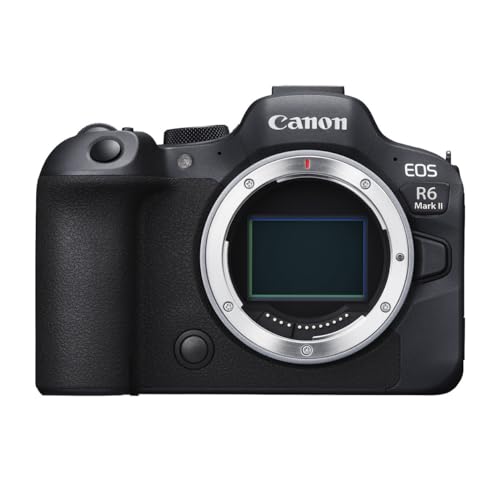
Canon EOS R6 Mark II — Best for dark houses
Put this body in the back row of a Victorian playhouse during a one-lamp monologue and its priorities become obvious within a single act. The sensor treats shadow as information rather than as an absence: a face half-turned from the only practical on stage keeps its modelling, the black of a tailcoat separates from the black of the wings, and when you lift the exposure later at your desk the file rises evenly instead of dissolving into coloured grit. For the punishing end of theatrical contrast, nothing else on this page is quite as forgiving.
Silence is complete when you ask for it, and the body’s behaviour under the mixed sources of a real rig — tungsten profiles, an LED cyc wash, a follow spot with its own opinion — stayed predictable across the shutter speeds a photographer actually uses from a seat. Its subject detection, tuned for people, finds eyes through haze and half-light with a persistence that feels almost indecent during a dance number, locking to the principal while the ensemble wheels behind her. You still choose the moment; the camera simply refuses to lose the face while you wait for it.
Ergonomics suit the fixed-seat reality. The dials sit where a thumb expects them in darkness, the vari-angle screen permits a discreet lap-level composition that disturbs nobody, and the in-body stabilisation steadies the braced-elbows stance that theatre seating imposes. Battery manners across a long evening — a full show, an interval of foyer portraits, a curtain-call burst — never became the story, which is the highest praise a working body can earn in this genre.
Choose it when the house is dark, the designer is bold and the photographs must carry the production’s memory for years. It is the body the other five are measured against in this particular darkness.
- Format: full-frame mirrorless, RF mount
- Silent work: full electronic shutter for hushed scenes
- Stage strength: shadow separation at high sensitivity
- Focus: people detection that holds faces through haze
- Screen: vari-angle for discreet lap-level framing
Strengths
- Near-black stage areas keep their layers and depth
- Faces stay found through haze, turns and ensemble motion
- Files accept gentle shadow rescue without falling apart
Trade-offs
- Resolution is the modest figure among the full-frame picks
- Long RF telephotos for big houses add real cost
- Electronic capture still needs care under some LED rigs
A regional theatre’s archive tells the story plainly: seasons shot on lesser bodies show the spotlit heroine floating in a black void, while the R6 Mark II seasons show the room around her — the doorway she fears, the furniture of her life, the darkness with furniture in it. Directors notice that difference even when they cannot name it, and they ask for the photographer who delivers it by name the following season.
Best for: professional and serious amateur coverage of dark, high-contrast productions. Not suited for: photographers who mainly need maximum resolution for huge prints

Sony Alpha 7 IV — Best for archival stills
Archival work changes the arithmetic of a theatre photograph. The press shot is chosen tonight, but the archive is mined for decades — for anniversary programmes, for a revived production’s poster, for the portrait of an actor in the role that made her — and mining means cropping. The Alpha 7 IV’s resolution is its archival argument: a wide frame taken from the only seat you were given can yield a tight single of the lead, a two-shot of the lovers and a detail of the set, each holding together at print size.
That resolution never comes at the price of the darkness. The full-frame sensor handles the high sensitivities a dim house demands with composure, skin tones under theatrical colour stay on the right side of plausible, and the dynamic range holds the spotlit face and the shadowed doorway in one honest exposure more often than any crop body here. Sony’s eye autofocus, working through the electronic viewfinder in near-darkness, keeps a moving soliloquy sharp in a way that lets you concentrate on expression instead of focus.
The E-mount lens bench matters to theatre specifically. Fast primes for the stalls, long zooms for the circle, and a deep used market that lets a company photographer build reach gradually — the system grows with the assignment. The body’s dual card slots suit archival duty too, writing a backup as you shoot, because a production that closes on Sunday cannot be restaged for a corrupted card on Monday.
Its manners in the seat are good rather than magical: the menus ask for homework before the house lights fall, and the body is a fraction less forgiving in the very deepest shadows than the Canon above. For the photographer whose theatre work must serve tonight’s newspaper and the next decade’s programme alike, those are small tolls on a very capable instrument.
- Format: full-frame mirrorless, E mount
- Silent work: electronic shutter for performance capture
- Stage strength: resolution that survives archival cropping
- Storage: dual slots for an in-camera backup
- Focus: eye detection that works in near-darkness
Strengths
- Wide frames crop into singles without dissolving
- Deepest lens bench for building stage reach over time
- Backup writing suits unrepeatable closing nights
Trade-offs
- Deepest shadows yield slightly to the Canon
- Menu system rewards preparation, not improvisation
- Full kit with long glass is a serious investment
Consider the anniversary test. Ten years from now a company revives the production you shoot this winter, and the designer asks what the original set looked like in the second-act moonlight. The Alpha 7 IV’s files will answer that question in detail — the gauze, the practical’s glow, the exact blue of that night — because resolution, honestly gathered in the dark, is a form of respect for the work on stage.
Best for: company photographers building a long-term production archive. Not suited for: casual shooters who will never crop or print large

Panasonic LUMIX S5II — Best stills-and-film body
Many houses now want two records of the same evening: photographs for the programme and a filmed archive of the dress rehearsal for the company’s own vault. The S5II is the body that treats that double commission as one job. Its full-frame sensor gathers theatrical light with the composure this genre demands, its phase-detect autofocus ended Panasonic’s old hesitation in low contrast, and its video engineering — cooling, recording endurance, monitoring tools — was designed by people who expect a camera to film a whole act without a thermal complaint.
As a stills body in the stalls it holds its own honestly. Highlights from a follow spot roll off with grace, the stabilisation steadies a long lens from a braced seat, and the files grade toward the warm, tungsten-leaning palette that flatters skin under stage light. Where it quietly outthinks rivals is the rehearsal room: mark a lighting state, film the designer’s notes being called, then step into the auditorium and shoot the result — one body, one colour language, no translation between systems in the edit.
The L-mount alliance widens the lens shelf across several makers, which matters when a theatre’s budget buys glass one piece per season. Long zooms for the balcony, fast primes for the studio theatre, all native to the mount and some of them surprisingly gentle on a grants application.
Weight is the honest toll; dressed with a long zoom it is the heaviest evening on this page, and its stills resolution is the working figure rather than the archival one. Houses that film as seriously as they photograph will pay both tolls gladly.
- Format: full-frame mirrorless, L mount
- Silent work: electronic shutter for the performance itself
- Stage strength: one colour language across stills and film
- Video: cooling and endurance for a full filmed act
- Focus: phase-detect system, steady in low contrast
Strengths
- Dress rehearsal filmed and photographed by one body
- Stabilisation calms long lenses in fixed seating
- Multi-maker lens shelf softens the cost of reach
Trade-offs
- Heaviest carry here once a long zoom is fitted
- Resolution serves programmes, not giant archival crops
- Video depth is wasted on stills-only photographers
A fringe company with one grant and two obligations — document the show, film the show — is this body’s natural parish. The S5II lets a single operator walk out of a dress rehearsal carrying both records, matched in colour, ready for the editor and the archivist on the same memory cards.
Best for: houses and companies that film rehearsals as seriously as they photograph performances. Not suited for: stills-only shooters counting every gram and pixel

Canon EOS R10 — Best for school stages
Most theatre on Earth happens under the lights of school halls and community centres, where the follow spot is a volunteer, the rig is whatever the budget stretched to, and the photographer is a parent, a teacher or the drama department’s own sixth-former. The R10 was ranked for that reality. It is silent when the scene demands silence, its autofocus finds a young actor’s face through the haze of an overworked smoke machine, and its low-light files stay presentable at the sensitivities a dim hall forces on you.
The crop sensor, so often discussed as a compromise, works as an ally from the back of a hall: the affordable telephoto in the kit bag frames the stage tighter than the same money reaches on full-frame, and school stages are shallow enough that the framing problem is usually distance, not darkness alone. Canon’s colour, particularly under the warm wash of hall lighting, renders young skin kindly straight from the camera — a mercy when the photographs are due in the school newsletter on Friday and nobody is paying for editing time.
Controls are grouped for learning. A student photographer can run the body in a guided automatic mode for the panto and grow into manual exposure by the spring production, on the same body, without the camera ever feeling like a toy they have outgrown. The RF lens shelf above it — shared with the Canon flagship at the top of this page — means the department’s glass survives every future body upgrade.
Deep-shadow separation and archival resolution belong to the full-frame picks, and a cavernous professional house will find this body’s limits in the second act. On the stages it was chosen for, those limits rarely get a line in the review.
- Format: APS-C mirrorless, RF mount
- Silent work: electronic shutter for quiet scenes
- Stage strength: crop reach from the back of a hall
- Focus: subject detection tuned for people on stage
- Handling: controls a student can grow into
Strengths
- Affordable telephotos frame school stages tightly
- Kind skin tones with almost no editing needed
- A body beginners can learn the craft on
Trade-offs
- Very dark professional houses expose its ceiling
- No in-body stabilisation for shaky long lenses
- Single card slot for unrepeatable evenings
The end-of-term production is its proving ground: forty children, one smoke machine, a lighting rig older than the cast, and a head teacher who wants photographs that make the school look like it believes in the arts. The R10 delivers that album without drama of its own, which is precisely what a school needs from a camera.
Best for: school, youth and community theatre on a defensible budget. Not suited for: cavernous professional houses with extreme lighting ratios

Fujifilm X-T5 — Best dials in the dark
There is a moment in every performance when you need to change exposure and cannot look down: the blackout ends, the new state is two stops hotter than the last, and the scene’s best expression is already happening. The X-T5 was built for that moment. Shutter speed and exposure compensation live on physical dials with detents your fingers can count, the aperture lives on the lens where photographers kept it for a century, and the whole exposure can be re-set by touch, in darkness, without a screen’s glow announcing you to the row behind.
The sensor behind those dials earns its place on resolution and character. Its high pixel count crops a circle-seat frame into a usable single, its files under theatrical colour carry a richness that suits the stage’s saturated gels, and Fujifilm’s film simulations give the photographer who hates editing a finished, programme-ready look straight from the body. High-sensitivity files are the crop format’s honest negotiation — a touch more grain than the full-frame picks at the extremes — yet in theatrical practice that grain reads as texture, closer to the memory of being there than a sterile digital cleanliness.
Stabilisation in the body steadies the long primes that fringe and studio theatres reward, and the compact system keeps a photographer’s silhouette small in a small venue, where discretion is a professional virtue. Weather sealing, rarely discussed for indoor work, earns a mention for the promenade and site-specific productions that move audiences through courtyards and warehouses, where the X-T5 shrugs at the drizzle between scenes.
Video is a supporting act here rather than the Panasonic’s headline, and the very darkest houses still belong to the full-frame pair above. As an instrument for a stills photographer who works by feel in a dark seat, it has no equal on this page.
- Format: APS-C mirrorless, X mount
- Silent work: electronic shutter for hushed passages
- Stage strength: exposure set by touch, without menus
- Files: high resolution plus finished in-camera looks
- Body: stabilised, sealed, compact for small venues
Strengths
- Dials re-set exposure mid-scene without looking down
- Resolution crops distant seats into printable singles
- In-camera looks suit photographers who skip editing
Trade-offs
- Extreme sensitivities show more grain than full-frame
- Video tools support rather than lead
- Dial layout is a taste some never acquire
Picture the studio-theatre photographer, close enough to hear the actors breathe, re-setting exposure by fingertip as the lighting state changes and never once dropping her eye from the scene. That tactile fluency is the X-T5’s whole argument, and in a small dark room it is a decisive one.
Best for: stills photographers in intimate venues who set exposure by feel. Not suited for: video-led coverage or the darkest large houses

Sony ZV-E10 II — Best discreet companion
Not every theatre photograph is taken from the stalls during act two. Companies live on the material gathered around the performance — the director’s foyer interview, the backstage diary, the cast announcement filmed in the rehearsal room — and the ZV-E10 II is ranked as the companion body for that surrounding life. It is small enough to be unremarkable at a press night, silent enough for a seat near the front, and its creator-first video tools make it the fastest body here from an idea to a publishable clip.
As a stills camera for the performance itself it is a capable understudy rather than the lead. The APS-C sensor handles house sensitivities respectably, Sony’s autofocus lineage keeps faces honest, and the vari-angle screen serves both the lap-level stall shot and the held-high curtain call. What it lacks beside the principals is depth: no viewfinder for the photographer who composes through one, no in-body stabilisation, and shadow files that ask for gentler treatment in the edit.
Its parish is the second body in the bag. While the main camera and the long lens hold the stalls position, the ZV-E10 II carries a fast wide prime for the dressing-room corridor, the set under work lights, the audience arriving through the foyer — the photographs and clips that give a production its social life online. Battery sharing and lens sharing with a Sony main body make the pairing economical; with any other main body it still earns its ticket as the house’s content camera.
Buy it as a lead body only if your theatre work is mostly daylight rehearsals and social coverage. Buy it as a companion and it may end up producing the material the audience actually shares.
- Format: APS-C mirrorless, E mount
- Silent work: electronic capture for close quarters
- Stage strength: fast, discreet social and backstage coverage
- Screen: vari-angle for vlogging and lap-level stills
- Role: second body beside a full-frame principal
Strengths
- Unremarkable size for press nights and foyers
- Creator video tools publish backstage clips quickly
- Shares lenses with a Sony main body economically
Trade-offs
- No viewfinder for traditional stall composition
- Shadow files need gentler editing than the flagships
- Understudy stills depth beside the full-frame picks
The marketing manager’s favourite frame of the season was not the soliloquy; it was this little body’s shot of the leading lady laughing in the wings, thirty seconds before her entrance, stage light spilling through the curtain gap. Companion cameras earn their keep on exactly those unrepeatable edges of the evening.
Best for: social, backstage and foyer coverage alongside a main body. Not suited for: sole-camera coverage of a dark professional production
How Do the Six Stage Cameras Handle a Full Evening?
| Camera | Format | Stage strength | Best seat in the house |
|---|---|---|---|
| Canon EOS R6 Mark II | Full-frame | Shadow depth in authored darkness | Anywhere in a dark professional house |
| Sony Alpha 7 IV | Full-frame | Croppable archival resolution | Back of a long auditorium |
| Panasonic LUMIX S5II | Full-frame | Stills and film in one evening | Dress rehearsals and hybrid commissions |
| Canon EOS R10 | APS-C | Reach and kindness on a budget | Back of a school hall |
| Fujifilm X-T5 | APS-C | Exposure by touch in darkness | Intimate studio theatres |
| Sony ZV-E10 II | APS-C | Discreet companion coverage | Foyer, wings and rehearsal room |
Read the table by commission rather than by price. A closing night in a dark playhouse, a season’s archive, a filmed rehearsal, a school panto, a fringe premiere and a press night’s social coverage are six different evenings wearing one title, and each body above leads exactly one of them.
How Should You Expose When a Follow Spot Owns One Face and Darkness Owns the Rest?
Decide whose exposure the photograph is about, and let the rest of the stage fall where the designer intended. In practice that means metering the lit face — spot metering if your position allows it, or a manual exposure set during the dress rehearsal and defended against the camera’s brighter ideas all evening. Automatic modes average the frame, and the average of a theatre frame is a lie: the camera brightens the darkness it was told to respect and clips the face it was hired to honour.
Highlights deserve a deliberate margin. Hold the spotlit skin a shade below where instinct places it; a slightly deep face can be lifted in the edit, while a clipped forehead is gone for the run of the show. Watch the blink warnings during the rehearsal rather than the performance, learn which lighting states run hot — the full-stage musical finale usually does — and pre-set your compensation for those states before they arrive.
Shutter speed is a negotiation with movement. Dance and fight scenes need speed that freezes intention without demanding sensitivities that shred the file; still scenes forgive a slower hand. Learn the show’s rhythm at the rehearsal, mark the fast numbers in your programme, and arrive at each with your settings already changed. The photographers whose theatre work looks effortless are simply the ones who did their panicking a day early, in an empty house, where panic is free.
What Mistakes Ruin Otherwise Good Production Photographs?
The flash that fires during a blackout scene leads this dishonour roll, and it is always set to automatic by somebody who meant well. Disable it before you sit down, along with every beep, focus light and screen glow the body offers; a theatre seat is a shared darkness, and your equipment’s manners are part of your professional reputation. Second comes the mechanical shutter in a quiet scene, chosen out of habit by a photographer who forgot the audience can hear a camera more clearly than the actors can.
Exposure surrender is the quieter failure: trusting the meter’s average, then spending the edit rescuing faces that were clipped in the camera. Chimping through an entire act is its cousin — the screen’s glow distracting the row, the photographer watching thumbnails while the unrepeatable expression happens above them. Review at the interval. During the act, watch the play.
Finally, the unasked photograph. Shooting a performance the house has not licensed, or publishing rehearsal images the company has not cleared, ends relationships that took seasons to build. The craft’s real currency is trust, and every camera in this guide is only as good as the access its owner has earned.
How Do You Work a Dress Rehearsal Differently From a Performance?
The dress rehearsal is the photographer’s one night of freedom, and it should be spent like capital. You may stand, move, kneel in the aisle, shoot from the wings with permission, and — above all — make your mistakes at full size. Map the lighting states: which scenes run dark, which finale will clip, where the follow spot lives and where it never reaches. Note the shutter speeds the dance numbers demand and the sensitivities the monologues allow. Every later performance is shot from a seat, on rails laid down during this night.
Use the freedom for the photographs a seat forbids: the wide that shows the whole design, the low angle that gives the set its grandeur, the backstage frame of an actor waiting in the wings with the lit stage burning behind her. Companies cherish those images precisely because the audience can never see them, and they are only available to the photographer who treats the rehearsal as the main event.
Bring the stage manager into your plan early. A two-minute conversation — where may I stand, which scene has the strobe, when is the quietest passage — prevents the two classic rehearsal disasters: the photographer in the sightline during the one full run, and the photographer surprised by the effect nobody mentioned. Professionalism in this genre is mostly choreography, yours as much as the cast’s.
Why Do LED Stage Lights Sometimes Band in Silent Shots?
Many LED fixtures do not shine steadily; they pulse, dimming by switching rapidly, and an electronic shutter reads the sensor line by line across a slice of time that can catch those pulses unevenly. The result is banding — soft horizontal stripes across the frame — that no amount of editing fully forgives. Tungsten, by contrast, glows continuously and never bands, which is why older rigs are kinder to silent capture than their reputations suggest.
The defences are practical. Choose shutter speeds that span whole pulse cycles rather than slicing them — slower speeds are often cleaner than very fast ones under LED. Where the body offers flicker-reduction or fine shutter tuning, use the rehearsal to dial it in against the actual rig. And where a production is wall-to-wall LED at high shutter speeds, a mechanical or electronic-first-curtain shutter for the loud scenes, reserving full silence for the quiet ones, is the professional compromise the ushers will never need to know about.
Test against the actual fixtures, because rigs differ by maker, dimmer and even by lighting state. Ten rehearsal frames at your planned settings will tell you more than any specification sheet, and they cost nothing but foresight.
How Should You Handle Colour When Every Gel in the Rig Disagrees?
Stage colour is authored, saturated and mixed within a single frame: a warm key, a blue backlight, a magenta wash for the dream sequence. Automatic white balance, confronted with that argument, picks a side and betrays the others, and it changes its mind between frames of the same scene. Set a fixed balance — the tungsten end of the scale suits most theatrical rigs — shoot raw, and let every frame of a scene share one colour decision that the edit can refine as a set.
Refinement should aim at skin, not at neutrality. The audience remembers the designer’s colours fondly; what looks wrong in a production photograph is a face turned green or tangerine by an over-corrected balance. Anchor on the principal’s skin in the key light, let the gels keep their theatrical saturation around her, and resist the tidy instinct to neutralise a dream sequence into daylight. The photograph’s job is to remember the evening, and the evening was magenta.
Mixed practicals — a real table lamp in the set, a window gelled for moonlight — will still fight in the corners of some frames. Local adjustments in the edit, warming one pool of light and cooling another, are the grown-up answer, and the bodies ranked highly here earn that rank partly by giving the editor files that tolerate such surgery without tearing.
Final Recommendation
For the darkest houses and the boldest lighting designers, take the Canon EOS R6 Mark II and its patient shadows. For a company archive that must be mined for a decade, the Sony Alpha 7 IV’s resolution is the safer inheritance. Houses that film their rehearsals should build around the Panasonic LUMIX S5II, schools and community stages around the Canon EOS R10, intimate venues around the Fujifilm X-T5’s dials, and every serious kit should find room for the Sony ZV-E10 II in the foyer. Whichever body you carry in, carry the manners with it: silent, still, and trusted.
Frequently Asked Questions
May I photograph any performance I have a ticket for?
Only if the house licenses it. Many theatres restrict photography to designated performances or the dress rehearsal, and some forbid it entirely. Ask the company or stage manager in advance; access in this world is earned by asking.
Is an electronic shutter always safe under stage lighting?
Almost always, with one caveat: pulsing LED fixtures can band at some shutter speeds. Test your settings against the actual rig at the rehearsal, favour speeds that span whole pulse cycles, and keep a mechanical mode in reserve for loud scenes.
Which lens matters most for theatre work?
A fast telephoto zoom covers most seats in most houses, because you cannot move and the stage will not come to you. Add a fast prime for small venues and backstage work, where closeness replaces reach as the problem.
How do I keep a spotlit face from blowing out?
Expose for that face, not for the frame’s average. Set exposure manually at the rehearsal, hold the highlights a shade deep, and let the shadows fall where the designer put them. Clipped skin cannot be rescued; deep skin usually can.
Why do my stage photographs look green?
Usually an automatic white balance arguing with mixed gels, sometimes compounded by LED colour. Fix a tungsten-leaning balance, shoot raw, and correct toward the principal’s skin in the edit rather than chasing a neutral stage that never existed.
How Do You Shoot Dance and Movement When the Light Barely Exists?
Dance concentrates every difficulty in this guide into four-minute numbers. The bodies move at the speed the choreography demands, the lighting designer treats the stage as a painting in motion, and the photographer sits fixed while both variables change at once. The craft answer is anticipation built at the rehearsal: learn where the lifts happen, which diagonal the ensemble travels, the exact beat where the principal holds a shape for one full second. Dance photographs are made in those held shapes; the blur between them belongs to the audience’s memory, not to your archive.
Shutter speed becomes a creative dial rather than a correctness setting. Freeze the leap and you honour the dancer’s athleticism; let the skirt and the arms smear a fraction and you honour the movement itself. Experienced dance photographers deliver both from the same number — a burst at freezing speed for the press, a deliberate slower frame for the programme — and the bodies above were chosen partly for buffers and sensitivity that make that double duty possible in light that barely qualifies as light.
Focus strategy changes with the choreography. Continuous tracking with a people-priority mode suits travelling ensemble work, while a soloist working a small pool of light rewards a single well-chosen focus area defended against the camera’s enthusiasm for brighter background dancers. Haze, beloved of designers and dreaded by autofocus, thins the contrast every system hunts by; the bodies that hold faces through haze in the reviews above earned that praise on dance numbers first.
Finally, respect the percussive quiet of some contemporary work, where the score is a whisper and the dancers’ breathing is part of the sound design. Silent capture is not merely permitted there; it is the condition of being invited back, and a photographer known for silence will be offered the experimental work that louder colleagues never hear about.
What Should a Theatre Photographer Carry Besides the Camera?
Less than instinct suggests, and all of it silent. A fast telephoto zoom does the evening’s heavy work from a fixed seat; a fast prime waits for the rehearsal’s freedom and the backstage’s closeness. A monopod helps where house rules allow one and the seat’s legroom forgives it, steadying a long lens without the tripod’s footprint or the aisle obstruction ushers rightly forbid. Kneeling pads, absurd as they sound, are professional equipment at a dress rehearsal spent on a bare stage floor.
The quiet accessories matter as much. Gaffer tape for the lens hood that rattles, a dark cloth to mute a screen’s glow, spare cards and a battery changed at the interval rather than prayed over during act two, and a notebook — paper, silent by nature — for the lighting states and cue numbers your future self will need when the revival is cast. A small red torch preserves both your night vision and your neighbours’ during any unavoidable fumbling.
Leave behind the flash, the tripod, the camera bag that rustles like a crisp packet, and every garment with a jangling zip. The audience paid for the play, not for your equipment’s commentary on it, and the discipline of a light, silent kit is itself a credential: stage managers watch how a photographer arrives before they decide where that photographer may stand.
End the evening with the oldest professional habit in the building: thank the stage manager, confirm which images the company wants first, and deliver a small selection fast — the morning-after photographs that feed the show’s own publicity while the run still has tickets to sell. Speed at that moment is worth more than perfection a week later, and it is remembered when the next production’s photographer is chosen.
How Do You Build a Working Relationship With a Theatre Company?
Access compounds like interest. The photographer who delivers the morning-after selection on time, credits the lighting designer when the company posts the images, and never publishes an unflattering rehearsal frame without asking becomes, within two seasons, part of how the company thinks about itself. That standing is worth more than any body in this guide, because it converts into the permissions this genre runs on: the extra rehearsal seat, the wings position for one scene, the early sight of the set under work lights.
Learn the building’s language and calendar. Attend the production meeting if you are invited; understand what a cue is, why the half-hour call matters, and which silences backstage are professional rather than unfriendly. Offer the archive as a service rather than a by-product — labelled, backed up, searchable by production and performer — and companies will begin to budget for photography as infrastructure instead of begging it as a favour. Several of the bodies above, with dual slots and honest colour, were ranked with exactly that infrastructural duty in mind.
Protect the performers’ dignity as fiercely as the company’s image. Costume malfunctions, falls and mid-change dressing-room frames are deleted in camera, not debated later; young performers in school productions are photographed under the safeguarding rules the school sets, without exception or negotiation. A reputation for that discretion travels between companies faster than any portfolio, and it is the real reason the same names shoot the same stages for twenty years while more talented strangers shoot them once.
Keep learning the art you document. Read the play before the rehearsal, watch how a designer builds a state from darkness, notice what the director protects in the notes session. Photographs taken by somebody who understood the scene carry an intelligence that audiences feel without analysing, and directors — who notice everything — notice that first of all.
How Should You Edit a Production Photograph Without Betraying the Design?
The edit of a theatre photograph is an act of translation, not of improvement, and its first law is that the lighting designer’s intentions survive it. Lift the shadows where a face was missed, yes; warm a complexion back toward the skin the audience saw, certainly; but a blue state should stay blue, a gloom should stay gloomy, and the saturated magenta of the dream ballet should never be corrected into the tasteful pastel of a wedding. Companies can smell an over-tidied stage photograph, and designers — whose work you have just repainted — talk to other designers.
Work in the order the eye complains. Exposure and contrast first, because they decide whether the scene reads at all; colour second, anchored on skin as the earlier section advised; local work last, dodging the principal’s face a breath brighter and letting the wings fall toward the black the designer bought with real money. Noise reduction deserves a gentle hand in this genre above all: the grain of a high-sensitivity frame is the texture of a dark room honestly recorded, and scrubbing it to plastic makes actors look like mannequins in a shop window.
Deliver in the shapes the company actually uses — a wide for the press release, a set of singles for the programme, a vertical for the poster site and the social feed — cropped from the archival files whose resolution the Sony section praised. Name the files by production, act and performer while the memory is fresh; an archive that cannot be searched is a cupboard, and the companies that rebook photographers are the ones whose cupboards open easily. Keep the raw files for the run of the production and beyond, because the anniversary request always arrives after somebody has suggested deleting them.
How Do Pantomime and Big Musical Finales Change the Brief?
Scale rewrites the exposure problem in the opposite direction. A pantomime or a big musical finale floods the stage with light, colour and bodies — twenty dancers, a glittering set, follow spots crossing — and the camera’s enemies change from darkness to excess: highlights clipping on sequins and foreheads, colour saturating into a single shout, motion everywhere at once. The discipline inverts accordingly. Guard the highlights first, because a finale’s whites are its sparkle; choose the wide frame more often, because the spectacle is the choreography’s geometry rather than any single face; and let the burst serve the ensemble’s unison moments, when twenty bodies hit one shape and the photograph explains why the audience is applauding.
Children in a panto audience add a second, gentler assignment that companies increasingly request: the auditorium itself, laughing, shouting back, lit by the stage’s spill. Those frames — taken discreetly, without flash, under the house’s safeguarding rules — often outsell the stage photographs in the company’s affections, because they prove the thing every theatre claims and few can show: that the room was alive. The quiet bodies in this guide, working at high sensitivity from a side seat, are built for exactly that proof.
Related Guides
Continue with our guide to cameras for concert photography, our notes on low-light lenses for indoor events, and our walkthrough for photographing dance performances.


