ilcastellomenu.com is reader-supported. When you buy through links on our site, we may earn an affiliate commission.
Where to Buy
Christmas asks two things of a camera, and the best cameras for xmas answer both: they are the cameras worth giving in December, and they are the cameras that survive December once given. The season’s photography is unlike any other month’s — tree lights glowing in a darkened room, faces lit by candle and fairy-light warmth, children moving at present-opening speed, grandparents who must be photographed beautifully without being asked to pose twice. A camera that shines in July daylight can spend Christmas producing orange faces and blurred unwrapping. This guide chooses for the season itself.
Giving logic runs alongside shooting logic throughout. A camera is the rare gift that manufactures its own memories of the day it was given, so the picks divide by recipient: the child or teenager opening a first real camera, the family whose phone has finally been outgrown, the enthusiast who has been dropping hints since October, the host who documents every gathering. Each verdict keeps one eye on Christmas morning — is it usable within the hour, batteries, film or a card to hand? — because a camera that cannot join the day it arrives at has missed its own celebration.
The light deserves its own warning. December rooms are lit like caves with jewellery: very dark backgrounds, very bright points, warmth everywhere and neutrality nowhere. Cameras cope through sensitivity, through flash handled gently, or — in the instant cameras’ case — by making the flash part of the aesthetic and printing the result before the moment cools. Every pick below was chosen for proven behaviour inside that cave.
And because Christmas photographs outlive Christmas — they are the ones framed, the ones sent to the relatives who could not come, the ones found in boxes in forty years — the guide weights warmth and presence over technical perfection. A slightly soft frame of a grandfather laughing by the tree is a treasure; a clinically perfect frame of the tree alone is a postcard. Buy for the laughter.
Key Takeaways
- Christmas cameras must do two jobs: delight as gifts and perform in tree-light gloom.
- The Fujifilm Instax Mini 12 turns Christmas morning into physical prints within minutes of unwrapping.
- Warm, dim, mixed light is the season’s test — sensitivity and gentle flash beat daylight specifications.
- Families graduating from phones should look at the Canon EOS R50, a gift that keeps growing for years beyond the holiday.
- Instant cameras put prints into grandparents’ hands before dinner, which no screen can do.
- Buy the camera that can join Christmas Day itself: charged, loaded and simple enough to use within the hour.
In this guide
Quick Picks
| Camera | Badge | Why it earns its place |
|---|---|---|
| Fujifilm Instax Mini 12 | Best gift for instant joy | Prints appear in hands during the party, and a child can operate it in minutes. |
| Canon EOS R50 | Best family camera gift | A real system the whole household grows into, kind to faces in warm light. |
| Canon PowerShot G7 X Mark III | Best for the party itself | A bright-lensed pocket compact for hosts who photograph the gathering they are giving. |
| Sony ZV-1F | Best for a young creator | The first video camera a teenager can master before the holidays end. |
| Fujifilm X100VI | Best enthusiast gift | A beautiful fixed-lens instrument whose colour makes December look like memory. |
| Polaroid Go Generation 2 | Best stocking-sized surprise | The smallest instant camera, made for pockets, parties and spontaneous prints. |
How Did We Choose Cameras for Christmas Specifically?
We tested every candidate against the season’s three hardest rooms. The first is the tree room at night: darkness punctured by a hundred small lights, faces lit from below by the warmest glow in the house. The second is the present-opening floor at morning speed, where the subjects are children, the action is tearing, and there are no second takes. The third is the dinner table — candlelit, crowded, steam rising through every frame — where a camera must be present without becoming a guest who keeps interrupting.
Gift-readiness formed the second audit. How quickly can the recipient make their first good photograph? Does the camera forgive a complete beginner on day one while still rewarding the same person in year three? Is the ecosystem around it — film, lenses, cases — a pleasure to add to at future birthdays, turning one December gift into a family’s running tradition? Cameras that answer those questions well are the ones still in use at the third Christmas, which is the only gift metric that matters.
Finally we weighed the season’s strange economics of feeling. Christmas photographs are rarely judged by strangers; they are judged by the people in them, across decades, by whether the picture feels like the day felt. Warmth, presence and print-in-hand immediacy therefore outrank specifications that would win a laboratory comparison in June. The picks below are December cameras, chosen by December rules.
Why Is Christmas Light So Hard on Cameras?
Because the season deliberately lights its rooms for mood rather than for sight. The tree is a constellation of point sources in a dark field — a metering nightmare in which automatic systems average the darkness, blow the bulbs into white blobs, or expose for the bulbs and drown the faces. Fairy lights add colour casts in every direction; candles add flicker; the television adds a cold blue argument from the corner. A camera at Christmas is a negotiator among light sources that refuse to agree.
Movement conspires with the gloom. Slow shutter speeds in dim rooms meet subjects — children, dancers, the dog stealing a pig in a blanket — who have no interest in holding still for exposure calculations. The season’s honest solutions are the ones the picks below divide among themselves: sensitivity that keeps shutter speeds alive, flash used as a gentle fill rather than a floodlight, or instant film whose direct-flash look has become, by long association, simply what Christmas photographs are supposed to look like.
Skin tones suffer most and matter most. Warm light turns faces orange in careless files; mixed light turns them patchy. The cameras favoured here render December skin as December skin should look — warm, rosy, alive — because in forty years nobody will ask what the white balance was. They will ask whether grandmother looked like grandmother. She must.
Which Cameras Belong Under the Tree and Beside It?
Six gifts, six recipients, one long day of light to survive together.

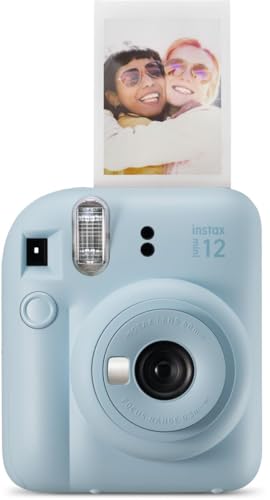
Fujifilm Instax Mini 12 — Best gift for instant joy
Every Christmas has a moment, usually around the second coffee, when the day needs its first artefact — something physical to pass hand to hand while the wrapping paper still covers the floor. The Instax Mini 12 manufactures that moment on demand. It is an instant camera of disarming simplicity: twist, point, press, and a small print develops in a palm while the room watches. For children it is close to magic; for grandparents it is a homecoming, the return of a kind of photography they thought the phones had taken forever.
Operation is the headline feature, because a gift camera that needs a manual fails Christmas morning. The Mini 12’s automatic exposure reads the room — tree gloom, window morning, party flash — and sets itself, while a simple close-up mode handles the selfie with the dog and the detail of the prized present. Its rounded, friendly design survives being passed around a room of excited hands, which is precisely its working environment.
The prints themselves are the argument. Small, white-framed, slightly imperfect in the way that makes them keepsakes rather than files, they go straight onto fridges, into cards, across the dinner table to the aunt who will keep hers in a purse for a decade. A Christmas photographed on instant film leaves the house in pockets that evening — distributed, displayed, loved — while a Christmas photographed on a phone stays in a camera roll, promising to be shared later, mostly not.
Costs are per-print and ongoing, and the film habit should be gifted alongside the camera: spare packs in the stocking are the difference between a camera used all day and a camera rationed by noon. Image quality is charm rather than resolution — small prints forgive, and are forgiven, everything.
Its defining Christmas scene assembles itself: the youngest photographer in the house, camera freshly unwrapped, directing the entire family by the tree with an authority no one questions, because she holds the machine that makes prints. The resulting photograph — slightly tilted, flash-lit, everyone laughing at being directed — will outlast every other frame taken that day. It will be on the fridge at Easter.
- Format: instant film camera, credit-card-sized prints
- Gift brief: a child’s first camera, a family’s party camera
- Operation: automatic exposure, twist to start
- Close-up: a simple mode for selfies and details
- Running note: gift spare film packs alongside it
Strengths
- Physical prints inside the celebration itself
- Simple enough for the youngest recipient
- The room gathers around it — it is a party instrument
Trade-offs
- Film is a continuing cost per photograph
- Prints are small and charm-grade, not gallery-grade
- No digital file unless prints are scanned later
Best for: children, families and anyone giving a first camera. Not suited for: photographers who need digital files of everything

Canon EOS R50 — Best family camera gift
Some gifts are for a person; this one is for a household’s next decade. The R50 is the camera a family graduates to when the phone’s limits have been met at one too many school plays — a real interchangeable-lens body with autofocus that finds children’s faces in living-room light, colour that treats skin kindly under the warm lamps of home, and handling gentle enough that every member of the family, from teenager to grandfather, can be handed it mid-party and return something worth keeping.
Christmas Day itself is its audition, and it passes in the ways that matter: quick to wake for the present-opening rush, dependable in the tree room’s gloom with the kit lens working honestly and a fast prime transforming it after dark, and friendly in its menus when a new setting must be found while the turkey rests. Video of the day — the carol, the toast, the toddler’s first Christmas at full sprint — comes back steady and warm.
The gift’s real size reveals itself across the following year. The RF mount offers the family a growth path measured in birthdays: a portrait lens by spring, a wider one for the holiday, each addition welcomed by a body that was never a toy to begin with. A camera that grows stops being a Christmas purchase and becomes the family’s recording instrument — the thing fetched, by name, whenever life is about to happen.
Costs are the system’s honest ones: it is a considered gift rather than a stocking filler, the kit benefits from a spare battery by Boxing Day, and its capabilities will eventually tempt its owners into lenses — which the family should read as the gift continuing to work. For a household ready to keep its memories properly, there is no warmer threshold in this guide.
Picture its first evening: the tree lit, the room dimmed, and the family’s designated photographer — whoever drew the long straw — discovering that the camera simply handles it: faces found, warmth kept, the grandfather’s laugh by firelight rendered exactly as it sounded. The photograph gets printed before New Year. That almost never happens with phone pictures, and it is the whole reason this camera exists in the guide.
- Format: APS-C mirrorless, RF mount
- Gift brief: the family’s first real camera
- Focus brief: faces found in living-room light
- Colour brief: skin kept kind under warm lamps
- Growth brief: lenses as future birthdays, for years
Strengths
- Every family member can succeed with it on day one
- A decade of growth inside one gift
- Stills and video of the day from one body
Trade-offs
- A considered purchase, not an impulse stocking gift
- Kit lens works honestly; darkness loves a fast prime
- Capabilities invite further lens spending
Best for: families graduating from phones, and givers buying for years. Not suited for: a small, secret, inexpensive surprise

Canon PowerShot G7 X Mark III — Best for the party itself
Hosts have a photographic problem nobody else shares: they must document the gathering without ever leaving it. The G7 X Mark III is the host’s camera — a compact with a bright lens that lives in a pocket or on the sideboard, emerges for ninety seconds at a time, and returns photographs that look like the party felt. Its lens gathers the room’s warm gloom generously, its zoom frames the toast without the photographer crossing the room, and its flip screen handles both the overhead shot of the table and the group selfie that ends the evening.
Low light is where its Christmas credentials are earned. Candlelit dinners and tree-lit rooms are its native exposure territory, and its flash, used sparingly, fills a face without flattening the room behind it — the balance that separates a Christmas photograph from a crime-scene record. Faces come back warm and recognisable; the tree keeps its glow; the wine glasses keep their sparkle. That trio is the season’s whole aesthetic, delivered by a camera that fits in an apron.
It is also the natural gift for the family’s existing documentarian — the aunt or cousin who already photographs everything on a phone and deserves an instrument. No system to build, no lenses to want, nothing to learn that a Christmas afternoon cannot teach: the upgrade is immediate, visible in the first evening’s frames, and complete the moment it is unwrapped.
Limits are the compact’s usual ones, worn lightly: battery life wants a spare during a full day’s hosting, and the enthusiast who discovers a passion here will eventually shop for a system body. Neither matters on the day. On the day, this camera is simply everywhere the party is, which is the only specification a host has ever needed.
Its signature frame comes at the table’s loudest moment: the cracker jokes being read aloud, heads thrown back, candles low — caught because the camera was within reach and ready, not because anyone arranged a photograph. Hosts collect a decade of such frames with this little machine, and the collection becomes, in time, the family’s visual history of itself at its happiest.
- Format: one-inch sensor compact, bright zoom
- Host brief: ninety-second appearances, all evening
- Light brief: candlelit rooms are home territory
- Screen: flip for the table overhead and the group selfie
- Gift brief: the phone documentarian’s instant upgrade
Strengths
- The party photographed without leaving the party
- Warm gloom rendered the way it felt
- Zero learning curve for its recipient
Trade-offs
- A spare battery earns its place by dinner
- No lens growth if the hobby catches fire
- Small body asks care among the festivities
Best for: hosts, documentarians and party-first photographers. Not suited for: system builders or print perfectionists

Sony ZV-1F — Best for a young creator
For the teenager whose Christmas list is written in content — whose year is measured in clips, whose friends live partly inside a group chat’s video stream — the ZV-1F is the gift that speaks their language fluently. It is a fixed-lens creator camera built around one idea: nothing should stand between a young presenter and a posted video. The lens is wide enough for a face and a bedroom tree in the same frame, the screen flips for self-recording, and the controls assume the operator is also the star, the director and the audience.
Christmas gives it a perfect first assignment. The holiday vlog — decorating, baking, the present haul, the walk to midnight mass or the cousins arriving — is a genre with forgiving audiences and genuine joy in it, and this camera lets a beginner produce a watchable version of it on the first attempt. Its forgiving depth of field keeps a moving presenter sharp; its built-in directionality of sound favours the voice over the room; its files drop into a phone for editing before the day is out.
As a gift it has a parent’s virtue too: it is a complete world. No lenses to request next, no system to fund, no settings labyrinth to get lost in — a camera whose ceiling is honest and whose floor is immediate success. When its owner outgrows it, they will do so knowing exactly what they want next and why, which is the most educational outcome a first camera can produce.
Its limits in December light are real: the fixed lens cannot reach across a hall, and the darkest rooms push its small sensor where the compacts above cope better. For its intended stage — the bedroom, the kitchen, the garden’s fairy lights, a face at arm’s length — those limits stay politely offstage.
Imagine Boxing Day in its owner’s hands: the tree still up, cousins still visiting, and a small production already under way — a review of the gifts, a tour of the decorations, a grandmother interviewed about Christmases past, who steals the entire video and knows it. The camera disappears; the family performs. That is the gift working exactly as designed.
- Format: fixed-lens creator compact
- Gift brief: the teenager’s first video camera
- Framing: wide lens for presenter plus place
- Audio brief: voice favoured over room noise
- Workflow: phone-friendly files, same-day posting
Strengths
- A first video posted before the holidays end
- Nothing to configure, buy or assemble first
- Forgiving focus for a moving presenter
Trade-offs
- Fixed lens cannot reach across a hall
- Darkest rooms test its sensor
- A complete world is also a closed one
Best for: young creators and first-time vloggers. Not suited for: telephoto needs or serious low-light filming

Fujifilm X100VI — Best enthusiast gift
There is a recipient for whom a camera is not a tool but an object of desire, discussed in forums since spring, and for that recipient this guide makes no apology for naming the X100VI. It is a fixed-lens compact of unusual beauty and resolution, with film simulations that render December — candle gold, tree green, the red of wrapping paper — in colours that feel remembered rather than recorded. Photographers who own one tend to describe it the way musicians describe an instrument, and a gift that lands in that register is remembered as long as the giver is.
Its Christmas performance justifies the romance. The lens focuses closely enough for the detail work the season is full of — the ornament with a history, the place setting, the hands shelling nuts — and the high-resolution sensor renders the tree room’s textures with a richness that survives printing large for next year’s card. A small built-in flash, partnered with its leaf shutter, fills a face at the table without murdering the candlelight behind it: the exact balance December demands, delivered with unusual grace.
Handling is part of the gift. Dials with engraved numbers, an aperture ring, a shutter speed you set by touch — the camera slows its owner into the deliberate pace that Christmas photography, alone among the year’s genres, actually has time for. Between courses, on the Boxing Day walk, in the quiet hour when the tree lights are the only lights left on, it makes picture-taking feel like a craft again rather than a reflex.
Honesty requires its caveats in full: it is a significant purchase, its fixed lens will not zoom to the far end of a hall, and its popularity has made it, at times, genuinely difficult to buy — a gift to plan early rather than to improvise in the final week. None of that dims it for the right recipient. It merely defines who the right recipient is: the photographer who will still be carrying it, daily, at the Christmas after next.
Its defining frame is the season’s quietest: the tree at midnight, the room asleep, one ornament catching the light — photographed at a pace of one frame per minute, each considered, the last one perfect. December gives every photographer a few such minutes. This camera was built to be in hand when they arrive.
- Format: fixed-lens APS-C compact, high resolution
- Gift brief: the enthusiast’s object of desire
- Colour brief: film simulations tuned to memory
- Detail brief: close focus for ornaments and tables
- Flash brief: gentle fill that respects candlelight
Strengths
- December colour that feels like remembering
- An object beautiful enough to be the gift itself
- Resolution for next year’s cards and prints
Trade-offs
- A significant purchase requiring early planning
- Fixed lens frames by walking, not zooming
- Availability can test a December deadline
Best for: enthusiasts who value craft, colour and the object itself. Not suited for: casual users or last-minute givers

Polaroid Go Generation 2 — Best stocking-sized surprise
The smallest camera in this guide earns its place by fitting where cameras are not expected: inside a stocking, inside a coat pocket at the carol service, inside the hand of a guest who has never owned any camera at all. The Polaroid Go Generation 2 is an instant camera shrunk to near-toy proportions that still produces real, credit-card-scale Polaroid prints — and its size changes its social physics completely, because a camera this small gets passed around like a party game rather than guarded like equipment.
That passing-around is its genius at Christmas. It travels the room: the cook photographs the pudding, a guest photographs the cook, the dog is photographed by everyone, and by dinner a small constellation of prints has appeared on the mantelpiece, each claimed, annotated, argued over. The Instax above is the better first camera for a child; the little Polaroid is the better social instrument for a mixed-age party, precisely because nobody feels responsible for it.
Operation is point, shoot, wait — with a selfie mirror, a simple flash and a double-exposure trick for the family’s one experimental photographer. Image quality is instant-film quality, with all the softness and surprise the format is loved for; exposures in tricky tree light will occasionally miss, and the misses, at a party, tend to be loved as much as the hits.
Film for its small format is its own ecosystem, so the wise giver includes packs with the camera and treats the combination as the complete gift. As a surprise — the extra present nobody listed, produced after dinner to general delight — it has few rivals in this guide or any other.
Watch its Christmas unfold in other people’s hands: it will be borrowed by the teenager, confiscated by the grandfather, discovered in the kitchen photographing the trifle. By midnight its prints will be the day’s most handled photographs. Cameras are usually judged by the images they make; this one should also be judged by the route it travels while making them.
- Format: miniature instant camera, small-format prints
- Gift brief: the stocking surprise and party guest
- Operation: point, shoot, pass it on
- Social brief: small enough to be shared without anxiety
- Running note: include its film packs in the gift
Strengths
- Fits a stocking, a pocket and any hand
- The room adopts it collectively within an hour
- Instant prints as party artefacts, immediately
Trade-offs
- Instant exposures in tree light can miss
- Small prints favour charm over detail
- Its film format is a separate, ongoing purchase
Best for: stockings, parties and spontaneous givers. Not suited for: anyone’s main or only camera
How Do the Six Christmas Cameras Compare?
| Camera | Type | Best recipient | Christmas strength |
|---|---|---|---|
| Fujifilm Instax Mini 12 | Instant | A child or the whole family | Prints during the party |
| Canon EOS R50 | Mirrorless system | A household | Years of growing Christmases |
| Canon PowerShot G7 X Mark III | Compact | The host or documentarian | Candlelit party coverage |
| Sony ZV-1F | Creator compact | A young creator | Holiday videos, posted fast |
| Fujifilm X100VI | Fixed-lens compact | An enthusiast | Colour like memory |
| Polaroid Go Generation 2 | Miniature instant | Anyone, as a surprise | The camera the room shares |
Choose by recipient first and by room second. The right person holding a modest camera produces the Christmas album; the wrong person holding a flagship produces a cupboard. Then check the light the gift will actually work in — tree gloom, candle warmth, morning chaos — against the verdicts above.
How Do You Photograph the Tree Without Losing the People?
Expose for the faces and let the tree be atmosphere. The instinct to make the bulbs sparkle leads automatic settings to darken everything human; the season’s correct bargain is the reverse — people lit warmly and recognisably, the tree glowing behind them at whatever brightness it chooses. Practically: stand the subjects a little away from the tree so its light becomes background rather than backlight, add the gentlest fill the camera offers, and take the photograph at the moment of laughter rather than the moment of posing, because Christmas faces arrange themselves best when they forget to.
Composition has one seasonal rule: get lower and closer than instinct suggests. The tree room photographed from standing height is a furniture catalogue; the same room from a child’s eye level, close to the action on the floor, is the day as it was lived. The compacts and instants in this guide excel here precisely because they ask for no setup — the floor-level frame is available to whoever is willing to sit on the floor, which at Christmas is most of the room anyway.
Take the tree’s portrait too, once, at the quiet end of the night, with the room’s other lights off and the exposure allowed to be slow and deliberate. Every family archive needs that one frame — the tree as it was this year, ornaments and all — because trees, like the people around them, are never quite the same twice.
What Mistakes Do Families Make Photographing Christmas?
Photographing only the set pieces leads the list: the posed line by the tree, the held-up presents, the table before anyone sits at it — an album of arrangements with the celebration missing. The cure is to photograph the middles of things: the tearing, the tasting, the reading of the joke, the falling asleep. Second is flash fired like a searchlight at every frame, bleaching faces and deleting the very warmth the family gathered to enjoy; the season asks for restraint, fill and forgiveness.
A third mistake is custody: one person, usually the same person every year, behind the camera for the entire day and therefore absent from the entire album. Christmas setups should rotate — the cameras in this guide were partly chosen for how handable they are — and the family’s photographer must be photographed, by somebody, every single year, without exception. Future grandchildren will look for them.
And the quietest mistake is postponement: the photographs live on a card or a phone, unshared and unprinted, until the moment’s warmth has cooled into an errand. Print something before New Year — a fridge set, a card for the relative who missed it, one frame enlarged — because a Christmas photograph’s value is at its highest while the day is still being retold, and the cameras above, the instants most literally, exist to make that printing effortless.
How Should the Day Itself Be Covered, Hour by Hour?
Morning belongs to speed and forgiveness: the present-opening floor allows no setup, so the camera — instant for the children’s hands, the Canon compact or R50 for the designated photographer — works at whatever settings forgive fastest, and nobody apologises for a blurred frame that contains the exact second a wish came true. Stockings, first reactions and the dog’s traditional crime against wrapping paper are the morning’s canonical subjects, in that order.
Afternoon belongs to the table and the walk. The dinner photographs are warmth and steam; the walk photographs — the day’s one excursion into real light — are where the enthusiast’s Fujifilm and the family R50 produce the year’s most printable frames, faces in cold air with the low sun doing the work. Evening returns to the tree room for the party games, the instant cameras’ second shift, and the group photograph that must, by law older than any camera, be attempted at least twice because someone always blinks.
End the day with the quiet frames: the tree alone, the sleeping child among the ruins of the paper, the grandparents’ last cup of tea. Christmas albums are read backwards in later life — from the quiet end toward the noisy morning — and the photographer who supplies both ends has told the whole story.
How Do You Photograph Grandparents Well at Christmas?
With time, which is the one gift the season’s schedule tries to steal. The elderly subjects of the family album are too often photographed in the margins — caught mid-sentence at the table’s far end, flash-lit and blinking — because the day’s energy belongs to the children. Deliberately reverse that priority once each Christmas: a quiet five minutes, the best chair by the tree or the window’s soft afternoon light, a conversation rather than a pose, and the camera — the Fujifilm for its colour, the Canon compact for its kindness, the R50 for its patience — working unhurriedly while stories are told. The frames from those five minutes will, in time, become the most valuable in the entire archive. Everyone in the family already knows this. The photographer’s job is merely to act on it before the light goes.
Include the generations together while the arrangement still exists: the oldest hand holding the newest baby, four generations arranged by accident on one sofa and photographed before anyone improves the arrangement. These photographs cannot be scheduled for next year with any certainty, which is precisely why this guide keeps insisting that the camera be ready, present and passed around. Christmas is the one appointment the whole family keeps. The album should show that they did — all of them, while all of them could.
Practical kindnesses matter: show the photograph to its subject on the screen, take another if they ask, print the good one before they leave. An elderly relative who has seen themselves look well in a Christmas photograph becomes, next year, the family’s most willing sitter — and willingness, at any age, is the raw material of every portrait worth keeping.
What About the Pets, the Food and the Decorations?
The season’s supporting cast deserves its own coverage plan, because future viewers ask after them by name. The dog in its traditional outrage against a paper hat, the cat asleep in the wrapping box it prefers to every gift — these frames are the album’s comedy, and they are made with the fastest camera to hand, which at most Christmases is whichever instant or compact is already out. Do not stage them. The comedy is documentary or it is nothing.
The food photographs best in the ninety seconds between the kitchen and the table, while the gloss and steam are still on it — the Canon compact’s home ground, or the host’s phone passed to the one guest with an eye. Photograph the cook with the dish, always: a turkey alone is an ingredient, but a cook holding it is a triumph, and triumphs are what the album is for.
Decorations are the year’s set design and should be recorded like it: the tree whole, the mantelpiece, the one ornament with a genealogy, the child’s handmade contribution given the same photographic respect as the heirloom beside it. In forty years the family will reconstruct entire eras from these frames — the year of the paper chains, the year the tree leaned — and the photographer who documented the set as faithfully as the cast will be thanked by people not yet born.
How Should Christmas Photographs Be Shared Before the Day Ends?
In the room first, and online second — an ordering the instant cameras enforce physically and the digital cameras should adopt voluntarily. The print passed across the table, the screen turned around to show the laugh just captured, the group photograph reviewed together with its traditional howls: these are the day’s own pleasures, and a Christmas whose photographs are only experienced later, alone, on other screens, has surrendered half of what the cameras in this guide were bought to create.
For the relatives who could not come, one photograph sent during the day outweighs forty sent in January. Choose it with the family’s whole heart: usually the group frame, or the grandparents, or the baby in the hat — the single image that says we are well, we are together, you were missed. The cameras above all make that sending easy; the discipline is remembering, mid-celebration, the people for whom the photograph is not a keepsake but a lifeline.
Then let the rest wait. The full edit, the album, the prints for the mantelpiece — January’s quiet work, done properly, at the speed memory deserves. Christmas Day itself is for making the photographs and being in them, in that order and no other. A family that protects that boundary will find, year after year, that its archive grows richer even as its Christmas Day grows calmer — which is, in the end, the finest verdict any camera guide could hope to earn.
How Do You Wrap a Camera So Christmas Morning Works?
Presentation is part of the engineering. A digital camera should arrive charged — by the giver, the night before, in secret — with a memory card already inside and the date already set, so that the recipient’s first action is a photograph rather than a setup wizard. An instant camera should arrive with film loaded and a spare pack visibly attached to the box, because the first print’s magic depends on nobody having to read a leaflet while the room waits. These small conspiracies, arranged on Christmas Eve, are the difference between a gift that joins the day and a gift that joins the following week.
Include one invitation with the wrapping: a note naming the first assignment. Photograph the tree tonight. Film the present-opening. Take the portrait of whoever cooked. A camera given with a mission is used within the hour; a camera given without one is admired, shelved for the manual, and — in the saddest and commonest outcome — rediscovered in February with its battery flat. Givers underestimate how much permission a new photographer needs to simply begin. The note is that permission, gift-wrapped.
And keep the receipt’s whereabouts known, without making a ceremony of it: exchanges of size, colour and occasionally of entire intention are part of camera giving, and a recipient who swaps a compact for the system body — or the reverse — has not rejected the gift. They have completed it. The aim was never the object. The aim was the photographs, and they are equally available down either path.
What Does Boxing Day Teach a New Camera Owner?
Everything Christmas Day was too joyful to teach. The light is ordinary again, the house is quiet, the tree is beginning its dignified decline — and the new camera, yesterday’s toy, becomes today’s instrument as its owner reviews the haul honestly: which frames sang, which blurred, which settings the camera chose when nobody was supervising. That review, done with the manual finally open and a cup of tea going cold, is the real beginning of ownership. Encourage it in any new photographer you have gifted: an hour with yesterday’s evidence teaches more than a month of anticipation.
Boxing Day is also when the year’s best photograph is usually recognised — rarely the posed line, almost always a middle: a laugh, a tear at a card’s message, the baby asleep in the paper. Print that one first, before the sales and the resolutions scatter the season’s attention. A new camera whose first print is on a wall by New Year has been adopted by the household. One whose files remain unexamined becomes, by slow degrees, a drawer. The cameras in this guide were all chosen to make the adoption easy; the final step, as ever, belongs to the people.
Why Do Christmas Photographs Matter More Each Year?
Because the cast changes at a rate nobody notices until the album proves it. Children who were photographed on laps are suddenly the tall figures at the back; chairs that were always occupied stand, one year, with a coat over them; a house that hosted thirty Christmases is sold, and the tree room exists afterwards only in these frames. The family archive is not nostalgia. It is evidence — of who was there, how they loved each other, what the room looked like when everyone was laughing — assembled one December at a time by whoever bothered to bring a camera and use it kindly.
That is the deepest reason this guide exists and the truest test of every pick in it: not whether the camera wins a comparison, but whether, thirty Christmases from now, someone will open a box or a folder and find the faces — warm, present, unposed in the ways that matter — because a giver in a long-ago December chose well, charged the battery, loaded the film and handed the thing over with a note that said begin. Every camera above can be that camera. The choosing is the easy part. The beginning is the gift.
Frequently Asked Questions
Which camera is the safest gift for someone whose wishes I do not know?
The Canon PowerShot G7 X Mark III for an adult — complete, immediate, no system to fund — or the Fujifilm Instax Mini 12 for a younger recipient, whose delight is the most predictable in this guide.
Do instant cameras really beat phones at a family Christmas?
For the album, no; for the day, yes. Prints circulate during the celebration, reach grandparents’ hands before dinner and end up on fridges — a social life no phone photograph lives until long after the moment has cooled.
How do I stop Christmas photos turning orange?
Shoot a test frame early and set white balance for the room’s main light rather than letting it chase every source; favour the cameras’ warmer scene intelligence, use fill flash gently, and remember that a little warmth is the season’s truth — the goal is faces that look alive, not neutral.
Is the X100VI a sensible gift if it might not arrive in time?
Only with a plan: order early, or give it as the promised centrepiece with a smaller camera — the Polaroid Go is made for this — carrying Christmas Day itself. A late flagship and an empty morning helps nobody.
What should accompany a camera gift to make it complete?
The means to use it within the hour: film packs for the instants, a charged spare battery and a memory card for the digitals, and a case if the recipient is young. A camera that must wait for accessories has been given an appointment, not a present.
Which pick suits photographing a school nativity or carol service?
The Canon EOS R50 with the longest lens available to it, from the back, without flash — its autofocus and warm colour suit a dim hall, and its silence respects the occasion. Arrive early; the best seat for photography is chosen before the audience sits.
Final Recommendation
Give by recipient and shoot by light. The Fujifilm Instax Mini 12 for the child and the family’s collective joy; the Canon EOS R50 for the household ready to grow; the Canon PowerShot G7 X Mark III for the host who documents everything; the Sony ZV-1F for the young creator; the Fujifilm X100VI for the enthusiast who has earned the beautiful object; and the Polaroid Go Generation 2 slipped into a stocking for the delight of everyone. Whichever leaves this guide under your tree, honour the season’s one rule: the camera must join the day — charged, loaded, passed around, forgiven its imperfections — because Christmas photographs are not judged in January. They are judged in forty years, by people looking for faces, in warm light, laughing. Make sure the faces are there.
One practical benediction to close: on Christmas Eve, charge everything, load everything, and put the cameras where the day begins — not in a cupboard of good intentions. The first frame of Christmas is always taken by the camera that was ready. Be ready, and then be in the photographs too; hand the camera over, at least once, to whoever offers. The album needs you in it. It always did.
Finally, a word to the giver who has read this far and still cannot decide: choose the camera you can picture in the recipient’s hands at the exact moment the tree lights come on. Not the most impressive, not the most future-proof — the one that belongs in that room, with those people, on that evening. Christmas has never rewarded the correct purchase. It rewards the present one, in every sense of the word, and any of the six above — given with film or a charged battery, a mission in a note and your own willingness to be photographed badly and gladly — will be present in exactly the way that matters. Give it, charge it, and go and stand by the tree. Your place in the album is waiting, and the light, for once, is perfect.
What Should You Do With the Photographs in January?
January is the album’s harvest month, and it rewards a small, deliberate ritual: one evening, the tree barely down, the whole household’s photographs gathered from every camera and phone into one place and culled with mercy. Keep the middles, the blurs that contain the laugh, the duplicates that differ by one expression; delete the accidents without ceremony. From that culled set, three products should emerge before the month ends — a print for the wall or the mantelpiece, a set for the relatives who were missed, and a backup stored somewhere that is not the house, because the only copy of a family’s Christmas should never share a roof with the family’s boiler.
Make it a tradition with a name and a date, and the cameras bought this December acquire their annual purpose: they are not really for Christmas Day at all, but for the January evening when the day is relived properly, and for every year after when the folder is opened again. A gift that creates a ritual has outgrown the category of gift entirely. It has become part of how the family remembers itself — which is, when all the wrapping is cleared away, the only thing any of these six cameras was ever for.
Related Guides
Prepare the season’s other photography with low-light family portraits by tree and candlelight, plan January’s printing through turning holiday photographs into prints and cards, or choose next year’s upgrade via a family’s first interchangeable-lens camera.


