Where to buy
Check the latest price, availability and delivery on Amazon. Orders are placed on Amazon. We may earn a commission from qualifying purchases.
- Best all-round AM4 pick: MSI MAG B550 Tomahawk — Check on Amazon
- ASUS ROG Strix B550-F Gaming WiFi II — Check on Amazon
- Gigabyte B550 Aorus Elite AX V2 — Check on Amazon
- ASUS TUF Gaming X570-Plus (Wi-Fi) — Check on Amazon
- MSI MPG B550 Gaming Plus — Check on Amazon
- ASRock B550M Pro4 — Check on Amazon
Read the full guide ↓
Disclosure: As an Amazon Associate, ilcastellomenu.com earns from qualifying purchases. Links to Amazon on this page are affiliate links; they cost you nothing extra. Listing details such as price and availability change often, so check the current Amazon listing before you buy.
Searching for the best motherboards for ryzen 5 3600x means you need a board that fits a specific job, and motherboard buying punishes vagueness faster than any other component choice: Socket AM4 is a mature DDR4 platform whose boards split by chipset — B450, B550 and X570 — with CPU support that depends on the chipset and the BIOS version, not just the socket. This guide names the six boards that genuinely serve this search, states exactly which processors and workloads each one suits, and labels every pick honestly — linked where its Amazon listing was verified during research, prose-only where it was not, with the reason recorded in the article’s source notes.
Here is the sentence this whole guide is built around: the AMD Ryzen 5 3600X (Socket AM4) decides everything, and the board’s job is to serve that exact chip — its core count, its power draw, its overclocking lock or freedom, and its integrated graphics or lack of them. Boards that merely share a socket name were excluded; boards that boot the chip but throttle it, lock its best feature or strand its graphics were ranked below boards that serve it completely. Readers comparing adjacent budgets should also see Best Motherboards For Ryzen 5 and Best Motherboards For Ryzen 5800x in this same category.
In this guide
Quick Picks
Short on time, or comparing several options at once? Each row below names a buyer type and the board that suits it, with a link to the listing where one is verified.
| Buyer type | Pick | Why it stands out | Link |
|---|---|---|---|
| Best all-round AM4 pick | MSI MAG B550 Tomahawk | Proven VRM cooling, PCIe 4.0 and dual LAN in a no-nonsense ATX board | Check on Amazon |
| Best AM4 pick with Wi-Fi | ASUS ROG Strix B550-F Gaming WiFi II | Wi-Fi 6E, strong power stages and FlashBack in a polished ATX package | Check on Amazon |
| Best AM4 value with Wi-Fi | Gigabyte B550 Aorus Elite AX V2 | 12+2 phases, Wi-Fi 6 and Q-Flash Plus without flagship pricing habits | Check on Amazon |
| Best AM4 expansion pick | ASUS TUF Gaming X570-Plus (Wi-Fi) | Chipset PCIe 4.0 lanes, 8 SATA ports and dual Gen 4 M.2 for loaded builds | Check on Amazon |
| Best budget ATX B550 | MSI MPG B550 Gaming Plus | Tomahawk-style layout and Flash BIOS at the friendlier end of B550 | Check on Amazon |
| Best compact AM4 pick | ASRock B550M Pro4 | Micro ATX, ECC support and APU-friendly display outputs with PCIe 4.0 | Check on Amazon |
How These Picks Were Chosen
We did not use these boards on a test bench. We read manufacturer specification pages, datasheets and listing records, cross-checked the numbers that decide a build — power design, memory support, M.2 and SATA counts, LAN and Wi-Fi modules, form factor — and favored boards whose makers publish complete specifications over boards sold on adjectives. Where a platform is discontinued, the guide says so and treats the used market as what it is: a real option with real inspection homework, not a defect to hide.
Every board in this guide was checked the same way: the manufacturer’s own specification page or datasheet first — socket, chipset, memory type, slot and port counts — and the retail listing record second, because listing titles compress and sometimes garble the details that decide compatibility. A board earns a purchase link in this guide only when its Amazon listing identity could be corroborated that way; boards whose specifications are solid but whose listing identity could not be confirmed are recommended in prose, clearly, with no link and no apology — a recommendation does not need a link to be honest, and a link should never exist without verification behind it.
Price was handled by the standing rule of this site: no printed product prices, because motherboard listings are promotion-driven and a printed figure is wrong more often than right. Linked picks say check price on Amazon; prose-only picks carry qualitative tier positioning. The keyword’s own budget figure, where there is one, is used as framing — a ceiling to reason against — never as a claim about what a specific board costs today.
The 6 Best Best motherboards for ryzen 5 3600x
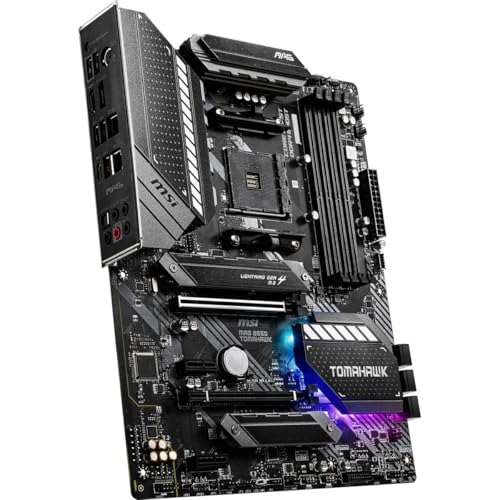
MSI MAG B550 Tomahawk
Who it suits: Best all-round AM4 pick — builders who want proven VRM cooling, PCIe 4.0 and dual LAN in a no-nonsense ATX board.
Start with the physical facts: AMD B550 on Socket AM4, ATX, 4x DDR4 DIMM, dual channel, PCIe 4.0 x16 primary slot (with Ryzen 3000/5000 CPUs), 2x M.2 (one PCIe 4.0 x4 with heatsink), 6x SATA 6Gb/s. The Tomahawk line earned its reputation on VRM cooling, and the B550 version pairs a substantial extended heatsink with a power design that runs high-core-count Ryzen chips at stock and mild overclocks without drama. Those facts place the board precisely: it is not trying to be every board at once, and the review judges it against the job its chipset and price class actually promise.
In practice, three experiences define ownership. The first is the build itself — connector placement, a legible manual and a BIOS that behaves predictably while you set boot order and memory speed. The second is the first month, when fan curves get tuned and the board disappears into the background of a stable system, which is the highest compliment a motherboard can earn. The third is the upgrade day, when a new GPU, a bigger NVMe drive or a faster CPU from the same platform tests whether the slot layout and firmware support were chosen well. Strong, well-cooled power delivery for its class, dual LAN and a Flash BIOS button that lets you update firmware without a CPU installed is where this board earns its keep across all three.
Judge this board against the peripherals already on your desk. Its rear panel and headers — USB 3.2 Gen 2 Type-A and Type-C at the rear; 7.1-channel HD audio — decide whether headsets, DACs, external drives and front-panel ports all connect at once, and its ATX footprint decides how much slot and cable room surrounds the graphics card. None of that appears in benchmark charts, and all of it is felt daily. The board’s centre of gravity is consistent: it serves the build described in its Who-it-suits line completely, and trades away the things that build does not need.
- Strong, well-cooled power delivery for its class, dual LAN and a Flash BIOS button that lets you update firmware without a CPU installed.
- AMD B550 chipset on Socket AM4 with 4x DDR4 DIMM, dual channel.
- 2x M.2 (one PCIe 4.0 x4 with heatsink); 6x SATA 6Gb/s.
Honest limitation: No onboard Wi-Fi, so wireless builds need a PCIe card or a USB adapter.
Choose it if its strengths match your build’s actual bottleneck. Skip it if its stated limitation is the thing your build cannot live with — the next pick in this guide trades exactly that point differently.
ASUS ROG Strix B550-F Gaming WiFi II
Who it suits: Best AM4 pick with Wi-Fi — builders who want wi-Fi 6E, strong power stages and FlashBack in a polished ATX package.
The WiFi II revision updates the original Strix B550-F with a Wi-Fi 6E module and keeps the features builders actually used: BIOS FlashBack, a pre-mounted I/O shield and some of the clearest debug LEDs in the class. On paper the essentials read: AMD B550 chipset on Socket AM4, ATX, 4x DDR4 DIMM, dual channel, PCIe 4.0 x16 primary slot (with Ryzen 3000/5000 CPUs), 2x M.2 (one PCIe 4.0 x4), 6x SATA 6Gb/s, 2.5Gb Ethernet, Wi-Fi 6E with Bluetooth. In a build, what those lines mean is simpler. The power design and its cooling decide whether your processor holds its boost clocks through a long render, a compile or a summer gaming session, or quietly trims them when the VRM heats up; the slot layout decides whether a thick graphics card buries the slot your capture card, sound card or extra NVMe adapter needed; and the rear panel decides how many dongles your desk accumulates.
Daily life with this board is mostly about what you stop noticing. BIOS updates arrive through the maker’s normal support channel — check the support page before a CPU upgrade, because on mature platforms the difference between a chip booting and a black screen is usually one firmware version. Fan control, boot order and memory profiles live in a BIOS whose layout rewards ten patient minutes of exploration on day one. Wi-Fi 6E, BIOS FlashBack and a 12+2 teamed power-stage design that handles flagship Ryzen chips comfortably — that is the sentence owners repeat when recommending it, and it is the reason this board holds its place in the guide.
Judge this board against the peripherals already on your desk. Its rear panel and headers — USB 3.2 Gen 2 Type-A and Type-C at the rear; SupremeFX 7.1-channel HD audio — decide whether headsets, DACs, external drives and front-panel ports all connect at once, and its ATX footprint decides how much slot and cable room surrounds the graphics card. None of that appears in benchmark charts, and all of it is felt daily. The board’s centre of gravity is consistent: it serves the build described in its Who-it-suits line completely, and trades away the things that build does not need.
- Wi-Fi 6E, BIOS FlashBack and a 12+2 teamed power-stage design that handles flagship Ryzen chips comfortably.
- AMD B550 chipset on Socket AM4 with 4x DDR4 DIMM, dual channel.
- 2x M.2 (one PCIe 4.0 x4); 6x SATA 6Gb/s.
Honest limitation: It sits at the upper end of B550 pricing territory, where sale prices on X570 boards sometimes overlap it.
Choose it if its strengths match your build’s actual bottleneck. Skip it if its stated limitation is the thing your build cannot live with — the next pick in this guide trades exactly that point differently.
Gigabyte B550 Aorus Elite AX V2
Who it suits: Best AM4 value with Wi-Fi — builders who want 12+2 phases, Wi-Fi 6 and Q-Flash Plus without flagship pricing habits.
Start with the physical facts: AMD B550 on Socket AM4, ATX, 4x DDR4 DIMM, dual channel, PCIe 4.0 x16 primary slot (with Ryzen 3000/5000 CPUs), 2x M.2 (one PCIe 4.0 x4 with heatsink), 6x SATA 6Gb/s. Gigabyte’s V2 revision is the quiet value play of the B550 generation: a 12+2 phase digital power design, Q-Flash Plus for CPU-less BIOS updates and Wi-Fi included, usually priced against boards with weaker VRMs and no wireless. Those facts place the board precisely: it is not trying to be every board at once, and the review judges it against the job its chipset and price class actually promise.
In practice, three experiences define ownership. The first is the build itself — connector placement, a legible manual and a BIOS that behaves predictably while you set boot order and memory speed. The second is the first month, when fan curves get tuned and the board disappears into the background of a stable system, which is the highest compliment a motherboard can earn. The third is the upgrade day, when a new GPU, a bigger NVMe drive or a faster CPU from the same platform tests whether the slot layout and firmware support were chosen well. 12+2 phase power design, Wi-Fi 6 and Q-Flash Plus at a mid-tier position in the B550 range is where this board earns its keep across all three.
One practical note on assembly: boards of this class reward a bench test — CPU, one memory stick, graphics — before the board goes into the case, because every connector is reachable and every debug signal is visible. Once installed, its 4x DDR4 DIMM, dual channel layout and PCIe 4.0 x16 primary slot (with Ryzen 3000/5000 CPUs) define the upgrade paths that stay open: memory capacity, a faster or additional drive, a second expansion card. A board is a five-year decision wearing a one-day purchase; this one’s five-year story is written in those paths, and the review’s verdict follows from them.
- 12+2 phase power design, Wi-Fi 6 and Q-Flash Plus at a mid-tier position in the B550 range.
- AMD B550 chipset on Socket AM4 with 4x DDR4 DIMM, dual channel.
- 2x M.2 (one PCIe 4.0 x4 with heatsink); 6x SATA 6Gb/s.
Honest limitation: Gigabyte’s BIOS menu layout takes longer to learn than MSI’s or ASUS’s equivalents.
Choose it if its strengths match your build’s actual bottleneck. Skip it if its stated limitation is the thing your build cannot live with — the next pick in this guide trades exactly that point differently.
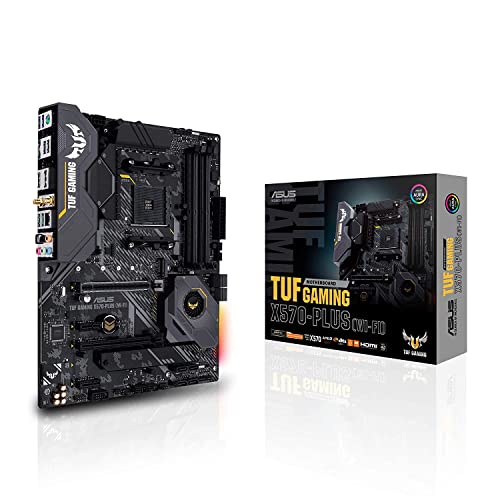
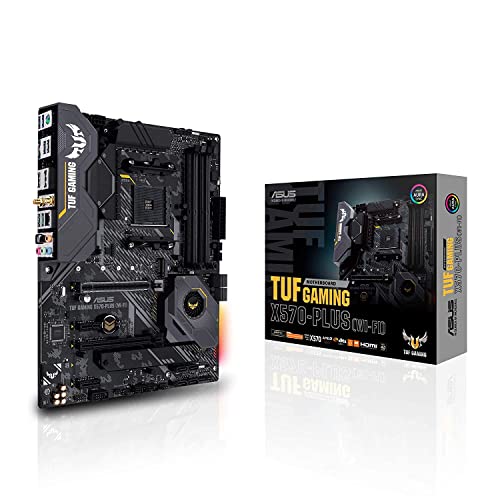
ASUS TUF Gaming X570-Plus (Wi-Fi)
Who it suits: Best AM4 expansion pick — builders who want chipset PCIe 4.0 lanes, 8 SATA ports and dual Gen 4 M.2 for loaded builds.
X570’s difference is lanes: the chipset itself serves PCIe 4.0, so both M.2 slots and the second x16 slot run at Gen 4 speeds — the platform for builders who genuinely fill expansion slots, capture cards and multiple fast NVMe drives. On paper the essentials read: AMD X570 chipset on Socket AM4, ATX, 4x DDR4 DIMM, dual channel, PCIe 4.0 on both x16 slots (chipset-fed lanes included), 2x M.2 PCIe 4.0 x4, 8x SATA 6Gb/s, Gigabit Ethernet, Wi-Fi 5 (802.11ac) with Bluetooth 5.0. In a build, what those lines mean is simpler. The power design and its cooling decide whether your processor holds its boost clocks through a long render, a compile or a summer gaming session, or quietly trims them when the VRM heats up; the slot layout decides whether a thick graphics card buries the slot your capture card, sound card or extra NVMe adapter needed; and the rear panel decides how many dongles your desk accumulates.
Daily life with this board is mostly about what you stop noticing. BIOS updates arrive through the maker’s normal support channel — check the support page before a CPU upgrade, because on mature platforms the difference between a chip booting and a black screen is usually one firmware version. Fan control, boot order and memory profiles live in a BIOS whose layout rewards ten patient minutes of exploration on day one. PCIe 4.0 from CPU and chipset, eight SATA ports and a 12+2 DrMOS power stage for flagship Ryzen chips — that is the sentence owners repeat when recommending it, and it is the reason this board holds its place in the guide.
One practical note on assembly: boards of this class reward a bench test — CPU, one memory stick, graphics — before the board goes into the case, because every connector is reachable and every debug signal is visible. Once installed, its 4x DDR4 DIMM, dual channel layout and PCIe 4.0 on both x16 slots (chipset-fed lanes included) define the upgrade paths that stay open: memory capacity, a faster or additional drive, a second expansion card. A board is a five-year decision wearing a one-day purchase; this one’s five-year story is written in those paths, and the review’s verdict follows from them.
- PCIe 4.0 from CPU and chipset, eight SATA ports and a 12+2 DrMOS power stage for flagship Ryzen chips.
- AMD X570 chipset on Socket AM4 with 4x DDR4 DIMM, dual channel.
- 2x M.2 PCIe 4.0 x4; 8x SATA 6Gb/s.
Honest limitation: The chipset has an active cooling fan — a small moving part B550 boards do not have — and Wi-Fi is the older Wi-Fi 5 standard.
Choose it if its strengths match your build’s actual bottleneck. Skip it if its stated limitation is the thing your build cannot live with — the next pick in this guide trades exactly that point differently.
MSI MPG B550 Gaming Plus
Who it suits: Best budget ATX B550 — builders who want tomahawk-style layout and Flash BIOS at the friendlier end of B550.
Start with the physical facts: AMD B550 on Socket AM4, ATX, 4x DDR4 DIMM, dual channel, PCIe 4.0 x16 primary slot (with Ryzen 3000/5000 CPUs), 2x M.2 (one PCIe 4.0 x4 with heatsink), 6x SATA 6Gb/s. The Gaming Plus is MSI’s step-down from the Tomahawk that keeps the layout, the Flash BIOS button and the M.2 heatsink while trimming the LAN and VRM extras — the board to buy when the Tomahawk’s price drifts up. Those facts place the board precisely: it is not trying to be every board at once, and the review judges it against the job its chipset and price class actually promise.
In practice, three experiences define ownership. The first is the build itself — connector placement, a legible manual and a BIOS that behaves predictably while you set boot order and memory speed. The second is the first month, when fan curves get tuned and the board disappears into the background of a stable system, which is the highest compliment a motherboard can earn. The third is the upgrade day, when a new GPU, a bigger NVMe drive or a faster CPU from the same platform tests whether the slot layout and firmware support were chosen well. Same builder-friendly layout as the Tomahawk with Flash BIOS and a shielded primary M.2 slot is where this board earns its keep across all three.
Judge this board against the peripherals already on your desk. Its rear panel and headers — USB 3.2 Gen 2 Type-A and Type-C at the rear; 7.1-channel HD audio — decide whether headsets, DACs, external drives and front-panel ports all connect at once, and its ATX footprint decides how much slot and cable room surrounds the graphics card. None of that appears in benchmark charts, and all of it is felt daily. The board’s centre of gravity is consistent: it serves the build described in its Who-it-suits line completely, and trades away the things that build does not need.
- Same builder-friendly layout as the Tomahawk with Flash BIOS and a shielded primary M.2 slot.
- AMD B550 chipset on Socket AM4 with 4x DDR4 DIMM, dual channel.
- 2x M.2 (one PCIe 4.0 x4 with heatsink); 6x SATA 6Gb/s.
Honest limitation: Gigabit rather than 2.5Gb LAN, and no Wi-Fi — wired desktop builds only, by design.
Choose it if its strengths match your build’s actual bottleneck. Skip it if its stated limitation is the thing your build cannot live with — the next pick in this guide trades exactly that point differently.
ASRock B550M Pro4
Who it suits: Best compact AM4 pick — builders who want micro ATX, ECC support and APU-friendly display outputs with PCIe 4.0.
The Pro4 is the engineer’s B550: micro ATX, ECC memory support on supported processors, a reinforced primary slot and display outputs (HDMI, DisplayPort and VGA) that make it the natural home for Ryzen APUs and compact workstations. On paper the essentials read: AMD B550 chipset on Socket AM4, Micro ATX, 4x DDR4 DIMM, dual channel, ECC support (with supported CPUs), PCIe 4.0 x16 primary slot (with Ryzen 3000/5000 CPUs), 2x M.2 (one PCIe 4.0 x4 Hyper M.2), 6x SATA 6Gb/s, Gigabit Ethernet, No onboard Wi-Fi (M.2 Key E slot for a Wi-Fi module). In a build, what those lines mean is simpler. The power design and its cooling decide whether your processor holds its boost clocks through a long render, a compile or a summer gaming session, or quietly trims them when the VRM heats up; the slot layout decides whether a thick graphics card buries the slot your capture card, sound card or extra NVMe adapter needed; and the rear panel decides how many dongles your desk accumulates.
Daily life with this board is mostly about what you stop noticing. BIOS updates arrive through the maker’s normal support channel — check the support page before a CPU upgrade, because on mature platforms the difference between a chip booting and a black screen is usually one firmware version. Fan control, boot order and memory profiles live in a BIOS whose layout rewards ten patient minutes of exploration on day one. ECC support, three display outputs for APUs and honest micro-ATX value with PCIe 4.0 — that is the sentence owners repeat when recommending it, and it is the reason this board holds its place in the guide.
Fit and finish decide where this board belongs in a case. As a Micro ATX board it asks for a case that genuinely fits that format with room to route cables past its edges; its Gigabit Ethernet and No onboard Wi-Fi (M.2 Key E slot for a Wi-Fi module) define the networking story without adapters; and its storage ceiling — 2x M.2 (one PCIe 4.0 x4 Hyper M.2); 6x SATA 6Gb/s — is the number to set against your drive count two upgrades from now, not the drive count on today’s parts list. Builders whose plans stay inside those lines will find the board disappears into a stable system; builders whose plans exceed them should move one pick up or down this guide rather than discover the limit mid-build.
- ECC support, three display outputs for APUs and honest micro-ATX value with PCIe 4.0.
- AMD B550 chipset on Socket AM4 with 4x DDR4 DIMM, dual channel, ECC support (with supported CPUs).
- 2x M.2 (one PCIe 4.0 x4 Hyper M.2); 6x SATA 6Gb/s.
Honest limitation: No built-in Wi-Fi and a plainer VRM heatsink than the ATX flagships — sensible for 6- and 8-core chips, less ideal for sustained 16-core overclocks.
Choose it if its strengths match your build’s actual bottleneck. Skip it if its stated limitation is the thing your build cannot live with — the next pick in this guide trades exactly that point differently.
Comparison Table
| Product | Chipset / Socket | Key specifications | Link |
|---|---|---|---|
| MSI MAG B550 Tomahawk | AMD B550 / Socket AM4 | ATX · 4x DDR4 DIMM, dual channel · PCIe 4.0 x16 primary slot (with Ryzen 3000/5000 CPUs) · 2x M.2 (one PCIe 4.0 x4 with heatsink) · 6x SATA 6Gb/s · 2.5Gb Ethernet plus Gigabit Ethernet · No onboard Wi-Fi | Check on Amazon |
| ASUS ROG Strix B550-F Gaming WiFi II | AMD B550 / Socket AM4 | ATX · 4x DDR4 DIMM, dual channel · PCIe 4.0 x16 primary slot (with Ryzen 3000/5000 CPUs) · 2x M.2 (one PCIe 4.0 x4) · 6x SATA 6Gb/s · 2.5Gb Ethernet · Wi-Fi 6E with Bluetooth | Check on Amazon |
| Gigabyte B550 Aorus Elite AX V2 | AMD B550 / Socket AM4 | ATX · 4x DDR4 DIMM, dual channel · PCIe 4.0 x16 primary slot (with Ryzen 3000/5000 CPUs) · 2x M.2 (one PCIe 4.0 x4 with heatsink) · 6x SATA 6Gb/s · 2.5Gb Ethernet · Wi-Fi 6 with Bluetooth | Check on Amazon |
| ASUS TUF Gaming X570-Plus (Wi-Fi) | AMD X570 / Socket AM4 | ATX · 4x DDR4 DIMM, dual channel · PCIe 4.0 on both x16 slots (chipset-fed lanes included) · 2x M.2 PCIe 4.0 x4 · 8x SATA 6Gb/s · Gigabit Ethernet · Wi-Fi 5 (802.11ac) with Bluetooth 5.0 | Check on Amazon |
| MSI MPG B550 Gaming Plus | AMD B550 / Socket AM4 | ATX · 4x DDR4 DIMM, dual channel · PCIe 4.0 x16 primary slot (with Ryzen 3000/5000 CPUs) · 2x M.2 (one PCIe 4.0 x4 with heatsink) · 6x SATA 6Gb/s · Gigabit Ethernet · No onboard Wi-Fi | Check on Amazon |
| ASRock B550M Pro4 | AMD B550 / Socket AM4 | Micro ATX · 4x DDR4 DIMM, dual channel, ECC support (with supported CPUs) · PCIe 4.0 x16 primary slot (with Ryzen 3000/5000 CPUs) · 2x M.2 (one PCIe 4.0 x4 Hyper M.2) · 6x SATA 6Gb/s · Gigabit Ethernet · No onboard Wi-Fi (M.2 Key E slot for a Wi-Fi module) | Check on Amazon |
A Note on Prices and Listings in This Category
Motherboards are among the most promotion-driven components sold online: the same board moves between list and sale figures across the year, discontinued models pass to third-party sellers at figures that wander widely, and bundles vary by listing. That is why this guide prints no product prices and sends you to the live listing for the current number — a printed price would be wrong more often than right, and a wrong price helps no one. When you check a listing, confirm the full model name (a single suffix decides Wi-Fi, chipset revision and sometimes the socket generation), confirm the seller and the return terms, and — on any mature platform — confirm the BIOS version the board ships with if your processor needs a recent one.
Building Around One Specific Processor
A processor-specific search is the healthiest way to buy a motherboard, because it collapses the market to the boards that can actually run your chip — and then the real questions begin. Does the board’s VRM match the chip’s core count under sustained load, or merely boot it? Does its BIOS, as shipped, support the chip, or is an update (and possibly a donor CPU) part of the purchase? Does the chipset unlock the features the chip was bought for — overclocking on a K processor, integrated graphics on a G processor, PCIe 4.0 on a Ryzen 5000?
This guide answers those questions per pick rather than in the abstract, because the answers differ by board even within one chipset. Where a pairing carries a caveat — a BIOS version, a VRM limit, a chipset that cannot use the chip’s headline feature — the review states it in the open. A board that boots your processor is the beginning of the decision, not the end of it.
The AM4 Chipset Ladder, Read Properly
B450 is the value survivor: PCIe 3.0, overclocking allowed, and — on the Max-class boards with larger BIOS chips — support stretching to Ryzen 5000 with a firmware update. B550 is the platform’s sweet spot: PCIe 4.0 from the CPU, modern networking and the widest Ryzen 5000 support, at the cost of Ryzen 1000/2000 and the 3000-series APUs. X570 is the expansion tier, adding chipset-side PCIe 4.0 and more SATA, with a chipset fan as its signature compromise. Choosing between them is choosing which CPUs and how many fast drives your build’s whole life must accommodate.
BIOS discipline is the platform’s one recurring chore. Boards shipped before a CPU generation launched need that generation’s BIOS before the chip will boot; flash-back buttons remove the donor-CPU problem entirely, which is why several picks in this guide carry them and why the reviews call the feature out by name.
Two Builds That Show the Difference
Consider two builders with the same processor and opposite instincts. The first buys the cheapest board that boots the chip and spends the savings on a faster graphics card; the system is quick on day one, and the compromises arrive on schedule — a second NVMe drive with nowhere full-speed to live, a capture card exiled by the graphics card’s cooler, a memory upgrade that means replacing both sticks. The second builder spends one tier higher on the board and keeps the same graphics card; nothing is faster on day one, and every subsequent upgrade is a purchase instead of a negotiation. Neither builder is wrong — but they are buying different things, and this guide’s ordering exists to make the trade visible before it is made.
Now consider the same two builders three years later, when the platform has matured and its faster chips are cheap on the used market. The first builder’s board accepts the upgrade only within its VRM and BIOS limits; the second builder’s board takes the platform’s best chip, the extra drive and the new card without a murmur. The lesson generalises beyond this category: on a motherboard, headroom is the only feature that appreciates. Buy the board whose limits you do not expect to meet, in the specific dimensions — power, slots, storage, memory — where your own history says you grow.
How to Choose
- Decide Wi-Fi before the build, not after. Onboard Wi-Fi costs less than a quality PCIe adapter, keeps a slot free and usually brings Bluetooth with it. If the board has an M.2 Key E slot, a module can sometimes be added later — otherwise the adapter card is the only route, and it needs that unobstructed slot.
- Treat the rear panel as a five-year commitment. USB ports are the interface you touch daily for the board’s whole life. Count what your desk actually uses — headset, DAC, external drives, VR sensors, drawing tablet — and require the board to cover it without a hub living permanently on the desk.
- Plan memory as a platform decision. DDR3 and DDR4 boards are different worlds and the memory you own only follows you within its generation. Four DIMM slots preserve the cheapest upgrade path — two sticks now, two later — while two-slot boards force a full replacement to grow capacity.
- Match the chipset to the overclocking question. On Intel platforms, only Z-series chipsets unlock K-chip multipliers; B- and H-series boards run K chips at stock. On AMD AM4, B550 and X570 allow overclocking while A520 does not. Buying a K processor for a locked chipset — or a locked processor on an expensive Z board — wastes money in both directions.
- Start with the socket — then verify the chipset generation. A socket name is a family, not a promise. LGA1151 spans two incompatible generations; AM4 spans four Ryzen generations with chipset-dependent support; LGA1200 is uniform but splits features by chipset. The manufacturer’s CPU support list for the exact board — not the socket’s reputation — is the only document that settles whether your chip boots.
- Check the BIOS version before pairing an older board with a newer CPU. Boards manufactured before a CPU’s launch need a firmware update to boot it. Flash-back buttons that update without a CPU are the clean solution; otherwise you need a supported chip installed first, or a seller who confirms the shipped BIOS version in writing.
- Check Windows 11 support at the firmware level. Modern platforms carry firmware TPM (AMD fTPM or Intel PTT) that satisfies Windows 11 without a discrete module, but it must be enabled in BIOS and the CPU itself must be on Microsoft’s supported list — several older generations in this guide are not, whatever the board offers.
- Count M.2 and SATA together — they share lanes. On many boards, populating an M.2 slot disables one or two SATA ports, and a second M.2 can drop the graphics slot to x8. The manual’s lane-sharing table, not the headline port count, tells you the storage configuration you can actually run.
- Measure the case, then read the form factor honestly. ATX boards need ATX cases; micro ATX fits almost everywhere but trims slots and sometimes SATA ports; mini ITX is a deliberate commitment to one expansion slot. The board’s width matters too — some ‘ATX’ boards are narrower and leave edge connectors easier to reach, which your cable management will notice.
- Let the graphics card choose your slot layout. Modern GPUs are two to three slots thick. A board whose only x1 slot sits directly under the graphics card has, in practice, no x1 slot. Capture cards, sound cards and Wi-Fi adapters all compete for the same few centimetres of unobstructed slot space.
Common Mistakes
- Pairing a flagship 12- or 16-core processor with the cheapest board that boots it, then diagnosing the resulting VRM throttling as a cooler problem.
- Judging a used board by its photographs alone: bent socket pins, swollen capacitors near the VRM and missing M.2 screws are the three checks that decide a used purchase, and none of them is visible in a listing’s hero shot.
- Skipping the I/O shield moment — realising the shield is uninstalled only after the board is screwed down and cabled, the oldest rite of passage in PC building.
- Buying a K-series Intel chip for a B- or H-series board and discovering the multiplier is locked — or buying a Z board for a locked chip and paying for controls that do nothing.
- Enabling a memory profile (XMP/DOCP) and an aggressive auto-overclock together on day one, then chasing the resulting instability for a week — change one variable at a time.
- Counting M.2 slots without reading the lane-sharing table, then discovering the second NVMe drive disabled two SATA ports or halved the graphics slot.
- Letting a thick graphics card cover the only free PCIe x1 slot, then blaming the board when the capture card or Wi-Fi adapter has nowhere to go.
- Ignoring chipset fans and VRM heatsink clearance with very large air coolers — a flagship tower cooler that overhangs the top PCIe slot or the VRM heatsink is a layout problem discovered at build time.
- Assuming every CPU with the same socket name fits every board with that socket — the two LGA1151 generations are the standing counterexample, and AM4’s chipset-by-chipset support table is the other.
Living With the Platform
A motherboard’s second life is decided by documentation. Save the CPU support list and the lane-sharing table for your board today, while they are easy to find; screenshot the BIOS settings that took an evening to dial in; and note which BIOS version your current processor required, because the next owner of your chip — or you, after a CMOS reset — will need exactly that fact. Platforms reward this housekeeping disproportionately: the hardware in this guide is durable, and most ‘dead board’ stories on mature platforms are really lost-information stories wearing a hardware costume.
Ownership of a mature platform has a rhythm worth planning for. BIOS updates slow as a platform ages, then stop — archive the final BIOS file, the chipset drivers and the manual for your exact board somewhere that is not the PC itself, because support pages for discontinued boards have a habit of moving or vanishing. The CMOS battery will need replacing somewhere in the board’s second half-decade; the symptom is a system that forgets its settings when unplugged, and the cure costs less than a coffee. And keep the I/O shield, spare M.2 screws and Wi-Fi antennas in the board’s box: on the used market, completeness is value, and in your own spares drawer it is the difference between a five-minute job and a week of waiting for a small part.
Final Recommendation
- Best all-round AM4 pick: MSI MAG B550 Tomahawk.
- Best AM4 pick with Wi-Fi: ASUS ROG Strix B550-F Gaming WiFi II.
- Best AM4 value with Wi-Fi: Gigabyte B550 Aorus Elite AX V2.
- Best AM4 expansion pick: ASUS TUF Gaming X570-Plus (Wi-Fi).
Our top two for this search are the MSI MAG B550 Tomahawk and the ASUS ROG Strix B550-F Gaming WiFi II — between them they cover the two shapes this search usually takes: the strongest all-round answer, and the answer for the build whose priorities run the other way. Readers still weighing the neighbouring questions in this category should see Best Motherboards For Ryzen 9 3900x, Best Motherboards For Amd Ryzen 9 3900x and Best Motherboards For Ryzen 3 3200g. Verify your exact processor against the maker’s CPU support list, check the shipped BIOS version where the pairing needs one, and check the live price before you order — with motherboards, that homework is the whole difference between a platform that serves the build for years and one that fights it from the first boot.
Frequently Asked Questions
Does a B550 board support every Ryzen processor?
No. B550 supports Ryzen 3000, 4000 (OEM/APU lines) and 5000 series processors, with the 3000-series APUs (3200G/3400G) notably excluded on most B550 boards, and Ryzen 1000/2000 not supported. Ryzen 5000 on early B550 stock can also need a BIOS update. The board maker’s CPU support list is the authority — check your exact chip against it before ordering.
What is the difference between B550 and X570?
Both allow overclocking and PCIe 4.0 from the CPU. X570 adds PCIe 4.0 from the chipset itself, so its extra slots and second M.2 run at Gen 4 speed, and it typically carries more SATA ports — at the cost of an active chipset fan and, when new, a higher price. B550’s chipset lanes are PCIe 3.0, which most builds never notice.
Will my DDR4 memory work on any AM4 board?
AM4 is DDR4 throughout its life, so the type always fits; speed support varies. Ryzen’s memory controller improved each generation — later chips hold faster kits stable more easily. Enable the DOCP/XMP profile in BIOS after the first successful boot, and prefer two sticks over four for the easiest high-speed stability.
Can I overclock on B550 and B450?
Yes — both chipsets allow CPU overclocking, unlike Intel’s B-series. The practical limit is the board’s VRM and your cooling: a strong B550 board overclocks an 8-core chip comfortably, while entry B450 boards are happiest at stock settings with Precision Boost doing the work.
How long should a motherboard last?
A quality board from a major maker is typically the longest-lived component in a build — it commonly outlasts two graphics cards and one CPU upgrade within its platform. The parts that age are capacitors on very old boards, chipset fans on X570, and the CMOS battery, which is replaceable for pennies.
Do I need to reinstall Windows after changing a motherboard?
A platform change (new chipset generation) deserves a clean installation: driver stacks differ enough that carried-over installs are a common source of phantom problems. Within the same platform, Windows usually adapts — but back up first either way, and note that OEM Windows licences are tied to the original board.