Disclosure: As an Amazon Associate, ilcastellomenu.com earns from qualifying purchases. Prices and availability change; check Amazon for the latest.
Where to buy
Searching for best laptop docking station for multiple monitors? Check the latest price, availability and delivery on Amazon. Orders are placed on Amazon.
- Plugable 12-in-1 USB-C Triple Monitor Docking Station — Best Overall for Multiple Monitors. Check on Amazon
- Plugable 13-in-1 USB-C Triple Monitor Docking Station — Best Triple-HDMI Dock. Check on Amazon
- CalDigit TS4 Thunderbolt 4 Dock — Best Premium Thunderbolt Dock. Check on Amazon
- CalDigit TS3 Plus Thunderbolt 3 Dock — Best Thunderbolt 3 Value. Check on Amazon
- GIGABYTE M27Q Gaming Monitor — Best Monitor with Built-In KVM. Check on Amazon
- Dell UltraSharp 27 4K USB-C Hub Monitor U2723QE — Best Hub Monitor Route. Check on Amazon
Read the full guide ↓
Shopping for best laptop docking station for multiple monitors sounds simple until you discover that your laptop, not the dock, decides how many screens you get. Docks differ in display outputs, charging power and the fine print of Mac and Windows support. This guide cuts the list to six picks, each with a clear badge, honest trade-offs and a straight statement of who should skip it.
A docking station is the difference between a laptop that visits your desk and a laptop that runs it: one cable for power, peripherals and two or three monitors. These picks cover the triple-display docks, the premium Thunderbolt route, and the hub monitors that fold the dock into the screen itself.
A note on honesty before the picks: where a keyword’s ideal product does not exist in the verified range — a tier with no genuine occupant, a feature combination nobody ships — this guide says so and shows the closest real alternative instead of pretending. You will also find setup, buying and troubleshooting guidance after the reviews, because choosing the screen is only half of owning it happily.
In this guide
Quick Picks
| Badge | Pick | Why it stands out | Link |
|---|---|---|---|
| Best Overall for Multiple Monitors | Plugable 12-in-1 USB-C Triple Monitor Docking Station | The practical route to three external monitors — including on laptops that natively support fewer | Check on Amazon |
| Best Triple-HDMI Dock | Plugable 13-in-1 USB-C Triple Monitor Docking Station | Three HDMI outputs suit desks that standardised on HDMI monitors | Check on Amazon |
| Best Premium Thunderbolt Dock | CalDigit TS4 Thunderbolt 4 Dock | The dock that ends port maths: 98W charging, fast storage, 2.5GbE and dual high-resolution displays in one box | Check on Amazon |
| Best Thunderbolt 3 Value | CalDigit TS3 Plus Thunderbolt 3 Dock | A proven, stable dual-display dock for Thunderbolt 3 Macs and PCs at a lower tier than the TS4 | Check on Amazon |
| Best Monitor with Built-In KVM | GIGABYTE M27Q Gaming Monitor | Built-in KVM is the headline: one keyboard and mouse control a desktop and a laptop through this screen | Check on Amazon |
| Best Hub Monitor Route | Dell UltraSharp 27 4K USB-C Hub Monitor U2723QE | A true one-cable desk: video, data, network and laptop charging through a single USB-C connection | Check on Amazon |
How These Picks Were Chosen
Each candidate was scored against the work this keyword actually describes. Display support was judged as a system — the dock’s outputs plus the laptop chips it must serve, including the base Apple silicon limit that shapes this whole category. Charging wattage was checked against real laptop classes, and port counts were weighed by what a working desk actually plugs in, not by the largest number on the box.
Plenty of popular options were rejected along the way: products whose headline specification dissolves under the keyword’s actual conditions, designs that solve a neighbouring problem instead of this one, and premium options whose price buys appearance rather than capability. If a well-known model is missing, it usually failed one of those filters rather than being overlooked.
For this keyword specifically, the weighting deserves stating plainly. Every pick below was re-scored against the lens set out in the introduction — the specific job, machine or budget the keyword names — before the badges were assigned, and two initially shortlisted models were dropped at that stage for fitting the general category better than this particular brief. Readers weighing neighbouring decisions may also find Best Graphics Card For 4 Monitors useful, since desk purchases interact more than product pages admit.
Finally, every linked product in this guide comes from a verified pool checked against manufacturer listings, and its specification box contains only attributes confirmed from those listings. Where a genuinely relevant product could not be verified for linking, it still appears — clearly, as a prose-only pick — because a buying guide should describe the real market, not only the linkable part of it.
The 6 Best Laptop Docking Station For Multiple Monitors

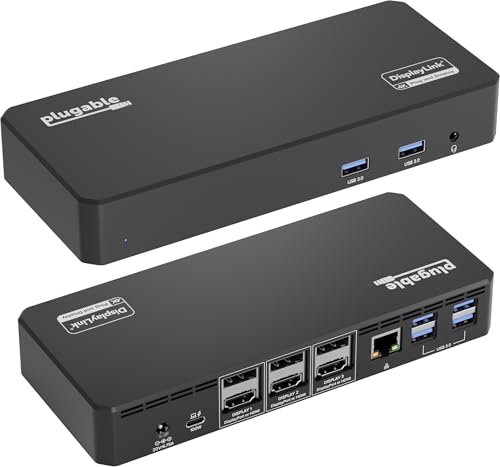
Plugable 12-in-1 USB-C Triple Monitor Docking Station (Best Overall for Multiple Monitors)
The Plugable 12-in-1 USB-C Triple Monitor Docking Station takes the Best Overall for Multiple Monitors badge because it solves this keyword’s core problem — screens, power and peripherals through one cable — more completely than the alternatives checked against it. That does not make it right for every laptop; its trade-offs are listed as plainly as its strengths.
See the Plugable 12-in-1 USB-C Triple Monitor Docking Station on Amazon
Strengths
- The practical route to three external monitors — including on laptops that natively support fewer
- 100W charging plus Ethernet plus six USB ports make it a complete desk hub
- Choice of HDMI or DisplayPort outputs matches mixed monitor fleets
Trade-offs
- DisplayLink compression is fine for office work but not for high-refresh gaming on the extra screens
- Requires driver installation, which some locked-down work laptops forbid
- One host at a time — it is a dock, not a two-computer KVM switch
Key specs
- Triple 4K display support via 3x HDMI or 3x DisplayPort
- 100W laptop charging
- 6x USB ports and Gigabit Ethernet
- Works with Mac, Windows, Thunderbolt, USB4 and USB-C hosts
- DisplayLink-based multi-display support
In daily use, the Plugable 12-in-1 USB-C Triple Monitor Docking Station is defined by the thirty seconds it saves you every morning: sit down, one cable, every screen wakes where you left it. Readers searching for best laptop docking station for multiple monitors usually have one laptop and one desk in mind, and this pick’s value is that it joins them without negotiation — no adapter hunt, no second charger, no peripheral that only works on alternate days.
Where it sits in the range matters too. Against cheaper docks it justifies itself with display headroom and charging power that survive your next laptop; against pricier docks it concedes ports or network speed your desk may never call on. That balance is exactly why it holds its badge.
Best for: laptop owners who want one cable to connect the whole desk / Not suited for: gamers wanting high refresh on the extra screens, and locked-down work laptops that forbid drivers

Plugable 13-in-1 USB-C Triple Monitor Docking Station (Best Triple-HDMI Dock)
Every roundup needs a pick that defines its category, and for the Best Triple-HDMI Dock slot that is the Plugable 13-in-1 USB-C Triple Monitor Docking Station. Its port list only tells half the story; the other half is how those ports behave at 9am on a Monday with every screen lit, which is what follows.
See the Plugable 13-in-1 USB-C Triple Monitor Docking Station on Amazon
Strengths
- Three HDMI outputs suit desks that standardised on HDMI monitors
- SD reader and front fast-charge port cover creator and phone habits the 12-in-1 skips
- Same triple-display trick for base-model laptops that cannot natively drive three screens
Trade-offs
- HDMI-only display outputs — DisplayPort monitor owners need adapters
- DisplayLink caveats apply: office yes, competitive gaming no
- Large brick and cable count demand under-desk management
Key specs
- Triple-monitor support via 3x HDMI outputs
- 100W laptop charging and 20W USB-C device charging
- 6x USB ports, Ethernet and SD card reader
- Compatible with Windows and Mac USB-C/Thunderbolt laptops
- 20W front USB-C fast-charging for phones
Judge the Plugable 13-in-1 USB-C Triple Monitor Docking Station on the whole desk, not the port count. Its display outputs decide your screens’ resolutions, its charging decides whether the laptop’s own brick stays in a drawer, and its port layout decides whether the front of your desk stays civilised. On the job it was chosen for, it behaves exactly as infrastructure should: installed once, then invisible.
Ownership details round out the case. Firmware updates, cable length to your laptop’s port side, and heat in its resting place are all recorded in the trade-offs where they bite. On balance, this one earns trust — with the stated exceptions, which the verdict makes explicit.
Best for: laptop owners who want one cable to connect the whole desk / Not suited for: DisplayPort-only monitor owners and high-refresh gamers
CalDigit TS4 Thunderbolt 4 Dock (Best Premium Thunderbolt Dock)
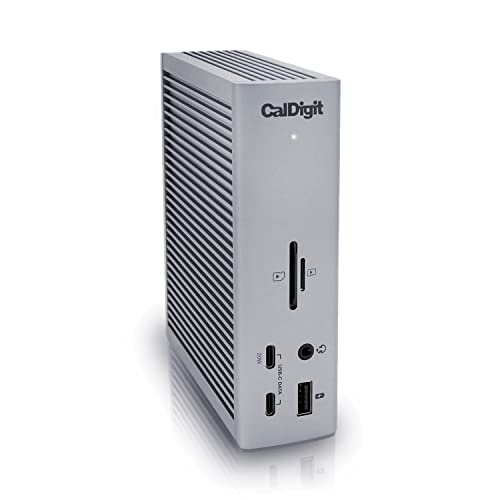
Start with the job this dock does better than any other in the roundup. As the Best Premium Thunderbolt Dock, the CalDigit TS4 Thunderbolt 4 Dock earns its place for readers whose laptop and screen count match its badge — and the sections below stay specific, because a dock is the invisible centre of a desk and vague praise helps nobody.
See the CalDigit TS4 Thunderbolt 4 Dock on Amazon
Strengths
- The dock that ends port maths: 98W charging, fast storage, 2.5GbE and dual high-resolution displays in one box
- Thunderbolt 4 host ports on the front and back keep desk cabling sane
- Consistent dual-display behaviour on Mac and Windows is its party trick
Trade-offs
- Premium tier — costs as much as a decent monitor
- Single-cable display counts still depend on your laptop’s own limits (notably base Apple silicon)
- No built-in KVM switching between two computers; it docks one host at a time
Key specs
- 18 ports including 3x Thunderbolt 4 (40Gb/s)
- 98W laptop charging
- 3x USB-C and 5x USB-A at 10Gb/s, 2.5GbE Ethernet
- Drives 8K at 30Hz or dual 6K at 60Hz displays
- Mac, Windows and ChromeOS compatible, 0.8m cable included
Consider how the CalDigit TS4 Thunderbolt 4 Dock pairs with the rest of a real desk. Its outputs decide whether your monitors connect directly or through adapters; its wattage decides which laptops it can honestly serve; its Ethernet and audio decide which dongles retire. Judged as a component rather than a trophy, it integrates cleanly into normal hybrid-work desks — the desks most readers actually have.
The honest summary is that this pick trades extremes for completeness. It is rarely the cheapest or the most port-laden dock in this guide, and for the reader matched to its badge it does not need to be. It needs to wake the desk, every day, with one cable — and on the evidence of its specification and design, it does.
Best for: laptop owners who want one cable to connect the whole desk / Not suited for: budget-led buyers and anyone who needs to switch one desk between two computers

CalDigit TS3 Plus Thunderbolt 3 Dock (Best Thunderbolt 3 Value)
The CalDigit TS3 Plus Thunderbolt 3 Dock takes the Best Thunderbolt 3 Value badge because it solves this keyword’s core problem — screens, power and peripherals through one cable — more completely than the alternatives checked against it. That does not make it right for every laptop; its trade-offs are listed as plainly as its strengths.
See the CalDigit TS3 Plus Thunderbolt 3 Dock on Amazon
Strengths
- A proven, stable dual-display dock for Thunderbolt 3 Macs and PCs at a lower tier than the TS4
- Fast UHS-II card slot is a genuine workflow win for photographers
- 85W charging covers most ultrabooks and MacBook Pro models
Trade-offs
- Thunderbolt 3 generation — slower USB and networking than the TS4
- Dual-display support on M-series Macs follows Apple’s own limits
- Design and port layout are older; front access is limited
Key specs
- Thunderbolt 3 dock with 85W laptop charging
- 7x USB 3.1 ports and USB-C Gen 2
- DisplayPort output plus Thunderbolt display pass-through
- UHS-II SD card slot and Gigabit Ethernet
- Optical audio output, for 2016+ MacBook Pro and PC
In daily use, the CalDigit TS3 Plus Thunderbolt 3 Dock is defined by the thirty seconds it saves you every morning: sit down, one cable, every screen wakes where you left it. Readers searching for best laptop docking station for multiple monitors usually have one laptop and one desk in mind, and this pick’s value is that it joins them without negotiation — no adapter hunt, no second charger, no peripheral that only works on alternate days.
Where it sits in the range matters too. Against cheaper docks it justifies itself with display headroom and charging power that survive your next laptop; against pricier docks it concedes ports or network speed your desk may never call on. That balance is exactly why it holds its badge.
Best for: laptop owners who want one cable to connect the whole desk / Not suited for: users who need the fastest modern USB and networking speeds

GIGABYTE M27Q Gaming Monitor (Best Monitor with Built-In KVM)
Every roundup needs a pick that defines its category, and for the Best Monitor with Built-In KVM slot that is the GIGABYTE M27Q Gaming Monitor. Its port list only tells half the story; the other half is how those ports behave at 9am on a Monday with every screen lit, which is what follows.
See the GIGABYTE M27Q Gaming Monitor on Amazon
Strengths
- Built-in KVM is the headline: one keyboard and mouse control a desktop and a laptop through this screen
- Fast IPS motion plus wide DCI-P3 colour covers gaming and content work equally well
- 165Hz QHD remains the best-balanced resolution and refresh pairing for mid-range GPUs
Trade-offs
- HDMI ports are 2.0, so consoles cannot use the panel’s full refresh at QHD the way a PC on DisplayPort can
- HDR is entry-level despite the wide gamut
- USB-C video support varies by revision — check the exact listing before relying on it
Key specs
- 27-inch QHD (2560 x 1440) Super Speed IPS panel
- 165Hz refresh rate, 0.5ms MPRT response
- 92% DCI-P3 colour coverage
- Built-in KVM switch with USB ports
- AMD FreeSync Premium, DisplayPort 1.2 and 2x HDMI 2.0
Judge the GIGABYTE M27Q Gaming Monitor on the whole desk, not the port count. Its display outputs decide your screens’ resolutions, its charging decides whether the laptop’s own brick stays in a drawer, and its port layout decides whether the front of your desk stays civilised. On the job it was chosen for, it behaves exactly as infrastructure should: installed once, then invisible.
Ownership details round out the case. Firmware updates, cable length to your laptop’s port side, and heat in its resting place are all recorded in the trade-offs where they bite. On balance, this one earns trust — with the stated exceptions, which the verdict makes explicit.
Best for: readers matched to this badge who want a screen that disappears into the work / Not suited for: console players who need full high-refresh over HDMI, and buyers wanting strong HDR

Dell UltraSharp 27 4K USB-C Hub Monitor U2723QE (Best Hub Monitor Route)
Start with the job this dock does better than any other in the roundup. As the Best Hub Monitor Route, the Dell UltraSharp 27 4K USB-C Hub Monitor U2723QE earns its place for readers whose laptop and screen count match its badge — and the sections below stay specific, because a dock is the invisible centre of a desk and vague praise helps nobody.
See the Dell UltraSharp 27 4K USB-C Hub Monitor U2723QE on Amazon
Strengths
- A true one-cable desk: video, data, network and laptop charging through a single USB-C connection
- IPS Black panel delivers noticeably deeper contrast than standard IPS for text and photo work
- Excellent factory calibration and uniformity make it trustworthy for colour-sensitive documents and images
Trade-offs
- 60Hz-class panel — the wrong choice if high-refresh gaming is a priority
- Premium positioning reflects the hub hardware; pure display-only buyers pay for ports they may not use
- No built-in camera or speakers to complete the all-in-one desk idea
Key specs
- 27-inch 4K UHD (3840 x 2160) IPS Black panel
- USB-C hub with docking and daisy-chain support
- RJ45 Ethernet pass-through via the hub
- Factory-calibrated colour for office and creative work
- Full ergonomic stand with height, tilt, swivel and pivot
Consider how the Dell UltraSharp 27 4K USB-C Hub Monitor U2723QE pairs with the rest of a real desk. Its outputs decide whether your monitors connect directly or through adapters; its wattage decides which laptops it can honestly serve; its Ethernet and audio decide which dongles retire. Judged as a component rather than a trophy, it integrates cleanly into normal hybrid-work desks — the desks most readers actually have.
The honest summary is that this pick trades extremes for completeness. It is rarely the cheapest or the most port-laden dock in this guide, and for the reader matched to its badge it does not need to be. It needs to wake the desk, every day, with one cable — and on the evidence of its specification and design, it does.
Best for: readers matched to this badge who want a screen that disappears into the work / Not suited for: high-refresh gamers — this is a 60Hz-class productivity panel
Comparison Table
| Pick | Badge | Key specification | Standout strength | Price |
|---|---|---|---|---|
| Plugable 12-in-1 USB-C Triple Monitor Docking Station | Best Overall for Multiple Monitors | Triple 4K display support via 3x HDMI or 3x DisplayPort | The practical route to three external monitors — including on laptops that natively support fewer | Check price on Amazon |
| Plugable 13-in-1 USB-C Triple Monitor Docking Station | Best Triple-HDMI Dock | Triple-monitor support via 3x HDMI outputs | Three HDMI outputs suit desks that standardised on HDMI monitors | Check price on Amazon |
| CalDigit TS4 Thunderbolt 4 Dock | Best Premium Thunderbolt Dock | 18 ports including 3x Thunderbolt 4 (40Gb/s) | The dock that ends port maths: 98W charging, fast storage, 2.5GbE and dual high-resolution displays in one box | Check price on Amazon |
| CalDigit TS3 Plus Thunderbolt 3 Dock | Best Thunderbolt 3 Value | Thunderbolt 3 dock with 85W laptop charging | A proven, stable dual-display dock for Thunderbolt 3 Macs and PCs at a lower tier than the TS4 | Check price on Amazon |
| GIGABYTE M27Q Gaming Monitor | Best Monitor with Built-In KVM | 27-inch QHD (2560 x 1440) Super Speed IPS panel | Built-in KVM is the headline: one keyboard and mouse control a desktop and a laptop through this screen | Check price on Amazon |
| Dell UltraSharp 27 4K USB-C Hub Monitor U2723QE | Best Hub Monitor Route | 27-inch 4K UHD (3840 x 2160) IPS Black panel | A true one-cable desk: video, data, network and laptop charging through a single USB-C connection | Check price on Amazon |
How to Choose the Right Docking Station
The reviews above make the decision if your needs match a badge. This guide exists for everyone else — and for readers who want to understand why the badges landed where they did. Work through the factors in order; the first one that strongly discriminates between your finalists is usually your answer. Related guidance in Best Computer Desk For Multiple Monitors covers neighbouring desk decisions in the same detail.
Dock, hub monitor or KVM: pick the architecture
Three architectures solve the same desk. A dock centralises everything in one box — most flexible, most cables. A hub monitor folds the dock into the screen — cleanest desk, and the monitor outlives the dock’s standards. A KVM switch serves two computers sharing one desk — a different problem entirely. This guide includes all three where they honestly fit the keyword, badged by architecture, because the right answer depends on whether your desk has one laptop, one desktop, or both.
Display count and your laptop’s limits
The dock does not decide your screen count alone — your laptop’s chip does. Most Windows and Thunderbolt laptops drive two external displays natively; base Apple silicon models officially drive one, which is why DisplayLink docks exist: they add screens over USB data where the native path stops. Before choosing, confirm your exact laptop’s external display limit from its maker’s specification, then pick the dock family — native Thunderbolt or DisplayLink — that honestly reaches your target count.
Thunderbolt, USB-C and DisplayLink explained
Thunderbolt docks pass native display signals: full resolution, full refresh, no compression — the right choice when a gaming or high-refresh screen is in the array. Plain USB-C docks rely on DisplayPort alt mode and share the same native behaviour with fewer ports. DisplayLink docks compress video over data: perfect for office screens, documents and dashboards, wrong for fast gaming or colour-critical video on the extra panels. Many triple-screen docks mix both: native for the main screen, DisplayLink for the companions.
Charging wattage
A dock that cannot charge your laptop under load is a dock plus a brick. Ultrabooks sip 45-65W; performance laptops want 90W and above; anything less and the battery quietly drains during heavy work. Match the dock’s delivered wattage — not its adapter’s size — to your laptop’s specification, and remember that phones and tablets charging from the same dock borrow from the same budget on some designs.
Ports, layout and front access
Count your permanent peripherals: keyboard, mouse, webcam, headset, storage, a printer perhaps. Those belong on the dock’s rear ports, cabled once and forgotten. Front ports serve the temporary — a phone cable, a card reader, a USB stick. SD readers matter to creators more than any other single port; Ethernet matters to anyone whose video calls freeze on Wi-Fi. Layout is a daily-quality feature disguised as a specification.
What ‘future-proof’ honestly means here
In this category, future-proofing is not a faster chip — it is a spare. One spare display output beyond today’s array, one input standard beyond today’s laptop, one arm position beyond today’s third screen. Standards will change regardless; the DisplayPort and Thunderbolt generations in this guide will be succeeded on schedule. What survives is headroom, and headroom is cheap exactly once: at the first purchase. Every pick here was scored partly on that spare capacity, because the second purchase is always the expensive one.
The photograph test
Take a photograph of your finished setup from the doorway — the view everyone else gets — and one from your chair. The doorway view exposes cable discipline and alignment; the chair view exposes screen heights, bezel steps and glare. Professional-looking setups pass both. It sounds cosmetic, but the photograph test catches the functional faults too: the screen two degrees off-axis, the dock stranded behind a panel, the power strip glowing in the dark corner. Fix what the photographs show before the final cable ties, and the setup will look — and work — like it was installed by someone who does this for a living.
Draw the desk before you buy it
Multi-monitor regrets are almost always drawn, not bought: a dock with the wrong display family, a laptop one screen short of the plan, cables two feet too short. Sketch the desk — laptop position, each screen, every peripheral, the power strip — and count the runs before ordering anything. The guides linked in this article cover neighbouring layouts; five minutes with a pencil beats a week of returns.
Weight and watts: the two budgets
Every desk setup balances two invisible budgets. Watts: the dock’s charging against the laptop’s appetite, the strip’s capacity against everything plugged into it. Weight: arms and stands against their limits, shelves against their loads. Setups fail quietly when either budget is ignored — a battery that fades by Friday, an arm that sinks by spring. The picks here publish both numbers; use them before you buy, not after you notice.
Alignment is a patience exercise
Three screens that almost line up are worse than two that do: the cursor snags on every crossing and your neck finds the step a hundred times a day. Align tops first with the stands or arms unloaded of cables, set heights with a level or a phone app, then cable with enough slack that alignment survives a nudge. Perfection is not required — consistency is. A layout you stop noticing is a layout done right.
Cables decide whether it looks built
The difference between a setup that looks engineered and one that looks assembled is entirely behind the screens. Route display cables through arm channels, bundle power separately from data, label both ends of every run, and leave one service loop per moving part. Order cables at the lengths the drawing says — excess cable is clutter, short cable is a rebuild. This is the hour that makes visitors ask who installed your desk.
Leave one hand free: access and reach
Anything you touch daily — the dock’s power button, the switch, the front USB port — must be reachable without moving a monitor. Place the dock or switch before the screens go up, at the edge of the desk your dominant hand owns. Setups designed around their photographs strand their controls behind panels; setups designed around their owners keep them under a fingertip.
The upgrade you will want in a year
Desks evolve: a bigger main screen, a second computer, a laptop refresh with different ports. Buying the dock or arm with one display of headroom, one output standard in reserve, is the cheapest future-proofing in this category. The picks here were scored partly on that headroom, because the cost of a setup is not its first invoice — it is the second one you did not plan.
Heat hides under desks
Docks, power bricks and desktop PCs all shed heat into the same trapped air under a desk, and multi-screen arrays add their own warmth behind the panels. Leave ventilation gaps, keep bricks out of sealed cable boxes, and let a dock sit where air moves. Heat is the slow cause of the dropouts people blame on drivers; a setup that breathes rarely misbehaves.
Label it like you will forget it
In six months you will not remember which cable feeds which screen, and neither will anyone helping you. Label both ends of every run with its source and destination the day you install it. The first time you swap one component — a laptop, a screen, a dock — those labels repay the ten minutes they took, with interest, at midnight, under the desk, by phone light.
The wake-up test is the real review
Judge any dock or mount setup by one moment: the morning wake. Screens that light in order, at their saved resolutions, with peripherals alive before you touch the keyboard — that is a setup working. Setups that renegotiate one display twice a week are telling you something specific: a cable at its bandwidth edge, a dock short on firmware care, a port being asked past its standard. The picks in this guide were chosen to pass the wake-up test boringly, every day, because boring is the highest praise infrastructure can earn.
Firmware is a feature, quietly
Docks and hub monitors are small computers, and their makers’ firmware habits decide their third year. A dock whose maker publishes fixes for new laptop generations keeps working across your next machine change; one abandoned at launch becomes a compatibility lottery. The same logic applies to monitor arms in mechanical form: replaceable bushings, available tension parts, a maker that still answers. None of this appears on a spec sheet’s front page, and all of it appears in this guide’s trade-offs where it matters.
One desk, two computers, honestly
Many readers of a multi-monitor guide secretly run two machines — a work laptop and a personal desktop, or a laptop and a console-adjacent PC. Be honest about that second machine at buying time. A dock serves one host beautifully; a KVM serves two deliberately; a hub monitor with a KVM inside serves the pair with the least hardware of all. Retrofitting the second machine into a one-host desk is how cable nests are born. The architecture section of the buying guide exists to make that call once, correctly.
Rent the setup before you own it
Before the final cable ties, run any new dock or mount arrangement loose for a full working week. Screen roles migrate — the chat screen wants to be left, not right; the dock’s front port faces the wrong chair; one arm needs its base two inches along the edge. A week of real work reveals all of it while every change is still free. The setups that look professionally installed in month two are the ones that were deliberately unfinished in week one.
Power strips are part of the design
Every component in this guide ultimately reports to one unglamorous box: the power strip. Size it for the whole desk — dock brick, monitor leads, laptop spare, lamp — mount it under the rear edge where its switch stays reachable, and feed it from a wall socket you do not share with a heater or kettle. Setups with mysterious dropouts are disproportionately setups with overloaded, daisy-chained power. It is the cheapest component in the array and the one most worth buying well.
Small screens, side quests
Not every position in a multi-screen desk needs a hero product. The chat screen, the monitoring dashboard, the reference document panel — these are jobs where a modest panel on a simple arm outperforms a flagship on a fixed stand, because position matters more than pedigree. The picks in this guide deliberately span that range, and the badges tell you which positions each product is honestly for. Spend on the centre; economise at the wings; never confuse the two budgets.
Write down your own setup
The final step of any install in this guide is documentation only you can write: which cable feeds which screen, which port the dock reserves for the gaming panel, the tension settings that finally held. Two minutes in a notes app, photographed labels on the cables themselves. Setups are forgotten at exactly the speed life happens; the written version is what turns a midnight fault from a rebuild into a five-minute fix. It is unglamorous, and it is the difference between owning a system and hosting a mystery.
The second laptop always arrives
Desks planned for one laptop meet a second one with near-certainty: a work machine joins the personal one, a partner’s laptop colonises the spare screen, a child’s school laptop needs the big display for a project. The setups that absorb that arrival gracefully are the ones with a spare input on the main screen, a dock architecture that was chosen knowing its one-host limit, or a KVM quietly designed into the plan. When you read the architecture section of this guide, read it as insurance against a purchase you cannot yet describe.
How Do You Set Up a Multi-Monitor Docking Station Step by Step?
Setup is where good purchases become good desks. Follow these steps in order, and keep Best Computer Desk For Dual Monitors in mind if your arrangement grows beyond its first form.
- Map the desk before buying cables. Sketch which computer drives which screen, where the keyboard, mouse, webcam and headset live, and how many HDMI, DisplayPort and USB runs the plan needs. KVM regrets are almost always cable-count regrets.
- Mount the screens and switch. Position the monitors, then place the KVM switch or dock within easy reach of its button or remote — you will press it daily.
- Wire displays first. Connect each computer’s video outputs to the switch inputs, then the switch outputs to the monitors, using certified cables rated for your resolution and refresh.
- Wire USB and audio. Run each computer’s USB connection to the switch, then attach keyboard, mouse and shared peripherals. Connect headset audio if your switch passes it through.
- Power up in order. Monitors first, then the switch or dock, then the computers. This order gives EDID handshakes the best chance of landing every screen at its native resolution.
- Test switching under load. Switch back and forth with real windows open. Confirm resolutions hold, windows stay put where EDID is supported, and peripherals reappear within a few seconds.
- Label everything. Label each cable at both ends with its computer and screen. The first time you change one component, the labels repay the ten minutes they took.
Troubleshooting quick list
- Problem: Windows rearrange after switching → fix: use a switch with EDID emulation, or accept and automate window positions with your operating system’s layout tools.
- Problem: Second screen stays dark → fix: check that the computer’s port can drive two displays at all, and that the cable run uses the switch input pair for the same computer.
- Problem: Peripherals lag or drop → fix: move wireless receivers to a front USB port on the switch with a short extension, away from USB 3.0 interference.
Common Mistakes
Forgetting work-laptop driver rules. DisplayLink needs a driver install. Locked-down corporate laptops may forbid it, which turns a triple-screen dock into an expensive paperweight. Check before ordering for a work machine.
Hiding the dock where heat builds. Docks are small computers that run warm under full load. A closed drawer or a cable box with no airflow shortens their life and invites dropouts. Give the dock air.
Assuming any USB-C dock drives three screens. Screen count is set by the dock’s display design and your laptop’s chip together. A handsome dock with two display outputs will never run three screens, whatever its port total says.
Ignoring base-Mac display limits. Base Apple silicon laptops officially support one native external display. Only a DisplayLink dock — or a hub arrangement built for it — honestly reaches two or three. Buying a native-only dock for a base Mac is the category’s most common regret.
Underpowered charging. A 60W dock under a 90W laptop means a battery that fades through heavy afternoons. Match delivered wattage to the laptop’s specification, not to the dock’s marketing.
Gaming through DisplayLink. DisplayLink compression is invisible in documents and wrong for fast games. If one of your screens is a gaming panel, it belongs on a native output — plan the dock around that screen first.
Final Recommendation
If you only read one paragraph, read this one. For best laptop docking station for multiple monitors, the shortlist resolves to: Plugable 12-in-1 USB-C Triple Monitor Docking Station (Best Overall for Multiple Monitors); Plugable 13-in-1 USB-C Triple Monitor Docking Station (Best Triple-HDMI Dock); CalDigit TS4 Thunderbolt 4 Dock (Best Premium Thunderbolt Dock). The first is the default recommendation for the broadest set of readers; the second and third win their specific badges for the reasons detailed above. Everything else in the top six is a specialist alternative for a defined reader, not a runner-up.
Buy the pick whose badge matches your actual week — your real machines, your real room, your real work — rather than the pick with the most impressive specification sheet. Then set it up properly using the steps above, check it thoroughly in the first days while exchanges are easy, and expect it to serve for years. Readers still torn between two finalists should revisit Best Dual Monitors For Business and the comparison table: the deciding factor is almost always a trade-off line, not a headline specification.
Frequently Asked Questions
Short answers to the questions readers ask most about this category. For a neighbouring use case, see Best Computer Monitors For Stock Trading.
Can one dock run three monitors from any laptop?
From most laptops, yes — with the right dock family. Thunderbolt laptops with two native displays reach three via a dock that adds a DisplayLink path; base Apple silicon laptops reach two or three external screens only through DisplayLink docks like the triple-display picks in this guide. The laptop’s chip sets the ceiling; the dock decides whether you reach it.
Will a dock charge my laptop too?
Almost every pick here delivers power over the same cable as video and data — 85W to 100W on the docks in this guide. Check the figure against your laptop’s requirement: ultrabooks are easily covered, while large performance laptops may still want their own adapter for sustained heavy loads.
Dock or hub monitor — which is cleaner?
A hub monitor is cleaner: the dock lives inside the screen, one cable reaches the laptop, and peripherals plug into the display. A separate dock is more flexible and survives monitor upgrades. Desks that change laptops often usually prefer the dock; desks built around one beloved screen prefer the hub monitor.
What size monitor is best for most desks?
For most readers, 27 inches is the safest answer: large enough for two windows, small enough for a standard desk, and available at every resolution and refresh tier. Choose 24 inches for compact desks, competitive gaming or tight budgets, and 32 inches or an ultrawide when documents, data or immersion dominate and your desk depth allows the screen to sit at a comfortable distance.
Is QHD or 4K the better choice?
QHD at 27 inches is the balanced pick for mixed work and gaming — sharp, spacious and easy to drive. 4K earns its premium for text-heavy work, photo and video editing, and larger screens where its extra clarity stays visible. If your graphics card or console cannot feed 4K at the frame rates you want, QHD is not a compromise; it is the correct specification for your hardware.


