Disclosure: As an Amazon Associate, ilcastellomenu.com earns from qualifying purchases. Links on this page are affiliate links; they cost you nothing extra. Prices and availability change often, so check the current Amazon listing before you buy.
Reading office chair wheels reviews one listing at a time is a slow way to learn what owners actually discover, because the same lessons repeat across almost every set on the market. The wheels that get praised are praised for the same three things — a quieter roll, a kinder relationship with hard floors, and a chair that finally moves the way it should. The wheels that get returned are returned for the same two reasons — a stem that did not fit, and a chair that rolled away more freely than its owner wanted. This roundup-style review pulls those patterns together across the main replacement sets, so you can shop the category with the lessons of other people’s purchases already learned. As throughout this cluster, products are described in prose and positioned by tier, with no invented figures attached to any set.
Key Takeaways
- Across owner experience, the pattern is consistent: fit decides success before wheel quality gets a chance to.
- Rollerblade-style sets dominate the praise for hard floors; soft twin-wheel sets win on familiarity and a planted feel.
- The recurring complaints are stem mismatches — IKEA chairs above all — and unexpected roll-away on uneven hard floors.
- Hair and grit neglect, not wheel quality, explain most reports of wheels that stopped rolling well.
- Buy the full set, measure first, and keep the old casters until the new feel has won you over.
In this guide
Office Chair Wheels Reviews: What Owners Consistently Report
The most useful thing a roundup can do is separate the signal from the noise. The signal, across the category, is remarkably stable. Owners who measured their stems and bought a matching set report a transformation that sounds exaggerated until you remember what they started from: a chair that rattled over every seam now glides; a floor that was quietly being sanded by hard casters is left alone; a desk setup feels calmer. Owners who skipped the measuring step report a different, shorter story that ends with a returns label. In other words, the reviews of these products are really reviews of the buying process. The wheels themselves, from reputable sets, are consistently decent. Whether they delight or disappoint depends almost entirely on decisions made before the box was opened — which is excellent news, because those decisions are entirely within your control.
The Category at a Glance: Two Designs, Three Tiers
Start with the honest core of this whole topic, because marketing rarely leads with it. The standard hard twin-wheel casters fitted to most office chairs are the ones that chew up hardwood. Each small, hard wheel concentrates your weight, plus the weight of the chair, onto a tiny contact patch, and every roll drags that hard edge across the finish. Add the grit that daily life supplies — dust, crumbs, tiny stones tracked in from outside — and the wheel effectively becomes a small grinding tool, pressing abrasive particles into the surface as it turns. The damage rarely appears in a week. It shows up over months as a dull, scuffed arc in front of the desk, exactly where the chair travels most, and by the time it is obvious the finish in that arc is already worn.
Noise is the second half of the floor story, and it is the one people notice first. Hard twin-wheel casters rattle. On hardwood, laminate or tile, every seam, board gap and grout line is announced, and in a flat, a shared house or a home office next to a sleeping baby’s room, that clatter becomes part of the soundscape of the working day. Softer rollerblade-style wheels roll noticeably smoother and quieter in qualitative terms — the rattle becomes a muted roll, and the small shocks that used to travel up through the chair frame largely disappear. We deliberately put no number on that difference here, because honest comparisons depend on the floor, the chair and the room. What can be said plainly is that almost everyone who swaps reports the quiet as the change they would least give back.
Within the two designs — rollerblade-style single wheels and soft twin wheels — the market arranges itself into rough tiers. Entry-tier sets exist to replace broken casters cheaply and do it adequately. Mid-tier sets are where most of the names in this roundup sit, and where the balance of roll quality, finish and fit support is strongest. Premium-leaning sets charge more for build feel and presentation. The reviews pattern follows the tiers loosely: disappointment clusters at the very bottom, where stems are vaguest and materials cheapest, while the mid tier collects the bulk of the satisfied long-term reports. That is the practical takeaway of this section — in this category, the middle of the market is not a compromise. It is the sweet spot the owner evidence keeps pointing to.
The Sets, Reviewed Together
These five sets are reviewed as a group because that is how owners actually choose — comparing near-neighbours, not reading one listing in isolation.
Lifelong Office Chair Wheels
The Lifelong set is the reference point for this whole category. The wheel itself is a single large rollerblade-style wheel rather than the paired small wheels of a stock caster, and that one change explains most of what owners notice: the chair tracks straighter, starts moving with less of a shove, and crosses small floor imperfections — a rug edge, a cable, the lip between boards — without the clatter and catch that hard twin wheels produce. The stem is the standard grip-ring style used by most mainstream office chairs, which is why this set fits so many chairs, but standard is not universal, and the measuring advice later in this article applies to this set exactly as much as to any other. In prose terms it sits in the mid tier of the category: not the cheapest way to replace a broken caster, and not priced or presented as a boutique part either.
Best for: readers who want the widely bought rollerblade-style set that most people picture when they first search for an upgrade. Not suited for: anyone who has not yet measured their chair stems, or whose chair uses a non-standard stem fitting. This pick is described in prose only in this draft, positioned by tier rather than by a fixed price, so check the current Amazon listing before you buy.
Office Owl Rollerblade Style Chair Wheels
Office Owl sells its rollerblade-style wheels on the same core promise — a softer, larger wheel that treats floors more kindly and rolls more quietly than the hard plastic casters a chair ships with. In day-to-day use the character is similar to the other rollerblade-style sets here: easy starts, a calmer roll across hard floors, and a chair that feels less reluctant to move in small adjustments. Where sets like this differ from one another is mostly in finish, in how the stem is presented and supported, and in the small print about which chairs are excluded. Treat the headline compatibility claims cautiously, measure your own stems, and this is a sensible mid-tier candidate for a hardwood or laminate home office.
Best for: readers who want a rollerblade-style set sold as a floor-friendly replacement for standard twin-wheel casters. Not suited for: anyone who has not yet measured their chair stems, or whose chair uses a non-standard stem fitting. This pick is described in prose only in this draft, positioned by tier rather than by a fixed price, so check the current Amazon listing before you buy.
Slipstick Caster Wheels
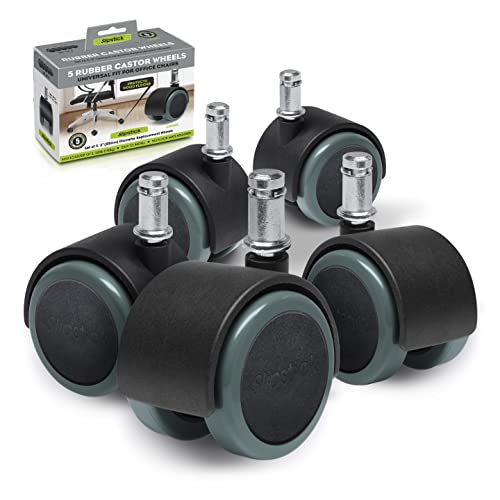
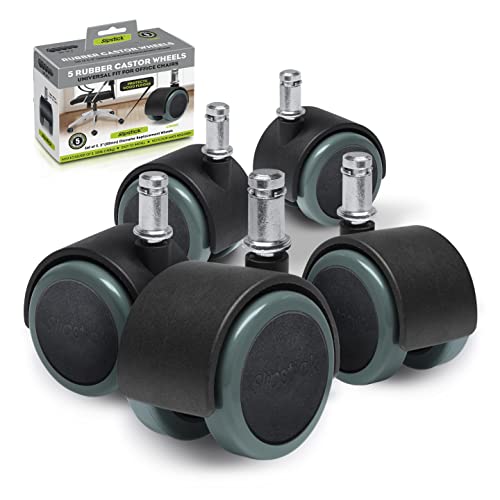
Slipstick takes a different route from the rollerblade-style sets. Its caster wheels keep a more conventional twin-wheel silhouette but use a softer wheel material intended to be gentler on hard floors than the hard plastic originals. That matters for people who do not want the taller ride height or the freer roll of a big single wheel, and for chairs that live partly on carpet, where a very free-rolling wheel can feel vague. Slipstick is a name many people already know from furniture floor protectors, and that floor-first thinking shows in how this set is positioned. It sits toward the entry-to-mid tier, and it is the pick in this group that changes the feel of the chair the least while still addressing the floor-damage complaint.
Best for: readers who want a softer twin-wheel style option from a brand better known for floor-protection furniture pads. Not suited for: anyone who has not yet measured their chair stems, or whose chair uses a non-standard stem fitting. This pick is described in prose only in this draft, positioned by tier rather than by a fixed price, so check the current Amazon listing before you buy.
SunnieDog Office Chair Wheels
SunnieDog’s chair wheels are another rollerblade-style set, aimed squarely at the home-office upgrader who wants the smoother, quieter roll without turning the purchase into a research project. The experience matches the style: the chair glides rather than rattles, small direction changes take less effort, and hard floors are treated more gently than they are by stock hard casters. As with every set here, the real buying work is not choosing between near-identical wheels — it is confirming your stem type and size before you order, because a beautifully made wheel on the wrong stem is simply a return waiting to happen. Positioned in the mid tier, it competes on overall value and presentation rather than on any single dramatic feature.
Best for: readers who want a rollerblade-style set positioned as a quiet, smooth-rolling everyday upgrade. Not suited for: anyone who has not yet measured their chair stems, or whose chair uses a non-standard stem fitting. This pick is described in prose only in this draft, positioned by tier rather than by a fixed price, so check the current Amazon listing before you buy.

Stealtho Office Chair Wheels
Stealtho is the premium-leaning name in this group. Its office chair wheels use the same rollerblade-style layout, presented with more emphasis on build quality, finish and the feel of the roll itself. Whether that emphasis is worth stepping up a tier depends on how much of your working day is spent moving in the chair and how much you care about the small difference between a wheel that rolls well and a wheel that rolls beautifully. The compatibility story is the familiar one — a standard grip-ring stem fits a great many chairs and still not all of them — so the measuring steps matter just as much here. Buy it for the feel and the finish, not because a premium badge exempts you from checking fit.
Best for: readers who want a premium-leaning rollerblade-style set marketed on build feel and smooth rolling. Not suited for: anyone who has not yet measured their chair stems, or whose chair uses a non-standard stem fitting. This pick is described in prose only in this draft, positioned by tier rather than by a fixed price, so check the current Amazon listing before you buy.
Performance Patterns in Real Use
Hard Floors: Where the Praise Concentrates
Softer wheels change that equation in a simple, physical way. A larger, softer wheel spreads the load over a bigger contact area and deforms slightly instead of digging in, so the same grit is far less likely to be ground into the finish. Rollerblade-style wheels add a second benefit: because the wheel is larger, it rolls over small debris and floor imperfections instead of stopping against them and skidding. A skid is where much of the scratching happens — a locked or dragging hard wheel scrapes. A wheel that keeps turning does far less harm. None of this makes any wheel magically floor-proof, and a soft wheel rolling through grit all day will still leave marks eventually, which is why the cleaning habits covered later matter. But the direction of travel is clear: softer and larger is kinder to hard floors than smaller and harder.
Noise is the second half of the floor story, and it is the one people notice first. Hard twin-wheel casters rattle. On hardwood, laminate or tile, every seam, board gap and grout line is announced, and in a flat, a shared house or a home office next to a sleeping baby’s room, that clatter becomes part of the soundscape of the working day. Softer rollerblade-style wheels roll noticeably smoother and quieter in qualitative terms — the rattle becomes a muted roll, and the small shocks that used to travel up through the chair frame largely disappear. We deliberately put no number on that difference here, because honest comparisons depend on the floor, the chair and the room. What can be said plainly is that almost everyone who swaps reports the quiet as the change they would least give back.
Carpet and Mats: The Mixed Reports Explained
Carpet changes the calculation. On deep carpet, the problem with stock casters is usually not damage — it is effort. Small hard wheels sink into the pile and the chair feels like it is being dragged through sand, which is why so many carpeted offices end up with a plastic chair mat. Larger wheels roll over pile more easily, and a rollerblade-style wheel can make a medium-pile carpet feel surprisingly manageable. On very deep pile, though, any wheel is fighting the floor, and a chair mat remains the honest answer for people who move a lot during the day. Be aware, too, that the mat question cuts both ways: if you already use a mat over hardwood, your current casters may not be touching the wood at all, which changes how urgent a wheel upgrade really is for floor protection alone.
Roll-Away: The Complaint That Is Really a Feature
There is a trade-off built into every smoother wheel, and an honest review has to state it plainly: faster, freer wheels make the chair roll away more easily. On a hard floor that is not perfectly level — and very few floors are perfectly level — a chair on rollerblade-style wheels may drift slowly away from the desk when you stand up, roll back when you reach for something, or travel further than you expected from a small push. On a sloped floor this stops being a quirk and becomes a genuine caution: sit down carefully, keep a foot on the floor while you settle, and think twice about very free-rolling wheels in a room where the chair can gather momentum toward a step, a stairwell door or a glass panel. People who like to perch, lean and fidget sometimes find a freer chair unsettling for the first week. Most adapt. Some prefer the planted feel of a conventional caster, and that preference is legitimate.
Height and Feel Changes Owners Mention
One change surprises people who were not warned: larger wheels raise the chair. A rollerblade-style wheel is bigger than the small twin wheels it replaces, so the seat sits a little higher, the armrests sit a little higher relative to the desk, and your feet sit a little differently on the floor. For most people the adjustment is a single tweak of the chair’s height lever and a day of getting used to it. For people at the edges — shorter users whose feet only just rested flat, taller users already at the top of the chair’s range, desks with a low modesty panel or a keyboard tray — the extra height is worth thinking about before ordering. Check that your chair has height adjustment in reserve, in the direction you will need it.
Beyond floors and noise, there is a simple feel argument that owners mention again and again. A chair on good wheels moves the way you expect it to move. Small adjustments — edging closer to the desk, turning toward a second monitor, rolling back to stand — happen without the little shove-and-clunk routine that stock casters impose. Over a full working day those small frictions add up to a background irritation you only notice once it is gone. This is also why wheels are such a popular first upgrade for a gaming setup: the chair is the one part of the setup you physically interact with all session long, and a smoother roll makes the whole station feel more expensive than it is.
Strengths and Trade-Offs Across the Category
Strengths
- Consistency: reputable sets deliver the promised change — quieter, smoother, kinder rolling — with very little variation in the core experience.
- Reversibility: the swap is push-fit and undoable, so a set you dislike is an afternoon’s experiment, not a commitment.
- Chair revival: wheels refresh chairs that were heading for replacement over nothing more than cracked or clogged casters.
Trade-Offs
- Fit homework: the category demands two minutes of measuring that most product categories do not, and punishes skipping it.
- Freedom versus plantedness: every gain in glide is paid for in drift on imperfect floors.
- Maintenance: wheels reward a little cleaning and punish neglect with a gritty, reluctant roll.
How the Sets Compare With Each Other
Compared head to head, the rollerblade-style sets — Lifelong, Office Owl, SunnieDog and Stealtho — are closer to one another than their listings suggest. All four deliver the same basic transformation on hard floors, and the differences an owner can actually feel are matters of degree: finish, presentation, and the confidence of the fit guidance supplied. Stealtho leans premium, the other three contest the mid tier, and choosing among them on stem clarity and tier is more rational than choosing on headline adjectives. Slipstick stands apart as the design alternative: less glide, more familiarity, and the natural choice for the buyer who read the roll-away reports and decided they preferred a chair that stays where it is left. That is a legitimate reading of the evidence, and this roundup respects it.
Value in this category is not really about the purchase itself, which is modest as office upgrades go. It is about what the purchase protects and what it replaces. A floor refinish, or even a professional repair of a worn arc in front of a desk, costs many times what a set of wheels costs. A chair condemned because its casters cracked or its roll became unbearable is a far bigger expense than the wheels that would have refreshed it. That is the honest frame: replacement wheels are one of the cheapest interventions in a home office, aimed at one of the most expensive surfaces in the home. The value case collapses only when the wheels are bought for a chair or a floor that does not need them — which is what the who-should-skip sections in this cluster are for.
Who Each Kind of Reviewer Turns Out to Be
The satisfied reviewers share a profile: hard floors, a chair worth keeping, stems measured before ordering, and expectations set by the honest trade-offs. The disappointed reviewers share the mirror profile: an unmeasured order, an IKEA or non-standard chair discovered too late, a sloped floor meeting the freest wheels in the category, or a deep-pile carpet that no wheel was going to conquer. Notice that product quality barely appears in either profile. If you take one idea from this entire roundup, take that one — and then go and measure your stems, because the choosing and installing guides in this cluster exist to put you firmly in the first group.
If this article could only give one piece of practical advice, it would be this: measure the stem before you order anything. A chair caster is not just a wheel. It is a wheel attached to a short metal stem, and that stem pushes up into a socket in the chair base. Two things have to match for a replacement to work — the stem’s diameter and its retention style. Most mainstream chairs use a grip-ring stem, where a split ring near the top of the stem compresses as it enters the socket and then springs out to hold the caster in place. Other chairs use a grip-neck style, threaded stems, or plate fittings. A grip-ring wheel will not stay in a chair designed for a different fitting, no matter how good the wheel itself is.
The classic trap, repeated in returns departments everywhere, is the IKEA chair. Many IKEA office chairs use a different stem size from the mainstream standard that most replacement wheels are built around. The wheels look identical in photographs, the listings look universal, and the mismatch only appears when the new caster either falls straight out of the socket or refuses to go in at all. The lesson generalises beyond one brand: gaming chairs, budget chairs from marketplace sellers, older chairs and design-led chairs all occasionally depart from the common standard. Brand loyalty is irrelevant here. What matters is the stem that comes out of your chair when you pull a caster free, measured across its width and compared, in kind, with what a replacement listing says it supplies.
Setup, Care and Maintenance Essentials
Safety around the swap is mostly about the chair, not the wheels. Never sit on the chair midway through the job, and never kneel or lean your full weight on a chair that has some casters removed — a base with missing or half-seated wheels can tip or roll without warning. The comfortable way to work is with the chair laid on its side on a rug or blanket, or tipped carefully with a second person steadying it while you pull and push casters. Two people make the job easier in every way: one holds, one works, and nobody is trying to control a top-heavy chair with one hand while pulling a stubborn caster with the other. Keep fingers away from the socket as a caster releases, because a stuck caster tends to let go suddenly.
The physical swap itself is genuinely simple, and it is worth saying so before the detail makes it sound complicated. Replacement casters are push-fit parts. The old caster pulls straight out of its socket — a firm pull, sometimes helped by wiggling the wheel as you pull, and occasionally by levering gently with a flat tool wrapped in cloth to protect the chair base. The new caster pushes straight in until it seats fully, which you feel as the stem sliding home and the grip ring settling into place. A caster that is only half-seated will wobble, click and eventually work loose, so the seated check matters: each wheel should sit at the same height as its neighbours, spin freely, and resist a firm downward tug. Do all of the wheels in one session, because mixing one tall new wheel with four worn old ones gives the chair a permanent limp.
Wheels are consumables that people forget to maintain, and most of the complaints aimed at replacement wheels — they stopped rolling smoothly, they started clicking, they feel gritty — are maintenance complaints in disguise. Hair is the main enemy. It wraps around axles and inside wheel hubs, slowly strangling the roll, and a home with long-haired people or pets supplies it constantly. Every few weeks, tip the chair, spin each wheel, and pull out any wound hair with tweezers or a seam ripper used carefully. Wipe the wheel surfaces with a damp cloth to remove the grit film that would otherwise be ground into your floor. A wheel that still feels rough after a proper clean has earned replacement; a wheel that was never cleaned has usually not been given a fair trial.
Final Verdict
Read as a body of evidence rather than as individual listings, office chair wheels reviews tell a simple story. The product works. The process is where purchases succeed or fail. Buy a reputable mid-tier set that matches your measured stem, expect a quieter and kinder roll rather than a miracle, respect the drift on hard floors, and clean the wheels occasionally, and you will almost certainly join the large, slightly evangelical group of owners who wonder why chairs do not simply ship this way. The shortlist above is ordered to make that outcome easy: two designs, clear tiers, and the fit warnings attached to every single pick, where they belong.
Reading Owner Reviews Like an Analyst
Since this article is a roundup of what owners report, it owes you the method behind the roundup: how to read this category’s reviews so the signal survives the noise. The first filter is fit. Any review — glowing or furious — that does not mention the chair, the stem or the floor is carrying almost no information, because those three variables decide the outcome before the wheel’s quality is consulted. A one-line verdict about a wheel, with no context, tells you about the reviewer’s afternoon, not about the product. Skim past those, however numerous they are, and read the reviews that describe a situation. Ten situated reviews outweigh a hundred bare verdicts.
The second filter is time. Reviews written on delivery day measure packaging and first impressions; the reviews that matter for wheels are written after months, when hair has had its chance to wind around axles, grit has tested the wheel surfaces, and the owner’s floor has delivered its own verdict. In this category the long-term reports are strikingly consistent: maintained wheels keep their character, neglected wheels lose it, and the difference between the two groups is cleaning, not brand. When you read a report of wheels that stopped rolling well, look for any mention of maintenance before you blame the moulding. It is usually absent, and its absence is the story.
The third filter is expectation. Some disappointed reviewers expected a wheel to solve a problem wheels cannot solve: deep carpet, a dying chair, a sloped floor. Their reviews are honest reports of a mismatch, and they are valuable precisely as warnings about matching. Read them as buying-guide evidence rather than product evidence. The same logic applies in reverse to the most enthusiastic reviews, which often come from owners whose previous casters were cracked, seized or actively destroying a floor — a low baseline makes any competent replacement feel miraculous. The truth of the category lives between those poles, and it is a good truth: a solid, repeatable improvement for the correctly matched buyer.
There is also a quiet bias worth naming: people review surprises. The owner whose wheels fitted, rolled and protected exactly as expected often says nothing, while the owner whose IKEA chair rejected the standard stem writes paragraphs. This is why the negative reviews in this category cluster so heavily on fit — fit failures are surprising, and surprise writes reviews. The correct conclusion is not that fit usually fails; it is that fit is the step worth your attention, because it is the one variable that generates almost all of the category’s unhappiness while being almost entirely within the buyer’s control.
Applied to the five sets in this roundup, the method produces calm conclusions. No set here has a pattern of situated, long-term complaints about the rolling itself. The complaints that exist trace back to fit, floors and maintenance — the three variables this cluster’s choosing and installing guides exist to manage. That is about as strong an endorsement as a product category honestly gets: not that the products are flawless, but that their failures are predictable, preventable and mostly not the products’ fault. Buy with the filters on, and your own review, if you ever write it, will be one of the boring satisfied ones — which is the best outcome a purchase can have.
The Vocabulary of Wheel Reviews, Translated
Owner reviews use a handful of words so often that they become a dialect, and translating that dialect is part of this roundup’s job. Smooth, in owner language, rarely means fast; it means the absence of the small catches — the seam, the board gap, the rug edge — that interrupt a roll. A wheel praised as smooth is a wheel that stopped announcing the floor’s construction. Glide means something slightly different: a long, low-effort roll from a single push, the quality that delights hard-floor owners and unsettles slope-floor ones. When a review says the chair glides across the room, read it as praise from a level floor and as a warning label for any other kind.
Sturdy, in this dialect, is usually a report about the stem and the seating rather than the wheel: the caster went in firmly, sits level and has not worked loose. Its opposite, wobbly, is almost never a complaint about moulding quality — it is the signature of a stem that does not match its socket, or of a caster that was never pushed fully home. Reading wobbly as a fit report rather than a quality report changes what you do with it: you do not avoid the set, you measure your stem and seat your casters properly. Whole categories of negative reviews dissolve under that translation, which is why this roundup insists on it.
Quiet needs the same care. No owner is measuring sound; they are reporting the disappearance of a rattle that had become part of the room. A review calling wheels silent is telling you the board seams stopped talking, not that physics was suspended. That is still valuable information — arguably the most valuable in the category, because the rattle is the complaint that brings most buyers here — but it should be read qualitatively, as this cluster presents it, and any review or listing that attaches a precise figure to a wheel’s loudness should be trusted less, not more, for the precision.
Finally, the phrase worth it appears in owner reviews with a consistency this roundup has tried to honour: it is used by owners who matched the wheel to their floor and chair, and withheld by owners who did not. The vocabulary, translated, keeps delivering the same message from every direction. Fit, floor, maintenance, expectations. Master those four and the dialect of the next hundred reviews you read will hold no surprises — you will already know, before the verdict line, exactly how each story was going to end.
One More Consideration Before You Decide
That is also why this roundup treats longevity reports as the gold standard of the category. A wheel’s first week tells you about fit; its second year tells you about everything else — whether the roll stayed smooth, whether the floor stayed unmarked, whether the stems stayed seated through thousands of small journeys. The sets that collect calm second-year reports are the sets this article keeps returning to, and the absence of drama in those reports is not a lack of information. In a category built on a part that lives in grit and takes every impact the chair ever meets, boring longevity is the highest praise available.
Underneath every section of this article sits the same physical story, and it is worth stating once more in its plainest form. A chair’s weight, and its occupant’s, reaches the floor through five small wheels. Make those wheels hard and small and the floor receives that weight as a series of concentrated, grit-grinding contacts, announced by a rattle at every seam. Make them softer and larger and the same weight arrives spread out, quietly, on wheels that roll over obstacles instead of arresting against them. Almost every claim in this cluster — about protection, about noise, about feel — is that one change of contact, viewed from a different angle. Products that alter a contact you use thousands of times a day do not need to be dramatic to be worthwhile.
The counterweight, stated just as plainly, is that a freer contact is a less anchored one. The chair that starts easily also starts by itself on a floor that is not level; the wheel that climbs a cable also travels further from a casual push. This is not a flaw in any particular set — it is the physics of the improvement itself, and it is why this cluster refuses to describe the upgrade as pure gain. Mature buying in this category means choosing your position on that single trade-off, glide against plantedness, with your own floor and your own habits as the evidence. Every other decision — design, tier, brand — is commentary on that one.
And the stem, always, is the gatekeeper. None of the physics above reaches your floor until a small metal post clicks securely into a socket it was sized for, which is why a two-minute measurement carries more weight in these articles than any product comparison. If you remember nothing else from this cluster, remember the sequence: measure, match, then choose. Buyers who follow it join the large, quiet majority whose wheels simply work. Buyers who reverse it become the cautionary reviews the rest of us read. The sequence costs nothing, and in this category it is very nearly everything.
It is worth closing the loop between this article and the rest of the cluster, because no single page in it was written to stand alone. The reviews gather the evidence, the worth-it analysis prices that evidence in attention and habit rather than in figures, the choosing guide turns it into an ordered set of decisions, and the installation guide makes the final ten minutes safe and certain. Read together, they describe one complete purchase, made once and made properly. Read separately, each still answers its own question — but the reader who follows the cluster in order will notice how often the same three facts recur: floors are expensive, stems are measurable, and a freer chair is a different chair, in ways both welcome and worth respecting. Those recurrences are not repetition for its own sake. They are the load-bearing facts of the category, and a buyer who carries them into any listing, on any marketplace, at any tier, is equipped to judge that listing better than its own marketing can. That, ultimately, is what this cluster is for: not to sell you a particular set of wheels, but to make you the kind of buyer for whom the right set is easy to recognise.
Checking a Office Chair Wheels Listing Against Reality: Variant, Contents and First Use
Compare what the listing promised with what the box actually contained, item by item, and treat any mismatch as a reason to pause before the return window closes. When a specification is stated in unfamiliar terms, translate it into your own routine: how long, how often, how far, how loud in practice, before letting it sway you. Think about storage for the accessories this office chair wheels brings with it, so spare parts and tools end up in one known place instead of scattered across drawers. Notice how the office chair wheels behaves when you are tired or in a hurry, since products that demand perfect technique tend to fail exactly when you have least patience.
As a concrete listing check, take the Lifelong Office Chair Wheels and the Office Owl Rollerblade Style Chair Wheels named earlier in this article and confirm, line by line, that each variant offered matches the size, connection and contents described for it here. If two options look identical on paper, choose the one whose controls, layout or handling you understood fastest, since clarity in daily use beats a longer feature list you never touch. Separate the features you will use in the first month from the ones that only sound reassuring, and let the first group carry far more weight in the decision. A calm final test is to walk away mid-task, come back later, and see whether the setup still makes sense at a glance without reconstructing what you were doing. When you check a single office chair wheels closely, work from the outside in: condition and finish first, then controls and connections, then behaviour during a real task from start to finish.
Clean and inspect the area around a office chair wheels on a simple schedule, since dust, loose fasteners and tangled leads cause many problems that get blamed on the product itself. Look for the failure you would notice first if you chose badly: a port you cannot reach, a part that will not fit, a control you cannot see, or a routine that becomes slower instead of easier. Notice the small sounds, lights and movements during normal use, because those everyday details decide whether a office chair wheels feels settled or constantly demands attention. Keep the area underneath and behind the office chair wheels reachable for cleaning, since the spots you cannot reach become the spots where dust and lost small parts collect.
Check the connection points you rely on every day, and note which ones are already occupied, shared or awkward to reach once furniture is back in place. Avoid forcing a connector, bracket or moving part that resists you, because resistance is usually information about alignment or fit rather than an invitation to push harder. The strongest sign in a hands-on check is consistency: the same input should produce the same result on the first attempt and on the twentieth. If you work in more than one place, decide whether this office chair wheels stays fixed in one spot or travels, and judge its size, weight and setup time accordingly. Test in the order you actually work: power on, connect, adjust, run a real task, then tidy up, rather than judging the office chair wheels on a single impressive first impression.
Give a new office chair wheels a fair trial in the position it was bought for before improvising workarounds, since many early complaints disappear once placement is corrected. Take a quick photo of the working setup before you change anything, so cable routes, positions and settings can be restored exactly if the new arrangement disappoints. Ask what you would do on the day this office chair wheels stops working as expected, and whether you could swap, reset, clean or return it without dismantling half your setup.
Think about the longest session you realistically run, not the average one, since heat, noise, clutter and small annoyances all grow more noticeable over time. Judge the controls by whether you can use them without looking down or stopping your task, because that is how they will be used for most of their life. Keep a short note of what worked, what annoyed you and what you adjusted, because that note is more useful than memory when you later replace or add another office chair wheels.
Frequently Asked Questions
Why do owner reviews of chair wheels disagree so much?
Because the reviewers are often reviewing different purchases without realising it. One bought a measured, matching set for a hardwood floor and reports a transformation. Another ordered blind for a non-standard chair and reports a useless product. The wheel can be identical in both stories. When you read individual reviews, filter for the details that decide outcomes — floor type, whether the stems were measured, and whether the chair is a known non-standard fitting such as many IKEA models — and the apparent disagreement mostly resolves into a single consistent pattern.
Which style of wheel gets the best owner reports?
Rollerblade-style wheels collect the strongest reports from hard-floor users, who praise the quiet, the smoothness and the relief of no longer hearing every board seam. Soft twin-wheel sets get quieter praise from a different group: people who value a planted, familiar feel and people working partly on carpet. The best-reported style is therefore the one matched to the reviewer’s floor and preferences, which sounds like a dodge until you notice that mismatched style is exactly what generates the disappointed reviews in both directions.
What is the most common reason wheels get returned?
Fit. The stem on the new caster does not match the socket on the chair — wrong diameter, wrong retention style, or the well-known IKEA difference in stem size. The returns are rarely about wheels that rolled badly. They are about wheels that never got to roll at all. Two minutes with the old caster pulled out and a ruler in hand prevents the great majority of these returns, which is why every article in this cluster repeats the measuring advice until it becomes tedious. Tedious and returned are worse.
Do premium wheels earn their higher tier in owner reports?
Partly. Owners of premium-leaning sets do report a finer finish and a particularly smooth roll, and for people who move in their chair all day, that difference is felt constantly. What premium pricing does not buy is immunity from the category’s rules: the stem still has to match, the chair still drifts more on a slope, and the wheels still need occasional cleaning. Treat the premium tier as paying for feel and finish, not for a different outcome, and decide whether your hours in the chair justify it.
Can I replace just one broken caster?
You can, and as an emergency repair it is better than a limping chair. As a lasting solution it is poor practice. A single new wheel among worn originals creates mismatched heights and rolling resistance, so the chair rocks subtly, rolls unevenly and wears its remaining old casters faster. Wheels are sold in sets because chairs use them as a system. If one caster has cracked, its same-age neighbours are usually not far behind, and replacing the full set in one short session is the repair owners report being glad they did.
What do owners wish they had known before buying?
Three things recur. First, that they should have measured the stem — the eternal lesson of this category. Second, that larger wheels raise the chair slightly, which is trivial with height adjustment in reserve and annoying without it. Third, that the freer roll changes the chair’s manners: it drifts on hard floors, travels further per push, and asks for a more careful sit-down on slopes. None of these are reasons not to buy. All of them are reasons the informed buyer enjoys the purchase more than the surprised one.
Related Guides
are office chair wheels worth it
how to choose office chair wheels
how to install office chair wheels
best chairs for office and gaming