Disclosure: As an Amazon Associate, ilcastellomenu.com earns from qualifying purchases. Prices and availability change; check Amazon for the latest.
Where to buy
Check the latest price, availability and delivery for the best keyboards for composing on Amazon. Orders are placed on Amazon.
- Novation Launchkey 49 MK3 (Best Overall) — prose-only recommendation, widely available from major retailers
- Arturia KeyLab 49 mkII (Best Studio Centrepiece) — prose-only recommendation, widely available from major retailers
- Novation Launchkey Mini MK3 (Best Portable Sketchpad) — Check on Amazon
- Akai Professional MPK Mini Play MK3 (Best for Beat-Led Writing) — Check on Amazon
- Nektar Impact LX49+ (Best Auto-Mapping Value) — prose-only recommendation, widely available from major retailers
- Yamaha MX49 (Best Sounds-Built-In Option) — prose-only recommendation, widely available from major retailers
Read the full guide ↓
Finding the best keyboards for composing sounds simple until you look at what the job actually demands: composing and songwriting — controllers and keyboards that get ideas into the DAW before they evaporate. Keyboards that look identical in photos behave very differently under real workloads, and the wrong choice nags at you every single day — a layout that fights your shortcuts, a connection that drops mid-session, or an action that tires your hands before the work is done.
Finally, a note on variants, because it decides more purchases than any other detail in this category: the same product name often covers several switch types, layouts, sizes or model generations that feel completely different. Every review below names the variant being recommended, and the linked listing is that variant — check it matches before you order.
The six picks below are deliberately different from each other: a best overall, safer budget routes, and specialist options for the edge cases inside this brief. Each review covers strengths, honest trade-offs, the verified key specs, and a plain verdict on who should and should not buy it. If a pick is listed without an Amazon link, it is prose-only — recommended on merit, with its sourcing explained in the notes that accompany this guide. Readers weighing neighbouring briefs may also want Best Gaming Keyboards Under $1000 for a closely related shortlist.
In this guide
Quick Picks
| Badge | Pick | Why it stands out | Link |
|---|---|---|---|
| Best Overall | Novation Launchkey 49 MK3 | Recommended on merit for this brief: scale and chord modes help non-pianists write parts, and Ableton integration is excellent | Prose-only |
| Best Studio Centrepiece | Arturia KeyLab 49 mkII | Recommended on merit for this brief: deep integration with Arturia’s software instruments and DAW controls | Prose-only |
| Best Portable Sketchpad | Novation Launchkey Mini MK3 | Ableton Live integration is the deepest in its class at this size | Check on Amazon |
| Best for Beat-Led Writing | Akai Professional MPK Mini Play MK3 | Built-in sounds and speaker mean ideas can start anywhere, no laptop needed | Check on Amazon |
| Best Auto-Mapping Value | Nektar Impact LX49+ | Recommended on merit for this brief: automatic mapping for major DAWs makes setup painless | Prose-only |
| Best Sounds-Built-In Option | Yamaha MX49 | Recommended on merit for this brief: a real sound engine rather than a controller, popular for worship and live bands | Prose-only |
How These Picks Were Chosen
Controllers were judged on integration first: how completely they map to the major DAWs without manual setup, how the pads and knobs feel, and whether the bundled software is genuinely useful or box-filling abandonware.
Key feel and size came second — mini keys are a portability trade, and the reviews are blunt about who should step up to 49 keys or a full computer-keyboard-friendly desk layout instead.
Because a studio desk holds two kinds of keyboard, the list mixes MIDI controllers with the computer keyboards that share the desk, and says which job each pick is actually for.
Availability and variant discipline mattered too. Every linked pick points to a specific, currently sold variant — not a discontinued predecessor trading on the same name — and where a product line spans several generations, the review states which generation is being recommended and why.
We also weighed the ownership layer that spec sheets hide: warranty reputation, whether settings survive without vendor software running, and how replaceable the wear parts are. A keyboard is a five-year purchase pretending to be a one-year one, and the rankings reflect that.
We also cross-checked the shortlist against adjacent briefs readers commonly compare, including Best Gaming Keyboards Under $2000, so the picks here do not duplicate a neighbouring guide’s winners without a reason.
The 6 Best Best Keyboards For Composing
Novation Launchkey 49 MK3 (Best Overall)
The case for this board is simple. For composing and songwriting — controllers and keyboards that get ideas into the DAW before they evaporate, the market splits into boards that compromise quietly and boards that do not — and this one is firmly in the second group. It is a 49-key MIDI controller built around DAW integration. A note on sourcing: the Novation Launchkey 49 MK3 is recommended prose-only here — scale and chord modes help non-pianists write parts, and Ableton integration is excellent; synth-action keys.
Strengths
- Recommended on merit for this brief: scale and chord modes help non-pianists write parts, and Ableton integration is excellent
- A proven, widely stocked model that is easy to find and easy to return if it does not suit
- Fills a gap in this shortlist that no verified-pool product honestly covers
Trade-offs
- Prose-only in this guide, so there is no verified Amazon link to check here
- Specifications and pricing vary by retailer and region — confirm before buying
- Synth-action keys
Key specs
- Type: a 49-key MIDI controller built around DAW integration
- Best use: composing and songwriting — controllers and keyboards that get ideas into the DAW before they evaporate
- Availability: sold through major retailers (prose-only in this guide)
Where it fits into a real setup: pair it with a monitor at eye level and a mouse that suits your grip, and it anchors the desk without dominating it. Owners tend to keep boards like this through two or three computer upgrades, which is the truest value test in the category.
On the Novation Launchkey 49 MK3 specifically — one more practical point: learning curve. Some boards demand a fortnight of retraining before they feel natural, and some feel right in an afternoon. This one falls toward the easy end for its type, which matters if the board has to earn its place during a busy month rather than a quiet one.
Desk reality check: a board claims a specific footprint and cable geometry, and it is worth ten seconds with a tape measure before ordering. Readers routinely discover that the board they love leaves their mouse, notebook, controller or coffee in a worse place than the board it replaced. This pick’s dimensions are mainstream for its class, so if your current setup works, this one will slot in without a desk rethink.
One more consideration on the Novation Launchkey 49 MK3: there is also the question of fit with the rest of your setup. This is a board that connects via its standard connection options, so it drops into most desks without adapters or dongles beyond what is in the box. That boring reliability matters more than any single headline feature once the novelty wears off.
Best for: readers who need composing and songwriting — controllers and keyboards that get ideas into the DAW before they evaporate and value this badge brief — best overall — above all else / Not suited for: buyers whose priorities run against the trade-offs listed above
Prose-only pick — no Amazon link in this guide; check major retailers for current availability.
Arturia KeyLab 49 mkII (Best Studio Centrepiece)
Start with who this is for: anyone whose day centres on composing and songwriting — controllers and keyboards that get ideas into the DAW before they evaporate and who is tired of keyboards that were designed for somebody else’s desk. It is a 49-key MIDI controller with a metal chassis. A note on sourcing: the Arturia KeyLab 49 mkII is recommended prose-only here — deep integration with Arturia’s software instruments and DAW controls; a studio desk centrepiece rather than a portable.
Strengths
- Recommended on merit for this brief: deep integration with Arturia’s software instruments and DAW controls
- A proven, widely stocked model that is easy to find and easy to return if it does not suit
- Fills a gap in this shortlist that no verified-pool product honestly covers
Trade-offs
- Prose-only in this guide, so there is no verified Amazon link to check here
- Specifications and pricing vary by retailer and region — confirm before buying
- A studio desk centrepiece rather than a portable
Key specs
- Type: a 49-key MIDI controller with a metal chassis
- Best use: composing and songwriting — controllers and keyboards that get ideas into the DAW before they evaporate
- Availability: sold through major retailers (prose-only in this guide)
The honest summary is that this pick trades breadth for depth — it does the core job of composing and songwriting — controllers and keyboards that get ideas into the DAW before they evaporate properly, with quality you can feel in every keystroke, and asks you to forgive a short, clearly listed set of compromises in return.
On the Arturia KeyLab 49 mkII specifically — look closer at the detail that owners mention most: the a 49-key midi controller with a metal chassis. It sounds like a spec-sheet line, but in practice it shapes every session — how the board feels at minute one and at hour six, and how well it survives the spills, dust and travel that real desks involve. Boards that cut this corner feel fine in a showroom and tired within a season.
Long-term, the ownership story with the Arturia KeyLab 49 mkII is about parts and standards. Where this design uses standard, replaceable components, a failure in year three is a five-minute fix; where it uses something proprietary, the same failure is a replacement purchase. That asymmetry — invisible in the first month — is priced into the ranking this pick received, and it is one of the reasons it sits where it does in the table.
One more consideration on the Arturia KeyLab 49 mkII: sound deserves its own sentence, because it is the thing reviews capture worst. In a real room — not a studio recording — this board’s character comes from its construction and switch choice working together, and it sits at the civilised end of its class. If your room is shared, that is not a footnote; it is the feature.
Best for: readers who need composing and songwriting — controllers and keyboards that get ideas into the DAW before they evaporate and value this badge brief — best studio centrepiece — above all else / Not suited for: buyers whose priorities run against the trade-offs listed above
Prose-only pick — no Amazon link in this guide; check major retailers for current availability.

Novation Launchkey Mini MK3 (Best Portable Sketchpad)
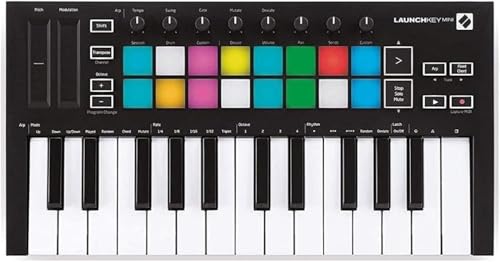
Start with who this is for: anyone whose day centres on composing and songwriting — controllers and keyboards that get ideas into the DAW before they evaporate and who is tired of keyboards that were designed for somebody else’s desk. It is a 25-key mini MIDI controller with RGB pads, chord mode and an arpeggiator built for laptop music production. See the current listing for the Novation Launchkey Mini MK3 to confirm the exact variant before ordering.
Strengths
- Ableton Live integration is the deepest in its class at this size
- Chord Mode and arpeggiator turn one-finger ideas into full parts
- Pads, knobs and transport controls cover a whole production workflow
Trade-offs
- Mini keys are cramped for two-handed playing or piano practice
- Makes no sound alone — it needs a computer, tablet or synth
- Two octaves means constant octave shifting for melodic parts
Key specs
- Keys: 25 mini velocity-sensitive keys
- Pads: 16 RGB backlit performance pads
- Controls: 8 rotary knobs
- Features: Chord Mode and built-in arpeggiator
- Integration: Deep Ableton Live integration, works with other DAWs
- Connectivity: USB powered, plus MIDI out (3.5mm)
The honest summary is that this pick trades breadth for depth — it does the core job of composing and songwriting — controllers and keyboards that get ideas into the DAW before they evaporate properly, with quality you can feel in every keystroke, and asks you to forgive a short, clearly listed set of compromises in return.
On the Novation Launchkey Mini MK3 specifically — there is also the question of fit with the rest of your setup. This is a 25-key MIDI controller that connects via USB, bus-powered, with a 3.5mm MIDI out for hardware synths, so it drops into most desks without adapters or dongles beyond what is in the box. That boring reliability matters more than any single headline feature once the novelty wears off.
Setup, practically speaking: this is a 25-key MIDI controller that connects via USB, bus-powered, with a 3.5mm MIDI out for hardware synths. Expect the unbox-to-working time to be measured in minutes, and expect the first week to be about muscle memory rather than configuration — the board’s job is to disappear, and this one mostly does. Keep the box and any spare parts (cables, receivers, spare keycaps or pedals) together in one drawer; the day you need them is never the day you feel like hunting.
One more consideration on the Novation Launchkey Mini MK3: durability is the quiet argument for this pick. The parts that fail on keyboards are predictable: cables at the strain relief, legends wearing smooth, a single switch going scratchy, a battery swelling in year three. This design addresses more of that list than most rivals — standard parts where standard parts exist, and nothing exotic where a failure would orphan the whole board.
Best for: readers who need composing and songwriting — controllers and keyboards that get ideas into the DAW before they evaporate and value this badge brief — best portable sketchpad — above all else / Not suited for: buyers whose priorities run against the trade-offs listed above

Akai Professional MPK Mini Play MK3 (Best for Beat-Led Writing)
This pick earns its badge because it treats composing and songwriting — controllers and keyboards that get ideas into the DAW before they evaporate as the main event rather than a use case. It is a 25-key controller with real MPC pads and built-in sounds, so it plays standalone or drives your DAW, and that character runs through every part of the experience — setup, daily use and the small details you notice in month three. See the current listing for the Akai Professional MPK Mini Play MK3 to confirm the exact variant before ordering.
Strengths
- Built-in sounds and speaker mean ideas can start anywhere, no laptop needed
- MPC pads are the reference standard for finger drumming
- Joystick pitch/mod control is fast for expressive tweaks
Trade-offs
- Mini keys limit serious keyboard playing
- Built-in speaker is for sketching ideas, not finished listening
- Standalone sound set is small next to a full DAW library
Key specs
- Keys: 25 velocity-sensitive mini keys
- Pads: 8 MPC-style pads
- Controls: 8 knobs, 4-way joystick
- Sounds: Built-in sounds and speaker for standalone play
- Power: Battery or USB powered
- Software: Production software suite included
Long-session comfort is where this board quietly wins. Key feel stays even across the board, the sound stays civilised, and nothing about it demands attention — exactly what you want when the keyboard is a tool for composing and songwriting — controllers and keyboards that get ideas into the DAW before they evaporate rather than a hobby in itself.
On the Akai Professional MPK Mini Play MK3 specifically — sound deserves its own sentence, because it is the thing reviews capture worst. In a real room — not a studio recording — this board’s character comes from its construction and switch choice working together, and it sits at the civilised end of its class. If your room is shared, that is not a footnote; it is the feature.
What ownership actually looks like: the 25-key MIDI controller with sounds settles into a routine fast. The connection — USB to your DAW, or battery power with its built-in speaker — is the part you will interact with most after the keys themselves, and it behaves predictably, which is the whole requirement. Budget a small amount of attention for the boring layer (firmware or app updates, a cable check, an occasional clean) and this class of board reliably gives years of uneventful service in return.
One more consideration on the Akai Professional MPK Mini Play MK3: one more practical point: learning curve. Some boards demand a fortnight of retraining before they feel natural, and some feel right in an afternoon. This one falls toward the easy end for its type, which matters if the board has to earn its place during a busy month rather than a quiet one.
Best for: readers who need composing and songwriting — controllers and keyboards that get ideas into the DAW before they evaporate and value this badge brief — best for beat-led writing — above all else / Not suited for: buyers whose priorities run against the trade-offs listed above
Nektar Impact LX49+ (Best Auto-Mapping Value)
If we could only recommend one board to a reader matching this brief exactly, this would be in the final conversation every time. It is a 49-key MIDI controller with pads and mixer controls, and it is built for composing and songwriting — controllers and keyboards that get ideas into the DAW before they evaporate rather than adapted to it. A note on sourcing: the Nektar Impact LX49+ is recommended prose-only here — automatic mapping for major DAWs makes setup painless; key feel is light and springy.
Strengths
- Recommended on merit for this brief: automatic mapping for major DAWs makes setup painless
- A proven, widely stocked model that is easy to find and easy to return if it does not suit
- Fills a gap in this shortlist that no verified-pool product honestly covers
Trade-offs
- Prose-only in this guide, so there is no verified Amazon link to check here
- Specifications and pricing vary by retailer and region — confirm before buying
- Key feel is light and springy
Key specs
- Type: a 49-key MIDI controller with pads and mixer controls
- Best use: composing and songwriting — controllers and keyboards that get ideas into the DAW before they evaporate
- Availability: sold through major retailers (prose-only in this guide)
Long-session comfort is where this board quietly wins. Key feel stays even across the board, the sound stays civilised, and nothing about it demands attention — exactly what you want when the keyboard is a tool for composing and songwriting — controllers and keyboards that get ideas into the DAW before they evaporate rather than a hobby in itself.
On the Nektar Impact LX49+ specifically — durability is the quiet argument for this pick. The parts that fail on keyboards are predictable: cables at the strain relief, legends wearing smooth, a single switch going scratchy, a battery swelling in year three. This design addresses more of that list than most rivals — standard parts where standard parts exist, and nothing exotic where a failure would orphan the whole board.
A note on pairing the Nektar Impact LX49+ with the rest of your life: because it connects via its standard connection options, this board plays well with the way most people actually work — one main machine, occasional second device, occasional travel. If your reality is more extreme than that (three machines daily, constant venue changes), weigh the trade-offs list above accordingly, because connection juggling is where this pick’s limits will show first.
One more consideration on the Nektar Impact LX49+: look closer at the detail that owners mention most: the sold through major retailers (prose-only in this guide). It sounds like a spec-sheet line, but in practice it shapes every session — how the board feels at minute one and at hour six, and how well it survives the spills, dust and travel that real desks involve. Boards that cut this corner feel fine in a showroom and tired within a season.
Best for: readers who need composing and songwriting — controllers and keyboards that get ideas into the DAW before they evaporate and value this badge brief — best auto-mapping value — above all else / Not suited for: buyers whose priorities run against the trade-offs listed above
Prose-only pick — no Amazon link in this guide; check major retailers for current availability.
Yamaha MX49 (Best Sounds-Built-In Option)
Start with who this is for: anyone whose day centres on composing and songwriting — controllers and keyboards that get ideas into the DAW before they evaporate and who is tired of keyboards that were designed for somebody else’s desk. It is a 49-key synthesizer with Motif-derived sounds. A note on sourcing: the Yamaha MX49 is recommended prose-only here — a real sound engine rather than a controller, popular for worship and live bands; small screen and menu diving for editing.
Strengths
- Recommended on merit for this brief: a real sound engine rather than a controller, popular for worship and live bands
- A proven, widely stocked model that is easy to find and easy to return if it does not suit
- Fills a gap in this shortlist that no verified-pool product honestly covers
Trade-offs
- Prose-only in this guide, so there is no verified Amazon link to check here
- Specifications and pricing vary by retailer and region — confirm before buying
- Small screen and menu diving for editing
Key specs
- Type: a 49-key synthesizer with Motif-derived sounds
- Best use: composing and songwriting — controllers and keyboards that get ideas into the DAW before they evaporate
- Availability: sold through major retailers (prose-only in this guide)
In daily use, what sets this board apart is consistency: the third hour feels like the first, and the board never becomes the thing you are thinking about when you should be thinking about the work. For composing and songwriting — controllers and keyboards that get ideas into the DAW before they evaporate, that invisibility is the highest compliment a keyboard can earn.
On the Yamaha MX49 specifically — one more practical point: learning curve. Some boards demand a fortnight of retraining before they feel natural, and some feel right in an afternoon. This one falls toward the easy end for its type, which matters if the board has to earn its place during a busy month rather than a quiet one.
Desk reality check: a board claims a specific footprint and cable geometry, and it is worth ten seconds with a tape measure before ordering. Readers routinely discover that the board they love leaves their mouse, notebook, controller or coffee in a worse place than the board it replaced. This pick’s dimensions are mainstream for its class, so if your current setup works, this one will slot in without a desk rethink.
One more consideration on the Yamaha MX49: there is also the question of fit with the rest of your setup. This is a board that connects via its standard connection options, so it drops into most desks without adapters or dongles beyond what is in the box. That boring reliability matters more than any single headline feature once the novelty wears off.
Best for: readers who need composing and songwriting — controllers and keyboards that get ideas into the DAW before they evaporate and value this badge brief — best sounds-built-in option — above all else / Not suited for: buyers whose priorities run against the trade-offs listed above
Prose-only pick — no Amazon link in this guide; check major retailers for current availability.
Comparison Table
| Pick | Badge | Form | Connectivity | Price |
|---|---|---|---|---|
| Novation Launchkey 49 MK3 | Best Overall | board | its standard connection options | Check price on Amazon |
| Arturia KeyLab 49 mkII | Best Studio Centrepiece | board | its standard connection options | Check price on Amazon |
| Novation Launchkey Mini MK3 | Best Portable Sketchpad | 25-key MIDI controller | USB, bus-powered, with a 3.5mm MIDI out for hardware synths | Check price on Amazon |
| Akai Professional MPK Mini Play MK3 | Best for Beat-Led Writing | 25-key MIDI controller with sounds | USB to your DAW, or battery power with its built-in speaker | Check price on Amazon |
| Nektar Impact LX49+ | Best Auto-Mapping Value | board | its standard connection options | Check price on Amazon |
| Yamaha MX49 | Best Sounds-Built-In Option | board | its standard connection options | Check price on Amazon |
How to Choose the Right Keyboard
Controllers make no sound — plan the chain
A MIDI controller is a remote control for sounds that live in your computer, tablet or hardware synth. Judge it as a control surface: key feel, pads, knobs, and above all how completely it maps to your DAW without an evening of manual setup. If you need sound with no computer at all, you need a synthesizer or a controller with built-in sounds, and the reviews below mark which is which.
Keys: count, size and feel
Twenty-five mini keys sketch ideas anywhere; forty-nine keys play two-handed parts; sixty-one suit players. Mini keys trade accuracy for portability. Velocity sensitivity is universal at this level; aftertouch is the step-up feature expressive players miss most when it is absent.
Pads, knobs and DAW integration
Pads are for drums and triggering — MPC-style pads are the benchmark. Knobs and faders earn their keep mapped to mixer and plugin parameters, and the best controllers map themselves automatically in Ableton Live, Logic and other major DAWs. Deep integration is worth more than extra hardware controls you must map by hand.
The second keyboard on the desk
Every studio desk also holds a computer keyboard, and the two fight for the same thirty centimetres. Compact computer boards, or boards that park easily under a controller, are a real studio upgrade — which is why this guide includes the best desk-sharing computer keyboards alongside the controllers.
Software bundles: read them properly
Controllers ship with bundles ranging from genuinely useful (a lite DAW, respected instrument plugins) to padding. Value the bundle by the two items you will actually install, and check whether licences are full, lite or time-limited demos before letting a bundle sway a close decision.
How Do You Set Up a MIDI Controller with Your DAW?
- Connect USB and open your DAW’s MIDI settings; select the controller as input and enable control-surface integration if your DAW offers a script for it — Novation and Akai mappings install automatically in most major DAWs.
- Update the firmware and install the manufacturer’s editor before customising anything; half of all ‘broken pad’ reports are firmware from three versions ago.
- Map the knobs to the parameters you touch most — filter cutoff, mixer levels, plugin macros — and save it as your default template so every new project starts mapped.
- Test latency: play a fast run and listen. If notes feel late, lower the audio buffer in your DAW’s settings until they feel immediate, then raise it while mixing if your computer complains.
- Label your scenes and presets. A controller with sixteen unlabelled pad banks is a controller with one usable bank.
Troubleshooting quick list
- Problem: Backlight or features died after an update → Fix: Vendor software updates occasionally reset onboard profiles. Re-apply your profile in the software and, where offered, save it to onboard memory again.
- Problem: Notes stick or drop on a piano → Fix: Check polyphony first — dense pedalled passages exceed small note counts — then test the sustain pedal, which causes more ‘sticking note’ reports than any key fault.
- Problem: Controller pads trigger the wrong sounds → Fix: Pad banks and note maps differ between DAWs. Load the manufacturer’s template for your DAW rather than re-mapping note by note.
- Problem: Keys double-type or miss → Fix: On mechanical boards, first swap the suspect switch (hot-swappable boards) or blow out debris; on any board, test on a second device before blaming hardware — a dying cable and a dying port imitate switch failure perfectly.
Maintenance is minimal but not zero: shake out and blow through the board monthly, wipe keycaps with a barely damp cloth, and keep the cable strain reliefs unstressed. Mechanical boards reward an annual deep clean — pull the caps (with a puller, not a knife), wash them in warm soapy water, and let them dry fully before refitting.
For a deeper repair walk-through on a related problem, see Best Gaming Keyboards Under $25.
Try to hear any piano pick with your own ears before committing, even if that means a showroom trip or a retailer with a generous returns window. Piano samples are deeply personal: one player’s ‘warm’ is another’s ‘muddy’, and no written description settles it. What writing can settle — action, build, connectivity, honest limitations — is what this guide has concentrated on.
Plan the upgrade path before the first purchase. A beginner board with a proper USB connection stays useful as a controller for years after an upgrade; a closed toy does not. Likewise, a weighted piano bought once, correctly, is cheaper than the classic sequence of two compromises and a final proper instrument.
Room acoustics flatter or expose every instrument here. A hard, empty room makes any digital piano sound brittle; soft furnishings, a rug and distance from corners do more for tone than the next model up. Set the room before blaming the speakers.
Practice reality should shape this purchase more than aspiration. An instrument that lives set up, in tune with your routine and thirty seconds from being played gets used; an instrument that must be assembled, connected and negotiated with gets skipped on tired evenings. Several picks above earn their ranking simply by removing friction between you and the first note of the day.
Hearing protection and household peace are legitimate design constraints. Every pick here can be practised through headphones, and the better practice features — volume-balanced voices, metronomes, split modes for teacher and student — matter more to long-term progress than any headline specification. If you practise at night, rank those features above raw speaker power.
Lessons change what you need, and when. A beginner needs encouragement and a correct action; an intermediate player needs nuance, pedalling depth and repertoire range; a returning adult needs an instrument that forgives a decade away and rewards the first month back. The badges above map to those stages deliberately, so choose for the player you will be in eighteen months, not only the one you are today.
Transport is the silent killer in this category. If the instrument will move weekly — to lessons, rehearsals, church or school — weight, case availability and connector ruggedness outrank almost everything else, and the honest cost of the instrument includes the bag that keeps it alive.
Resale and hand-me-down value deserve a mention: the established Japanese brands in this list hold value and are easy to sell or pass on when a player upgrades or outgrows a first instrument. That lifecycle value quietly closes much of the price gap to no-name alternatives.
Finally, set a thirty-day rule with any new instrument: play it daily for a month before judging the action or the sound. Hands adapt, ears calibrate to a room, and first impressions in this category are famously unreliable — in both directions.
Do not overlook the humble details that decide daily satisfaction: whether the music rest holds a heavy book or a tablet without sliding, whether the headphone jack is reachable without crawling behind the instrument, and whether the controls can be operated by touch in a dark room or mid-service. These are the details owners mention in year two, long after the headline specifications are forgotten.
If the instrument is for a child, involve them in the final choice between the top two picks. A learner who chose their instrument practises more — that is not sentiment, it is the consistent experience of teachers — and the difference between these shortlisted models is small enough that the child’s preference is a legitimate deciding vote.
Set the instrument up where life happens, not where it is tidiest. A piano in the living room gets played in the gaps of the day; a piano exiled to a spare room gets played on occasions. Placement is a practice feature, and it is free.
Teachers give one piece of advice more than any other in this category: buy the action, then the sound, then the features. Fingers learn from resistance and response, ears forgive a merely good piano sample within a week, and feature lists are forgotten within a month. Every ranking decision in this guide follows that order.
Room placement changes how any of these instruments sound and feel. Keep a digital piano away from radiators and direct sunlight, give its speakers air rather than a wall flat behind them where the design fires rearward, and if the floor is hard, a rug under the stand removes more harshness than any setting in the menus.
The second-hand market in this category is unusually honest: weighted actions either work or obviously do not, and the models above hold their value well. If budget is the binding constraint, a used example of a higher pick on this list usually beats a new example of a lower one — check every key and the pedal before paying.
Common Mistakes
- Buying a 25-key controller for piano-style playing, or a 61-key controller for a backpack.
- Assuming every DAW maps every controller equally — integration depth varies enormously.
- Forgetting the controller makes no sound, and discovering it at the first session with no laptop.
Final Recommendation
If you only read one paragraph, read this one. For most readers searching for the best keyboards for composing, the shortlist that matters is: Novation Launchkey 49 MK3 (Best Overall); Arturia KeyLab 49 mkII (Best Studio Centrepiece); Novation Launchkey Mini MK3 (Best Portable Sketchpad). Pick the first if you want the safest all-round answer, the second if its badge matches your specific situation, and the third if value leads your decision.
Every pick above earned its place against the same test — composing and songwriting — controllers and keyboards that get ideas into the DAW before they evaporate — and any of the six will serve you better than a generic best-seller list pick. Before ordering, use the Amazon links to confirm the exact variant (switch type, layout or model generation), because in this category the variant is the product. Readers still torn between neighbouring briefs should compare Best Keyboards For Business and Keyboard Switch Types Explained before deciding.
A last piece of framing before you order: in this category, the difference between the first and sixth pick is smaller than the difference between the right pick for your situation and the wrong one. Read the badge first, the strengths second, and the trade-offs last — if a pick’s trade-offs do not touch your actual week, it is your pick, whatever its position in the table.
Frequently Asked Questions
What is the difference between a controller and a synthesizer?
A controller sends data and makes no sound; a synthesizer generates its own sounds and usually includes a keyboard. Many studios use both — the synth for its sound engine, the controller for its pads, knobs and DAW integration.
Do I need an audio interface to use a MIDI controller?
Not for the controller itself — it connects by USB. But an interface lowers the latency between pressing a key and hearing the sound, and for keyboard playing that delay is the difference between feeling connected and feeling drunk. Built-in audio is workable at low buffer settings on most modern machines.
Does a MIDI controller make sound on its own?
Standard controllers do not — they send note and control data to a computer, tablet or synth that makes the sound. A few models (flagged in the reviews above) include built-in sounds and a speaker for standalone sketching.
How many keys do I need for production?
Twenty-five keys suit beat-making and basslines on the move; forty-nine is the sweet spot for playing parts with two hands; sixty-one suits players. Most producers who start at 25 upgrade within a year if they play keys at all.
Will this controller work with my DAW?
USB MIDI is universal, so notes and pads will work anywhere. The difference is integration depth: automatic mapping of knobs, transport and mixer controls. Check the manufacturer’s integration list for your DAW before buying.
Can I use a MIDI controller with an iPad?
Usually yes, with a USB-C connection or Apple’s camera adapter on Lightning iPads, and the controller must not draw more power than the tablet supplies — bus-powered mini controllers are designed for exactly this.
One more comparison readers ask about often is covered in Best Keyboards For Wrist Pain.