ilcastellomenu.com is reader-supported. When you buy through links on our site, we may earn an affiliate commission.
Where to Buy
All six cameras in this guide are sold through Amazon, where you can bundle the camera with the surf-specific hardware it actually needs — board mounts, floating grips, and tethers — in a single order. If you are comparing the best action cameras for surfing, buy the tether and the floaty at the same time as the camera, not after the ocean has made the decision for you.
Salt water is the most honest testing department in consumer electronics. It corrodes, it infiltrates, it tears cameras off boards with hydraulic indifference, and it does all of this while the light is perfect and the swell is finally working. A camera that survives surfing — really survives it, season after season — has passed an examination that no other sport administers quite so completely. That is the spirit of this guide: these are not the six best action cameras that can film surfing, they are the six that keep filming it.
The surfing use case splits into three distinct jobs, and a good buy starts by knowing which one is yours. There is the board’s-eye view, camera mounted on the nose looking back at the rider or forward down the line, which demands bombproof mounting and a camera that can be drowned a hundred times a session. There is the swimmer’s and filmer’s job, camera in hand or on a grip in the impact zone, which rewards screens, battery life, and a camera that floats or can be made to float. And there is the self-documenting solo surfer’s job — the dawn patrol regular who wants proof, coaching material, and occasionally a clip worth sending to friends — where a 360 camera on a short pole or a board-mounted camera with a wide lens does the work of a film crew of one.
Every pick below is waterproof in its bare body or built for the sea outright, because a surfing camera that needs a housing to survive is a camera one forgotten latch away from retirement. We weighed mounting ecosystems heavily — surfing breaks more mounts than any sport on earth — and we were unsentimental about the two unglamorous accessories that decide whether footage exists at all: the tether that keeps a torn-off camera attached to something, and the float that keeps a lost camera at the surface where it can be found. Six cameras earned their place. One is a specialist that is not really an action camera at all, and it might be the most surf-proof device in the entire guide.
Key Takeaways
- Waterproof without a housing is non-negotiable for surfing — one forgotten latch should not be able to retire your camera.
- The GoPro HERO13 Black leads on mount ecosystem and stabilization that keeps board footage watchable in chop.
- The OM SYSTEM Tough TG-7 is the sea’s own camera: no housing, no seals to babysit, and it survives the shore break’s worst.
- The Insta360 X4 turns a solo surfer into a film crew, reframing the ride afterward from a single capture.
- Every camera here needs a tether and a float strategy — the ocean collects unsecured cameras professionally.
- Rinse in fresh water after every session; salt claims more surfing cameras than wipeouts do.
In this guide
Quick Picks
| Pick | Badge | Why surfers reach for it |
|---|---|---|
| GoPro HERO13 Black | Best Overall | The surf standard: the deepest board-mount ecosystem and stabilization that tames a bouncing nose mount. |
| DJI Osmo Action 5 Pro | Best for Long Sessions | Battery endurance for full-morning surfs and bright screens for the swimmer filming from the channel. |
| Insta360 X4 | Best for Solo Surfers | Captures the whole wave in every direction, so one surfer with a pole gets the shot a filmer would. |
| OM SYSTEM Tough TG-7 | Best No-Housing Pick | Built for the sea itself — waterproof, crush-proof, and unbothered by sand, drops, and shore break. |
| Insta360 Ace Pro 2 | Best for Dawn Patrol | A big sensor that keeps the first, greyest waves of the day clean instead of grainy. |
| GoPro HERO12 Black | Best Value Second Camera | Last year’s flagship for the second board, the loaner, or the mount position you do not fully trust. |
How We Chose These Picks
Waterproofing came first, and we were strict about its form. Every pick is waterproof as it sits in your hand — no housing required for surf depths — because housings fog, muffle, complicate, and introduce the single most common surf-camera failure: the not-quite-closed latch discovered by the first duck dive. Depth ratings beyond surf needs earned no extra credit; what matters is surviving the washing machine of the impact zone, repeatedly, plus the rinse-and-dry cycle afterward.
Mounting came second, judged by surf-specific hardware rather than generic compatibility. Board mounts live or die by their adhesive pads and their behavior when a lip lands on them; mouth mounts, wrist mounts, and pole grips each serve a filming style; and every position demands a tether point, because the question in surfing is never whether a mount will eventually fail but when. Cameras inside the GoPro and DJI ecosystems inherit a surf-hardware catalog refined by two decades of lost cameras, and that inheritance is worth real money. We also checked float options for each pick — a factory floaty, a floating grip, or a body that tolerates one — because a sunken camera films nothing ever again.
Image quality was judged in surf conditions specifically: hard overhead sun with glittering water (the exposure nightmare), grey dawn light, and the fast lateral movement of a rider crossing the frame. Stabilization had to handle the nose-mount case, where the camera bounces with every chop strike, and screens had to be legible in full tropical sun to the swimmer trying to confirm a setting with wet hands. Battery judgments assumed the real pattern of surf filming — long standby, bursts of recording, a session measured in hours — rather than continuous recording, and cold-water endurance counted for the winter-swell crowd.
Finally, we kept one seat at the table for a camera that breaks the action-camera mold entirely, because surf photographers have quietly used the Tough series for years and any honest guide should say why. Variety of approach, unity of standard: everything here can be taken into the ocean today, bare, and expected to come home working.
Why Does Surfing Destroy Cameras That Other Sports Spare?
Start with the water itself. A wave is not a splash; the impact zone delivers repeated, violent turbulence that works on every seal, door, and mount with a persistence no rain shower or river dunking matches. Sand joins in as an abrasive that grinds seals and scratches lenses, and salt finishes the job chemically, creeping into contacts and threads and blooming into corrosion weeks after the session that caused it. A camera can survive a hundred gentle immersions and die on the first serious hold-down, which is why surf veterans speak of waterproof ratings the way sailors speak of weather forecasts — as a starting point for judgment, not a guarantee.
Then there is the simple physics of loss. A board-mounted camera sits on a vehicle that is regularly buried, rolled, and ripped from its rider’s feet by moving water with real mass behind it. Mounts tear, adhesive pads let go in the heat of a car or the violence of a lip, and a camera without a tether or float becomes a donation. Even handheld filming in the water carries the same arithmetic: a swim fin kicks a wrist, a set wave arrives unannounced, and the grip that was secure a second ago is tumbling in whitewater. The cameras in this guide were chosen partly for how gracefully they participate in loss-prevention — tether points, float options, bright colors and floaty accessories that make a lost camera findable — because the best surf camera is definitionally the one you still own in September.
Heat is the third assassin, and the least discussed. A camera baking on a black traction pad in tropical sun, or sealed in a hot car between sessions, ages its battery and can soften the very adhesives its mount depends on. The rituals in the care section below — shade, rinsing, drying, seal checks — sound fussy in the abstract. In practice they are the entire difference between the surfer whose camera is on its third season and the one shopping again by midsummer.
What Are the Best Action Cameras for Surfing? Six Picks in Detail

GoPro HERO13 Black — Best Overall
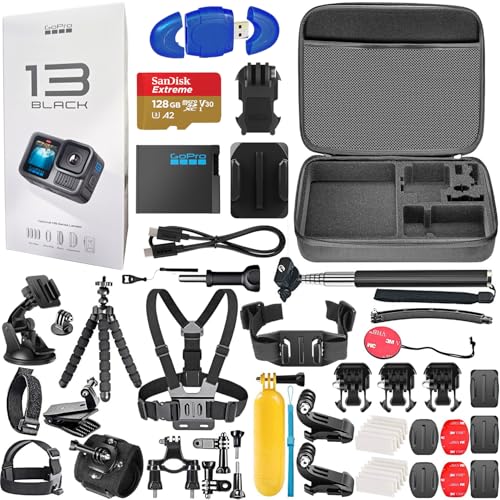
GoPro built its name in the surf, and the HERO13 Black shows the accumulated wisdom. The surf-specific hardware ecosystem is unmatched: board mounts refined over generations, leash plugs and tethers, floaty backdoors and floating grips, mouth mounts for the point-of-view purists — if a surfer has ever wanted to attach this camera to anything, the part exists and has been ocean-tested by thousands of sessions. The camera itself is waterproof bare, its HyperSmooth stabilization performs the small miracle of making nose-mount footage — the bounciest seat in sports filming — genuinely watchable, and its lens cover unscrews and replaces after the inevitable reef or car-park scrape.
For the rider filming themselves, the wide and ultra-wide lens options frame a whole stance from a nose mount without cutting off the rider’s head or the wave behind, and the tall sensor leaves room to reframe vertical clips for the group chat without re-surfing the wave. GPS overlays can log speed down the line, a stat surfers argue about happily. The weaknesses are the flagship standards: it is the priciest camera here to feed to the ocean, heat management on a sun-baked board demands the usual sense (start recording in the water, not on the sand), and the battery, while good, will not cover an all-day session of constant recording without a swap. None of that dethrones it. This is the camera the surf world is organized around, and for board-mounted work it remains the default for good reason.
- Waterproofing: sealed body, no housing needed for surf and snorkeling depths
- Mounts: the deepest surf-specific catalog — board, mouth, wrist, and pole options
- Stabilization: flagship smoothing tuned for high-frequency bounce
- Extras: replaceable lens cover, GPS, interchangeable lens mods including ultra-wide
Strengths
- Every surf mount and float accessory imaginable, ocean-proven.
- Stabilization that rescues the nose-mount view from chop.
- Replaceable lens cover turns reef scrapes into cheap maintenance.
Trade-offs
- Flagship price is a real consideration when the ocean is the co-owner.
- Needs a battery swap for true all-day filming.
- Sun-baked boards and static recording are a heat combination to manage.
Best for: board-mounted filming, self-documenting riders, and anyone building a long-term surf kit. Not suited for: buyers who cannot stomach flagship replacement risk in heavy surf.

DJI Osmo Action 5 Pro — Best for Long Sessions
Surf sessions are long, and the filming pattern — paddle, wait, burst, wait — murders batteries through standby drain and screen time as much as through recording. The Osmo Action 5 Pro is the endurance answer: its rated battery life leads this class, and in the water that translates to a camera that is still alive for the midday glass-off when everyone else’s has retired to the beach bag. Its dual OLED screens are the brightest here, a genuine working advantage for the swimmer or filmer in the channel trying to check framing and settings in hard sun with water streaming off everything.
DJI’s magnetic quick-release mounting, usually praised for convenience, has a surf-specific virtue: fast swaps between a board mount, a handheld grip, and a pole as conditions and angles change through a session, with cold, wet, sandy hands. Stabilization is confident, the image is clean and pleasing straight out of the camera, and the body is waterproof without a case and rated to go deeper than surf will ever ask. The ecosystem caveat applies — surf-specific hardware is plentiful but a shelf smaller than GoPro’s — and there is no GPS for speed overlays. For the filmer-in-the-water role and the marathon session, though, this is the camera that simply refuses to be the reason the last set went unrecorded.
- Battery: class-leading endurance suited to long, bursty surf sessions
- Screens: dual OLED touchscreens readable in harsh overhead sun
- Mounting: magnetic quick-release plus standard adapter compatibility
- Waterproofing: sealed body rated beyond surf depths, no housing required
Strengths
- Still recording when the session’s best hour arrives.
- Screens a swimmer can actually use in glare and spray.
- Fast mount swaps with wet, cold, sandy hands.
Trade-offs
- Surf hardware catalog trails GoPro’s depth.
- No GPS for speed and location overlays.
- Premium pricing, though a step of mercy below the top flagship tier.
Best for: swim-filmers, long-session surfers, and anyone who films others as much as themselves. Not suited for: GPS-overlay fans or buyers wanting the absolute deepest surf accessory shelf.

Insta360 X4 — Best for Solo Surfers
The solo surfer’s eternal problem is that the person who could film the wave is on it. The X4 is the most complete answer yet devised: mounted on a short pole in hand, on a board mount, or trailed on a selfie setup, it records the entire sphere of the wave — the rider, the face, the lip, the beach behind — and lets the framing happen later, on the couch, where a single ride becomes a follow shot, a front shot, and a look-back at the section that nearly closed out. The reframing workflow turns one surfer into a small production company, and the invisible-pole effect keeps the trick invisible.
Surf imposes specific costs on the design. The twin lenses bulge and the ocean is full of boards, fins, and reef; lens guards are not optional equipment, they are the price of admission, and even guarded, this is the most delicate camera in the guide. It is also the heaviest, which a hand-held pole feels across a long session, and its files are large enough that storage planning becomes a real chore on a surf trip. Water droplets on two lenses double the wiping ritual — a lick and a dip, surfers learn, keeps the domes clear. Deploy it for what it is: the solo session and the surf-trip diary, where its magic is unmatched, rather than as the camera you lend the ocean on a heavy day.
- Capture: 360-degree video up to 8K, reframed afterward in the app or studio
- Mounting: standard ecosystem compatibility; excels on poles and board mounts
- Protection: lens guards essential; body waterproof for surf depths
- Workflow: single-lens mode doubles as a conventional action camera ashore
Strengths
- One rider, one camera, every angle of the wave.
- Reframing rescues rides a fixed camera would have missed entirely.
- Surf-trip storytelling with a floating, third-person feel.
Trade-offs
- Most fragile lenses here, in the sport least forgiving of them.
- Heavy on a pole and heavy on your storage drives.
- Two lenses to keep droplet-free doubles the ritual.
Best for: solo surfers, surf travelers, and self-coaching riders who review everything. Not suited for: heavy shore break, loaner duty, or anyone who hates post-production.

OM SYSTEM Tough TG-7 — Best No-Housing Pick
Surf photographers kept a secret for years: the camera in more beach bags than any action cam was this armored compact. The TG-7 is waterproof to real snorkeling depth with no housing and no ritual, drop-proof onto concrete, crush-resistant under a pile of boards and bags, and sealed against the sand that infiltrates everything else at the beach. It also does the one thing no cube camera can: it zooms, optically, which transforms shore-based filming and photography of a break from the beach or the headland, and its stills are proper photographs rather than video frames.
In the water it is a swimmer’s and snorkeler’s delight, and its macro mode turns the reef flat at low tide into an entire second hobby. As a pure surf-action video tool it concedes ground honestly: stabilization is a step behind the dedicated action cameras, there is no front screen and no board-mount ecosystem in the action-camera sense, and its video polish suits documentation more than cinematic edits. But consider its actual surf résumé: it floats no better than others (a wrist strap and a floating hand grip remain wise), yet it is the camera most likely to be working, un-fussed-over, on the five-hundredth beach day. For the surfer whose camera life is ninety percent ocean and shore rather than mounts and poles, it is not the compromise pick. It is the correct one.
- Protection: waterproof, drop-proof, crush-resistant, freeze-proof by design
- Lens: true optical zoom for shore and headland filming
- Photos: strong stills plus a celebrated close-up macro mode
- Sensors: logs location and conditions, a gift for trip journals
Strengths
- The most environmentally unbothered camera in this guide.
- Zoom makes it the only real shore-filming option here.
- Survives the car, the bag, and the beach as happily as the sea.
Trade-offs
- Video stabilization trails the action cameras.
- No action-mount ecosystem or front screen.
- A photographer’s tool first, a board-cam second.
Best for: snorkelers, shore filmers, beach-life documenters, and the chronically hard on gear. Not suited for: nose-mount point-of-view filming as the primary job.

Insta360 Ace Pro 2 — Best for Dawn Patrol
The best waves of the day frequently arrive in the worst light of the day: a grey pre-sunrise ocean, mist on the water, the first sets feeling their way in while the sky is still deciding. Most action cameras answer that light with grain. The Ace Pro 2, built around a large sensor and Leica co-engineered glass, answers it with footage that stays clean and detailed — the dawn patrol regular’s camera, and equally the pick for the overcast, moody breaks of northern coasts where the sun is a rumor until noon. Its low-light processing is the most sophisticated here, and it shows exactly where surfers need it: in the shadow of the wave face and the dim channel at first light.
By full daylight it is a complete flagship — high-resolution capture with cropping room, strong stabilization, a flip screen that the beach filmer and the van-life trip diarist will use constantly. It mounts through the standard ecosystem with good surf hardware availability, though the catalog is still growing compared with GoPro’s, and the flip hinge is a mechanism to treat with respect around sand — rinse before you flip, as the care section advises. Battery life is solid rather than class-leading. None of that dims the core proposition: if your surf life happens disproportionately at the dim edges of the day, this camera will show you your own surfing more clearly than any rival here.
- Sensor: large-format sensor with AI-assisted low-light processing
- Lens: Leica co-engineered optics for clean shadow detail
- Video: high-resolution recording with room to crop in the edit
- Screen: flip display for beach filming and trip diaries
Strengths
- Dawn, dusk, and overcast footage rivals cannot keep clean.
- Full flagship performance once the sun is up.
- Flip screen serves the shore filmer and the self-documenter.
Trade-offs
- Sand and the flip hinge require a rinse-first habit.
- Surf accessory shelf is growing, not yet the deepest.
- Battery endurance is good rather than class-leading.
Best for: dawn patrollers, northern-coast surfers, and low-light specialists. Not suited for: the roughest mount-and-forget board duty or marathon all-day recording.

GoPro HERO12 Black — Best Value Second Camera
Every surf kit eventually wants a second camera: one on the nose and one on the tail, one on the good board and one on the beater, one for the rider and one to hand to a friend in the channel. The HERO12 Black is the value answer to that want — the previous flagship, sharing the HERO13’s mounting universe and most of its manners, at the friendlier prices and deep used availability of a superseded model. Its footage intercuts with its successor’s closely enough that a two-camera edit does not jar, and its stabilization remains thoroughly surf-grade.
What you give up is known and bounded: no GPS for speed overlays, no lens-mod system (third-party filters fill the gap cheaply), and a notch less refinement in heat and endurance. What you gain is the psychological freedom of the second camera — the one that can go on the sketchy mount, the borrowed board, the heavy day, without the flagship’s replacement math shadowing every wave. Surf photographers have always understood that the camera you are willing to risk gets the shots; the HERO12 is priced to be risked, and built well enough that the risk usually pays off in footage rather than loss.
- Compatibility: shares the full GoPro surf-mount and accessory ecosystem
- Recording: previous-generation flagship video and stabilization
- Availability: widely stocked and common on the used market
- Notable omission: no built-in GPS
Strengths
- Second-camera economics without second-rate footage.
- Intercuts cleanly with the flagship in two-camera edits.
- The camera you can afford to risk is the one that gets the shot.
Trade-offs
- No GPS overlays and no first-party lens mods.
- A step behind on heat handling in static sun.
- Endurance trails the newest endurance leaders.
Best for: second boards, two-angle setups, loaners, and value-first surfers inside the GoPro ecosystem. Not suited for: buyers wanting the newest lens system or built-in telemetry.
How Do the Six Compare for Life in the Ocean?
| Camera | Badge | Standout trait | Watch out for |
|---|---|---|---|
| GoPro HERO13 Black | Best Overall | Surf-mount ecosystem and stabilization | Flagship loss math, midday heat |
| DJI Osmo Action 5 Pro | Best for Long Sessions | Endurance and glare-proof screens | No GPS, smaller surf catalog |
| Insta360 X4 | Best for Solo Surfers | Every angle from one capture | Fragile lenses, heavy files |
| OM SYSTEM Tough TG-7 | Best No-Housing Pick | Survives sea, sand, and concrete | No board-mount ecosystem |
| Insta360 Ace Pro 2 | Best for Dawn Patrol | Clean low-light wave faces | Hinge care around sand |
| GoPro HERO12 Black | Best Value Second Camera | Flagship footage, riskable price | No GPS or lens mods |
Where Should the Camera Ride — Board, Hand, Mouth, or Pole?
The nose mount looking back is the classic surf shot for a reason: it frames the rider against the wave they are actually riding, and modern stabilization has finally made it watchable in chop. Mount it with a fresh adhesive pad on a clean, wax-free patch, tether it to the leash plug, and accept that the mount is a consumable — replace pads that have baked through a summer in the car. The tail mount looking forward gives the down-the-line driver’s view, all speed and approaching sections, and pairs beautifully with the nose angle in a two-camera edit, which is precisely the HERO12’s second-camera brief.
Hand and pole filming from in the water is the filmer’s craft: a floating grip keeps the camera at the surface if a set catches you, the wrist leash keeps it yours, and the swimmer’s reward is the angle no mount can give — water-level, inside the action, with the wave’s face as the backdrop. Mouth mounts serve the point-of-view purist who wants their own eyes’ record of the ride, hands free and framing honest; they take a session to get used to and produce the most intimate footage in surfing. Choose by the story you want told: the board mounts tell the wave’s story, the mouth mount tells the rider’s, and the in-water filmer tells everyone’s. The X4 cheats the choice entirely by telling all of them at once, at the price of its post-production toll.
How Do You Keep a Surf Camera Alive Season After Season?
The rinse is the religion. Every session, without exception, the camera gets a soak or a gentle shower in fresh water — with all doors closed — to dissolve the salt before it dries into crystals that grind seals and bloom into corrosion. Then it dries fully, in shade, before any door is opened or any cable connected, because the moisture you trap inside is the fog and corrosion you meet in a month. Check the seals as you close them, every time: one grain of sand on a seal line is the entire story of most “waterproof” cameras that drowned.
Keep a small surf-camera kit where the board bag lives: a soft brush for sand, a microfiber cloth that is replaced before it becomes a sandpaper of collected grit, spare tethers and adhesive pads, and the little tube of seal-safe lubricant if your camera’s maker recommends one for its door seals. The kit’s purpose is to make the right action the easy action at the exact moment you are tired, sandy, and thinking about lunch — which is when maintenance is skipped and cameras begin their slow decline. Put the rinse bucket by the outdoor shower or the hose, not in a cupboard, for the same reason.
Lenses and droplets decide image quality daily. A hydrophobic treatment or the surfer’s traditional lick-and-dip keeps domes shedding water instead of beading it into soft blobs across the frame; check the lens before the set of the day, not after. Store the camera out of the car, out of the sun, with the battery at partial charge between swell cycles, and retire adhesive mounts and tethers on suspicion rather than evidence — they are cheap, and their failure mode is total. Once a season, run the full audit: seals supple, doors closing flush, mounts flexed for cracks, floaty bright and intact. Ten minutes of this is the whole difference between a quiver of cameras and a shelf of casualties.
What Settings Work Best for Surf Filming?
Frame rate is the first decision, and surfing argues for generosity: the sport’s beauty lives in spray, lip lines, and the half-seconds of a turn, all of which reward recording at higher frame rates so the good moments can be slowed gracefully. For pure documentation and coaching review, a standard frame rate keeps files lean and batteries long; for anything destined to be watched for pleasure, step up and let the slow motion breathe. Resolution should follow the edit: if you crop and reframe — nose-mount footage almost always gets cropped — the extra resolution of the flagship picks is working headroom, not vanity.
Exposure is the surf-specific battle. A glittering ocean fools meters relentlessly, so lock what you can: fix the white balance for the session’s light rather than letting it drift as you turn between sun and shore, and consider a touch of exposure compensation downward on blazing days to protect the whitewater detail that clipping destroys first. Stabilization deserves an honest test at your break — maximum smoothing can crop the frame’s edges and soften the wave’s shape, while a moderate setting keeps the energy of the ride. Shoot one session each way before deciding; surfing punishes assumptions made on land. And use the quick-capture behaviors these cameras offer — a surfer’s recording window is the length of a lull, and a camera that starts instantly from a single press films waves that a booting camera only hears about.
How Do You Film Your Own Surfing Well Enough to Learn From It?
Self-filming for improvement is a different discipline from self-filming for sharing, and it rewards a coach’s eye over a cinematographer’s. The nose mount looking back is the coaching angle: it shows stance, weight distribution, where your eyes were looking, and what your arms did during the turn — the four things surf coaches charge money to diagnose. Frame it deliberately before the session, wide enough to include your whole body and a margin of wave, and leave the settings alone once they are right; coaching footage values consistency across sessions far more than beauty within one.
Review like an athlete, not a fan. Watch the rides at reduced speed and compare the best wave against the worst: where did your head turn, when did you compress, what did the failed takeoff look like three seconds before it failed? The X4’s reframing is a secret weapon here, because it can show you the wave’s shape and your position on it in the same clip — the relationship that decides everything in surfing and that a fixed camera can only imply. Keep a small archive organized by fault rather than by date — “late takeoffs,” “back foot,” “the left at the point” — and within a season you will own the most honest surf coaching available at any price: your own surfing, undeniable, in sequence.
What Should a Surf Trip Camera Kit Actually Contain?
Travel lightens every other bag and should lighten this one ruthlessly. One primary camera, one mount per job you will actually do (board, plus grip or pole), two batteries, a charger that runs from any USB source, and cards enough for the trip with a nightly offload habit to a phone, tablet, or small drive. The spares that earn their space are the failure-prone smalls: a spare adhesive pad and tether, a replacement lens cover for the GoPros, lens guards for the X4, and a microfiber cloth. Everything else — the third mount style, the just-in-case housing — is weight that history says you will carry around the tropics unused.
Two travel habits protect the footage and the gear. Rinse discipline doubles in importance in the tropics, where salt, heat, and humidity conspire and fresh water is sometimes a bottled resource — use it on the camera anyway; the camera is worth more than the bottle. And insure the archive, not just the camera: footage offloaded to two places before the flight home is a trip that survives a lost bag, while a trip that lives on one card in one camera is a story you will tell with your hands. The surfers whose trip edits appear like clockwork are not luckier. They are the ones with the rinse bucket and the backup drive.
How Does Your Home Break Change the Right Choice?
Beach breaks with shifting peaks reward the versatile and the patient: sessions are long, angles change as banks move, and the camera that covers board, hand, and shore duty with quick swaps — the Osmo Action 5 Pro’s magnetic system, or a GoPro with a practiced hand — earns its keep, while battery endurance matters because the good bank might switch on at any hour. Reef and point breaks, where the wave is a known machine and the lineup is a commitment, reward the specialized: the nose-mounted flagship for the rider’s record, the X4 for the solo regular who wants the whole geometry of a perfect, repeatable wave, and the discipline of tethers doubled, because reef is where lost cameras go to become habitat.
Cold-water surfers should weight two factors the tropical crowd can ignore: battery behavior in the cold, where the endurance leaders pull further ahead, and operation with thick gloves, where big physical record buttons and quick-capture behaviors beat touchscreen elegance every time — test any camera wearing your actual gloves before the winter swells arrive. Warm-water and travel surfers face the opposite enemies, heat and glare, and should weight screens and shade discipline accordingly. None of this changes the guide’s hierarchy dramatically, but it shuffles it honestly: the best surf camera is the one matched to your water, and your water is specific.
What If You Are the Filmer, Not the Surfer?
The water filmer’s kit and technique deserve their own word, because this is the role that produces the footage everyone else shares. Your camera lives on a floating grip, tethered to your wrist, and your virtues are battery endurance, a screen you can read in glare, and stabilization that forgives being duck-dived — the Osmo Action 5 Pro’s brief, exactly, with the Ace Pro 2 as the low-light alternative for dawn sessions. Position is your craft: close enough that a wide lens fills the frame with the rider, far enough that the wave’s business end is not your business, and always with an exit — the channel is your office and your escape route both.
Communicate before the session, not during it: agree on the peak you will work, the signals for “that was the one” and “one more,” and who reviews what on the beach afterward. Film in generous bursts around each ride rather than rolling continuously — your battery and your editor will both thank you — and shoot the in-between moments too, the paddling out and the laughing, because surf films are made of the day as much as the waves. Finally, protect the archive like it is the product, because it is: offload on the beach or the moment you are home, every session, no exceptions made for tiredness. The filmer who loses a card loses everyone’s day, not just their own.
Should You Buy the Newest Model or Last Season’s?
Surfing argues for the previous generation more strongly than most sports, because the ocean does not grade on a curve — it takes its percentage of cameras regardless of their model year, and a superseded flagship at a friendlier price changes the emotional economics of every heavy session. The HERO12’s presence in this guide is that argument made concrete: its footage intercuts with the newest, its mounts are identical, and the savings outfit the entire tether-float-spare system that actually determines survival. Buy the newest when a specific new capability maps to your surfing — the endurance jump if your sessions are marathons, the low-light leap if your waves come at dawn — and buy last season’s without a flicker of regret when it does not. Used purchases follow the surf-specific inspection: seals and doors first, lens second, battery health third, and any hint of past flooding ends the conversation, because salt’s damage is patient and always eventually collected.
Which Mistakes Cost Surfers Their Cameras and Their Footage?
The un-tethered mount is the classic: a perfect adhesive bond, right up to the wave that was not perfect, and a flagship settling toward the reef while its owner watches. Tether everything, float everything, no exceptions for “just one quick session.” Second is the housing habit — putting a waterproof camera inside a case it does not need, then losing it to fog, muffled handling, or a latch — followed closely by the opposite sin of opening battery doors on the beach with sandy, wet hands and sealing the beach inside the camera.
Third is baking: the camera left on the board in midday sun or in the car through lunch, cooking its battery and its mount adhesive before the afternoon session. Fourth is skipping the rinse “just this once,” weekly, until the contacts green and the buttons stiffen. Fifth is filming the whole session at maximum settings and discovering the battery’s opinion of that plan during the best set. And sixth is the archive failure — a trip’s worth of waves on one card, in one bag, in one car. Offload nightly on trips. The ocean is patient and collects what it is owed; discipline is how you stop paying.
One Last Consideration Before You Spend Anything
Be honest about the surf you actually surf, not the surf in the magazines. A camera bought for overhead reef barrels that spends its life in knee-high beach break is not wasted — the same virtues apply — but the priorities shuffle: endurance and ease beat exotic low-light heroics, and the value picks climb the list. Conversely, the regular at a serious break who buys the fragile option to save money will pay the difference to the ocean by winter. Match the camera to your water, your session length, and your honest relationship with maintenance, and every pick in this guide becomes the right one for somebody — the work above exists to figure out which somebody is you.
Final Recommendation
A closing thought for the surfer still weighing the flagship against the sensible option: the ocean will eventually test whichever camera you buy in ways no review can simulate, and the footage that survives will come from the setup you maintained, tethered, and understood — not from the longest specification list. Buy the camera whose ecosystem and habits you will actually sustain, then go and get it wet.
Most surfers should buy the GoPro HERO13 Black: the surf ecosystem is built around it, its stabilization owns the nose-mount problem, and its lens cover is replaceable when the reef collects its toll. Choose the Osmo Action 5 Pro if your sessions are marathons and you film from the water as much as from the board. Take the X4 if you surf alone and want a film crew in a pole. Take the TG-7 if your camera life is the ocean and the shore rather than mounts, the Ace Pro 2 if your waves arrive before the light does, and the HERO12 as the second camera your kit will eventually demand anyway. Whatever you choose: tether it, float it, rinse it, back it up — and then go surfing, because the best waves for filming are always the ones happening while the camera is still being debated.
Related guides
- Best Animal Cameras for Schools: 6 Cameras for Class Pets, Nests, and Schoolyard Wildlife
- Best App for Funlux Cameras: 6 Options for Owners of a Retired Brand
Frequently Asked Questions
Do I need a waterproof housing for surfing?
Not with any pick in this guide — all are waterproof in their bare bodies to depths beyond what surfing involves, and the TG-7 goes further still for snorkeling. A housing becomes relevant for actual scuba depths, not for waves. In fact, skipping the housing is the surf-savvy choice: no fogging, no muffled handling, no latch to betray you, and one less thing for the impact zone to tear away.
How do I stop water droplets ruining my footage?
Keep the lens shedding rather than beading. Surfers traditionally lick the lens or use a hydrophobic treatment so water sheets off in a film instead of sitting in droplets; a quick dip before the wave arrives clears what has settled. Check the lens in the lull before a set, especially on 360 cameras with two domes to maintain, and prefer lens positions that face away from the worst of the spray when you have the choice.
What is the best way to avoid losing a camera in the surf?
Layer the defenses, because each one fails eventually: a sound mount, a tether from the camera to the board’s leash plug or your wrist, and a float — a floaty backdoor, floating grip, or bright float accessory — sized to keep the camera at the surface. Then add the human layer: check the tether as part of your pre-surf ritual, the way you check your leash. Cameras are lost to skipped rituals, not to bad luck.
Can I film other surfers well from the beach?
Only one pick here truly can: the TG-7, whose optical zoom reaches across the water in a way fixed wide lenses cannot. The action cameras are wide-angle instruments designed to be in the scene; from the beach they render surfers as distant specks. If shore filming matters, pair the TG-7 for the beach with any action camera for the water, or accept the swim — the water-level angle is why surf filmers get wet in the first place.
How long will a battery last through a surf session?
Longer than continuous-recording ratings suggest, because surf filming is bursty — but standby drain and screen checks eat quietly. The Osmo Action 5 Pro is the endurance pick for full-morning sessions; the flagships from GoPro and Insta360 cover a typical two-to-three-hour session of mixed standby and recording, especially if you power down between sets rather than idling. Carry a swap for marathon days and keep the spare somewhere that is not baking in the car.
Can I use the same camera for surfing and snowboarding seasons?
Yes — the crossover is natural, since both sports reward the same traits: waterproof sealing that also keeps out snow, stabilization for speed and chop, and mounts that speak the standard ecosystem language. The TG-7 is explicitly freeze-proof, and the endurance leaders in this guide handle cold-water and cold-air duty best. Rinse after salt, dry after snow, and the same camera that filmed your winter swells can film your winter mountains without missing a season.
Is 360 footage worth the editing effort for surfing?
For the solo surfer, emphatically yes — it is the only way to film yourself properly without a filmer, and reframing turns one ride into several clips. For surfers who already have a board-mount routine and a friend in the channel, a fixed camera is lighter, tougher, and instantly editable. Judge by your crew: the X4’s value scales with how alone you surf.
How do you stop a surf camera lens from fogging and spotting?
Fog forms when warm, moist air trapped inside the housing meets a lens port cooled by the ocean — which is why a camera sealed in a humid car park fogs within minutes of hitting cold water. Anti-fog inserts genuinely work: the small desiccant tabs absorb the trapped moisture before it can condense, and they can be dried in a low oven and reused for a season. Sealing the housing in air-conditioned air, or with a hair dryer warming the port first, starves the fog of its ingredients from the start. Water spots are the surface counterpart. A droplet sitting on the port bends light exactly where you least want it, and the surfer’s traditional cure — a lick of the lens, letting saliva’s surfactants sheet the water off — sounds like folklore and behaves like chemistry. Hydrophobic coatings and a quick dunk-and-shake before each set achieve the same sheeting effect more hygienically. Between sessions, rinse the whole rig in fresh water, because dried salt crystals on the port act as seeds for the next spots and quietly abrade coatings when wiped. Ten seconds of lens care before paddling out is the difference between a keeper clip and a beautiful wave filmed through frosted glass.
Related Guides
Keep the kit growing with best action cameras for drones for the aerial view of your home break, best action cameras for preteens when the grommet in your life is ready for a first camera, and best action cameras for vlogging for the surf-trip diary cameras that live on land.


