ilcastellomenu.com is reader-supported. When you buy through links on our site, we may earn an affiliate commission.
Where to Buy
Adventure travel is where cameras go to be tested by the world rather than by reviewers: salt water on the kayak deck, dust on the desert track, a fall onto granite, a battery dying two days from the nearest socket. If you are choosing the best cameras for adventure travels, the hierarchy of virtues rearranges itself — survival first, weight second, readiness third, and image quality a close fourth, because the finest sensor in the world photographs nothing from the bottom of a river or the inside of a repair centre in a country whose language you do not speak.
Start by defining your adventure honestly, because the word covers multitudes. The trekker needs grams and weather sealing; the diver needs depth ratings and underwater colour; the overlander needs dust tolerance and power that sips; the adventure-racer needs a camera that operates with gloves, one hand, or no hands at all. The six picks below are cast for those different expeditions, and the badges name the terrain each owns — read for your itinerary, not for the most extreme trip you will never take.
Weight deserves its reputation as the adventure specification: every gram is carried up every hill, and camera kits shrink trips as reliably as they document them. Several picks here exist because they collapse the kit — a rugged compact that needs no housing, a pocket gimbal that replaces a tripod’s job for video, a fixed-lens camera that ends lens-changing in a sandstorm. The adventure photographer’s deepest skill is subtraction, and the best adventure cameras are the ones that subtract most gracefully.
Finally, power and data, the expedition’s invisible logistics: batteries that last days or charge from anything, files that back up to a phone in a tent, cards that survive being swapped with cold fingers. The picks were assessed on those expedition behaviours as much as on their pictures, because adventure photography’s failures are logistical far more often than optical — and its triumphs are the frames that exist at all.
Consider, finally, the traveller’s relationship with risk, because the camera decision is really a risk decision: how much value will you carry, how replaceable is it where you are going, and how much of the trip would its loss darken? The list spans from the nearly-loss-proof rugged compact to the scarce fixed-lens instrument partly so that each traveller can place their own answer on that scale. Buy the camera whose loss you could shrug off by Thursday — that shrug is what freedom to use it fully feels like.
Key Takeaways
- For adventure, survival and weight outrank image quality — a drowned flagship photographs nothing.
- Define your adventure first: trek, dive, desert and race each crown a different pick.
- The best adventure kits subtract: no housing, no lens changes, no second bag.
- Power and backup logistics decide expeditions more often than sensors do.
- Every pick here is chosen to be present at the hard moment, not protected from it.
In this guide
Quick Picks
| Camera | Badge | Why it earns its place |
|---|---|---|
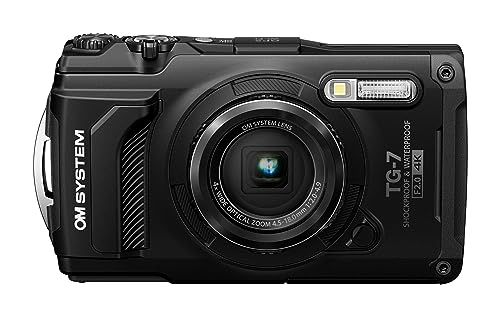
| OM SYSTEM Tough TG-7 | Best adventure camera for water and rough country | Waterproof, shockproof and crush-resistant with macro superpowers — the expedition’s indestructible witness. |
| GoPro HERO13 Black | Best for athletes filming their own expeditions | Mounted, worn and crashed: the adventure camera for the participant, with lens mods per sport. |
| Insta360 X4 | Best for never missing the expedition moment | Records the whole sphere — the whale, the summit panorama, the fall — and lets you direct it later. |
| Sony RX100 VII | Best quality compact for serious adventure photography | A real zoom, real tracking and a one-inch sensor in a pocket — the photographer’s expedition compact. |
| DJI Osmo Pocket 3 | Best for adventure films and travel vlogs | Gimbal-smooth expedition films from a pocket: the trek, the market and the summit walk, stabilised. |
| Fujifilm X100VI | Best for the deliberate traveller’s documentary | A fixed prime, film colour and a leaf-quiet shutter: the slow traveller’s instrument of record. |
How Did We Choose Cameras for Adventure Travel?
We scored survival as engineers and as insurers: sealing against water and dust, tolerance of drops and knocks, operating range in cold and heat, and — just as important — the simplicity that lets a camera be operated by exhausted, gloved, sunburned hands. Adventure cameras fail at interfaces as often as at seals, and a camera that needs a dry thumbprint and a menu dive at altitude is a liability wearing a specification.
Second, the expedition arithmetic of weight and power: what the complete working kit weighs (body, lens or none, batteries, charger, case), how many shooting days a battery strategy honestly covers, and whether the camera charges from the universal sources travellers actually have. A camera whose charger is a proprietary brick has a weight the spec sheet hides, and this guide counts the brick.
Third, image quality sufficient for the story: adventure photographs are judged by where they were taken and what they show, and every pick clears the quality bar for serious travel publication and large prints of the trip’s best frames. Beyond that bar, we spent the ranking on presence — the camera that is carried, ready and alive at the summit, the rapid and the border post outranks the finer camera that was rested, flat or left behind.
We also tested, in imagination at least, the bad day: the camera dropped at the pass, soaked at the crossing, frozen at the high camp, and asked what its owner does next. Picks that keep working after the bad day — or fail so cheaply that the trip continues with the backup — outranked picks whose bad day ends the photography. Adventure is a sequence of managed mishaps; equipment should be chosen by people who expect them, and this list was.
Which Are the Best Cameras for Adventure Travels on Real Trips?
Cast by expedition: the water camera, the athlete’s camera, the all-seeing camera, the quality compact, the pocket gimbal, and the fixed-lens instrument for the deliberate traveller.

OM SYSTEM Tough TG-7 — Best adventure camera for water and rough country
The TG-7 is the camera adventure travellers buy when the itinerary includes the words ‘and then we get in the water’. It is waterproof to depths snorkellers and kayakers actually reach, built to survive drops onto rock, resistant to being crushed in a pack, and operable in gloves and spray. It needs no housing, no rain cover and no anxiety, which makes it the camera that is simply there — clipped to a strap, riding in a pocket — at the exact moments adventure happens and housed cameras are still being assembled.
Its photographic party tricks serve expeditions specifically: macro modes that document the reef’s small citizens and the desert’s details at life size, underwater colour correction that saves the snorkel footage from the blue-green murk, and GPS and sensor logging that records where and in what conditions each discovery occurred — the expedition log written by the camera itself. For science-leaning travellers, trekkers and anyone whose adventures are wet, it is less a compact than a field instrument.
Its ceiling is its sensor size: low-light and ultimate detail sit below the bigger picks, and it is a stills-first camera whose video is a supporting feature. Adventure travellers whose trips are daylight, water and walking will never meet that ceiling; those whose adventures run to night markets and interiors should pair it with, or choose, the RX100 below. As the indestructible member of any travel kit, it stands alone in this guide.
Expedition medics and field scientists have a TG-7 use worth borrowing: documentation under conditions — rain, gloves, haste — where a system camera would stay in its case and the record would simply not exist. Wounds, specimens, river states, camp conditions: the camera that can be operated by a tired person in weather is the camera of record for serious fieldwork, and its macro and logging serve the record precisely. Toughness, in the field, is a form of accuracy.
River journeys — raft, canoe, packraft — are the TG-7’s native biography: clipped to a life vest, dunked at every rapid, photographing the canyon from inside the water that carved it. No housed camera competes with that readiness, because the housing is always in the dry bag when the moment is in the river. For wet journeys, this camera is not the safe choice; it is the only choice that is actually a camera at the decisive seconds.
- Format: rugged compact, waterproof and shockproof
- Macro: extreme close-focus modes
- Logging: GPS and field sensors built in
- Build: crush and freeze resistant, glove friendly
Strengths
- No housing, no fear, always present
- Underwater colour handled in camera
- Macro turns expeditions into discoveries
Trade-offs
- Small-sensor low-light limits
- Video is a supporting feature
- Fixed screen and compact controls
Best for: kayakers, snorkellers, trekkers and any traveller whose adventures are wet and rough.
Not suited for: night-market photographers, or video-first creators.

GoPro HERO13 Black — Best for athletes filming their own expeditions
When the adventurer is the subject — the descent, the climb, the crossing — the HERO13 remains the instrument the tribe trusts: waterproof without a case for the ordinary immersions of expedition life, stabilised through terrain that shakes footage to soup, and mountable to helmets, chests, handlebars, paddles and poles with an accessory universe no rival matches. Its stills and bursts cover the participant’s photography, and its high-rate video slows the rapid and the drop into the trip’s legend.
This generation’s lens mods give expeditions a rare flexibility: change the camera’s field of view and character for the sport of the day — the wide for the bike, the anamorphic-leaning look for the film of the journey — without changing cameras. Battery and media handling are field-practised, voice control serves gloved and occupied hands, and the whole package tolerates being lived with roughly for months, which is the actual expedition test.
Its boundaries are the action camera’s constants: low light softens it, stills are documentation rather than fine photography, and its perspective is wide or nothing. The adventurer whose story is their own movement should start here and add the TG-7 or a compact for the camp and the culture; the adventurer who watches rather than rides should read on.
Multi-day races have made the HERO13 a logistical standard beyond its images: it charges from anything, mounts to anything, and its files are small enough to move by whatever connectivity the route offers. Race media teams plan around exactly that universality. When the adventure is also a production with deadlines in distant places, the camera that fits the infrastructure wins — and this one fits all of it.
Expedition cycling has standardised on the HERO13 for a compound reason: it is the camera, the dashcam and the evidence recorder in one mounted unit, across weeks of vibration that loosen lesser equipment’s mounts and morale alike. Reliability across a month of daily abuse is a different property from toughness in a single drop, and it is the property distance travellers actually buy. This camera owns it.
- Format: action camera, waterproof, mount ecosystem
- Lenses: swappable mods per activity
- Stabilisation: advanced electronic system
- Control: voice options for occupied hands
Strengths
- The participant’s expedition camera
- Mounts for every sport humans do
- Survives the trip’s worst day
Trade-offs
- Low-light footage is modest
- Stills are documentation grade
- Wide perspective is the house style
Best for: riders, climbers, paddlers and skiers filming their own adventures.
Not suited for: photographers of cultures, faces and distant wildlife.

Insta360 X4 — Best for never missing the expedition moment
Adventure’s cruellest property is that its best moments are unannounced and unrepeatable: the whale breaches behind the boat, the summit clears for ninety seconds, the rope team laughs at something off-axis. The X4 is the camera built for that cruelty: it records everything in every direction, so the moment is captured before it is noticed, and the framing — even slow-motion reframing — is decided in the evening’s edit rather than in the second’s panic. For expedition storytelling, it is a second chance machine of genuine power.
Its travel virtues compound: the invisible-stick effect produces drone-like footage of treks and rides where drones are banned, impractical or exhausted; reframed clips feed every platform’s shape from one recording; and its action-camera toughness suits the same environments as the GoPro’s. Expedition films cut from X4 footage have a completeness — the reaction shot, the reverse angle, the panorama — that directed cameras achieve only with a crew.
The costs are workflow and care: large files, an editing step between shooting and sharing, stitch awareness in placing the camera, and two exposed fisheye lenses that demand guards and a case’s respect in a rucksack. Travellers who think in edits will pay gladly; travellers who want finished frames from the camera should choose a directed pick. For the unmissable moment, nothing else here — or anywhere — does what it does.
Sailors give the X4 its most poetic testimonial: mounted at the stern, it records the whole horizon’s weather — the squall arriving behind while the crew watches ahead — and the night passages’ full sky. A boat is a 360-degree experience that directed cameras sample; this one keeps. For travellers whose vehicle is part of the story — boat, bike, train window — the sphere is not a gimmick but the honest shape of the memory.
Volcano, glacier and canyon travellers — anyone whose adventure is scale — use the X4 as their scale instrument: the sphere holds the immensity that a directed frame crops into a postcard, and the evening’s reframe finds the composition the overwhelmed eye missed at noon. Grandeur is the hardest subject in travel photography, and this is currently its most forgiving tool.
- Format: 360 action camera, dual fisheye lenses
- Workflow: record all, reframe in app or desktop
- Effects: invisible selfie stick support
- Build: action-tough with lens guards advised
Strengths
- Captures moments before you notice them
- Drone-like travel footage without a drone
- One recording feeds every platform shape
Trade-offs
- Editing step before sharing
- Large files and stitch care
- Exposed lenses need protection
Best for: expedition storytellers, trekkers and sailors who cannot afford to miss the moment.
Not suited for: shoot-and-share travellers, or the case-averse.

Sony RX100 VII — Best quality compact for serious adventure photography
For the adventurer who is a photographer first — the trekker who plans around light, the overlander whose images must print — the RX100 VII is the expedition compact: a one-inch-type sensor and a genuinely useful zoom in a body that disappears into a jacket, with autofocus tracking inherited from Sony’s professional line for the wildlife encounter and the market’s motion. It produces the best stills quality per gram in this guide, and it does so without a lens ever being changed in dust, rain or a bouncing bus.
That sealed simplicity is its adventure argument: no sensor dust from a windy lens swap, no second body, no bag of glass to guard at borders — one pocketable instrument that covers wide landscapes, compressed ridges, portraits and the short-telephoto wildlife chance. Its pop-up finder serves the noon glare its rivals’ screens surrender to, and its battery discipline, with spares the size of matchboxes, suits multi-day legs between sockets.
It is not ruggedised: rain wants a cover, drops want luck, and water wants it elsewhere — pair it with the TG-7 for the wet days and the pair covers an expedition between them at less weight than one system kit. Its low-light work is compact-class, honest rather than heroic. For the quality-led traveller, it remains the benchmark pocket expedition camera.
Heritage and city adventures — the old town at dawn, the festival, the mountain village — are the RX100’s quiet kingdom: quality that respects the subject, a presence too small to disturb it, and a zoom for the detail across the square. Adventure is not only wilderness, and the traveller whose wild places are human ones will find this pocket instrument out-photographs bigger kits by being welcome where they are resented.
Expedition rest days — the town, the market, the museum mile — are the RX100’s gift to mixed itineraries: the big camera rests, the pocket camera works, and the archive gains the human chapters that adventure albums usually lack. Trips remembered only as terrain are half-told; the compact that covers the town without ceremony completes the story, and its quality means those chapters print as proudly as the summit’s.
- Format: premium compact, one-inch type sensor
- Lens: versatile zoom, no changes ever
- Focus: professional-line tracking and eye focus
- Carry: jacket pocket, matchbox spare batteries
Strengths
- Best stills quality per gram here
- No lens changes in dust or rain
- Tracking autofocus for wildlife chances
Trade-offs
- Not waterproof or drop-proofed
- Low light is compact class
- Premium price among compacts
Best for: photographer-travellers wanting serious quality without a system kit.
Not suited for: water sports, or travellers who drop things professionally.

DJI Osmo Pocket 3 — Best for adventure films and travel vlogs
Adventure film has a texture problem: the better the terrain, the worse the shake. The Pocket 3 solves it with the only built-in gimbal in this guide, turning the trek’s walk, the boat’s roll and the market’s weave into glide — footage that looks produced rather than endured. Its one-inch-type sensor gives that movement real image quality, its rotating screen flips to vertical for the audience back home, and its wireless microphone pairing makes the summit commentary sound like a broadcast rather than a weather report.
For the solo adventure creator it is close to a complete studio: face tracking for the to-camera pieces, deployment in seconds when the light breaks, and a size that means it is carried on the person rather than decided about each morning. Expedition vlogs shot on it have a production calm that belies the conditions, and in adventure storytelling that calm is the difference between a diary and a film.
It is not sealed like the TG-7 or mountable like the GoPro, its lens is fixed, and its battery is internal — carry the charging handle for long days. Treat it as the film unit of an expedition kit, partnered with a stills camera that fears nothing, and the combination covers the modern adventure story — film and photographs — at a weight previous generations needed a porter for.
Long-distance trails have adopted the Pocket 3 as the daily-film standard: a minute at dawn, a minute at the pass, a minute at camp, cut into the journey’s serial story. Its size makes the ritual sustainable for months, which is the entire creative challenge of thru-hiking media — not the filming, but the continuing. Tools that respect a months-long rhythm are rare in every craft, and this is one.
Boat journeys belong to the Pocket 3’s stabilisation in a way land travellers underestimate: the gimbal absorbs the vessel’s roll that turns other footage queasy, so the crossing, the harbour entry and the deck life film as calmly as they are remembered. Sea stories deserve that calm, and solo sailors — who are their own crew and camera department — have adopted it as standard issue.
- Format: pocket gimbal camera, fixed lens
- Sensor: one-inch type for low light
- Screen: rotating for vertical stories
- Audio: wireless microphone ecosystem
Strengths
- Gimbal glide over any terrain
- Complete solo film studio in a pocket
- Strong low-light for its size
Trade-offs
- Not sealed for immersion
- Fixed lens and internal battery
- Needs a stills partner for photography-led trips
Best for: adventure vloggers and filmmakers travelling solo and light.
Not suited for: underwater work, or stills-first photographers.

Fujifilm X100VI — Best for the deliberate traveller’s documentary
The X100VI is the adventure pick for a different philosophy of travel: not the expedition that conquers terrain, but the journey that pays attention. Its fixed prime lens — wide enough for streets, markets and mountain villages, fast enough for interiors and evenings — removes every decision except where to stand, and its film simulations give the journey a coherent, beautiful colour identity straight from the camera. Travellers who shoot one camera and one lens for months produce the deepest work in travel photography, and this is that discipline’s definitive modern instrument.
Its adventure credentials are quieter but real: a weather-resistant build when paired with its filter adapter, a leaf shutter that is nearly silent and flash-friendly at any speed, a hybrid finder that works in desert glare, and a body small enough to be carried all day, every day, without negotiation — the carry discipline that decides travel archives. Its files, from a high-resolution sensor, print at exhibition sizes; its JPEGs have ended many travellers’ editing backlogs entirely.
Availability and fit are its honest caveats: demand has made it scarce and priced accordingly in many markets, the fixed lens will frustrate travellers who need reach or true wide, and it is a stills instrument whose video is a sideline. For the deliberate traveller whose adventure is cultural and human, it is not a compromise — it is the point, and its waiting lists are the market agreeing.
The X100VI’s scarcity has created a traveller’s paradox worth stating: it is the camera its owners most want to take everywhere and most fear losing. The resolution is behavioural, not technical — insure it properly, carry it on the body, and let the fixed lens’s simplicity do its work. Travellers who manage the anxiety report the deepest archives of their lives; the camera rewards custody with intimacy, which is the whole of its design.
Pilgrimage and long walking routes are the X100VI’s spiritual home: one lens, one camera, weeks of attention, and a colour identity that binds a thousand kilometres into a single body of work. The fixed focal length becomes the route’s visual signature — every village seen the same way, honestly — and travellers who complete such journeys with it describe the constraint as the making of the archive, not its limit.
- Format: fixed-lens compact, high-resolution APS-C sensor
- Lens: fast wide prime, no changes
- Finder: hybrid optical/electronic for bright light
- Colour: film simulations for a journey’s identity
Strengths
- One-lens discipline deepens travel work
- Beautiful colour straight from camera
- Carried all day without negotiation
Trade-offs
- Scarce and priced by demand
- Fixed lens excludes reach and true wide
- Video is a sideline
Best for: slow travellers, documentary and street photographers on long journeys.
Not suited for: wildlife travellers, zoom-dependent shooters, or the impatient buyer.
What Should an Adventure Camera Kit Weigh, and What Can You Leave?
Weigh the working kit, not the camera: body, lens, batteries for the longest leg, charger, cards, case and the strap it rides on. Adventure kits fail by accumulation — the just-in-case lens, the second body, the tripod that fits no terrain — until the camera bag becomes the expedition’s heaviest member and starts being left at camp, which is the only unforgivable outcome. The discipline is to pack for the photographs you actually take on actual trips, audited from your own archive, not for the photographer you are in the shop.
Leave, in order of usual guilt: the telephoto you used twice in three trips (unless wildlife is the trip), the second body (unless you are paid), the full-size tripod (a mini or a beanbag serves adventure’s ground-level reality), and every cable with a twin. Take, without negotiation: more storage than the estimate, batteries for the cold’s tax, a cleaning kit for dust and salt, and a dry bag sized for the whole camera kit — the cheapest insurance in expedition photography and the one that pays out most often.
Power strategy deserves a paragraph of its own: standardise on USB charging where your kit allows it, carry one power bank that serves camera, phone and headtorch, and learn your batteries’ cold behaviour before the high trip — lithium cells sulk in cold and recover in a sleeping bag, a fact every polar traveller knows and every first-time winter camper learns expensively. Solar helps on long static camps and disappoints on the move; plan it as a bonus, never as the budget.
Finally, the backup that weighs nothing: a phone you already carry is the expedition’s second camera, and a nightly routine — copy the day’s cards to the phone or a small drive, in the tent, before sleep — is the difference between an adventure’s archive and its anecdote. Gear is lost, soaked and stolen on real trips; files that exist in two places survive all three. The cameras here were chosen partly for how gracefully they join that routine.
Repairs and resourcefulness close the kit guide: carry the tiny tools — a blower, a cloth, tape, a spare strap lug, the cables’ twins — and learn your camera’s field resets before departure, because the nearest service centre may be a continent away and the manual is a download you should already own offline. Adventure travellers fix cameras the way sailors fix boats: approximately, sufficiently, and with whatever the nearest town sells. Choose bodies whose common failures are the field-fixable kind.
Companions deserve the guide’s final consideration: the best adventure camera is often the one your travel partners will also use — handable to a friend for the frame you are in, operable by the guide for the group shot, simple enough that the expedition’s photography is shared rather than bottlenecked through its owner. Several picks here earn their places partly on that handability. An archive of a journey should contain its photographer; choose the camera that lets it.
Companionship with the kit closes the guide: learn your camera’s sounds and tempers until its state is legible without a screen — the tired battery’s behaviour, the full card’s warning, the seal that needs reseating. Expedition equipment should be known the way sailors know a boat, by ear and by hand, in the dark, in weather. The picks here reward that intimacy; the intimacy itself is the traveller’s to build, on local weekends, before the big itinerary tests it.
Resale and replacement geography is the guide’s last practical note: popular cameras can be repaired, replaced or sold in more of the world’s cities than obscure ones, and on a long journey that geography is a feature. The picks here are all travellers in that sense — known to rental counters and repair benches across continents. When the itinerary is measured in months and borders, buy the camera the world already knows how to help you with.
How Do You Keep Shooting Through an Expedition’s Worst Day?
Prepare the camera for the environment before the environment tests it: seals checked, lens cleaned and capped, strap secured with a backup tether in boats and on ridges, and settings simplified to the configuration you can operate with gloves and no attention — adventure days punish menu divers. Decide the day’s defaults at breakfast (mode, file quality, battery plan) and let the camera disappear into the experience until the moment needs it.
Manage condensation, the silent killer of expedition mornings: a camera slept cold and brought into warm, damp air fogs inside and out. Keep it in its dry bag while temperatures equalise, warm it gradually, and resist wiping an internal fog that patience will clear. Salt gets the opposite treatment — wiped and rinsed per the maker’s guidance at the day’s end, before it dries into the seals and dials it will otherwise inhabit permanently.
Shoot the expedition’s story, not just its summits: the packing, the weather days, the repairs, the people who carried and cooked and guided. Adventure archives age into value through their completeness, and the summit frame without the journey reads as a postcard anyone could buy. The cameras in this guide reward the always-carried habit precisely because the story happens between the landmarks, in weather, at knee height, on the ordinary miraculous days.
Close each day like a professional: cards copied, batteries charged or swapped, kit dried and inventoried, and three sentences in a notebook about what the light did. That ritual — twenty minutes in a tent or a bunk — is what separates travellers who return with an archive from travellers who return with a memory card and a hope. Expeditions are remembered through their records; keep the records like the expedition depends on them, because the remembering does.
Photograph the expedition’s people with the same seriousness as its geography: the porters, drivers, cooks and companions are the journey’s true archive, and they are photographed best by the camera that has been present and unthreatening all week — another dividend of the small, quiet picks here. Ask, offer to share the pictures, and keep the promise. Adventure ethics and adventure photography are the same discipline: leave the place and its people better documented and no worse for your passing.
End the expedition’s ritual where it began: clean the kit before you pack it home, copy the final day’s files before the journey’s last sleep, and write the trip’s camera notes while the failures are fresh — which seal wept, which battery lied, which setting saved the summit. That debrief, kept with the archive, is the next expedition’s first preparation, and it is how travellers’ kits evolve from purchases into equipment in the true sense: known, trusted, and ready.
Share the archive as you go when connectivity allows — the expedition’s story told in instalments is safer (copies exist elsewhere), kinder (the people at home travel with you), and truer (memory edits less when the record is already public). Adventure storytelling has always been serial, from ships’ logs to expedition dispatches; the modern traveller’s nightly upload is that tradition with better pictures, and the cameras here were chosen to feed it without friction.
Practise the one-handed and gloved operation of your chosen camera before departure until it is dull: mode, exposure compensation, playback, battery change. Expeditions are filmed by hands that are cold, wet, occupied or holding on, and the camera that demands two dry hands and a menu will be operated less precisely when it matters most. Familiarity is the only feature that works in every weather, and it is installed by rehearsal, not by purchase.
How Do the Six Adventure Travel Picks Balance Toughness, Size and Quality?
| Camera | Badge | Format / type | Standout trait | Watch out for |
|---|---|---|---|---|
| OM SYSTEM Tough TG-7 | Best adventure camera for water and rough country | Format: rugged compact, waterproof and shockproof | No housing, no fear, always present | Small-sensor low-light limits |
| GoPro HERO13 Black | Best for athletes filming their own expeditions | Format: action camera, waterproof, mount ecosystem | The participant’s expedition camera | Low-light footage is modest |
| Insta360 X4 | Best for never missing the expedition moment | Format: 360 action camera, dual fisheye lenses | Captures moments before you notice them | Editing step before sharing |
| Sony RX100 VII | Best quality compact for serious adventure photography | Format: premium compact, one-inch type sensor | Best stills quality per gram here | Not waterproof or drop-proofed |
| DJI Osmo Pocket 3 | Best for adventure films and travel vlogs | Format: pocket gimbal camera, fixed lens | Gimbal glide over any terrain | Not sealed for immersion |
| Fujifilm X100VI | Best for the deliberate traveller’s documentary | Format: fixed-lens compact, high-resolution APS-C sensor | One-lens discipline deepens travel work | Scarce and priced by demand |
The field divides by philosophy of presence. The TG-7 and GoPro achieve presence by indestructibility — they go where the adventure is wettest and fastest. The X4 achieves it by omniscience, the RX100 and Pocket 3 by pocketability, and the X100VI by the discipline of a single lens carried without fail. All six are answers to the same question — will the camera be there, alive, at the moment? — asked in different terrains. Your itinerary knows which answer it needs.
Quality, for once, is the easy comparison: every pick clears the bar for serious travel work, and the differences — the Sony’s detail, the Fujifilm’s colour, the TG-7’s macro — are matters of taste and trip type rather than rank. Spend the decision on survival, weight and carry, and let quality, which refuses to separate these six decisively, be the tiebreaker it deserves to be.
What Adventure Travel Camera Mistakes Ruin Trips?
Taking the fragile flagship unprotected is the classic: the system camera in a shoulder bag meeting its first river crossing, its first dust storm, its first fall — and the trip’s photography ending on day two. Match the camera’s sealing to the itinerary’s worst credible day, protect what cannot be sealed in dry bags, and let the rugged picks carry the dangerous hours. Adventure does not grade your intentions; it grades your preparation, in weather.
The second mistake is the kit that ate the trip: so much camera that the traveller becomes its porter, photographing less as the days pass because every outing begins with a packing negotiation. Audit against your own archive, subtract ruthlessly, and remember that the photographs adventure travellers actually publish cluster overwhelmingly on one lens and one body. The rest was luggage with a viewfinder.
The third is data neglect: one card, filled across three weeks, lost on the last bus. The nightly copy routine costs twenty minutes and a small drive; its absence has cost more expedition archives than every camera failure in history combined. Adventure is risk accepted in the open; your files should be the one part of the trip that takes no risks at all.
A fourth adventure mistake is the untested kit: the new camera, the new housing, the new workflow all debuting on the expedition itself, where their lessons are taught at altitude with an audience of weather. Every system here should be boringly familiar before departure — a local weekend is the expedition camera’s true christening. Travellers who test at home photograph abroad; travellers who debut abroad troubleshoot, and troubleshooting is a poor souvenir.
Final Recommendation
Match the pick to the expedition: water and rough country to the TG-7, the participant’s sports to the HERO13, the unmissable moment to the X4, serious stills at pocket weight to the RX100 VII, the adventure film to the Pocket 3, and the slow human journey to the X100VI. Many real kits pair two — a tough camera and a quality camera — and still weigh less than the system outfit they replaced.
Then pack light, back up nightly, and go. Adventure photography’s archive is written by the travellers whose cameras were present and alive at the hard moments — choose for presence, and the pictures will take care of themselves.
A last word for the traveller still torn between two rows: choose by the worst day of your itinerary, not its best photograph. The camera that survives the worst day will be present for the best one; the reverse has never once been true. Pack that camera, learn it until it disappears, and let the adventure — which was always the point — fill the frame.
Years later, the expedition’s photographs will be the trip — the rest will have faded into the one story you tell. Choose the camera that maximises the archive’s survival and completeness: present at the worst moments, alive at the best, and honest throughout. Every pick here has carried that responsibility for someone; pick yours, test it locally, pack it light, and go and earn the archive.
The archive test is the decision’s simplest form: imagine the trip’s photographs spread on a table in ten years, and ask which camera’s presence made the most of them exist. That is the camera to buy — not the finest, not the toughest in the abstract, but the one whose survival, weight and readiness match your journey’s actual shape. The table in ten years is the only review that matters, and every pick here has passed it for somebody. Make one of them pass it for you.
Frequently Asked Questions
Can one camera really cover a whole adventure trip?
Yes, if the trip’s shape matches the camera’s: the TG-7 covers wet, rough, daylight adventures entirely; the RX100 VII covers quality-led journeys that stay dry; the X100VI covers slow cultural travel completely. Mixed expeditions — dive plus trek plus city — are where pairs earn their weight. Audit your itinerary’s worst day and its dominant photography, and let those two answers choose between one camera and two.
How do I protect a camera that is not waterproof?
Dry bags for transport and river days, a rain cover or even a well-fitted plastic sleeve for shooting in weather, silica gel in the case for humidity, and discipline about lens changes in dust — change under shelter, body facing down, or not at all. Most damage happens in transit and in camp rather than at the moment of photography; protect the boring hours and the camera will survive the exciting ones.
How many batteries does an adventure trip need?
Enough for your longest leg between charging, plus the cold tax: count your realistic shooting days, learn your camera’s honest days-per-battery from a test weekend, and add a third again for cold, altitude and the day everything happens at once. Standardise charging around one power bank where possible. Batteries are the expedition’s fuel; nobody has ever regretted arriving with fuel left over.
Is a phone enough for adventure travel now?
For sharing and for the second angle, phones are superb — and they are in this guide’s backup plan for exactly that reason. But they are not sealed like the TG-7, not mountable like the GoPro, not optically zoomed like the RX100, and their batteries are the expedition’s communications lifeline, which photography should not spend. Serious adventure archives are still built on dedicated cameras, with the phone as their honoured understudy.
What is the best way to back up photos without a laptop?
A nightly routine to a phone or a small portable drive, using the camera’s own transfer or a card reader, verified before the card is reused — and the card itself kept as the second copy until you are home. Some travellers mail or cloud-upload at connectivity stops for a third copy of the best frames. The method matters less than the rhythm: daily, verified, in two places before sleep.
Should I insure my camera for an adventure trip?
For valuable kits, yes — travel policies vary widely on electronics, so read the actual cover for theft, water damage and single-item limits, and photograph your kit and serial numbers before departure. For the rugged picks at their price positions, many travellers self-insure and rely on the cameras’ toughness. Either way, decide before the trip; the middle of an incident is the worst insurance office in the world.
Pack the camera last, on top, where the journey can reach it — because the first photograph of an adventure is usually taken before the expedition officially begins, at the dock, the trailhead, the border post in first light. Travellers who keep the camera reachable from minute one return with beginnings to their stories; travellers who bury it return with middles. Presence, this guide’s whole argument, starts in the packing.
One more honest packing truth, learned slowly by every long traveller eventually: the camera you lend is the camera that returns with other people’s photographs of your journey — the crew, the companions, the versions of the trip you never saw. Choose a pick simple enough to lend without a lecture, and the archive doubles its perspectives for free. Generosity, in expedition photography, is a wide-angle lens of its own.
So choose for presence, pack for the worst day, back up every night, and let the journey — which never repeats itself for anyone — find your camera awake, ready and already waiting patiently in your own hand.
Go well, shoot honestly, and bring the archive home — the journey deserves a witness as durable as the memories it is about to make.
How should you split camera gear between bags on an adventure trip?
Assume one bag will eventually be delayed, soaked or left behind somewhere, and pack so that losing it does not end photography for the whole journey. Keep the main camera, one versatile lens, a charged battery and a card on your person or in the bag that never leaves your side, while chargers, backup bodies and specialty optics can travel in secondary luggage. A phone photograph of serial numbers and receipts, stored online, also speeds insurance conversations if anything genuinely disappears.
Daily habits on the trail matter as much as the initial split. Each evening, copy that day’s images to a second device or drive and store the two copies in different places, perhaps one in your rucksack and another in a companion’s pack or a waterproof pouch with your documents. Rotate cards instead of filling a single huge one across a fortnight, because a failed card then costs a day rather than the expedition. Add silica gel sachets wherever gear sleeps, seal equipment inside bags before stepping from cold mountain air into warm huts so condensation forms on the bag instead of the lens, and carry a simple rain cover even when forecasts promise sunshine.
Rugged handling completes the picture once you reach camp or coastline. Rinse salt spray from hands before touching controls, dry everything thoroughly before sealing cases for the night, and never change lenses facing into windblown sand if waiting ten minutes or turning your back to the gusts would spare the sensor. Keep a rocket blower, not canned air, in the repair pouch alongside a spare lens cloth sealed in its own bag so the cloth itself stays grit-free. Learn your camera’s menus well enough to operate core settings wearing gloves, because fumbling through screens on a freezing ridge wastes both battery and goodwill. Travellers who build these small rituals into each day return home with functioning equipment and complete stories, rather than a heroic tale about the wonderful photographs their camera almost captured before the trip defeated it.
Related Guides
Keep exploring with our guide to the best cameras for travel and everyday carry and our roundup of rugged cameras for water and outdoors and our explainer on addon cameras for traveling.


