ilcastellomenu.com is reader-supported. When you buy through links on our site, we may earn an affiliate commission.
Where to Buy
The beach is the worst place in the world to learn photography and the best place to want to. Salt spray corrodes, sand infiltrates like a rumour, sun glares off every screen, and the one wave you did not see coming arrives precisely when the camera is out. The best beach cameras for beginners are therefore not the cameras with the most impressive specifications — they are the ones that forgive the beach while teaching the beginner, that can be dropped in the shallows, rinsed under a tap and handed to a child without a family summit about consequences.
Six cameras make this list, and every one comes from this site’s verified camera pool, linked accordingly. They divide the beginner’s beach into its honest territories: the armoured camera built to be submerged, the action cameras that treat the sea as a playground, the 360 camera that makes the whole shoreline the frame, the action camera for the budget that still wants real footage, and the instant camera that turns a beach day into photographs before the towels are dry. What they share matters more than what divides them: none requires a housing to meet the water, none punishes a beginner’s mistakes with fragility, and none costs so much that its loss would ruin the holiday it was bought to remember.
A note on what beach-proof means in this guide, because the word is abused by marketing. These cameras carry genuine waterproofing to real depths — the shallows, the rock pools, the snorkel over the reef’s edge — rather than splash resistance dressed in wetsuit colours. Their limits are stated in each verdict, and the how-to sections teach the small rituals — the rinse, the seal check, the freshwater soak — that keep waterproof a fact rather than a memory.
Finally, a beginner’s reassurance that shapes the whole list: beach photography is mostly about presence and nerve, not about settings. The camera that is in the water with you, at the moment the wave breaks over the rock pool, will take the photograph that the magnificent camera in the dry bag on the sand will only hear about. Every pick here was chosen to be that camera — present, brave and unbothered — because for a beginner, the best camera is unfailingly the one that comes swimming.
Key Takeaways
- OM SYSTEM Tough TG-7 is the beginner’s beach champion: waterproof, shockproof, crushproof and a real stills camera with a macro mode for rock pools.
- GoPro HERO13 Black is the video answer — waterproof, stabilised and simple enough that a beginner films well on the first day.
- Waterproof ratings are a beginning, not a lifestyle: rinse in fresh water after every sea day and check the seals before every swim.
- DJI Osmo Action 5 Pro counters GoPro with longer battery life and a screen on the front for framing at arm’s length.
- AKASO Brave 7 LE proves the beach does not require a flagship budget — waterproof, dual-screen and honest.
- Fujifilm Instax Mini 12 is the beach day’s memory machine — keep it dry, and it returns photographs before the ice cream melts.
In this guide
Quick Picks
| Pick | Badge | Why it earns its place |
|---|---|---|
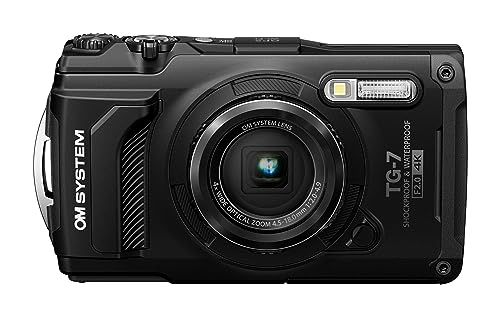
| OM SYSTEM Tough TG-7 | Best overall beach camera for beginners | Waterproof to real depths, shockproof, crushproof — and a proper stills camera with a microscope mode for the rock pools. |
| GoPro HERO13 Black | Best for beach video | Waterproof, gimbal-smooth and nearly indestructible — the camera that films the swim, the surf and the run back up the beach. |
| DJI Osmo Action 5 Pro | Best battery life action camera | Front and rear screens, long endurance and excellent low-light manners for a camera that films the whole beach day. |
| Insta360 X4 | Best for never missing the moment | Films everything in 360 degrees — the beginner points it at the day and chooses the framing later, at home, dry. |
| AKASO Brave 7 LE | Best budget beach camera | Dual screens, waterproof body and honest 4K at a price that treats a beach accident as a lesson, not a tragedy. |
| Fujifilm Instax Mini 12 | Best for instant beach memories | The camera that prints the day while it is still happening — with one honest rule: it watches the water, it does not swim. |
How We Chose These Picks
Candidates were judged by the beach’s own examination: genuine waterproofing without a housing, survival of drops onto the hard surfaces holidays provide, screens that can be read in glare, controls that work with wet hands, and image quality that flatters a beginner’s subjects — family, water, light — without demanding a photography course first. Cameras that needed accessories to meet the sea were marked down to their true whole-cost, and cameras whose toughness was a marketing adjective rather than an engineering fact were excluded entirely.
Beginner fit was weighted as heavily as toughness. A beach camera for a new photographer must start fast, focus by itself, forgive the wrong mode, and produce something joyful from an unsteady hand in bright chaos — because the beach beginner is also, usually, a parent, a swimmer and a person carrying three other people’s towels. The six survivors divide by the kind of beach day their owners actually have, and the verdicts assign them accordingly rather than pretending one camera wins every shoreline.

OM SYSTEM Tough TG-7 — Best overall beach camera for beginners
The TG-7 is the camera this category would invent if it did not exist: a compact armoured like a diving instrument, waterproof to depths a beginner’s snorkelling will never trouble, shockproof against the drops that sand and boardwalks arrange, freezeproof and crushproof for the bag it will live in — and, crucially, a real photographer’s camera inside the armour, with a bright lens, RAW files for the learner who grows curious, and image quality that embarrasses the ‘tough toy’ reputation of its ancestors.
Its party trick deserves its reputation: the microscope and underwater modes turn the rock pool into a studio. A beginner who has never thought about macro photography will spend an entire low tide photographing anemones, hermit crabs and the tiny architecture of shells, at magnifications that feel like a magic trick — and will learn more about light and patience in that tide than in a month of ordinary shooting. The underwater modes correct the sea’s colours automatically, so a first snorkel produces photographs that look like the memory rather than a green fog.
Honesty about shape and screen: the TG-7 is a chunky object with a fixed screen, its video is a supporting feature rather than a headline, and its controls reward a ten-minute read of the quick-start guide. None of that matters at the water’s edge, where its virtues are the only ones on the beach. It can be handed to a child, dropped on a shingle bank, taken swimming and rinsed under the beach tap, and it will be ready for the sunset portrait with sand still in its seams.
Buy it if the beach means stills, snorkelling and rock pools, and if the camera must survive being a family’s shared instrument rather than one person’s precious object. It is the most complete answer this guide offers, and the one its author would pack first.
- Waterproof: to 15m-class depths without housing
- Protection: shockproof, crushproof, freezeproof
- Lens: bright zoom with macro/microscope modes
- Modes: dedicated underwater colour correction
- Files: JPEG and RAW for growing learners
Strengths
- Toughness is engineering, not marketing
- Rock-pool macro is a beginner’s revelation
- Underwater modes fix the sea’s colours
Trade-offs
- Chunky body, fixed screen
- Video is a supporting act
- Controls reward a short read first
Best for: families, snorkellers and rock-pool explorers who want one camera that swims, survives and teaches.
Not suited for: video-first creators, whose pick is the GoPro or DJI below.

GoPro HERO13 Black — Best for beach video
If the beach day is a film rather than an album, the HERO13 is its camera. It is waterproof out of the box to depths a holiday swimmer will not reach, stabilised so effectively that running down the sand with it produces footage like a tracking shot, and simple in the way beginners need: one button, a forgiving wide lens, and an app that assembles the day’s clips into something watchable while the towels are still damp. A beginner cannot really fail with it, which is the highest praise a first video camera can earn.
The HERO13 generation added the modular touches creators asked for — accessory lenses for different looks, strong battery endurance for its class, and image quality that handles the beach’s brutal contrast between white sand and dark water with unusual grace. Mounted on a chest strap it films the bodyboard ride; on a floating grip it films the swim without the sinking anxiety that ruins other cameras’ afternoons; in a child’s hand it films the rock-pool expedition from inside the expedition.
Its limits are a stills camera’s revenge: photographs are a by-product here, wide and vivid but no match for the TG-7’s considered frames, and the fixed ultra-wide perspective that flatters action distorts a portrait at close range. Battery swaps are its refuelling ritual, and a long day’s filming wants a spare. None of this troubles its parish.
Buy it when the holiday’s memories move. For the family whose beach is surfing, swimming, cycling the promenade and racing the tide, the HERO13 is not the action option — it is simply the camera, and its toughness means the beginner’s whole learning curve happens in the water rather than in fear of it.
- Waterproof: to 10m-class depths, no housing
- Stabilisation: HyperSmooth, gimbal-rivalling
- Video: 5.3K-class with high frame rates
- Lens system: accessory lenses for new looks
- Mounts: the vast action-camera ecosystem
Strengths
- Beginner-proof filming in real surf
- Stabilisation forgives every unsteady hand
- Mounts and grips for every beach sport
Trade-offs
- Stills are a by-product, not a strength
- Ultra-wide perspective flattens close faces
- Long days want a spare battery
Best for: families and beginners whose beach is movement — surf, swim, ride, run — filmed without fear.
Not suited for: stills photographers and rock-pool macro lovers, who belong in the TG-7’s paragraph.

DJI Osmo Action 5 Pro — Best battery life action camera
DJI’s Action 5 Pro is the connoisseur’s action camera, and its beginner case rests on two mercies: endurance and visibility. Its battery life leads the action class by a margin a beach day can feel — the camera that is still awake at the sunset swim — and its front screen, absent or lesser on rivals, lets a beginner frame themselves at arm’s length without the guess-and-check ritual that fills memory cards with chins. For the vlogger-beginner filming a beach day to camera, that front screen is worth more than any resolution figure.
As a camera it is thoroughly modern: a larger sensor than the action class’s tradition, with low-light and dynamic-range manners that handle the cave, the beach bar and the golden hour with unusual composure; stabilisation that rivals GoPro’s; waterproofing to greater depths than its rival without a case; and a quick-release mounting system that moves the camera between grips in a click. Its colour science flatters skin and sea alike, and its footage cuts happily beside phone video in the family edit.
The compromises are ecosystem and familiarity. GoPro’s mount-and-accessory universe and cultural default status are larger; a beginner already surrounded by GoPro-owning friends may value the shared chargers and advice above DJI’s refinements. The Action 5 Pro also asks its owner to learn DJI’s menu logic, a small tuition repaid in a week.
Buy it for the long day and the self-filmed story. If your beach is a dawn-to-dusk narrative and you are its presenter, this is the camera that will still be awake, and still showing you your own face, when the light turns gold.
- Waterproof: deeper than rivals without a case
- Screens: front and rear touchscreens
- Battery: class-leading endurance
- Sensor: larger, strong in low light
- Mounting: quick-release magnetic system
Strengths
- Front screen ends framing guesswork
- Battery outlasts the beach day
- Low-light manners lead the class
Trade-offs
- Accessory universe smaller than GoPro’s
- Menus are a new language to learn
- Stills remain a secondary talent
Best for: self-filming beginners and all-day beach storytellers who need endurance and a front screen.
Not suited for: beginners embedded in a GoPro-owning circle whose shared kit and advice outweigh refinements.

Insta360 X4 — Best for never missing the moment
The X4 proposes a radical kindness to beginners: stop aiming. A 360 camera records the entire sphere around it — the wave and the face it hits, the child and the parent filming, the whole beach in every direction at once — and the framing decisions move to the app afterwards, where a dry, seated editor can re-aim the shot at leisure. For a beginner whose beach moments keep happening beside the camera rather than in front of it, that reframing superpower is worth more than any lens.
As beach hardware it is properly equipped: waterproof to a swimmer’s depths without a case, stabilised by software that treats the horizon as sacred, and capable of footage that becomes ordinary wide video, tiny-planet novelties or follow-me edits from the same swim. The invisible-selfie-stick trick — the pole vanishes from the footage — produces drone-like shots of a run along the waterline that will make a beginner’s first holiday film look professionally impossible, which does wonders for a beginner’s confidence.
The costs are workflow and delicacy. Two bulging lenses are the camera’s eyes and its vulnerability: sand is their enemy, the lens guards are mandatory beach kit, and a scratched dome is a ruined camera in a way a flat lens never is. Editing 360 footage is a skill and a time commitment, and the files are large. Beginners who want to film, swim and share in the same hour should choose GoPro or DJI; beginners who love the edit will find the X4 the most creative object in this guide.
Buy it if your beach days are chaos you want to keep whole — the group swim, the boat trip, the festival on the sand — and if reframing at home sounds like play rather than homework. It is the only camera here that can miss nothing, priced in the effort of choosing what it saw.
- Capture: full 360 degrees, reframe later
- Waterproof: to swimmer depths without case
- Stabilisation: FlowState with horizon lock
- Footage: 8K-class 360, reframed exports
- Signature: invisible selfie stick effect
Strengths
- Impossible to miss the moment
- Reframing teaches editing joyfully
- Drone-like shots from a stick
Trade-offs
- Bulging lenses fear sand — guards essential
- Editing is a real time commitment
- Large files, hungry storage
Best for: group adventures and creative beginners who love editing and want the whole scene, always.
Not suited for: beginners wanting film-and-share simplicity, whom GoPro and DJI serve better.

AKASO Brave 7 LE — Best budget beach camera
Every beginner category needs the camera whose price changes the owner’s behaviour, and the Brave 7 LE is this guide’s: inexpensive enough that a parent hands it to a seven-year-old at the water’s edge without a tightening chest. It is waterproof in its body, carries front and rear screens — a feature the flagships charge handsomely for — records honest 4K video with usable stabilisation, and arrives with the mounts and accessories other brands sell separately. As a first action camera, its completeness is its curriculum.
The footage is a clear class below the GoPro and DJI picks — stabilisation that smooths rather than glides, colours that please rather than impress, low light that should be left to the campfire’s edge — and a beginner will not care, because the footage is of their family, in the sea, today. That is the budget camera’s eternal defence, and it is sound: the Brave’s owner films everything, everywhere, without the flagship owner’s protective hesitation, and presence beats polish in the family archive every single time.
Its compromises beyond footage are the usual value-tier ones: an app that serves rather than delights, battery endurance that wants the included spare on a long day, and a build that is waterproof-honest but not armoured like the TG-7 for drops onto rock. Treat it as the camera it is — the beach’s disposable-income answer — and it will be loved without reservation.
Buy it for children, for the second angle, for the camera that goes on the kayak’s bow and the boogie board’s nose. It is the pick that proves the beach does not check your receipt before giving you the light.
- Waterproof: body-sealed for swimming depths
- Screens: front and rear
- Video: 4K with electronic stabilisation
- In the box: mounts and accessories included
- Power: spare battery commonly bundled
Strengths
- Price removes the fear of using it
- Dual screens at a budget tier
- Complete kit in the box
Trade-offs
- Footage a class below the flagships
- App and polish are serviceable only
- Not armoured for rocky drops
Best for: children, second angles and budget beginners who will film more bravely at this price.
Not suited for: creators whose footage must impress strangers — the GoPro and DJI paragraphs are theirs.

Fujifilm Instax Mini 12 — Best for instant beach memories
Every other pick in this guide stores the beach for later; the Instax Mini 12 develops it on the spot, and for a certain kind of beginner — the one whose photography is a social act — that immediacy is the whole art. The camera is simplicity itself: twist to wake, point, shoot, and a small print emerges to be shaken, shared, stuck to the holiday fridge and treasured with an intensity no phone gallery has ever produced. On a beach day with friends or grandparents, an Instax print is not a photograph. It is a gift, made in ninety seconds.
Beginner fit is total. There are no settings to ruin a shot, exposure is automatic, close-up mode handles the shell and the ice cream, and the selfie mirror on the lens acknowledges how beach photographs actually happen. Its film cost per frame imposes a gentle discipline — a beginner thinks before an Instax frame in a way digital never asks — and many photographers trace their eye to exactly that discipline, learned on cameras like this.
The honesty paragraph matters: the Mini 12 is not waterproof, not sandproof and not a swimmer. It lives in the dry bag, comes out for the picnic, the portrait and the sunset, and goes back before the swimming resumes — a rhythm beachgoers have kept with instant cameras for fifty years. Its prints are small, its flash is enthusiastic, and night defeats it kindly. Judged as a beach camera entire, it is a specialist; judged as the memory machine of a beach day, nothing else here competes.
Buy it alongside, not instead of: the TG-7 or GoPro for the water, the Instax for the people. The beginner who packs both will come home with footage and with prints — the day as it moved, and the day as it will be remembered on a fridge door for a decade.
- Output: instant prints, developed in minutes
- Operation: fully automatic, twist-to-wake
- Modes: close-up and selfie mirror
- Power: AA batteries, long-lived
- Water: none — a dry-bag camera, honestly
Strengths
- Prints turn photographs into gifts instantly
- Zero settings to learn or ruin
- Film cost teaches a beginner’s eye
Trade-offs
- Not waterproof — watches the sea only
- Prints are small and film is a running cost
- Night and action defeat it
Best for: social beginners, families and grandparents — anyone whose beach photographs are for sharing on the day itself.
Not suited for: anyone wanting one camera that swims — that is every other pick in this guide.
How Do the Six Beach Cameras Compare Side by Side?
| Pick | Badge | Best for | Not suited for |
|---|---|---|---|
| OM SYSTEM Tough TG-7 | Best overall beach camera for beginners | families, snorkellers and rock-pool explorers who want one camera that swims, survives and teaches. | video-first creators, whose pick is the GoPro or DJI below. |
| GoPro HERO13 Black | Best for beach video | families and beginners whose beach is movement — surf, swim, ride, run — filmed without fear. | stills photographers and rock-pool macro lovers, who belong in the TG-7’s paragraph. |
| DJI Osmo Action 5 Pro | Best battery life action camera | self-filming beginners and all-day beach storytellers who need endurance and a front screen. | beginners embedded in a GoPro-owning circle whose shared kit and advice outweigh refinements. |
| Insta360 X4 | Best for never missing the moment | group adventures and creative beginners who love editing and want the whole scene, always. | beginners wanting film-and-share simplicity, whom GoPro and DJI serve better. |
| AKASO Brave 7 LE | Best budget beach camera | children, second angles and budget beginners who will film more bravely at this price. | creators whose footage must impress strangers — the GoPro and DJI paragraphs are theirs. |
| Fujifilm Instax Mini 12 | Best for instant beach memories | social beginners, families and grandparents — anyone whose beach photographs are for sharing on the day itself. | anyone wanting one camera that swims — that is every other pick in this guide. |
How Do You Keep a Waterproof Camera Waterproof?
Waterproofing is a system of seals, and seals are maintained, not possessed. Before every swim, run a finger around the battery and port doors: a single grain of sand or a hair across the seal is the entire difference between a waterproof camera and a story. Close the doors until they click with conviction, and if a seal looks nicked or tired, treat the camera as a dry camera until it is serviced — the sea does not grade on intention.
After every sea day, the rinse is the ritual: the camera, doors closed, under a gentle freshwater tap or soaking in a bowl of fresh water, then dried and left with doors open in moving air so the seals dry without trapping salt. Salt left to crystallise works on seals and lenses alike, and the cameras in this guide that die young almost always die of skipped rinses rather than of the sea itself. Ten minutes of freshwater is the cheapest insurance in beach photography.
Know your depth honestly. The ratings here cover swimming, snorkelling and the surf zone — the beginner’s whole ocean. They do not cover diving beyond their stated depths, hot showers (heat and soap attack seals), or the pressure of jumping from height into water, which multiplies impact pressure beyond the number on the box. Stay inside the rating and the camera will outlive the decade; treat the rating as a dare and the sea will collect.
What Should a Beginner Actually Photograph at the Beach?
Begin with the water’s edge, where the light does the work for you: waves arriving over wet sand in the last hour of the day will make a beginner’s first great photograph with almost any pick here, because wet sand is a mirror and the low sun is a studio. Shoot the same scene at the TG-7’s feet and from standing height and learn, in one frame pair, what viewpoint means. Then go macro: the rock pool at low tide is the beginner’s university, and the TG-7’s microscope mode or any camera’s close focus will fill an afternoon with subjects that hold still and glow.
Film people the way the beach makes them: mid-laugh, mid-run, mid-wave, from the water looking back at the shore as often as from the shore looking out. The action cameras here exist for exactly this reversal — the swimmer’s view of the beach is the photograph the dry cameras never take. And give the Instax the portraits. A printed portrait given on the day is the beginner’s fastest lesson in why photography matters to anyone, and it costs one frame of film.
Finally, shoot the weather when it turns. Beginners pack cameras away at the first cloud, and the sea under a storm light — grey water, white horses, empty sand — makes the photographs the whole beach will envy at home. The tough cameras in this guide were built for that hour. Stay for it, rinse the camera after, and let the fair-weather photographers keep the postcards.
How Do You Pack, Shoot and Rinse Like a Beach Photographer?
Pack the beach kit like a swimmer, not a studio: camera on a floating wrist strap — the single accessory that has saved more cameras than any case — a microfibre cloth in a sealed bag, spare battery or film in the dry bag, and the rinse bowl waiting at home. Set the camera before the sand: the right mode, the lens wiped, the seals checked at the car rather than with wet hands at the waterline, because every adjustment made on dry land is one not fumbled in the surf.
Shoot with wet-hand discipline. Rinse or dry your hands before handling doors and ports, never open a compartment at the beach, and treat the camera’s lens as the one surface sand must never be wiped across dry — a dry wipe grinds; a rinse floats the grains away first. These are thirty-second habits, and they are the whole difference between a tough camera that ages like a tool and one that ages like a casualty.
End the day like a professional: rinse, dry, charge, and look at the photographs while the day is still warm. The beginner who reviews the day’s frames nightly learns at holiday speed — what the light did, where the camera was, what tomorrow’s tide should find them ready for. A beach holiday with a camera is a photography course with better catering, if its student does the small homework of looking.
What Mistakes Do Buyers Keep Making?
- Opening a battery door at the beach. Sand on a seal is a leak scheduled. Charge and swap on dry land, every time.
- Wiping a sandy lens dry. That is grinding glass with glass. Rinse first, always, and let water do the dangerous work.
- Trusting ‘waterproof’ in a hot shower or a dive beyond rating. Heat, soap and depth-pressure are different enemies from the sea, and seals negotiated only with the sea.
- Leaving the camera in a hot car. Heat ages seals and batteries together. The camera goes where the people go.
- Keeping the good camera dry ‘for safety’. A tough camera in the bag takes no photographs. Its toughness is the permission — use it in the water it was built for.
- Forgetting the floating strap. Cameras that sink are found by nobody. Ten grams of foam is the difference between a scare and a loss.
What About Phones at the Beach — the Beginner’s Honest Alternative?
A modern phone in a good waterproof pouch is a legitimate beach camera, and this guide loses no credibility by saying so: it is waterproofed by the pouch, familiar to its owner and already paid for. Its beach weaknesses are the pouch’s — fogging, muffled touch controls, a lens behind plastic — and the catastrophe asymmetry: a drowned TG-7 is a sad afternoon, a drowned phone is the holiday’s maps, cards, photographs and communications in one brick. Many beginners rationally choose a dedicated tough camera precisely to retire the phone to the dry bag, where it can be a phone.
The deeper argument is about attention. A camera that only takes photographs makes a photographer of its holder for the hour it is carried; the phone makes a correspondent, forever one notification from leaving the moment it was raised to capture. Beginners who wonder why their beach photographs feel distracted often find the answer in the device rather than in themselves. The picks here, even the humblest AKASO, offer the single-purpose hour — and on a beach, with the light doing its evening miracle, an hour of single purpose is worth more than any specification in this article.
How Does Each Pick Handle the Five Moments of a Beach Day?
A beach day has five photographic moments, and the picks divide them like specialists at a relay. Dawn and the empty shore belong to whichever camera is awake and present — usually the one that slept in the beach bag, which argues for toughness over ceremony. The morning swim belongs to the TG-7 and the action cameras, in the water, at wave height. Midday, when the light is a bully and the subjects are lunch, shade and each other, belongs to the Instax and to any camera whose owner has the sense to shoot the people instead of the glare. The afternoon’s sports — the bodyboard, the beach cricket, the dog’s eternal retrieve — belong to GoPro and DJI. And the golden hour, when the whole beach turns to honey, belongs to the photographer who kept a camera dry, charged and ready rather than spent by noon.
Reading the day this way cures the beginner’s commonest error, which is asking one camera to be the hero of all five moments and resenting it by the fourth. The TG-7 comes closest to the full relay, which is why it leads; the others win their legs outright. A household that packs two picks from this list — a swimmer and a storyteller, an action camera and an Instax — covers the day the way a relay team covers a race, and the photographs show it.
What Should a Beginner Spend on Accessories — and What Is a Waste?
The floating wrist strap is the only accessory this guide uses the word essential for, because it converts the commonest beach camera death — the fumbled drop in deep water — into a bobbing retrieval. After it comes the humble dry bag, which serves every pick including the waterproof ones, because cameras also travel through car parks, cafés and rainstorms, and because the Instax and the phones need a home. A spare battery for the action cameras and spare film for the Instax complete the honest list; everything else is a want, and should be bought after the first holiday, when the wanting has evidence behind it.
The waste list is longer and more profitable to publish. Underwater housings for cameras already waterproof to the beginner’s depths. Red filters for the shallows. Chest mounts, head mounts and drone-envy accessories for a first season whose footage will be the family’s faces. A beginner’s accessory budget follows a strict order — flotation, dryness, power, then nothing — until the photographs themselves file a request for something specific. Cameras are improved by use far more than by company, and the beach, which provides subjects by the thousand and light by the megawatt, is the last place on earth that needs help from a shopping basket.
Learning Photography at the Beach: The Beginner’s Secret Curriculum
The beach teaches photography’s fundamentals faster than any classroom because it exaggerates all of them. Exposure: the sand-and-water glare that fools every meter is a daily lesson in compensation, learned in an afternoon of white-framed mistakes. Timing: waves are a metronome for the decisive moment, and a beginner who has shot a hundred breakers has internalised anticipation without knowing the phrase. Composition: a shoreline is a horizon that punishes tilt instantly and rewards the rule of thirds with postcard evidence. A holiday with any camera in this guide is a foundation course wearing a swimsuit.
The tough cameras accelerate the curriculum by removing its fear. Beginners learn by volume and by risk — the low angle in the surf, the shot from inside the rock pool, the frame attempted in the rain shower — and a camera that must be protected teaches caution instead, which is photography’s least useful first lesson. This is the deepest reason the TG-7 and its armoured cousins lead a beginners’ guide rather than a merely practical one: they are not just harder to break. They make braver photographers, faster, and bravery at the water’s edge is where every memorable beach photograph in history was standing when it was taken.
What Happens After the Holiday: Keeping the Camera Alive for Next Summer
More beach cameras die in the fortnight after the holiday than in the sea: left in a damp bag with salt drying on their seals, batteries swelling quietly in a hot drawer, seals perishing in the dark they were stored in. The homecoming ritual is the rinse repeated once more, thoroughly, followed by a full dry day with doors open, a battery stored at partial charge, and the camera kept in a cool, dry, unsealed place — not the airtight box its damp self would steam in. Ten minutes of this converts a holiday tool into a decade’s companion, and its omission converts the same tool into next summer’s disappointment, discovered at the worst possible moment: the first swim of the next trip.
Test before the next departure, not at it. A bathtub is the honest laboratory: seals inspected, doors clicked, the camera submerged in fresh water and watched for the bubble-trail that betrays a tired seal while a replacement is still a purchase rather than an emergency. Owners who run the bathtub test each spring swim with confidence all summer. Owners who skip it are conducting the same test in the sea, with the stakes inverted — the oldest bargain in this entire guide, offered one final time.
A Short Word for the Beginner Who Feels Overwhelmed by Six Cameras
Then ignore five of them. If your beach is swimming and children, the TG-7 is your paragraph and your purchase. If it is surfing and stories, take the GoPro. If money is the loudest voice, take the AKASO and spend the change on the holiday itself, which is, after all, the subject. The other cameras in this guide exist for the readers whose beaches differ from yours, and a guide’s length is a map of other people’s summers, not a measure of your decision’s difficulty.
What no beginner here can choose wrongly is the category itself: a camera that comes into the water, survives the sand and forgives the learning. Photography’s first year is not about the perfect instrument; it is about the thousand frames, the hundred mistakes and the dozen photographs that make a family say — usually over the Instax prints, at the kitchen table, in October — that was the best summer. Every pick above will take you to that table. Choose one, pack the floating strap, and go and get wet.
Why the Beach, of All Places, Deserves a Real Camera
It would be easy to leave the beach to phones and memory, and many holidays are. But the beach is where families are most themselves — unposed, sunlit, in motion, in the water that levels every generation to the same shrieking joy — and it is where the years will most want evidence. The photographs from these weeks are the ones framed, the ones at funerals and weddings, the ones a grandchild will hold. A camera chosen to survive that environment, and to be present in its wettest moments, is not a gadget purchase. It is the family archive’s founding decision, made once, at the price of a modest camera, repaid at every reunion for the rest of the century.
That is the spirit in which this guide ranked toughness beside image quality and forgiveness beside both. The best beach camera for a beginner is the one still working, still present and still brave in the tenth summer — and the six above were chosen because their makers built them, each in its own dialect, to be exactly that.
One practical promise to end on: whichever camera you choose, take it into the water on the first morning, not the last. Beginners who save the swimming shots for later in the holiday discover the seals, the straps and their own nerve all at once, under time pressure, with the best light already spent. The first-morning swim — camera checked at the car, strap on the wrist, one joyful hour in the shallows — converts the camera from luggage into a companion for the whole trip, and every photograph after it is taken by a photographer the beach itself has begun to train. That training, more than any camera in this guide, is what you are really packing for.
Sand: A Short Treatise on the Enemy That Gets Everywhere
Sand deserves its own respect in any beach guide, because it is not dirt — it is powdered rock with an agenda, and it migrates into seals, zips, lens barrels and sandwiches with equal dedication. The defence is choreography rather than equipment: a designated dry zone on the towel where cameras are handled, hands brushed before touching doors, the camera bag zipped between uses as a religion, and the end-of-day shake-and-rinse performed over the bin rather than the bed. Beginners imagine waterproofing is the beach’s examination and sand is a footnote; veterans know the examination is sand, sat daily, and that the sea — which rinses away — is almost a friend by comparison.
The cameras here were chosen partly for their sand manners: sealed bodies with few moving external parts, lenses that do not telescope into the grit, doors that click rather than slide. Even so, the final responsibility is the owner’s choreography, and it costs nothing but attention. Master it in the first holiday and every camera you ever take to a coast will live twice as long — the cheapest upgrade in this entire article, and the only one that cannot be bought, only practised — one brushed hand, one clicked door, one rinsed camera at a time, all summer long, year after happy year, until the rituals disappear into habit and only the photographs remain — bright, salt-flecked and gloriously alive, exactly as the days themselves were lived, from the first brave swim to the last golden evening.
Final Recommendation
Beginners should start with the OM SYSTEM Tough TG-7 unless their beach is a film waiting to happen: it swims, survives, teaches and produces stills a family will print, and its rock-pool macro mode alone justifies the packing space. Video beginners should take the GoPro HERO13 for its forgiving genius, or the DJI Osmo Action 5 Pro when the day is long and the presenter is you.
The Insta360 X4 waits for the creative beginner who loves an edit, the AKASO Brave 7 LE for the budget that refuses to be left out of the water, and the Instax Mini 12 for the soul of the day — the prints given away before the towels dry. Whichever you pack, pack it bravely: the beach rewards the camera that comes swimming, and every pick here was chosen to do exactly that.
Related guides
- Best Cameras for Bowfishing: 6 Waterproof Cameras for the Night Deck
- Best Cameras for Adventure Travels: Tough, Small and Ready for the Trip That Fights Back
Frequently Asked Questions
Can I really take these cameras into the sea without a case?
Yes — the TG-7, GoPro, DJI, Insta360 and AKASO picks are waterproof in their bodies to the depths stated in their verdicts, which cover swimming, snorkelling and surf. The rituals matter: seals checked before the swim, doors never opened at the beach, a freshwater rinse after. The Instax Mini 12 is the honest exception in this guide — a dry-bag camera that watches the water from the picnic, included for its prints rather than its swimming.
Which is best for a child to use at the beach?
The AKASO Brave 7 LE for filming — inexpensive enough to hand over without fear, dual-screened and waterproof — and the OM SYSTEM Tough TG-7 for a child graduating to real photography, because its armour survives a childhood and its macro mode rewards one. The Instax Mini 12 is the other great children’s beach camera, with the dry-bag rule understood: its prints make photographers of children faster than any screen does.
Will salt water damage a waterproof camera?
Salt is the slow enemy rather than the sudden one: the swim is safe, the residue is not. Salt left on seals crystallises, works at the rubber and clouds lenses across a season. The freshwater rinse after every sea day — tap or soak, doors closed, then air-dry — is the entire defence, and cameras rinsed faithfully serve for years of summers. Cameras that ‘mysteriously’ leak in their third season almost always skipped their rinses in the first.
What is the best beach camera here for snorkelling?
The OM SYSTEM Tough TG-7, by design: the deepest comfort in the shallows, underwater colour modes that correct the sea’s green cast automatically, and a macro mode that turns the reef’s small citizens into portraits. The action cameras film a snorkel beautifully — the GoPro on a floating grip is the classic rig — but for a beginner whose snorkelling is about looking closely, the TG-7 is the camera that looks back.
Do I need a red filter or underwater housing for good colours?
Not for the beginner’s ocean. The TG-7’s underwater modes and the action cameras’ colour profiles handle the shallows’ light honestly, and a housing’s budget buys a great deal of film, batteries and ice cream before it buys noticeably better colour at snorkelling depths. Filters and housings belong to the diver’s deepening hobby — a wonderful second year purchase, an unnecessary first one.
How do I stop the lens fogging or spotting in the surf?
Water spots are managed, not abolished: a licked-and-rinsed lens — the surfer’s old trick, a hydrophobic kiss — sheds droplets far better than a dry one, and a quick dip resets a spotted lens mid-swim. Fogging comes from temperature shocks; let the camera acclimatise in the shade rather than moving it between a hot car and cold sea, keep the anti-fog discipline of dry hands and closed doors, and the beach’s two oldest nuisances become minor weather rather than ruined days.
Related Guides
Take the beach kit further with our guide to the best beginning cameras for travel, film the holiday properly with the best beginner cameras for video, and compare creator value in the best bang for your buck vlogging cameras.


