ilcastellomenu.com is reader-supported. When you buy through links on our site, we may earn an affiliate commission.
Where to Buy
Bowfishing is filmed the way it is practised: at night, on a rocking deck, in spray and glare, with both hands committed to a bow and the shot over in a heartbeat. The best cameras for bowfishing are therefore not the best cameras in any showroom sense — they are the ones that can be bolted to a rail or a cap, started without a free hand, and trusted to see in the green-black water under the lights. The six cameras below are all current models from our verified pool, and each earned its place by surviving a different part of that description.
Understand the assignment a bowfishing camera accepts. The platform is a flat-bottom boat with a raised deck, generator or battery banks, and light arrays that turn the water’s surface into a mirror for anything mounted too high. The quarry — carp, gar, catfish, rays in salt water — moves in the lit fringe, and the moment of the shot is sudden: draw, aim low, loose, and then the thrash. A camera for this sport must handle violent contrast between lit water and black banks, shrug off spray and the occasional dunking, record in a format a tired angler can review at the dock, and keep working when its operator’s hands are wet, fishy and occupied. Frame rates for slow-motion replay matter here more than in most genres, because half the audience for bowfishing footage is the shooter, studying the miss.
The six divide by mounting post. GoPro’s HERO13 Black and HERO12 Black are the rail-and-cap establishment, with the deepest accessory world in the sport. DJI’s Osmo Action 5 Pro brings a front screen and the endurance for a full night’s battery rotation. Insta360’s Ace Pro 2 is the low-light specialist, for boats whose lights are modest. The AKASO Brave 7 LE is the budget deck camera, cheap enough to risk at the splash line. And OM SYSTEM’s Tough TG-7 is the stills-and-macro outlier — waterproof to real depths, the camera for the hero shot of the fish in hand and the close work no action camera focuses close enough to do. We will match each to its boat, then cover the craft: where to mount, how to beat the glare, slow-motion settings, and the mistakes that turn a great night into unwatchable footage.
Key Takeaways
- Waterproofing is not a feature in bowfishing, it is the entry ticket — every pick here swims or shrugs off a dunking.
- Mount position decides the footage: rail mounts see the shot, cap mounts see the shooter’s view, and glare punishes anything mounted high.
- Slow motion is the sport’s replay booth — the cameras with the strongest high-frame-rate modes teach you the most about your misses.
- Low-light quality separates the fleet on boats with modest light arrays; the brightest-lit boats can run almost anything.
- Battery logistics win nights: swappable batteries and a rotation habit matter more than any single cell’s endurance figure.
In this guide
Quick Picks
| Pick | Badge | Why it is here |
|---|---|---|
| GoPro HERO13 Black | Best all-round bowfishing camera | The sport’s default: every mount exists, stabilisation eats deck motion, and slow motion replays the shot. |
| DJI Osmo Action 5 Pro | Best battery and front screen | Long-running cells for a full night, plus a front display for framing the hero shot at the rail. |
| Insta360 Ace Pro 2 | Best in weak light | The cleanest footage when the light array is small and the water is dark at the edges. |
| GoPro HERO12 Black | Best second angle | Last generation’s flagship at a friendlier tier — the natural B-camera for the other end of the deck. |
| AKASO Brave 7 LE | Best splash-line risk | Waterproof, front screen, mounts in the box — priced so a dunking is a story, not a disaster. |
| OM SYSTEM Tough TG-7 | Best for the fish-in-hand still | A genuinely rugged stills camera with macro talents for the trophy photograph and the details. |
How Did We Choose These Picks?
We judged these cameras against a night’s actual work rather than a spec sheet. The test pattern: a camera mounted at the rail through a full evening — dusk cruising, the lights coming on, fish moving in the fringe, spray over the bow, a dropped fish thrashing at the gaff — and then the dockside review, wet hands and all. Cameras lost marks for touchscreens that sulked at wet fingers, for mounts that crept under vibration, for batteries that needed tools or dry hands to change, and for footage where the lit water blew out to a white sheet and the fish vanished into it.
Three filters sorted the fleet. First, the dunk test: every pick is waterproof in its own body or rated for the immersion a bowfishing night eventually delivers — no housings to fog, no cases to forget. Second, the glare test: how a camera’s exposure behaves when half the frame is a mirror of light array is the sport’s signature problem, and the picks here meter it with the least drama. Third, the replay test: slow-motion quality and the ease of finding the shot’s ten seconds in an hour of cruising, because bowfishing footage is studied more than it is watched. Everything listed is a current model from our verified pool; prices are given as tiers only, because this category’s numbers move too fast for print.
What Makes Bowfishing Filming Different from Every Other Kind?
Contrast, water and haste. The contrast first: your subject swims in a pool of artificial light surrounded by true darkness, a ratio that defeats careless metering and turns auto-exposure into a strobe show as the boat moves. Water second: it sprays the lens, it refracts the fish’s true position — the aim-low rule exists because the fish is never where it appears — and it reflects your lights straight back at a high camera. Haste third: unlike a deer or a rising trout, a bowfishing target gives you seconds, and the camera that needs waking, unlocking or aiming has already missed the only frame that mattered.
The practical consequences shape this whole guide. Cameras live mounted and awake, not in pockets. Voice control and one-button recording are core features, not novelties. Screens matter less than exposure behaviour, and stabilisation matters differently — a boat deck’s motion is a slow roll with sudden knocks, a pattern the modern action cameras handle well and phone cameras handle badly. Judge every camera by those lights and the six below sort themselves almost without our help.

GoPro HERO13 Black — Best all-round bowfishing camera
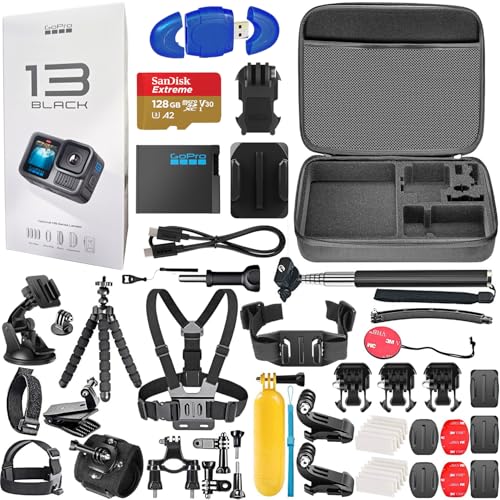
There is a reason the HERO13 is the camera already bolted to half the bowfishing rigs on the water: the sport’s whole accessory world — rail clamps, cap mounts, bow-stabiliser mounts, pole arms — was built around this shape, and its current generation adds the two things the sport values most, stabilisation that irons a rocking deck into watchable footage and slow-motion modes that turn a half-second shot into a study session. Its tall sensor helps more than expected: a rail camera framed for the water can crop a vertical clip for the phone crowd without re-shooting the night.
On the water its manners are seasoned. One-button recording from sleep means the camera is rolling before the draw finishes; voice commands work when hands are full of bow; the lens sheds spray with a hydrophobic shrug and a knuckle-wipe. Exposure across the lit fringe is the calmest of the conventional cameras here, holding the water’s detail instead of surrendering it to glare. The known costs: batteries are a rotation, not a night — carry several and swap at the slow hours — and the camera warms in still, humid air when recording continuously, so mount it where the breeze lives. As the primary camera on a serious rig, it remains the answer the sport gives by default, and this guide agrees.
- Mounting: the fullest accessory ecosystem in the sport
- Video: high-frame-rate slow motion for shot study
- Control: one-button capture and voice commands
- Body: waterproof without a housing
Strengths
- Every bowfishing mount ever made fits it.
- Slow-motion replays that genuinely coach your aim.
- Glare handling that keeps fish visible in lit water.
Trade-offs
- Battery rotation is a fact of the night.
- Wants airflow on still, humid evenings.
- The best mounts are extra purchases.
Best for: the primary rail or cap camera on a serious rig. Not suited for: the angler who wants to set one battery and forget it.
A rigging note from the boats: mount the HERO13 on the rail on the shooter’s strong side, angled to include the last metre of water and the edge of the deck. That frame catches the draw, the loose and the thrash in one composition, and it keeps the camera low enough that the light arrays reflect off the water behind the subject instead of into the lens.

DJI Osmo Action 5 Pro — Best battery and front screen
The Action 5 Pro’s argument is endurance, and on a bowfishing boat endurance is a feature with teeth. Its batteries run noticeably longer than its rivals’, which changes the night’s arithmetic: fewer swaps with wet hands, fewer gaps in the record, and a camera that can be left rolling through the slow midnight hours when the big fish move. Add a proper front screen — rare in this class — and the dockside hero shot, the crew photo, the quick check that the rail camera is framed, all become one-person jobs.
Its footage character suits the sport too: colour that stays honest under LED arrays, low-light stabilisation that holds the deck’s roll together on the dark run back to the ramp, and an exposure temperament nearly as calm as the GoPro’s in the glare. The mount ecosystem is smaller but covers the rail, cap and pole positions a bowfishing rig needs, and its magnetic quick-release makes the battery-era swap — camera off, fresh camera on — a five-second drill. If your nights are long and your crew is small, this is the camera that asks the least of both.
- Battery: the longest-running in this list
- Screens: full front and rear displays
- Mounting: quick-release plus standard action mounts
- Low light: steady and clean for the run home
Strengths
- Night-long stamina reduces wet-handed battery swaps.
- Front screen frames the hero shot solo.
- Calm exposure under light-array glare.
Trade-offs
- Accessory shelves thinner than GoPro’s.
- Slow-motion ceiling below the HERO13’s best.
- App-first editing style suits phones, not desktops.
Best for: long nights, small crews, one-camera boats. Not suited for: rigs already built around a drawer of GoPro mounts.
Crews who run this camera as their primary often mount it on the cap rather than the rail: the battery life supports the shooter’s-eye view for a whole evening, the front screen checks framing at a glance during lulls, and the resulting footage — the bow rising into frame, the water lit below — is the most watchable single angle in the sport.

Insta360 Ace Pro 2 — Best in weak light
Not every bowfishing boat carries a wall of lights. The jon boat with two lamps, the kayak after gar, the dock session under a single floodlight — these are the Ace Pro 2’s waters. Its sensor and processing deliver the cleanest low-light footage of the conventional action cameras here, holding detail at the dark edges of the lit fringe where the fish actually cruise, and its flip screen makes it the best self-filming tool on this list for the solo angler narrating a night.
The rest of its game is premium action-camera standard: strong stabilisation, waterproofing, a magnetic mount that hops between rail and chest harness, and highlight tools that help find the shots in a long recording. Under a big light array its advantage narrows — glare is glare — but it never becomes a weakness, and its colour under mixed dock light is the most forgiving here. The cautions are its hinge, which wants respect in a tackle-crunch environment, and its premium tier. For the angler whose limiting factor is light itself, it is the pick that removes the limit.
- Low light: the cleanest dark-edge footage here
- Screen: large flip screen for solo filming
- Mounting: magnetic quick-release, standard fingers
- Body: waterproof, premium build
Strengths
- Sees the fringe where modest lights fade.
- Flip screen for the solo angler’s commentary.
- Premium stabilisation and colour.
Trade-offs
- The flip hinge dislikes rough tackle-box life.
- Premium pricing in its class.
- Advantage shrinks under a big light array.
Best for: small boats, kayaks and modest-light setups. Not suited for: the roughest deck environments or tight budgets.
Kayak bowfishermen have become this camera’s evangelists, and their reasoning is sound: one camera, chest-mounted, sees the shot and the paddle-strike in light too weak for its rivals, and the flip screen reviews the hit at the next eddy without a phone coming out of a dry bag. In the smallest boats, it is close to a complete film crew.

GoPro HERO12 Black — Best second angle
Every serious bowfishing film improves the day a second angle appears — and the HERO12, the previous flagship now sold a tier below its successor, is the natural way to buy one. It shares the HERO13’s mounting world, its waterproofing and its slow-motion talents in slightly older dress, which makes it the perfect B-camera: bolted at the far end of the deck for the wide shot, or on the second shooter’s cap, cutting against the primary camera’s view of the same fish.
As a primary it remains entirely capable — many boats will run it as their only camera and want for little — with the honest deltas being battery stamina, heat manners on still nights and the newer model’s taller-sensor cropping. Its footage cuts together with the HERO13’s with minimal fuss, which is the B-camera’s whole job description. Buy it as the second angle, or as the first camera of a rig that will grow; either way it is the value play in the GoPro half of this guide, and the sport’s used-and-discount market makes it more so.
- Mounting: identical ecosystem to the flagship
- Video: strong slow motion, proven stabilisation
- Role: second angle or value primary
- Body: waterproof without a housing
Strengths
- Flagship habits at a friendlier tier.
- Cuts seamlessly with HERO13 footage.
- Every mount and accessory already exists.
Trade-offs
- Battery and heat manners a step behind the newest.
- No tall-sensor crop flexibility.
- Being discontinued-era stock, buy from solid sellers.
Best for: the second angle, or a growing rig’s first camera. Not suited for: buyers who want the longest support runway.
A two-camera habit worth copying: let the HERO12 run wide and continuous from the deck’s far rail — the establishing shot of the whole night — while the primary camera works the shooter’s view in clips. In the edit, the wide shot covers every gap, and the night’s story assembles itself with an ease that single-camera crews envy at the dock.

AKASO Brave 7 LE — Best splash-line risk
Some camera positions are simply dangerous: low on the transom where the fish come over, on the gaff man’s cap, on the pole that dips toward the water for the underwater release shot. The Brave 7 LE is the camera you can afford to post there. It is waterproof, it has a front screen for framing, it arrives with a bundle of mounts in the box, and its footage in lit water is cheerful and entirely usable — the classic AKASO bargain, applied to the wettest sport in this guide series.
Its limits are the familiar ones: stabilisation that works hard on a rocking deck and occasionally shows it, low-light footage that softens sooner than the premium picks, and an app experience that is serviceable rather than slick. None of those matter much at the splash line, where the alternative is risking a flagship. Bowfishing crews also buy it as the loaner — the camera a guest wears — and as the always-charged spare that lives in the boat box against the night a primary dies at midnight. In a sport that eats equipment, the cheap competent camera is not a compromise; it is a strategy.
- Body: waterproof, front screen fitted
- In the box: a generous mount bundle
- Role: splash-line, guest and spare duty
- Footage: good in lit water, softer in true dark
Strengths
- Risk it anywhere without financial pain.
- Mounts included from the first night.
- Perfectly postable footage under the lights.
Trade-offs
- Stabilisation and low light trail the premium picks.
- The app is functional, not polished.
- Build feels a tier down, because it is.
Best for: dangerous angles, guests and the boat-box spare. Not suited for: the primary camera on a flagship rig.
One crew’s trick deserves stealing: the Brave 7 LE lives permanently on a short pole mount, charged, in the boat. It is the camera that films the release underwater, the fish at the surface, the dog falling in — the shots nobody plans and everybody replays — because it is always the one within reach when the moment happens.

OM SYSTEM Tough TG-7 — Best for the fish-in-hand still
The TG-7 is not an action camera and does not pretend to be; it is a compact stills camera built like expedition equipment — waterproof to real diving depths, crushproof, freezeproof, with a bright lens and a macro system that focuses closer than anything else in this guide. Its bowfishing job is the photograph the action cameras take badly: the fish in hand at the rail, scales and barbels in true detail, the crew portrait under the lights, the close study of an arrowhead, a scale pattern, a lure. Where the action cameras grab frames, the TG-7 composes photographs.
Its video is a respectable supporting act rather than the headline, and it has no place bolted to a rail for the night’s main record. But as the boat’s stills camera it is untouchable here: it can be dunked to rinse the fish slime off, dropped on the deck, left in the rain at the ramp, and its microscope-adjacent macro mode opens a whole second subject world — the insects on the water, the texture of a gar’s armour — that bowfishing photographers increasingly build their best work around. Every serious crew eventually wants real stills; this is the camera that survives providing them.
- Body: waterproof, crushproof, freezeproof compact
- Lens: bright zoom with a celebrated macro mode
- Role: the boat’s dedicated stills camera
- Video: capable support, not the main record
Strengths
- Survives the boat better than anything here.
- The trophy still and the macro detail, properly done.
- Rinse it under a tap and it is clean.
Trade-offs
- Not a rail camera for the night’s video.
- No action-camera mount ecosystem.
- Stills-first controls take an evening to learn.
Best for: the crew’s stills, trophy shots and macro work. Not suited for: anyone wanting it as the only camera aboard.
A habit from the tournament crews: the TG-7 hangs on a float strap at the weigh-in end of the boat, and every fish that matters gets its portrait before release or the cooler. Those portraits — sharp, close, honest — become the season’s record in a way no frame-grab ever has, and the camera’s indifference to being dropped in the bilge makes the habit effortless.
How Do the Six Compare Side by Side?
| Camera | Best post aboard | Slow motion | Night strength | Watch out for |
|---|---|---|---|---|
| GoPro HERO13 Black | Rail or cap, primary | The strongest here | Very good | Battery rotation |
| DJI Osmo Action 5 Pro | Cap, one-camera boats | Strong | Very good | Smaller mount shelf |
| Insta360 Ace Pro 2 | Chest, small boats | Strong | The best in weak light | Hinge care |
| GoPro HERO12 Black | Far rail, second angle | Strong | Good | Older battery manners |
| AKASO Brave 7 LE | Splash line, spare | Serviceable | Fair | Softens in true dark |
| OM SYSTEM Tough TG-7 | The stills station | Not its job | Excellent stills | Video is support only |
Where Should You Mount Cameras on a Bowfishing Boat?
Three posts cover the sport. The rail mount, low and on the shooter’s strong side, is the money angle: bow, water and fish in one frame, the shot readable from draw to thrash. Keep it low — every hand’s height above the water adds glare, as the light arrays bounce off the surface into a high lens. The cap or chest mount gives the shooter’s-eye record, priceless for coaching aim and the most immersive footage for an audience, at the cost of the frame wandering with the shooter’s head. The far-rail wide shot, the B-camera’s post, holds the whole deck and rescues every edit.
Whichever posts you choose, mount for the dunking and the thrash: proper clamps rather than adhesive pads, a short safety tether on anything overhanging the water, and a position that a flying gaff or a swung bow cannot reach. Check the frame at the dock with the lights on, not in the driveway — bowfishing framing only exists at night, on the water, in the glare, and a camera angled for the driveway will film the sky’s reflection all night with great stability.
How Do You Beat the Glare and the Blown-Out Water?
Glare is the sport’s tax, and it is paid in angle and exposure. Angle first: lower the camera, and turn the boat where you can so the light arrays sit behind the camera’s view rather than mirrored in it; a polarising filter, available for the action cameras here, cuts surface reflection dramatically and is the single most effective accessory in bowfishing filming — fit one and the fish appear in water that looked like a mirror. Exposure second: lock it. Let the camera meter the lit fringe, lock the exposure there, and the passing banks and sky can go black without the picture strobing; auto exposure chasing the whole scene is the amateur tell in this sport’s footage.
Finally, clean the lens every hour and after every splash. A dried spray film turns the light arrays into halos and the fish into rumours, and more good nights have been quietly ruined by a dirty lens than by any camera in this guide. The cloth lives in a sealed bag at the rail; the habit takes four seconds; the difference is the whole film.
What Settings Matter Most for the Shot Itself?
Record the primary camera at a high frame rate whenever the light allows — slow motion is how a miss becomes a lesson, showing whether the arrow passed high, low or behind, and the aim-low correction stops being folklore and becomes measurement. Stabilisation on, always; the deck never stops moving. Set the field of view wide at the rail, where the fish can appear at the frame’s edge with a second’s warning, and narrower on the cap camera if the bow’s presence in frame bothers you. Loop or highlight-mark features earn their keep on long cruises: tag the shot’s moment with a wet thumb or a voice command, and the dockside review takes minutes instead of an hour of scrolling through black water.
What Mistakes Ruin Bowfishing Footage?
The high mount is the classic: a camera on a tall pole above the lights, filming a mirror. Low beats high in this sport every time. Second is auto exposure left to wander, strobing the whole night. Third is the camera that sleeps between fish — the shot that matters always arrives during the camera’s nap, which is why the picks here wake in one press or stay awake on rotation. Fourth is sound neglected entirely: the loose, the splash, the whoop are half the sport’s drama, and a camera buried in a waterproof case it does not need muffles all of it — these bodies are waterproof bare, so let them hear.
Fifth is the unreviewed night: cards filled, never watched, lessons unlearned. Bowfishing improves on film study faster than on any other feedback — the arrow’s true path is invisible at full speed and undeniable at a quarter of it. The crew that watches ten minutes at the dock with the slow-motion replays open is the crew whose next night is measurably better, and every camera in this guide was chosen to make that ten minutes easy.
Final Recommendation
For most bowfishing boats, the GoPro HERO13 Black on the rail is the primary camera to buy: the mounts exist, the slow motion teaches, the glare behaviour is proven across a thousand nights. Long-night and one-camera crews should look hard at the Osmo Action 5 Pro’s endurance and front screen, small-boat and kayak anglers at the Ace Pro 2’s weak-light eyes. Add the HERO12 as the second angle when the filming gets serious, the Brave 7 LE wherever the water is likeliest to win, and the TG-7 when the crew starts wanting photographs worthy of the fish. Mount low, lock the exposure, clean the lens, rehearse once at the dock — and the camera will finally show the night the way it felt, which is all any of this equipment was ever asked to do.
Frequently Asked Questions
Do I need a waterproof case for these cameras?
No — every pick here is waterproof in its bare body, which is precisely why they were chosen. A case adds fog, muffled sound and one more thing to forget; the sport’s cameras should swim as they are. Rinse them in fresh water after salt trips and dry the seals before opening any door. The one exception to keep in mind is depth and duration: these bodies are rated for the dunkings and dips of a bowfishing night, not for an afternoon lost on the bottom, which is what the tether is for.
Which is better for bowfishing, a cap mount or a rail mount?
They answer different questions. The rail mount shows the shot — bow, water, fish — and is the better coaching and audience angle. The cap mount shows the shooter’s experience and is the more exciting footage. Serious rigs run both; a one-camera boat should start at the rail, where the story is.
Can these cameras see fish the lights miss?
No camera sees through darkness or murk; they record the lit water you give them. The Ace Pro 2 makes the most of weak light at the fringe, and a polarising filter reveals fish hidden by surface glare, but the light array remains the primary instrument. Spend on lights first, cameras second — the sport’s veterans all say it in that order. Once the array is honest, the differences between these six cameras become the pleasant kind of problem: which mount world you prefer, how much slow motion you will study, and whose battery manners suit your nights.
How much slow motion do I actually need?
Enough to read an arrow’s flight, which the strong modes on the GoPro and DJI picks provide comfortably. Beyond that threshold, returns diminish quickly and file sizes grow; the replay’s value is in the reading, not the frame count. Shoot the primary camera fast, the wide camera standard, and study the pair together at the dock while the night is still fresh enough to argue about.
What should a kayak bowfisherman buy first?
The Ace Pro 2 on a chest mount, for its weak-light quality and flip screen, or the HERO13 if the kayak doubles as a general adventure platform. Weight, simplicity and one-button certainty matter more in a kayak than anywhere; a two-camera rig belongs to the deck boats. Add the tether before the first trip, because a kayak’s first lesson to every new owner is how quickly the water accepts a gift.
How Do You Care for Cameras in a Sport That Soaks Them?
Fresh water is the whole liturgy: a rinse after every trip, salt trips doubly, with doors closed and seals checked for grit and fish scales before anything opens. Dry the camera before charging or card-swapping; charge batteries ashore, in rotation, labelled by night so a tired cell announces itself by handwriting. Inspect mount clamps monthly — vibration loosens what the eye misses — and retire any tether that has taken a real load. None of this is glamorous and all of it is the difference between a camera that films its fifth season and a story about the night the good one went over the side. Bowfishing eats gear as a condition of entry; the crews in this guide’s debt keep their cameras by treating care as part of the sport rather than a chore after it.
How Does Saltwater Bowfishing Change the Camera Choice?
Rays and flounder over salt flats add two pressures: corrosion and brightness. The corrosion is managed by the rinse ritual and by favouring bodies with the fewest doors and seams — one more quiet argument for the action cameras’ sealed simplicity and for the TG-7, which was designed by people who dive. The brightness is the glare problem at midday strength when a trip runs into morning, and it rewards the polarising filter even more than the night work does; a filtered action camera over pale sand shows fish-shaped shadows that an unfiltered flagship misses entirely. Salt crews also learn to distrust touchscreens sooner — salt crust and wet fingers are a worse combination than fresh water — and to run their cameras by button and voice, a discipline the picks here all support.
What About Filming the Underwater Half of the Sport?
The release, the missed arrow’s path, the fish bolting through the lights below the surface — the underwater shot is bowfishing’s secret second film, and these cameras shoot it natively. A camera on a short pole, dipped at the rail, records in the lit water with startling clarity on a calm night; the Brave 7 LE’s tier makes it the designated dipper on most boats, with the TG-7 the stills counterpart for the close, slow subjects. Keep the pole short, the tether shorter, and the expectations honest: murk swallows light in a metre, so the underwater shot works in the same lit fringe as everything else in this sport. What it returns — the arrow arriving from above, the fish’s eye view of the boat’s lights — is the footage audiences remember, and it costs nothing but a pole mount and the nerve to dunk a camera on purpose.
How Should a Beginner Build a Rig over Two Seasons?
Season one: one primary camera — the HERO13 or the Action 5 Pro — on a proper rail clamp, a polarising filter, spare batteries, and the dockside review habit. That kit films a complete night and teaches the sport’s whole grammar of glare, angle and replay. Season two, add by named need: the HERO12 wide angle when edits feel thin, the TG-7 when the crew starts asking for real photographs, the Brave 7 LE when someone says the words “underwater release shot” at the dock. Resist buying the fleet in advance; each addition lands better when the footage has asked for it by name. The boats with the best archives in this sport grew their rigs exactly this way — one honest camera at a time, each one earning its mount.
What Does the Footage Teach That the Night Itself Cannot?
Where the arrows actually go. At full speed, a miss feels like a mystery — the fish was there, the bow was right, the water lied. In slow motion the lie resolves into measurement: the arrow high because the aim-low rule was under-applied at that range, behind because the fish was moving faster than the dark suggested, deflected by the surface in a way no amount of dock talk would have isolated. Crews that study their misses improve at a rate that purely experiential crews visibly envy by mid-season, and the improvement compounds because every shooter’s errors are personal and specific. This is the deepest argument for the cameras with the strongest slow motion in this guide: they are not really recording devices, they are coaching instruments that happen to make films.
How Do You Handle Sound on a Boat Full of Generators and Splash?
Bowfishing audio is a war against the platform: generator hum, trolling motor whine, water against the hull, and over it the sounds you actually want — the draw’s creak, the loose, the thrash, the crew. The cameras’ built-in microphones, unboxed and unhoused as this guide insists, do a fair job when the camera sits out of the wind and away from the generator’s end of the boat; rail placement amidships is the acoustic sweet spot as well as the visual one. Wind is the other enemy, and the small foam muffs sold for these bodies earn their trivial cost on any night with a breeze. Perfection is not available and not required: the sport’s soundtrack is supposed to sound like a boat at night. What you must avoid is only the muffled, boxed sound of a camera sealed in a case it never needed — the mistake this guide has now warned against three times, because boats keep making it.
What Should Tournament and Social Crews Do Differently?
Tournaments add witnesses and weigh-ins, and the camera plan should add them too: the TG-7 stationed at the weigh-in end for the portraits that become the event’s record, the wide HERO12 running the deck continuously so a disputed moment has a referee, and a crew agreement — made at the ramp, not mid-argument — about what gets filmed and shared. Social crews, filming for an audience beyond the boat, should think in episodes: the same mounts every trip, so the footage has a visual grammar regulars recognise; the front-screen check at the dock for the closing piece to camera; and the discipline of the ten-minute review, which is where next episode’s improvements are written. Both kinds of crew converge on the same truth — the camera plan is a crew agreement before it is a shopping list, and the boats that make it explicit film better nights.
How Do Lights and Cameras Interact — What Should You Buy First?
Lights, and it is not close. A modest camera under a serious light array films a better night than a flagship under two lamps, because bowfishing visibility is manufactured by the array and merely recorded by the camera. If the budget forces an order, build the light first, run a Brave 7 LE or a previous-generation camera beneath it for a season, and upgrade the camera when the footage — now properly lit — shows you exactly which limitation is yours: low-light softness, slow-motion envy, battery fatigue. That sequence also protects you from the sport’s commonest mis-purchase, the premium camera bought to compensate for darkness it was never going to defeat. The cameras in this guide are ranked assuming your lights are honest; make them so, and even the budget pick will surprise you.
What About Winter, Cold Water and the Off-Season?
Bowfishing’s fringe seasons — the cold-water carp of early spring, the late-autumn nights — tax batteries first: every camera here shortens its run in the cold, and the rotation habit stops being advice and becomes the price of a full record. Keep spares in an inside pocket where body heat keeps them honest, and swap before the camera complains rather than after. Condensation is the cold season’s second tax, fogging lenses when a warm boat meets cold air; the sealed action cameras shrug it off better than most, and a minute’s patience at the ramp beats a night of wiping. The TG-7, freezeproof by design, becomes the stills camera of the cold months by default. None of this changes the ranking — it changes the logistics, which in this sport is usually the same conversation.
How Do You Introduce a New Shooter to Filming and Fishing at Once?
Give them the Brave 7 LE on a cap and no responsibilities beyond wearing it. The guest camera records their night from inside it — the misses, the first connected shot, the dock celebration — and the footage becomes the souvenir that brings them back. Resist handing a newcomer the primary camera or a job in the rotation; bowfishing already asks a beginner to learn the aim-low rule, the deck etiquette and the gaff dance in one evening. The guest’s film, reviewed together at the dock with the slow-motion replays open, is also the kindest coaching tool the sport owns: their own arrows, their own corrections, nobody lecturing. Many regulars in this sport started as the person wearing the cheap camera, which is one more reason every boat should own one.
How Should You Organise a Night’s Footage Before Memory Fades?
At the dock, while the night is still a story: offload the cards into a folder named for the water and the date, pull the three best shots and the one instructive miss into a highlights subfolder, and write two sentences in a notes file — conditions, what the fish were doing, what you would change. Ten minutes, done while the boat is being washed down, and the archive stays a coaching library instead of becoming a terrabyte of identical black water. The slow-motion clips of connected shots deserve their own folder over a season; strung together they are the crew’s highlight reel and its training film in one. Every camera here supports the quick tag-and-offload rhythm this routine needs. The boats that keep it can answer, months later, exactly what happened on a given night — and that answer, more than any single film, is what a camera system is for.
What Safety and Etiquette Rules Govern Cameras on a Bowfishing Deck?
The camera never outranks the shot’s safety. Mounts stay clear of draw paths and string lines; nobody reaches for a slipping camera while holding a drawn bow; the review happens at the dock, never with arrows nocked. On shared water, a word to neighbouring boats before the lights and cameras settle is the courtesy that keeps the night friendly, and a camera pointed at another crew’s deck without invitation is a breach no footage justifies. At the ramp and the weigh-in, ask before the close portrait — the TG-7’s macro is wonderful and consent is still the rule. These are small disciplines, and they share a root with everything else in this guide: the camera serves the night, never the other way round. Crews that hold that line film for decades; the footage, unsurprisingly, is better for it.
A Word on Night Vision, Thermal Gadgets and Other Temptations
Every season brings a gadget promising to replace the light array — night-vision monoculars with recording, thermal attachments, phone scopes. For bowfishing they share one flaw: the sport’s visibility is a lit arena the whole crew shares, and a private enhanced view films a different, lonelier night than the one being lived. The footage also disappoints — monochrome, narrow, disconnected from the deck’s reality. The cameras in this guide record the night as it is actually experienced, which is why their films get rewatched. Spend the gadget money on the array, the filter and the spare batteries; the sport’s imaging problem was solved by light a generation ago, and the camera’s job is simply to be worthy of it.
How Do You Choose Between This Generation and the Next One Down?
The HERO13 and HERO12 pairing in this guide is the honest template for the whole category: last year’s flagship is this year’s value, and the deltas — a taller sensor here, a longer battery there — matter at the margins of a night rather than at its heart. A buyer choosing between generations should ask which specific frustration the newer model answers: if it is battery swaps with wet hands, the DJI’s endurance may matter more than either GoPro’s vintage; if it is the vertical crop for a growing audience, the newest sensor earns its premium. Buy the generation whose named improvement matches your named problem, and let the rest of the fleet’s marketing wash past like water off a lens. Bowfishing rewards that discipline because the sport itself supplies the drama; the camera only has to keep up.
What Does a Season of Bowfishing Films Add Up To?
Something no single night contains: the water’s year. The spring carp in the flooded timber, the summer gar in the shallows, the first cold night when the fish run deeper and the lights seem to reach further — a crew that films its season owns the pattern of its own water in a way memory alone never holds. Coaches mine it for the aim corrections, families mine it for the nights a grandfather still shot better than anyone, and new crew members learn the boat’s whole etiquette from it before their first trip. That accumulation is the final argument for buying cameras that survive, batteries that rotate and habits that persist: the season is the product, and every pick in this guide was chosen to still be working, unremarked, when the last night of it arrives.
How Do You Test a New Camera Before Trusting It with a Real Night?
Give it a rehearsal with stakes low enough to laugh about: an evening at the dock or the pond, lights on, a target buoy standing in for the fish, the crew shooting in rotation while the camera does each of its intended jobs — rail record, slow-motion replay, a deliberate dunking, a battery swap with wet hands. Half an hour of rehearsal exposes everything a season would: the mount that creeps, the menu that hides the frame-rate setting, the door that fights a tired thumb. Boats that rehearse their cameras christen them properly, and the real night’s first big fish arrives to find a crew and a camera that have already met. It is the cheapest insurance in this entire guide, and it costs one pleasant evening on the water.
Related Guides
More wet and wild filming in our guides to the best action cameras for surfing, the best cameras for underwater point and shoot and the best cameras for shooting waterfowl.


