ilcastellomenu.com is reader-supported. When you buy through links on our site, we may earn an affiliate commission.
Where to Buy a Camera for Shooting, Full Stop
The best affordable cameras for shooting are the ones that answer the most ordinary sentence in photography: I just want to take pictures of my life, and I want them to be good. Every camera below is available through Amazon, where you can check the listing, the kit choices, and delivery timing; prices move too much for a guide to print figures in good faith, so this page spends its words on what the cameras do in your hands across a normal year. Shooting, unqualified, is the hardest brief in the industry, because it means birthdays and beaches, dogs and dinners, the school play and the supermarket flowers, all with one instrument and no specialist excuses.
Generalist cameras fail in generalist ways. They are too slow to wake for the toddler’s expression, too complicated for the partner who borrows them, too fragile for the beach bag, too dim for the restaurant. The six picks here were chosen by walking them mentally through an ordinary calendar and rejecting anything that stumbled on the ordinary: the camera that needs a manual at a birthday, the one whose battery dies at the zoo, the one whose files look worse than a phone’s at the exact moment, dusk, when family life is most photogenic.
Notice that this list deliberately mixes species. Two are system cameras that grow; two are simple fixed-lens shooters that ask nothing; two print or survive in ways that redefine what shooting even means. That mixture is the honest shape of the affordable market for generalists, because “shooting” means different things at different ages of a life: the student wants a system to learn on, the new parent wants speed and forgiveness, the grandparent wants a camera that feels like the film compacts they trusted, and the teenager wants prints to trade like currency. One ranking, six temperaments.
A promise shapes everything below: no camera here requires a course, a forum account, or a personality transplant. Each was also chosen with an eye on the secondhand shelf and the hand-me-down ladder, because everyday cameras in real families rarely retire; they migrate, from parent to teenager, from main camera to party camera, from the house to the holiday cottage. A model with common batteries, available film or lenses, and a maker who will still answer for it in five years migrates gracefully. An orphan gadget, however charming this season, tends to stop at the drawer, and the drawer, as this guide will argue more than once, is where good intentions go to be forgotten. Each one produces good photographs on its automatic settings from the first afternoon, and each one leaves room, a lens mount, a mode dial, a better habit, for the photographer you might become. Affordable shooting is not about settling. It is about starting, today, with an instrument that respects both your wallet and your eye.
Key Takeaways
- For general shooting, startup speed and forgiving autofocus beat every exotic specification.
- System cameras reward learners; fixed-lens cameras reward people who just want the picture.
- Evening performance is the generalist’s true test, because family life happens after six, indoors, under imperfect kitchen light.
- A camera the whole household can operate gets used ten times more than a personal instrument.
- Spend first on the camera you will carry; a fast prime or a second battery comes second.
- The right camera disappears into the day, leaving only the photographs as evidence it was there.
In this guide
Quick Picks
| Pick | Badge | Why it suits everyday shooting |
|---|---|---|
| Canon EOS R50 | Best All-Purpose Shooter | A system camera with family-friendly color and autofocus that forgives beginners. |
| Nikon Z30 | Best for Home and Family Video | Calm, simple, and excellent for the seated, talking, everyday moments at home. |
| Sony ZV-1F | Best Point-and-Shoot Simplicity | A wide fixed lens and face-first automation; charge it and shoot your life. |
| Fujifilm Instax Mini 12 | Best for Parties and Keepsakes | Instant prints that turn shooting into a social event with a souvenir attached. |
| Polaroid Go Generation 2 | Best Tiny Instant | The smallest instant camera going, for pockets, festivals, and spontaneous portraits. |
| GoPro HERO13 Black | Best for Shooting Adventures | Mount it, submerge it, drop it; the everyday camera for extraordinary days. |
How Did We Choose Cameras for Plain, Everyday Shooting?
We began by banning the word enthusiast from the judging room. Everyday shooting is judged at the kitchen table, not the gallery: Did the camera wake before the moment ended? Did it focus on the child rather than the chair behind her? Did the colors make the birthday look like the birthday felt? Did the battery survive the outing, and did the files please people who will never know what a sensor is? Cameras that aced laboratory tests and failed those questions were cut without sentimentality.
Second, we scored forgiveness. Generalist life is shot in bad light, through doorways, one-handed, with the other hand holding a dog lead or a drink. Forgiving cameras stabilize the shot, expose faces correctly even against windows, and keep automatic white balance honest under the mixed bulbs of real homes. Third, we scored shareability: the borrowed test. A camera that a grandparent, a teenager, and a partner can all operate within a minute multiplies its household value beyond any specification, because the best shooting camera is the one pointed at the moment by whoever is standing closest.
Every candidate was checked against this site’s verified pool, and the ownership sums were done in full: for system cameras, the body with its kit lens and the fast prime that will inevitably follow; for instant cameras, the honest cost of film across a year of parties; for the action camera, the mounts that make it useful. Affordable means the whole story, told in advance, with no ambush in month three.
One more consideration belongs before the reviews, because everyday shooters mention it more than any specification: how the camera feels to be photographed by. A small, friendly camera changes a room’s behavior; subjects continue their conversations, children forget to perform, and the photographs keep the day’s actual expressions. A large, serious rig, however capable, announces an occasion and manufactures stiffness. Every body on this page was chosen partly for its social size, its ability to be present without becoming the event, because everyday shooting is documentary work in the home, and the documentarian’s first skill is not disturbing the document. Keep that in mind as the badges fly below: the best everyday camera is often the one the room forgives for being there.
Which Affordable Shooter Fits Your Everyday Life?

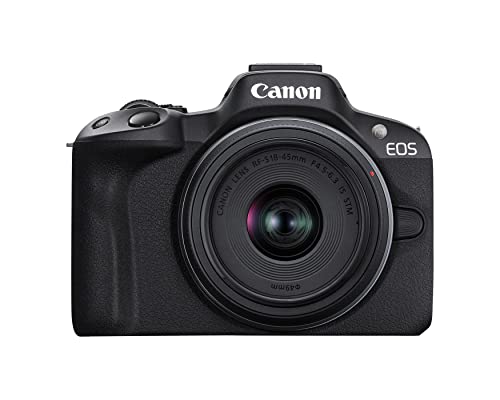
Canon EOS R50 — Best All-Purpose Shooter
Start with the camera that says yes to everything. The R50 photographs the school play with a telephoto, the new baby with a fast prime, the holiday with the kit zoom, and films all of it in 4K without changing its personality. Its autofocus detects the subjects everyday life actually contains, faces, eyes, the family dog mid-bounce, and its color renders those subjects the way memory insists they looked. For a household buying one serious camera to shoot everything for the next several years, this is the default answer, and defaults earn that status by failing at almost nothing.
The learning curve is the gentlest in the system-camera world. A guided interface explains the camera in plain language and then, crucially, gets out of the way; the standard controls and menus beneath it are the same language Canon’s professionals speak, so nothing learned here is ever unlearned. The body is light enough for a whole day at the fair and small enough that subjects, especially children and the camera-shy, relax in front of it instead of performing for it.
The compromises are known and manageable: a single card slot that only paid redundancy obsessives will mourn, a battery that rewards carrying a spare, and a kit lens whose politeness you will outgrow into a prime. None of them touches the everyday core. If the sentence “we should get a proper camera” has been said in your house three times, the R50 is what the sentence means.
- Mount: Canon RF, lenses for every subject and budget
- Autofocus: people, animal, and vehicle detection
- Video: 4K for the moments that move
- Interface: guided help over professional controls
- Role: the household’s do-everything camera
Strengths
- Forgiving automation with a real ceiling above it
- Color that makes family photographs feel true
- Light, friendly body that subjects relax around
Trade-offs
- Spare battery is standard equipment on long days
- Kit lens will be outgrown by keen shooters
- Single card slot rules out some paid work
Best for: households buying one serious camera for everything. Not suited for: buyers who want literally nothing to learn or configure.

Nikon Z30 — Best for Home and Family Video
Modern shooting includes a genre our parents never had: the family on video, talking. The grandparent interview, the child’s presentation recorded for relatives abroad, the lessons and calls and kitchen-table podcasts that fill a home’s digital life. The Z30 is the everyday camera specialized, quietly, for exactly that: it records long stretches without fuss, shows a tally light so nobody performs for a camera that is off, renders faces with Nikon’s natural restraint, and its built-in microphones treat a voice in a living room with respect.
As a stills camera it is the same calm personality: honest photographs, a vari-angle screen for the low angle on the toddler and the high angle on the parade, and Z-mount lenses that include genuinely small options for a camera that lives on a shelf, ready, rather than in a bag, packed. Households find that readiness changes behavior; the camera that is out gets used, and the Z30 is designed to be out, on its small tripod in the corner where family life happens.
Its limits are the outdoorsy ones: no viewfinder for glaring beaches, autofocus that is steady rather than clairvoyant, stabilization that depends on the lens. A family whose shooting is mostly sport and travel should look at the Canon above. A family whose shooting is mostly home, talk, and togetherness will find the Z30 the most livable camera on this page, a recording appliance in the best sense, like the piano that is always in tune and therefore always played.
- Mount: Nikon Z, compact lenses available
- Recording: long sessions, tally light, continuous power
- Stills: natural color for home documentation
- Screen: vari-angle for family framing
- Role: the home’s standing camera
Strengths
- Everyday video of people talking, done calmly
- Lives ready in the room, not packed in a bag
- Faces and voices rendered naturally
Trade-offs
- No viewfinder for bright outdoor stills
- Not built for sports or fast action
- Lens-dependent stabilization
Best for: home-centered families, interviewers, teachers. Not suited for: sideline sports or adventure-first shooters.

Sony ZV-1F — Best Point-and-Shoot Simplicity
The ZV-1F is the camera for the shooter who has read this far with rising impatience at words like mount and system. It has one lens, wide and fixed, chosen so that a room, a group at a table, and a face at arm’s length all frame themselves. It has autofocus that finds faces and eyes and holds them, exposure that favors those faces, and a defocus button that blurs a background when you want the photograph to look fancy and sharpens it when you do not. It charges like a phone, fits a small bag, and its entire philosophy is that the best photograph is the one you actually took.
Do not mistake simplicity for poverty. The one-inch sensor outclasses phone cameras exactly where everyday shooting needs it, in the restaurant, the evening garden, the school hall, and the video is proper 4K with a directional microphone that hears the person in front rather than the room behind. Product-showcase focus, borrowed from the creator world, turns out to be a family feature too: hold the baby’s first shoe, the exam certificate, the ring, up to the lens and watch it snap into clarity.
The fixed lens is the honest trade: your zoom is your feet, forever, and the school play’s far stage will stay far. Low light is good, not miraculous. And a shooter who catches the photography bug seriously will eventually want lenses, at which point the ZV-1F retires gracefully into the role of household second camera and travel lightweight. For the years before that day, it is the least intimidating route from phone frustration to real photographs that this page can offer.
- Lens: fixed wide-angle for rooms, groups, arm’s length
- Autofocus: face and eye priority, product showcase
- Audio: directional built-in microphone with windscreen
- Sensor: one-inch class for evenings
- Role: the zero-fuss everyday camera
Strengths
- Nothing to configure, nothing to attach
- Wide lens solves the family-room framing problem
- Evening quality a clear step beyond phones
Trade-offs
- No zoom reach for stages and sidelines
- Fixed lens means growth requires a new camera
- No viewfinder for the brightest days
Best for: phone upgraders, grandparents, minimalists. Not suited for: distant subjects or committed hobbyists-in-waiting.

Fujifilm Instax Mini 12 — Best for Parties and Keepsakes
Some shooting is not about files at all. The Instax Mini 12 makes small physical prints, instantly, and in doing so it changes every gathering it attends: guests queue to be photographed, hosts tape prints to the fridge before the evening ends, and children who have never seen a photograph exist outside a screen watch the image surface like a magic trick they are allowed to keep. As an everyday shooter it covers the social half of life, birthdays, visits, holidays, reunions, with a warmth no specification can measure.
Operation could not be simpler: twist to wake it, look through the finder, press. Automatic exposure handles the room; a close-up mode and selfie mirror handle the group shots; AA batteries mean it never waits for a charger and never dies of a forgotten cable in a drawer. The prints are small and soft, deliberately so, the size of a keepsake rather than a document, and the film’s cost per frame imposes a gentle discipline: people compose, smile properly, and value the result, because there are ten frames in a pack and each one counts.
Its limits are the medium’s: no zoom, no low-light heroics, no file to reprint at poster size, and a running film cost that makes it a companion rather than a household’s only camera. But judged as a shooting experience rather than a specification, it may be the most-loved object on this page. Families routinely report that the Instax, technically the simplest camera they own, produces the photographs that end up on walls, in wallets, and in the boxes that get rescued first.
- Output: instant prints on Mini film
- Exposure: fully automatic, anyone can shoot it
- Power: AA batteries, drawer-proof readiness
- Extras: selfie mirror, close-up mode
- Role: the social and keepsake camera
Strengths
- Photographs become gifts and decorations instantly
- Zero learning curve across all ages
- Always ready; no charging ritual
Trade-offs
- Film is a continuing cost per photograph
- Small, soft prints only
- No digital file unless you scan the print
Best for: parties, families with children, keepsake keepers. Not suited for: detail, distance, or archive-grade documentation.

Polaroid Go Generation 2 — Best Tiny Instant
The Polaroid Go Generation 2 shrinks the instant idea to its minimum viable joy: a camera small enough for a coat pocket or a festival bum-bag, producing little square-ish prints with that unmistakable Polaroid border and color character. Where the Instax is the party’s official photographer, the Go is the camera that wanders: it lives in a pocket for months, emerges at the picnic, the gig, the roadside stop, and makes portraits of a life as it is actually lived, unposed and slightly sun-drenched.
The second generation tidied the original’s quirks: a rechargeable battery over USB, a more reliable exposure temperament, a selfie mirror, and double-exposure tricks for the experimentally inclined. Its film is its own smaller format, so the prints are keepsakes in the truest sense, wallet and journal sized, meant to be given away, stuck to laptops, and pinned above desks. Shooting with it feels like the film compacts of memory, except the photograph arrives before the song ends.
Expect the medium’s character in full: colors that interpret rather than transcribe, softness that flatters faces and forgives everything, and a per-print cost that asks you to mean it when you press the button. It will not document the school play or archive the artwork. It will, however, be present for more of your life than any other camera here, because presence is a function of size, and this is the smallest serious fun in photography.
- Output: instant prints in Polaroid Go film format
- Size: pocketable, the smallest instant here
- Power: rechargeable over USB
- Extras: selfie mirror, double-exposure mode
- Role: the wandering everyday instant camera
Strengths
- Goes everywhere because it fits anywhere
- Prints carry the classic Polaroid character
- Rechargeable, simple, and sociable
Trade-offs
- Smallest prints of any camera here
- Film cost per shot is the highest here
- Image character is interpretive, not accurate
Best for: festivals, journals, gifts, everyday wandering. Not suited for: documentation, accuracy, or large prints.

GoPro HERO13 Black — Best for Shooting Adventures
Everyday life, for some households, includes the sea, the slope, the trail, and the dog’s-eye view of the park. The HERO13 Black is the shooter for those days: waterproof, mountable to almost anything, stabilized so well that rough motion reads as glide, and tough enough that the camera is the last thing anyone worries about. It shoots video primarily, and grabs stills and frame-worthy moments along the way, from perspectives, handlebars, helmets, chest straps, the dog’s harness, that no handheld camera can occupy.
The current generation broadens the everyday case beyond sport: interchangeable lens mods for wider or closer views, magnetic mounting that speeds the constant repositioning, and battery behavior that survives a day’s outing of clips. Families use it as the holiday camera of record for everything wet or fast, the snorkeling, the sledging, the cycling into town, and its ultra-wide view has become the native look of adventure footage that relatives actually enjoy watching.
As an only camera it asks real compromises: faces at conversational distance flatten under the wide lens, dim interiors are its weakest light, and stills are a supporting feature rather than a craft. Most owners pair it, eventually, with one of the calmer cameras above. But for the shooting that happens at speed, in water, or upside down, it is not one option among many; it is the category, and on those days it is the best affordable camera for shooting, full stop.
- Capture: high-resolution action video, ultra-wide view
- Stabilization: advanced smoothing for rough motion
- Mounting: magnetic latch plus a vast accessory world
- Sealing: waterproof for sea, pool, and weather
- Role: the adventure-day camera
Strengths
- Shoots where and how nothing else here can
- Survives drops, dunks, and dust without drama
- Perspectives that make holiday footage watchable
Trade-offs
- Weak in dim interiors and at conversation distance
- Stills are secondary to video
- Small screen is a blunt instrument for review
Best for: active families, travelers, pet-perspective pioneers. Not suited for: indoor, portrait, or detail-led shooting as an only camera.
How Do the Six Everyday Shooters Compare?
| Pick | Kind | Asks of you | Gives you |
|---|---|---|---|
| Canon EOS R50 | System | A little learning | Every subject, for years |
| Nikon Z30 | System | A corner to live in | Calm home video and stills |
| Sony ZV-1F | Fixed lens | Nothing | Easy, good photographs and clips |
| Fujifilm Instax Mini 12 | Instant | Film money | Prints and party magic |
| Polaroid Go Generation 2 | Instant | Film money | Pocketable keepsakes |
| GoPro HERO13 Black | Action | Mounts and daylight | Impossible perspectives |
The asks column is the honest core of this comparison. Everyday cameras differ less in what they can do than in what they demand: learning, space, film, light, patience. Choose the demand your life can meet daily and the camera will feel brilliant; choose against it and even a superb camera becomes a cupboard resident. Shooting, in the end, is a habit wearing a camera, so buy the camera your habits can carry.
What Should an Everyday Shooter Check Before Buying?
Check the wake-up: from pocket or shelf to first focused photograph, in the shop if you can, because everyday moments do not wait for boot sequences. Check the screen and controls with one hand occupied, because the other hand will be. Check the battery’s real-world reputation among owners who shoot like you, and the price and availability of its spares and, for the instant cameras, its film, because a camera whose consumable is scarce locally is a camera on a countdown.
Check the household vote. Show the candidates to the people who will borrow the camera, and watch which one they pick up twice. Check your own drawers for the graveyard of previous good intentions, and interrogate what killed them: size, complexity, fragility, boredom. The correct affordable camera is the one engineered against your household’s specific graveyard, and only you know its inventory.
How Do You Shoot Better Everyday Photographs Without New Gear?
Move closer, then closer again; everyday photographs fail by distance more than by equipment. Put the light in front of your subject rather than behind, even if that means turning a chair around, and watch faces bloom. Shoot the moment before and after the posed one, when expressions are arriving and leaving, because life lives in those frames. Keep the camera where life happens, charged and carded, and take it on the unremarkable errands, because the archive of an ordinary year, honestly shot, becomes the most treasured object a family owns.
Review weekly and print monthly, even a handful of frames. And shoot the boring subjects with the same respect as the beautiful ones: the kitchen in morning light, the commute, the dog asleep in the exact patch of sun he has claimed for years. Future nostalgia is manufactured from precisely this material, and the photographers who understand that early end up with archives their families fight happily over, while the ones who waited for occasions own a thin folder of birthdays. Everyday shooting, done faithfully, is a long kindness to people you have not met yet, including your own older self. Printing teaches the eye faster than any tutorial, because paper is honest about focus, light, and distance, and a household that prints develops a house style without ever using the phrase. The cameras here all reward that rhythm; the instant pair build it into their very operation, which is a large part of their charm.
What Mistakes Do Everyday Shooters Make When Buying?
The classic is buying for the holiday and ignoring the year: the rugged or exotic camera that excels for two weeks and annoys for fifty. The second is buying a system camera as a status object and never learning its first menu page, when the simple fixed-lens camera would have photographed the family happily for a decade. The third is the opposite snobbery, refusing the instant or action camera as toys, and missing the prints on the fridge and the footage from the sea that turn out to be the year’s most-kept images.
Buyers also forget the second seat: the camera only one person can operate becomes that person’s job, and jobs get resented at parties. And they forget to budget the boring consumables, film, cards, the spare battery, so the camera’s first crisis arrives at the worst moment, which is how crises schedule themselves. Buy the camera, feed the camera, share the camera: the whole doctrine of everyday shooting in nine words.
How Does Everyday Shooting Change With the Seasons?
Spring shooting is garden shooting: new light, new growth, children rediscovering the outdoors, and cameras that focus close and render greens honestly earn their keep. It is also the season of the school calendar’s crescendo, plays, sports days, presentations, where the system camera’s reach and the simple camera’s speed divide the honors. Summer is the stress test: glare that defeats screens, water that defeats seals, heat that defeats batteries, and holidays that defeat everyone’s storage discipline. The cameras that survive summer in a family’s affections are the ones with viewfinders or bright screens, honest batteries, and either sealing or the cheapness to be risked near the sea without a family conference.
Autumn is the portrait season, low golden light and gatherings returning indoors, where the fast prime on the system camera and the one-inch sensor of the compact produce the year’s most-flattering photographs almost by accident. It is also the season of evening events, concerts, matches under lights, where high-sensitivity performance stops being a specification and becomes the difference between the photograph and the blur. Winter belongs to the indoors and the instant: flash-lit parties where the Instax and the Polaroid are not novelties but the official medium, and long home evenings where the Z30’s calm recording documents the family’s talking life while the tree lights do the cinematography.
Read your own calendar before you buy and weight the seasons honestly. A household that lives for summer water should let the action camera climb this ranking; a household whose year peaks at winter gatherings should let the instants climb. The all-purpose system camera is the champion of the average year, but nobody lives an average year, and the best affordable camera for shooting is the one matched to your calendar’s actual peaks.
What Technique Matters Most for Everyday Subjects?
For children, the technique is anticipation and altitude: get down to their eye level, pre-focus on the place the action will happen, and shoot through the moment rather than at its posed peak. Every camera here with face and eye detection automates the hard half of that; your half is kneeling. For pets, add patience and a low angle again, plus the burst mode you have been saving, because animals give you the expression once and the camera must be ready in clusters. For food and the home’s still lifes, the technique is window light and a step closer, which the compacts and the prime lenses render beautifully and which no flash in this price class improves upon.
For groups, the technique is choreography: arrange faces in two loose rows, shoot from a slight height, and take three frames because someone always blinks in the first two. The instant cameras turn this chore into a ceremony, which is why their group photographs so often look happier than digital ones; people perform differently when the photograph is about to become an object. For evenings and events, the technique is steadiness and mercy: brace, shoot more, delete later, and let the camera’s high-sensitivity abilities work rather than forcing a flash that flattens the room’s mood into a police photograph.
None of this requires a course, and all of it compounds. Everyday technique is a handful of habits, level, light, closeness, patience, repetition, and the affordable cameras here were chosen because they reward those habits immediately instead of demanding new ones. A month of deliberate everyday shooting on any of them will improve your photographs more than a year of reading about cameras, a sentence this guide prints with full awareness of the irony.
Why Does Every Household End Up With a Camera Drawer, and How Do You Avoid It?
The drawer fills with cameras that each failed one ordinary test: too slow, too complicated, too fragile, too similar to the phone to bother charging. The avoidance strategy is the one this whole page practices: buy against the ordinary tests first and the impressive ones second, share the camera across the household so its quirks become everyone’s fluency, and give it a home in the living space rather than a case in a cupboard. Cameras die of storage more than of use.
There is also an honorable exit for the drawer: pass cameras down. The fixed-lens simple camera becomes the teenager’s; the instant becomes the party box’s permanent resident; the old system body becomes the second angle. A household that circulates its cameras keeps its archive growing from several pairs of eyes, and the affordable tier is priced exactly for that circulation. Buy the camera you will hand over happily in three years, and you will find you chose well for the three years before that too.
How Do You Decide Between Simple, System, Instant, and Action?
Ask four questions in order. First: will anyone in this house enjoy learning a camera, even a little? If yes, the system cameras repay that enjoyment for years, and the question is settled early. Second: how far away are your subjects, honestly? Stages, sports, and shy wildlife demand reach, which only the system cameras provide; if your subjects are across rooms and tables, every camera here qualifies and the question dissolves. Third: do you want files or objects? The instant cameras are the only ones selling objects, and households that light up at the word keepsake should not let a specification talk them out of the fridge door’s future contents.
Fourth: where does your life get wet, fast, or airborne? If the answer is every weekend, the action camera stops being a specialty and becomes a primary, and the calmer cameras audition for the role of its partner. Notice that none of the four questions mentions image quality, because at this tier, in daylight and domestic light, all six cameras produce results their owners love. The differences that govern satisfaction are behavioral, and behavior is what the questions measure. Answer them in writing if the decision feels stuck; the page has a way of choosing for you.
What Does Shooting Well Mean at Each Age of a Photographer?
For the child photographer, shooting well means safely and often: a camera that survives drops, starts instantly, and makes something, a print, a clip, that can be shown at dinner. The instants are childhood’s native medium for a reason. For the teenager, it means expression and audience: the system camera’s growing craft or the simple camera’s immediate publishing, judged by whether the work finds its people. For the parent, it means capture under chaos, one-handed, half-asleep, in bad light, which is why forgiveness outranks every specification in the family years.
For the grandparent, shooting well means continuity: a camera that behaves like the trusted compacts of the film era, honest controls, no account passwords standing between them and the grandchildren’s photographs. Several cameras here were plainly designed with that voter’s hand in mind. And for the lifelong amateur, the one this guide suspects is reading most carefully, shooting well means the camera disappears and the seeing remains, which any of the six can achieve once its habits become yours. Affordable cameras serve all five ages because the fundamentals, light, moment, closeness, do not retire.
How Should You Care for an Everyday Camera So It Lasts?
Everyday cameras die of neglect in drawers and of enthusiasm at beaches, so care is mostly rhythm: a soft cloth in the bag for the lens’s daily fingerprint, a wrist strap actually used, a dry shelf rather than a bathroom cabinet for storage, and batteries charged before they are empty rather than after they are dead. Sand is the everyday camera’s true predator; a zip bag at the beach and a blower at home defeat most of it. Instant cameras ask only to be kept from heat with their film, and action cameras ask for a freshwater rinse after the sea, two minutes of penance for a day of immunity.
Once a year, give the camera an audit: firmware if the maker offers it, a test of every button and dial, a look at the sensor or lens for the spots that have been quietly photobombing your skies. Households that audit yearly own cameras that last a decade; the affordable tier, cared for this way, stops being a compromise and becomes simply the family’s long-serving instrument, its scratches a curriculum vitae of everything it attended.
What Do Owners Actually Say After a Year of Everyday Shooting?
The pattern in owner reports, across all six cameras here, is that satisfaction tracks use rather than specifications. The system-camera owners talk about the lens they added in month four and the subject they can suddenly reach; the simple-camera owners talk about photographs existing at all, in evenings and halls where their phones used to surrender; the instant owners talk about objects, the print taped inside a locker, the duplicate sent to a grandparent, with a fondness that sounds less like reviewing a product and more like describing a family ritual. The action-camera owners talk about footage of days that would otherwise live only as anecdotes, the wave, the descent, the dog’s first swim.
The regrets are equally patterned and equally instructive. System owners regret the second battery they did not buy before the holiday. Simple-camera owners regret nothing except, occasionally, the stage they could not reach. Instant owners regret underestimating film consumption at the first party, a mistake made exactly once. Action owners regret assuming it could be their only camera through a winter of indoor birthdays. Every one of those regrets is printed somewhere in the reviews above, which is what a buying guide is for: letting you have other people’s year first, cheaply, before you spend your own.
How Does Shooting Fit a Household Budget Honestly?
Honesty begins with the whole bill: camera, the card and battery it needs to be useful on day one, and the consumable it will eat across a year, film for the instants, perhaps a mount or two for the action camera, the prime lens the system camera is quietly destined for. Told that way, the six cameras sort into a gentler order than sticker prices suggest, and some apparent bargains reveal their appetites while some apparent luxuries prove to be one-time purchases that then behave for a decade. This guide has priced nothing, deliberately, because figures expire; but the structure of the costs, what recurs and what does not, is permanent, and it is the structure a household budget actually feels.
The second honesty is about value received. A camera’s cost per photograph collapses with use, and use is a choice the household makes weekly. The most affordable camera for shooting is therefore never the cheapest one; it is the one still being picked up in month thirteen, its cost by then divided across thousands of kept moments until the arithmetic becomes a joke at the camera’s expense. Buy for month thirteen and the budget takes care of itself.
Can One of These Cameras Really Replace a Phone for Shooting?
Replace is the wrong verb; relieve is the right one. The phone remains the camera of convenience, administration, and instant sharing, and fighting that is a losing war no dedicated camera should enlist in. What these six do is relieve the phone of the assignments it performs worst, the evening, the stage, the keepsake, the adventure, and in relieving it they also relieve its battery for the maps and messages a day actually needs. Households that adopt this division stop asking which device wins and start noticing that both are finally being used for what they are.
There is a subtler relief too: attention. Shooting with a dedicated camera is a small ceremony of intention, screen down, both hands, one job, and families report that photographs taken that way get reviewed, printed, and kept at rates phone photographs never achieve. The camera’s very separateness is a feature in an age of infinite casual capture. Affordable dedicated cameras, in other words, are not competing with the phone’s convenience; they are selling the opposite of convenience, a deliberate act of keeping, and the market for that act has never been larger.
Final Recommendation
One camera for everything, with room to grow: the Canon EOS R50. A home that talks and teaches on camera: the Nikon Z30. The least camera-shaped route to good photographs: the Sony ZV-1F. A life measured in gatherings: the Fujifilm Instax Mini 12, or the Polaroid Go Generation 2 when the camera must vanish into a pocket. A life that happens outdoors at speed: the GoPro HERO13 Black. Shooting is not a genre; it is the whole of life asking to be kept, and each of these six keeps it in a different, honorable way.
Related guides
- Best Cameras for Everyday Use: 6 Picks for Daily Life, Family and Travel
- Best Android App for Viewing Security Cameras: 6 Everyday Windows Onto Your Home
Frequently Asked Questions
I just want better photos than my phone. Which one is the smallest step?
The Sony ZV-1F, because it preserves the phone’s contract, point, shoot, share, while quietly upgrading the sensor, the lens, and the evening performance underneath. If your subjects are often far away, stages, sports, wildlife in the garden, step instead to the Canon EOS R50 with its kit zoom, because reach is the one thing the little Sony structurally cannot give you.
Are instant cameras a waste of money compared with digital?
They are a different purchase: not files but objects and occasions. Measured per photograph they cost more; measured per photograph actually displayed, gifted, and kept for decades, they are often the cheapest cameras a family owns. The honest answer is that most households end up valuing one of each, the digital for the archive and the instant for the fridge door.
Can a beginner handle a system camera like the R50?
Yes; the current generation was designed for exactly that reader. Guided interfaces explain settings in plain language, automatic modes are genuinely competent, and the manual world unlocks gradually rather than confronting you on day one. The system camera’s complexity is optional and arrives on your schedule, which is why it is the growth pick rather than the simplicity pick.
How many batteries and cards does an everyday shooter need?
One spare battery and one spare card cover almost every household emergency; heavy video days argue for a second spare battery. Instant shooters should keep two film packs beyond the one in the camera, because film runs out at parties with the reliability of rain at picnics. The rule is cheap insurance bought before the occasion, not during it.
How long will an affordable camera stay satisfying?
Longer than the upgrade industry hopes. The fundamentals these cameras master, honest color, reliable focus on faces, good files in domestic light, do not expire, and the photographs they make this year will look exactly as good in twenty years, because they were good when the shutter fell. Owners typically replace cameras on this page because their lives changed, a new sport, a new business, a new grandchild in a distant city demanding video calls of higher ceremony, not because the old camera stopped shooting well. Buy for the life you have and the camera will keep its side of the bargain for years.
Is it worth insuring or registering an affordable camera?
Registration with the maker costs nothing and occasionally matters for warranty and theft recovery, so do it on the first evening while the box is still open. Formal insurance rarely pencils out at this tier unless the camera rides along on a household policy that already covers it, but photographing serial numbers and keeping the receipt in the family archive are free habits with occasional large payoffs. The deeper protection is behavioral: a strap used, a home shelf, a household that knows where the camera lives.
What if I mostly shoot my kids and pets?
Prioritize autofocus that detects faces and animals, a screen that flips for low angles, and a camera that wakes instantly, which points to the Canon EOS R50 first and the Sony ZV-1F for a simpler life. Pets add one more argument: the GoPro’s pet-harness perspective has launched a thousand family legends, and as a second camera it is pure joy.
Which three settings should a beginner learn before anything else?
Aperture, shutter speed and ISO — the exposure triangle — in that order, because every photograph you will ever take is a negotiation among the three. Aperture controls how much of the scene is sharp: open it up and backgrounds melt away from a portrait; close it down and a landscape holds focus from the near grass to the far ridge. Shutter speed controls time: fast settings freeze a cyclist mid-pedal, slow ones turn a waterfall silky and demand a steady hand or a support. ISO is the amplifier you spend when the first two cannot gather enough light, and its currency is noise — every step up buys shutter speed at the cost of grain. The learning exercise that fixes the triangle in a weekend is to shoot the same scene a dozen ways, changing one setting at a time and reading the result at full size. Auto mode will keep rescuing you if you let it, which is exactly why one deliberate hour in aperture-priority, watching the camera trade the other two values as you turn a single dial, teaches more than a month of snapshots. The cameras in this guide all expose these controls kindly; the triangle itself has not changed in a century, and it will not change for your next camera either.
Related Guides
Continue with our beginner’s guide to the settings that matter and the ones to ignore, how to start a family photo archive that survives phones and laptops, and instant photography ideas for parties, journals, and gifts.


