Disclosure: As an Amazon Associate, ilcastellomenu.com earns from qualifying purchases. Links on this page are affiliate links; they cost you nothing extra. Prices and availability change often, so check the current Amazon listing before you buy.
This office chair wheels review exists because the wheels a chair ships with are quietly one of the worst parts of the whole chair. The seat gets the research, the armrests get the complaints, and the little hard plastic casters underneath get ignored — right up until they have scratched an arc into a hardwood floor, started rattling across every board seam, or cracked and left the chair limping. This review looks at replacement office chair wheels as a product class: what the upgrade actually changes, which replacement sets are worth shortlisting, who should buy them, and who should honestly keep their money. Every product named here is described in prose only, positioned by tier, because fit — not branding — is what decides whether any of these sets works on your chair.
Key Takeaways
- Standard hard twin-wheel casters are the ones that damage hardwood — softer, larger wheels are the floor-friendly direction.
- Measure your stem diameter and check grip-ring versus grip-neck style before ordering anything; IKEA chairs are the classic size trap.
- Rollerblade-style wheels roll smoother and quieter, but the chair will also roll away more easily on hard or sloped floors.
- Replace the full set in one session and keep the old casters until you are sure you prefer the new feel.
- Every pick in this review is prose-only and tier-positioned; check the current Amazon listing before you buy.
In this guide
Office Chair Wheels Review: The Short Verdict
Replacement office chair wheels are worth it for most people who work on hard floors, and the reason is not luxury — it is protection and basic rolling sanity. A good set turns a rattling, floor-chewing chair into one that glides quietly and treats the surface underneath it far more kindly. The upgrade suits home-office workers on hardwood, laminate or tile, gamers who move constantly in the chair, and anyone whose stock casters have cracked, clogged or started to feel like dragging furniture through gravel. It does not suit people who have not checked their stem fitting, people on very deep carpet who really need a chair mat instead, or people whose floor slopes enough that a free-rolling chair becomes a hazard. The rest of this review earns that verdict section by section.
What Replacement Office Chair Wheels Are and Where They Fit
Start with the honest core of this whole topic, because marketing rarely leads with it. The standard hard twin-wheel casters fitted to most office chairs are the ones that chew up hardwood. Each small, hard wheel concentrates your weight, plus the weight of the chair, onto a tiny contact patch, and every roll drags that hard edge across the finish. Add the grit that daily life supplies — dust, crumbs, tiny stones tracked in from outside — and the wheel effectively becomes a small grinding tool, pressing abrasive particles into the surface as it turns. The damage rarely appears in a week. It shows up over months as a dull, scuffed arc in front of the desk, exactly where the chair travels most, and by the time it is obvious the finish in that arc is already worn.
Softer wheels change that equation in a simple, physical way. A larger, softer wheel spreads the load over a bigger contact area and deforms slightly instead of digging in, so the same grit is far less likely to be ground into the finish. Rollerblade-style wheels add a second benefit: because the wheel is larger, it rolls over small debris and floor imperfections instead of stopping against them and skidding. A skid is where much of the scratching happens — a locked or dragging hard wheel scrapes. A wheel that keeps turning does far less harm. None of this makes any wheel magically floor-proof, and a soft wheel rolling through grit all day will still leave marks eventually, which is why the cleaning habits covered later matter. But the direction of travel is clear: softer and larger is kinder to hard floors than smaller and harder.
Replacement wheels sit in an odd corner of the office market: they are simultaneously a repair part, a floor-protection product and a comfort upgrade. As a repair part, they revive chairs whose original casters have split, lost a wheel, or seized with hair and grit. As floor protection, they are the cheapest intervention most people will ever make in defence of an expensive surface. As a comfort upgrade, they change the single most-touched behaviour of the chair — how it moves. Understanding which of those three jobs you are actually hiring them for matters, because it decides which style you should buy. A repair buyer needs an exact stem match above all. A floor-protection buyer needs softness and size. A comfort buyer needs the roll quality itself, and should be honest about the roll-away trade-off that comes with it.
Beyond floors and noise, there is a simple feel argument that owners mention again and again. A chair on good wheels moves the way you expect it to move. Small adjustments — edging closer to the desk, turning toward a second monitor, rolling back to stand — happen without the little shove-and-clunk routine that stock casters impose. Over a full working day those small frictions add up to a background irritation you only notice once it is gone. This is also why wheels are such a popular first upgrade for a gaming setup: the chair is the one part of the setup you physically interact with all session long, and a smoother roll makes the whole station feel more expensive than it is.
Design, Build and Setup: The Picks in This Review
Two designs dominate the replacement market. The rollerblade-style wheel uses one larger, softer wheel per caster, borrowed from inline skates, and it is the design behind most of the enthusiastic owner reports in this category. The soft twin-wheel design keeps the familiar two-small-wheels layout but moulds the wheels from a gentler material, changing the floor behaviour while keeping the chair’s original character. Neither design is universally better. The rollerblade style rolls freer, quieter and kinder; the twin-wheel style feels more planted, adds less height and behaves better for people who found a very free chair unsettling. The five sets below cover both designs and the main tiers, and each one is presented the same way: what it is, who it suits, and the honest limitation that applies to it.
Read these five the way you would read a shortlist in a shop: the differences that matter are design, tier and fit support, not headline claims.
Lifelong Office Chair Wheels
The Lifelong set is the reference point for this whole category. The wheel itself is a single large rollerblade-style wheel rather than the paired small wheels of a stock caster, and that one change explains most of what owners notice: the chair tracks straighter, starts moving with less of a shove, and crosses small floor imperfections — a rug edge, a cable, the lip between boards — without the clatter and catch that hard twin wheels produce. The stem is the standard grip-ring style used by most mainstream office chairs, which is why this set fits so many chairs, but standard is not universal, and the measuring advice later in this article applies to this set exactly as much as to any other. In prose terms it sits in the mid tier of the category: not the cheapest way to replace a broken caster, and not priced or presented as a boutique part either.
Best for: readers who want the widely bought rollerblade-style set that most people picture when they first search for an upgrade. Not suited for: anyone who has not yet measured their chair stems, or whose chair uses a non-standard stem fitting. This pick is described in prose only in this draft, positioned by tier rather than by a fixed price, so check the current Amazon listing before you buy.
Office Owl Rollerblade Style Chair Wheels
Office Owl sells its rollerblade-style wheels on the same core promise — a softer, larger wheel that treats floors more kindly and rolls more quietly than the hard plastic casters a chair ships with. In day-to-day use the character is similar to the other rollerblade-style sets here: easy starts, a calmer roll across hard floors, and a chair that feels less reluctant to move in small adjustments. Where sets like this differ from one another is mostly in finish, in how the stem is presented and supported, and in the small print about which chairs are excluded. Treat the headline compatibility claims cautiously, measure your own stems, and this is a sensible mid-tier candidate for a hardwood or laminate home office.
Best for: readers who want a rollerblade-style set sold as a floor-friendly replacement for standard twin-wheel casters. Not suited for: anyone who has not yet measured their chair stems, or whose chair uses a non-standard stem fitting. This pick is described in prose only in this draft, positioned by tier rather than by a fixed price, so check the current Amazon listing before you buy.
Slipstick Caster Wheels
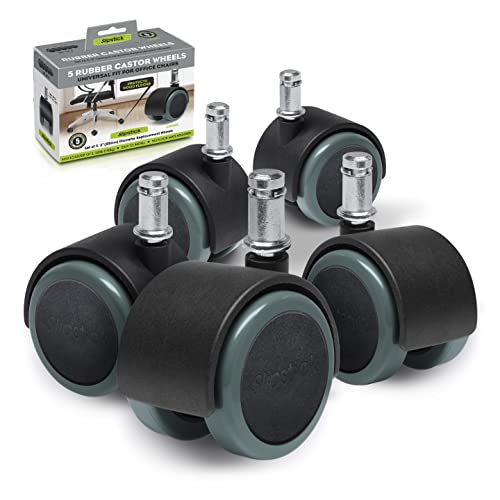
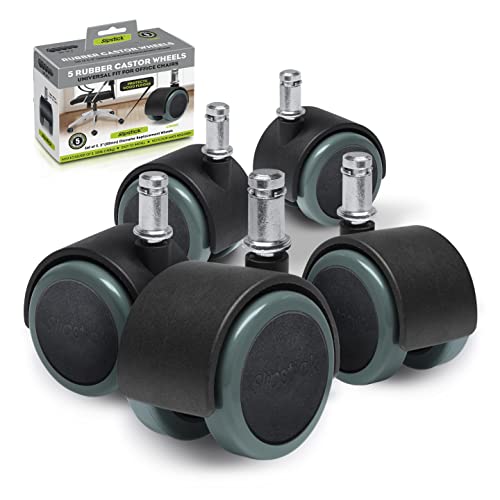
Slipstick takes a different route from the rollerblade-style sets. Its caster wheels keep a more conventional twin-wheel silhouette but use a softer wheel material intended to be gentler on hard floors than the hard plastic originals. That matters for people who do not want the taller ride height or the freer roll of a big single wheel, and for chairs that live partly on carpet, where a very free-rolling wheel can feel vague. Slipstick is a name many people already know from furniture floor protectors, and that floor-first thinking shows in how this set is positioned. It sits toward the entry-to-mid tier, and it is the pick in this group that changes the feel of the chair the least while still addressing the floor-damage complaint.
Best for: readers who want a softer twin-wheel style option from a brand better known for floor-protection furniture pads. Not suited for: anyone who has not yet measured their chair stems, or whose chair uses a non-standard stem fitting. This pick is described in prose only in this draft, positioned by tier rather than by a fixed price, so check the current Amazon listing before you buy.
SunnieDog Office Chair Wheels
SunnieDog’s chair wheels are another rollerblade-style set, aimed squarely at the home-office upgrader who wants the smoother, quieter roll without turning the purchase into a research project. The experience matches the style: the chair glides rather than rattles, small direction changes take less effort, and hard floors are treated more gently than they are by stock hard casters. As with every set here, the real buying work is not choosing between near-identical wheels — it is confirming your stem type and size before you order, because a beautifully made wheel on the wrong stem is simply a return waiting to happen. Positioned in the mid tier, it competes on overall value and presentation rather than on any single dramatic feature.
Best for: readers who want a rollerblade-style set positioned as a quiet, smooth-rolling everyday upgrade. Not suited for: anyone who has not yet measured their chair stems, or whose chair uses a non-standard stem fitting. This pick is described in prose only in this draft, positioned by tier rather than by a fixed price, so check the current Amazon listing before you buy.

Stealtho Office Chair Wheels
Stealtho is the premium-leaning name in this group. Its office chair wheels use the same rollerblade-style layout, presented with more emphasis on build quality, finish and the feel of the roll itself. Whether that emphasis is worth stepping up a tier depends on how much of your working day is spent moving in the chair and how much you care about the small difference between a wheel that rolls well and a wheel that rolls beautifully. The compatibility story is the familiar one — a standard grip-ring stem fits a great many chairs and still not all of them — so the measuring steps matter just as much here. Buy it for the feel and the finish, not because a premium badge exempts you from checking fit.
Best for: readers who want a premium-leaning rollerblade-style set marketed on build feel and smooth rolling. Not suited for: anyone who has not yet measured their chair stems, or whose chair uses a non-standard stem fitting. This pick is described in prose only in this draft, positioned by tier rather than by a fixed price, so check the current Amazon listing before you buy.
Performance in Real Use
On Hardwood and Laminate
Noise is the second half of the floor story, and it is the one people notice first. Hard twin-wheel casters rattle. On hardwood, laminate or tile, every seam, board gap and grout line is announced, and in a flat, a shared house or a home office next to a sleeping baby’s room, that clatter becomes part of the soundscape of the working day. Softer rollerblade-style wheels roll noticeably smoother and quieter in qualitative terms — the rattle becomes a muted roll, and the small shocks that used to travel up through the chair frame largely disappear. We deliberately put no number on that difference here, because honest comparisons depend on the floor, the chair and the room. What can be said plainly is that almost everyone who swaps reports the quiet as the change they would least give back.
Softer wheels change that equation in a simple, physical way. A larger, softer wheel spreads the load over a bigger contact area and deforms slightly instead of digging in, so the same grit is far less likely to be ground into the finish. Rollerblade-style wheels add a second benefit: because the wheel is larger, it rolls over small debris and floor imperfections instead of stopping against them and skidding. A skid is where much of the scratching happens — a locked or dragging hard wheel scrapes. A wheel that keeps turning does far less harm. None of this makes any wheel magically floor-proof, and a soft wheel rolling through grit all day will still leave marks eventually, which is why the cleaning habits covered later matter. But the direction of travel is clear: softer and larger is kinder to hard floors than smaller and harder.
On Carpet, With and Without a Mat
Carpet changes the calculation. On deep carpet, the problem with stock casters is usually not damage — it is effort. Small hard wheels sink into the pile and the chair feels like it is being dragged through sand, which is why so many carpeted offices end up with a plastic chair mat. Larger wheels roll over pile more easily, and a rollerblade-style wheel can make a medium-pile carpet feel surprisingly manageable. On very deep pile, though, any wheel is fighting the floor, and a chair mat remains the honest answer for people who move a lot during the day. Be aware, too, that the mat question cuts both ways: if you already use a mat over hardwood, your current casters may not be touching the wood at all, which changes how urgent a wheel upgrade really is for floor protection alone.
Moving Around a Desk All Day
Beyond floors and noise, there is a simple feel argument that owners mention again and again. A chair on good wheels moves the way you expect it to move. Small adjustments — edging closer to the desk, turning toward a second monitor, rolling back to stand — happen without the little shove-and-clunk routine that stock casters impose. Over a full working day those small frictions add up to a background irritation you only notice once it is gone. This is also why wheels are such a popular first upgrade for a gaming setup: the chair is the one part of the setup you physically interact with all session long, and a smoother roll makes the whole station feel more expensive than it is.
There is a trade-off built into every smoother wheel, and an honest review has to state it plainly: faster, freer wheels make the chair roll away more easily. On a hard floor that is not perfectly level — and very few floors are perfectly level — a chair on rollerblade-style wheels may drift slowly away from the desk when you stand up, roll back when you reach for something, or travel further than you expected from a small push. On a sloped floor this stops being a quirk and becomes a genuine caution: sit down carefully, keep a foot on the floor while you settle, and think twice about very free-rolling wheels in a room where the chair can gather momentum toward a step, a stairwell door or a glass panel. People who like to perch, lean and fidget sometimes find a freer chair unsettling for the first week. Most adapt. Some prefer the planted feel of a conventional caster, and that preference is legitimate.
When the Chair Will Not Stay Put
There is a trade-off built into every smoother wheel, and an honest review has to state it plainly: faster, freer wheels make the chair roll away more easily. On a hard floor that is not perfectly level — and very few floors are perfectly level — a chair on rollerblade-style wheels may drift slowly away from the desk when you stand up, roll back when you reach for something, or travel further than you expected from a small push. On a sloped floor this stops being a quirk and becomes a genuine caution: sit down carefully, keep a foot on the floor while you settle, and think twice about very free-rolling wheels in a room where the chair can gather momentum toward a step, a stairwell door or a glass panel. People who like to perch, lean and fidget sometimes find a freer chair unsettling for the first week. Most adapt. Some prefer the planted feel of a conventional caster, and that preference is legitimate.
Strengths and Trade-Offs
Strengths
- Floor protection: softer, larger wheels spread the load and keep turning over grit instead of grinding it into the finish.
- Quiet: the rattle of hard casters over seams and board gaps becomes a muted roll that housemates and sleeping children will appreciate.
- Feel: small adjustments take less effort, so the whole chair — and the setup around it — feels more premium.
Trade-Offs
- Roll-away: freer wheels drift on hard floors that are not perfectly level, and need real caution on slopes.
- Extra height: larger wheels raise the seat slightly, which matters at the edges of a chair’s adjustment range.
- Fit risk: none of the benefit arrives if the stem does not match your chair, and the common standard is not universal.
One change surprises people who were not warned: larger wheels raise the chair. A rollerblade-style wheel is bigger than the small twin wheels it replaces, so the seat sits a little higher, the armrests sit a little higher relative to the desk, and your feet sit a little differently on the floor. For most people the adjustment is a single tweak of the chair’s height lever and a day of getting used to it. For people at the edges — shorter users whose feet only just rested flat, taller users already at the top of the chair’s range, desks with a low modesty panel or a keyboard tray — the extra height is worth thinking about before ordering. Check that your chair has height adjustment in reserve, in the direction you will need it.
How Replacement Wheels Compare With the Alternatives
There are three honest alternatives to replacing wheels, and a fair review should name them. The first is a chair mat, which protects the floor without changing the chair at all — the right answer on deep carpet and a reasonable one anywhere, at the cost of a large sheet of plastic or glass defining your workspace. The second is doing nothing and accepting the wear, which is defensible on a floor that is already worn or due for refinishing. The third is replacing the whole chair, which solves caster problems by spending chair money. Against those options, replacement wheels win when the chair itself is still good, the floor is hard and worth protecting, and the stems match a standard fitting. They lose when the chair is dying anyway, when the carpet is deep, or when the fitting is exotic enough that no mainstream set will stay in the sockets.
Value in this category is not really about the purchase itself, which is modest as office upgrades go. It is about what the purchase protects and what it replaces. A floor refinish, or even a professional repair of a worn arc in front of a desk, costs many times what a set of wheels costs. A chair condemned because its casters cracked or its roll became unbearable is a far bigger expense than the wheels that would have refreshed it. That is the honest frame: replacement wheels are one of the cheapest interventions in a home office, aimed at one of the most expensive surfaces in the home. The value case collapses only when the wheels are bought for a chair or a floor that does not need them — which is what the who-should-skip sections in this cluster are for.
Who Should Buy Replacement Wheels — and Who Should Skip Them
Buy them if your chair rolls on hardwood, laminate or tile and you can see, or fear, the scuffed arc forming in front of the desk. Buy them if the rattle of your chair is a household issue. Buy them if a caster has cracked and the chair is otherwise sound. Buy them if you are setting up a gaming station and want the chair to feel as considered as the rest of it. Skip them, for now, if you cannot identify your stem fitting — measuring comes first, and the choosing guide in this cluster walks through it. Skip them if your floor slopes noticeably and the chair already wanders. Skip them if deep carpet is your real problem, because that is a mat problem wearing a wheel costume. And skip the premium tier if your chair is near the end of its life; put the money toward the chair that replaces it.
The mistakes in this category are remarkably consistent. People order before measuring and discover the stem mismatch on delivery day. People replace only the one broken caster and create a chair with mismatched wheel heights. People buy the softest, freest wheels for a sloped hard floor and then blame the wheels for a chair that will not stay put. People assume a wheel upgrade removes the need for any floor care, stop sweeping the grit from the rolling zone, and mark the floor anyway. And people throw away the old casters the moment the new ones are in, then discover a week later that they preferred the planted feel — keep the old set in a drawer until you are sure. Every one of these mistakes is avoidable with information that costs nothing, which is precisely what this cluster exists to supply.
Setup, Care and Maintenance Essentials
Safety around the swap is mostly about the chair, not the wheels. Never sit on the chair midway through the job, and never kneel or lean your full weight on a chair that has some casters removed — a base with missing or half-seated wheels can tip or roll without warning. The comfortable way to work is with the chair laid on its side on a rug or blanket, or tipped carefully with a second person steadying it while you pull and push casters. Two people make the job easier in every way: one holds, one works, and nobody is trying to control a top-heavy chair with one hand while pulling a stubborn caster with the other. Keep fingers away from the socket as a caster releases, because a stuck caster tends to let go suddenly.
The physical swap itself is genuinely simple, and it is worth saying so before the detail makes it sound complicated. Replacement casters are push-fit parts. The old caster pulls straight out of its socket — a firm pull, sometimes helped by wiggling the wheel as you pull, and occasionally by levering gently with a flat tool wrapped in cloth to protect the chair base. The new caster pushes straight in until it seats fully, which you feel as the stem sliding home and the grip ring settling into place. A caster that is only half-seated will wobble, click and eventually work loose, so the seated check matters: each wheel should sit at the same height as its neighbours, spin freely, and resist a firm downward tug. Do all of the wheels in one session, because mixing one tall new wheel with four worn old ones gives the chair a permanent limp.
Wheels are consumables that people forget to maintain, and most of the complaints aimed at replacement wheels — they stopped rolling smoothly, they started clicking, they feel gritty — are maintenance complaints in disguise. Hair is the main enemy. It wraps around axles and inside wheel hubs, slowly strangling the roll, and a home with long-haired people or pets supplies it constantly. Every few weeks, tip the chair, spin each wheel, and pull out any wound hair with tweezers or a seam ripper used carefully. Wipe the wheel surfaces with a damp cloth to remove the grit film that would otherwise be ground into your floor. A wheel that still feels rough after a proper clean has earned replacement; a wheel that was never cleaned has usually not been given a fair trial.
Final Verdict
As this office chair wheels review has argued from the first section, the category earns its popularity honestly. The stock casters on most chairs are a false economy — hard, small and unkind to floors — and replacing them is one of the few home-office upgrades where a modest, prose-tier purchase protects a genuinely expensive asset while also making every working day a little quieter and smoother. The conditions are real: measure the stem, respect the IKEA trap, replace the full set, and go in clear-eyed about roll-away on hard floors. Meet those conditions and the shortlist above contains a set for every tier and both major designs. Ignore them and even the best wheel in the world becomes a return label.
A Closer Look at How Wheels Behave, Room by Room
The same set of wheels can feel like three different products in three different rooms, which is why this review tests its judgements against rooms rather than against a laboratory bench. In a small home office with the desk against a wall, travel is short and mostly straight: in and out, a small turn toward a printer or a shelf. Here the headline benefit is not speed but silence and floor kindness, because the chair repeats the same short journey hundreds of times a week over the same patch of floor. That patch is exactly where hard stock casters do their damage, and it is exactly where a softer wheel earns its keep first. Owners in small rooms also notice the drift least, because there is simply less distance for a free chair to travel before it meets furniture.
In a larger room — a studio, a shared workspace, a gaming setup with the desk in open floor — the character of the wheel matters more. Longer rolls expose every flaw: a caster that starts reluctantly, a wheel that wanders off line, a rattle that builds as speed builds. Rollerblade-style wheels come into their own here, tracking straighter and holding a line across open floor in a way that small twin wheels rarely do. The trade-off grows with the room too, because a chair with further to drift will drift further, and in a room with a doorway, a step or a sloped board run, the roll-away discussion in this review stops being theoretical. Judge the freest wheels by your largest room, not your smallest.
The kitchen-table office, still the real workplace for many people, is the hardest environment of all. The floor is usually hard, the chair travels constantly as the table is cleared and reset, and the audience for the noise is the whole household. Here the review’s verdict sharpens: soft wheels are close to a courtesy, because the rattle of hard casters across a kitchen floor at the start of every call is a sound everyone in the home learns to dread. The floor-protection argument also runs at full strength, because kitchen floors in rented homes are deposit-relevant surfaces. If any single scenario justifies the mid tier on its own, it is this one.
Bedroom offices add one more variable: other people’s sleep. A chair that clatters over floorboards during a late finish or an early start is a relationship issue disguised as an equipment issue, and the qualitative quiet of a softer wheel — no figure attached, just the difference between rattle and roll — is the benefit owners in this setting mention first and defend hardest. It is also the setting where the swap pays back fastest in goodwill, which never appears in a listing and always appears in owner reports.
Finally, consider the chair that leaves the desk entirely: the workshop chair, the craft-room chair, the chair that rolls between stations. Thresholds, rug edges and cables are its daily terrain, and a larger wheel’s ability to climb over small obstacles instead of stopping dead against them changes the whole experience. A stock caster meets a cable and halts; a larger wheel rolls over it and continues. That single behaviour, repeated daily, is why so many owners describe the upgrade as making the chair feel younger. It is also a safety point in reverse: a chair that stops dead throws its occupant forward slightly, every time, and removing that small jolt is worth more than it sounds.
Pulling the room-by-room evidence together, the pattern behind this review’s verdict is consistent. The worse your current casters behave in your actual room — the more rattle, the more visible floor wear, the more obstacles — the more any reputable set improves your day, and the less the differences between the named sets matter. The better your current situation already is, the more the purchase becomes about refinement, and the more the tier and finish differences between sets like the ones shortlisted above become the real decision. That is a useful rule for any buyer: diagnose your room honestly, and the shortlist mostly ranks itself.
What This Review Deliberately Leaves Out — and Why
A responsible review should name its own limits. This one attaches no figures to any wheel: no load numbers, no noise numbers, no diameter claims for specific sets, because those figures vary by listing revision, by market and by the chair underneath, and a review that prints precise numbers it cannot stand behind teaches readers to trust the wrong things. What it offers instead is the structure of the decision — design, fit, floor, tier — which stays true even as individual listings change. If you finish this article knowing which design suits your floor and exactly what to measure, the review has done the part of the job that cannot go out of date.
It also refuses to crown a single winner, and that refusal is deliberate rather than diplomatic. The five sets shortlisted here divide by design and tier because buyers divide by floor and habit. A single-winner review would be simpler to write and worse to use: it would push the carpet-edge buyer toward a hard-floor champion and the slope-floor buyer toward the freest wheel in the group. The honest output of testing a category like this is a map, not a podium — which set, for which room, under which chair, at which tier. Readers who want a podium can find plenty; readers who want their purchase to still feel right in a year should prefer the map.
One more limit deserves stating: this review judges wheels as replacements for standard office and gaming chairs with push-fit casters. It does not cover chairs with plate-mounted casters, threaded stems as a first language, or the specialised bases of drafting stools and medical seating, except to warn that those fittings exist and must be identified before ordering. If your chair belongs to that minority, the measuring sections of this article matter even more to you, and the shortlist matters less — your correct set is the one whose stated fitting matches your chair’s, wherever in the market it sits.
Within those limits, the review’s confidence is genuine. The core claims — that hard stock casters are the floor-damaging ones, that softer and larger wheels roll smoother and quieter, that fit is decided by a measurable stem, and that freer wheels drift more on imperfect floors — are the stable physics of the category, confirmed by the broad pattern of owner experience. Everything else in this article is guidance built on that foundation, and the foundation is the part you can rely on longest.
What a Careful First Week With a Office Chair Wheels Reveals
The strongest sign in a hands-on check is consistency: the same input should produce the same result on the first attempt and on the twentieth. Check that nothing you place on, under or beside the office chair wheels blocks airflow, movement, visibility or access that the design quietly depends on. Write the exact model name and variant from the packaging into your notes, so replacement parts, accessories and support conversations start from certainty rather than guesswork. Keep the packaging and any small adapters, feet, brackets or fasteners together until the office chair wheels has survived a full week of ordinary use in its final position.
As a concrete listing check, take the Lifelong Office Chair Wheels and the Office Owl Rollerblade Style Chair Wheels named earlier in this article and confirm, line by line, that each variant offered matches the size, connection and contents described for it here. A calm final test is to walk away mid-task, come back later, and see whether the setup still makes sense at a glance without reconstructing what you were doing. If the office chair wheels will be shared, agree on one home position and one simple reset routine, so each person does not undo the previous person’s adjustments. Prefer a setup you can explain to another person in a minute, because simple arrangements are easier to troubleshoot, share and repeat than fragile clever ones. Judge the controls by whether you can use them without looking down or stopping your task, because that is how they will be used for most of their life.
When something behaves oddly, return to the basics first: power, connection, position, cleanliness and the last setting you changed, in that order, before assuming a fault. Think about the longest session you realistically run, not the average one, since heat, noise, clutter and small annoyances all grow more noticeable over time. When you compare notes with other owners, match their comments to setups like yours, because advice from a very different room, workload or routine can mislead. Keep the area underneath and behind the office chair wheels reachable for cleaning, since the spots you cannot reach become the spots where dust and lost small parts collect.
Start this final check away from the listings, with the space, the equipment and the routine you already have written down in plain terms. Write down the oldest and the newest device you expect this office chair wheels to work alongside, because compatibility problems usually appear at the edges of a setup rather than in the middle of it. A fair test repeats the same task at least twice, once while you are paying attention and once while you work normally, because concentration can hide clumsy design. Make one change at a time during the first days, so that when something improves or gets worse you know which change caused it. Test in the order you actually work: power on, connect, adjust, run a real task, then tidy up, rather than judging the office chair wheels on a single impressive first impression.
Check the connection points you rely on every day, and note which ones are already occupied, shared or awkward to reach once furniture is back in place. Leave a little headroom in every direction that matters, whether that means physical space, connection capacity, adjustment range or simply time to do a task properly. Decide in advance what good enough looks like for your use, so a minor cosmetic flaw does not distract you from performance that genuinely meets the brief.
If you work in more than one place, decide whether this office chair wheels stays fixed in one spot or travels, and judge its size, weight and setup time accordingly. Compare what the listing promised with what the box actually contained, item by item, and treat any mismatch as a reason to pause before the return window closes. Check the underside, back or hidden face of the office chair wheels as part of your inspection, because labels, vents, switches and fasteners often live where first impressions never look. Recheck the return window and the condition requirements before you discard any packaging, especially for a office chair wheels whose fit only becomes clear after several real sessions. When a specification is stated in unfamiliar terms, translate it into your own routine: how long, how often, how far, how loud in practice, before letting it sway you.
Revisit the decision after the novelty fades: the right office chair wheels should feel almost boring in use, doing its job without negotiation every single time. Avoid forcing a connector, bracket or moving part that resists you, because resistance is usually information about alignment or fit rather than an invitation to push harder.
Frequently Asked Questions
Will replacement wheels really protect a hardwood floor?
They help a great deal, with one honest condition. Softer, larger wheels spread your weight over a bigger contact patch and keep rolling over grit instead of grinding it into the finish, which is how the classic scuffed arc in front of a desk forms. The condition is basic floor hygiene: grit left in the rolling zone will still be pressed into the surface by any wheel, so a quick sweep of the area the chair travels remains part of the deal. Wheels plus a clean floor is real protection. Wheels alone, on a gritty floor, is only an improvement.
How do I know whether replacement wheels will fit my chair?
Pull one existing caster straight out and examine the stem. Most mainstream chairs use a grip-ring stem of a common size, and most replacement sets are built for exactly that fitting. Measure the stem diameter, note whether it has a grip ring or a threaded or neck style, and compare that with the stem description in the listing — not the headline promise of universal fit. IKEA chairs are the famous exception, using a different stem size on many models, so owners of those chairs should measure with particular care before ordering anything.
Are rollerblade-style wheels better than soft twin wheels?
They are better at rolling: smoother, quieter and kinder to hard floors, with an easier start and a calmer crossing of seams and rug edges. Soft twin wheels are better at feeling familiar: they add less height, feel more planted, and suit people who find a very free-rolling chair unsettling or who work partly on carpet. Neither answer is wrong. The right choice is the one that matches your floor, your chair and your own preference for glide versus grip, which is why this review shortlists both designs.
Will new wheels make my chair too tall?
Larger wheels do raise the seat a little, because the wheel itself is bigger than the small twin wheels it replaces. Most people solve it in seconds with the chair’s own height adjustment and forget about it within a day. The people who should think ahead are those already at the very top or bottom of their chair’s height range, shorter users whose feet only just rest flat, and anyone with a low keyboard tray or modesty panel. If your chair has adjustment in reserve in the direction you need, the height change is a non-issue.
Why does my chair roll away from the desk now?
Because that is the honest trade-off of a freer wheel. Hard floors are rarely perfectly level, and a wheel that starts moving easily will also start moving on its own when the chair is empty or when you shift your weight. On a mild slope it is a quirk you adapt to — a foot left down while settling, a hand on the desk as you sit. On a pronounced slope it is a genuine caution, and a more planted twin-wheel design, or keeping the stock casters, may be the wiser choice for that room.
How long do replacement chair wheels last?
Longer than most people expect, provided they are maintained like the moving parts they are. The killers are hair wound around the axles, grit embedded in the wheel surface, and impacts from being dragged sideways over thresholds. A quick clean every few weeks — tip the chair, spin each wheel, remove wound hair, wipe the surfaces — keeps a good set rolling smoothly for a long working life. A wheel that still feels gritty or rough after a thorough clean has genuinely reached the end, and at that point replacing the set is maintenance, not indulgence.
Related Guides
are office chair wheels worth it
how to choose office chair wheels
how to install office chair wheels
best chairs for office and gaming