Disclosure: As an Amazon Associate, ilcastellomenu.com earns from qualifying purchases. Links on this page are affiliate links; they cost you nothing extra. Prices and availability change often, so check the current Amazon listing before you buy.
This thunderbolt docking station reviews guide is written for laptop owners who are tired of the daily cable ceremony and want one honest account of what this class of hardware does, what it cannot do, and how the real choices differ. Plural matters here: this roundup reads across the current field of Thunderbolt docks, comparing how the leading models behave for different desks rather than crowning a single winner for everybody, because the right dock for a shared family desk and the right dock for a creative workstation are rarely the same object.
Key Takeaways
Across these thunderbolt docking station reviews, one pattern repeats: the docks themselves are mature and dependable, and satisfaction is decided by fit. Port geography, charging intent, display ambitions and platform behaviour separate the picks far more than build quality does. Shortlist by your device list, verify your laptop generation against the maker’s notes, and let the desk you actually have choose between otherwise excellent hardware.
In this guide
Reading Dock Reviews Like an Owner, Not a Shopper
Compatibility with docks is best thought of in groups rather than absolutes. A dock described as working with Thunderbolt laptops on both major desktop platforms will generally behave as expected, while edge cases gather around older machines, machines whose ports are data-only, and multi-display ambitions on hardware that supports only one external screen. Makers publish compatibility notes for a reason, and reading the notes for your exact laptop generation takes less time than a return. The category is mature; surprises now come mostly from assumptions, not from the hardware.
The second-hand and hand-me-down angle is worth a thought. Docks tend to outlive the laptop they were bought for, because the connection standard persists across laptop generations and the peripherals change slowly. A dock bought for one machine often serves its replacement without complaint, which softens the purchase considerably when you spread it across two laptop lifetimes. That longevity argues for buying the dock that suits the desk you actually have, from a maker likely to still be publishing support notes when the next laptop arrives.
Finally, a dock should be judged by the standard of infrastructure: uneventful days. The best dock is the one you stop thinking about, the one that turns a laptop into a workstation in the seconds it takes to sit down, and back into a portable machine in the seconds it takes to stand up. Features matter, compatibility matters more, and the calm of a desk that is always ready matters most of all. Every section of this guide returns to that standard, because it is the outcome owners are actually buying.
Where the Current Field Agrees
The reason that single cable can carry so much is that Thunderbolt is a tunnelling standard rather than a simple port expander. Display signals, data and power travel together over one connection, coordinated by the dock’s internal controllers. Newer Thunderbolt generations offer more headroom than older ones, and USB4 shares much of the same underlying thinking, but the buying lesson is simpler than the engineering: a genuine Thunderbolt dock is built and certified around that one-cable promise in a way a basic port adapter is not.
Charging is the second promise of a good dock, and it changes daily life more than any port count. The dock takes power from its own supply, passes a charge on to the laptop, and keeps the battery topped up through the working day, so the charger that came with the laptop can live in a travel bag permanently. Machines differ in how much power they accept and docks differ in how much they offer, so the honest check is whether the dock’s charging is described as suitable for your class of laptop, not a hunt for a single impressive number.
Network and audio connections are the unglamorous ports that separate a workstation dock from a travel adapter. A wired network socket gives a laptop a stable connection that does not compete with household wireless traffic, which matters for calls, large transfers and shared office files. A combined audio jack keeps a headset or speakers permanently attached to the desk instead of the laptop. Neither feature photographs well, and both are the kind of thing owners praise six months later when describing why the desk simply works.
Where the Current Field Diverges
Display support is where docks diverge most visibly. Some are content driving a single external screen, others are built to run two or more at once, and the answer depends on the dock, the laptop and the operating system working together. Macs and Windows machines have historically treated multiple displays over one connection differently, and even two laptops from the same brand can behave differently across generations. Treat any multi-monitor plan as a three-way compatibility question and verify all three parts before money moves.
Heat is the quiet companion of that convenience. A dock that is charging a laptop, driving displays and moving data is doing real electrical work, and warm enclosures are normal in this category. What matters is management rather than absence: a dock with a metal shell, sensible vents and room to breathe on the desk will behave better over years than one sealed inside a drawer or buried under papers. If a dock runs uncomfortably hot to the touch or drops connections when warm, that is a fault to act on, not a personality trait to accept.
The port layout of a dock deserves a slow look before buying, because you will live with its geography every day. Ports on the front serve the things that come and go: a headset, a phone cable, a memory card, a flash drive. Ports on the back serve the things that stay: monitors, network, printer, backup drive. A dock that puts a frequently used socket around the back will annoy you daily in a small way, and small daily annoyances are exactly what a dock is supposed to remove from a working life.
Ownership Patterns That Reviews Rarely Mention
Firmware and system updates arrive quietly and occasionally change behaviour. A setup that was perfect can develop a quirk after a major operating system release, and the fix is usually a matching update from the dock maker or a setting that moved. This is an argument for buying from makers who maintain their products in public, with dated support pages and plain release notes. It is also an argument for updating one thing at a time when you can, so that when behaviour changes you know which change to suspect first.
Expansion should be planned in named devices, not in vague headroom. The right amount of spare capacity is the port for the scanner you are actually buying, the screen you have measured the desk for, the drive already sitting in a drawer. Ports bought for imaginary futures add size, cost and heat without adding a single good day. This discipline keeps a dock or hub purchase honest, and it explains why experienced buyers describe their needs in devices and habits rather than in port counts and superlatives.
Environmental details shape satisfaction quietly. Sunlight warming a black dock on a windowsill, a hub trapped under a laptop’s exhaust, a power strip switched off by a cleaner’s knee: real desks have these stories. Place hardware out of direct sun and exhaust paths, keep vents visible, and make power switches deliberate rather than accidental. None of this is technical, and all of it decides whether a good product gets the chance to behave like one in your particular room.
The Picks at a Glance
| Pick | Tier | Where it shines |
|---|---|---|
| CalDigit TS4 | Premium tier | Dense, permanent workstations with many peripherals |
| Plugable Thunderbolt 4 Docking Station | Mid tier | Mixed-brand households that value documentation |
| Kensington SD5780T | Mid tier | Managed offices and traditional home setups |
| Anker 778 Thunderbolt Docking Station | Premium tier | Modern desks wanting generous front access |
| OWC Thunderbolt Dock | Mid tier | Creative desks with older peripherals in the mix |
Thunderbolt Docking Station Reviews: Model by Model

CalDigit TS4
Best for: readers who want a flagship Thunderbolt dock from a maker long associated with professional desk setups, aimed at users who connect many peripherals and want one substantial hub at the centre of the desk. Not suited for: anyone whose laptop cannot use this class of connection properly, because no accessory can lend a machine capabilities its own ports do not have.
Considered as the centre of a permanent desk, this pick earns attention through steadiness rather than novelty. In daily use, what matters is unglamorous: the unit wakes with the system, the connected devices appear without negotiation drama, and the desk behaves the same on a wet Tuesday as it did on the day everything was installed. Judge this model the way you would judge any piece of desk infrastructure, by how completely it disappears into the routine. Check the current listing before you buy, confirm the port mix matches the devices you actually own, and plan its power and cable routing as part of the purchase rather than as an afterthought.
Strengths worth weighing include a clear purpose within its tier, a layout that suits real furniture, and a setup routine another member of the household could repeat without help. The honest trade-offs are the ones shared by its whole class: your laptop’s own capabilities set the ceiling, warmth under sustained load must be given air rather than complaints, and your cables remain half the system. Bought with those truths in view, it is a sensible representative of its tier, and a fair benchmark against the other picks gathered in this guide.
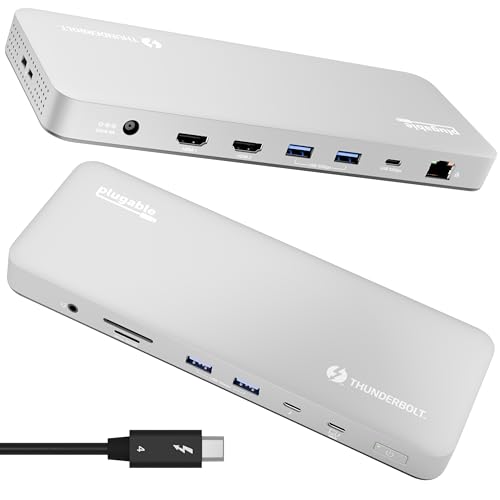
Plugable Thunderbolt 4 Docking Station
Best for: readers who want a dock from a connectivity specialist known for clear documentation, aimed at mixed laptop households and offices that value straightforward behaviour across brands. Not suited for: anyone whose laptop cannot use this class of connection properly, because no accessory can lend a machine capabilities its own ports do not have.
Viewed from the chair of someone who sets up workstations for other people, this pick makes sense because its behaviour is predictable. In daily use, what matters is unglamorous: the unit wakes with the system, the connected devices appear without negotiation drama, and the desk behaves the same on a wet Tuesday as it did on the day everything was installed. Judge this model the way you would judge any piece of desk infrastructure, by how completely it disappears into the routine. Check the current listing before you buy, confirm the port mix matches the devices you actually own, and plan its power and cable routing as part of the purchase rather than as an afterthought.
Strengths worth weighing include a clear purpose within its tier, a layout that suits real furniture, and a setup routine another member of the household could repeat without help. The honest trade-offs are the ones shared by its whole class: your laptop’s own capabilities set the ceiling, warmth under sustained load must be given air rather than complaints, and your cables remain half the system. Bought with those truths in view, it is a sensible representative of its tier, and a fair benchmark against the other picks gathered in this guide.

Kensington SD5780T
Best for: readers who want a Thunderbolt dock from an established office accessories maker, aimed at managed workplaces and home offices that prefer a traditional, support-friendly design. Not suited for: anyone whose laptop cannot use this class of connection properly, because no accessory can lend a machine capabilities its own ports do not have.
Approached as a first serious dock for a home office that has outgrown adapters, this pick keeps the learning curve gentle. In daily use, what matters is unglamorous: the unit wakes with the system, the connected devices appear without negotiation drama, and the desk behaves the same on a wet Tuesday as it did on the day everything was installed. Judge this model the way you would judge any piece of desk infrastructure, by how completely it disappears into the routine. Check the current listing before you buy, confirm the port mix matches the devices you actually own, and plan its power and cable routing as part of the purchase rather than as an afterthought.
Strengths worth weighing include a clear purpose within its tier, a layout that suits real furniture, and a setup routine another member of the household could repeat without help. The honest trade-offs are the ones shared by its whole class: your laptop’s own capabilities set the ceiling, warmth under sustained load must be given air rather than complaints, and your cables remain half the system. Bought with those truths in view, it is a sensible representative of its tier, and a fair benchmark against the other picks gathered in this guide.

Anker 778 Thunderbolt Docking Station
Best for: readers who want a dock from a widely recognised accessories brand, aimed at buyers who like a modern enclosure and a broad spread of everyday ports on the front and back. Not suited for: anyone whose laptop cannot use this class of connection properly, because no accessory can lend a machine capabilities its own ports do not have.
Judged for a shared or managed desk that cannot afford mid-morning surprises, this pick represents the dependable end of the market. In daily use, what matters is unglamorous: the unit wakes with the system, the connected devices appear without negotiation drama, and the desk behaves the same on a wet Tuesday as it did on the day everything was installed. Judge this model the way you would judge any piece of desk infrastructure, by how completely it disappears into the routine. Check the current listing before you buy, confirm the port mix matches the devices you actually own, and plan its power and cable routing as part of the purchase rather than as an afterthought.
Strengths worth weighing include a clear purpose within its tier, a layout that suits real furniture, and a setup routine another member of the household could repeat without help. The honest trade-offs are the ones shared by its whole class: your laptop’s own capabilities set the ceiling, warmth under sustained load must be given air rather than complaints, and your cables remain half the system. Bought with those truths in view, it is a sensible representative of its tier, and a fair benchmark against the other picks gathered in this guide.

OWC Thunderbolt Dock
Best for: readers who want a dock from a maker with deep roots in the Mac upgrade world, aimed at creative users who still rely on a mix of newer and older peripherals. Not suited for: anyone whose laptop cannot use this class of connection properly, because no accessory can lend a machine capabilities its own ports do not have.
For a buyer comparing tiers rather than chasing novelty, this pick shows what stepping up to an established dock maker buys in confidence. In daily use, what matters is unglamorous: the unit wakes with the system, the connected devices appear without negotiation drama, and the desk behaves the same on a wet Tuesday as it did on the day everything was installed. Judge this model the way you would judge any piece of desk infrastructure, by how completely it disappears into the routine. Check the current listing before you buy, confirm the port mix matches the devices you actually own, and plan its power and cable routing as part of the purchase rather than as an afterthought.
Strengths worth weighing include a clear purpose within its tier, a layout that suits real furniture, and a setup routine another member of the household could repeat without help. The honest trade-offs are the ones shared by its whole class: your laptop’s own capabilities set the ceiling, warmth under sustained load must be given air rather than complaints, and your cables remain half the system. Bought with those truths in view, it is a sensible representative of its tier, and a fair benchmark against the other picks gathered in this guide.
Strengths and Trade-Offs Across the Field
Strengths
- One cable turns a laptop into a full workstation and back again
- Charging, displays and peripherals are all handled by the station
- The desk stays set up, so work starts the moment you sit down
- A good dock outlives the laptop it was bought for
Trade-offs
- Your laptop’s own port capabilities set a hard ceiling
- Warmth under load is normal and must be given air
- The supplied cable matters more than buyers expect
- A dock is desk furniture, not a travel accessory
Who Each Kind of Dock Suits
A dock also changes how a desk is shared. In a household or small office where two people use the same desk on different days, a dock turns handover into one cable: the monitors, keyboard and network are already waiting, and each person’s laptop simply takes over the station. That only works smoothly when both machines speak the same connection language, which is worth checking before building a shared-desk plan around a single dock. When it does work, the dock quietly becomes the most democratic object in the building.
Portable and permanent are different design briefs, and docks belong firmly to the second. A full docking station expects its own power supply and a fixed place on the desk, and in exchange it offers charging, many ports and dependable multi-device behaviour all day. Owners who try to travel with a desktop dock usually end up buying a small hub as well, and that is not a failure of the dock; it is the category working as intended, with each tool sized for its own half of a hybrid working life.
A Closer Hands-On Check: Putting a Thunderbolt Docking Station Through Real Tasks
Note the moment you first had to think about the thunderbolt docking station instead of your work, since that moment usually reveals more than any summary of features can. Keep liquids, loose papers and anything that sheds dust or fibres at a sensible distance, unless the thunderbolt docking station was clearly designed to work right beside them. When a specification is stated in unfamiliar terms, translate it into your own routine: how long, how often, how far, how loud in practice, before letting it sway you. Decide in advance what good enough looks like for your use, so a minor cosmetic flaw does not distract you from performance that genuinely meets the brief.
As a concrete listing check, take the CalDigit TS4 and the Plugable Thunderbolt 4 Docking Station named earlier in this article and confirm, line by line, that each variant offered matches the size, connection and contents described for it here. Test in the order you actually work: power on, connect, adjust, run a real task, then tidy up, rather than judging the thunderbolt docking station on a single impressive first impression. Picture the busiest version of your week and ask whether this thunderbolt docking station still fits when other people, other tasks and other equipment compete for the same space. Treat any accessory bundled in the box as a starting point, and check whether it suits your setup before assuming the maker has solved that part for you. Compare what the listing promised with what the box actually contained, item by item, and treat any mismatch as a reason to pause before the return window closes.
Ask whether the benefit you want survives your least favourite conditions, such as low light, a crowded desk, a warm room or a rushed start to the day. Notice the small sounds, lights and movements during normal use, because those everyday details decide whether a thunderbolt docking station feels settled or constantly demands attention. Leave a little headroom in every direction that matters, whether that means physical space, connection capacity, adjustment range or simply time to do a task properly. Give a new thunderbolt docking station a fair trial in the position it was bought for before improvising workarounds, since many early complaints disappear once placement is corrected.
Plan where the cables or materials connected to this thunderbolt docking station will run when the room is tidy, not just while you are testing on an empty surface. Consider who else will use, move or clean around this thunderbolt docking station, because a choice that only works for one careful owner often frustrates everyone else in the household or team. A fair test repeats the same task at least twice, once while you are paying attention and once while you work normally, because concentration can hide clumsy design. Allow a short settling period for your own habits to adapt, but set a firm date to decide, well inside the return window, whether this thunderbolt docking station has earned its place. Take a quick photo of the working setup before you change anything, so cable routes, positions and settings can be restored exactly if the new arrangement disappoints.
If you work in more than one place, decide whether this thunderbolt docking station stays fixed in one spot or travels, and judge its size, weight and setup time accordingly. Prefer a setup you can explain to another person in a minute, because simple arrangements are easier to troubleshoot, share and repeat than fragile clever ones. Think about the next purchase this one commits you to, whether that is matching accessories, consumables, a bigger surface or a different connection, and count that commitment honestly.
Look for the failure you would notice first if you chose badly: a port you cannot reach, a part that will not fit, a control you cannot see, or a routine that becomes slower instead of easier. When you check a single thunderbolt docking station closely, work from the outside in: condition and finish first, then controls and connections, then behaviour during a real task from start to finish. Check the connection points you rely on every day, and note which ones are already occupied, shared or awkward to reach once furniture is back in place. Keep a short note of what worked, what annoyed you and what you adjusted, because that note is more useful than memory when you later replace or add another thunderbolt docking station.
Frequently Asked Questions About Thunderbolt Docking Stations
Do I need Thunderbolt on my laptop to use a Thunderbolt dock?
For the full one-cable experience, yes. A Thunderbolt dock expects the laptop to hand it displays, data and charging over a Thunderbolt connection. A laptop with a plain USB-C port that lacks Thunderbolt may still connect in a limited way on some models, or not at all, and the display behaviour is usually the first casualty. Check your laptop’s specification for the Thunderbolt name rather than trusting the shape of the socket, because the connector alone promises nothing.
Can one dock charge my laptop and run my monitors at the same time?
That is precisely the job the category was designed for. The dock takes power from its own supply, passes a charge to the laptop, drives the connected displays and serves the peripherals, all over the single cable between laptop and dock. Whether a particular pairing keeps a particular laptop fully charged under heavy load depends on both machines, so confirm that the dock’s charging is described as suitable for your class of laptop before buying.
Why does my second monitor not appear through the dock?
Work through the likely causes in order. Confirm the display is on the input you actually used, swap its cable for a known-good one, and then check the harder limit: some laptops support only one external display over a single connection, and operating systems differ in how they handle several. If the laptop itself supports only one external screen, no dock can overrule it. Testing with the laptop maker’s stated display support in hand turns this mystery into a short checklist.
Does a dock stay warm when it is not being used?
A dock that remains powered will often feel mildly warm, because it is awake, listening for a laptop and keeping its circuits ready. That is normal behaviour for powered desk infrastructure. What is not normal is a dock too hot to touch comfortably, or one whose connections drop as it warms up. Give any dock air around its shell, keep it out of drawers and direct sun, and treat genuine overheating as a fault to raise with the maker rather than a quirk to live with.
Will a Thunderbolt dock work with both Mac and Windows laptops?
In most current cases, yes, with the display caveat doing most of the talking. Data devices, network, audio and charging generally behave across platforms, while the number of external screens a machine will drive over one cable can differ between operating systems and laptop generations. Households sharing one dock between platforms should verify the screen count for each machine specifically, because that is where the platforms part company, and the rest of the experience is usually reassuringly similar.
What cable should I use between the laptop and the dock?
Use the cable supplied with the dock, or a certified equivalent of a similar short length from a maker you can identify. That single link carries displays, data and power together, and marginal cables are the most common hidden cause of dock faults that look like hardware failures. Longer fashion cables and bargain substitutes may charge perfectly yet misbehave under full load. If a dock ever misbehaves, returning to the supplied cable is the first and cheapest test you can run.
Related Guides
an honest pros and cons breakdown
whether a dock is worth it for you
a step-by-step guide to choosing
a USB-C hub for multiple monitors
a docking station for four monitors on Windows
a dock for a MacBook Air with two monitors
a KVM switch for two computers and two monitors
sharing a desk between two computers with a KVM switch
Living With the Setup, Month After Month
Ownership after the first month is mostly a story of habits. The station becomes furniture, the cable becomes a reflex, and the only remaining questions are small ones: whether the spare port you left free was the right one, whether the cable routing survived the last desk clean, whether the backup drive still mounts the moment the laptop lands. These are good problems, the kind that mean the system is working, and they are the true texture of life with desk infrastructure bought well.
A monthly glance keeps a station honest. Look at the back of the desk with fresh eyes: connectors seated, vents clear, no cable being slowly sawn by a desk edge, no new device quietly added by another member of the household. Small drifts explain most sudden mysteries in shared setups, and a glance catches them while they are still trivial. The habit costs less time than making tea and preserves the feeling of inevitability that a good station gives a working morning.
Recommendations between friends in this category travel best as method rather than as model names. Count your devices, check your laptop’s port capabilities, decide what stays permanently and what travels, and buy the hardware that matches that description from a maker you can identify. The method survives model changes, laptop changes and house moves. A name alone survives none of those, which is why experienced owners, when pressed, describe their reasoning first and their purchase second.
Resist the sprawl. Every added device on a station is another cable to seat, another driver of heat, another place a fault can hide. The best stations stay legible: anyone standing at the desk can say what is connected and why. When a new device earns a permanent place, something else often retires to a drawer, and that exchange keeps the system understandable. Legibility, far more than port count, is the mark of a mature setup and the thing guests actually admire.
If you move house or change desks, the station is the easiest part of a workstation to carry forward. Photograph the chain before dismantling, keep each cable with the device it served, and rebuild in the same order in the new place. Because the concept never changes, one laptop connected to a waiting desk, prior experience transfers completely. Owners regularly report the second installation taking minutes rather than an evening, and that confidence is part of what the first purchase really bought.
Support quality reveals itself in the small print long before you need it. A maker who publishes a clear setup order, names compatible laptop generations honestly, and answers display questions in ordinary language is describing how ownership will feel. Keep your purchase record and model details with your other household documents. Faults are not likely, but precise information shortens every conversation you might ever have, with support, with a retailer, or with the next person to own the desk.
Patience during the first fault is a skill worth rehearsing. The urge to replace the most impressive-looking component immediately is strong and usually wrong, because chained systems fail at their cheapest links first: a cable, a setting, a sleeping display, a laptop that updated itself overnight. Work from the wall socket outward, change one thing, and observe. That discipline, borrowed from every trade that maintains systems, is why some owners solve in minutes what others chase for a weekend with identical hardware.
The deeper satisfaction of a good station is that the desk becomes a place rather than a pile. Work starts when you sit down, not after a setup ritual, and ends cleanly when the laptop leaves. That transformation is available at every level of this category provided the expectations are honest and the hardware matches the machine. Choose for the desk you have, install calmly, and let the station disappear into the background of a working life; that disappearance is the product.
There is a rhythm to a well-set desk that owners rarely articulate until it is gone. The laptop lands, the screens wake in their places, the work is simply there, at the size and posture the day requires. Nothing about that rhythm is automatic; it is the accumulated result of small correct decisions, the right dock for the machine, the supplied cable kept in service, the ports arranged the way hands actually move. Naming the rhythm matters because it is the thing being bought, long after the product name is forgotten.
Visitors judge a workstation in the first ten seconds, and what they are really judging is legibility. A desk where every device has a reason and every cable has a route reads as competence before a word is spoken. The dock or hub at the centre of that desk is doing quiet reputational work in calls, in meetings, in the background of every video window. It is not the reason anyone buys one, and it is a reason many people, once they have it, refuse to work any other way.
Consider the alternative history, because most buyers have lived it. Adapters multiply in drawers. A charger lives under the desk and another in a bag, and somehow both are always in the wrong place. A screen works through one adapter but not another, for reasons nobody recorded. The station, whether dock or hub, is best understood as the decision to end that history deliberately, to replace a drawer of improvisations with one considered connection and a note in a drawer that explains it.
Maintenance in this category is mercifully close to none, which is why the little that exists gets skipped. Dust the vents when you dust the desk. Reseat the main cable if behaviour ever changes. Read the maker’s firmware notes when a major system update arrives. That is the whole liturgy, and it takes minutes a year. Hardware that asks so little should be given it promptly, because nearly every sad story in this category begins with a small ignored symptom and a long delay.
Children, partners, cleaners and colleagues will all, in time, unplug something. The station that survives domestic life is the one documented for other people: a label on the main cable, a note about the power-up order, a photograph of the back of the desk. This is not fussiness. It is the recognition that a shared home is a shared system, and that the kindest feature any setup can have is being restorable by whoever finds it disturbed.
Think about the second year when you buy, because the first month is a honeymoon any product can survive. In the second year the cable has been flexed ten thousand times, the desk has been rearranged twice, the laptop has updated itself more often than anyone counted, and a new device has joined the population. The hardware that still feels inevitable in that year is the hardware that was chosen by method in the first week: matched to the machine, matched to the desk, bought from a maker who stayed interested.
There is also an economics of attention at work. Every minute spent coaxing a connection is a minute taken from the work the connection exists to serve, and those minutes compound across a year into days. A station that simply works is therefore not a luxury purchase but an attention purchase, and its return is paid daily in the least replaceable currency a working person has. This is why owners defend these purchases with a warmth that surprises people who have only ever shopped by specification.
When the time comes to replace a laptop, the station earns one final compliment: continuity. The new machine arrives, the cable moves across, the screens and drives and network are already home. Settings need an evening, not the setup a whole weekend. In a technology landscape where every upgrade usually means starting again, a desk that persists across machines is a small miracle of standardisation, and it is available to anyone who buys the connection carefully once.
The environmental ledger deserves one honest line. A dock or hub that serves for years, across two machines, replaces a stream of disposable adapters bought in frustration and discarded in drawers. Buying once, buying suitably and keeping hardware in service is the greenest pattern this category offers, and it happens to be the cheapest and calmest pattern as well. Durability is not a separate virtue here; it is the same virtue as satisfaction, measured over a longer period.
New devices will keep arriving with new connector promises, and the station concept will survive them, because the need it answers is human rather than technical. People work in places. Places accumulate tools. A single, calm connection between the person, the machine and the place is always going to be worth having, whatever shape its plug takes next decade. Buy the version of that idea that fits your machine and your desk today, and you are buying something with a longer future than any single product cycle.
Ask owners what they would change and the answers are instructively small. A front port moved two inches. A cable six inches longer. A power switch in a kinder place. Nobody wishes they had bought a different concept; they wish the execution of the right concept had been tuned to their room. That is the strongest evidence available that the method in this guide, desk first, laptop second, product last, is the correct order of operations for the whole category.
A final practical habit separates the satisfied from the merely equipped: the first-week test. Use every port you intend to rely on. Sleep and wake the machine a dozen times. Unplug and replug at the speed of a real morning. Swap nothing, change nothing, just observe. Faults found in the first week are shopping problems, solved by exchanges and adjustments. The same faults found in the sixth month feel like betrayals. The test costs an evening and buys certainty, which in this category is the entire product.
One underappreciated virtue of a proper station is what it does to the laptop itself. Ports on the machine stop being consumables, flexed twice a day by five different plugs, and become what they should have been all along: a single connection point, used gently, in one place, with a cable that lives there. Laptops are replaced for many reasons, but a worn, wobbling port should not be one of them, and a docked or hubbed routine is the simplest insurance a port can be given.
Sound is the sense that reports a setup’s health first. The click of a connector seating properly, the absence of a fan straining under a pile of papers, the quiet of a desk where nothing dangles and nothing strains: these are the acoustics of a system at rest. When a station starts to sound different, a new rattle, a cable ticking against a desk edge as it slowly slips, it is reporting a physical change worth ten seconds of attention before it becomes a disconnection during a call.
Light tells the same story. A small indicator that confirms the station is awake, a screen that wakes in its assigned place rather than negotiating anew each morning, a charging light that behaves the same on Friday as it did on Monday: these tiny consistencies are how an owner knows, without thinking, that the system is itself today. Infrastructure earns trust in exactly this currency, small kept promises, and it spends that trust only when something genuinely changes.
There is a social etiquette to shared stations that is worth stating once. Leave the desk as the next person expects to find it: main cable coiled where hands look for it, screens off or asleep rather than blazing, your own portable drive taken with you. The station makes sharing easy; etiquette makes it pleasant. Households and small offices that agree these courtesies early find the shared desk becomes a small point of pride rather than a recurring negotiation.
Travel teaches the value of the home station by contrast. A week of borrowed desks, borrowed chairs and cables borrowed from hotel televisions sends most people home with a sharpened appreciation for the place where everything is already connected. That contrast is not an argument against travel hubs, which do their own job honourably. It is a reminder that the two halves of a hybrid life serve each other, and that gratitude, in equipment as in much else, is a form of information.
Budget the whole system, not the headline item. A station purchase that leaves nothing for the right cable, the small shelf that gives the unit its air, or the spare lead that lives in the drawer, is a purchase half finished. Experienced buyers hold back a modest portion of the budget for exactly these finishing items, because they know the last few connections decide whether the first big one delivers. The finishing items are unglamorous, and the morning routine they protect is anything but.
When something does go wrong, resist theatre. Do not rebuild the desk in an afternoon of frustration. Sit down with the narrowing method, power first, then the main cable, then one device at a time, and let the system confess in its own order. Almost every owner who has kept a station for years has a story of a fault that turned out to be a switched-off power strip or a display asleep on the wrong input, and the moral of every one of those stories is the same: the boring explanation is usually the true one.
Record what you learn in the place you keep such things. The working power-up order, the port the backup drive prefers, the setting that fixed the wake behaviour after the big system update: three lines in a note will save a future hour, possibly a future you who has forgotten the whole episode. Systems maintained by notes stay calm. Systems maintained by memory alone depend on one person’s presence, and presence is the one resource no desk can stock.
The category will keep changing its vocabulary. New generation names will arrive, new port shapes will be proposed, and listings will shout about all of it. The questions in this guide will not change, because they are about devices, desks, machines and habits rather than about any year’s specification sheet. Keep asking them in order, and each new generation becomes a simple reassessment instead of a fresh confusion. That stability is the real return on learning the method once.
Finally, notice what success feels like, because it is easy to miss. Success is the morning nothing happened. The laptop landed, the work appeared, the day began, and the connection between those events never crossed your mind. Weeks of such mornings are the product this entire category exists to sell, under two different names and at two different sizes. Choose the name that matches your life, set it up with care, and then enjoy the most underrated luxury in modern work: not thinking about it.
A word about buying in the wrong season of your own life. A station bought the month before a house move, a job change or a new laptop is a station bought for a desk that is about to stop existing. The hardware is patient; it will keep. The method in this guide is patient too. When the desk, the machine and the routine have settled into their new shapes, the same six questions will produce a sharper answer in an evening than any amount of research done against a life in transition.
Desk depth is a specification nobody lists and everybody lives with. A deep desk lets a dock sit behind the screens, present but invisible, with its front ports reached by a hand that knows the way. A shallow desk pushes everything closer, and the same dock becomes a neighbour rather than a backdrop. Neither is better, but the purchase should know which desk it is joining, because port geography and cable lengths are measured in the inches of your furniture, not in the abstractions of a product page.