Disclosure: As an Amazon Associate, ilcastellomenu.com earns from qualifying purchases. Links on this page are affiliate links; they cost you nothing extra. Prices and availability change often, so check the current Amazon listing before you buy.
Learning how to choose a universal remote is mostly learning what to ignore. Ignore the biggest compatibility claims, the longest button grids and the slickest app screenshots, and start instead with your own device list, your room, and the people who will share the handset. This guide on how to choose a universal remote walks through the decision in clear steps — inventory, control method, activities, streaming, comfort, power and support — then shows three worked examples of buyers reaching different right answers. Follow the steps in order and the shortlist writes itself.
Key Takeaways
- One remote should run the whole viewing routine — power, input, navigation and volume — not just the television.
- Your exact device list matters more than any headline compatibility claim; check every device, including the old ones.
- Activities that start the whole system with one press are the feature households actually fall in love with.
- Logitech Harmony remotes are discontinued; treat them as second-hand enthusiast buys, not default recommendations.
- Setup done slowly, one device at a time, is the difference between delight and a drawer full of regret.
- Best for methodical buyers who want a repeatable process. Not suited to readers replacing an identical remote who already know the exact model they need.
In this guide
How to Choose a Universal Remote: The Main Options at a Glance
The models below represent the main styles on the market rather than a ranked league table. Each is treated in prose, in plain language about who it suits, because honest positioning helps you more than invented precision. Read them as archetypes: find the description that sounds like your household, then use the criteria sections that follow to test that instinct before you spend anything.

SofaBaton X1S
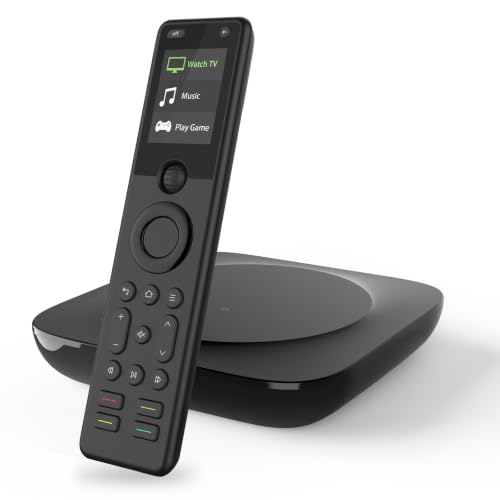
The SofaBaton X1S is a hub-based smart remote with an app-driven setup, a scroll wheel and activity-style control aimed at multi-device living rooms. Judge it on how it handles your exact device list, how its setup route fits your patience, and how gracefully it recovers when a device was left on or an input lands wrong. In daily use, the questions that matter are unglamorous: does volume always land on the right speakers, can a guest start a film without instructions, and does the layout make sense in the dark? If the answer to those is yes for your room, this style deserves a place on your shortlist; if any answer is no, keep reading the criteria sections before deciding.
Strengths in daily use tend to cluster around consistency: the same press producing the same result every evening, a layout your thumb learns within a week, and setup tools that let you fix a small problem without starting again. The trade-offs are equally consistent — every universal remote asks for one patient setup session, every database has gaps at the edges of a system, and every household must agree where the remote lives. None of those trade-offs is a reason to walk away; they are simply the price of admission, and knowing them in advance is what separates satisfied owners from disappointed ones.
SofaBaton U2
The SofaBaton U2 is a direct-control universal remote that keeps setup on the handset and suits viewers who dislike phone apps. Judge it on how it handles your exact device list, how its setup route fits your patience, and how gracefully it recovers when a device was left on or an input lands wrong. In daily use, the questions that matter are unglamorous: does volume always land on the right speakers, can a guest start a film without instructions, and does the layout make sense in the dark? If the answer to those is yes for your room, this style deserves a place on your shortlist; if any answer is no, keep reading the criteria sections before deciding.
Strengths in daily use tend to cluster around consistency: the same press producing the same result every evening, a layout your thumb learns within a week, and setup tools that let you fix a small problem without starting again. The trade-offs are equally consistent — every universal remote asks for one patient setup session, every database has gaps at the edges of a system, and every household must agree where the remote lives. None of those trade-offs is a reason to walk away; they are simply the price of admission, and knowing them in advance is what separates satisfied owners from disappointed ones.

GE Universal Remote
The GE Universal Remote is a simple, widely available replacement-style remote in the entry tier, aimed at a TV plus one or two extra devices. Judge it on how it handles your exact device list, how its setup route fits your patience, and how gracefully it recovers when a device was left on or an input lands wrong. In daily use, the questions that matter are unglamorous: does volume always land on the right speakers, can a guest start a film without instructions, and does the layout make sense in the dark? If the answer to those is yes for your room, this style deserves a place on your shortlist; if any answer is no, keep reading the criteria sections before deciding.
Strengths in daily use tend to cluster around consistency: the same press producing the same result every evening, a layout your thumb learns within a week, and setup tools that let you fix a small problem without starting again. The trade-offs are equally consistent — every universal remote asks for one patient setup session, every database has gaps at the edges of a system, and every household must agree where the remote lives. None of those trade-offs is a reason to walk away; they are simply the price of admission, and knowing them in advance is what separates satisfied owners from disappointed ones.
Philips Universal Remote
The Philips Universal Remote is a familiar big-brand replacement remote in the entry tier, with straightforward code entry and clear labelling. Judge it on how it handles your exact device list, how its setup route fits your patience, and how gracefully it recovers when a device was left on or an input lands wrong. In daily use, the questions that matter are unglamorous: does volume always land on the right speakers, can a guest start a film without instructions, and does the layout make sense in the dark? If the answer to those is yes for your room, this style deserves a place on your shortlist; if any answer is no, keep reading the criteria sections before deciding.
Strengths in daily use tend to cluster around consistency: the same press producing the same result every evening, a layout your thumb learns within a week, and setup tools that let you fix a small problem without starting again. The trade-offs are equally consistent — every universal remote asks for one patient setup session, every database has gaps at the edges of a system, and every household must agree where the remote lives. None of those trade-offs is a reason to walk away; they are simply the price of admission, and knowing them in advance is what separates satisfied owners from disappointed ones.
Inteset INT-422
The Inteset INT-422 is a learning, backlit universal remote favoured by home-theatre enthusiasts who want custom key mapping. Judge it on how it handles your exact device list, how its setup route fits your patience, and how gracefully it recovers when a device was left on or an input lands wrong. In daily use, the questions that matter are unglamorous: does volume always land on the right speakers, can a guest start a film without instructions, and does the layout make sense in the dark? If the answer to those is yes for your room, this style deserves a place on your shortlist; if any answer is no, keep reading the criteria sections before deciding.
Strengths in daily use tend to cluster around consistency: the same press producing the same result every evening, a layout your thumb learns within a week, and setup tools that let you fix a small problem without starting again. The trade-offs are equally consistent — every universal remote asks for one patient setup session, every database has gaps at the edges of a system, and every household must agree where the remote lives. None of those trade-offs is a reason to walk away; they are simply the price of admission, and knowing them in advance is what separates satisfied owners from disappointed ones.
How to Choose a Universal Remote: How to Judge Any Model in Ten Minutes
Give any candidate remote a ten-minute judgement before you read another word of marketing. First, list your devices and check each one is genuinely supported, including how your streaming devices accept commands. Second, picture the start of a film night and count the presses the activity needs. Third, find the volume and mute buttons with your eyes closed, because that is how you will use them. Fourth, ask what happens when something goes wrong mid-sequence — is recovery one obvious press or a menu expedition? Fifth, confirm the maker still maintains the product. A remote that passes those five tests in your imagination will very likely pass them on your sofa.
Soundbars and Receivers: Where Consolidation Pays
If one device refuses every code in the list, do not assume the remote is useless. Try the automatic code search if the handset offers one, then try learning the essential commands from the original remote if learning is supported. Sometimes only a few keys matter — power, volume and input — and a hybrid arrangement where the universal remote handles daily driving while the original lives in a drawer for deep settings menus is a perfectly respectable outcome. Perfection is optional; a calm living room is the actual goal, and partial control that works every day beats total control that works most days.
Think about what your system will look like in two years. Televisions get replaced, streamers multiply, and a soundbar today can become a full receiver setup tomorrow. A remote with a maintained device database, learning capability or app-based reprogramming adapts to those changes without starting again, while a fixed-code bargain may need replacing alongside the television. You do not need to future-proof obsessively — nobody can — but favouring products whose makers still publish updates and support pages is simple prudence, and it costs nothing to check before you commit.
The practical takeaway is simple: test this aspect against your own room and your own devices before you commit, write down what you find, and let that evidence — not packaging, not habit, not hope — drive the final choice between the handful of remotes still on your shortlist.
Gaming Sessions and Input Discipline
Manufacturers describe compatibility in different ways, so treat headline claims with care and think in terms of your actual devices instead. Write down every piece of kit you want controlled, with its exact brand and model from the label on the back or the settings screen. A remote that handles your television and soundbar but not your ageing disc player has not really solved your problem, and a remote that covers everything except volume on the receiver will annoy you every single evening. Your device list, not marketing copy, is the specification that counts.
Value in this category is measured in evenings, not specifications. A remote that saves your household thirty seconds of fumbling several times a day, ends input confusion, and survives being sat on will repay a mid-tier price many times over, while a premium handset whose app you dread opening is poor value at any price. Think about the cost of doing nothing too: keeping four remotes means four sets of batteries, four things to lose, and a standing invitation for guests to press the wrong power button and desynchronise the whole system at the worst possible moment.
The practical takeaway is simple: test this aspect against your own room and your own devices before you commit, write down what you find, and let that evidence — not packaging, not habit, not hope — drive the final choice between the handful of remotes still on your shortlist.
What a Universal Remote Actually Does — and What It Does Not
Voice control tempts many buyers and divides households just as quickly. Speaking to a remote is wonderful when your hands are full or when searching for a film title letter by letter would take minutes. It is less wonderful in a quiet house at midnight, or for viewers who simply dislike talking to objects. Remember that voice features usually belong to the streaming device or television rather than the universal remote itself, so check which microphone you will actually be speaking into and which assistant ecosystem it answers to before counting voice as a reason to buy.
Power strategy is an unglamorous deciding factor. Remotes using standard replaceable cells are easy to revive in seconds if you keep spares in the same drawer, and they can sit unused in a guest room for months. Rechargeable models with docks look tidier and avoid disposable waste, but they must return to their cradle or they will be flat exactly when guests arrive. Whichever you choose, keep loose and spare batteries — especially small coin cells — stored safely away from young children, because swallowed button batteries are genuinely dangerous and need urgent medical attention. That one safety habit matters more than any feature discussed in this guide.
The practical takeaway is simple: test this aspect against your own room and your own devices before you commit, write down what you find, and let that evidence — not packaging, not habit, not hope — drive the final choice between the handful of remotes still on your shortlist.
Choosing Kindly: Older Viewers and Shared Homes
A universal remote replaces a pile of separate handsets with one controller that can operate a television, a soundbar or AV receiver, a streaming box or stick, and often a disc player or games console as well. It does not add any new picture or sound quality by itself. What it adds is order: one power sequence, one volume control, and one place to look when the coffee table starts disappearing under plastic. Understanding that modest, practical promise is the key to judging every model fairly, because the best universal remote is the one that disappears into your routine rather than the one with the longest feature list.
Activities, sometimes called macros or scenes, are the real product you are buying. One press should turn on the television, wake the streamer or console, set the right input, and hand volume control to the soundbar or receiver. Done well, guests and family members stop needing instructions, and the phrase just press watch becomes true. Done badly, an activity is a fragile chain that fails whenever one device was left on, a console updates, or someone used a different remote in between. Judge any remote by how gracefully it recovers when the chain breaks, not by how slick the first demo feels.
The practical takeaway is simple: test this aspect against your own room and your own devices before you commit, write down what you find, and let that evidence — not packaging, not habit, not hope — drive the final choice between the handful of remotes still on your shortlist.
Projector Rooms and Tricky Infrared Paths
For older viewers and anyone with limited grip or vision, the best universal remote is the kindest one. Large, well-spaced buttons, high-contrast labels, a simple activity layout and forgiving setup matter far more than app dashboards. Consider how the remote behaves after a mistake: does one wrong press strand the viewer on a blank input, or can they recover by pressing the same clear activity button again? Recovery is the feature. A remote that forgives errors will be used confidently, and confident use is the whole point of consolidating control in the first place.
Comparing universal remotes fairly means comparing ecosystems, not just handsets. Ask how devices are added, whether the code or device database is still maintained, whether setup needs a phone or a computer, and what happens if the maker shuts a server down. Ask whether the remote works acceptably when the internet is down — your evening film should not depend on a distant data centre. Finally ask how the remote handles the odd devices: the old DVD player, the imported streamer, the projector. Mainstream televisions are easy for everyone; the edges of your system reveal the truth.
The practical takeaway is simple: test this aspect against your own room and your own devices before you commit, write down what you find, and let that evidence — not packaging, not habit, not hope — drive the final choice between the handful of remotes still on your shortlist.
Troubleshooting the Failures Everyone Meets
A universal remote succeeds socially, not just technically. The true test is whether a partner, a grandparent, a babysitter or a houseguest can watch something without a tutorial or a phone call to you. That argues for fewer, clearer activities, sensible button labels, and restraint with custom pages and hidden long-press tricks that only you understand. If you love tinkering, keep your experiments on a second profile or a spare page and leave the main layout boring. Boring is a compliment for shared technology: predictable, forgiving, and identical every evening of the year.
Weight and balance sound trivial until you live with them. A remote that is too light can feel toy-like and slides off cushions; one that is too heavy tires the wrist during long browsing sessions and hurts more when dropped on a bare foot. Rounded backs sit better in the palm than sharp slabs. If you can, imagine using the remote with your eyes on the screen, because that is how it will actually be used: glancing down occasionally, pressing by memory most of the time, and expecting the same button to do the same thing every night.
The practical takeaway is simple: test this aspect against your own room and your own devices before you commit, write down what you find, and let that evidence — not packaging, not habit, not hope — drive the final choice between the handful of remotes still on your shortlist.
Setup Routes Compared: Codes, Learning and Apps
Players notice input behaviour that film viewers never would. A universal remote will never replace a controller, but it often starts the session: powering the display, selecting the console input, setting the receiver to game mode territory and handing volume to the right speakers. Delays or missed steps in that chain feel worse mid-evening than they look on a checklist. If gaming is central in your home, test the start-up activity with the console fully asleep, and make sure returning to television afterwards is a single press rather than an archaeological dig through menus.
Volume control deserves its own decision. Most households want volume and mute to operate the soundbar or AV receiver no matter which source is playing, a feature often called volume lock or punch-through. Without it, you will change the television speakers by mistake and wonder why everything sounds thin. Set punch-through deliberately during setup, test it inside every activity, and make sure mute sits somewhere obvious. In a family room the remote that always gets volume right will be loved more than a cleverer remote that occasionally blasts the wrong speakers at full tilt.
The practical takeaway is simple: test this aspect against your own room and your own devices before you commit, write down what you find, and let that evidence — not packaging, not habit, not hope — drive the final choice between the handful of remotes still on your shortlist.
Voice Control: Delight, Gimmick or Both?
Most universal remotes speak infrared, the same invisible light signals your original remotes use, which means they usually need a reasonably clear line of sight to each device. Hub-based systems add a small base station that blasts infrared around the cabinet and can also relay commands over your home network or Bluetooth to certain streaming devices. That difference in architecture matters more than button count. A simple infrared handset is cheap, instant and dependable in one room, while a hub earns its place when equipment hides behind cabinet doors or when you want one button to start a whole viewing session.
HDMI-CEC lets devices control each other over the HDMI cable — the TV remote wakes the streamer, the console switches the input, the soundbar follows the TV power. Brands give it different names, which confuses everyone, but the idea is the same. CEC can make a cheap setup feel magical, or it can cause loops where everything turns off when you only wanted to pause. A universal remote gives you a way to impose order on top of CEC, or in some setups to replace its unpredictability with explicit infrared commands. Expect to spend a little time deciding which system is in charge.
The practical takeaway is simple: test this aspect against your own room and your own devices before you commit, write down what you find, and let that evidence — not packaging, not habit, not hope — drive the final choice between the handful of remotes still on your shortlist.
Will It Still Fit Your System in Two Years?
The second-hand market needs a cool head. Logitech has discontinued the Harmony line, so Harmony remotes and hubs now appear as used or leftover stock with no long-term guarantee that supporting services will run forever. A bargain Harmony can still delight an enthusiast who understands that risk, but it is a poor default recommendation for a family that wants set-and-forget reliability. For most buyers, choosing a currently supported product from a maker still actively maintaining its database and app is the safer route, even when a discontinued flagship looks more impressive on paper.
There is an honest split between people who want a remote and people who want a control system. A remote is a handset: pick it up, press, watch. A control system adds hubs, apps, voice assistants and automations that can dim lights or close blinds alongside the film. Neither preference is wrong, but buying across the line causes regret — the minimalist resents every app notification, while the enthusiast finds a basic handset limiting within a week. Decide which person you are before choosing, and let that answer narrow the field faster than any feature comparison table ever will.
The practical takeaway is simple: test this aspect against your own room and your own devices before you commit, write down what you find, and let that evidence — not packaging, not habit, not hope — drive the final choice between the handful of remotes still on your shortlist.
Strengths and Trade-Offs in Balance
Strengths
- One handset ends the nightly hunt and the coffee-table clutter in a single stroke.
- Volume and mute can be locked to the soundbar or receiver across every activity.
- A good activity button makes the whole system usable by guests, children and babysitters.
- A maintained database or learning function lets the remote adapt when you replace a device.
Trade-Offs
- First setup takes a patient session, and rushing it is the main cause of failure.
- No database covers every obscure or ageing device; some systems end up hybrid.
- App-based models add accounts and updates to objects that used to be simple.
- Discontinued lines such as Harmony carry long-term support risk on the second-hand market.
Common Mistakes to Avoid
Programming everything before testing anything, so small err
Programming everything before testing anything, so small errors hide inside activities and take an evening to unpick. Every one of these mistakes is avoidable with ten slow minutes of checking, and every one of them appears in disappointed owner stories far more often than any genuine product defect. The category rewards patience at the start and repays it for years.
Forgetting the streaming stick
Forgetting the streaming stick: buying an infrared-only remote for a Bluetooth-controlled box and discovering the gap on film night. Every one of these mistakes is avoidable with ten slow minutes of checking, and every one of them appears in disappointed owner stories far more often than any genuine product defect. The category rewards patience at the start and repays it for years.
Leaving volume control attached to the television speakers i
Leaving volume control attached to the television speakers instead of locking it to the soundbar or receiver. Every one of these mistakes is avoidable with ten slow minutes of checking, and every one of them appears in disappointed owner stories far more often than any genuine product defect. The category rewards patience at the start and repays it for years.
Throwing the original remotes away on day one, instead of ke
Throwing the original remotes away on day one, instead of keeping them labelled in a drawer for rare settings menus and setup rescue. Every one of these mistakes is avoidable with ten slow minutes of checking, and every one of them appears in disappointed owner stories far more often than any genuine product defect. The category rewards patience at the start and repays it for years.
Judging by button count or database size rather than by your
Judging by button count or database size rather than by your own device list, your room and your household. Every one of these mistakes is avoidable with ten slow minutes of checking, and every one of them appears in disappointed owner stories far more often than any genuine product defect. The category rewards patience at the start and repays it for years.
One safety note belongs in every universal remote guide. Keep spare and loose batteries, particularly small coin or button cells, stored out of reach of young children, and fit battery covers fully after every change. A swallowed button battery is a medical emergency, so treat storage and disposal with the same seriousness you would give to medicines. Keep rechargeable remotes and their docks on stable surfaces away from drinks, and never leave a remote with a damaged battery compartment in a toy box or play area.
Final Verdict
Best for methodical buyers who want a repeatable process. Not suited to readers replacing an identical remote who already know the exact model they need. Whichever route you choose, buy from a maker that still supports its products, set the remote up slowly, test the full start-up sequence from cold, and keep the original handsets until the new routine has survived a week of real family use. Do that, and the universal remote stops being a gadget and becomes what it should have been all along: invisible infrastructure for relaxed evenings.
Related Reading
For more on our universal remote reviews roundup, see our universal remote reviews roundup.
For more on the full universal remote review, see the full universal remote review.
For more on universal remote buying guide, see universal remote buying guide.
For more on the pros and cons ledger, see the pros and cons ledger.
For more on is a universal remote worth it, see is a universal remote worth it.
For more on how to set up a universal remote, see how to set up a universal remote.
For more on our indoor TV antenna review, see our indoor TV antenna review.
For more on the indoor TV antenna buying guide, see the indoor TV antenna buying guide.
For more on how to set up an indoor TV antenna, see how to set up an indoor TV antenna.
If one device refuses every code in the list, do not assume the remote is useless. Try the automatic code search if the handset offers one, then try learning the essential commands from the original remote if learning is supported. Sometimes only a few keys matter — power, volume and input — and a hybrid arrangement where the universal remote handles daily driving while the original lives in a drawer for deep settings menus is a perfectly respectable outcome. Perfection is optional; a calm living room is the actual goal, and partial control that works every day beats total control that works most days. Keep this in perspective as you read on: small, repeatable conveniences compound across hundreds of evenings, which is why owners who set a universal remote up properly tend to describe it as one of the best-value objects in the house, while owners who rushed setup describe the same product as a disappointment. The difference is rarely the hardware.
Think about what your system will look like in two years. Televisions get replaced, streamers multiply, and a soundbar today can become a full receiver setup tomorrow. A remote with a maintained device database, learning capability or app-based reprogramming adapts to those changes without starting again, while a fixed-code bargain may need replacing alongside the television. You do not need to future-proof obsessively — nobody can — but favouring products whose makers still publish updates and support pages is simple prudence, and it costs nothing to check before you commit. Keep this in perspective as you read on: small, repeatable conveniences compound across hundreds of evenings, which is why owners who set a universal remote up properly tend to describe it as one of the best-value objects in the house, while owners who rushed setup describe the same product as a disappointment. The difference is rarely the hardware.
Manufacturers describe compatibility in different ways, so treat headline claims with care and think in terms of your actual devices instead. Write down every piece of kit you want controlled, with its exact brand and model from the label on the back or the settings screen. A remote that handles your television and soundbar but not your ageing disc player has not really solved your problem, and a remote that covers everything except volume on the receiver will annoy you every single evening. Your device list, not marketing copy, is the specification that counts. Keep this in perspective as you read on: small, repeatable conveniences compound across hundreds of evenings, which is why owners who set a universal remote up properly tend to describe it as one of the best-value objects in the house, while owners who rushed setup describe the same product as a disappointment. The difference is rarely the hardware.
Value in this category is measured in evenings, not specifications. A remote that saves your household thirty seconds of fumbling several times a day, ends input confusion, and survives being sat on will repay a mid-tier price many times over, while a premium handset whose app you dread opening is poor value at any price. Think about the cost of doing nothing too: keeping four remotes means four sets of batteries, four things to lose, and a standing invitation for guests to press the wrong power button and desynchronise the whole system at the worst possible moment. Keep this in perspective as you read on: small, repeatable conveniences compound across hundreds of evenings, which is why owners who set a universal remote up properly tend to describe it as one of the best-value objects in the house, while owners who rushed setup describe the same product as a disappointment. The difference is rarely the hardware.
Voice control tempts many buyers and divides households just as quickly. Speaking to a remote is wonderful when your hands are full or when searching for a film title letter by letter would take minutes. It is less wonderful in a quiet house at midnight, or for viewers who simply dislike talking to objects. Remember that voice features usually belong to the streaming device or television rather than the universal remote itself, so check which microphone you will actually be speaking into and which assistant ecosystem it answers to before counting voice as a reason to buy. Keep this in perspective as you read on: small, repeatable conveniences compound across hundreds of evenings, which is why owners who set a universal remote up properly tend to describe it as one of the best-value objects in the house, while owners who rushed setup describe the same product as a disappointment. The difference is rarely the hardware.
Power strategy is an unglamorous deciding factor. Remotes using standard replaceable cells are easy to revive in seconds if you keep spares in the same drawer, and they can sit unused in a guest room for months. Rechargeable models with docks look tidier and avoid disposable waste, but they must return to their cradle or they will be flat exactly when guests arrive. Whichever you choose, keep loose and spare batteries — especially small coin cells — stored safely away from young children, because swallowed button batteries are genuinely dangerous and need urgent medical attention. That one safety habit matters more than any feature discussed in this guide. Keep this in perspective as you read on: small, repeatable conveniences compound across hundreds of evenings, which is why owners who set a universal remote up properly tend to describe it as one of the best-value objects in the house, while owners who rushed setup describe the same product as a disappointment. The difference is rarely the hardware.
A universal remote replaces a pile of separate handsets with one controller that can operate a television, a soundbar or AV receiver, a streaming box or stick, and often a disc player or games console as well. It does not add any new picture or sound quality by itself. What it adds is order: one power sequence, one volume control, and one place to look when the coffee table starts disappearing under plastic. Understanding that modest, practical promise is the key to judging every model fairly, because the best universal remote is the one that disappears into your routine rather than the one with the longest feature list. Keep this in perspective as you read on: small, repeatable conveniences compound across hundreds of evenings, which is why owners who set a universal remote up properly tend to describe it as one of the best-value objects in the house, while owners who rushed setup describe the same product as a disappointment. The difference is rarely the hardware.
Activities, sometimes called macros or scenes, are the real product you are buying. One press should turn on the television, wake the streamer or console, set the right input, and hand volume control to the soundbar or receiver. Done well, guests and family members stop needing instructions, and the phrase just press watch becomes true. Done badly, an activity is a fragile chain that fails whenever one device was left on, a console updates, or someone used a different remote in between. Judge any remote by how gracefully it recovers when the chain breaks, not by how slick the first demo feels. Keep this in perspective as you read on: small, repeatable conveniences compound across hundreds of evenings, which is why owners who set a universal remote up properly tend to describe it as one of the best-value objects in the house, while owners who rushed setup describe the same product as a disappointment. The difference is rarely the hardware.
A Careful Work-Through: Getting a Universal Remote Set Up and Settled
If a step produces an unexpected result, stop and return to the last point where everything behaved as expected, rather than layering new adjustments on top of confusion. Think about the next purchase this one commits you to, whether that is matching accessories, consumables, a bigger surface or a different connection, and count that commitment honestly. Revisit the decision after the novelty fades: the right universal remote should feel almost boring in use, doing its job without negotiation every single time. Check that nothing you place on, under or beside the universal remote blocks airflow, movement, visibility or access that the design quietly depends on.
As a concrete listing check, take the SofaBaton X1S and the SofaBaton U2 named earlier in this article and confirm, line by line, that each variant offered matches the size, connection and contents described for it here. If the universal remote will be shared, agree on one home position and one simple reset routine, so each person does not undo the previous person’s adjustments. Take a quick photo of the working setup before you change anything, so cable routes, positions and settings can be restored exactly if the new arrangement disappoints. Write the exact model name and variant from the packaging into your notes, so replacement parts, accessories and support conversations start from certainty rather than guesswork. Finish by repeating the whole routine once more from the beginning, because fluency on the second run is the real sign that the method, and the universal remote, suit you.
Keep the instructions somewhere you can find them months later, since the setting or step you skip today is often the one a future problem sends you hunting for. If you work in more than one place, decide whether this universal remote stays fixed in one spot or travels, and judge its size, weight and setup time accordingly. Notice how the universal remote behaves when you are tired or in a hurry, since products that demand perfect technique tend to fail exactly when you have least patience. When a specification is stated in unfamiliar terms, translate it into your own routine: how long, how often, how far, how loud in practice, before letting it sway you.
Allow a short settling period for your own habits to adapt, but set a firm date to decide, well inside the return window, whether this universal remote has earned its place. If two options look identical on paper, choose the one whose controls, layout or handling you understood fastest, since clarity in daily use beats a longer feature list you never touch. Before the first real attempt, do one slow practice run that you are willing to undo, which lets you learn the sequence without pressure and spot missing tools early. Prefer a setup you can explain to another person in a minute, because simple arrangements are easier to troubleshoot, share and repeat than fragile clever ones. Avoid forcing a connector, bracket or moving part that resists you, because resistance is usually information about alignment or fit rather than an invitation to push harder.
Plan where the cables or materials connected to this universal remote will run when the room is tidy, not just while you are testing on an empty surface. When you compare notes with other owners, match their comments to setups like yours, because advice from a very different room, workload or routine can mislead. Think about the longest session you realistically run, not the average one, since heat, noise, clutter and small annoyances all grow more noticeable over time.
Make one change at a time during the first days, so that when something improves or gets worse you know which change caused it. Take a short break between setup and first proper use to look at the result with fresh eyes, checking alignment, access and cable routes one final time. Ask what you would do on the day this universal remote stops working as expected, and whether you could swap, reset, clean or return it without dismantling half your setup. Decide in advance what good enough looks like for your use, so a minor cosmetic flaw does not distract you from performance that genuinely meets the brief. Consider who else will use, move or clean around this universal remote, because a choice that only works for one careful owner often frustrates everyone else in the household or team.
Frequently Asked Questions
Will a universal remote work with my streaming stick or box?
It depends on how the streamer accepts commands. Infrared models need a line of sight and a device that listens for infrared; many sticks use Bluetooth instead, but televisions can often pass commands along through HDMI-CEC, and hub-based remotes bridge the gap more reliably. Check your exact streamer model against the remote maker’s support information before buying, and test navigation, home and back commands during setup, not just power.
What happens if my device is not in the code list or database?
Try the automatic code search if the remote offers one, then try learning the essential commands from the original remote if learning is supported. Many households run a happy hybrid: the universal remote handles power, volume, input and playback, while the original stays in a drawer for rare deep settings. That outcome is a success, not a failure — daily calm is the goal.
Is the Logitech Harmony line still a good buy?
Harmony remotes were excellent, but Logitech has discontinued the line, so new stock is leftover and most listings are second-hand, with no guarantee about how long supporting services will continue. An informed enthusiast may still enjoy one at the right price. For a family wanting set-and-forget reliability, a currently supported product from an active maker is the safer default recommendation.
How long does setup usually take?
Plan one unhurried session rather than a stopwatch target. Simple code-entry setups for a TV and soundbar can be quick, while multi-device activities with a receiver, console and streamer deserve a slow evening of adding, testing and adjusting delays. Working device by device and testing as you go is faster in the end than programming everything and debugging it afterwards.
Can one universal remote control equipment behind cabinet doors?
A basic infrared handset needs a reasonably clear path to each device sensor, so closed doors usually defeat it. Hub-based systems solve this by placing a hub or small infrared blasters inside the cabinet, and some devices can also be controlled over the network or Bluetooth. If your kit lives out of sight, treat hub control as a requirement, not an upgrade, and test every device with the doors closed.
What should I do with my old remotes afterwards?
Keep them, labelled, in one drawer with spare batteries stored safely away from young children. You will want an original occasionally for deep settings menus, firmware updates or rescuing a setup that has gone sideways. Once the universal remote has run the house happily for a few months, you can retire the originals to a box — but there is no prize for throwing them away early.