ilcastellomenu.com is reader-supported. When you buy through links on our site, we may earn an affiliate commission.
Where to Buy
All six cameras below are current models from the major makers, stocked by the usual outdoor and camera retailers, and every one sits in our verified pool with a proper product link. The line-up deliberately spans the trail photographer’s real choices — a weather-sealed system camera, a crushproof compact, two action cameras, a pocket zoom and a fixed-lens favourite — because ‘backpacking camera’ means different things at mile two and mile two hundred.
The best cameras for backpacking and hiking are chosen the way everything in a backpack is chosen: by weight, by weather, and by what happens when things go wrong at altitude. A camera that is magnificent in a studio becomes a resentful brick on day four of a thru-hike if it is heavy, fragile, thirsty for batteries or impossible to operate with cold fingers and gloves. The trail is a filter that strips photography down to what you will actually carry, actually protect, and actually pull out in horizontal rain on a ridge.
So this guide judges six cameras by trail logic rather than showroom logic. Weight is counted honestly, as a system — body, lens, batteries, charger, case — because a light body with a heavy lens and a nightly charging habit is not a light camera. Weather sealing is treated as a spectrum, from cameras you can rinse under a tap to cameras you merely need not panic about in drizzle. And handling matters out of proportion: a camera you can shoot one-handed, with gloves, without opening your pack in a storm, takes the photographs the others miss.
The six picks divide into philosophies. The OM-5 Mark II is the serious system camera shrunk to trail weight. The Tough TG-7 is the camera that survives the trip the others do not. The GoPro and Insta360 document the journey itself, hands-free. The RX100 VII is the pocket camera for hikers who refuse to carry a system. And the X100VI is the beautiful fixed-lens indulgence that makes a certain kind of hiker walk further for a photograph. We will match each to its hiker, then get practical about carrying, power and weather.
Key Takeaways
- Count system weight, not body weight: lenses, batteries and chargers are part of the camera you carry up every pass.
- Weather sealing decides where the camera can live — a sealed camera rides on a strap in the rain; an unsealed one rides in the pack and misses the storm light.
- One-handed, gloved operation is worth more on a trail than any specification: the best trail photo is the one taken without stopping.
- Power is a logistics problem on multi-day trips; cameras that sip batteries or charge from a power bank beat cameras that demand nightly mains power.
- Decide your philosophy first — document the hike, or hike to photograph — because the six picks below serve those two religions very differently.
In this guide
Quick Picks
| Pick | Badge | Why it is here |
|---|---|---|
| OM SYSTEM OM-5 Mark II | Best system camera for the trail | A weather-sealed interchangeable-lens camera light enough to actually backpack with, and tough enough not to baby. |
| OM SYSTEM Tough TG-7 | The indestructible one | Waterproof, crushproof and freezeproof — the camera for river crossings, scree and weather that ends trips. |
| GoPro HERO13 Black | Best for documenting the journey | Mount it, forget it, and come home with the climb, the descent and the summit all recorded hands-free. |
| Insta360 X4 | Best for reliving the trail | Shoots everything in every direction at once, so the view behind you is captured while you watch the one ahead. |
| Sony RX100 VII | Best pocket camera | A real zoom and a real sensor in a jacket pocket — the hiker’s camera for people who will not carry a camera bag. |
| Fujifilm X100VI | Best for the deliberate photographer | A fixed-lens camera whose film looks and simple joy make rest stops turn into photo walks. |
How Did We Choose These Cameras for Backpacking and Hiking?
We applied the backpacker’s spreadsheet first: all-in trail weight. For the system camera that meant body plus a versatile zoom plus two batteries and a way to charge them; for the compacts and action cameras, the camera, its case and its cables. Anything whose honest trail weight crept toward a kilogram had to justify every gram with capability the lighter picks lacked — the OM-5 does, which is why it is here, and several heavier full-frame favourites are not, which is why you will not find them.
Second, weather and abuse. Backpacking weather is not a forecast, it is a certainty distributed randomly across your trip, and the camera will be rained on, knocked against granite, dropped in dust and stored in a damp tent. We weighted maker-rated sealing and proven toughness heavily: the TG-7’s waterproof, crushproof construction sits at one extreme, the OM-5’s serious weather sealing in the middle, and the pocket cameras at the ‘protect it in a dry bag’ end — a legitimate choice, but one we score as a handling cost rather than a virtue.
Third, the human factors of the trail: can you shoot it with gloves, one-handed, from a hip-belt pocket or a chest strap, in the ninety seconds a cloud break gives you? Does its battery strategy fit a multi-day carry — spares, a shared power bank, solar top-ups? And will its files make you happy at home, because a camera whose photos disappoint gets left behind on the next trip, and a camera left behind has a trail weight of infinity.

OM SYSTEM OM-5 Mark II — Best system camera for the trail
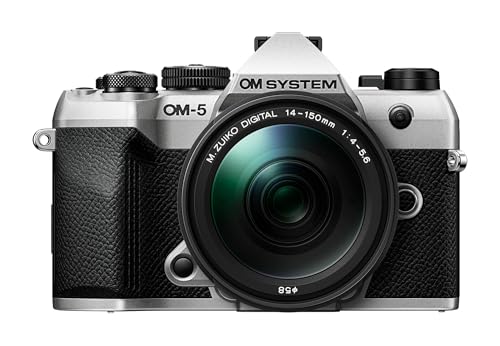
The OM-5 Mark II is what happens when a camera maker takes backpacking seriously as an engineering brief. It is a proper interchangeable-lens camera — Micro Four Thirds, with that system’s famously small lenses — wrapped in serious weather sealing and a body light enough that the whole kit, camera plus versatile zoom plus spare battery, undercuts most rivals’ body alone. For the hiker who wants real photography, not just documentation, this is the camera that does not ask you to choose between the trip and the hobby.
The system’s trail manners go deeper than weight. The lenses are small enough to ride in a hip-belt pocket or a padded pouch inside the pack lid, the sealing shrugs off the drizzle-to-downpour range that constitutes mountain weather, and the in-body stabilisation is strong enough to shoot dawn from a cold bivouac without unpacking a tripod — a genuine mile-maker, since tripod weight is where backpacking photography budgets go to die. Computational tricks inherited from its bigger siblings, like in-camera neutral-density effects for silky streams, replace filters you would otherwise carry.
Its sensor is smaller than full-frame rivals, and in deep darkness that shows: a star-filled sky over a high camp is harder work here than on a big-sensor camera, though entirely possible with technique. The menu system rewards owners who set the camera up at home and customise the dials, rather than spelunking options with numb fingers. Neither point is a surprise at this weight; both are the honest price of a system you will actually carry to the places worth photographing.
Battery strategy is workable rather than endless — carry two spares on a long trip and top up from the power bank you already carry for your phone, because the camera charges over USB. Pair it with the compact weather-sealed zoom for general duty and one fast small prime for camp evenings, and you have a two-lens mountain kit that would embarrass expedition photographers of a generation ago.
Choose it if photography is a reason you hike. It is the only pick here that grows with your skill for a decade, and the only system camera we would recommend for a week-long backpack without a paragraph of caveats.
- Format: Micro Four Thirds interchangeable-lens camera
- Sealing: weather-sealed body and matched sealed lenses
- Stabilisation: in-body, strong enough for tripod-free dawns
- Charging: USB charging for power-bank top-ups
- Trail role: the serious photographer’s backpacking system
Strengths
- Genuine system capability at true backpacking weight
- Weather sealing lets it ride outside the pack in bad weather
- Small lenses make a two-lens mountain kit realistic
Trade-offs
- Smaller sensor works harder in deep darkness than full-frame
- Menus reward home setup rather than trail-side improvisation
- Lens ecosystem is a commitment, not a casual purchase
Best for: a hiker-photographer who wants interchangeable lenses without expedition weight.
Not suited for: an ultralight purist counting every gram, or a pure point-and-shoot walker.

OM SYSTEM Tough TG-7 — The indestructible one
The TG-7’s product briefing appears to have been ‘what if the trip goes wrong?’ It is waterproof to real depths, crushproof under real loads, freezeproof, dustproof, and fitted with a lens that shrugs off the knocks that would retire every other camera on this page. On a backpacking trip that involves river crossings, slot canyons, scree fields, boat sections or weather with a personality disorder, this is not the backup camera. It is the camera.
Its party pieces are outdoors-specific in a way that shows long attention to actual field use. A microscope mode focuses almost on the lens itself, turning trail-side finds — frost crystals, alpine flowers, a beetle’s armour — into frame-filling photographs no phone can match. GPS and environmental sensors log where and in what conditions each frame was taken, so the photo of the pass comes home with the pass’s altitude attached. The controls are chunky enough for gloves, the screen readable in glare, the whole thing operable by feel while clipped to a pack strap on a carabiner, which is exactly where it should live.
The trade is image quality ambition. Its sensor is small — compact-camera class — and in good light at phone-screen sizes its files are lively and pleasing, while in deep dusk or for large prints the bigger-sensor picks walk away from it. The zoom range is modest. Nobody buys a TG-7 to win landscape competitions; they buy it because on the day the weather turns and everyone else’s camera retreats into a dry bag inside a pack inside a tent, theirs is out, shooting the storm light on the ridge.
That last point deserves emphasis, because it inverts the usual hierarchy. The best photograph of most trips is not taken in the golden calm; it is taken in the dramatic hour when conditions are worst. The TG-7 is the only camera here that is guaranteed to be present for that hour, and presence, on a mountain, beats specifications.
Pack it for trips where the environment is the story — canyoneering, coastal trails, winter routes, anything involving boats or bikes — or as the second camera beside a system you protect. It is also, not incidentally, the one to lend.
- Format: rugged compact, fixed zoom lens
- Protection: waterproof, crushproof, freezeproof, dustproof
- Close focus: microscope mode for near-macro trail finds
- Logging: GPS and environmental sensors
- Trail role: the camera that survives the trip
Strengths
- Survives water, drops, dust and cold that stop every rival here
- Microscope mode opens a whole trail-side miniature world
- Glove-friendly controls and strap-clip portability
Trade-offs
- Small sensor limits dusk quality and large prints
- Modest zoom range for distant wildlife
- Fixed lens — no growing the system later
Best for: trips with water, winter, canyons or chaos in the forecast.
Not suited for: a photographer whose priority is exhibition-size landscape prints.

GoPro HERO13 Black — Best for documenting the journey
The GoPro answers a different question from the other picks: not ‘how do I photograph the trail?’ but ‘how do I come home with the trail itself?’ Worn on a chest mount, clipped to a pack strap or held on a short grip, the HERO13 records the climb as it felt — the exposure on the ridge, the wade across the river, the scramble where your hands were too busy for any conventional camera. Its stabilisation turns bouncing trail footage into something watchable, and its toughness means the rain that stops a photography session is, for the GoPro, just weather in the shot.
For stills it is better than its video-first reputation: perfectly capable frames, especially pulled from its wide, sharp view in good light, and honest about its nature in the dark, where it is not the tool. The backpacking virtues are operational — it is tiny, it is light enough to forget, its batteries swap in seconds, and mounts exist for every strap, pole and helmet you own. On a long trail, a camera that asks nothing is a camera that gets used at mile ninety, when the beautiful system camera is riding in the pack ‘for later’.
The HERO13 generation added lens mods and refinements that matter to hikers less than to creators, but two things do matter out there: battery endurance improved, and the whole thing remains waterproof without a case, which simplifies river days. Carry two batteries and a cable to your power bank, and the power question is closed for a week of daily highlights. What it will not give you is photographic control or reach — there is no zooming to the marmot, no shallow depth for the portrait, no raw-file craft at the evening edit. It documents; it does not compose.
That division of labour is why so many serious trail kits pair the GoPro with one of this page’s stills cameras. But if the choice is one camera and the goal is to relive and share the journey — the film your friends actually watch — the GoPro is the pick, and it is not close.
One trail habit to adopt: short clips, often. Thirty seconds at each viewpoint, water source and summit beats an hour of continuous walking footage nobody will ever watch, and your future editing self will send thanks back in time.
- Format: action camera, ultra-wide fixed lens
- Protection: waterproof without a housing
- Stabilisation: advanced electronic smoothing
- Power: swappable batteries, USB charging
- Trail role: hands-free journey documentation
Strengths
- Captures the hike itself, hands-free, in any weather
- Featherweight and tiny — present at mile ninety
- Stabilisation makes trail footage genuinely watchable
Trade-offs
- No zoom, no real low-light stills, limited photographic control
- Stills are a by-product, not the main event
- Wide view distorts close faces and near subjects
Best for: a hiker whose goal is a film of the journey to relive and share.
Not suited for: a stills photographer who wants reach, depth and craft.

Insta360 X4 — Best for reliving the trail
The X4 is the camera that removes the cameraman’s oldest anxiety: pointing the thing the right way. Two lenses capture everything in every direction at once, and you choose the framing later, at home, from footage that contains the summit cross, your face, the valley behind you and the eagle nobody noticed, simultaneously. On a trail — where stopping to compose is a tax and the light changes by the minute — that shoot-first, frame-later freedom is a genuinely different way of travelling with a camera.
The backpacking case is strong. It is light, it mounts on an invisible selfie stick that gives floating third-person shots of you walking ridges as if a drone were following, and its flow-state stabilisation is superb. For solo hikers especially, it solves the ‘every photo is of the view, none is of me in it’ problem that afflicts a decade of trip albums. Its stills, extracted or shot directly, are respectable in daylight and share the action-camera family’s honest weakness after dark.
The costs are workflow and fragility management. The footage is only potential until you reframe it in the app or desktop software, which some hikers love as a fireside ritual and others experience as homework that quietly never happens — be honest about which you are. The bulging lenses are exposed by design and want their protective guards and a moment’s care in the pack; the camera is water-resistant for rain and splashes, and river-immersion ambitions should be checked against its ratings and accessories before the trip, not during it.
Battery life per charge is measured in long shooting sessions rather than days, so the power bank is part of the kit, as with the GoPro. What you get in return is unique: a complete spherical memory of the trip. Hikers who share their journeys, hike solo, or simply hate missing things will find the X4 the most fun camera on this page by a distance.
Battery swaps on the move are part of its trail craft: the battery door is glove-tolerant, the spares are small enough to live in a chest pocket where your warmth keeps them honest, and a disciplined hiker can run the X4 across a full day’s highlights on two batteries and a power-bank top-up at camp. Log the reframing ideas as you go — a note on the phone naming the moment — and the home edit becomes assembly rather than archaeology.
Choose it if your trip’s story includes you. Choose anything else if the thought of reframing footage at home makes your shoulders drop — the best camera is the one whose workflow you will actually finish.
- Format: 360-degree action camera, dual lenses
- Protection: water-resistant; lens guards advised
- Stabilisation: advanced electronic smoothing
- Power: rechargeable, power-bank friendly
- Trail role: capture-everything journey recording
Strengths
- Records every direction — nothing on the trail is missed
- Invisible-stick shots put solo hikers in their own film
- Reframing at home turns one walk into many edits
Trade-offs
- Footage needs reframing work before it is finished
- Exposed lenses demand guards and care in the pack
- Low-light performance is action-camera class
Best for: a solo hiker or sharer who wants to be inside the story.
Not suited for: a photographer who wants finished files straight from the camera.

Sony RX100 VII — Best pocket camera
The RX100 VII is the answer for the hiker who has tried carrying a ‘real camera’ and quietly stopped. It is a jacket-pocket compact with a one-inch sensor — several times the area of a phone’s — and a genuinely useful zoom that runs from wide landscapes to a respectable telephoto for the deer at the meadow’s edge. That combination, at a weight your hip belt will not notice, is why this camera has been the serious pocket option for years: it is the most photography you can carry without carrying a camera.
The trail virtues compound. It powers on fast, focuses fast, and its pop-up viewfinder — a small miracle of packaging — saves the day in the glare where screens wash out, which on snowfields and high passes is most of the day. Battery life is the known tax of the format: small body, small battery, so the backpacking kit is the camera plus two spares in a pouch, still lighter than most single lenses. It charges by USB, which folds it neatly into the power-bank economy of a modern pack.
Weather is its honest weakness: no meaningful sealing, so rain means the camera retreats to an inside pocket or a dry pouch, and the storm-light hour belongs to the TG-7 or the OM-5. Dust and grit are likewise enemies of its extending lens. None of this is a flaw so much as a definition — this is the fair-weather artist of the line-up, and on the fair days, which are most days on most trails, its files are the ones that make the prints.
Who is it for? The hiker whose photography is opportunistic and excellent: the alpenglow caught from the tent door, the portrait at the pass, the ptarmigan that waited. If your trips are planned around photographs, buy the OM-5 and carry it proudly. If your photographs are planned around the trip, the RX100 VII is the camera that respects that priority and still delivers.
Its autofocus deserves a trail-specific compliment: it tracks a walking companion, a dog, a bird’s brief appearance with a tenacity that pocket cameras a generation ago could not approach, and its burst speeds turn the RX100 into a legitimate wildlife-ambush tool at a waterhole or a col where marmots sun themselves. The files from that one-inch sensor print beautifully to sensible sizes, which closes the loop for the hiker who wants wall photographs without a camera bag’s penance.
One carrying tip from long use: a small padded pouch on the hip belt, not a neck strap, is this camera’s natural home — out in two seconds, protected in three, and never swinging against rock on a scramble.
- Format: pocket compact, one-inch sensor
- Lens: versatile zoom from wide to telephoto
- Viewfinder: pop-up electronic finder for glare
- Charging: USB, small spare batteries advised
- Trail role: maximum photography per gram carried
Strengths
- Real zoom and a real sensor at pocket weight
- Pop-up viewfinder defeats mountain glare
- Fast enough for wildlife that does not pose twice
Trade-offs
- No weather sealing — rain sends it into hiding
- Small battery demands spares on multi-day trips
- Extending lens dislikes dust and grit
Best for: a hiker who photographs opportunistically and travels light.
Not suited for: a storm-chaser or a trip built around photography itself.

Fujifilm X100VI — Best for the deliberate photographer
The X100VI is the romantic of this line-up, and romance is a legitimate backpacking specification. It is a fixed-lens camera — one focal length, wide-ish, no zoom, no lens changes — with an analogue-feeling control layout and Fujifilm’s film simulations that make photographs look like memories straight from the camera. Hikers who carry it describe a change in behaviour: you stop documenting and start noticing, because a fixed lens turns every viewpoint into a small creative problem with a beautiful answer.
On the trail its virtues are simplicity and size. It slips into a small pouch, asks for no lens decisions at 6 a.m., and its hybrid viewfinder lets you shoot through glare and darkness alike. The lens is sharp, the sensor is large and excellent in low light — camp evenings and dawn starts are its home turf — and the built-in neutral-density filter handles bright snowfields and slow-shutter stream experiments without extra glass. Files need so little editing that the phone-transfer-and-share workflow most hikers actually use produces finished pictures, not homework.
The constraints are the philosophy. No zoom means your feet are the zoom, and the marmot stays a speck. The camera is not weather-sealed in the way the OM-5 is, so mountain weather asks for care and a dry pouch. And demand for this model has historically outrun supply, so buying one can require patience or luck — plan the purchase well before the trip rather than the week of it.
Why include an indulgence in a practical guide? Because backpacking is itself an indulgence, and the camera that makes you walk an extra mile for a photograph, then makes the photograph sing, is serving the trip as truly as the one that survives the river. The X100VI hiker is a known type: fewer photos, better ones, and a grin at every rest stop.
If that description sounds like a warning rather than an invitation, believe it and buy the RX100 VII. If it sounds like a diagnosis, you have found your camera.
- Format: fixed-lens compact, large sensor
- Lens: single wide-ish focal length, no zoom
- Viewfinder: hybrid optical/electronic
- Extras: film simulations, built-in ND filter
- Trail role: the deliberate photographer’s companion
Strengths
- Film looks finish photographs in-camera
- Fixed lens simplifies every trail-side decision
- Excellent in dawn and camp-evening light
Trade-offs
- No zoom — wildlife stays distant
- Weather resistance is modest; needs care in storms
- Famously hard to find in stock
Best for: a photographer-hiker who values feel and simplicity over reach.
Not suited for: a hiker who needs zoom, sealing or guaranteed availability.
How Do the Six Trail Cameras Compare Side by Side?
| Pick | Key specification | Standout trait | Watch out for |
|---|---|---|---|
| OM SYSTEM OM-5 Mark II | Sealed system, small lenses | Capability per gram | Smaller sensor at night |
| OM SYSTEM Tough TG-7 | Waterproof, crushproof | Survives anything | Small-sensor image ceiling |
| GoPro HERO13 Black | Waterproof action camera | Hands-free journey film | No zoom or stills craft |
| Insta360 X4 | 360-degree capture | Nothing missed, ever | Reframing homework |
| Sony RX100 VII | Pocket zoom, 1-inch sensor | Photography without a bag | No weather sealing |
| Fujifilm X100VI | Fixed lens, large sensor | Joy and finished files | No zoom, scarce stock |
Read the table by asking where the camera lives during the hike. The TG-7 and GoPro live outside — on a strap, in the weather, ready in the worst hour of the trip. The OM-5 lives outside too, on a capture clip or strap, but asks for a moment’s respect in a true downpour. The X4 lives mounted and working. The RX100 VII and X100VI live in pockets and pouches, emerging for the moments that deserve them. A camera’s address during the hike predicts its photo count better than any sensor measurement.
The second reading is by failure mode. The TG-7 fails by image quality at dusk. The GoPro and X4 fail by absence of craft — no reach, no depth. The pocket cameras fail by weather retreat. The OM-5 fails by commitment: it is a system, and systems ask for lenses, learning and care. None of these failures is disqualifying; each is simply the shadow of the camera’s virtue, and the right choice is the failure you can live with on your kind of trip.
How Should You Carry a Camera on a Multi-Day Hike?
Carrying is a system, and the rule is that a camera you must open your pack to reach effectively does not exist. The proven addresses are three. A capture clip on a shoulder strap puts a system camera or compact at chest height, secure against swinging and reachable in two seconds — the OM-5’s natural home, and the reason so many trail photographers standardise on it. A hip-belt pouch suits the pocket cameras: the RX100 VII or X100VI rides at the waist, padded, dry-ish, and out before the light changes. A carabiner on a strap is the TG-7 and GoPro’s territory, where toughness makes exposure a feature.
Inside the pack, the camera’s overnight home matters too: a padded pouch in the lid or top of the main compartment, never at the bottom under the food bag, and never loose against stove parts or poles. In wet climates add a lightweight dry bag as the camera’s sleeping bag — tents are condensation machines, and a camera that fogs internally at dawn has missed the day’s best light before the day begins.
Straps deserve one warning. A camera swinging from a neck strap on a scramble will eventually meet granite, and trekking poles plus dangling cameras are a tangle that ends trips’ photo ambitions. Whatever address you choose, the test is the same: can you shoot, one-handed, within five seconds of seeing the shot, and stow it just as fast when the terrain turns serious? If yes, the system works. If no, the camera will spend the trip as ballast.
How Do You Power Cameras When There Is No Wall for a Week?
Power planning starts with an honest count of shots per day, not the manufacturer’s best-case figure. Cold halves batteries’ generosity, altitude and stabilisation tax them, and video eats what stills sip. The robust pattern for a week is boring: two to three spare batteries for the stills camera, a power bank sized for the whole trip’s electronics, and every device charging from that one bank over USB so a single cable strategy serves phone, headtorch and camera alike. The picks here mostly cooperate with that pattern, which was a quiet filter in our choosing.
Solar panels tempt every backpacker and disappoint most: on a moving hiker in northern latitudes they harvest optimism more than watts. They earn their place on basecamp-style trips and desert traverses with long static evenings, not on a ridge walk. Better weight economics usually come from one more battery and the discipline of turning cameras fully off between viewpoints rather than letting them sleep-drain in standby.
Cold-weather craft matters more than capacity. Batteries sleep inside the jacket or the sleeping bag at night, a warm spare rotates into the camera at dawn, and the ‘dead’ battery from the morning often revives by lunch once warm — label them, rotate them, and never throw a cold battery’s evidence away by deleting its card in frustration. The TG-7’s freezeproofing covers the camera; the batteries still appreciate the same warmth you do.
What Should You Photograph on a Backpacking Trip, Beyond the Summit?
The summit shot is the trip’s punctuation, not its story, and the cameras here reward hikers who shoot the commas. Camp life — the tent glowing at dusk, boots drying, the morning’s frost on the fly — is where the OM-5 and X100VI earn their keep in low, warm light. The trail itself, shot by the GoPro and X4 as it is actually travelled, becomes the film that returns the trip’s feeling rather than its geography. Water in all its forms — the TG-7 rinsed under the waterfall it just photographed — gives a trip album its texture.
People are the hardest and most valuable subject. Backpacking companions at their most unguarded — cooking, laughing, enduring — are the photographs that matter in twenty years, and they ask for the fast, kind cameras: the RX100 VII from a pocket before the moment notices, the X100VI whose quiet shutter and finished files flatter everyone. Wildlife, by contrast, mostly rewards the zoom you carried or the patience you did not; the RX100’s telephoto end and the OM-5’s small telephoto lenses are the honest tools, and the fixed-lens picks teach the older skill of getting closer or letting it go.
Finally, shoot the weather. Every instinct says shelter the camera and wait; every great trip album says otherwise. The sealed and tough picks exist precisely for the hour the front comes through, when the light goes theatrical and the trip becomes a story. The camera you protected all week owes you that hour.
How Do You Protect Photographs Themselves on a Long Trip?
The files are the trip’s cargo, and they deserve the same redundancy thinking as water treatment. Memory cards fail rarely and consequentially; the fieldcraft is to shoot smaller cards and swap them, so one failure costs a day rather than the expedition, and to store full cards apart from the camera — a different pocket, a different bag — so a lost pack is not a lost archive. Hikers with a phone routine can back up the day’s keepers nightly over the camera’s Wi-Fi; it costs battery and buys peace.
At home, the trail discipline continues for exactly one evening: copy everything twice before formatting anything, and let the reframing cameras — the X4 especially — get their session while the trip is still vivid, because 360 footage loses its meaning as memory fades. The GoPro’s short-clip habit pays off here: an album assembled from thirty-second moments edits in an evening, while hours of continuous footage edits never.
None of this requires expedition stakes to be worth doing. A weekend’s photographs are as irreplaceable as a thru-hike’s, and the habits are identical, merely shorter. Protect the files like the trip mattered, because it did.
What Changes in Winter and at Altitude?
Cold and height rewrite camera behaviour in ways spec sheets understate. Batteries deliver less and recover with warmth, LCDs slow, and condensation becomes the trip’s quiet saboteur: a camera brought from a freezing ridge into a warm, steamy tent will fog inside and out, and the discipline is to bag it before entering the warmth and let it acclimatise sealed. The TG-7’s freezeproof rating makes it the winter default for good reason, and the OM-5’s sealing handles the cold well provided its batteries get the sleeping-bag treatment described earlier.
Altitude adds glare and thin, contrasty light. The RX100 VII’s pop-up viewfinder stops being a curiosity and becomes the instrument you shoot through for hours, and exposure compensation becomes a trail skill: snowfields fool meters into grey, and every camera here lets you correct it once you know to look. UV and polarising filters, dead weight in the valley, earn discussion at altitude for the system camera — though the OM-5’s in-camera effects cover some of that ground without glass.
The human factors peak here too. Gloves turn small buttons into fiction, which is why the chunky-control picks and the set-it-at-home philosophy run through this guide. A camera configured in a warm kitchen — custom dials set, menus trimmed — is a different instrument at a windy 4,000 metres from the same camera being configured there. Winter does not forgive improvisation; it rewards the prepared, camera included.
How Should Beginners Split a Budget Between Camera and Trip?
The heretical truth of trail photography is that the trip is the photograph’s main ingredient, and a modest camera in a magnificent place outperforms a flagship at home. Beginners with a fixed pot should fund the journey first — boots, shelter, the permit, the extra day — and buy from this page’s honest middle: the TG-7’s toughness, the RX100 VII’s pocket craft, or a used previous-generation OM-5 body with the sealed kit zoom, which is the connoisseur’s budget route into a system.
What not to economise on is the carrying and power around the camera: the clip or pouch that keeps it reachable, the spare batteries, the cards. Those small spends decide whether the camera gets used, and an unused bargain is the most expensive camera of all. Accessories beyond that — filters, cages, elaborate straps — can wait for the second trip, when experience has replaced guesswork about what you actually missed.
Grow deliberately thereafter. The OM-5 path adds a lens a year. The pocket path upgrades when its limits, not its age, annoy you. And the documentation path — GoPro or X4 — pairs with any stills camera later. Backpacking rewards the patient kit built over seasons, and punishes the January splurge that February’s credit card makes you leave at home.
How Do You Shoot the Night Sky From a High Camp?
A clear night above the treeline is the backpacking photographer’s jackpot, and even this light-travel line-up can collect it. The recipe is stable support without a tripod’s weight — the camera on a stuff-sack of clothes, a flat rock, or a mini tripod that doubles as a handle — plus the self-timer or a remote release so your touch does not blur the exposure, and manual focus set carefully on a bright star before the composition is finalised. The OM-5 and X100VI, with their larger sensors and fast glass options, lead here; the RX100 VII manages respectable star fields in its wide, bright end; the action cameras’ night modes produce pleasing time-lapses rather than serious stills.
Expectations should be calibrated by sensor, and there is no shame in the calibration: the small-sensor picks make lovely screen-sized Milky Way souvenirs, while print ambitions belong to the system camera. What matters more than either is being awake and ready — the hiker who set focus and framing at dusk, over dinner, photographs the sky at midnight in four minutes and returns to the sleeping bag, while the improviser is still focusing as the cold wins.
One courtesy belongs in every night-sky paragraph: the red-light discipline of camp. Set the camera’s screen dim, work by headtorch on red, and your companions — and your own dark adaptation — will thank you. The stars are shared property at a high camp; so is the darkness.
What Mistakes Do Backpacking Photographers Keep Making?
Counting body weight and forgetting the system. The camera you carry is body plus lens plus batteries plus charger plus case; weigh the whole photography line on the kitchen scale before the trip, not your optimism about it at the shop.
Storing the camera inside the pack. A camera that needs a stopped pack, an opened lid and a rummaged pouch will miss the light, the wildlife and the moment, every time. If it is not reachable in five seconds, it is not on the trip.
Buying for the summit and ignoring the storm. Trips are remembered in dramatic weather, and an unsealed camera in a dry bag photographs none of it. Match the camera’s sealing to the trip’s worst plausible day, not its brochure day.
One battery, one card, one hope. Cold, loss and failure are normal trail events; spares for power and storage are the cheapest insurance in the whole pack and the most commonly skipped.
Deleting in the field. Culling photographs on a tiny screen, in glare, with trail-tired eyes deletes keepers and saves nothing worth having; cards are light, regret is heavy. Carry the storage, judge at home.
Photographing only viewpoints. The album that survives is camp, trail, weather and people — the journey — not six angles of the same panorama. Shoot the commas, not just the exclamation marks.
Final Recommendation
If photography is a reason you hike, the OM SYSTEM OM-5 Mark II is the recommendation: a real, sealed, growing system at a weight that respects the backpack, and the only camera here that serves a decade of trips. If your trips court water, winter and chaos, the Tough TG-7 is the one that will be working on the day that defines the trip — pair them and you own both ends of the mountain.
For documentation over deliberation, the GoPro HERO13 is the journey camera and the Insta360 X4 its capture-everything rival, divided by whether you want finished footage or infinite reframing. The RX100 VII is the light traveller’s stills camera, and the X100VI the deliberate photographer’s joy. Choose by the hiker you actually are — your pack, your weather, your workflow — and the camera will feel less like gear and more like a companion, which on a long trail is the highest praise equipment can earn.
And if you are buying for a first serious trip, a word of proportion: any camera on this page, carried reachable and used constantly, will bring home a better album than a superior camera left in the lodge. The trail rewards presence over pedigree. Pick the one whose compromises fit your route, put it where your hand falls, and walk — the photographs are already out there waiting for someone carrying a camera they like.
Frequently Asked Questions
Is a phone not enough for backpacking photographs?
For many hikers, honestly, yes — and the picks here justify themselves where phones stop: real zoom for wildlife, sealing and toughness for storms, stabilised hands-free video of the journey, batteries that swap instead of ending the day, and files that print. If your trips are fair-weather and your sharing is social, a phone plus the TG-7 as the tough companion is a legitimate kit. The moment you plan trips around photographs, the OM-5’s case becomes clear. There is also a dignity argument hikers rarely voice: a dedicated camera keeps the phone — your map, your emergency line, your battery-critical device — in the pack where it belongs, instead of draining it as the trip’s shutter. On a long route, that separation alone can justify a pocket camera.
How much camera weight is reasonable on a multi-day hike?
It depends on the trip’s total load and purpose, but the honest method is the kitchen scale and a percentage: many backpackers happily give photography five to ten percent of base weight when it is a trip priority, and resent every gram when it is not. The pocket picks here sit under that bar almost unnoticed; the OM-5 system kit is the deliberate version of the same decision. Weigh the full system — the mistake is weighing the body and lying to yourself with accessories.
Can these cameras handle rain without extra protection?
The TG-7 and GoPro are built for it outright. The OM-5 with a sealed lens handles real rain with ordinary care — dry it at camp, keep the mount cap discipline — while the X4 shrugs off rain and splashes within its ratings. The RX100 VII and X100VI are the protect-them picks: an inside pocket in showers, a dry pouch in downpours. Match the camera to your climate honestly; a Scottish November and a Utah October are different purchasing departments.
What is the best single accessory for trail photography?
The capture clip or hip-belt pouch that puts the camera within five seconds of your hand — carrying method beats glass. After that, spare batteries, a small lens cloth that lives in a chest pocket, and a lightweight dry bag for the camera’s nights. A tripod is the most overrated trail accessory for most hikers; the stabilised picks here and a well-braced rock cover dawn duty at a fraction of the carry.
Should I bring a zoom or a fast lens on the OM-5?
Both jobs exist: the sealed zoom is the daylight workhorse for landscape and reach, and one small fast prime transforms camp evenings and tent interiors where the zoom is slow and the light is gone. That two-lens pairing, at Micro Four Thirds sizes, is precisely the system’s backpacking argument. If forced to one, take the zoom and raise the ISO cheerfully — a sharp, slightly noisy photograph of the moment beats a clean photograph of nothing.
How should I protect my camera on a multi-day trek when the weather turns mid-route?
Start before the clouds arrive, not after the first drops land. Slip the camera into a resealable dry pouch inside your pack lid or hip pocket while conditions still look settled, and keep a lightweight rain cover or even a sturdy food bag folded beside it so protection takes seconds rather than a full stop in exposed wind. If you keep shooting through drizzle, work from under your shell or a tree canopy, point the lens slightly downward between frames, and wipe the front element with a dry section of cloth rather than the damp corner you have already used three times. At camp, resist sealing a wet camera inside an airtight box overnight, because trapped moisture fogs elements from within; instead leave it in the tent vestibule or a breathable stuff sack with a small desiccant packet nearby and the battery removed if temperatures drop hard. In the morning, check the mount, dials and memory door for grit before powering on, since trail dust ground into a seal does more quiet damage than rain itself. Photographers who build this little sequence into their walking rhythm rarely lose a day to weather, whereas improvising protection in a squall usually means soaked controls, misted glass and a camera that spends the best evening light buried at the bottom of the pack.
Related Guides
Keep exploring with best cameras for travel and best action cameras for hiking and best waterproof cameras for outdoor adventures.


