ilcastellomenu.com is reader-supported. When you buy through links on our site, we may earn an affiliate commission.
Where to Buy
Skiing is filmed at speed, in cold that eats batteries, on slopes where stopping to fiddle with a menu can mean losing the light, the line or the group. The best cameras for filming skiing therefore start from a different place than most camera guides: they must work with gloves on, survive being buried in powder, stabilise footage shot one-handed while its owner is also descending a mountain, and keep recording when the temperature would make a studio camera file a complaint. Beauty matters — ski films are gorgeous — but it is beauty that has first survived the mountain.
This guide serves three kinds of ski filmer. There is the follow-cam rider, filming friends and athletes from a few metres behind at full descent speed. There is the ski-film maker, building cinematic segments with a mirrorless body at the side of the piste or the top of a line. And there is the family and holiday filmer, whose footage of a child’s first parallel turns will outvalue every professional segment ever made, at least at their own dinner table. The six picks span all three, from helmet-proof action cameras to the full-frame body that shoots resort campaigns.
Cold is the silent specification. Lithium batteries surrender capacity as temperature falls, screens slow, lubricants thicken and bare fingers — the usual interface for small buttons — become a frostbite negotiation. Every pick below was judged on winter manners: glove-operable controls or voice control, battery strategies that work from inside a jacket, and housings and builds that treat snow as an environment rather than an accident.
Stabilisation is the second mountain law. Ski footage is shot from the least stable platform in sports — a human sliding downhill — and the difference between watchable and wonderful is how completely the camera erases the platform while keeping the speed. Modern action-camera stabilisation has rewritten what one rider with a pole-mounted camera can produce, and this list reflects that revolution honestly, while keeping a place for the mirrorless craft that still defines the ski film’s highest tier.
Safety, stated before any pick: no shot is worth a collision, an avalanche slope entered for a backdrop, or a distracted descent through a crowded piste. The best ski footage in the world is shot by filmers who ride within themselves, agree plans at the top, and stop in safe places to work. The cameras below include options that minimise distraction — set-and-forget angles, voice control, 360 capture that reframes later — partly because attention on the mountain is a safety device, and the camera should consume as little of it as possible.
A promise about the rankings: every camera here has been judged by skiers’ actual hierarchy of regret. Nobody at the bar tells the story of the descent their sensor rendered imperfectly; they tell the story of the descent the battery missed, the mount lost or the gloves prevented. The picks are ordered so that the regrets run out long before the light does — because on a mountain, the light always goes first, and it takes the best footage of the day with it.
Key Takeaways
- Cold is a specification: battery strategy and glove operation decide what films at altitude.
- Action cameras own the follow-cam; mirrorless bodies own the cinematic segment.
- Stabilisation must erase the sliding platform while keeping the sensation of speed.
- 360 capture buys safety — ride the line now, choose the framing tonight.
- Set-and-forget angles protect attention, and attention on a mountain is safety equipment.
- Agree the filming plan at the top; nobody directs well at forty kilometres an hour.
- Film the waiting too: lifts, weather and the top-of-line silence are the ski film’s spine.
In this guide
Quick Picks
| Pick | Badge | Why it is here |
|---|---|---|
| GoPro HERO13 Black | Best follow-cam and all-round ski camera | The mountain standard: stabilisation, mounts and lens mods for every ski angle. |
| DJI Osmo Action 5 Pro | Best low-light and battery action camera | For dawn patrols, tree runs and long cold days — the action cam that lasts. |
| Insta360 X4 | Best 360 camera for ski now, frame later | Capture the whole sphere on the descent; direct the film tonight by the fire. |
| Insta360 Ace Pro 2 | Best image-first action camera | A larger-sensor action cam with a flip screen — the image quality pick of the riders. |
| Sony Alpha 7 IV | Best cinematic ski-film body | Full-frame cinema for segments filmed from the side of the line. |
| OM SYSTEM Tough TG-7 | Best pocket camera for ski schools and families | Drop-proof, freeze-proof and simple — the camera that survives ski school. |
How Did We Choose Cameras for Filming Skiing?
We weighted winter survival first: operating temperament in real cold, controls that answer to gloves or voice, and mounting systems that stay attached through crashes, powder burials and the chairlift’s daily abuse. A camera that films brilliantly in a shop and sulks at minus ten is a summer camera, and this guide has no use for it between November and April.
Second, stabilisation under ski-specific violence — not the gentle sway of walking, but edge chatter, landing impacts, pole plants and the rhythmic carve. We favoured the systems whose footage keeps the horizon’s dignity through all of it, and we valued 360 capture as a distinct philosophy: record everything around the rider, choose the shot in the evening, and never once look at a screen on the descent.
Third, the two crafts of ski filming were ranked separately and then combined: follow-cam practicality (size, mounts, one-button certainty) and cinema quality (sensor, lenses, colour) for the segment makers working from the side of the line. The list’s shape — action cameras at its heart, serious stills-video hybrids at its head — is that combination made visible.
What we ignored: studio virtues, quiet shutters, tethering and everything else the mountain renders moot. We also refused to reward any camera whose winter use requires bare fingers for routine operation; on a cold ridge that is not an inconvenience, it is an injury mechanism, and it disqualified more than one otherwise excellent body from the follow-cam roles.
We also listened to ski instructors, the sport’s most honest camera critics, because they film more descents in a season than most professionals do in a career. Their testimony shaped the pocket and follow-cam rankings directly: a camera an instructor cannot operate with a class of children orbiting them does not get recommended to families, whatever its specifications promise in a warm showroom.
Which Six Cameras Belong on the Mountain?
The ranking puts the follow-cam revolution first — the cameras that actually film most of the world’s skiing — then climbs toward the cinema tier. Most serious ski filmers own one from each end: an action camera that rides, and a body that waits at the perfect corner with the light behind it.

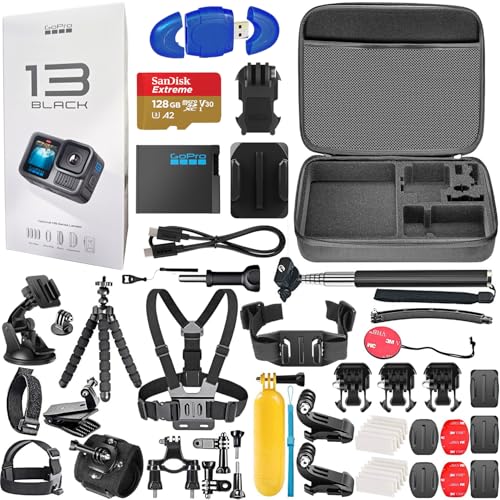
GoPro HERO13 Black — Best follow-cam and all-round ski camera
The HERO13 is the camera skiing films itself with, and the reasons are cumulative rather than singular. Its stabilisation turns a following rider’s descent into footage that looks gimbal-flown; its mounting ecosystem reaches helmets, chests, poles, skis and backpack straps; its lens mods stretch from ultra-wide follow views to a more cinematic crop. A group of friends with one HERO and a pole mount can produce, by lunch, the kind of follow footage that required a professional crew a decade ago.
- Rugged action camera, waterproof without a housing
- HyperSmooth stabilisation for descent footage
- Interchangeable lens mods including ultra-wide options
- Voice control for glove-and-pole operation
Winter manners seal the case. Voice control starts and stops recording without a glove coming off; the body shrugs off powder burials and piste-side drops; batteries, kept warm in an inside pocket and rotated, deliver a full day’s honest work. Its cold-weather discipline is a routine, not a hope — warm spares, short standby times, the camera living against the body between lines — and riders who learn the routine stop thinking about the camera entirely, which is when their filming gets good.
Its footage also edits like a citizen of the modern world: frame-flexible captures that crop vertical for the feeds without losing the rider, colour that grades convincingly beside mirrorless material, and a file ecosystem every ski editor alive already knows. As the one camera a skiing life buys first, nothing else on this list is close; as the camera a ski film’s B-unit rides with, it has no rival at all. Programme its voice commands with your group’s call words at home; the lift is no place to teach it your accent.
Strengths
- Stabilisation that makes follow-cams look professionally flown
- Mounts and lens mods for every angle the sport offers
- Voice control keeps gloves on and attention on the descent
Trade-offs
- Small sensor shows its limits in flat, low winter light
- Cold still taxes batteries — the warm-pocket routine is mandatory
- Fixed lens perspective needs mount craft to stay varied
Best for: follow-cams, ski groups, athletes filming training and holiday epics.
Not suited for: cinematic segments needing shallow depth of field and lens choice.

DJI Osmo Action 5 Pro — Best low-light and battery action camera
The Action 5 Pro is the connoisseur’s answer to the follow-cam default, built around the two conditions that defeat lesser action cameras: darkness and duration. Tree runs at last light, the dawn patrol before the lifts open, storm days when the light never arrives — its low-light footage holds together where rivals smear, and its battery endurance stretches across the long cold days when rotating spares is a faff nobody needs. Skiers who film in real weather, rather than brochure weather, have been migrating to it for exactly these reasons.
- Rugged action camera with strong stabilisation
- Larger sensor approach for better low-light footage
- Long battery life rated generously in the cold
- Front and rear screens for self-filming checks
Its dual screens serve the solo filmer, who is most ski filmers: a quick glance confirms the self-framed start-gate shot or the piece to camera at the summit cairn, and then the camera disappears back into the descent. The colour science flatters snow — a harder trick than it sounds, snow being a highlight that lesser pipelines render as grey porridge or blue plastic — and its stabilisation stands comparison with the class best through chatter and landing.
Choose it over the GoPro when your filming lives at the day’s edges and your mountain days run long; choose the GoPro for the mounting ecosystem’s sheer breadth. Either way, the Action 5 Pro has earned its place as the thinking rider’s primary — the camera for the filmer whose best lines happen in weather the resort’s own photographers have gone home to avoid. Its colour profiles reward a moment’s setup — snow filmed in its flatter profile grades like a camera twice its size.
Strengths
- Low-light footage that survives tree runs and storm days
- Battery endurance built for long, cold filming days
- Snow colour that stays white instead of drifting grey or blue
Trade-offs
- Mounting ecosystem is younger than GoPro’s
- Third-party accessory range still catching up
- Fewer lens-mod options for specialist angles
Best for: dawn patrols, storm-day filming and long backcountry-style days on resort.
Not suited for: riders wanting every exotic mount ever manufactured.

Insta360 X4 — Best 360 camera for ski now, frame later
The X4 changes the ski filmer’s job description: instead of directing on the descent, you direct in the evening. Its twin lenses capture everything around the rider — the line ahead, the friend behind, the cornice, the sky — and the film is composed later from that sphere, with pans, refranes and angle changes that no physical camera movement could have achieved at speed. For safety, for spontaneity and for solo filmers, this is not a novelty; it is a different and arguably saner philosophy of mountain filming.
- 360-degree action camera with high-resolution capture
- Reframing workflow that creates directed shots in post
- Invisible selfie-stick effect for drone-like follow views
- Strong stabilisation across the whole sphere
The invisible-stick follow shot is its signature: the camera on a pole, the pole erased, the rider apparently filmed by a drone that loves them. Group footage transforms too — one X4 in the middle of a descending pack captures every member’s best moment simultaneously, and the edit chooses heroes afterwards. Families and crews who could never coordinate a follow-cam roster discover they have been filming cinema all along; it was just waiting in the sphere for someone to direct it.
The costs are workflow-shaped: reframing is an editing discipline, files are hungry, and the flat-light days that defeat other cameras defeat its small lenses too. But as the second camera in a serious kit — or the only camera of a safety-first solo rider — the X4 earns its keep every single descent, because it never misses the moment that happened behind you, beside you, or in the two seconds you were busy not falling over. Reframe the day’s sphere footage the same evening; spheres age into hard drives’ forgotten continents if they wait.
Strengths
- Nothing is ever out of frame — the moment is always captured
- Invisible-stick shots imitate a drone at a fraction of the fuss
- Lets riders ride first and direct later, a genuine safety gain
Trade-offs
- Reframing workflow adds real editing time to every clip
- Large files and hungry storage on big mountain days
- Low-light performance trails the best single-lens action cams
Best for: solo riders, groups, and safety-first filmers who direct in post.
Not suited for: anyone wanting finished footage straight from the chairlift.

Insta360 Ace Pro 2 — Best image-first action camera
The Ace Pro 2 is the action camera for filmers who keep noticing action-camera footage. Its larger sensor and serious processing produce the cleanest, most gradeable pictures in the pocketable class — snow texture that stays texture, faces under helmets that stay faces, dusk descents that hold their colour. Mounted as a follow-cam it delivers the genre’s convenience; reviewed in the evening, its files are the ones that make editors ask what they were shot on.
- Action camera with a larger sensor than classic rivals
- Flip touchscreen for self-framing at the summit
- Strong stabilisation and low-light processing
- Rugged, waterproof construction for mountain abuse
The flip screen is its social weapon. Ski content runs on the summit piece-to-camera, the lift-ride commentary, the start-gate selfie — and the Ace Pro 2 frames all of them properly instead of hopefully. For the athlete-creator building an audience from a season pass, that screen converts the camera from a witness into a studio, one that happens to survive being dropped in a car park.
It sits between the philosophies on this list: more image-ambitious than the classic action cams, less post-demanding than the 360. Riders who film one descent at a time, care how it looks, and publish it that night will find it the most satisfying tool here — the action camera that stopped apologising for being one. Its flip screen should live closed on descents and open at summits — the hinge is a feature, not a sail.
Strengths
- Best-looking footage in the pocketable action class
- Flip screen transforms self-filming and vlogging on snow
- Low-light processing that flatters dawn and dusk sessions
Trade-offs
- Slightly larger than the slimmest action rivals
- Ecosystem of mounts still growing into its ambitions
- Premium pricing within the action category
Best for: athlete-creators and quality-first follow-cam filmers.
Not suited for: sphere-capture workflows or the tightest budgets.

Sony Alpha 7 IV — Best cinematic ski-film body
Above the follow-cam tier stands the segment: the ski film’s set piece, shot from a chosen position with the light arranged by patience. The Alpha 7 IV is that tier’s body. From a knoll beside the line, its autofocus tracks a descending skier through a telephoto’s narrow world; its full-frame files render spray, sastrugi and storm light with a richness action cameras gesture at; its log profiles grade into the cool, deliberate palette that defines the modern ski film. Resort campaigns and athlete segments are shot on bodies like this because nothing smaller survives the comparison on a big screen.
- Full-frame mirrorless body on the Sony E-mount system
- Real-time autofocus for tracking descending skiers
- Log profiles for the graded ski-film look
- Telephoto lens options for compressed mountain frames
The craft around it is heavier — tripod or monopod planted in snow, lenses changed with a photographer’s ceremony, a filmer who skis to positions rather than filming while skiing. That division of labour is the point: the action cameras ride, this body waits, and the edit braids their testimonies into the complete film. Productions that try to make one camera do both jobs usually end with neither done properly.
Its presence here also serves the hybrid shooter: the resort photographer filming campaign stills all morning who needs the afternoon’s video segments to match. One body, one lens system, both crafts at professional standard. For the ski-film maker whose work is commissioned rather than casual, the Alpha 7 IV is not the expensive option on this list; it is the entry fee to the tier where the work is paid. A rain cover and a monopod are its entire entourage; resist the urge to accessorise it into a second production.
Strengths
- Full-frame image that defines the cinematic ski segment
- Autofocus tracking that holds skiers at telephoto distances
- One system for campaign stills and film segments alike
Trade-offs
- Not a ride-with camera — it works from positions, with support
- Cold and knocks demand real protection and planning
- Cost of body and fast telephoto glass is professional-tier
Best for: segment makers, resort campaigns and hybrid photo-film professionals.
Not suited for: follow-cam riding or casual holiday filming.

OM SYSTEM Tough TG-7 — Best pocket camera for ski schools and families
Every ski area runs on footage no professional shot: the instructor filming a child’s first turns, the parent at the bottom of the nursery slope, the friend designated chronicler of the whiteout day. The TG-7 is that footage’s perfect instrument — a camera that can be dropped on ice, buried in a fall, frozen in an outside pocket and still be filming at pickup time, with a simplicity that cold, gloved, distracted operators can actually use.
- Rugged compact, waterproof, crush and freeze resistant
- Simple operation with gloves and cold hands
- Close-focus modes for snow crystals and details
- Compact enough for a jacket pocket all day
Its macro modes give ski filming an unexpected second genre: snow crystals on a glove, frost feathers on a lift cable, the structure of the medium itself. Films and lessons alike use those details as transitions and title backgrounds, and no other pick here can focus on a snowflake while standing in the snowfall that made it. Instructors building teaching libraries have quietly standardised on it for exactly this double life.
Judge it as the camera of record rather than of art and it is flawless at its post: present at every lesson, alive after every crash, simple enough to hand to any parent at the fence. The family’s archive of a skiing childhood will be shot on something like this or on a phone that died in February; the TG-7 is the choice that is still filming in March. Its close-focus party trick at the summit cairn — frost on the sign, crystals on a glove — gives films their title cards.
Strengths
- Survives the drops, burials and freezes of real ski days
- Simple enough for any designated filmer to operate
- Macro modes open the snow-crystal genre no rival here touches
Trade-offs
- Image quality is the most modest of the six picks
- Fixed lens limits cinematic and telephoto ambitions
- Small controls still prefer thinner gloves for fine work
Best for: ski schools, families, instructors and expedition pockets.
Not suited for: cinematic segments or professional follow-cam work.
How Do You Film a Follow-Cam Without Filming a Collision?
The follow-cam is a dance with one rule: the filmer rides their own line, offset from the subject’s, and never the other way round. Agree the line, the speed and the bail-out at the top; keep the subject at the frame’s edge of your vision rather than its centre, because your centre belongs to your own descent. The wide lenses of the action picks exist precisely to make that offset framing possible — the subject stays large in frame while the filmer stays safely wide of their tracks.
Speed matching is the craft inside the craft. Filmers learn to ride slightly above the subject’s pace and bleed speed with turns, rather than braking in a panic behind them, and to call off the shot — audibly, early — when terrain or traffic closes the plan. Every experienced follow-cam has a reel of abandoned takes and no reel of collisions, and the ratio is not luck. It is the discipline that keeps the genre’s insurance theoretical.
Afterwards, credit the format’s honesty: great follow footage is a riding achievement before it is a filming one. The cameras here minimise the filming half — one button, voice control, stabilisation that forgives — so the rider’s whole talent can go to the riding. Choose the body that asks least of you at speed, because at speed is exactly where you will be using it.
What Does Cold Actually Do to a Camera Day?
Cold taxes everything in sequence: batteries first, reporting a fraction of their charge and recovering some of it when warmed — hence the inside-pocket rotation that every pick’s section assumes. Screens grow sluggish, condensation waits inside the warm lodge for the cold camera that enters it, and snow finds every seam that summer called sealed. The winter filmer’s kit therefore includes habits as equipment: cameras acclimatised in bags before entering warmth, silica gel in the case, lens cloths in three pockets because the first two are already damp.
Plan the day in filming blocks rather than continuous readiness. The descent is the shoot; the lift is transport, charging and review. Riders who keep cameras warm and sleeping between lines end the day with batteries and footage; riders who leave everything running on a chest mount in the wind end it with neither and a story about a great morning. The mountain gives its light in chapters — the storm morning, the cleared afternoon — and the prepared filmer’s power budget is written in the same chapters.
And dress the camera as you dress yourself: layers of protection, nothing irreplaceable at the surface. The TG-7 wears the weather bare; the mirrorless body works from a proper pack and a weather cover; the action cams live in their mounts like tools on a belt. Every pick here can survive a ski season. The ones that survive five are the ones whose owners treated winter as a system, not a surprise.
How Should You Expose and Colour Snow Without Lying?
Snow is a highlight with ambitions, and auto-exposure reads it as a mistake to be corrected toward grey. The ski filmer’s first skill is exposure compensation as a reflex: open up so the snow renders white, protect the texture in the brightest banks, and let the sky go dramatic if it insists. The action picks’ exposure tools and the mirrorless bodies’ zebras and histograms exist for this single negotiation, conducted on every aspect change as the sun swings around the mountain.
Colour follows the light’s own plot. Morning blue shadow, noon neutrality, the alpenglow that turns a whole face into cinema for eleven minutes — the film should keep that plot rather than normalise it away. Set white balance deliberately per chapter of the day, or shoot the log and raw-flexible files the top picks offer and decide by the fire. What you must not do is let an auto system wander mid-descent, painting the same run in three colour temperatures across one continuous shot.
Finally, film the weather you have. Flat light is the ski filmer’s honest enemy and the storm day is its embassy: footage goes soft, contrast dies, and the correct response is to change genre — close follow-cams, tree runs where the forest provides the contrast, the TG-7’s snow-crystal macro in the calm of the fall. The mountain offers a film every day; it is rarely the film you planned, and the flexible kit — action, 360, pocket, cinema — is how you accept the substitution gracefully.
Where Should Cameras Live on a Skier’s Body?
Each mount is a grammar. The helmet speaks first-person: speed, gaze, consequence. The chest speaks effort — poles, arms, the working body — and stays steadier through turns. The pole mount speaks companionship, the follow and selfie angles that group films are built from. The ski and boot mounts speak texture and risk, and should be used like exclamation marks: rarely, and only where the sentence needs one.
Mount discipline is a safety system disguised as tidiness. Everything tethered, nothing dangling, breakaway where the manufacturer intends it, and a pre-descent pat-down as ritual as binding checks. A camera lost at speed is litter with a battery in it; a camera torn away in a fall should part cleanly rather than anchor a tumbling rider. The ecosystems around the GoPro and DJI picks have evolved these details across millions of descents, which is part of what their maturity is worth.
Choose the day’s grammar before the first lift. One mount, mastered, produces a film; five mounts, rotated anxiously, produce a catalogue. The mature ski filmer’s footage is recognisable by its restraint — the same faithful angle, deepening in skill across a season, until the angle itself becomes a signature the audience waits for.
How Do You Film in the Backcountry Without Filming Foolishly?
Beyond the ropes, the camera’s rank in the decision order falls to last, and this guide insists on the demotion. Avalanche assessment, group competence and the day’s snowpack decide where anyone goes; filming is what happens inside those decisions, never their author. The picks that serve here are the ones demanding least attention — the X4’s capture-everything passivity, the TG-7’s pocket indifference, voice-controlled starts that keep eyes on the slope — because attention spent on a screen is attention stolen from the terrain’s own testimony.
Weight and simplicity govern the kit: one action camera, warm batteries, a pole mount, and the discipline to leave the cinema body at home unless the day is a dedicated shoot with dedicated safety cover. Professional backcountry productions staff their filming like expeditions, with guides holding the safety veto over every frame. Amateur filmers should copy the veto structure even when they cannot copy the staffing: someone in the group owns the word ‘no’, and the camera obeys it instantly and without sulking.
The footage that results — smaller in quantity, enormous in value — carries the backcountry’s real signature: space, silence and consequence. Film it sparingly, come home with everyone, and let the rarity be the aesthetic. No frame in this guide’s entire subject area is worth a rescue call, and the best ski filmers alive are recognisable by how boring their safety stories are.
What Does the Edit Do With a Day of Ski Footage?
Ski footage arrives in abundance and leaves in seconds: a day’s riding distils to the two descents where light, line and rider agreed. Edit for sensation first — the carve’s rhythm, the spray’s punctuation, the lift’s anticipation — and let geography be implied rather than mapped. The 360 filmer directs here, choosing frames from the sphere; the follow-cam filmer selects; the segment maker assembles. All three are doing the same job: finding the descent the mountain meant to give them, inside the one they got.
Sound is the ski film’s secret weapon and its usual casualty. Wind murders microphones at speed, so the craft records it deliberately — sheltered mics for the carve’s hiss, the lift’s clank, the lodge’s roar — and lays music where the wind won. Even simple attention here separates films from footage: the audience may not notice good sound, but they feel its absence as cheapness they cannot name.
Deliver in the shapes the snow community actually watches: the vertical minute for the feeds, the three-minute season edit for the group chat’s hall of fame, the long cut for the one evening a year it will be projected. Shoot with those crops in mind — headroom in the follow frame, the sphere’s freedom, the segment’s patience — and a single winter becomes a small filmography, which is what a season of dawn alarms deserves.
How Do You Film Children Learning to Ski?
Filming a child’s skiing is a front-row job with a documentary’s heart. The camera belongs at the bottom of the learning slope and at the gentle follow distance behind the first linked turns — positions the TG-7 and a pole-mounted action camera were born for — and its operator’s first duty is to be an audience, not a crew. Children ski for the face at the bottom of the hill; the camera should live near that face, cheering first and filming second, because the footage of a child who felt watched-over is visibly different from the footage of one who felt observed.
Keep sessions short and victories long. Film the attempt, then put the camera away and ski the success together. The archive that matters is a decade’s worth of firsts — first lift, first parallel, first run from the top — and it is built by a camera that appears for the milestone and vanishes for the afternoon. Durability matters here in a specific way: the family camera will be dropped by mittened hands, sat on in gondolas and frozen in car boots, which is the TG-7’s entire design brief read aloud.
As the child becomes the teenager, hand the camera over. The pole-mounted action cam in a young skier’s own hands produces the group’s defining footage — their line, their friends, their mountain — and the parent’s role graduates to editor and archivist. Skiing families who make that handover keep filming for decades; the ones who guard the camera become a parent with old footage of a child who no longer skis with them. The equipment is cheap. The handover is the valuable part.
What Changes on a Helicopter or Cat-Skiing Day?
A guided powder day is the most expensive filming opportunity in the sport and the least forgiving of preparation failures. The kit shrinks to what a pack can carry beside avalanche gear — one action camera, the 360 if the group is filming each other, batteries counted like the precious objects they are — and every setting is decided in the lodge, because the mountain will offer neither time nor bare fingers for menus. Guides appreciate filmers whose cameras are invisible to the day’s safety rhythm; be that filmer, and the guides will start placing you where the light is.
Film the waiting as faithfully as the descents. The cat’s climb, the heli’s approach, the guide’s snow pit, the silence at the top before the first line of someone’s life — that is the film’s spine, and the descents are its punctuation. A camera that lives ready in a chest mount or a pocket, operable in one motion, captures the spine; a camera that needs assembly captures only the punctuation and wonders why the film feels thin.
And accept the day’s arithmetic: you will film a fraction of what you ski, because skiing it properly is the job. Come home with four great descents honestly filmed and the spine intact, rather than nine descents filmed distractedly by a rider who was composing instead of turning. The powder will not repeat itself for your second take. Neither, on the best days, would you want it to.
How Do Ski Films Use Weather as a Cast Member?
The great ski films are weather films with skiing in them. Storm cycles, clearing windows, the eleven minutes of alpenglow — productions plan around forecasts the way theatres plan around actors, and the camera kit is chosen to be ready inside the weather’s brief appearances. This is the Action 5 Pro’s low-light endurance and the Alpha 7 IV’s segment patience working the same problem from opposite ends: be ready when the mountain performs, because it does not encore.
Build the habit of the dawn check: forecast read, batteries charged, the day’s grammar chosen — follow-cam if the group rides, segments if the light promises, macro and detail if the storm wins. Filmers who decide at breakfast film all day; filmers who decide on the first lift film from the second. The mountain’s schedule is published every morning in the sky, and it does not wait for the undecided.
Finally, let bad weather make its own film rather than apologising for yours. The whiteout’s muffled world, the storm-day trees, the lodge window’s condensation framing the abandoned piste — ski life includes all of it, and audiences who ski recognise its truth instantly. A kit spanning the action cam’s indifference and the pocket camera’s survival exists so that no weather can declare your filming day void. Some of the most beloved ski footage ever shared was shot on days the brochures would have cancelled.
How Should a Ski Filmer Pack for a Week, Not a Day?
A ski week exposes every weakness a single day forgives. Charging becomes a rota, cards become a library, and the drying of gloves, cloths and camera gear becomes the chalet’s evening liturgy. Build the week’s system around a single charging hub and a labelled card wallet, offload every night without exception, and let one rest morning in seven belong to maintenance — mounts tightened, lenses cleaned, footage reviewed with the week’s remaining days in mind. The cameras here all tolerate the rhythm; the filmer’s job is to keep the rhythm from becoming the holiday’s second job.
Choose the week’s grammar as deliberately as the day’s. Perhaps the action cam rides daily, the 360 joins for the group’s big tour, and the cinema body — if it travelled at all — works one golden morning from one perfect corner. A week filmed that way returns a film with movements, like music; a week filmed with everything everywhere returns a hard drive. The mountain will not organise your footage for you, but a plan whispered to it at the start of the week comes surprisingly close.
How Do the Six Compare on Snow?
Divide them by where they work. Riding with the subject: HERO13, Action 5 Pro, X4 and Ace Pro 2. Waiting at the corner: the Alpha 7 IV. Living in a pocket and surviving everything: the TG-7. A complete ski-film kit is usually one rider and one waiter; a complete skiing life usually starts with one rider and adds the others as the films demand.
| Pick | Badge | Where it earns its place |
|---|---|---|
| GoPro HERO13 Black | Best follow-cam and all-round ski camera | The default ski camera: every mount, every angle, stabilisation that defines the genre. |
| DJI Osmo Action 5 Pro | Best low-light and battery action camera | The endurance action cam: low-light grace and battery life for full mountain days. |
| Insta360 X4 | Best 360 camera for ski now, frame later | The safety-first storyteller: ride first, direct later, never miss the moment. |
| Insta360 Ace Pro 2 | Best image-first action camera | The image-quality rider: bigger-sensor footage and a flip screen for self-filming. |
| Sony Alpha 7 IV | Best cinematic ski-film body | The cinema tier: full-frame segments, telephoto compression, campaign polish. |
| OM SYSTEM Tough TG-7 | Best pocket camera for ski schools and families | The indestructible pocket witness: ski school, families and whiteout days. |
What Mistakes Ruin Ski Footage?
Filming with bare fingers at altitude. Beyond the footage lost to shaking, fumbling hands, it is how cameras get dropped and skin gets hurt. Set the camera before the gloves-off moment ends: voice control on, mount checked, one button between you and recording. If a camera needs your bare hands to start a clip, it is not a ski camera, whatever its other virtues.
Leaving batteries to die in the cold between runs. The warm-pocket rotation is not a tip; it is the difference between a day filmed and a morning filmed. Carry the spares against your body, swap at the lift, and let the spent ones recover their warmth — and some of their charge — while the fresh ones work.
Chasing the subject’s line exactly. The follow-cam that rides the filmed skier’s tracks inherits their braking, their blind spots and their falls. Offset, anticipate, ride your own descent — the footage improves and so does everyone’s afternoon. The wide lenses exist to forgive the offset; use the forgiveness.
Bringing the cinema body on a casual day. The Alpha 7 IV earns its place on planned segments; on a friends’ cruise it is weight, worry and a lens fogged from lodge transitions. Match the kit to the day’s actual film, and both kinds of day get better.
A fifth mistake is reviewing footage on the lift with gloves off and standards low. The screen lies in bright alpine light, the wind steals the moment, and the descent that follows the review is skied by a distracted rider. Trust the routines, check framing at stops, and save judgement for the evening — the mountain shows your footage honestly by firelight, and it shows your descents honestly immediately. Only one of those screenings can hurt you.
Final Recommendation
For most skiing lives, start with the rider: the GoPro HERO13 Black for the ecosystem and the follow-cam standard, the DJI Osmo Action 5 Pro for darkness and duration, the Insta360 X4 for capture-everything safety, the Ace Pro 2 for image quality in the same pocketable class. Add the Sony Alpha 7 IV when segments and commissions enter the picture, and keep the TG-7 wherever ski school, family or weather writes the day’s script. Together they cover every honest way skiing gets filmed, from the nursery slope to the heli pad.
Then learn the winter routines — warm batteries, glove discipline, plans agreed at the top — and the mountain will start handing you footage that looks like the brochures. It was never hiding it. It was waiting for a filmer whose camera could keep up with their riding, instead of the other way round. Go and be awake for it, gloves on.
One last encouragement for the holiday filmer reading this with more enthusiasm than experience: the best ski footage of your life is probably one warm battery and one agreed plan away. The mountain supplies the cinema. Your camera’s job is merely to be awake for it — and every pick above, in its own way, is very good at staying awake.
Frequently Asked Questions
Which is better for skiing, GoPro or 360?
They answer different questions. The GoPro films the shot you intend, finished in camera, with the deepest mounting ecosystem. The 360 films everything and lets you intend it later, at the cost of reframing work. Many riders carry the GoPro as the primary and the X4 as the insurance — and argue happily about it on every lift. Serious kits carry both and let the day’s light referee between them.
How do I stop my action camera dying in the cold?
Keep the camera and its spare batteries against your body, swap at lifts, minimise standby in the wind, and start recordings decisively rather than leaving the camera awake. Cold saps charge rather than destroying it — a ‘dead’ battery often revives in a warm pocket, which is a rescue, not a strategy. Rotate ruthlessly and log the rotation on the lift — memory is the first casualty of altitude.
Can I film skiing with a mirrorless camera while skiing?
Technically yes, sensibly rarely. The craft standard is division of labour: action cameras ride, mirrorless bodies wait at positions with support. Filming handheld from a descent on a full-frame body risks the camera, the shot and the skier in one gesture. If you must move with it, use a lift-served piste, a slow pace and a strap you trust with the camera’s price. If a position needs you to ski with it, the action camera on a pole is the honest compromise the professionals actually use.
What mount should a beginner buy first?
A pole mount. It gives the follow angle, the selfie angle and the group angle from one accessory, it keeps the camera off your head while you learn, and it stows in a pole’s natural carry. Add the chest mount second for the effort-and-arms grammar, and let exotic mounts wait until your films ask for them by name. Master the pole mount’s angles in the garden before the season; the mountain is a poor classroom for new grammar.
How do I keep snow off the lens?
A hydrophobic lens protector, a cloth in a dry pocket, and the discipline of checking the lens at every stop — a single frozen droplet owns the centre of every frame until it is cleared. Face the camera backward on lifts in storms, and never wipe snow with a glove’s icy palm; melt and cloth, in that order. Carry two cloths in separate pockets — the second is the one that saves the sunset run.
Is the TG-7 really enough for a family ski holiday?
For the holiday’s true purposes — the children’s progress, the group’s laughter, the whiteout day survived — yes, entirely, and it will still be working on the last day when finer cameras have been left in the chalet for safety. Add one action camera when the teenagers start filming each other, and the family’s ski filmography is complete. Its freeze resistance is the quiet headline: it works on the morning the car thermometer stops trying.
Related Guides
Keep exploring with our action cameras for surfing guide and the cameras for filming concerts roundup and our film makers camera guide — each guide applies the same verified-pool, no-invented-specs approach to a neighbouring question.


