ilcastellomenu.com is reader-supported. When you buy through links on our site, we may earn an affiliate commission.
Where to Buy
Night does not wait for a tripod. The best cameras for taking night shots, as this guide defines them, are the ones that work in your hands at the hour when the city changes its mind: neon waking up in wet pavement, a birthday dinner sinking into candlelight, friends laughing outside a bar under a sign that paints them amber. Our companion coverage of night photography leans toward the deliberate, tripod-and-long-exposure school; this page is about the other night — handheld, unplanned, walking-around night, where the shutter must be fast, the stabilisation must be honest, and the sensor must stay composed when sensitivity climbs.
Handheld night photography is a negotiation among three scarcities. Light is scarce, so lenses must open wide and sensors must gather greedily. Time is scarce, because a shutter left open too long records your pulse instead of the scene. And cleanliness is scarce, since high sensitivity always sends an invoice in grain — the question is whether your camera pays it as fine, film-like texture or as smeared, watercolour mush that eats faces. The six cameras below were ranked on how gracefully they settle that negotiation in real streets, not in laboratories.
Three are full-frame mirrorless bodies, the natural aristocracy of the dark. One is a high-resolution APS-C camera whose stabilisation and pixel density give it a different, cleverer route through the night. One is a premium compact that proves a pocket camera can still come home with the evening. And one is an action camera whose low-light video and stills have quietly become the night-shift worker of the group. Each is linked on Amazon in the Quick Picks table and beside its detailed review.
Before you choose, read the sections on stabilisation and on noise character. At night, those two qualities — how slow a shutter you can trust, and how the grain looks when it arrives — will decide your keeper rate far more than resolution figures or the badge on the prism housing.
Key Takeaways
- Canon’s EOS R6 Mark II pairs superb in-body stabilisation with clean high-sensitivity files — the handheld night photographer’s default.
- Sony’s Alpha 7 IV brings a larger resolution cushion for cropping dark scenes and autofocus that finds eyes in near-darkness.
- Panasonic’s LUMIX S5II is the low-light bargain of the full-frame class, with stabilisation that invites daring shutter speeds.
- Fujifilm’s X-T5 answers with resolution, film-like grain and dials you can work with gloves on a cold street.
- Sony’s RX100 VII keeps a bright zoom and a one-inch sensor in a coat pocket for unplanned evenings.
- DJI’s Osmo Action 5 Pro covers the moving night — walks, rides and vlogs — where stills cameras stay home.
In this guide
Quick Picks
| Camera | Badge | Why it earns its place |
|---|---|---|
| Canon EOS R6 Mark II | Best handheld at night | Stabilisation and clean files that forgive slow shutters and dark streets. |
| Sony Alpha 7 IV | Best all-round night body | Resolution to crop, autofocus that hunts successfully after dark. |
| Panasonic LUMIX S5II | Best value full-frame | Night manners and stabilisation above its price station. |
| Fujifilm X-T5 | Best dials and grain | Tactile night controls and noise that looks like film, not failure. |
| Sony RX100 VII | Best pocket night camera | A bright zoom for evenings you did not plan to photograph. |
| DJI Osmo Action 5 Pro | Best moving night | Low-light footage and stills from a camera that shrugs at rain. |
How Did We Judge Cameras for Handheld Night Work?
Every candidate was assessed as a handheld instrument first. We weighted in-body stabilisation heavily — not the headline stop count measured on a bench, but the practical question of how slow a shutter an ordinary person, cold and tired at midnight, can use before faces soften. A camera that reliably delivers sharp frames at a quarter of a second doubles the light a lens can gather; one that demands a sixtieth throws that light away and bills the sensor instead.
Noise character came second, judged as photographers actually meet it: in faces at the sensitivities real evenings require. Some sensors smear detail into plastic when sensitivity rises; others keep edges and let grain sit over the image like weather. We favoured the second behaviour, and we favoured cameras whose automatic white balance stays sane under the mixed tyranny of sodium lamps, LED signs and shop windows, because correcting a green-orange street scene afterwards is nobody’s idea of a good night.
Autofocus after dark formed the third test. Night subjects move — friends gesture, traffic passes, the cat declines to cooperate — and a camera that hunts in low light converts the evening into a slideshow of almosts. Eye detection that still functions in dim restaurants, and focus that locks without a searchlight of assistance, separated the top three from the rest of the field. Resolution mattered mainly as cropping freedom: the right to tighten a loose night composition later without the file falling apart.
Why Is Handheld Night Photography a Different Craft From Tripod Work?
The tripod photographer commands time. Exposures stretch into seconds, sensitivity stays low and pure, and the night is rendered as a serene accumulation — water like glass, traffic like ribbons. The handheld photographer surrenders that command and gains the street instead: gestures, glances, the decisive half-second that no long exposure can hold because long exposures average such moments away. These are different arts sharing one sunless setting, and they reward different cameras.
Practically, the handheld craft lives between roughly a fifteenth of a second and a five-hundredth, at sensitivities the tripod school considers scandalous, through lenses chosen for aperture rather than reach. Its failures are motion and noise; its triumphs are presence. You are inside the scene rather than surveying it, and the photograph carries your own stance — braced against a doorway, breath held, elbows tucked — in its sharpness. Choose a camera for this page’s craft and you are choosing how much of that stance it will forgive.
The good news is that modern stabilisation and sensors have moved the boundary astonishingly far in a decade. Streets that once demanded a tripod and a prayer now surrender to a steady hand and the right body, and the six cameras below mark the current frontier of that change, at prices from pocket money to professional.
What Are the Best Cameras for Taking Night Shots Handheld?
Three full-frame bodies that treat darkness as home territory, a high-resolution APS-C alternative, and two small cameras for the nights you never scheduled.

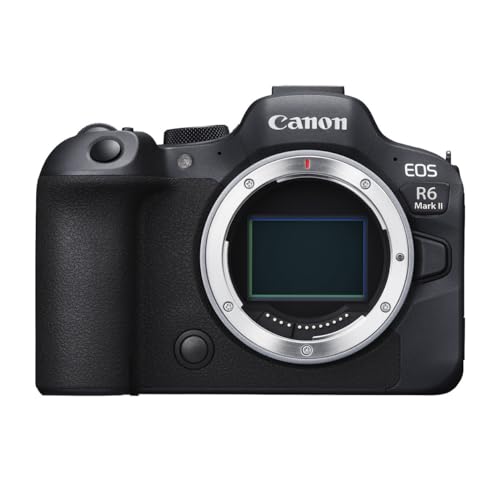
Canon EOS R6 Mark II — Best handheld at night
Start with the camera that makes the handheld night feel almost unfair. The R6 Mark II’s in-body stabilisation, working with stabilised RF lenses, holds frames sharp at shutter speeds that would have been a dare a generation ago, and that single talent rewrites the night photographer’s arithmetic: slower shutter, lower sensitivity, cleaner file. Street scenes settle. Interiors glow without flash. The camera seems to absorb the tremor of cold hands and late hours as a designed-in courtesy.
Its sensor’s behaviour at high sensitivity suits this guide’s angle precisely. Grain arrives fine and even, detail in hair and fabric survives, and Canon’s colour keeps skin recognisably human under the mixed lighting of restaurants and bars — the exact conditions where night portraits live. Autofocus continues to find eyes in light so dim the photographer is working partly by memory, which converts the most failure-prone part of night portraiture into the most reliable.
Nothing here is free, and the honest costs are a resolution figure that trails the Sony below for aggressive cropping, and an RF lens shelf whose fastest primes command serious money. But for the assignment named in this article — night shots, handheld, in the real world’s light — the R6 Mark II is the body we would hand to a friend crossing a strange city after dark, with the fewest instructions and the most confidence.
- Format: full-frame mirrorless, RF mount
- Stabilisation: in-body, coordinated with RF lenses
- Night strength: clean files at high sensitivity
- Autofocus: eye detection that persists in dim light
- Colour: skin tones that survive mixed lighting
Strengths
- Slow shutters stay sharp in ordinary hands
- Grain with manners, detail without smearing
- Faces stay believable under bar and street light
Trade-offs
- Less cropping headroom than the Sony
- Fast RF primes are a real investment
- Video heat limits on the longest clips
A rainy Thursday in a port city makes the case: reflections doubling every sign, a friend laughing under an awning, shutter slow enough to let the street smear slightly behind a face held perfectly still by the stabilisation. That photograph — motion around stillness — is this camera’s signature, and it is available to any steady pair of hands.
Best for: street photographers, night portraits and travellers who refuse tripods. Not suited for: heavy croppers or landscape perfectionists counting pixels

Sony Alpha 7 IV — Best all-round night body
Where the Canon specialises in forgiveness, the Alpha 7 IV specialises in options. Its higher resolution means a night photograph can be composed loosely in the moment — because the decisive second rarely waits for perfect framing — and tightened later with detail to spare. Its autofocus system, trained on eyes, faces, animals and more, hunts in dim conditions with a persistence that feels less like a feature and more like a colleague who refuses to go home.
At high sensitivities the Sony’s files hold a slightly different bargain from the Canon’s: a touch more visible grain in exchange for a touch more retained texture, a trade many night photographers actively prefer, since grain can be styled while smear cannot be undone. Sony’s vast E-mount shelf then becomes the night worker’s true advantage — fast primes at every price, from humble bargains to legendary glass, all gathering light for the same sensor.
Through this article’s handheld lens, its weakness is stabilisation a half-step behind the Canon and Panasonic below, asking a slightly faster shutter and therefore a slightly higher sensitivity on the darkest streets. In exchange it offers the most complete night system here: the body, the lenses, the resolution and the autofocus forming an ecosystem a photographer can inhabit for a decade of evenings.
- Format: full-frame mirrorless, E mount
- Resolution: generous headroom for night cropping
- Autofocus: broad subject recognition in low light
- Lenses: the deepest fast-prime shelf available
- Files: texture retained as sensitivity climbs
Strengths
- Crop dark scenes without the file collapsing
- A fast lens exists for every night budget
- Autofocus that treats darkness as a rumour
Trade-offs
- Stabilisation slightly behind the class leaders
- Menus reward study more than rivals do
- Grain more visible at the highest settings
Its emblematic frame is the festival crowd at midnight: one wide, hurried photograph of lanterns and faces, from which three separate publishable portraits are later carved. The R6 might make the single frame cleaner; the Sony makes the evening yield more pictures.
Best for: night photographers who crop, and anyone building a long-term lens system. Not suited for: shooters wanting the slowest possible handheld shutters

Panasonic LUMIX S5II — Best value full-frame
The S5II is the camera that makes full-frame night photography feel mispriced, in your favour. Panasonic’s stabilisation is the equal of anything in this guide — long, slow, handheld exposures of lit streets come back unnervingly sharp — and the sensor’s low-light behaviour is calm and clean, with shadow detail that survives the lifting every night photograph eventually requests. For the handheld brief, it stands shoulder to shoulder with bodies costing considerably more.
Its character differs from the two above in ways night workers notice. The body feels engineered rather than styled, the video tools are the strongest here for those who film the night as well as photograph it, and the L-mount lens alliance means Sigma and Leica glass share the shelf with Panasonic’s own — including fast primes that keep the total bill sane. Phase-detect autofocus, the addition that defines this generation of the camera, removed the old hesitation in dim focusing that once kept Panasonic off lists like this.
Remaining compromises are ecosystem matters: the lens catalogue, while growing and shared across an alliance, is thinner at the exotic end, and resale shelves are quieter than Canon’s or Sony’s. As a night instrument judged purely on the photographs it hands back per unit of money, though, the S5II may be the smartest purchase on this page.
- Format: full-frame mirrorless, L mount
- Stabilisation: among the best in this guide
- Sensor: clean shadows for lifted night files
- Autofocus: phase detection for dim subjects
- Video: the strongest night filming tools here
Strengths
- Full-frame night quality at a friendlier price
- Handheld exposures that feel tripod-adjacent
- Shared lens alliance keeps glass costs sane
Trade-offs
- Lens shelf smaller than Sony’s or Canon’s
- Subject-detection menu less extensive
- Bulkier feel than its APS-C rivals here
Picture the night market assignment: steam, bulbs, crowds, no permission to loiter with a tripod. The Panasonic walks it at slow shutters and moderate sensitivities and returns files that look catered rather than scavenged — the working definition of value in this craft.
Best for: budget-conscious night shooters and hybrid photo-video workers. Not suited for: photographers committed to Canon or Sony glass already

Fujifilm X-T5 — Best dials and grain
The X-T5 approaches the night from the photographer’s hands rather than the laboratory. Its top plate carries physical dials for shutter speed and sensitivity, workable by touch, with gloves, without waking a screen to glow in a dark street — a small mercy that compounds across an entire evening. Its in-body stabilisation is strong, and its high-resolution APS-C sensor resolves lit detail, signage and architecture with a crispness that makes city nights look engraved.
Its noise deserves the paragraph this guide keeps returning to. Fujifilm’s colour science renders high-sensitivity grain with a randomness that reads as film texture rather than digital distress, and its film simulations — including monochrome renderings with real gravitas — let a night photographer finish photographs in-camera with a look rather than a repair job. Black-and-white street work after midnight, shot on this body, has a house style waiting for it.
The APS-C sensor concedes ultimate low-light cleanliness to the full-frame trio above; physics keeps that ledger. What the X-T5 returns in exchange is size, discretion and those dials, plus resolution that embarrasses larger sensors in good light. For the night photographer whose subjects are streets and cities rather than unlit countryside, it is not a compromise pick at all — it is a preference, argued in silver and black.
- Format: APS-C mirrorless, X mount
- Controls: physical dials for shutter and sensitivity
- Resolution: the highest in this guide
- Grain: film-like rendering at high sensitivity
- Stabilisation: in-body, effective for street work
Strengths
- Adjust exposure blindfolded, gloved, mid-street
- Monochrome night photographs with real mood
- Compact system that travels without complaint
Trade-offs
- Full-frame rivals stay cleaner in true darkness
- Autofocus tracking a step behind Sony’s
- High resolution exposes unsteady technique
Its home ground is the old town at closing time: cobbles shining, one bar still lit, the photographer working dials by fingertip memory while the last conversations spill into the lane. The photographs look like stills from a film the town never made.
Best for: street photographers, monochrome lovers and tactile-control devotees. Not suited for: the darkest rural work or pixel-level shadow lifting

Sony RX100 VII — Best pocket night camera
Some evenings are not photographic expeditions; they are dinners, walks and gigs that turn photogenic without asking permission. The RX100 VII exists for those evenings. Its one-inch sensor and bright zoom lens fit in a jacket pocket, yet after dark it produces photographs that embarrass phones and shame bulkier compacts: faces under restaurant light stay detailed, street scenes keep their colour, and the zoom reaches across a venue to the stage without a crop’s apology.
Sony poured its autofocus inheritance into this small body, and eye detection in a pocket camera changes what casual night photography can promise — the friend across the table, caught mid-story, is actually in focus. Stabilisation in the lens helps the handheld cause at the zoom’s longer end, where night concerts live. It is, in the strict terms of this guide, the weakest sensor here; in the practical terms of photographs actually taken on unplanned nights, it routinely beats the full-frame camera that stayed at home.
Battery life and tiny controls set its limits, and its price buys real mirrorless bodies on promotion — the eternal compact dilemma. Buy it as the camera of presence, the one whose size guarantees attendance, and its night files will justify the logic across a year of evenings you never intended to photograph.
- Format: premium compact, one-inch sensor
- Lens: versatile zoom with bright wide end
- Autofocus: eye detection in a pocket body
- Carry: genuinely pocketable, always present
- Stabilisation: optical, tuned for handheld video and stills
Strengths
- Attends evenings bigger cameras miss entirely
- Stage and table photographs from one pocket
- Autofocus far beyond compact-class expectations
Trade-offs
- Small sensor trails the mirrorless picks in darkness
- Battery life asks for a spare on long nights
- Controls are miniature by physical necessity
The jazz club tells its story: no camera bag checked, no fuss at the door, just a pocket camera producing the saxophonist’s portrait in blue light while phone screens around it render the same moment as fog. Presence is a specification; this is its proof.
Best for: diners, gig-goers and travellers who pack light. Not suited for: dedicated night expeditions or interchangeable-lens ambitions

DJI Osmo Action 5 Pro — Best moving night
The final pick breaks the pattern deliberately, because a share of night photography now happens in motion: the cycle ride home through lit streets, the night market walk filmed and photographed as one continuous prowl, the rainy run, the boat deck after sunset. The Osmo Action 5 Pro’s larger sensor class gives it low-light manners unusual among action cameras, and its stabilisation — electronic, tireless, indifferent to footsteps — holds the moving night together in a way no handheld stills camera attempts.
As a stills camera it is a blunt instrument: fixed ultra-wide lens, modest resolution for photographs, composition by screen rather than finder. Judged as this guide judges — by the night images it actually returns — its bargain is different. It returns the journey itself, weatherproof and unbothered, with stills pulled from the flow whenever a frame deserves independence. For vloggers and movers, that is not a compromise; it is the assignment.
Its presence also disciplines the rest of the list. If your nights are static — portraits, streets, interiors — every camera above serves you better. If your nights move, this small brick of a camera is the only pick that moves with you through rain and spray and keeps the neon honest while it does.
- Format: action camera, larger sensor class
- Low light: cleanest evening footage in its class
- Stabilisation: electronic, built for motion
- Build: waterproof and weatherproof unaided
- Stills: serviceable frames from a moving night
Strengths
- The night in motion, stabilised and lit honestly
- Rain and spray are working conditions, not risks
- Front and rear screens for framing on the move
Trade-offs
- Stills resolution modest beside every rival here
- Fixed ultra-wide view only
- No viewfinder or manual stills depth
Its defining document is the ride home: twenty minutes of wet streets and lit bridges, filmed without a thought for the camera’s survival, from which the evening’s best single frame is later lifted like a coin from a fountain.
Best for: movers, vloggers, riders and wet-weather nights. Not suited for: stills purists or portrait photographers
How Do the Six Night Cameras Compare After Dark?
| Camera | Format | Night advantage | Best use |
|---|---|---|---|
| Canon EOS R6 Mark II | Full-frame | Stabilisation plus clean files | Handheld streets and portraits |
| Sony Alpha 7 IV | Full-frame | Resolution and lens choice | Cropping and system building |
| Panasonic LUMIX S5II | Full-frame | Stabilisation per unit of cost | Value night work, photo and video |
| Fujifilm X-T5 | APS-C | Dials, grain and resolution | Street and monochrome nights |
| Sony RX100 VII | Compact | Presence in a pocket | Unplanned evenings and venues |
| DJI Osmo Action 5 Pro | Action camera | Stabilised moving night | Rides, walks and wet weather |
The table’s hidden column is intention. Decide whether your night is walked, watched, attended or ridden, and the right row selects itself; photographers who buy for a night they do not actually live end up praising cameras they never carry.
How Slow a Shutter Speed Can You Honestly Use Handheld?
The honest answer is personal, and discovering yours takes one evening of deliberate testing. Photograph a lit shopfront at successively slower speeds — a sixtieth, a thirtieth, a fifteenth, an eighth, a quarter — and inspect the results at full size. Somewhere in that descent sits your floor: the speed where your hands, your stance and your camera’s stabilisation stop agreeing. Most photographers with the stabilised bodies above find their floor far lower than old rules promised, especially with wide lenses, braced elbows and the trick of exhaling as the shutter fires.
Subject motion sets a second, independent floor. A sharp building behind a blurred pedestrian is art; a blurred bride is a complaint. For people who are posing, a thirtieth often survives; for people who are living — talking, laughing, walking — a hundred-and-twenty-fifth is the realistic border, and sensitivity must pay whatever that speed costs. Night craft is largely the wisdom of knowing which floor governs each frame, and the cameras above were ranked partly on how gracefully they pay when the faster floor wins.
What Mistakes Ruin Handheld Night Photographs?
Flash is the first and most tragic: the built-in blast that flattens a candlelit room into a police photograph, killing the very light that made the scene worth capturing. Every camera here was chosen partly for making flash unnecessary; honour the design and leave it off. Second is trusting the screen’s brightness — a night photograph reviewed on a glowing display looks correctly exposed while actually sinking, so judge by the histogram or by a deliberately dimmed screen, and bracket the frames that matter.
Chimping through a whole evening is the third error, the social one: the photographer who reviews every shot misses the next three. And the fourth is standing in the light rather than beside it. Night scenes photograph best from the shadow’s edge, where contrast organises itself and the camera’s meter is not bullied by the nearest lamp. Step into the doorway, not under the streetlight, and half the exposure battles in this craft simply never happen.
How Do You Keep Skin Looking Human Under Street Lighting?
Mixed light is the night portraitist’s true opponent: sodium orange from the left, shop-window daylight from the right, a greenish tube above. No white balance can satisfy three colours at once, so choose which light owns the face and let the others become atmosphere. Position your subject so the kindest source — usually the broadest and softest — does the portrait work, then set white balance for that source and allow the background to drift into whatever colours the street insists on. The result looks like night actually feels.
In the file, restraint is the skill. Lifting shadows on night portraits invites noise and strange colour to the party; a slightly darker, moodier portrait with honest skin will always beat a brightened one with mottled cheeks. The Canon and Fujifilm picks above flatter skin most forgivingly straight from the camera, while the Sony and Panasonic reward a gentler hand in editing. Either way, photograph the person in the light that loves them, and let the street keep its theatrical colours behind.
Why Does the Lens Matter as Much as the Sensor After Dark?
Because aperture is light admitted, and no sensor can photograph photons the lens refused. A kit zoom that narrows to a dim maximum at its long end forces sensitivity upward exactly when the photographer zooms toward a face; a fast prime gathering several times more light lets the same camera work at civilised sensitivities with shutter speeds to spare. This is why experienced night photographers speak of their fastest lens the way sailors speak of a harbour: it is where the camera goes when conditions turn.
The practical path for buyers of the interchangeable-lens picks above is well worn: live with the kit lens until its darkness frustrates you twice, then buy the fast, affordable prime in your system’s classic focal lengths. That single purchase transforms night work more than any body upgrade in this guide, and it explains why lens shelves — Sony’s depth, Canon’s quality, the L-mount alliance’s value — were weighed so heavily in the rankings.
How Should You Photograph City Lights Without Blowing Them Out?
Cities at night are exposure traps because the frame’s most important elements — signs, windows, headlights — are also its brightest, and a meter averaging the whole scene will sacrifice them to rescue shadows nobody needed. Expose for the lights: let the camera’s highlight-weighted metering work if it offers one, or dial exposure down deliberately and check the result. A night photograph with deep, honest shadows and intact neon looks rich; one with grey shadows and white holes where the signs were looks broken.
Reflections are the city night’s free gift, doubling every light source in wet stone, windows and puddles. Lower the camera toward the reflection and the composition often builds itself, symmetry doing the work that effort cannot. The stabilised bodies above permit the slow shutters these scenes love, and their files hold the colour saturation that makes a lit street look like the memory of it rather than a diagram.
How Do You Photograph People Moving Through the Night?
Movement at night divides into two photographs wearing one coat: the subject frozen out of the flow, or the subject smeared deliberately while the world holds still. For the frozen version, the recipe is unsentimental — the fastest shutter the light allows, sensitivity pushed until the speed is honest, and timing borrowed from sport: watch the gesture repeat, anticipate the peak, and fire as it crests rather than after it charms you. The autofocus systems in the Sony and Canon picks above were ranked with exactly this photograph in mind, because a dancer, a skater or a laughing friend crossing lamplight gives the camera one chance per pass.
The smeared version is the night photographer’s sleight of hand: pan with the subject at a slow shutter so the person stays recognisable while the street stretches into ribbons behind them. Stabilisation modes that distinguish panning from shake — offered across the mirrorless picks — make the trick repeatable rather than lucky. Practise on buses and cyclists, whose motion is metronomic, before attempting it on anything you would grieve losing.
Either way, dress the attempt in patience. Night movement yields a lower keeper rate than any other subject in this guide, and professionals quietly budget for it: dozens of frames for the one that will be printed. The cameras above differ in how gracefully they absorb that budget — buffer depth, autofocus stubbornness, file forgiveness — but all of them reward the photographer who treats the first twenty frames as rehearsals rather than failures.
What Should You Do About Noise When You Get Home?
Begin by forgiving some of it. Grain is the night photograph’s native texture, and files scrubbed to porcelain smoothness announce their artificiality louder than any noise would. The modern craft is selective: reduce the colour noise that mottles shadows, soften luminance grain on skin while protecting eyes and hair, and let the street’s texture keep its weather. Every pick in this guide produces files that respond well to that restraint, because their noise is fine-grained rather than blotchy.
Shooting decisions made hours earlier decide how much mercy the file needs. Exposing slightly brighter than instinct suggests — without clipping the lights that matter — gives shadows cleaner information to work with, a paradox beginners resist until their first comparison proves it: the brightened-in-camera file is calmer than the rescued dark one. Similarly, a photograph focused correctly at high sensitivity edits beautifully, while a soft one merely becomes smooth, which is why this guide weighted autofocus in darkness alongside noise itself.
For photographs destined to be shared at screen size — which is most night photographs — much of this anxiety evaporates at the export stage, where downscaling averages grain into discretion. Save your heaviest editing for the frames you will print, and let the rest carry the night honestly. A little grain is not the tax on night photography; it is the receipt proving you were actually there.
How Do You Work a Single Street Until It Gives You a Photograph?
Choose a pool of good light and fish in it. The working night photographers’ open secret is that they do not wander hoping; they find one lit stage — a café window, a bus stop under a sign, the mouth of an alley where a lamp does Rembrandt’s work — and they wait, camera set, while the city casts its actors through the light. Exposure, focus distance and framing are settled in advance, so when the right figure crosses, the photograph is a reflex rather than a negotiation.
This method flatters the cameras above in different ways. The Fujifilm’s dials let settings be pre-arranged by touch and left alone; the Canon’s stabilisation forgives the long, cold wait’s effect on hands; the little Sony disappears against a wall. What matters more than the body is the discipline of staying: most beginners leave a good stage four minutes before the photograph walks into it, because waiting feels like doing nothing. It is the opposite. It is the photograph being made slowly.
Work the stage’s edges before you leave it. Shoot the reflection across the street, the view from inside the café outward, the detail of the sign itself. A location mined thoroughly teaches composition faster than a dozen locations visited once, and the night — generous to the patient — usually pays the stayer in a currency of strangers, weather and light that no itinerary can schedule.
Why Do Night Photographs from Phones Look Flat Beside These?
The phone’s night modes are marvels of computation performing a specific trick: many frames merged into one bright, even, shadowless result. The trick’s cost is the night itself. Shadows are where night keeps its drama, and a photograph that abolishes them produces a scene lit like an office at noon wearing a dark filter. Faces flatten, neon loses its halo, and the atmosphere — the entire reason for being out with a camera — is processed away in the name of brightness.
The cameras in this guide take the opposite bargain: one exposure, honestly gathered, with darkness left where the eye found it. Their larger sensors collect the light directly rather than inferring it, so highlights keep their glow, blacks stay velvet instead of grey, and a face lit by a single window looks sculpted rather than scanned. That is why a modest night photograph from the RX100 VII — the smallest sensor here — still feels more nocturnal than a phone’s brightest night-mode triumph.
None of this denies the phone its role as the camera of last resort. But the reader who searched for cameras for night shots has usually already met the phone’s ceiling at exactly the moments that matter: the proposal in a dim restaurant, the band in a basement, the city in the rain. These six cameras are what is on the other side of that ceiling.
How Should You Dress, Carry and Behave for a Night Shoot?
The unglamorous logistics decide whether the photographs happen. Dress warmer than the evening suggests, because standing still at midnight is colder than walking at dusk, and cold hands are the true ceiling on handheld shutter speeds. Carry the camera on a strap that keeps it at your ribs rather than swinging at your stomach, keep the spare battery in an inside pocket where body heat preserves it, and let a small cloth live in the same pocket for the condensation that blooms when you step from cold streets into warm bars.
Behaviour is equipment too. Night photography asks strangers for their unguarded faces, and the photographer’s manner is the permit: camera visible rather than hidden, a smile and a gesture ready, an offered look at the photograph when someone is curious, and instant, cheerful deletion when anyone objects. Photographers who work streets regularly report that courtesy returns more photographs than stealth ever took, and keeps the whole evening — photographer included — safer.
Finally, plan the way home as part of the shoot. The best night photographs often happen in the last hour, when resolve and judgement are thinnest; knowing the route, the last train and the lit streets in advance is what allows a photographer to stay relaxed enough to notice the final frame. Craft, at night, is mostly the management of one’s own comfort and nerve — the cameras above simply refuse to be the weak link in that arrangement.
How Can You Practise Night Photography Before the Big Evening?
Rehearse on your own street, where failure costs nothing and the light is already mapped by familiarity. Walk the same short route at the same hour across a week, photographing the same five subjects — the lit window, the corner, the bus stop, the doorway, the sky above the roofs — and vary one discipline per night: shutter floor on Monday, white balance on Tuesday, panning on Wednesday. By Friday the route will have taught you your camera’s true behaviour more honestly than any review, including this one, because the variables were your own hands and your own weather.
Keep the rehearsal files and annotate them without mercy. Note which sensitivity stopped being acceptable on faces, which shutter speed your hands betrayed, which lens setting gathered the café scene without complaint. That notebook becomes your personal exposure table, worth more than any generic chart, and it converts the next real evening — the trip, the festival, the family celebration — from an experiment into a performance.
Bring a companion on the final rehearsal if portraits are your aim, and repay them with the best frame of the week, printed. Night portraiture is a collaboration disguised as a technique, and a subject who trusts the photographer’s patience will stand in cold lamplight longer, laugh more naturally, and return for the next session — which is where the real portfolio comes from.
What Separates a Good Night Photograph From a Merely Bright One?
Intention about darkness. The beginner’s instinct is rescue: brighten everything, reveal everything, apologise for the hour. The good night photograph does the opposite, deciding what the darkness is for — to isolate a face, to let a city glow against a black sky, to hide the ordinary street and crown the extraordinary window. Cameras were ranked in this guide partly on how well they serve that intention: highlight-friendly metering, shadows that stay clean without being lifted, colour that survives restraint.
Composition simplifies after dark, which is its gift to the attentive. Daylight scenes are democracies of detail; night scenes are monarchies of light, and the eye goes where the lamp tells it. Place your subject in the light that already exists rather than hunting new light for your subject, and the photograph arranges itself with a clarity daytime rarely permits. The photographers who master this page’s craft are not the ones with the cleanest sensors. They are the ones who stopped fighting the dark earliest.
How Do Seasons Change the Night Photographer’s Plans?
Winter is the night photographer’s generous season in northern cities: darkness arrives before dinner, the working day itself becomes a night shoot, and wet streets plus early illuminations hand the handheld photographer hours of material on an ordinary Tuesday. Its costs are cold batteries and colder fingers, answered by the pocket-warming habits described earlier and by cameras whose controls — the Fujifilm’s dials above all — tolerate gloves. Summer reverses the bargain: the blue hour lingers deliciously but true dark may not fall until the photographer’s own bedtime, and festivals replace streets as the reliable stage.
Rain deserves its own sentence in every season’s plan, because a wet city is a doubled city — every light repeated in the pavement, every colour saturated by reflection. The weather-sealed bodies and the little DJI in this guide treat rain as a scheduling opportunity rather than a cancellation, and experienced night workers check forecasts hoping for the drizzle that empties streets of crowds while filling them with mirrors.
Plan your ambitions by the calendar, then: markets and illuminations in the dark months, festivals and harbour evenings in the light ones, interiors and portraits whenever the year refuses to cooperate. The night is not one subject. It is a rotating cast, and the cameras above are the company that can play every role in it.
How Do You Photograph Fireworks, Fairgrounds and Other Bright Chaos?
Bright night events invert the usual problem: light is suddenly abundant but uncontrollable, arriving in bursts that fool meters and delight crowds. For fairgrounds, the craft is choosing a viewpoint where the ride’s motion becomes pattern — a slow shutter handheld against a railing, letting the wheel draw its own circles while the stabilised bodies above hold the fixed lights steady. Sensitivity can stay modest; the rides bring their own illumination and the photographer’s job is timing and steadiness rather than gathering.
Fireworks reward a different humility. The first bursts are for learning the sky’s geography — where the shells open, how the wind leans the trails — and the camera should be exposing through them rather than reviewing. Handheld fireworks work is a gamble at slow shutters, but braced against a wall with a stabilised body it produces painterly results that purists secretly enjoy. Photograph the crowd’s upturned faces between salvos; the show’s light on human expressions is the frame the professionals come home with.
Concerts and street parties complete the trio: fast lenses, the highest sensitivity you have personally approved in rehearsal, and autofocus set to chase eyes through coloured light. Every camera in the top half of this guide has earned money in such rooms. The lesson across all three subjects is the same — at bright chaos, exposure is a decision you make before the moment, because the moment itself will not wait while you decide.
Final Recommendation
Take the Canon EOS R6 Mark II for the purest handheld night craft — the slowest shutters, the calmest files, the fewest apologies. Choose the Sony Alpha 7 IV to build a system and crop with confidence, the Panasonic LUMIX S5II to spend wisely without surrendering the dark, and the Fujifilm X-T5 when dials, discretion and grain are the point. Let the RX100 VII cover the evenings you never planned, and the DJI Osmo Action 5 Pro the nights that refuse to stand still. Whichever you carry, switch the flash off, step out of the light, and let the night be dark where it wants to be — that is where its photographs live.
Related guides
- Best Cameras Small for Concert Photography: Pocket and Compact Picks for Low Light, No Flash
- Best Cameras for Wedding Reception Photography: Dancefloor, Speeches and Low Light
- Best Cameras for Xmas: Gifts and Festive Photography in Warm Low Light
Frequently Asked Questions
Do I really need full-frame for night photography?
No — the Fujifilm X-T5 in this guide proves APS-C can own city nights, and the RX100 VII proves a pocket camera can save unplanned ones. Full-frame buys cleaner files in true darkness and shallower focus effects; whether your nights need that depends on how dark your subjects honestly get.
What sensitivity is too high for a usable night photograph?
There is no universal ceiling, because grain that ruins a wedding portrait can glorify a street scene. Judge by purpose: examine a test frame at the size you will actually share or print, and let the photograph’s job — not a forum’s folklore — set your limit.
Should I use a flash for night portraits instead?
Skilled flash work is its own craft, but the unmodified pop-up flash is the enemy of everything this guide celebrates. If you add light, bounce it, diffuse it or move it off the camera; otherwise trust the fast lens and the stabilisation you paid for.
How do I stop my night photos looking orange?
Shoot a custom white balance from a neutral surface under the dominant light, or adjust the raw file afterwards toward cooler tones while protecting skin. Mixed scenes cannot be fully corrected — choose the face’s light as the truthful one and let the street keep its colour.
Can these cameras photograph the stars handheld?
Honestly, no: the sky’s faint light demands exposures of many seconds that no stabilisation can hold. These cameras excel at the inhabited night. For star fields, the tripod school takes over, and several bodies here serve it well when the night finally stands still.
What is the single best accessory for handheld night work?
A fast prime lens, for the reasons the lens section gives. After that, a wrist strap you trust, a spare battery warmed in a pocket, and shoes you can stand in for an hour while a street composes itself.
One habit separates the photographers who improve at night from those who merely accumulate evenings: the contact sheet review, a week later, in daylight, with the rehearsal notebook open. Mark the frames where the darkness was used rather than fought, and write one sentence about what your hands did right. Night skill compounds quietly in that half hour — the cameras in this guide will be ready whenever you are, but the review is what makes you ready.
Bring one more ally on your side before you go: a companion who understands that the walk will pause without warning and that the pauses are the point. Night photography done well looks, from the outside, like loitering with intent, and it goes better — safer, warmer, more observant — in unhurried company. Some of the finest frames in any night portfolio exist because a patient friend said the words every photographer needs to hear at the right corner: wait, look at that light.
Choose your first night with any of these cameras the way you would choose a first rehearsal with a band: low stakes, familiar territory, forgiving company. Walk the streets you already know, photograph the corners you have passed a thousand times in daylight, and let the darkness introduce you to them again. The portfolio can wait until the second night; the first belongs to your hands, learning what your particular camera forgives and what it refuses, in the only classroom this craft has ever really had.
Related Guides
Go further with our guide to long-exposure night photography with a tripod, our notes on fast prime lenses explained, and our walkthrough for editing night photographs without plastic skin.


