ilcastellomenu.com is reader-supported. When you buy through links on our site, we may earn an affiliate commission.
Where to Buy
Let us translate the search honestly before anything else: the best cameras for within 1 meter are cameras for photographing subjects that live closer than one metre from the lens. That is the world of macro and close-up work — a ring photographed for a sale listing, a watch movement, a bee working a flower head, the texture of a handmade product, a coin, a stamp, a spider in the corner of the bath. Nobody buys a camera “for within one meter” to shoot portraits across a room; they buy it because their subject is small, near, and unforgiving of blur.
Close work rewrites the usual camera virtues. Autofocus that is heroic at ten metres can become hesitant at ten centimetres, where depth of field shrinks to millimetres and the slightest sway of the photographer’s hand moves the subject out of the plane of focus entirely. Light, abundant across a room, becomes scarce and shadowed at close range, because the camera itself blocks it. And magnification exposes everything: dust on the product, fibres on the fabric, the photographer’s own reflection in the jewellery.
The six cameras below approach that small world from different directions. Some carry dedicated macro modes that focus almost to the front element. Some are compacts whose lenses happen to focus closely and whose size lets light in around them. One is a system camera included because serious close-up work eventually wants a true macro lens, and pretending otherwise would not serve the reader whose jewellery business depends on it. All of them were chosen for subjects inside a metre; several focus inside a centimetre.
Technique threads through the picks because at this distance technique is half the equipment. A tripod or a beanbag, a way of adding light without flattening it, a background chosen rather than inherited — these decisions will improve close photographs more than the difference between any two bodies here. Buy the camera that fits your subject, then learn the small, still, patient craft that close work rewards.
Key Takeaways
- “Within 1 meter” means macro and close-up subjects: products, insects, jewellery, details and textures.
- The OM SYSTEM Tough TG-7 focuses almost to its own front glass and stacks focus in-camera.
- Depth of field at close range is measured in millimetres — support and stillness beat specifications.
- The Canon EOS R50 is the growth path, because a dedicated macro lens changes everything.
- Small compacts let light reach small subjects instead of shadowing them.
- Lighting a subject at twenty centimetres is a craft of diffusion, angles and patience.
In this guide
Quick Picks
| Camera | Badge | Why it earns its place |
|---|---|---|
| OM SYSTEM Tough TG-7 | Best true macro mode | Microscope-style focusing and in-camera stacking built for insects and tiny subjects. |
| Sony RX100 VII | Best pocket close-up | A one-inch sensor compact that focuses closely and travels anywhere the subjects are. |
| Canon PowerShot G7 X Mark III | Best for product sellers | Bright lens, close focus and friendly colour for listings, crafts and tabletop work. |
| Canon EOS R50 | Best system for macro growth | The body to choose when a real macro lens and lights are in your future. |
| Fujifilm X100VI | Best for detail storytelling | Close-focusing fixed lens and film colour for textures, food details and craft stories. |
| DJI Osmo Pocket 3 | Best for close-up video | A stabilised pocket camera for product demos and hands-at-work footage up close. |
How Did We Choose Cameras for Subjects Under a Metre?
Minimum focusing distance led the audit, but not naively: what matters is the distance at the focal length you will actually use, and the magnification that results. A camera that focuses to a centimetre only at its widest setting distorts a ring into a fisheye curiosity; one that focuses closely at a moderate telephoto gives working room for lights and a natural rendering of the subject. Each pick below was assessed on that honest basis — usable closeness, not brochure closeness.
Focus reliability at close range came next. Macro autofocus hunts in every system ever built, so we favoured bodies with helpful manual-focus aids — peaking, magnification, screens that stay readable at odd angles — because close work is where photographers most often focus by hand and by rocking, an ancient technique several of these cameras support gracefully. Stabilisation that calms the sway at magnified distances also counted heavily; at one-to-one, your heartbeat is a camera movement.
Finally, we considered the subject’s world. Insects need a camera that can work outdoors, in dew, without a lighting rig. Products need colour honesty and tether-friendly workflows. Jewellery needs resolution and reflection control. No single body wins all three worlds, which is why this guide contains six different answers rather than one crowned champion.
Why Does Everything Get Harder Inside One Metre?
Depth of field collapses first. At ordinary distances, an aperture gathers a scene into acceptable sharpness from foreground to background; at macro distances, the sharp zone can be thinner than the bee. Photographers respond three ways — stopping down and feeding the subject more light, stacking multiple focused slices into one composite, or embracing the thin plane as an aesthetic — and the picks below divide by which of those responses they make easiest.
Light becomes a geometry problem next. The closer the camera, the more of the subject’s sky it blocks; a lens hovering over a coin is an eclipse with a shutter. Working distance — the gap between front element and subject — therefore matters as much as magnification, because it is where light, diffusers and the subject’s own escape routes live. Insects vote on this too: a lens that must nearly touch the flower will photograph a great many empty flowers.
Movement completes the trio of difficulties. At close range, a millimetre of sway is a composition change and a focus error simultaneously, and the subject may have its own agenda involving wings. Support, short exposures, stacked sequences and sheer repetition are the genre’s answers. None of them is glamorous. All of them are learnable in a weekend at a kitchen table, which is where every close-up photographer in this guide’s audience should start.
Which Cameras Belong on the Small Subjects’ Shortlist?
Six instruments for the near world, from microscope modes to a system built for growth.

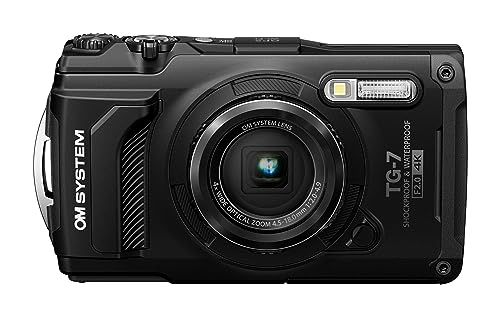
OM SYSTEM Tough TG-7 — Best true macro mode
Most cameras treat macro as a menu item; this one treats it as a homeland. The TG-7’s microscope mode focuses to within about a centimetre of its front element, magnifying the small world — a beetle’s armour, a snowflake’s brief architecture, the weave of a banknote — to a degree that general-purpose cameras simply cannot reach without accessory lenses. For a photographer whose subjects are measured in millimetres, that mode alone justifies the body’s existence.
Focus stacking, performed in-camera, answers the depth-of-field problem in the genre’s most practical way: the camera fires a sequence at shifting focus planes and merges them into one frame sharp across the subject. A spider that would be a face and a blur on other bodies becomes a spider entire. The feature works handheld with a little care, which moves stacking from a studio ritual to a field technique — dew, garden, morning light and all.
Toughness is not a side feature here; it is what lets the macro work happen where macro subjects live. The body is waterproof, dustproof and crush-resistant, so it can be laid in wet grass at dawn, rinsed after a beach-pool session, and carried in a pocket that also contains keys and courage. Underwater close-ups — a whole subgenre of the near world — are native territory rather than a housing purchase.
Its compromises are the compact camera’s eternal ones. The sensor is small, so large prints and aggressive cropping are not its gifts, and the fixed lens means working distance is what it is: close, intimate, occasionally alarming to the subject. Macro photographers learn to approach slowly and let subjects settle, and this camera rewards exactly that temperament.
Picture its morning: a frost-edged leaf, a ladybird waking inside it, and a photographer lying full-length on wet grass with the camera an inch from the scene, stacking focus while the light comes up. The resulting frame — insect, frost, leaf veins, all of it sharp — is the kind of photograph that makes viewers ask what microscope was used. None was. It was this, and patience.
- Format: rugged compact with dedicated microscope mode
- Close brief: focuses to roughly a centimetre from the glass
- Stacking: in-camera focus stacking for full-subject sharpness
- Field brief: waterproof and crush-resistant for real habitats
- Light note: accessory LED guidance exists for the darkest corners
Strengths
- Magnification ordinary cameras cannot reach unaided
- Stacking solves depth of field in the field
- Goes where insects actually live, wet grass included
Trade-offs
- Small sensor limits print size and cropping
- Very short working distance can startle subjects
- Not the tool for shallow, dreamy product backgrounds
Best for: insect, nature and underwater close-up photographers. Not suited for: large-format product printing or studio tethering

Sony RX100 VII — Best pocket close-up
Versatility at pocket scale is the RX100 VII’s lifelong argument, and close work is one of its quieter talents. Its zoom reaches a genuinely useful telephoto, its one-inch sensor gathers respectable detail, and at its wider settings it focuses closely enough for the tabletop subjects — a signature on a letter, a watch on a wrist, the detail of a dish — that fill the near-world photographer’s ordinary day. It is the camera for close-ups that happen inside a life rather than inside a studio.
Autofocus, inherited from Sony’s serious bodies, behaves unusually well at these ranges: eye detection for the pet’s face at arm’s length, tracking for the toddler’s hands investigating a ladybird, quick acquisition for the product turned this way and that during a listing shoot. Close photography of living subjects is a speed game disguised as a stillness game, and this body’s reflexes respect that.
The flip screen earns specific praise at this distance. Close subjects live at awkward heights — ground level for fungi, table level for products, below eye level for almost everything interesting — and a screen that tilts for composition saves knees, backs and dignity. Combined with the pocketable size, it makes the RX100 VII the close-up camera most likely to be present, and presence, again, is the specification that produces photographs.
True macro magnification is beyond its brief, and honesty requires saying so: insects fill less of its frame than the TG-7’s microscope mode manages, and its closest focus at telephoto settings is a portrait distance rather than a macro one. Read it as the near-world generalist — superb from a metre down to a few centimetres, outclassed only in the final centimetre where the specialists live.
Its emblematic use is travel’s small print: the mosaic detail in the cathedral floor, the spice merchant’s hand mid-measure, the hotel key’s engraving — the close frames that give a trip’s gallery its texture. Photographers who carry it return with the near world documented as faithfully as the far one, because the camera asked for no extra bag, no extra decision, no extra courage.
- Format: one-inch sensor compact, versatile zoom
- Close brief: honest close focus at wider settings
- Focus brief: grown-up autofocus for living subjects
- Screen: tilts for ground-level and tabletop composition
- Carry: the near world in a jacket pocket
Strengths
- Close capability inside a genuinely pocketable camera
- Autofocus that keeps up with small, moving subjects
- Detail and colour from a larger sensor than most compacts
Trade-offs
- True macro magnification needs a specialist instead
- Closest focus lengthens as the zoom extends
- Battery life asks for a spare on long days
Best for: travellers and everyday photographers whose close-ups happen anywhere. Not suited for: dedicated insect macro at maximum magnification

Canon PowerShot G7 X Mark III — Best for product sellers
Online selling created a new photographic profession — the tabletop product photographer — and this compact reads like it was briefed by one. Its bright lens gathers the kitchen-table light most sellers actually have, focuses closely enough to fill a frame with a handmade candle, a restored watch or a vintage brooch, and renders colours with the friendly honesty that makes a listing look like the object rather than an advertisement for it.
The close-focus behaviour at its wider settings is the working detail: a seller can lean over the product, fill the frame, and keep enough working distance for a hand to enter the shot — and hands, marketplaces have learned, sell things, because they prove scale and care simultaneously. The flip screen supports the overhead flat-lay composition that dominates craft marketplaces, letting the seller arrange, shoot and adjust without a ladder or a second pair of eyes.
Video belongs in this pick’s argument because sellers increasingly demonstrate: a clasp opening, a glaze catching light as the mug turns, a mechanism working. This body films those demonstrations capably, with close focus maintained and a microphone input for the seller’s narration — the combination that turns a listing into a small shopfront. Jewellery and watches, whose buyers zoom into photographs hunting for flaws, benefit from the sensor’s honest detail: what is shown is what ships, and returns fall accordingly.
Its limits are scale and ultimate magnification. Multi-product scenes in large spaces want a wider system; true macro detail of a hallmark or a movement jewel wants the TG-7’s microscope or the R50’s macro lens. For the great middle of selling — one beautiful object on one honest table — this is the most efficient instrument in the guide.
Watch a potter work with it: morning light, a linen cloth, each finished piece given ninety seconds — three angles, one close detail of the glaze, one short clip of hands turning it — and by lunch the shop is updated with photographs that look the way the pots feel. That is not a small thing for a small business. That is the whole shop window, made by a camera that fits in the apron pocket between pieces.
- Format: one-inch sensor compact, bright fixed zoom
- Seller brief: close focus plus hands-in-frame working room
- Colour brief: honest rendering that matches the shipped object
- Video brief: demonstrations with a microphone input
- Composition: flip screen for overhead flat-lays
Strengths
- Listing photographs that look like the product
- Bright lens forgives ordinary room light
- Stills and demo video from one pocket camera
Trade-offs
- Hallmark-level macro belongs to the specialists
- Large scenes outgrow a compact’s staging
- Serious lighting rigs eventually want a system body
Best for: marketplace sellers, crafters and tabletop product work. Not suited for: microscopic detail or large studio sets

Canon EOS R50 — Best system for macro growth
Every other body in this guide brings its close-up ability built in; the R50 brings a doorway. As an APS-C mirrorless body on Canon’s RF mount, it accepts a dedicated macro lens — the class of glass designed to focus to true one-to-one magnification at a working distance that leaves room for light — and the moment such a lens mounts, the near world changes scale: a ring’s engraving fills the frame, a movement’s jewels become landscapes, an insect’s eye becomes a portrait.
Why recommend a body for a lens it does not include? Because serious close-up work — the jewellery business, the product studio, the entomology habit — always ends at a macro lens, and the honest advice is to start on the system that leads there. The R50’s friendly handling, focus peaking and magnification aids for manual focus, and clean files make the apprenticeship pleasant, and its ordinary kit lens focuses closely enough to learn the craft’s grammar before the specialist glass arrives.
Studio habits grow on it naturally. Tethered review on a big screen — where a product’s dust and a jewel’s facet can be inspected at the size they will be judged — turns close-up sessions from hopeful to deliberate. Lighting, the genre’s other half, plugs into a system body without the workarounds compacts impose: off-camera flash, continuous panels, triggers and stands all speak its language.
The costs are the system’s costs, stated plainly: the macro capability is an additional purchase, the kit is no longer pocketable, and a product table that begins with this body tends to accumulate — lights, rails, backgrounds — the way studios do. Photographers who want close-ups inside an ordinary life should choose the compacts above. Photographers building a small, serious close-up practice should start exactly here.
Its defining scene is a watchmaker’s bench photographed by the watchmaker: the R50 on a small rail, macro lens fitted, a movement under soft window light rendered gear by gear in a stacked sequence the compacts cannot attempt. The image sells the craft because it reveals it. Systems earn their complexity at exactly such benches.
- Format: APS-C mirrorless, RF mount
- Growth brief: accepts dedicated macro lenses
- Focus brief: peaking and magnification for manual work
- Studio brief: tethered review and real lighting control
- Learning brief: kit lens focuses close enough to begin
Strengths
- The only route here to true one-to-one magnification
- A system that grows with a serious close-up practice
- Manual-focus aids that teach the genre’s core skill
Trade-offs
- Macro power arrives with a lens purchase
- The kit outgrows pockets and casual carry
- Studio accumulation is a real and slippery slope
Best for: jewellery, product and macro photographers building a practice. Not suited for: anyone wanting close-ups with zero extra kit

Fujifilm X100VI — Best for detail storytelling
Some near-world photography is not about magnification at all; it is about attention. The X100VI, with its fixed lens that focuses down to a genuinely close range, is the camera of the detail noticed across a table: the steam’s curl over a cup, the stitching on a handmade bag, the worn corner of a beloved book. Its high-resolution sensor renders those details with a richness that invites the crop, and its film simulations give small subjects a finished, editorial character straight from the camera.
The fixed lens, so often discussed as a limitation, becomes a close-up discipline: the photographer moves — leaning, crouching, re-arranging the table — rather than zooming, and the resulting photographs carry the coherence of a single, learned perspective. Built-in conversion options widen or narrow that perspective modestly when a detail demands it, but the essential bargain holds: one view, mastered.
A small built-in flash, unusual in this class, deserves mention at this distance: used gently, it lifts a shadowed detail or adds a catchlight to a product without a lighting rig, and its leaf-shutter partnership allows flash at speeds that tame bright backgrounds behind close subjects. Café-table photographers — food writers, diarists, craft documenters — quietly build entire bodies of work on exactly these small mercies.
Boundaries: it will not magnify like the TG-7, will not accept a macro lens like the R50, and its fixed view excludes the seller who needs variety from one position. Its kingdom is the considered detail inside a story — the close frame that makes a reader feel the texture of a day. Within that kingdom it is, at the moment, close to untouchable.
Its emblematic photograph is a baker’s hands dusted with flour, shot from across the worktable at its closest comfortable distance, every grain and crease rendered, the morning’s first loaf soft behind. Nothing in the frame is microscopic. Everything in it is near, noticed and honoured — which is a complete definition of one entire school of close photography.
- Format: fixed-lens APS-C compact, high resolution
- Detail brief: close focus for textures and tabletop stories
- Colour brief: film simulations as a finished look
- Flash brief: a small built-in unit for gentle fill
- Discipline: one perspective, learned deeply
Strengths
- Resolution that invites confident cropping
- Details emerge with editorial colour
- Always carried, so details never go unphotographed
Trade-offs
- No path to true macro magnification
- Fixed view frustrates multi-product sellers
- Availability and patience are part of ownership
Best for: writers, diarists and detail-led storytellers. Not suited for: insect macro or interchangeable-lens ambitions

DJI Osmo Pocket 3 — Best for close-up video
Close-up video has a problem stills never meet: at twenty centimetres, every tremor of the operator’s hand becomes an earthquake in the frame. The Pocket 3’s gimbal exists precisely at that problem. Held over a workbench, it glides across a product, tilts down into a mechanism, and tracks a maker’s hands with a steadiness that makes small-scale demonstrations look professionally crewed — which is why repair channels, craft demonstrators and sellers filming their process have adopted it so completely.
Its focusing at close range is cooperative rather than microscopic: it will hold a product, a pair of hands, a detail being pointed at, and its screen — large for the device’s size — lets the operator confirm what is sharp without a monitor. Face and product tracking keep a demonstrator’s subject centred while both hands work, a small miracle for solo creators whose hands are the content.
Sound and workflow suit the bench. A small wireless microphone captures the narration and the near world’s own audio — the click of a clasp, the scratch of a nib, the tick of a movement — which at close range is half the storytelling. Clips move to a phone quickly for the short-form versions that close-up demonstrations thrive as: thirty seconds of a restoration, a repair, a reveal.
It is not a macro stills camera and does not pretend otherwise: the TG-7 magnifies further, the R50 resolves finer, and product photographers needing printable files should look up this list. For motion at arm’s length — the growing language of showing how things work and what things are — it is the most capable small instrument here.
Watch a restorer film a watch coming back to life: the Pocket hovering, steady, as the balance wheel wakes — a shot that would judder hopelessly from a handheld body at that distance. The audience leans in. Leaning in is the entire economy of close-up video, and this little gimbal manufactures it on demand.
- Format: pocket camera on a three-axis gimbal
- Video brief: steady close-ups of products and hands
- Tracking: holds a product or face while hands work
- Audio brief: wireless mic captures near-world sound
- Workflow: quick phone transfer for short clips
Strengths
- Steadiness that transforms bench demonstrations
- Solo creators keep both hands in the story
- Short-form close-up clips are its native language
Trade-offs
- Stills and magnification trail the specialists
- Very closest subjects still need a macro body
- Battery rhythm suits sessions, not marathons
Best for: demonstrators, repair and craft channels, process sellers. Not suited for: printable macro stills
How Do the Six Close-Range Cameras Compare?
| Camera | Format | Closest talent | Signature subject |
|---|---|---|---|
| OM SYSTEM Tough TG-7 | Rugged compact | Microscope mode and stacking | Insects, frost, tide pools |
| Sony RX100 VII | One-inch compact | Everyday close focus | Travel’s small print |
| Canon PowerShot G7 X Mark III | One-inch compact | Seller’s tabletop | Listings and flat-lays |
| Canon EOS R50 | APS-C mirrorless | True macro via lenses | Jewellery and movements |
| Fujifilm X100VI | Fixed-lens compact | Detail storytelling | Hands, textures, food |
| DJI Osmo Pocket 3 | Pocket gimbal | Steady close video | Demonstrations and repairs |
Choose by subject size and destination. Millimetre subjects that must be sharp throughout point to the TG-7; subjects that must sell point to the Canon compact or the R50 system; subjects that must move point to the Pocket; subjects that must be felt point to the Fujifilm.
How Do You Light a Subject Twenty Centimetres Away?
Gently, and from the side. A small subject lit from the camera’s own position looks like a police photograph of a coin; the same subject lit from forty-five degrees acquires modelling, texture and dignity. A window is the beginner’s best close-up studio — soft, directional, free — with a sheet of white card opposite it to lift the shadows and a sheet of black card to deepen them when the subject is pale. Master those two cards and you have mastered most of product lighting at this scale.
Diffusion is the second lesson. Small light sources make hard shadows that dwarf small subjects, so every close-up light wants softening: a diffuser panel, a tracing-paper tent around a product, the LED softened through cloth. Jewellery adds its own demand — reflections are its portrait — so the light is arranged to draw long, elegant highlights along metal rather than spot it with glare. Move the light, not the ring, and watch the reflection walk across the surface until it flatters.
Finally, expose for the subject’s brightest meaningful detail and let the background fall where it wants. At close range, backgrounds are suggestions, and a dark, quiet one flatters almost everything small. The cameras above all offer the manual control this lighting craft requires; none of them can want it for you.
What Mistakes Make Close-Ups Look Amateur?
Camera shadow leads the list — the photographer’s own equipment eclipsing the subject, discovered only in the edit. Second is the handshake at magnification: shooting macro handheld at hopeful shutter speeds and calling the softness a style. Third is the cluttered background at close range, where a centimetre of tabletop debris becomes a landscape of distraction behind a ring.
Dust deserves its own sentence, because magnification is a dust detection system. Products photographed uncleaned look neglected at sizes the naked eye forgave, so the close-up workflow includes a blower, a cloth and a final inspection on a big screen before the set is struck. And focus placement — the beginner puts it on the nearest edge; the craft puts it on the subject’s eye, the engraving, the hallmark: the point the viewer is meant to meet. At millimetre depths of field, that choice is the photograph.
How Do You Photograph an Insect Without It Leaving?
Slowly, early, and from its own level. Insects are coldest and calmest at dawn, which is why macro photographers keep dawn hours that rival the wildlife shooters’. Approach along the subject’s blind angles, move in the final distance by leaning rather than stepping, and let the first frames be distant insurance before attempting the portrait. A camera like the TG-7, happy in wet grass at ground level, is built for exactly this diplomacy.
Accept the empty frames as tuition. Every departed butterfly teaches the approach speed its species tolerates, and the knowledge compounds across a season into something that looks, to beginners, like luck. It is not luck. It is a notebook of tolerances, written one departure at a time — and it is why the finest insect portfolios come from the same gardens, visited daily, by photographers whose cameras are almost incidental to their patience.
How Do You Photograph Jewellery Without Photographing Yourself?
Metal and gemstones are mirrors with ambitions, and the close-up photographer’s first jewellery lesson is that the camera, the room and the photographer all appear in the subject unless arrangements are made. The classic answer is a light tent or a curved sweep of white material around the piece, so the metal reflects a clean, bright environment instead of a person holding a black box. Gaps in the tent are left deliberately — a dark edge here, a bright strip there — because pure white reflection reads as plastic; jewellery needs contrast in its reflections to look like metal at all.
Focus placement follows the buyer’s eye: the hallmark for authenticity, the stone’s table for brilliance, the engraving for sentiment. A stacked sequence, from the R50 with a macro lens or the TG-7 in its stacking mode, can hold all three in one frame, but a single, chosen plane often photographs more honestly — jewellery in life is seen one facet at a time, and the photograph that mimics that seeing feels true.
Colour honesty is the commercial bottom line. Stones photographed under mixed light arrive at the buyer’s screen wearing colours they do not own, and returns follow. One light source, one white balance, a grey reference in the first frame of the session — the unglamorous liturgy of product truth. The cameras above all support the manual control this requires; the discipline itself is, as ever, the photographer’s contribution.
What Changes When the Subject Is Food at Close Range?
Appetite becomes the brief. Food at close range is photographed to be wanted, which reverses several product-photography instincts: a little shine is welcome rather than polished away, steam and melt are motion to be caught rather than flaws to be frozen, and the depth of field that would fail a ring becomes the creamy fall-off that makes a dish look abundant. The Fujifilm and the Canon compact above both serve this world naturally, with colour that treats warmth as an ingredient.
Timing tightens cruelly. A sauce’s gloss, a yolk’s surface, the frost on a glass — each has a lifespan measured in tens of seconds, so the close-up food set is built backwards: background, light and camera composed around an empty plate, the dish admitted last like a guest of honour. Photographers who reverse that order spend their careers chasing gloss that has already left.
Hands return here as they did in the sellers’ section, because food at close range wants scale and story: fingers tearing bread, a spoon mid-lift, salt falling. The Pocket 3’s steady close video has made this its empire on social platforms, where the tear and the pour outperform any plated still. Close food work is theatre with a very small stage, and the audience must never see the strings — or the photographer’s shadow across the plate.
How Do You Keep a Product Set Consistent Across a Whole Shop?
By writing everything down the first time it works. Distance from lens to product, light position measured in hand-spans, background material, exposure, white balance — a one-page set recipe that any future session can rebuild in minutes. Marketplaces reward consistency with a quality buyers feel rather than notice: every listing lit the same way becomes a shop; every listing lit differently becomes a jumble sale, whatever the objects are worth.
The recipe also protects against the close-up photographer’s quiet enemy, drift. Across a long session, lights migrate as they are nudged, the photographer tires and leans closer, backgrounds creep. A mid-session return to the recipe — one reference frame compared against the morning’s first — catches the drift while it is still cheap. Several bodies in this guide help with tethered or phone review at honest sizes; use the biggest screen you have, because at macro distances the small screen lies by omission.
Consistency extends to editing. One crop ratio, one background tone, one sharpening habit across the catalogue, and the shop acquires the visual calm that lets buyers compare objects instead of photographs. The cameras were chosen partly for colour that stays put under fixed settings — the rest is liturgy, repeated until it looks like talent.
Why Do Close-Up Photographers Talk About Slowing Down?
Because the near world punishes hurry with a precision other genres forgive. A portrait can survive a hurried frame; a macro of a beetle cannot, because the hurried frame is a photograph of the photographer’s sway. Close work therefore develops its own tempo: compose, breathe, wait for the sway to settle, fire — a rhythm closer to archery than to reportage. Photographers arriving from faster genres often describe the first macro month as a kind of rehabilitation, after which their other work improves too, because stillness, once learned, is portable.
The equipment in this guide divides by how it treats that tempo. Stacking modes and gimbals buy time back in specific ways; manual-focus aids reward the slow hand; small compacts forgive a quicker, diary-style pace at moderate distances. None of them repeals the genre’s central law, which the first month teaches everyone: the subject is small, the tolerances are smaller, and the photograph belongs to whoever can be still the longest. Buy accordingly — and then go and practise stillness at a table, with a leaf, a lamp and an hour you refuse to hurry.
How Close Should You Get to a Watch, a Coin or a Stamp?
Collectors photograph evidence, and evidence has its own distances. A watch movement wants the frame filled by the mechanism, with focus stacked or carefully placed so the maker’s marks and the jewel bearings share the story; a coin wants raking light from a low angle so its relief casts tiny shadows and the date stands up to be read; a stamp wants flat, even, shadowless light and a camera squared perfectly to the paper, because its value lives in perforations and postmarks that distortion would slander. Three subjects, three geometries — the near world is not one technique but a family of them.
Resolution earns its keep in this corner of the guide. A buyer, an insurer or an auction house will zoom into these photographs with intent, and the bodies with detail to spare — the R50 behind a macro lens, the X100VI’s dense files, the RX100 VII at its honest best — protect their owners in that zoom. Photograph a collection once, properly, at the highest quality the camera offers, and the archive serves insurance, sale and scholarship from the same session.
Handling discipline matters as much as optics. Cotton gloves for the metal, a copy stand or a firmly braced position for the camera, the subject returned to its storage before the next is fetched — collecting photography borrows the conservator’s habits because it shares the conservator’s stakes. The photograph must never become the most dangerous thing that ever happened to the object.
What About Documents, Artwork and the Family Archive?
A large, quiet share of within-a-metre photography is preservation: letters, photographs of photographs, a child’s drawing, a recipe card in a grandmother’s hand. The requirements are humble and specific — even light from two sides to kill glare and shadow, a camera parallel to the page, enough resolution that handwriting stays legible at full zoom, and colour faithful enough that a faded ink reads as itself. Several bodies here, the compacts especially, perform this duty beautifully on a table by a window.
Glare is the archive’s enemy and polarisation its friend, but technique outruns accessories: angle the lights, not the page; shoot in the room’s softest hour; check the first frame at full magnification for the tell-tale sheen across the ink. Work in batches with a rhythm — place, flatten gently, shoot, log — and a shoebox of family paper becomes a searchable, shareable, fireproof inheritance in a weekend.
It is worth saying plainly that this may be the most valuable photography in the entire guide. Insects and products are replaceable subjects; the recipe card is not. A camera chosen for close work will, at some point in its life, be asked to save the family’s paper memory — and every body recommended above can answer that call with honour.
How Do You Focus When Autofocus Gives Up?
By hand, by rail, or by rocking — the three ancient answers. Manual focus with magnification and peaking, offered across these bodies, lets the photographer place the plane exactly on the eye, the hallmark, the stamen, and hold it there; a focusing rail, for the system shooters, moves the whole camera in increments finer than any hand, which is how stacked sequences are built in studios; and rocking — leaning the handheld camera through the focus plane while firing — remains the field macro photographer’s beloved cheat, turning body sway from the enemy into the mechanism.
Whichever method serves, the discipline is identical: focus on the point the viewer must meet, and let everything else fall away in order of importance. At millimetre depths, focus is not a technical setting but the photograph’s argument about what matters. Beginners spread it hopefully; practitioners place it like punctuation. The cameras above merely make the placement visible — the meaning is yours to intend.
How Should a Beginner’s First Close-Up Month Be Spent?
Week one belongs to one object and one window. Photograph the same ring, leaf or watch every day at the same table, changing one variable at a time — distance, angle, the white card’s position — and keep the frames in order. By the seventh day the sequence itself becomes the teacher: light’s behaviour, focus’s thinness and the camera’s habits all visible as a strip of evidence no tutorial can match. This is deliberately unglamorous homework, and it works faster than any purchase.
Week two adds a living subject: a houseplant’s new leaf, a spider in residence, a pet’s patient face. Movement enters the equation and with it the genre’s timing — the sway, the breath, the chosen second. Week three goes outside at dawn for the TG-7’s natural congregation of dew, insects and frost, or stays in to build the product set recipe if selling is the goal. Week four is for printing one frame large and living with it on a wall, because close work reveals its truths at size: the focus placed a millimetre behind the eye, the dust nobody cleaned, the background that seemed quiet and was not.
By the month’s end the beginner owns something no camera shop sells: a calibrated sense of their own small world — which subjects call them, which distances they work at, which of this guide’s six bodies their hands have been describing all along. Buy then, from evidence. The near world is patient; it will still be there, inside a metre, waiting to be noticed properly.
Related guides
Frequently Asked Questions
What does “within 1 meter” actually mean for a camera?
It describes close-range work: subjects between the lens and one metre away — macro, products, details, insects. This guide interprets the phrase that way throughout, because no other reading makes photographic sense.
Can a phone replace these for product photos?
For casual listings, increasingly yes. The bodies here earn their place when detail must survive a buyer’s zoom, when light is poor, or when the photographs are the business itself rather than an errand within it.
What is focus stacking, and do I need it?
Stacking merges frames focused at different depths into one sharp image. If your subjects are insects, jewellery or anything with depth measured in millimetres, it changes what is possible — the TG-7 performs it in-camera.
How close is too close for insects?
When the subject changes its behaviour because of you, you are too close — whatever the lens allows. Working distance, patience and dawn sessions exist so the photograph never has to cost the subject its morning.
Do I need a tripod for tabletop products?
Need is strong, but a support — tripod, mini-tripod, even a stack of books — transforms close work by removing sway from the focus equation. At these distances, support is the cheapest sharpness ever sold.
Which pick suits a complete beginner to close-ups?
The Canon PowerShot G7 X Mark III for products and everyday details, or the TG-7 if insects and the outdoors are the draw. Both produce satisfying close photographs before any technique is learned, and keep rewarding it as it grows.
Final Recommendation
Match the body to the small world you actually inhabit. Insect and nature photographers should take the OM SYSTEM Tough TG-7 and its microscope mode without a second thought; sellers should choose between the Canon PowerShot G7 X Mark III’s tabletop ease and the Canon EOS R50’s system future; travellers and diarists will be served by the Sony RX100 VII and Fujifilm X100VI respectively; and anyone whose close-ups must move should carry the DJI Osmo Pocket 3. Then learn the near craft — side light, support, a cleaned subject, a chosen background — because inside one metre, the photographer is half the camera. The subjects are small. The difference good close work makes is not.
Start tonight, at a table, with one object you love: a ring, a leaf, a watch, a shell. Photograph it from a metre, from thirty centimetres, from as close as your camera allows, moving a lamp and a white card between frames. By the tenth frame you will understand this entire guide from the inside — and you will know, from evidence rather than reviews, which of these six bodies your own small world is asking for.
There is a pleasure waiting in that exercise that deserves the last word. The near world is the only photographic territory that requires no travel, no permission and no luck with weather: it is already on your table, in your garden, inside the objects you own and the creatures that share your walls. A camera that opens it — any of these six, honestly chosen — converts the most ordinary square metre of a life into a permanent exhibition. Photographers who discover that stop waiting for expeditions. They lean in, over breakfast, over a workbench, over a flower bed, and find the universe conducting its business at a scale they had somehow never been introduced to. Consider this guide the introduction. The metre is yours.
A Note on Renting Before You Commit
Close-up work is the genre where a weekend’s rental teaches the most, because the differences between these bodies are differences of distance — and distance is felt, not read. Rent the TG-7 for a garden weekend and the R50 with a macro lens for a tabletop weekend, photograph the same subjects with both, and the files will conduct the argument this guide has been making in words: magnification against system, immediacy against growth. Whichever body you missed on the following weekend is the one to buy. The near world rewards that kind of evidence, gathered at your own table, over every review ever written — including, the authors freely admit, this one.
One Last Check Before You Spend
Measure your actual subject and your actual distance before any money moves: the ring across the table, the insect on the actual flower, the product on its actual cloth. Then ask which of these six bodies was described, in its section above, doing almost exactly that job at almost exactly that distance. The match will usually be obvious — and where two bodies both match, choose the one whose compromises you mind least, because at close range you will meet those compromises every single session, at a distance of centimetres, with nowhere for either of you to hide.
And If the Subject Is a Person at Arm’s Length?
One near subject deserves a final mention: the human face inside a metre — the grandchild’s eyelashes, the maker’s concentration, the portrait taken across a café table rather than across a room. Every body in this guide handles that distance, but they divide by flattery: the Fujifilm’s colour and the Canon compact’s bright lens render skin kindly at close range, while the sharper systems reward honest light and punish tired skin without malice. Choose the rendering your subjects will thank you for, focus on the nearer eye, and remember that at this distance a portrait is a conversation — the camera is simply the part of it that keeps a copy.
Related Guides
Build the tabletop further with small product lighting with one window and two cards, explore the outdoor side in garden macro photography through the seasons, or plan the system route via choosing your first dedicated macro lens.


