ilcastellomenu.com is reader-supported. When you buy through links on our site, we may earn an affiliate commission.
Where to Buy
There is a trip on the calendar — flights held, leave approved, a route taking shape — and one decision left that people reliably leave too late: the best cameras to get for travel are the ones bought for the journey you are actually about to take, chosen in time to learn before departure, and small enough that they come with you every day of it. This guide is written as a buying decision, not a catalogue: one body, bought once, matched to a trip type, and carried without regret from the first dawn start to the last night market.
Two neighbouring guides in this series wear similar titles and answer different questions, so let us separate them before money moves. One covers creators who publish travel content while moving — a working tool for a travelling channel. Another treats travel and backpacking as an endurance discipline, where kit is weighed in grams across months. This page is for the person in between: a traveller with a specific trip coming, deciding what to buy for it, who wants photographs worthy of the journey without turning the journey into a photography expedition.
The method below is deliberately decision-shaped. First, name the trip — city, coast, mountains, family, festival, the once-a-decade expedition. Then let the trip, not a spec sheet, rank the cameras: every pick here is annotated with the journey it serves best and the journey it would quietly ruin. Travellers who buy in that order come home with photographs and no regrets; travellers who buy the internet’s favourite camera regardless of itinerary come home with a very good camera that stayed in the hotel safe.
A note on timing, because this guide’s reader has a departure date and procrastination is the enemy with a calendar: camera decisions made a month out are shopping; decisions made in the departure week are gambling. Stock vanishes, prices wander, and learning curves do not compress. If your trip is close, weight the readily available picks in this list accordingly — an excellent camera in your hand in three days beats a perfect one arriving the morning you fly, every single time.
Key Takeaways
- Buy for the specific trip on your calendar, not for travel in the abstract.
- One body, carried daily, beats a system that lives in the hotel safe.
- The Fujifilm X100VI is the city traveller’s one-camera answer — if you can find one.
- Weather sealing decides coastal, mountain and festival trips more than resolution does.
- Buy early enough to learn the camera at home; departure day is not a tutorial.
- The OM SYSTEM Tough TG-7 is the only pick here that survives being dropped in a river.
In this guide
Quick Picks
| Camera | Badge | Why it earns its place |
|---|---|---|
| Fujifilm X100VI | One-camera city classic | A fast fixed lens and filmic colour for travellers who pack light and shoot daily. |
| Sony RX100 VII | Zoom in a jacket pocket | The widest-to-telephoto range that still vanishes into a daypack’s side pocket. |
| Canon EOS R50 | First system for big trips | Interchangeable lenses at a size and price a once-a-decade trip justifies. |
| OM SYSTEM OM-5 Mark II | Weatherproof trekker | Sealed body, small lenses and stabilisation for mountains and coasts. |
| DJI Osmo Pocket 3 | Movement specialist | Stabilised video and stills for travellers whose memories move. |
| OM SYSTEM Tough TG-7 | Indestructible companion | Waterproof, crushproof and unbothered by beaches, boats and children. |
How Did We Choose Cameras for a Trip You Have Not Taken Yet?
We started from itineraries rather than sensors. Six journeys recur in travellers’ plans — the city break, the grand tour, the family holiday, the trek, the water-based trip, and the big expedition saved for over years — and each candidate camera was assigned the journeys it genuinely serves. A camera had to win at least one itinerary outright to appear here; all-rounders that win none were cut, because a buying decision needs a first choice per trip, not a grid of respectable maybes.
Carry was the second sieve, applied with a traveller’s cruelty. The test was not weight on a scale but presence at hour nine of a sightseeing day: does this camera still hang on the shoulder in the evening, or has it been demoted to the bag, the room, the list of things to stop doing? Cameras are bought in shops and abandoned in afternoons, and every pick here was chosen for the afternoon test as much as the shop test.
We weighted evening performance with similar cruelty, because travel days save their best for last: the golden hour over the harbour, the restaurant’s candlelight, the night market’s neon. A camera that is superb at noon and helpless at eight in the evening has failed the itinerary’s climax daily. Each pick was therefore asked what it does after dark — fast lens, stabilisation, honest high ISO, or in the Tough’s case the humility to be the second camera while another pick takes the night shift.
Finally we graded learning curves against departure dates. A camera bought for a trip must be learnable in the evenings before it — its controls familiar enough that the traveller watches the place rather than the manual. Bodies whose gifts require a season of practice were marked down for imminent trips however fine they are, because the correct camera for a journey three weeks away is the one that will be a companion by the second morning.
Resale and rental realities were allowed a vote, because trip purchases are often semi-permanent decisions. Cameras that hold value, rent easily and accessorise from deep second-hand markets reduce the cost of choosing imperfectly — a genuine mercy in a decision made under departure pressure. The picks above all pass that test, though the Fujifilm passes it so completely that its second-hand market has become part of its legend.
Two admired categories were excluded on this guide’s specific terms. Dedicated travel zooms with enormous ranges and small sensors were cut because their daylight convenience collapses in the evening light where travel memories concentrate. Full-frame travel systems were cut for the opposite reason: magnificent, and larger than the journeys described here — their owners are expedition photographers, served by other pages, not travellers deciding what to get for the trip on the calendar.
Why Does One Body Beat a System for Most Trips?
Every lens you carry is a decision you must make a hundred times a day, and travel days are already rich in decisions that matter more — trains, meals, neighbourhoods, light. A single body with a fixed lens, or one lens mounted and the rest left at home, returns those decisions to the journey. Photographers call this constraint liberating because it is: the frame is given, and the traveller’s whole attention goes to where to stand and when to press, which is where travel photographs actually come from.
Airlines have quietly joined this argument. Cabin-baggage limits, personal-item dimensions and the simple geometry of an under-seat bag all tax camera systems at exactly the moment a journey begins, and a one-body kit sails through gates that make system travellers repack at the check-in desk. The picks below were each imagined at that desk, in that queue, and chosen partly for how little drama they cause before the trip has properly started.
Weight compounds the argument across a real itinerary. A system kit’s true cost is not its purchase price but its daily tax — the shoulder at hour nine, the bag that cannot come into the museum, the evening walk skipped because the camera is back at the room and the light, unhelpfully, is perfect. The history of travel photography is mostly a history of the camera that was there; one-body discipline is how travellers maximise “there”.
The exception proves the rule honestly: the deliberate photography expedition, where the trip exists for the pictures, inverts every priority in this guide. Those travellers should buy systems, carry them gladly, and read different pages. This guide’s reader has a journey to live and photographs to gather along the way — a distinction the picks below respect in every entry.
There is also a memory argument hiding inside the practical one. Travellers remember trips through the photographs they actually took, and the archive’s shape is set by the camera’s habits: the ever-present compact produces the dense, daily, affectionate record; the hotel-safe system produces twelve masterpieces and a gap. Decades later, families page through the dense record with a tenderness the masterpieces rarely provoke. Buy the camera whose archive you want to inherit from yourself.
Which Camera Should You Get for Your Trip?
A fixed-lens classic for cities, a pocket zoom for grand tours, a starter system for the big expedition, a sealed body for wild weather, a gimbal for movers, and a tank for water and family chaos.

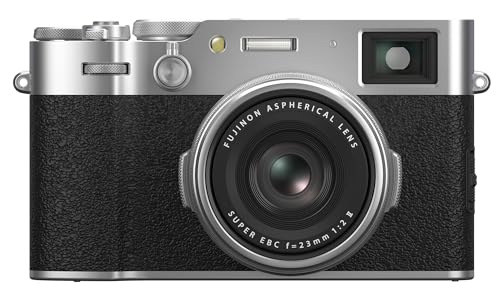
Fujifilm X100VI — One-camera city classic
For the city trip — Lisbon’s hills, Kyoto’s lanes, a long weekend in a capital you have always meant to know — the X100VI is the closest thing travel photography has to a settled answer. One fast fixed lens at the focal length city days are made of; a sensor with the resolution to crop a detail from a facade; film simulations that give a trip a coherent colour story straight from the camera; and a body handsome enough to sit on a café table like an invited guest. Travellers shoot more with it because carrying it never feels like equipment duty.
The discipline it imposes becomes the trip’s aesthetic. Without a zoom, the traveller walks to the frame — down the alley, up the steps, across the square for the angle — and the photographs inherit that walking: closer, more involved, more clearly made by someone who was somewhere rather than someone who observed it from a viewpoint. Albums from an X100 trip have a recognisable intimacy that zoom albums rarely match, and many owners date their serious photography from the first journey they took with one lens.
Buying realities, plainly: demand for this camera chronically outruns supply, so a traveller with a fixed departure date should order early, consider authorised waiting lists, or treat the RX100 below as the readily available alternative rather than a consolation. The fixed lens also sets the terms — wildlife, distant architecture and sports across a stadium are simply other cameras’ trips. For the city, the old town, the market and the café, it is the connoisseur’s one-body answer.
- Format: fixed-lens APS-C compact
- Trip parish: cities, old towns, food and street days
- Carry: jacket pocket to small sling
- Colour: film simulations as a trip’s house style
- Buying note: order early — availability is the tax
Strengths
- The most shootable one-camera city kit made
- Files and colour that flatter real travel light
- Constraint that visibly improves albums
Trade-offs
- No zoom, for any subject, ever
- Finding one before departure takes planning
- Not the tool for wildlife or wild weather
Its emblematic album is ten days in one city shot entirely at one focal length: dawn markets, noon museums, dusk rooftops, the same lens learning the place the way the traveller did. Friends paging through it ask what tour the photographer joined. The honest answer — none; the camera made him walk — is the highest compliment one-body travel photography can earn.
Second-hand and rental routes deserve a sentence for travellers whose departure is near and whose hearts are set: because this camera holds its value unusually well, buying one for a major trip and reselling it afterwards — a pattern owners call the world’s most enjoyable rental — is a rational strategy rather than a compromise. Few consumer objects forgive indecision this gracefully, and none of them take photographs this good while doing it.
Best for: city breaks and slow travel in walkable places. Not suited for: safaris, distant subjects or trips booked for next week if stock is scarce

Sony RX100 VII — Zoom in a jacket pocket
The grand tour — multiple cities, trains between them, viewpoints, churches, coastlines, a grandchild’s recital squeezed into the middle — asks for the opposite virtue from the Fuji’s: range. The RX100 VII packs a genuinely useful zoom span into the smallest serious body in this guide, so the traveller frames the cathedral from the square, the detail from the cathedral, and the singer from the back of the hall without changing anything but a dial. It is the one-camera answer for itineraries whose subjects refuse to hold still at one distance.
Speed serves travel in ways spec sheets understate. This camera starts fast, focuses faster, and tracks a moving grandchild, a street performer or a boat-deck dolphin rumour with a hit rate that makes its owner look prescient. Travel moments are unrepeatable by definition — the light, the procession, the expression — and a camera whose autofocus converts more of them into keepers is, in the only accounting that matters, the highest-quality camera on the trip.
Its compromises are the one-inch sensor’s physics and a menu system denser than its body. Low light in cathedrals and evening streets is handled respectably rather than magically, and the traveller should learn its settings at home rather than in a piazza. Battery appetite across a long sightseeing day argues for the spare-in-pocket habit. None of it dents the central fact: no other camera this small covers this much of a varied itinerary.
- Format: premium compact, one-inch sensor
- Trip parish: grand tours, mixed itineraries, family trips
- Carry: the smallest serious option here
- Autofocus: tracking for unrepeatable moments
- Day kit: spare battery rides in the same pocket
Strengths
- Range that matches chaotic itineraries
- Focus speed that rescues fleeting moments
- Vanishes into any day bag or coat
Trade-offs
- Low light is respectable, not magical
- Menus reward homework before departure
- No weather sealing for wild days
Its signature trip is three weeks and five cities by rail, camera living in a jacket, producing the album that finally does justice to a journey the phone years kept flattening. The RX100’s owner is the traveller other travellers ask to take the group photograph — because everyone can see, by day three, whose pictures are coming out.
Family travellers should register one under-sung virtue: this is the camera most likely to be in the right pocket when the unscripted thing happens — the toddler’s first gelato verdict, the grandfather asleep under a newspaper in the sun, the street cat adopting the tour group. Planned photography rewards systems; family photography rewards presence, and presence is a specification measured in pockets and seconds, both of which this Sony wins outright.
Best for: varied itineraries and travellers who want one pocket camera for everything. Not suited for: dedicated low-light city work or sealed-body weather duty

Canon EOS R50 — First system for big trips
Some trips justify a system: the safari-adjacent reserve visit, the aurora expedition, the once-a-decade journey planned around photographs as much as places. The R50 is how a traveller buys into interchangeable lenses without buying a professional’s burden — a compact, friendly body whose kit zoom covers the everyday, whose mount accepts the telephoto the safari demands and the fast prime the night markets deserve, and whose menus teach rather than test. It is the starter system sized for a suitcase.
The buying logic is rental-friendly and future-proof in a way fixed compacts cannot be. Buy the body and kit lens for this trip; rent the specialised glass for the expedition days rather than owning it forever; come home with a camera that then serves family, hobbies and the next decade’s journeys. For travellers whose trip is also the start of photography as a pursuit, no other pick here opens as many doors per unit of luggage.
Discipline is the price of admission, and it should be budgeted honestly: a system invites accumulation, and the traveller who packs three lenses “just in case” has rebuilt the burden this guide exists to prevent. Travel with two at most — the kit zoom and one specialist — and let the itinerary choose the specialist. The R50 also asks the usual system courtesies: a real camera bag, a sensor-cleaning plan for dusty places, and charging logistics for longer days.
- Format: APS-C mirrorless, RF mount
- Trip parish: expeditions, safaris-by-extension, photo-ambitious tours
- Kit logic: kit zoom daily, rented specialist for big days
- Learning curve: guided menus, gentle start
- Afterlife: the household’s camera for years
Strengths
- A real system at holiday scale and price
- Lens rental turns one trip into every trip
- Friendly enough to learn in a fortnight
Trade-offs
- Systems accumulate weight if you let them
- No weather sealing on the body
- More decisions than one-body travellers want
Its defining journey is the family expedition of the decade — a national-parks circuit with a rented telephoto for the wildlife days and the kit zoom for everything else, photographs on the wall a year later that the family simply calls “the trip”. The R50 made those frames possible at a weight a parent carrying everything else could still carry. That is the entire case for a starter system, kept.
A note for travellers buying their first system with a partner or family in tow: shared systems compound. One body this trip becomes two bodies sharing lenses next trip, and the household’s whole photographic future standardises on a mount chosen, almost accidentally, by a holiday. That is a happy accident when the mount is a major one with deep rental and second-hand benches — as Canon’s is — and another reason this body, rather than an exotic alternative, is the recommended first step.
Best for: big, photo-ambitious trips and travellers starting photography seriously. Not suited for: minimalist packers or anyone who knows they will not swap lenses

OM SYSTEM OM-5 Mark II — Weatherproof trekker
Trips that go uphill and outdoors — coastal paths, mountain huts, waterfall country, the shoulder-season city where it rains sideways — are decided by sealing and stabilisation before resolution gets a hearing. The OM-5 Mark II is this guide’s trekker: a weather-sealed body, small sealed lenses, and in-body stabilisation that keeps dawn viewpoints and dusk harbours sharp at hand-held shutter speeds other systems would need a tripod to attempt. It is the camera for travellers whose itineraries are written by weather maps.
The Micro Four Thirds system’s size dividend compounds on foot. Lenses are small enough that a two-lens walking kit — a wide zoom and a fast prime — rides in a jacket-and-daypack arrangement that full-frame travellers would need a dedicated camera bag to match, and the whole system shrugs at the rain that sends bigger kits under ponchos. On a week of trail days, that difference is measured in photographs taken rather than photographs contemplated from shelter.
Physics collects its toll in the darkest conditions: the smaller sensor’s high-ISO ceiling sits below the big-sensor picks, and night markets ask its fast primes to earn their keep. Computational modes claw back ground on still subjects — a harbour at blue hour, a temple courtyard — with a patience handheld photographers find addictive. For the trekker’s actual subjects — landscape, weather, walking companions — it is the most capable small system in this guide.
- Format: Micro Four Thirds mirrorless
- Trip parish: treks, coasts, mountains, wet cities
- Build: sealed body and lens options
- Stabilisation: hand-held dawns and dusks
- Kit shape: two small lenses, daypack-friendly
Strengths
- Weather stops being a photography decision
- The lightest full system for walking trips
- Stabilisation replaces the travel tripod
Trade-offs
- Highest ISOs trail the big-sensor picks
- Sealing only counts with sealed lenses mounted
- A system, with a system’s packing choices
Its emblematic week is a coastal path walked end to end: gales on day two, gold on day five, the OM-5 shooting through both from a hip holster while companions’ cameras stayed bagged against the weather. The album’s drama is the sky’s, and the camera’s contribution was simply refusing to sit out the interesting days. Trekkers understand that as the highest praise equipment can earn.
Altitude and cold, the trekker’s other two weathers, also favour this system’s efficiency: batteries last respectably in the chill when kept in an inside pocket rotation, and the body’s controls remain operable in the light gloves mountain mornings demand. Travellers planning high or cold itineraries should rehearse exactly that — gloves on, at home, changing a battery against a clock — because a camera that can only be operated bare-handed has a season, and it is not the mountain one.
Best for: walking, coastal and mountain trips in real weather. Not suited for: night-market specialists or travellers wanting one fixed lens only

DJI Osmo Pocket 3 — Movement specialist
Some trips are remembered in motion: the scooter ride along the coast road, the market walk, the child’s first snorkel, the train window’s changing countries. For travellers whose memories move, the Pocket 3 is the one-body answer of a different kind — a gimbal camera that stabilises walking footage into a glide, flips its screen between the world and the traveller’s own narration, and stills-captures respectably between clips. It packs smaller than every other pick here and starts faster than all of them.
Its travel manners are immaculate. No lens changes, no bag Tetris, no setup ceremony at the viewpoint — out of the pocket, on, recording, back in the pocket while the moment is still warm. Solo travellers especially should note its face tracking from any ledge or wall: the Pocket turns a café table into a camera operator, which quietly solves the oldest solo-travel problem — being in your own journey’s record — without a tripod’s bulk or a stranger’s framing.
Boundaries in daylight: the lens is fixed and wide, the sensor small, and a photographer whose trip is primarily stills — especially in low light — should buy up this list instead. Rain wants the optional protection rather than optimism. But for the hybrid traveller whose album is half film, whose family watches the trip as much as pages through it, nothing else here is remotely as fluent.
- Format: gimbal camera, rotating screen
- Trip parish: road trips, markets, solo travel, family films
- Carry: the smallest object in this guide
- Solo trick: face tracking from any ledge
- Stills role: capable, secondary to motion
Strengths
- Movement footage no stills camera can imitate
- A solo traveller’s self-filming solution
- Zero setup between moments
Trade-offs
- Stills-first travellers should look elsewhere
- Fixed wide lens, small sensor in the dark
- Weather protection is an accessory, not a birthright
Its signature souvenir is a single unbroken take: out of the riad door, through the medina’s morning chaos, to the rooftop where breakfast and the whole waking city wait — three minutes that family members rewatch the way previous generations re-read postcards. No stills camera in this guide can bring that home. Travellers who know their memories move should believe it and pack accordingly.
Accessibility is a genuine, rarely reviewed strength here: travellers for whom a heavy camera is not a preference question but a physical one — smaller hands, older shoulders, a wrist that complains — will find the Pocket’s featherweight, one-handed operation the difference between filming a trip and merely attending it. Travel photography advice assumes a standard body far too often; this pick quietly serves the travellers that assumption forgets.
Best for: hybrid film-and-stills travellers, solo travellers and road trips. Not suited for: stills-led trips, low-light cities or telephoto subjects

OM SYSTEM Tough TG-7 — Indestructible companion
Every travel camera guide needs one entry for the trips that destroy cameras: the beach week with toddlers, the boat-and-waterfall itinerary, the ski trip, the festival in a field of mud. The TG-7 is built for exactly those journeys — waterproof well beyond snorkelling depths, crushproof, freezeproof, and happy to be rinsed under a tap at the day’s end. It is the only pick here a traveller can hand to a child, drop on a dock, or take into the sea without a ceremony of anxiety.
Its photographic party trick is proximity. The TG-7’s celebrated microscope modes focus at distances that turn tide pools, market spices, frost patterns and insect life into a macro safari conducted from a deckchair — a whole category of travel photograph that the other picks cannot attempt without accessories. For travellers whose curiosity runs small as well as grand, it opens the trip’s hidden half.
Image-quality honesty, as always: a small sensor in a rugged compact will not match the low-light files or fine detail of the bigger picks, and its zoom and controls are a holiday camera’s, not an enthusiast’s. The TG-7 is therefore often a second camera — the one that goes where the good camera cannot — and as a family’s only camera for a wet, sandy, chaotic trip it beats a superior camera that spent the week in a dry bag being protected from the holiday.
- Format: rugged compact, waterproof
- Trip parish: beaches, boats, snow, family chaos
- Signature: microscope macro modes
- Handling: glove- and child-friendly by design
- Care: rinse it, dry it, done
Strengths
- Goes everywhere the trip goes, including in
- Macro worlds the other picks cannot reach
- The family camera nobody has to guard
Trade-offs
- Small-sensor image quality, honestly stated
- Not an enthusiast’s control layout
- Low light is its weakest weather
Its representative album is gloriously unprecious: a crab at macro range, a wave taken from inside the wave, the toddler’s underwater grin, the waterfall from beneath it. Every frame exists because the camera was unafraid. Travel photography’s first rule — be there — has a corollary this camera embodies better than any other here: be there without flinching.
Grandparents, of all travellers, may be its perfect market: the TG-7 asks for no protective rituals, survives being borrowed by every grandchild at the beach house, and produces the holiday’s most joyful frames precisely because nobody was guarding it. Cameras that must be worried about change how families behave around water; this one restores the old disposable-camera freedom at a quality the disposable era could not imagine.
Best for: water, snow, sand and family trips — alone or as the fearless second camera. Not suited for: low-light city albums or detail-critical landscape work
How Should You Learn a New Camera in the Three Weeks Before Departure?
Week one is for the hands: charge it, carry it daily, and shoot your own neighbourhood as if it were a foreign city — the market street at dawn, the café window at dusk, the neighbour’s cat as wildlife. The goal is not photographs but fluency: power, focus, exposure compensation and playback found without looking, the way you find your own front door key. Any setting you must hunt for at home will be unfindable abroad, under better light and worse jet lag.
Week two is for the workflow: shoot a full pretend day, then perform the whole evening ritual — download, back up, charge, clear, repack — and time it honestly. That ritual will happen in hotel rooms, on night trains and in tents, performed tired; if it takes forty minutes at home it will be skipped abroad, and skipped backups are how trips are lost. Simplify the kit and the file settings until the ritual fits inside fifteen painless minutes.
Week three is for the failures: fill a card deliberately, drain a battery, shoot in rain if your pick allows it and in darkness if it must. Learn what the camera does at its edges while the stakes are a Tuesday. Travellers who rehearse failure arrive abroad with a machine they trust, and trust — not resolution, not range — is what lets a photographer put the camera down and be present for the journey it came to record.
What Should Ride Alongside the Camera in the Day Bag?
Less than instinct suggests. The working list for most picks here fits a palm: the spare battery, a second card in a hard case, a microfibre cloth that will serve a hundred small emergencies, and a strap or wrist loop you actually like wearing. Add weather’s footnote where relevant — a simple rain cover for the unsealed picks, a dry bag for boat days — and the charging cable that matches the camera, because borrowed cables are a genre of travel disappointment unto themselves.
Deliberately absent: the charger brick during the day (it belongs in the evening ritual), the just-in-case lens for one-body travellers, and any tool whose absence has never once ruined a photograph. Day bags grow by sentiment and shrink by experience; experienced travellers pack for the day’s ninety percent and improvise the rest, which is also, not coincidentally, how they travel light enough to walk all day.
One paper item earns its grams: a small card with the camera’s settings that work for you — your dawn configuration, your night-market configuration — written after the practice weeks. Abroad, tired, in a crowd, that card is a letter from your rested self. Photographers mock it in shops and bless it in night markets, which is the correct order of operations for most travel wisdom.
How Do You Photograph a Trip Without Letting the Camera Eat It?
Set the camera office hours. Many seasoned travellers shoot deliberately in the day’s two generous lights — the morning’s first hours and the evening’s last — and let the camera rest through the middle, when light is harsh, sights are crowded and the journey’s other pleasures (lunch, museums, naps, people) are at their best. The album loses nothing; midday’s frames were rarely its treasures. The traveller gains a holiday that happens to contain excellent photography rather than a photography expedition that occasionally permits lunch.
Photograph people with the manners of a guest. Ask where asking is the custom, smile where it is not, buy the tea, learn the word for thank-you, and accept refusals as gracefully as acceptances. Travel portraits made under those manners carry a warmth no lens renders, and the photographer comes home with invitations and addresses alongside the frames — the souvenirs that appreciate. Every camera in this guide is small enough to be a guest’s camera; behave as one and doors open that no specification can buy.
Finally, schedule the looking. One evening in three, review the days’ frames briefly — not to edit, but to notice what the trip is actually about while there is still time to photograph it properly. Travellers discover their journey’s real subject around day four: not the monuments but the bakeries, not the peaks but the walking companions. A camera bought well and used reflectively turns that discovery into the album’s spine.
How Does the Right Answer Change Between a Honeymoon, a Trek and a Family Holiday?
A honeymoon is a portrait assignment disguised as a holiday: two people, beautiful places, and a future audience of anniversaries. Its camera must be hand-over-able — a fellow diner, a guide, a tripod substitute of a café table — and flattering in evening light, which is why the fixed-lens Fujifilm and the pocket Sony dominate this itinerary in practice. The couple who rehearse handing the camera to strangers, one sentence of instruction ready, come home actually in their photographs together; the couple who buy complexity come home with superb pictures of each other, separately.
A trek is a logistics problem wearing scenery. Every gram is carried uphill by its owner, weather is a participant rather than a backdrop, and charging opportunities arrive on a schedule set by huts and guides. Sealing, stabilisation and battery honesty outrank every photographic glamour — the OM-5’s entire candidacy rests on this paragraph — and the correct emotional posture toward the camera is that of a mountaineer toward boots: fitted early, trusted completely, thought about never.
A family holiday is a documentary shot by its own cast. The camera will be borrowed, dropped, sand-encrusted and operated one-handed while the other hand holds a small person or a melting ice cream. Durability and simplicity stop being features and become the assignment itself — the TG-7’s parish, with the RX100 as the quality upgrade for the designated family photographer. Families who choose on any other criteria spend the holiday protecting a camera from the holiday, which veterans recognise as the exact inversion of the point.
How Do the Six Travel Picks Compare by Trip?
| Camera | Trip it owns | Carry style | Remember before buying |
|---|---|---|---|
| Fujifilm X100VI | City and slow travel | Pocket to sling | Availability — order early |
| Sony RX100 VII | Grand tours, mixed routes | Jacket pocket | Spare battery daily |
| Canon EOS R50 | Expeditions, big trips | Small camera bag | Two lenses maximum |
| OM SYSTEM OM-5 Mark II | Treks and coasts | Daypack kit | Sealed lenses complete the promise |
| DJI Osmo Pocket 3 | Road and solo trips | Any pocket | Film-first travellers only |
| OM SYSTEM Tough TG-7 | Beach, boat and family | Wrist strap | It fears nothing but darkness |
The carry column is the honest one. Travellers do not experience specifications on a journey; they experience objects — their weight at hour nine, their bulk at the museum door, their courage at the water’s edge. Choose the row whose carry style matches the days you have actually planned, and the specifications will take care of themselves.
One row deserves a second glance from indecisive readers: the RX100 VII appears in this guide’s thinking for almost every itinerary because range plus pocketability is the closest thing travel photography has to a universal solvent. It is rarely the single best camera for a specialised trip, and it is never a bad one — which is why, when a traveller genuinely cannot name their trip’s dominant word, it is this guide’s default answer while they decide.
Similarly, the Tough TG-7 appears in more packing lists than its row suggests, because fearless second cameras obey different arithmetic: they are judged not against the main camera’s quality but against the photographs that would otherwise not exist at all. Any frame from inside the wave defeats the perfect frame that stayed dry on the beach, and travellers who grasp that stop apologising for carrying two very different cameras on one trip.
How Do You Decide in One Evening? A Buyer’s Checklist
Write the itinerary in one line — places, pace, weather, water, wildlife — and underline the word that will dominate the photographs. That word chooses the shortlist from this guide: city, range, expedition, weather, motion or chaos. Then apply the departure test: can you buy it, charge it, and shoot three practice outings with it before you leave? A camera that fails the departure test fails the trip, however perfect its parish, and the runner-up you can learn in time becomes the correct purchase.
Interrogate the runner-up honestly before crowning it, because trips forgive a second-best parish more readily than a first-choice camera that arrives unlearned or unpackable. The correct question is never “which camera is best?” in the abstract — it is “which camera will be in my hand, understood and charged, at the trip’s best moment?” Answer that, in writing, with your actual calendar and your actual bag open beside you, and the decision makes itself with a clarity no review can supply.
Run the carry rehearsal nobody does and everybody should: load the actual day bag, walk your own neighbourhood for two hours, and shoot as you would on the trip. Shoulders file truthful reports. If the kit nags by your own high street, it will mutiny by a foreign one; if it disappears into the walk, you have found your travelling weight. Adjust the kit — not your ambitions — until the rehearsal passes.
Close the decision with the unglamorous logistics: memory cards counted against your shooting appetite, batteries against your longest day, a charging plan for trains and huts, and a backup habit — nightly to a phone, a drive or the cloud — that a tired traveller will actually perform. Cameras are bought in an evening; trips are saved by checklists. Do both, in that order, and then stop shopping and start anticipating.
Add one line to the checklist that experienced travellers swear by and beginners find morbid: the plan for the camera’s worst day. A phone number for a rental shop at the destination, a companion device that can deputise, a decision made in advance about whether a failure means buying a disposable substitute or simply travelling lighter and freer. Trips are not ruined by broken cameras; they are ruined by broken cameras with no plan, met at midnight in a foreign language. Decide the plan while the language is your own.
What Mistakes Do Travellers Make When Buying for a Trip?
Buying for a fantasy itinerary leads the list: the telephoto for a safari that is actually one morning’s game drive in a two-week city trip, the underwater housing for a single snorkel in a fortnight of mountains. Weight the purchase by the trip’s majority days, and rent or borrow for its exceptional hours. Second is buying the week of departure — a stranger’s camera in a foreign city is a tax on every photograph, paid in missed moments while menus are deciphered.
Third is insuring nothing and backing up less: the lost card of a once-a-decade trip is travel photography’s true horror story, and it is entirely a logistics failure, not a camera failure. Fourth is packing for photography instead of for the journey — the extra lens carried ten days for one frame, the tripod that attended every dinner and no sunrise. This guide’s picks share one virtue above their differences: they were all chosen to be smaller than the trip they serve.
Fifth is shopping against a departure countdown in a panic tier — the flagship bought at the airport’s exchange rate of desperation, unlearned, uninsured, and resented by day three. The checklist above exists to move this purchase into calm weeks, where it belongs. Sixth, quietly, is forgetting the companions: a camera whose operation excludes the people you travel with — too complex to hand over for the photograph of you — will document everyone except its owner. Every pick here can be handed to a fellow traveller with one sentence of instruction, which is a travel feature no lab measures.
Final Recommendation
Decide by your itinerary’s dominant word. City and slow travel: the Fujifilm X100VI, ordered early — or the Sony RX100 VII when range or availability rules. Mixed grand tours: the RX100 VII outright. The big, photo-ambitious expedition: the Canon EOS R50 with a rented specialist lens. Treks, coasts and weather: the OM SYSTEM OM-5 Mark II. Journeys remembered in motion: the DJI Osmo Pocket 3. Water, snow and family chaos: the OM SYSTEM Tough TG-7, alone or riding shotgun to a bigger camera. Buy it this week, learn it on three home outings, rehearse the carry — and let the camera become the trip’s quietest companion rather than its loudest packing problem.
Then close the tabs. The weeks before a great trip are a finite resource, and every hour spent re-deciding a settled camera is an hour not spent on the language, the maps, the restaurants and the anticipation that are themselves half the journey’s pleasure. The travellers whose albums you envy did not buy perfectly; they bought adequately, early, and then went and stood in wonderful places with their attention undivided. This guide’s six answers are all adequate-to-excellent for their parishes. Pick yours, learn it, pack it — the trip is waiting, and it will not photograph itself.
Frequently Asked Questions
Is a dedicated camera worth it when my phone is this good?
For snapshots, honestly, the phone competes. The case for a travel camera rests on the photographs phones still fumble: reach across a square, faces in candlelit restaurants, weather that ends phone photography, macro worlds, motion that stays smooth, and the simple discipline of a device whose only job is the trip’s record. If your itinerary is heavy in those columns — most of this guide’s are — the camera earns its pocket.
How long before departure should I buy?
Three practice outings is the honest minimum; a month is comfortable. You need the camera’s controls in your fingers, its battery appetite in your planning, and one full rehearsal of the shoot-download-backup loop at home. Buying earlier also solves availability — several picks here, the Fujifilm famously, cannot be summoned the week before a flight.
One camera or a camera plus my phone?
Both, with divided labour. Let the camera own the deliberate photographs — the viewpoints, the portraits, the low light — and the phone own the documentary stream: menus, maps made visible, the quick share to family. Travellers who assign the roles stop experiencing the two as rivals, and the camera’s battery and card survive to the moments that justified bringing it.
What about theft and loss on the road?
Choose unobtrusive kit, keep the camera on your body in crowds, use the hotel safe for the hours it is genuinely idle, and make backups nightly so a lost camera loses hardware rather than the trip. Insurance that covers travel photography exists and suits the system picks; for the compacts, their smallness is itself a security feature — nothing in this guide advertises its value across a crowded square.
Should I rent instead of buying for one big trip?
Rental is the intelligent answer for specialised glass — the safari telephoto, the aurora-fast prime — and a legitimate trial for a body you may keep. But a once-only trip usually rewards ownership of the main camera: you learn it beforehand, keep it afterwards for the decade’s smaller journeys, and never watch a rental clock during the trip’s best light. Rent the extremes; own the everyday.
How many memory cards and batteries does a trip need?
Enough that neither can end a day: most travellers here settle on cards totalling several days of their real shooting volume, downloaded nightly, plus one battery in the camera and one in the pocket for the compacts, two spares for the system bodies on expedition days. Count from your practice outings’ actual consumption, not from optimism — the rehearsal exists precisely to replace guesses with numbers.
What should I do with the camera after the trip?
Keep travelling with it, in miniature. The body that learned a great city can learn your own at weekends; the family camera from the beach week becomes the birthday and holiday camera without missing a beat. Travellers who buy well for one journey usually discover they have accidentally equipped a decade of smaller ones — which is why this guide insisted on honest, parish-matched picks rather than disposable trip gadgets. And when the next big itinerary appears on the calendar, you will read its dominant word with an experienced eye, already owning either the right camera or the knowledge of exactly why not.
Related Guides
Travellers who publish as they go should read cameras for travel vlogging and creators on the move, long-haul minimalists can compare camera kits for backpacking and ultralight travel, and city specialists will enjoy one-lens travel photography in great cities.


