ilcastellomenu.com is reader-supported. When you buy through links on our site, we may earn an affiliate commission.
Where to Buy
One wording needs clearing up before any ranking makes sense: in this guide, the best cameras used for film are cameras used for filmmaking — bodies chosen to shoot narrative scenes, documentaries, shorts and features — not second-hand cameras and not stills bodies with a record button bolted on. Readers hunting the used market want a different page entirely; readers here want to know which machines working filmmakers actually roll when the clapper closes and the room goes quiet.
Filmmaking asks a body for things photography never does. A take may run twenty minutes, so heat behaviour and honest recording limits matter more than burst depth. Focus is pulled by hand or by an assistant, so focus breathing, repeatable manual control and clean monitoring outputs outrank headline autofocus scores. Footage gets graded, sometimes hard, so log profiles, codec depth and highlight manners decide whether a scene survives the colour suite or falls apart inside it.
Lenses shape the shortlist just as much. Cinema glass — manual, geared, often adapted from older mounts — has to sit on these bodies without drama, and the mount ecosystems below were weighed for exactly that adaptability. A camera that fights adapted primes, crops unexpectedly or hides its exposure tools behind stills menus was marked down no matter how handsome its demo reel looked.
Six bodies survived, spanning full-frame production hybrids, a retro-styled stills star that moonlights beautifully on set, a compact APS-C option for lean crews, and one pocket gimbal camera that has quietly become the insert-shot specialist of independent production. None is assigned a price anywhere in this guide; production budgets are built per project, and bodies are hired, borrowed and bought through too many channels for a shelf figure to mean anything here.
Key Takeaways
- Here, ‘used for film’ means used to shoot films — filmmaking bodies, not second-hand stock.
- Long-take reliability and heat manners outrank burst rates and headline megapixels.
- Log profiles and codec depth decide how far footage can be graded.
- Mount adaptability matters: cinema primes and adapted glass must sit without fuss.
- Monitoring outputs and clean menus separate set tools from stills cameras with video modes.
- A pocket gimbal camera earns its place as the insert and movement specialist.
In this guide
Quick Picks
| Camera | Badge | Why it earns its place |
|---|---|---|
| Panasonic LUMIX S5II | The independent set’s workhorse | Full-frame log depth, serious cooling manners and an L-mount that welcomes adapted cinema glass. |
| Sony Alpha 7 IV | The hybrid the rental houses stock deep | S-Log3 depth, a vast E-mount universe and autofocus cinematographers actually trust with faces. |
| Canon EOS R6 Mark II | The actor-friendly Canon | Canon’s colour science flatters skin, C-Log3 grades kindly, and RF glass renders faces beautifully. |
| Fujifilm X-T5 | The retro body with a colourist’s soul | Film simulations for fast turnarounds, F-Log2 depth when grading matters, and dials a cinematographer can work blind. |
| Nikon Z50 II | The lean crew’s Nikon | Compact APS-C body, honest video tools and Z-mount access for productions travelling light. |
| DJI Osmo Pocket 3 | The insert-shot specialist | A gimbal-stabilised pocket camera that floats through spaces no rigged body can enter. |
How Did We Judge Cameras as Film Tools Rather Than Photo Bodies?
Judging began on a virtual set. Each candidate was imagined through a twelve-hour day: interviews in the morning, a dialogue scene after lunch, a night exterior to finish. Bodies that would need cooling prayers by hour six, that buried zebras and waveforms behind stills logic, or that demanded proprietary media for ordinary frame rates lost ground quickly, however strong their photography pedigrees.
Codec behaviour received its own audit. Graders push shadows, rescue skies and match cameras across a scene, so the guide favoured bodies offering deep colour information, forgiving log curves and highlight roll-off that behaves like a shoulder rather than a cliff. A pretty image straight from the camera counted for less than a flexible one, because film images are finished in post, not in the viewfinder.
Crew reality closed the selection. Independent sets run lean — sometimes one operator, a sound recordist and hope — so weight, rigging points, battery ecosystems shared with lights and monitors, and menus a tired assistant can navigate at midnight all carried real weight. The six below are the bodies a working unit can build a day around.
Why Do Filmmakers Care About Heat More Than Megapixels?
A stills photographer fires in bursts and rests the sensor between them; a film camera holds its sensor at full read for minutes at a stretch, scene after scene, under lights that warm the room as surely as they warm the subject. Thermal design is therefore a creative specification. A body that throttles mid-take does not merely inconvenience a crew — it breaks performances, wastes the one unrepeatable reaction, and teaches directors to shoot defensively around the equipment instead of for the story.
Resolution, by contrast, has been sufficient for years. Delivery for independent film is overwhelmingly at resolutions every body here exceeds, and the industry’s most decorated digital cinematography was shot on sensors whose pixel counts would embarrass a modern phone. What separates film images is not counting ability but character: how highlights surrender, how skin survives mixed light, how grain-like noise behaves when a night scene is pushed in the grade.
That is why this guide reads thermal reports and codec tables before pixel counts, and why a lower-resolution body with cool manners and deep files outranks a resolution champion that wilts under a lighting rig. Sets remember which camera finished the day. Audiences never ask which one had the biggest number on its box.
What Does a Cinema Lens Actually Need From a Camera Body?
Adaptability, first of all. Working sets mix native glass with vintage primes, anamorphic attachments and rehoused classics, so a mount with a deep adapter ecosystem — and a sensor mode that does not crop the adapted image into a different lens — is worth more than any single native zoom. Several bodies below are beloved on sets precisely because almost anything round and made of glass can be persuaded to sit in front of them.
Focus behaviour comes next. Cinema focus is a performed craft: marks on a barrel, a puller’s hand, distances rehearsed like choreography. Bodies that offer magnified focus views without lag, peaking that can be tuned subtle, and — for solo operators — autofocus that can be slowed, softened and trusted not to hunt mid-line are the ones focus pullers request by name.
Finally, exposure tools must live where a cinematographer can reach them blind: waveform or honest zebras, false colour on the serious bodies, shutter angle thinking rather than stills shutter speeds. A camera that makes its operator translate stills logic into cinema logic on every setup taxes the whole production, one small conversion at a time.
Which Are the Best Cameras Used for Film on Real Sets?
A full-frame production anchor, two hybrid flagships with genuine set manners, a retro body whose files grade far above its styling, a lean APS-C option for small crews, and a gimbal pocket camera that shoots the shots nothing else can reach.

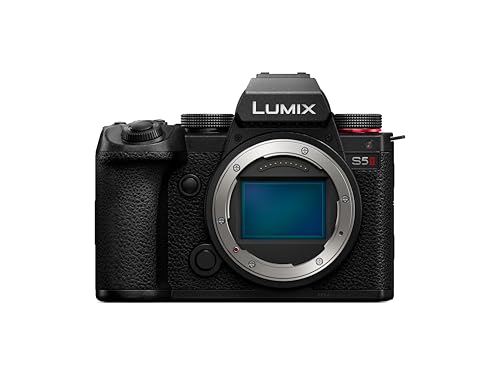
Panasonic LUMIX S5II — The independent set’s workhorse
Ask around independent sets and one body keeps being unboxed first. The LUMIX S5II earned that status the unglamorous way: it records long takes without thermal drama, its V-Log footage grades with a flexibility that embarrasses bodies costing far more, and its fan-assisted design treats a twelve-hour day as a normal shift rather than an endurance event. For narrative work built on performance, that reliability is not a convenience — it is the difference between directing actors and managing equipment.
Viewed through this guide’s filmmaking lens, its decisive virtue is how completely it thinks in cinema terms. Waveform monitoring lives natively in the body, shutter behaviour suits motion work, and the full-frame sensor gives cinematographers the depth control and low-light reach that night exteriors demand. Crews rig it small for gimbal days or build it out with cages, follow focus and external monitors for studio scenes, and the body accepts both lives without complaint.
- Format: full-frame hybrid built for long video takes
- Colour: V-Log capture aimed at graded workflows
- Cooling: active design for extended recording
- Mount: L-mount, deep adapter ecosystem for cinema glass
- Role: A-camera for independent narrative and documentary
Strengths
- Long takes without thermal anxiety
- Log files that welcome a serious grade
- Rigs up small or fully built with ease
Trade-offs
- Autofocus trails the very best for sports stills
- L-mount native cinema glass is still growing
- Menus reward a proper setup afternoon
Documentary units prize a quality directors rarely name in interviews: forgettability. Once rolling, this body stops asking questions — no warnings nibbling at the frame, no fan theatrics, no mysterious stops — and a camera that disappears lets a crew attend to the fragile thing in front of it. Verité work lives on that invisibility; a subject who forgets the camera gives a film its honest minutes.
Budget officers on small productions love its second career as its own backup. Because the body is attainable enough for a production to own two, matching A and B cameras stop being a rental negotiation and become a packing decision, and matched cameras save the colourist hours that small films do not have. Consistency across angles is a luxury this body quietly democratises.
Night work deserves a final mention. Streetlight exteriors, practical lamps, a face lit by a shop window — the sensor holds such scenes together with a steadiness that lets cinematographers light for mood instead of for the camera’s limitations, which is where filmmaking starts to feel like filmmaking.
Sound departments quietly approve of it, which rarely happens with hybrid bodies. Its audio inputs and monitoring let a small unit run a proper boom and a backup recorder without the syncing gymnastics that eat an editor’s evening, and timecode-friendly workflows on larger shoots keep its footage welcome in professional post houses. A camera the sound recordist does not complain about is a camera that gets invited back.
Second-unit directors borrow it for pickups because its files sit beside the main unit’s footage without a colourist’s apology. Matching is the invisible craft of production — the insert shot in March must marry the master shot from October — and a body whose colour science behaves predictably across seasons becomes the unit’s insurance policy against reshoots.
Weather-sealed location days round out its reputation: rain on a night exterior, dust on a rural shoot, the body shrugging at conditions that send lesser hybrids into plastic bags and prayers. Crews remember which camera kept rolling through the storm scene, and they write that memory into the next production’s rental list without discussion.
Rental managers complete its portrait from the business side: it returns from hires unbroken, its accessories are cheap to replace, and its footage never generates the apologetic phone call that follows a body failing mid-shoot. Cameras acquire reputations in rental ledgers long before they acquire them in reviews, and this one’s ledger is a love letter written in uneventful returns.
Best for: independent features, documentaries and lean crews needing a dependable full-frame A-camera. Not suited for: stills-first shooters who only dabble in clips.

Sony Alpha 7 IV — The hybrid the rental houses stock deep
Rental counters are a film industry’s honest ballot box, and the Alpha 7 IV sits in their fleets in depth for reasons that compound: an E-mount lens universe deeper than any rival’s, autofocus that tracks a face through a dialogue scene without the hunting that ruins takes, and S-Log3 files that colourists know intimately. A production can hire three on Friday and match them by instinct, because half the industry’s muscle memory already lives in this body.
Through the filmmaking frame of this guide, its standout trait is trust at the focus plane. Solo operators and two-person crews lean on its eye tracking during walk-and-talk scenes, rehearsed moves and documentary encounters where no puller stands ready. Focus breathing compensation with supported lenses tidies the remaining distraction, letting a small crew shoot dialogue that cuts like a crewed production’s.
- Format: full-frame hybrid, deep rental availability
- Colour: S-Log3 for graded production work
- Focus: face and eye tracking trusted on dialogue
- Mount: E-mount, the widest adapted and native choice
- Role: A or B camera across narrative and commercial sets
Strengths
- Lens universe solves most set problems
- Autofocus a small crew can lean on
- Colourists know its files by heart
Trade-offs
- Long hot takes need thermal awareness
- Rolling shutter shows in violent pans
- Best video tools sit behind menu layers
Commercial directors keep it for a different reason: client monitors. Its clean output feeds a director’s screen without fuss, playback is quick to review between setups, and a body the whole crew already knows shortens every conversation on a day when conversations cost money. Familiarity is a production value, and this camera is the industry’s familiar face.
Music-video work exploits its low-light poise and the E-mount’s fast primes, shooting nightclub scenes at apertures that would strand lesser systems. Paired with a gimbal — a role its size suits — it delivers the floating, face-locked shots that define the current visual grammar of the genre, take after take.
Owner-operators building a first serious kit find its resale and rental ecosystem a quiet financial argument: accessories hold value, bodies hire out on idle weekends, and skills learned on it transfer to the cinema bodies above it in the same mount family. A career ladder disguised as a camera.
Focus pullers who distrust autofocus make an exception here after one experiment: a rehearsed walk toward camera, marks ignored, the body holding the eye as if glued. That experiment, repeated on sets worldwide, is why this camera changed small-crew practice — the puller’s craft did not vanish, it moved to the shots that deserve it, while the machine minds the ones that merely require perfection.
Streaming-era productions exploit a plainer virtue: it doubles as the broadcast body for the premiere’s behind-the-scenes, the press junket and the director’s Q-and-A without a second package. A camera fluent in both the film and the film’s publicity collapses two budgets, and producers have noticed even when cinematographers pretend not to care about such arithmetic.
Its stills competence keeps earning the production money between films: unit photography, poster shoots and cast portraits from the same body that shot the feature, in files a publicity department accepts without blinking. A package that covers the film and its marketing with one insurance line is a producer’s quiet favourite, whatever the cinematographer thinks of the arrangement.
Its menu’s customisation, tedious on day one, becomes a set virtue by week two: the video functions a crew actually uses migrate to the surface, the stills inheritance retreats, and the body stops feeling like two cameras sharing a coat. Cinematographers who persist through that setup week describe a tool that finally moves at the speed of the day it is serving.
Best for: commercial, music-video and narrative crews wanting the industry’s most familiar hybrid. Not suited for: purists who pull every focus throw by hand and resent autofocus entirely.

Canon EOS R6 Mark II — The actor-friendly Canon
Directors who shoot people for a living develop loyalties to colour, and Canon’s rendering of skin has kept this body on sets where faces carry the film. The EOS R6 Mark II pairs that colour science with C-Log3 capture that grades without fighting the operator, oversampled video that looks rich rather than sharpened, and autofocus that holds an actor’s eye through tears, laughter and the small head movements of real performance.
Judged strictly as a film tool, its grace under mixed light stands out. Practical lamps, a window going blue at dusk, neon bleeding from a shopfront — scenes that turn lesser files waxy or green stay coherent here, which matters enormously to productions that cannot relight a location into obedience. The body asks little and forgives much, and forgiveness is a cinematographic virtue.
- Format: full-frame hybrid with forgiving colour
- Colour: C-Log3 for flexible grading
- Strength: skin tones under mixed practical light
- Mount: RF mount, with EF classics adapting cleanly
- Role: performance-led narrative and interview films
Strengths
- Faces look right with minimal rescue work
- Mixed-light scenes hold together gracefully
- EF cinema-era glass adapts with full manners
Trade-offs
- Resolution trails rivals for heavy cropping
- Long-form heat manners need sensible settings
- RF cinema-specific glass remains a short shelf
Interview filmmaking is its home ground. A two-camera interview — this body wide, a sibling tight — runs for the length of a life story without the operator hovering, and editors receive footage whose colour needs polish rather than repair. Documentary producers budget that reliability in saved post hours, which is to say in money.
The EF back catalogue deserves its paragraph: decades of beloved Canon stills and cine-serviced glass reach this body through adapters with their character intact. A production that already owns EF primes effectively owns a cinema lens package, and this body is the bridge that keeps that investment working on modern sets.
Wedding filmmakers — cinema’s unacknowledged repertory company — rely on it for ceremonies that cannot be repeated, where its autofocus discretion, low-light grace and colour straight from the camera protect a film shot live, unscripted and unrepeatable. If a body survives wedding season, narrative days feel restful.
Actors ask for it by reputation more often than actors ask for any camera, because word travels through casts about which lens flatters and which file forgives a sleepless night. A body that performers trust relaxes a set measurably — faces soften, takes lengthen, directors stop directing the camera’s reputation and start directing the scene. Such trust is not in any specification table, and it is worth more than most of what is.
Colourists add a professional footnote: its files intercut with Canon’s dedicated cinema bodies more gracefully than any hybrid has a right to, letting a production scale its package up for the big days and down for the small ones without a visible seam. Scalability is a budget strategy disguised as a colour opinion, and this body is its favourite example.
Wedding-season endurance is its unofficial certification: ten-hour days, churches to dancefloors, autofocus in candlelight and colour that survives every white-balance ambush a venue can stage. Narrative directors poach wedding shooters precisely for that conditioning, and they poach this camera along with them, as a package deal the industry quietly understands.
Its high-frame-rate options serve one filmic purpose directors actually request: the brief, lyrical slow motion of a laugh, a dive, a door closing on a decade. Used sparingly — a seasoning rather than a sauce — those frames give an edit its poetry, and a body that keeps them in its pocket without a specialist sibling earns a line in this guide’s ledger of practical graces.
Best for: performance-led films, interviews and documentaries where faces carry every scene. Not suited for: resolution maximalists planning aggressive crops in post.

Fujifilm X-T5 — The retro body with a colourist’s soul
Nobody expects the prettiest stills camera on the shelf to hold a film set together, yet the X-T5 keeps doing exactly that for a particular kind of production: small, stylish, and built around Fujifilm’s colour heritage. Its film simulations let a director shoot a finished look on fast-turnaround work, while F-Log capture opens the door to a full grade when the project deserves one. Two workflows, one small body, no apology either way.
For filmmaking specifically, its physical dials change the temperature of a shoot. Shutter, ISO and exposure compensation sit under fingers rather than inside menus, so an operator adjusting between takes works by touch while watching the actor, not the screen. On intimate sets — two actors, one room, natural light failing — that tactile calm is worth more than specifications, and directors who have felt it ask for the body again.
- Format: APS-C body with tactile cinema-friendly dials
- Colour: film simulations plus F-Log for grading
- Handling: physical controls worked by touch
- Mount: X-mount, compact fast primes abound
- Role: intimate narrative, styled shorts, fast-turnaround films
Strengths
- Finished looks straight from the camera when needed
- Dials keep eyes on actors, not menus
- Small body suits intimate, unobtrusive sets
Trade-offs
- APS-C depth control needs faster glass
- Rolling shutter asks for disciplined pans
- Thermal limits on the longest takes
Student and festival filmmakers form its loudest constituency, because the body teaches cinematography the way film schools preach it: set the shutter, choose the aperture, commit to a look. Crews raised on its dials develop exposure instincts that menu-driven bodies never demand, and their festival shorts carry a confidence of image that juries notice without naming.
Travel documentaries exploit its discretion. A camera that reads to bystanders as a hobbyist’s stills body draws no crowd in a market, no suspicion at a border of the story, no performance from its subjects. Films that need the world to ignore the camera find, in this retro shell, a kind of camouflage money cannot usually buy.
Its stills heritage pays an unexpected dividend on set: production photographers are forever stealing it between takes for behind-the-scenes frames, and a unit’s publicity archive ends up shot on the B-camera. Small efficiencies, fondly remembered at wrap.
Period and stylised productions lean on its simulations as production design for the image itself: a palette chosen in camera, defended on set, and printed in the grade with minimal argument. Directors who fear the blank-canvas paralysis of log workflows find in its looks a set of strong, finite choices — and finite choices, as every editor knows, are how films get finished.
Its photographs-from-the-set afterlife deserves a line of its own: posters, festival stills and press kits shot between takes on the same body carry the film’s colour signature into its publicity without translation. Marketing departments rarely thank a camera; this one has received the closest thing to thanks the industry issues, which is repeat bookings.
Its silent, small presence has made it the documentary interview’s secret weapon in rooms where a cinema package would rearrange the furniture of trust — a hospice, a workshop, a family’s kitchen at the hour nobody performs. Testimony gathered at that register is a film’s conscience, and this body gathers it without ever raising its voice.
Its mechanical shutter’s sound, irrelevant to its video and beloved by its stills owners, gives a set one unexpected gift: the production photographer’s frames arrive without the electronic silence that makes actors flinch at an unheard camera. Behind-the-scenes work is diplomacy conducted in shutter sounds, and this body is a diplomat by accident of its heritage.
Best for: intimate, styled and fast-turnaround productions that value colour and tactility. Not suited for: long-take recordists needing unlimited thermal headroom.

Nikon Z50 II — The lean crew’s Nikon
Not every film needs a full-frame entourage. The Z50 II is the body lean productions — a director, a recordist, a borrowed location — build around when the story matters more than the rig. It brings Nikon’s modern video toolkit into a compact APS-C frame: capable log capture, dependable autofocus for run-and-gun scenes, and a sensor whose images cut together more convincingly than its modest silhouette suggests.
Seen through this guide’s production lens, its virtue is proportionality. A two-person documentary team crossing a city on foot shoots all day on a kit that fits one bag, batteries included, and never becomes the story itself. Locations admit them, subjects relax around them, and the film that results owes its access to the camera’s restraint as much as to its image.
- Format: compact APS-C for small travelling crews
- Colour: log capture for matched grading
- Focus: modern subject tracking for run-and-gun
- Mount: Z-mount, with a deep adapted heritage
- Role: lean documentary and short-form narrative
Strengths
- One-bag productions stay genuinely mobile
- Subjects relax around its modest presence
- Z glass and adapted lenses widen the kit
Trade-offs
- Smaller sensor asks more of fast glass at night
- Fewer pro video assists than flagship siblings
- Rigging options thinner than full-frame rivals
Regional and community filmmaking is its natural habitat: the town’s story told by a crew of neighbours, the training film a charity shoots itself, the wedding of a cousin filmed properly rather than expensively. Bodies at this level of attainability decide whose stories get filmed at all, and this one decides in favour of the small crew with something to say.
As a B-camera beside Nikon’s bigger bodies it punches calmly above its station, matching colour closely enough that editors stop asking which angle was which. Productions discover that the cheap seat in the kit gets used for the risky angle — the stairwell, the boat, the crowd — and delivers.
Battery and media modesty complete the production case: cards the budget can multiply, cells a pocket can carry six of. Logistics are the unglamorous half of cinematography, and this body keeps them light enough for a crew of two to stay filmmakers instead of porters.
Film schools have begun issuing it to first-year crews for the same reason productions buy it: the mistakes it permits are survivable and the images it returns are not embarrassing. A student film shot on it screens without the audience diagnosing the equipment, which frees the critique to discuss story — the entire point of the exercise, and a mercy earlier generations of student cameras rarely granted.
Guerrilla shoots prize its permit-free silhouette. A small Nikon on a small tripod reads to the world as a hobbyist’s afternoon, and locations that would require paperwork for a cinema package simply wave it through. Filmmakers should always secure the permissions their work legally needs — but the scenes a small body can gather while paperwork matures are a real, if unofficial, line in its favour.
Festival programmers keep meeting its footage without knowing its name, which is the sincerest compliment a camera can receive: the image stopped announcing its equipment. Shorts and features shot on it screen as films, not as budget statements, and that invisibility at the projection stage is the final examination every body in this guide was ultimately sitting.
Its battery life across a shooting day surprises crews raised on hungrier hybrids: the small sensor sips, the spares stay in the bag, and the location day ends with power to spare for the evening’s interviews. Logistics again — the unglamorous arithmetic by which small cameras keep winning work that larger specifications assumed was theirs by right.
Best for: lean documentaries, community productions and small crews travelling on foot. Not suited for: night-heavy features needing full-frame depth and reach.

DJI Osmo Pocket 3 — The insert-shot specialist
Every production discovers shots the A-camera cannot make: through the car window as the city wakes, down the corridor in one unbroken breath, across the market stall at the height of a child’s eyes. The Osmo Pocket 3 exists for those shots. Its mechanical gimbal holds a genuinely cinematic steadiness in a device that vanishes into a jacket, and its footage — shot in its flat profile and graded with care — intercuts with bigger cameras far more bravely than its size promises.
For filmmakers, its real revelation is rehearsal freedom. A director can walk a scene with it in minutes, testing moves the full rig would take an hour to attempt, and arrive at the shooting day already knowing which dolly move the story wants. Choreography discovered cheaply is choreography the schedule can afford, and several directors now scout with it as a matter of professional habit.
- Format: pocket gimbal camera for movement shots
- Stabilisation: mechanical three-axis gimbal
- Colour: flat profile for graded intercutting
- Carry: jacket-pocket, always on the unit
- Role: inserts, walkthroughs, scouting and B-roll
Strengths
- Movement shots no rig can reach quickly
- Directors scout scenes with it before rigging
- Footage intercuts bravely when graded with care
Trade-offs
- Fixed lens limits framing choices
- Small sensor needs light or accepts noise
- Not a dialogue A-camera by any stretch
Travel films lean on it hardest: border towns, night markets, ferries and mountain paths where a rigged camera would announce a production and change every face it met. The Pocket’s discretion is editorial — it gathers the world as the world behaves when unobserved, and editors build entire transitions from its unobtrusive wanderings.
Continuity departments have quietly adopted it too, walking every set before strike so the reconstruction of a dressed room never depends on memory. Production uses multiply around tools this portable; a camera bought for inserts ends up insuring the art department.
Sound is its honest boundary — dialogue belongs to the real cameras and real microphones — and the guide states it plainly so no reader miscasts it. Cast correctly, as the movement and insert specialist, it is irreplaceable; asked to carry a feature’s dialogue, it would be as miscast as a crane asked to do close-ups.
Editors have developed a private shorthand for its footage: the breath between scenes. Establishing drifts, corridor transitions, the walk from the car to the door that narrative grammar demands and schedules resent — the Pocket gathers them in minutes while the main unit relocates. Films cut smoother for its presence, and smoother cuts are the ones audiences feel without noticing.
Archival and institutional filmmakers use it for access interviews in sensitive places — clinics, shelters, workshops — where a full rig would change the room’s behaviour for an hour. The little gimbal is forgotten in ninety seconds, testimony resumes its natural register, and the film gains the only footage that could not have been staged. Discretion, again, is a specification.
One-handed operation opens shots its rivals cannot attempt: the filmmaker holding a door, a railing, a child’s hand, still gathering the scene’s connective tissue with the other. Productions are full of such moments, and a camera designed for the hand that is free — rather than the crew that is absent — understands something true about how films actually get made.
Its timelapse discipline deserves the closing word: mounted and forgotten, it compresses a location’s whole afternoon into the thirty seconds a film needs to breathe between acts. Crews set it at call time and harvest it at wrap, and the footage — clouds rehearsing, light emigrating across a wall — is the cheapest beauty a production ever buys.
Best for: directors and small units needing movement, inserts and scouting freedom. Not suited for: dialogue-led productions as a main camera.
How Do the Six Film Bodies Compare on Set?
| Camera | Set role | Crew size it suits | Choose it when |
|---|---|---|---|
| Panasonic LUMIX S5II | Full-frame A-camera | Builds out fully | Own two and match angles |
| Sony Alpha 7 IV | Full-frame rental staple | Feeds client monitors cleanly | Skills transfer up the range |
| Canon EOS R6 Mark II | Full-frame people camera | Forgiving in mixed light | EF glass bridge |
| Fujifilm X-T5 | APS-C colour specialist | Dials over menus | Camouflage on real locations |
| Nikon Z50 II | APS-C lean-crew body | One-bag logistics | B-camera that matches |
| DJI Osmo Pocket 3 | Pocket gimbal specialist | Scouts before rigging | Inserts and transitions |
Read the table as a casting sheet rather than a league table. Most real productions mix two rows — a workhorse A-camera, a specialist for movement or intimacy — and the combinations matter more than any single winner. The S5II with a Pocket 3 covers a feature’s angles astonishingly far; the Alpha 7 IV beside the R6 Mark II gives a commercial two colour temperaments to choose between on the day.
Casting the camera package is a producer’s decision as much as a cinematographer’s: rental depth, crew familiarity and lens ownership bend the right answer toward the familiar. This guide’s rankings assume a free choice; a production with a garage of EF glass or a crew raised on Sony menus should honour those assets, because a known camera shoots better than a theoretically superior stranger.
How Should a Small Crew Light and Rig for These Bodies?
Light for the sensor you brought. Full-frame bodies here forgive practical-led scenes — a lamp in frame, a window doing the key work — while the APS-C picks repay one deliberate soft source that lifts faces out of guesswork. A single large, dimmable panel through diffusion covers most dialogue scenes any of these cameras will meet, and money spent there improves the image more than any body upgrade in this guide.
Rigging follows a poverty-friendly order: support first, because a stable frame reads as production value before any other cue; then sound, because audiences forgive grain sooner than echo; then glass, because a fast prime transforms night scenes these bodies are asked to shoot. Cages, rails and matte boxes arrive last, when the production’s habits have proven which accessories it actually reaches for.
Power discipline closes the setup. Sets run on batteries the way theatres run on cues, and a labelled rotation — charged, in use, spent — prevents the small catastrophe of a dead body at the golden minute. Every body here sips or swallows predictably enough that a charged rotation planned at breakfast survives until wrap.
What Does a Sensible First Shooting Day Look Like?
Begin with coverage that protects the story: a wide master that could, in emergency, carry the whole scene, shot while the light and the actors are fresh. Then move inward — singles, reactions, the insert the Pocket was born for — knowing the edit is already insured. New cinematographers reverse this order, chasing close-ups while the day’s coherence evaporates, and learn the master’s value in the edit suite.
Slating and sound discipline sound bureaucratic until the first lost sync doubles an editor’s night. A clap, a spoken scene number, a room-tone minute at each location: three tiny rituals that cost nothing and rescue everything. Bodies with timecode ambitions help, but habit helps more, and habit is free on every camera in this guide.
Review at lunch, honestly. Play the morning back on the biggest screen available, check focus at full size, listen on headphones rather than the room, and let the afternoon correct the morning. Productions that build this pause into the day finish with footage they trust; productions that skip it discover their mistakes at the exact moment they become permanent.
How Do You Match Cameras When a Production Runs Two Bodies?
Matching begins before the shoot, on a test afternoon nobody wants to fund and everybody needs. Shoot the same face, the same grey card and the same difficult window light on both bodies, at the settings the production will actually use, then build the show’s base correction from the difference. An hour of this unglamorous work saves the colourist a day and the director a screening-room argument, which makes it the best-value hour in the entire budget.
Lens character is the second variable, and the sneakier one. Two bodies matched for colour still disagree if one wears a clinical modern prime and the other a vintage lens with dreams in its corners. Productions either embrace the difference — assigning each body its own dramatic territory — or neutralise it with matched glass. What they cannot do is discover it in the edit, when the discovery costs reshoots.
White balance discipline closes the ritual: fixed values agreed per location, never auto, logged on the camera report like focus distances once were. Auto balance drifts between bodies like two singers drifting apart in a duet, and no grade fully reunites them. The unglamorous paperwork of matching is, in the end, what makes a two-camera production look like one film.
What Should a Director Ask Before Choosing the Camera Package?
Ask the editor first — a question productions postpone at their peril. The person who must marry the footage to the story knows which bodies’ files their suite handles gracefully, which codecs slow the timeline to a crawl, and which camera’s quirks consumed the last production’s weekends. Camera choices made with the edit in the room are cheaper in every currency a film has.
Ask the locations second. A cathedral of glass and steel wants different dynamic range from a candlelit cottage; a desert exterior punishes heat manners that a studio stage never tests. The package should be cast for the film’s actual geography, and directors who walk locations with the camera shortlist in mind stop renting insurance they do not need.
Ask the schedule last, and believe its answer. A package that needs an hour of rigging per setup cannot serve a day planned at twelve setups, whatever its image quality. The best camera for a film is the best one that fits inside its days — a truth this guide’s six picks were chosen to honour from six different directions.
How Does a Crew Keep a Shooting Day From Eating Its Own Tail?
Call sheets are promises, and the camera department keeps them by front-loading certainty: the wide shots that establish geography while light and energy are fresh, the performances that need the actors’ morning freshness, the company moves scheduled like trains rather than wishes. A day planned around the camera’s strengths finishes; a day planned around optimism donates its evening to the overtime ledger.
Playback discipline saves the tail from the other end. Reviewing the last setup before striking it — focus at full size, sound on headphones, the director’s nod recorded — converts tomorrow’s reshoot into today’s two-minute correction. Crews that skip playback to save time are borrowing minutes at loan-shark rates, and the edit collects the debt with interest.
Finally, wrap is a department, not a moment: media backed up twice before the cards sleep, batteries on charge before the crew eats, the camera report honest about the day’s accidents. Tomorrow’s first setup is built tonight, by tired people performing small rituals correctly — which is, in the end, most of what professionalism means on a film set or anywhere else.
What Mistakes Do First-Time Filmmakers Keep Making?
Choosing by stills reputation leads the list. A legendary photography body can be a miserable film tool — short takes, hostile menus, files that crumble in a grade — and this guide exists because the two crafts overlap less than marketing implies. Judge a film camera on a set’s terms: takes, tools, colour depth and crew comfort.
Starving the sound budget follows closely. Audiences describe bad audio as a bad film even when the image is gorgeous, yet first productions routinely spend everything on the body and record dialogue through hope. Any of these cameras deserves a real microphone and a person whose only job is listening; that pairing improves perceived quality more than stepping up a body tier.
Over-rigging completes the trio. A small body buried under rails, cages and counterweights loses the mobility that justified it, while the crew loses the day to Allen keys. Build the rig the scene needs, strip it for the scene after, and let the camera stay the nimble tool it was bought to be.
Final Recommendation
For most readers, the LUMIX S5II is the recommendation to build a production around: dependable over long days, generous in the grade, and priced by the market — though never printed here — within reach of the independent sector it serves. Pair it with the Osmo Pocket 3 and a two-tier package covers masters, dialogue and movement with a coherence that would have required a rental house a decade ago.
Choose the Alpha 7 IV when crew familiarity and lens depth rule the production, the Canon when faces and mixed light carry the story, the Fujifilm when colour and tactility define a small film’s identity, and the Nikon when the crew is two people and a city to cross. The best cameras used for film are, in the end, the ones a crew can forget — and every body above has earned days on which exactly that happened.
One last casting note for readers torn between two rows of the table: choose the body your crew already half-knows. A first production is a hundred small emergencies wearing a schedule, and the camera whose menus somebody on the unit can navigate in the dark removes an entire category of them. Familiarity is not a compromise a filmmaker makes instead of quality; on a real set, with the light going and the actor ready, familiarity is the form quality takes when it is needed most. The stranger with the finer specification can wait for the second film, when the crew has the calm to learn it properly and the schedule has the slack to forgive the learning.
And if the budget forces a single-body start, let it be the body whose weaknesses your kind of film can survive — every camera in this guide has them, named in its own review, and a weakness you have planned around stops being a weakness and becomes merely a characteristic the schedule already knows.
Related guides
- Best DSLR Cameras for Film: Reflex Bodies for Filmmaking, Plus Labelled Mirrorless Alternatives
- Best Canon Cameras Under 600 Dollars: New Kits, Refurbished Bodies and Used Gems
Frequently Asked Questions
Does ‘used for film’ in this guide mean second-hand cameras?
No — and the intro states the reading plainly because the phrase misleads many searchers. This page ranks cameras used for filmmaking: bodies chosen to shoot scenes, documentaries and features. Buyers wanting pre-owned bargains need a used-market guide, where condition checks matter more than codec tables.
Which of these is best for a first short film?
The LUMIX S5II for most beginners, because its long-take reliability and grading headroom forgive the mistakes a first production inevitably makes. Crews already owning Canon EF glass may start happier on the EOS R6 Mark II, where their lenses work immediately.
Can the Fujifilm X-T5 really handle a narrative shoot?
Yes, within its terms: shorter takes, disciplined pans and fast primes for night work. Its colour and tactile controls make it a favourite for intimate, styled shorts, while long dialogue days are kinder on the full-frame bodies in this guide.
Why is a pocket gimbal camera in a filmmaking guide?
Because productions use it constantly — for inserts, walkthroughs, scouting and movement shots a rigged body cannot reach quickly. It is cast here as a specialist, not a main camera, and its review states that boundary plainly.
Do I need cinema lenses to use these bodies well?
No. Fast photographic primes serve most independent work beautifully, and adapters open decades of affordable glass. Cinema housings add repeatable focus mechanics for crewed work, which is a workflow upgrade rather than an image-quality ransom.
How much should lighting matter in my choice?
More than the body, after a point. Every camera here rewards one good soft source and punishes bare overhead light equally. Budget the light before upgrading the body, and the films improve in the order audiences actually perceive.
Related Guides
Movement and craft continue in our guide to cameras for beginner cinematography, compare hybrid cameras for video production, or plan your package with choosing lenses for independent film before the first shooting day.


