ilcastellomenu.com is reader-supported. When you buy through links on our site, we may earn an affiliate commission.
Where to Buy a DSLR for Moving Pictures — and What “Film” Means Here
One clarification belongs at the very front of any search for the best dlsr cameras for film, because the keyword carries a typo and an ambiguity, and honest guidance starts by untangling both. The spelling is read throughout this guide as DSLR — the digital single-lens reflex camera with its mirror and optical viewfinder. And “film” is read as filmmaking: shooting video, the moving image, rather than loading a roll of photographic film into a body. If you came hunting for cameras that burn celluloid, this page will disappoint you kindly and quickly; if you came to make films with a DSLR, you are exactly where you belong.
That reading deserves defending, because DSLRs genuinely changed cinema. A generation of short films, music videos, documentaries and wedding films was shot on reflex bodies whose large sensors delivered the shallow depth of field and low-light grace that camcorders of their era could not touch at any sane budget. The look people still call “filmic” — a subject carved out of a soft background, highlights rolling gently, night streets glowing rather than smearing — entered ordinary creators’ hands through these cameras, and the craft built around them remains worth learning on the bodies that taught it.
Three of the picks below are true DSLRs, written in prose because the right specimen depends on the used market, the lenses you already own and the mount your hands know — facts no product link can see. Three further picks are mirrorless bodies, labelled openly as alternatives wherever they appear: they are not DSLRs, nothing here pretends otherwise, and they earn their places because a reader shopping for film work in this decade deserves to see what the mirrorless generation does with the same brief before spending money either way.
Key Takeaways
- “Film” in this guide means filmmaking — video — and every pick is judged on moving-image craft.
- True DSLRs remain superb film teachers: big sensors, mature lens mounts, honest manual control.
- Autofocus while recording, screen articulation and recording limits separate film-ready DSLRs from stills cameras that merely dabble.
- Audio is half the film: microphone inputs and headphone monitoring matter more than another resolution step.
- The three mirrorless alternatives are labelled as such — included for comparison, never disguised as DSLRs.
- Budget for the rig around the body: lenses, audio, support and media decide the finished film more than the badge does.
In this guide
Quick Picks
| Pick | Badge | Why it earns its place |
|---|---|---|
| Full-Frame DSLR in the Canon 5D Tradition | The classic film DSLR, in prose | The body type that taught a generation to shoot cinema on a stills camera. |
| APS-C DSLR in the Canon 90D Tradition | The learner’s film DSLR, in prose | Articulating screen, friendly controls and a lens mount with decades of affordable glass. |
| Full-Frame DSLR in the Nikon D780 Tradition | The hybrid Nikon DSLR, in prose | Modern live-view autofocus borrowed from mirrorless, inside a true reflex body. |
| Panasonic LUMIX S5II | Mirrorless alternative — not a DSLR | Video-first design with stabilisation and monitoring tools film crews ask for by name. |
| Canon EOS R6 Mark II | Mirrorless alternative — not a DSLR | The natural next step for Canon DSLR film shooters bringing their eye to a new mount. |
| Sony Alpha 7 IV | Mirrorless alternative — not a DSLR | Tracking autofocus and low-light files that show where the craft’s centre of gravity moved. |
How Did We Choose Cameras for Film Work Specifically?
Stills excellence was treated as the entry ticket, not the prize. A camera earns film consideration on a different ledger: what it records and for how long without overheating or hitting a clip limit, whether its screen articulates so a lone operator can frame from in front of the lens, whether focus can be trusted or must be pulled by hand, and whether sound — the half of cinema beginners forget — can be captured and monitored properly through real microphone and headphone sockets.
Sensor behaviour under motion received close attention. Filmmakers live with rolling shutter on panning shots, with high-ISO grain in evening scenes, with highlights that must roll off gracefully on faces lit by windows. Bodies were favoured whose video image holds together in those ordinary cruelties, described qualitatively here because a filmmaker’s eye, watching test footage shot in real rooms, remains a better instrument than any chart this page could print.
Ergonomics for long filming days were scored quietly but firmly. A body that balances a cinema prime without front-heaviness, whose record button falls where a thumb expects it, whose menus can be navigated by touch while an eye stays on the scene — these small mercies compound across a ten-hour shoot into either stamina or resentment. Reviewers filming one afternoon rarely grade them; filmmakers living inside a production week grade nothing else, so this guide weighed handling reports from working sets alongside the specification sheets.
Lens ecosystems were weighed as film infrastructure. A DSLR mount with decades of glass behind it offers cheap, characterful primes, mature manual-focus options and adapters in every direction; a newer mirrorless mount offers autofocus brilliance and native video lenses. Neither answer is wrong — they are different productions. The picks below state which ecosystem each body belongs to and who that ecosystem serves, because the second lens you buy will matter more than the body you bought first.
Finally, honesty about category boundaries shaped the whole list. Mirrorless bodies now dominate new film production for reasons this guide explains rather than hides. Including three of them — clearly labelled, never costumed as DSLRs — respects the reader twice: once by answering the question actually asked, and once by showing the neighbouring shelf where much of the craft now lives, so the money is spent with open eyes in whichever direction it goes.
Why Did DSLRs Become Film Cameras at All?
Accident opened the door and economics walked through it. When stills bodies first gained serious video modes, their sensors dwarfed those in comparably priced camcorders, and the depth of field that came with that size read instantly as “cinema” to audiences raised on film. A short-movie look that had required a crew and a rental house suddenly fitted into a camera bag, and an entire visual dialect — the interview melted into bokeh, the night street glowing — became the vernacular of independent production.
Craft grew around the bodies’ limitations and turned several into style. Manual focus discipline, external audio recorders, cages and monitors and follow-focus wheels: the DSLR rig became a small film school in hardware form, teaching operators that a shot is built, not found. Filmmakers trained in that school carry its habits into every later format, which is one reason these bodies still teach better than they have any right to.
Rental houses wrote an unexpected chapter of the story. Because DSLR bodies were cheap to buy, they were cheaper to rent, and film students who could never have hired a cinema package for a weekend suddenly could — repeatedly, until the camera’s habits became their own reflexes. Festivals filled with work shot on borrowed reflex bodies, and the democratisation people credit to the technology belonged just as much to that rental shelf and the second-hand market that followed it, which is why this guide treats used bodies as first-class citizens rather than as leftovers.
The limitations were real, and naming them serves the reader. Recording time caps on older bodies, autofocus that hunted while filming, screens fixed flat against the body, audio without monitoring — the mirrorless generation was designed in direct answer to that list. A guide that sold DSLRs for film without reciting it would be nostalgia wearing a badge; the picks below were chosen because they answer as much of the list as a reflex body honestly can.
Which Are the Best DSLR Cameras for Film, and Which Mirrorless Bodies Stand Beside Them?
Read the six portraits in two movements. The first three are true DSLRs — mirror, optical finder, mature mounts — spanning the classic full-frame tool, the approachable APS-C teacher and the modernised Nikon hybrid. The last three are mirrorless alternatives, labelled as such in every heading, included so a film budget can be compared across the aisle before it is spent. Every portrait closes with the productions it suits and the ones it does not, because a camera for film is a crew decision even when the crew is one person.
Full-Frame DSLR in the Canon 5D Tradition — The classic film DSLR, in prose
Certain cameras become genres. The full-frame Canon DSLR line that began the video revolution remains the reference point for what a reflex body can do with moving pictures: a large sensor’s forgiving light, colour that flatters skin without coaxing, and a mount surrounded by more lenses — new, used, adapted, borrowed — than any filmmaker could exhaust in a career. Written in prose because the sensible purchase is often a well-kept used body, and the right generation depends on the features your productions actually use.
Working method defines this class’s pleasure. You compose through an optical finder for stills, then live on the rear screen for film, pulling focus manually on lenses whose rings reward the habit, monitoring sound through an external recorder or the body’s sockets where fitted. It is a deliberate, tactile way of shooting that slows a set down in the best sense — every frame considered — and its footage carries a composure that run-and-gun bodies rarely fake convincingly.
- Format: full-frame DSLR, Canon EF mount ecosystem
- Focus for film: manual tradition; later bodies add live-view AF
- Audio: microphone input; headphone monitoring on film-minded generations
- Lenses: the deepest used market in the business
- Role: the reference DSLR for narrative and interview work
Strengths
- Full-frame depth and low-light grace for cinema looks
- Endless affordable lenses, including characterful classics
- A generation of tutorials, rigs and knowledge surrounds it
Trade-offs
- Earlier generations cap clip length and lack modern AF
- No in-body stabilisation; support gear is part of the deal
- Used-market buying demands inspection and patience
Buying used deserves its own counsel here. Check the shutter count the way you would read an odometer, inspect the sensor with a bright, plain frame, test every socket with your own cables, and favour sellers who can describe the body’s working life. A professional tool that filmed weddings for five years may be a bargain or a tired horse; the difference is legible to anyone who spends twenty minutes testing rather than admiring.
Who still chooses this class new-to-them in a mirrorless age? Filmmakers who own EF glass, directors who shoot locked-off interviews and narrative scenes where manual craft rules, and students who want the discipline. For a talking head on a tripod and a short film shot in available evening light, this tradition remains not a compromise but a style with a pedigree.
Best for: narrative shorts, interviews and filmmakers invested in Canon EF lenses. Not suited for: solo creators who need autofocus to track them while presenting to camera
APS-C DSLR in the Canon 90D Tradition — The learner’s film DSLR, in prose
Every craft needs a first serious tool, and the advanced APS-C DSLR fills that role for film with unusual grace. A body in this tradition offers an articulating touchscreen you can frame yourself with, approachable controls that stop intimidating by the second weekend, uncropped 4K on the film-minded generations, and a crop sensor whose depth of field forgives a beginner’s focus in a way full-frame never will. It teaches the whole grammar — exposure, focus, sound, light — without charging full-frame tuition.
The crop factor deserves translation rather than apology. Lenses frame tighter than their markings suggest, which telephoto work enjoys and wide interiors resent; a modest wide zoom belongs in the first kit. In exchange, everything costs less, weighs less and focuses more forgivingly, and the footage from a well-lit scene cut beside full-frame material surprises audiences who claim they can always tell.
- Format: APS-C DSLR, Canon EF-S and EF lenses
- Screen: fully articulating touchscreen for self-shooting
- Focus for film: smooth live-view autofocus suited to learners
- Audio: microphone input for a first shotgun or wireless mic
- Role: the film school you can hold in one hand
Strengths
- Articulating screen makes solo filming genuinely practical
- Forgiving depth of field while focus skills develop
- Affordable lenses keep a starter kit honest
Trade-offs
- Low-light ceilings arrive sooner than full-frame
- Wide-angle choice needs the crop counted in
- Serious productions will outgrow it in time
Curriculum matters more than specification at this tier. Shoot a one-minute portrait of a friend with window light. Film a recipe from three angles and cut it. Record an interview and discover, in the editing, why the microphone’s position mattered more than the lens. A body in this class survives all those lessons without punishing any of them, and the filmmaker who completes them owns skills that transfer to every camera ever made.
Resale kindness is a hidden virtue worth naming. Because this class is where so many filmmakers begin, a healthy second-hand market waits when you outgrow it, and the lenses mostly travel onward or adapt upward. Buying the learner’s DSLR is therefore less a sunk cost than a deposit on an education — one whose footage, watched years later, tends to embarrass its maker far less than expected.
Best for: students, first short films, YouTube creators learning real craft. Not suited for: low-light specialists or productions needing the full-frame look on day one
Full-Frame DSLR in the Nikon D780 Tradition — The hybrid Nikon DSLR, in prose
Nikon’s answer to the film question was to smuggle mirrorless intelligence into a reflex body. A DSLR in this tradition keeps the mirror, the optical finder and the beloved F-mount, then borrows the on-sensor autofocus of its mirrorless cousins for live view — which is where film lives. The result tracks faces while recording with a competence earlier DSLRs never approached, while still feeling, in the hands and through the finder, like the Nikons generations of photographers grew up on.
F-mount glass is this class’s treasury. Decades of Nikon lenses — including manual classics whose focus rings seem designed by filmmakers before filmmaking was the plan — mount directly or adapt trivially, and the used market prices them like tools rather than collectibles. A director building a small prime set on a budget can assemble a coherent, characterful kit around this body for the cost of one modern autofocus lens elsewhere.
- Format: full-frame DSLR, Nikon F mount
- Focus for film: mirrorless-grade live-view AF with face tracking
- Screen: tilting touchscreen for high and low angles
- Lenses: decades of F-mount glass, new and used
- Role: the DSLR for Nikon loyalists who film seriously
Strengths
- Film autofocus that earlier DSLRs could not offer
- F-mount lens value is unmatched for prime sets
- Optical finder keeps stills work joyful and battery-frugal
Trade-offs
- Screen tilts rather than fully articulating for self-shooting
- Nikon’s video ecosystem is smaller than Canon’s or Sony’s
- Future lens development lives on the mirrorless mount instead
Stills-and-film hybrid days are where this portrait sharpens. Photograph a production’s stills through the finder in the morning, then flip to live view and film its behind-the-scenes with the same lenses after lunch, on batteries that treat both jobs gently. Event filmmakers and documentary makers who owe their clients photographs and footage from one bag keep this class in work long after speculators declared the DSLR finished.
Judgement, plainly: this is the DSLR for a filmmaker already fluent in Nikon. A newcomer with no lenses should weigh the mirrorless alternatives below with an open mind; a shooter with a shelf of F-mount glass and a production next month should not let fashion talk them out of a body that turns that shelf into a film kit overnight.
Best for: Nikon shooters with F-mount lenses filming events, documentaries and hybrid days. Not suited for: vloggers needing a fully articulating screen, or newcomers starting with an empty bag

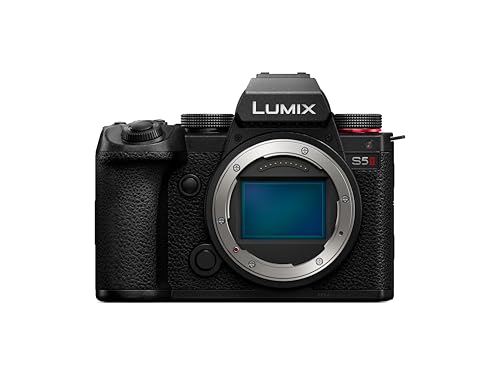
Panasonic LUMIX S5II — Mirrorless alternative — not a DSLR
Label first, as promised: the S5II has no mirror and no optical finder, and it appears here because Panasonic designed it as a film tool before anything else. Phase-detect autofocus answered the one criticism its predecessor earned, joining a video specification — open-gate recording, serious monitoring tools, cooling that respects long takes — that working videographers recite with respect. For a production that films interviews all afternoon, this body’s manners under sustained recording are the argument.
Stabilisation changes what one operator can attempt. The in-body system smooths handheld walking shots and static frames that would otherwise demand a tripod, which quietly expands a small crew’s shot list on real locations. Combined with the L-mount’s growing lens shelf — native glass plus alliance partners — the S5II assembles into a rig that punches at productions with larger crews and longer call sheets.
- Format: full-frame mirrorless, L mount — not a DSLR
- Focus for film: phase-detect autofocus with subject tracking
- Stabilisation: in-body, suited to handheld production
- Recording: long-take cooling and open-gate options
- Role: the video-first alternative for interview and event crews
Strengths
- Built for sustained filming rather than adapted to it
- Handheld footage stays composed without a gimbal on many shots
- Monitoring tools serve serious colour work
Trade-offs
- Leaving DSLR mounts behind means new lenses or adapters
- No optical finder for stills traditionalists
- L-mount shelf, while growing, is younger than rivals’
Consider this body the control group in the guide’s experiment. Set its portrait beside the DSLRs above and the differences are the decade’s story: autofocus you can delegate, stabilisation you can lean on, recording designed for hours. Filmmakers who find themselves nodding at every sentence of this section have learned something useful about which side of the aisle their next body lives on — and that knowledge is worth the detour whatever they buy.
Crews shooting weddings and corporate films report the same quiet virtue: predictability. The camera starts, records, tracks and survives the day without becoming the day’s story, and in professional film work the absence of drama is the highest specification of all.
Best for: videographers filming long interviews, weddings and events as a primary living. Not suited for: DSLR loyalists with deep EF or F-mount shelves and no wish to adapt

Canon EOS R6 Mark II — Mirrorless alternative — not a DSLR
Again, plainly labelled: no mirror lives in this body. The R6 Mark II is what Canon built for the filmmakers its DSLRs raised — a full-frame mirrorless camera whose autofocus follows faces and eyes with calm certainty, whose stabilisation steadies handheld work, and whose video credentials were specified by people who had read a decade of DSLR filmmakers’ wish lists. For the 5D-tradition shooter whose EF lenses adapt gracefully onto it, this is less a defection than a graduation.
Adaptation is the bridge worth describing carefully. Canon’s EF-to-RF adapters carry the older lenses’ autofocus and communication across with a fidelity that surprised sceptics, so a film kit assembled over years keeps working while native RF glass arrives piece by piece. The body’s own contribution — dependable tracking, generous recording, colour that matches the Canon look its users chose originally — then upgrades every lens on the shelf simultaneously.
- Format: full-frame mirrorless, Canon RF mount — not a DSLR
- Focus for film: deep-learning subject and eye tracking
- Stabilisation: in-body, coordinating with lens stabilisation
- Lens bridge: EF lenses via Canon adapter
- Role: the graduation path for Canon DSLR filmmakers
Strengths
- Autofocus a solo operator can genuinely delegate
- Existing EF film kits keep working through the adapter
- Hybrid stills quality keeps one body on mixed jobs
Trade-offs
- Native RF lenses ask real money as the kit rebuilds
- Electronic finder changes the stills feel DSLR hands love
- Not a DSLR — buyers wanting a mirror should look above
Solo creators feel this body’s case most strongly. A presenter filming alone — framing on the articulating screen, trusting the tracking, monitoring levels on real sockets — recovers the crew member the DSLR era made them hire or become. Productions that were logistics puzzles become afternoon tasks, and the films get made more often, which is the only metric that compounds.
Heat and recording endurance, the working filmmaker’s background worries, are handled with the seriousness this class now standardly offers, though long-event shooters should still test their exact settings — resolution, frame rate, ambient temperature — before a paid day. That advice, in truth, applies to every body in this guide; this one simply starts its test from a stronger position.
Best for: Canon DSLR filmmakers ready to modernise, and solo creators needing trustworthy tracking. Not suited for: buyers specifically seeking a true reflex body and optical finder

Sony Alpha 7 IV — Mirrorless alternative — not a DSLR
The third alternative wears its label openly too: the Alpha 7 IV is a mirrorless camera, included because Sony’s system became the working filmmaker’s default for reasons a film shopper should examine before committing anywhere. Autofocus that treats focus pulling as a solved problem, low-light files that stay composed at sensitivities DSLR filmmakers would have lit around, and an E-mount lens catalogue spanning every budget from kit zooms to cinema-minded primes.
Breadth is this portrait’s theme. A creator can begin with one affordable prime, add a workhorse zoom when commissions arrive, and rent exotic glass for the production that needs it, all inside one mount whose third-party support is the industry’s deepest. The body rewards that growth with hybrid manners — stills for the poster, film for the premiere — that suit the way modern creators actually earn.
- Format: full-frame mirrorless, Sony E mount — not a DSLR
- Focus for film: real-time eye and subject tracking
- Low light: high-sensitivity video that stays usable
- Lenses: the broadest native and third-party shelf
- Role: the mainstream mirrorless benchmark for hybrid creators
Strengths
- Focus tracking that frees attention for composition
- Lens choice at every price a production can justify
- Low-light filming without a lighting truck
Trade-offs
- Menus and handling divide opinion among DSLR-trained hands
- Crop applies in its highest frame-rate 4K mode
- Nothing about it is a DSLR, however the search began
Colour workflow deserves a sentence of respect. Sony’s picture profiles offer filmmakers a genuine grading path from flat, flexible footage to finished look, and the community of shared looks and tutorials around them is vast. Beginners can shoot a pleasing standard profile today and grow into the graded workflow next year without changing bodies — a learning curve built into the purchase rather than waiting at its end.
Set beside the DSLRs that open this guide, the Alpha 7 IV clarifies the actual decision. Nobody is choosing between good and bad cameras here; they are choosing between crafts — the deliberate, lens-rich, manual tradition of the reflex, and the delegated, stabilised, tracking fluency of the mirrorless present. Choose the craft you will enjoy practising weekly, because practice, not specification, is what finished films are made of.
Best for: hybrid creators filming in low light who want the widest lens ecosystem. Not suited for: DSLR purists, or anyone whose hands dislike Sony’s handling
How Do the Six Picks Compare?
| Pick | Category | Focus for film | Defining virtue |
|---|---|---|---|
| Full-Frame DSLR in the Canon 5D Tradition | True DSLR | Manual tradition | The classic cinema look and lens ocean |
| APS-C DSLR in the Canon 90D Tradition | True DSLR | Friendly live-view AF | The forgiving teacher |
| Full-Frame DSLR in the Nikon D780 Tradition | True DSLR | Mirrorless-grade live AF | F-mount value with modern tracking |
| Panasonic LUMIX S5II | Mirrorless alternative | Phase-detect tracking | Video-first endurance |
| Canon EOS R6 Mark II | Mirrorless alternative | Deep subject tracking | The Canon graduation path |
| Sony Alpha 7 IV | Mirrorless alternative | Real-time eye AF | Ecosystem breadth and low light |
Category honesty is the table’s first column on purpose. Decide whether a mirror matters to you — for the finder, for your lenses, for the craft’s feel — and the list halves itself; then let autofocus needs and recording style choose within your half.
Which Lenses Actually Make a DSLR Film Look Filmic?
Fast primes write the look beginners chase. A modest 50mm with a wide aperture, a 35mm for environmental scenes and an 85mm for interviews assemble the classic three-lens film kit on either Canon or Nikon mounts, each available used at prices that embarrass their image quality. Depth of field, gentle focus fall-off and low-light reach all arrive with those three purchases, and they arrive regardless of which body from this guide sits behind them.
Focus mechanics matter as much as optics for film. Lenses with long, smooth focus throws and hard stops reward manual pulling; fly-by-wire stills lenses can fight the habit. This is where the DSLR mounts’ depth becomes treasure — older manual primes, designed when focus was always human, adapt beautifully and cost little, and many working filmmakers quietly prefer their rendering to modern clinical sharpness.
Zooms earn one honest paragraph. A constant-aperture standard zoom covers event and documentary work where scenes cannot be re-blocked for a prime swap, at the cost of some low-light reach and depth play. Most film kits end up mixed — the zoom for the unpredictable day, the primes for the deliberate one — and mounts with deep used markets make that mixed kit a budget strategy rather than a compromise.
How Do You Record Sound a Film Can Be Proud Of?
Begin with the confession every film school makes on day one: audiences forgive soft pictures and never forgive bad sound. The microphone built into any camera body is a dictation device, adequate for sync reference and little more. A first shotgun microphone on the camera, or a wireless lavalier on the speaker, transforms production value more per unit of money than any lens in this guide, and every pick above provides the microphone input to accept one.
Monitoring separates recording from hoping. Headphone sockets — present on the film-minded bodies here — let an operator hear interference, clothing rustle and room echo while repair is still possible. Where a body lacks monitoring, an external recorder earns its bag space twice: once as the better recorder, once as the witness that the day’s sound actually exists. Check levels by ear on every setup, because meters alone have lied to generations of filmmakers.
Dialogue editing begins during recording, not after it. Leave a breath of silence before and after each answer, keep the microphone’s distance constant while a thought completes, and resist nodding encouragement that the microphone hears as percussion. Interviewers trained on DSLR sets develop these courtesies because the footage taught them to — one more way the tradition’s constraints quietly manufacture better filmmakers than its conveniences would have.
Rooms deserve as much attention as equipment. Hard walls echo, air conditioners drone, and the microphone hears the space the camera politely ignores. Choose softer rooms, move closer rather than louder, record thirty seconds of room tone for the edit, and your DSLR’s celebrated picture finally gains the soundtrack it deserved — the cheapest upgrade in this entire guide, purchasable with attention alone.
What Support, Power and Media Does a Film Day Consume?
Stability is a purchase, not a setting, on DSLR bodies without in-body stabilisation. A fluid-head tripod for deliberate work, a shoulder rig or monopod for movement, and the discipline to use them separate filmed scenes from captured wobbles. Budget the support with the body, because a classic DSLR on a proper head outperforms a newer body handheld on every locked shot a narrative film is built from.
Power planning is arithmetic again. Video drains batteries at a pace stills shooters find shocking, screens and live view drinking steadily through long takes. Carry multiples, rotate them with intent, and consider the dummy-battery and external-power options rigs use for interview days — few failures are as complete, or as avoidable, as a body going dark mid-answer while the spare sits in a car.
Media closes the triangle. Film files are large and arrive continuously, so cards must be fast enough for the chosen bitrate, capacious enough for the day, and duplicated into a backup habit the evening of every shoot. Two smaller cards rotated beat one enormous card hoarding a whole production, and the filmmaker who formats only after two copies exist sleeps the sleep of the insured.
How Do Recording Limits and Heat Shape a Real Shoot?
Older DSLRs divide the world into clips — a tax-era inheritance that caps continuous recording — and interview filmmakers learned to schedule around it: questions grouped, a stills frame taken while the counter reset, a second body rolling for coverage. The film-minded generations in this guide stretch or remove those caps to varying degrees, but the working habit survives: know your body’s limit precisely, and design the day so the limit is a footnote rather than a cliff edge.
Heat is the modern form of the same negotiation. High resolutions and frame rates in warm rooms tax any body, mirrorless alternatives included, and honest productions test their exact settings under their exact conditions before money rides on them. Shade, airflow, battery grips that move heat outward and sensible resolution choices keep most shoots clear of shutdowns; denial, by contrast, has ended more filming days than any specification gap.
Coverage thinking dissolves most of these worries at the planning stage. A companion camera — even the learner-class DSLR from this guide holding a wide shot — insures the main camera’s limits, gives the edit somewhere to go, and makes a two-body kit worth more than either body alone. Filmmaking has always been the art of the workaround; plan the workaround and the limits become texture rather than failure.
What Mistakes Do First-Time Film Buyers Keep Making?
Spending the whole budget on the body leads, as it leads in every camera guide ever written, because film is a system that bills by the department. A body at two-thirds of the budget, wearing a fast prime, fed by a real microphone and standing on a fluid head, produces films visibly and audibly superior to a flagship body with a kit lens recording its own echo. Allocate like a producer, not a collector.
Chasing resolution while ignoring focus runs second. A soft 4K shot is a soft shot at four times the file size, and beginners who buy resolution before they can hold focus — manually on a DSLR, or by choosing a body whose tracking they trust — end up with very detailed evidence of their learning curve. Focus, light and sound, in that order, are where first films are won.
Confusing category labels completes the trio, and this guide’s labelling exists because of it. A mirrorless body is not a failed DSLR and a DSLR is not an obsolete mirrorless; they are different tools whose names describe their construction. Buyers who choose by craft and ecosystem, rather than by which label sounds more serious, end up filming more — which was, beneath the typo that brought us here, the entire point.
How Should Different Filmmakers Divide This List?
Narrative directors working with a small crew and controlled scenes should start at the top: the classic full-frame DSLR tradition, manual primes, deliberate light. Your sets already pause for focus marks and second takes, so the DSLR’s demands are your workflow’s native language, and its look is the one your references were shot with.
Documentary and event filmmakers live in unrepeatable moments, so autofocus honesty should lead their reading — the Nikon hybrid among the DSLRs, or the mirrorless alternatives whose tracking was built for exactly the wedding entrance and the conference answer that happens once. Weddings forgive nothing; choose the body whose focus you would trust with the kiss.
Teachers, students and solo creators should let the articulating screen and the forgiving crop of the learner class argue first, with the Canon mirrorless graduation as the visible next step. Skills compound faster than equipment depreciates, and the filmmaker who shoots weekly on an approachable body will out-direct the collector waiting for a perfect one — this month, next month, and at every festival deadline in between.
How Does Light Decide More Than the Body Ever Will?
Watch any admired low-budget film with the sound off and a notebook open, and a pattern emerges that camera shopping tries to hide: the scenes glow because somebody placed the subject near a window, waited for the cloud, or hung one practical lamp with intent. A DSLR’s celebrated large sensor is best understood as a light multiplier — it makes modest, well-placed light look expensive — rather than a substitute for lighting altogether. The filmmaker who learns to see light owns an upgrade no manufacturer can sell them twice.
Window light is the first studio and it charges nothing. North-facing softness for interviews, hard morning sun for texture, the blue quarter-hour after sunset for exteriors that look budgeted: a week of deliberate experiments with one window teaches more cinematography than a month of specification comparisons. Every body in this guide records those experiments faithfully, which is precisely why the experiments outrank the bodies.
One lamp, thoughtfully owned, is the second studio. A single dimmable light with a softbox covers interviews, product scenes and night interiors for most small productions, and learning its three positions — key, fill by bounce, background separation — is a weekend’s work with a lifetime’s compound interest. Buy the lamp before the second lens; your future footage will testify in the lamp’s favour.
What Does a Sensible First Production Look Like, Step by Step?
Pre-production is where beginners save the money professionals spend. Write the one-page script, list every shot on a single sheet, scout the room at the hour you will film it, and test the whole audio chain in that room before any actor arrives. A DSLR kit rewards this discipline disproportionately, because its manual habits — focus marks, exposure set by hand, levels checked by ear — are simply pre-production continued by other means.
Shoot day runs on small rituals. White-balance deliberately rather than trusting auto under mixed light. Record the room tone. Slate or clap where an external recorder is running so picture and sound can marry in the edit. Check the first take’s focus magnified, not its tenth, and glance at the histogram before the location is struck and the light that made the scene has gone home without you.
Post-production closes the loop the purchase began. Back up the cards twice before formatting anything, sync sound before cutting picture, and grade gently — the DSLR image, especially, rewards a light hand, because its colour was the reason for choosing the tradition in the first place. Then screen the finished piece for one honest friend, note where their attention wandered, and let that screening, not the internet, write the shopping list for whatever comes next.
How Do Frame Rates and Shutter Choices Shape the Film Look?
Motion has a grammar audiences learned from a century of cinema. The familiar cadence of twenty-four frames per second, paired with a shutter near the traditional angle, produces the slight blur-and-stutter that viewers read as “film” before they can name why. Every body in this guide offers that cadence; the discipline is choosing it deliberately for narrative work rather than drifting into television-smooth rates because a menu made them easy.
Higher frame rates are tools with specific jobs. Slow motion for the athlete’s effort, the product’s splash, the dress’s turn — shot fast, played at the project’s base rate, rationed to the moments that earn emphasis. Beginners spray slow motion across whole films and wonder why nothing feels emphatic; professionals treat it as italics, powerful exactly because the rest of the page is set in roman.
Shutter discipline protects the illusion in both directions. Too fast a shutter makes motion stroboscopic and cheap; too slow smears faces into watercolour. Neutral-density filtration — the filmmaker’s sunglasses for the lens — exists so the shutter can stay grammatical in bright light while the aperture stays wide for depth, and a variable ND filter is among the first accessories a DSLR film kit should adopt after the microphone.
How Should You Test a Film Camera Before the Money Settles?
Rent or borrow before buying whenever the market allows it, and test the exact work you intend to do rather than a tour of the menu. Shoot an interview in your real room with your real microphone. Film a face beside a window at noon and again at dusk. Record the longest take your productions need and watch the body, the card and the battery all the way through it. A weekend of honest rehearsal reveals more than a season of other people’s reviews, because it measures the camera against your light, your rooms and your patience.
Inspect the footage at full size with the sound turned up and your optimism turned down. Hunt for the faults your productions cannot forgive: focus that breathes or hunts during dialogue, highlights that tear on skin, audio that hums when the camera moves, files that fight your editing machine. Every body in this guide passes somebody’s test triumphantly and fails somebody else’s on one of those lines, and the only verdict that should govern your money is the one your own footage delivers.
Used DSLRs add one inspection ritual of their own. Bring a lens you trust, shoot a plain bright wall to expose sensor marks, work every dial and socket, and record a minute of video while listening through headphones to the body’s own noises. Sellers of honest equipment welcome the ceremony; sellers who hurry it are providing information too, and the wise buyer prices that information into the walk-away.
Final Recommendation
Choose by allegiance, then by autofocus. If your shelves hold Canon EF glass and your heart holds the reflex tradition, the classic full-frame class is your film camera and the R6 Mark II is its designated successor when tracking envy strikes. Nikon loyalists should take the hybrid DSLR and its F-mount treasury without a backward glance. Newcomers owe themselves the learner’s APS-C year — or, if the budget stretches and solo creation is the plan, an honest look at the S5II and Alpha 7 IV, whose labels this guide has kept clean so the comparison stays honest.
Whatever body wins, spend the remainder like a filmmaker: a fast prime, a microphone you can monitor, support that holds still, cards and batteries in plural. That allocation, repeated across every portrait above, is the difference between owning a camera that records video and owning a film kit — and it is achievable at every tier this guide covers.
And keep the typo that started the search as a small souvenir. “Dlsr” brought you to a page that insisted on definitions before recommendations, and filmmaking rewards exactly that habit: define the shot, the sound, the light, then reach for the tool. The directors whose work you admire are not the ones with the newest bodies; they are the ones who knew what they meant before they pressed record.
Frequently Asked Questions
Does “film” here mean shooting on photographic film?
No — and this guide says so at the top rather than burying it. Film is read as filmmaking: recording video. Every pick is a digital camera judged on its moving-image work. True film photography is a wonderful and separate discipline with its own bodies and laboratories, and a reader seeking it deserves a guide written for that craft rather than a section smuggled into this one.
Are the mirrorless picks in this guide DSLRs?
They are not, and they are labelled “mirrorless alternative — not a DSLR” in the quick picks, their headings and the comparison table. They are included because a film shopper today should see the comparison before spending, not because the categories blur. If you want a mirror and an optical finder, the first three picks are your list; if the label matters less than the filming, all six are.
Can a DSLR record a full interview without stopping?
It depends on the generation. Older DSLRs cap continuous clips at limits that interviewers must schedule around, while film-minded later bodies stretch those limits considerably. Check the specific body’s continuous recording behaviour against your longest expected take, design coverage with a companion camera for anything precious, and test under your real room temperature — the professional habit that makes limits boring.
Why does everyone say audio matters more than the camera?
Because audiences experience it that way. A slightly soft image reads as style; distorted, echoing or missing sound reads as failure within seconds. Every pick here accepts an external microphone, and the film-minded ones add headphone monitoring so problems are heard while they can still be fixed. Spend on the microphone before the second lens and your films will sound like the exception among beginners.
Do I need full-frame for a filmic look?
No — you need control of depth, light and motion, all of which the APS-C pick provides with training wheels on the focus. Full-frame buys shallower depth and cleaner low light, which narrative work enjoys and interviews rarely require. Generations of admired short films were shot on crop sensors; the look lives in the lens choice, the lighting and the grade far more than in the sensor’s dimensions.
Should a beginner buy a used DSLR or a new mirrorless body?
Both are defensible, and the decider is temperament. A used DSLR with a fast prime teaches manual craft cheaply and resells kindly; a new mirrorless body delegates focus and stabilisation so a solo beginner can concentrate on story. Buy the one whose daily handling you will enjoy, because the camera that leaves the bag weekly teaches more than the superior one that stays home.
Related Guides
Continue with choosing fast prime lenses for video on a budget, work through recording clean dialogue with your first microphone, or compare the neighbouring shelf in mirrorless cameras for filmmaking explained plainly. Each follows one department of the film kit — glass, sound, bodies — to the depth a first production deserves.
One last piece of counsel belongs to whoever shoots their first real scene on any body in this guide: watch the footage that same evening, with the sound up, and write down three things that worked and three that did not before sleep files the day as a blur. Filmmakers are made in that nightly honesty far more than in any purchase, and the camera — DSLR or otherwise — is simply the instrument that keeps giving you evenings to learn from.


