ilcastellomenu.com is reader-supported. When you buy through links on our site, we may earn an affiliate commission.
Where to Buy a First Camera You Intend to Learn On
The best digital cameras for a beginner photographer who means it — who is buying a first dedicated camera for themselves, to learn the craft properly rather than to escape a phone — share one trait the casual shortlists ignore: they teach without ceilings. This guide is written for the adult beginner standing in front of the shelf with a serious intention and a finite budget, wondering which body and kit lens will still be serving their education in year three. Every pick below is sold with a kit lens by mainstream retailers, every one belongs to a lens system worth growing into, and every one was chosen because its automatic kindness on day one does not become a limitation by month twelve.
One distinction before the shopping starts, because readers arrive here from two directions. If you already photograph fluently with a phone and want that skill translated onto real glass, our companion guide to the best digital cameras for beginning photographers argues the phone-graduate case in full. This page assumes something slightly different: that you are starting photography as a discipline — exposure, focus, light, composition — and want the camera itself to be structured like a curriculum. The picks overlap less than you would expect, because a camera that flatters existing habits and a camera that builds new ones are different instruments.
What “learning seriously” actually requires is worth stating plainly, since marketing will not. You need manual controls that are physically reachable, not buried; a viewfinder or screen that shows you the effect of your settings before the shot; files that tolerate your editing education; and a kit lens honest enough that your early failures are your own, because a beginner cannot learn from equipment that lies to them. You do not need the most expensive sensor, the fastest burst or a body built for war zones. The six cameras below were ranked by how well they run a two-year apprenticeship, and the order may surprise readers who shop by specification alone.
Key Takeaways
- Buy the mount and the controls, not the launch headline — you are purchasing an education.
- The kit lens is your first teacher; choose the body whose kit covers your real subjects.
- A viewfinder changes how beginners learn to see; screen-only bodies teach a different path.
- Physical dials shorten the road to manual confidence more than any tutorial.
- Plan the second lens from month six’s evidence, not from month one’s enthusiasm.
- Every pick here can be operated fully automatically on day one and fully manually by year two.
In this guide
Quick Picks
| Camera | Badge | Why it earns its place |
|---|---|---|
| Canon EOS R50 | The kindest classroom | Guided menus explain the craft as you use it, inside the friendliest system a beginner can join. |
| Nikon Z50 II | The apprenticeship in one body | A proper viewfinder, serious subject detection and controls that assume you will grow — because you will. |
| Canon EOS R10 | The fast learner’s Canon | Joystick handling and rapid bursts for the beginner whose subjects refuse to sit still. |
| Fujifilm X-T5 | The dial-driven education | Shutter, sensitivity and compensation as metal dials: the exposure triangle learned by fingertip. |
| Sony ZV-E10 II | The learner who also films | Video-first design over a serious stills core, opening onto the widest lens library in the business. |
| OM SYSTEM OM-5 Mark II | The field-school camera | Compact, weather-sealed and clever, built for learners whose classroom is outdoors in any forecast. |
How Did We Choose Cameras for a Deliberate Beginner?
Our test was a syllabus in disguise. Each candidate had to support, in order, the lessons a serious beginner actually takes: automatic shooting with honest results; aperture control explored through portraits and landscapes; shutter control learned on water, wheels and animals; sensitivity understood in real indoor light; manual exposure assembled from those parts; and the beginnings of deliberate focus — choosing the point, not accepting it. Bodies that made any lesson awkward — controls exiled to touch menus, viewfinders too poor to judge focus, automatic modes that sabotaged rather than assisted — lost marks however fine their sensors.
We also interrogated the kit lens, because for the first year the kit lens is the camera. A learning kit must focus closely enough to experiment at the kitchen table, zoom widely enough for interiors and landscapes, and stay sharp enough that a beginner’s improving technique shows up in the files as improvement. Several famous bodies ship with kits that fail the last test, quietly convincing learners that they have plateaued when they have merely been out-resolved by their own zoom. All six kits here pass, though they differ in character, and the individual sections say how.
The final filter was the community around the camera. A self-teaching beginner lives on tutorials, forums, local clubs and the friend who answers questions at midnight. Systems with deep beginner literature and large user bases — Canon and Sony above all, Nikon and Fujifilm close behind — shorten every lesson. The OM System pick is the exception that argues its own case: a smaller tribe, but one disproportionately full of outdoor teachers, and a body whose weather sealing suits a learner whose practice happens in real weather.
What Does a Beginner Actually Need to Learn, in What Order?
Less than the internet claims, in a sequence kinder than most courses admit. The first lesson is simply attention: standing in the right place, noticing the edges of the frame, waiting one breath longer. Any camera teaches it, which is why week one belongs to automatic mode and volume. The second lesson is aperture, because its effect — what is sharp, what melts away — is the most visible signature of intentional photography, and beginners who grasp it feel the craft click. The third is shutter speed, learned the first time a fountain or a cyclist is frozen and then deliberately smeared. Sensitivity, white balance and exposure compensation follow as refinements, each answering a frustration the learner has personally had.
Notice what is absent from that sequence: manual mode as an entrance exam. Manual exposure is a destination assembled from the earlier lessons, useful for studios, night skies and stubborn lighting, and a poor way to learn any of them individually. The cameras in this guide were partly chosen because their priority modes — aperture-priority and shutter-priority, the working photographer’s daily tools — are first-class citizens with dedicated dials or immediate access, not afterthoughts. A beginner should live in those modes for most of year one and visit manual the way a language student visits a new tense: deliberately, with support.
Composition, the lesson that outlasts all the technical ones, is taught by constraints rather than settings. This is why the guide keeps returning to the kit lens’s honest focal lengths and why several picks reward the photographer who moves their feet. The beginner who learns to see with one zoom’s range — what to include, what to exclude, where to stand — has learned the transferable skill; the one who collects lenses to solve composition problems has learned shopping. Both are pleasant. Only one is photography.
Why Do Controls Matter More Than Sensors for a Learner?
Because learning is a loop — decide, shoot, review, adjust — and controls set the loop’s speed. A setting reachable by a dedicated dial gets experimented with a hundred times a month; a setting buried three menus deep gets experimented with twice and then left alone, and the corresponding lesson quietly never happens. This is the entire argument for the Fujifilm’s dials and the Nikon and Canon enthusiast layouts in this list: they are not professional affectations but pedagogical instruments, placing the exposure triangle where a beginner’s fingers can interrogate it daily.
Sensors, by contrast, have plateaued at a level where every body in this guide produces files far beyond a beginner’s ability to exploit in year one. The differences that remain — a little more dynamic range here, a little cleaner high sensitivity there — matter to the photographer’s third year more than their third month, and by the third year the learner will know their own priorities well enough to shop for them. Buying a first camera by sensor ranking is like buying a first piano by the metallurgy of its frame: not irrelevant, merely not where the learning lives.
The screen and viewfinder deserve the same practical scrutiny. A beginner learns exposure partly by preview — seeing brightness and depth change as settings change — so the quality of the live view is a teaching feature. Bodies with bright, responsive finders make the loop feel immediate; the one screen-only pick here compensates with the largest, clearest display of the group and a video-led design its intended learner will prefer. Judge these parts in a shop if you can, with your own eyes, for a full minute each. It is the most informative minute of the whole purchase.
Which Are the Best Digital Cameras for a Beginner Photographer Learning Seriously?
Two Canons split by temperament, a Nikon that refuses to patronise, a Fujifilm that teaches through its dials, a Sony for the learner whose course includes filmmaking, and an OM System body for the student whose classroom has weather. All six assume the same reader: an adult, a budget that matters, and an intention that will outlast the honeymoon.

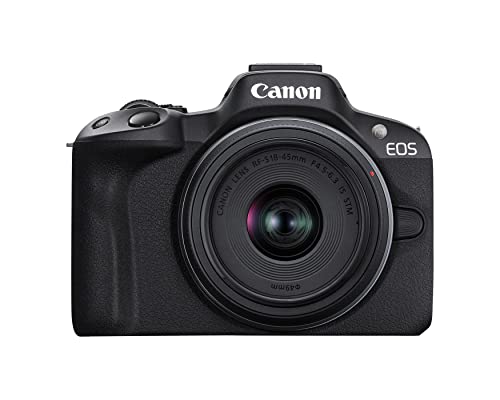
Canon EOS R50 — The kindest classroom
The R50 is the beginner camera Canon designed by watching beginners. Its guided interface replaces jargon with plain sentences and sample images — the mode dial becomes a sequence of intentions (“blur the background”, “brighten the scene”) that map, invisibly, onto the real controls underneath. For the self-teaching adult this matters enormously in month one: instead of memorising vocabulary before making photographs, you make photographs and absorb the vocabulary as the camera explains what it just did. Confidence arrives early, and early confidence is the currency all later learning is bought with.
Beneath the kindness sits a real system. The autofocus detects and follows eyes with a reliability that lets a learner concentrate on composition rather than focus anxiety; the RF mount offers an affordable staircase of lenses; and when the guided interface is switched off — a graduation day most owners reach within the year — the full manual apparatus is waiting, in menus widely considered the easiest in the industry to navigate. The kit lens is a competent, honest zoom that covers the beginner’s actual subjects: rooms, people, streets, the nearer end of landscapes.
- Format: APS-C mirrorless, Canon RF mount
- Guidance: assisted interface explaining settings in plain language
- Focus: eye detection for people and animals
- Screen: fully articulating touchscreen
- Role: the beginner system with training wheels that unbolt
Strengths
- Fastest route from first frame to intentional photographs
- Menus a self-teacher can navigate without a manual open
- Colour and automatic exposure that reward early efforts
Trade-offs
- Enthusiast controls are deliberately modest in number
- Compact body can feel small in very large hands
- No in-body stabilisation; stabilised lenses do that work
For the deliberate beginner, the R50’s deepest virtue is the size of its congregation. Canon’s entry system is the one your local club, your evening class and half the internet’s beginner tutorials are built around, which means every question you will ask in year one has been answered, filmed and argued about already. Self-teaching is lonely enough without choosing an orphan dialect. The R50 lets a beginner spend their solitude on photographs instead of translation.
Choose it if your learning style is guided and social, and your subjects are the human world. Look at the R10 instead if you already know your subjects move fast, and at the Fujifilm if you learn best with your hands on metal dials.
Best for: self-teaching beginners who want guidance without a ceiling. Not suited for: action specialists or dial traditionalists

Nikon Z50 II — The apprenticeship in one body
Nikon’s Z50 II is the pick for the beginner who dislikes being treated as one. It offers the full apparatus of an enthusiast camera — a bright electronic viewfinder, subject detection spanning people, animals and vehicles, fast continuous shooting, and a control layout with room for your fingers to develop opinions — while keeping its automatic modes honest and its menus navigable. The serious beginner can begin in the shallow end on the first weekend and still be finding new depth in the same body two years later, which is precisely the economics a deliberate learner should want.
The viewfinder deserves its own argument, because it changes the kind of photographer a beginner becomes. Composing at the eye, elbows tucked, shuts out the world’s distractions and stabilises the camera against the face; depth of field and focus become visible rather than theoretical. Beginners who learn through a finder tend to shoot fewer, more considered frames — a discipline that accelerates the attention lesson described earlier in this guide. The Z50 II’s finder is good enough to teach that discipline properly, which cannot be said of every beginner body.
- Format: APS-C mirrorless, Nikon Z mount
- Finder: electronic viewfinder for braced, deliberate composition
- Detection: people, animals and vehicles
- Handling: full grip and enthusiast control layout
- Role: the one-body apprenticeship
Strengths
- Headroom that postpones any second body for years
- Viewfinder discipline visibly improves handheld sharpness
- Subject detection covers the beginner’s whole likely world
Trade-offs
- Steepest first month of the cameras in this guide
- A bag camera — larger than the screen-led alternatives
- Rich menus reward study rather than forgiving its absence
The Z50 II also suits the beginner whose likely subjects are already visible on the horizon: the child joining a team, the dog, the garden birds, the motorsport habit of a friend. Its tracking and burst abilities mean those subjects become curriculum rather than frustration, and the Z mount’s telephotos give the second-lens decision an obvious, affordable answer when the evidence arrives. It is the least “beginner” camera here in specification and the most respectful of a beginner’s trajectory.
Buy it if your history with new skills is intense — you finish courses, you practise scales, you keep notebooks. The Z50 II assumes that reader and rewards them earliest.
Best for: committed learners who want one body for the whole apprenticeship. Not suited for: minimalists or the casual weekend shooter

Canon EOS R10 — The fast learner’s Canon
Where the R50 teaches gently, the R10 teaches briskly. It shares Canon’s welcoming colour and menus but adds the apparatus of speed: a joystick for placing focus deliberately, a deeper grip for longer lenses and longer days, and continuous shooting quick enough to make sport and wildlife legitimate beginner subjects rather than advanced electives. For the learner whose diary is already full of motion — touchlines, dance classes, gundogs, grandchildren — it is the Canon that will not ask them to slow their life down to the camera’s pace.
The pedagogical difference is subtle but real. The R10’s controls assume the student will graduate to deliberate technique quickly, so the dials and buttons for the priority modes sit closer to the surface, and customisation lets a growing photographer arrange the body around their emerging habits. Beginners who learn fast often find gentle cameras begin to chafe by month six; the R10’s layout postpones that friction for years, at the cost of a slightly denser first fortnight. Its kit options also stretch further, including zooms that reach into telephoto territory for the action-minded.
- Format: APS-C mirrorless, Canon RF mount
- Controls: joystick, deeper grip, enthusiast layout
- Detection: people, animals and vehicles with tracking
- Speed: rapid bursts for action and wildlife lessons
- Role: the accelerated Canon apprenticeship
Strengths
- Action capability that turns hobbies into curriculum
- Handling rewards growing technique immediately
- Same friendly Canon ecosystem and colour as the R50
Trade-offs
- More camera than a gentle learner will use in year one
- No in-body stabilisation; lens stabilisation carries the load
- The second-lens itch arrives early and points at telephotos
Think of the R10 as the honours stream of the Canon classroom: same school, faster set. Its particular economy is the avoided transaction — beginners who buy gentle, sell at a loss within eighteen months and rebuy at this level are a cliché of camera retail. The learner who recognises their own intensity honestly at the start skips the cliché and spends the saved money on the telephoto or prime their subjects actually demand.
Choose it when motion is already your subject and technique is a pleasure rather than a chore. The R50 remains the better door for the uncertain; the R10 is the better door for the certain.
Best for: fast-learning beginners whose subjects move. Not suited for: anyone wanting the smallest, quietest start

Fujifilm X-T5 — The dial-driven education
The X-T5 teaches photography the way a piano teaches music: by putting the mechanism under your fingers. Shutter speed is a metal dial on the top plate. Sensitivity is a dial beside it. Exposure compensation has its own wheel, and aperture is a ring on the lens. Every core setting is visible with the camera switched off, adjustable without a menu, and memorable by touch within a month. Beginners who learn on this body describe the exposure triangle not as a diagram they memorised but as a place their hands know — and that embodied knowledge transfers to every camera they will ever touch.
It helps that the instrument is formidable. The high-resolution APS-C sensor out-resolves several full-frame rivals, in-body stabilisation steadies the learning process, and Fujifilm’s film-inspired colour profiles produce files that look finished before editing enters the curriculum — a mercy in year one, when post-processing is a second education competing for the same evenings. The X mount’s lens catalogue is deep, characterful and rich in the compact primes that suit a learner’s walk-around practice.
- Format: APS-C mirrorless, Fujifilm X mount
- Controls: dedicated dials for shutter and sensitivity, aperture rings
- Colour: film-inspired profiles finished in camera
- Sensor: high-resolution with in-body stabilisation
- Role: the tactile, traditional apprenticeship
Strengths
- Exposure learned physically, at fingertip speed
- Files that flatter a beginner before editing skills arrive
- A body beautiful enough to be carried daily, which teaches most
Trade-offs
- Priced above the entry bodies; it is an investment pick
- Tracking autofocus trails the Canon and Nikon for erratic action
- Dial discipline is wasted on learners who prefer full automation
The X-T5’s distinctive gift to a curriculum is honesty about process. Because every setting sits in the open, a beginner’s mistakes are diagnosable at a glance — the dial says what the camera was told to do — and mentors, club members and the learners themselves can read the error off the top plate. Cameras that hide their state inside menus make the same mistakes mysterious. For a student who intends to understand, that legibility is worth real money.
Buy it if you learn by handling, if you suspect photography is a long affair rather than a phase, and if the idea of a camera as an instrument — tuned, carried, kept — appeals to you as much as the photographs do.
Best for: tactile learners investing in a long apprenticeship. Not suited for: budget-first buyers or action-led beginners

Sony ZV-E10 II — The learner who also films
Some beginners are honest that their course has two subjects: photography, and the moving image they already publish. The ZV-E10 II is the pick that takes that honesty seriously. It is a compact APS-C body organised around filming — flip screen for self-framing, a record button that cannot be missed, focus behaviour designed for presenting objects and people to camera — built over a stills core with autofocus as good as anything in this guide. A learner can study exposure on stills in the morning and apply the same triangle to footage in the afternoon, in one body, on one lens mount.
That mount is the strategic half of the argument. Sony’s E system offers the widest lens choice in modern photography, including a deep bench of affordable third-party glass, so the student’s second lens — the fast prime that teaches depth of field properly — can be bought sooner and cheaper than in any rival system. Sony’s autofocus, meanwhile, is the patient tutor of the video age: it holds eyes through movement and occlusion, letting a solo learner perform, demonstrate and narrate without a camera operator, which is how most modern beginners actually practise.
- Format: APS-C mirrorless, Sony E mount
- Orientation: video-first controls over a serious stills core
- Focus: tenacious face and eye tracking for solo work
- Lenses: the widest native and third-party catalogue available
- Role: the combined stills-and-film apprenticeship
Strengths
- One body teaches both halves of a modern visual practice
- Lens library makes the educational second lens affordable
- Autofocus forgiving enough for solo filming lessons
Trade-offs
- No viewfinder — the stills education is screen-led
- Layout favours filmmakers; stills purists may grumble
- Rolling shutter asks for care with fast pans in video
Its particular service to the deliberate beginner is economic realism about where visual skills now lead. The student who emerges able to light, expose and focus both a portrait and a product film holds a portfolio most workplaces and clients can use immediately. If your learning plan has a practical destination — a channel, a shop, a freelance sideline — this Sony is the only pick designed from the factory for that destination, rather than adapted to it later.
Stills-only learners should admire the autofocus, then buy the Nikon or a Canon and enjoy their viewfinders. This body’s talents are genuine but aimed, and aiming is a virtue only when it matches the target.
Best for: beginners learning stills and video as one craft. Not suited for: viewfinder traditionalists

OM SYSTEM OM-5 Mark II — The field-school camera
Every class has a student whose real classroom is a hillside. The OM-5 Mark II is built for that learner: a compact Micro Four Thirds body with serious weather sealing, in a system whose lenses are famously small, so the whole school — body, standard zoom, a telephoto for wildlife — fits a bag that would embarrass the other systems’ body-and-one-lens kits. For the beginner whose intended subjects are landscapes, weather, trails and wildlife, the size of the system is not a compromise; it is the enabling feature, because the best learning camera is the one present at the summit.
The body’s cleverness serves the curriculum directly. Computational aids — the kind that preview long-exposure effects live, or stack focus for close-up work — let a beginner experiment with techniques that on other systems demand tripods, filters and arithmetic, and see results as they happen. That live feedback is pedagogically precious: the loop of decide-shoot-review tightens to seconds. The sealing, meanwhile, removes the beginner’s most paralysing fear, that weather will kill the investment, and replaces it with permission to practise in the rain, the spray and the frost where the interesting light lives.
- Format: Micro Four Thirds mirrorless, compact system
- Sealing: weather-resistant body for outdoor practice
- Tools: live long-exposure preview and focus stacking aids
- Lenses: the smallest interchangeable-lens catalogue
- Role: the outdoor learner’s field school
Strengths
- A whole learning kit that travels in a small bag
- Weather sealing converts bad forecasts into practice days
- Computational aids teach advanced techniques interactively
Trade-offs
- Smaller sensor concedes some low-light and blur potential
- Menus are denser than Canon’s for a first month
- The system’s tribe is smaller; local advice is thinner
There is a reach argument hiding in the small sensor, too: its crop makes telephoto lenses effectively longer, so the beginner naturalist gets wildlife framing from lighter, cheaper glass than any rival system demands. The learner whose notebook fills with birds, boats and distant ridges will feel that advantage on every walk, in the shoulders as much as the files. Few beginner decisions compound as reliably as choosing the system whose weight you will still be carrying in year three.
Choose it if your intended photography happens outdoors, uphill and in weather, and if a compact kit is the difference between practising weekly and practising on holidays.
Best for: outdoor learners who value reach, sealing and small kits. Not suited for: low-light portrait specialists
How Do the Six Learning Cameras Compare?
| Camera | Teaching style | Finder | Second-lens outlook |
|---|---|---|---|
| Canon EOS R50 | Guided, plain-language | Electronic | Affordable RF staircase |
| Nikon Z50 II | Full apparatus, learn fast | Electronic | Z primes and telephotos |
| Canon EOS R10 | Brisk, action-led | Electronic | Telephotos arrive early |
| Fujifilm X-T5 | Dial-driven, tactile | Electronic | Compact characterful primes |
| Sony ZV-E10 II | Video-led, screen-based | None | Widest and cheapest choice |
| OM SYSTEM OM-5 Mark II | Field school, computational | Electronic | Small, long-reaching zooms |
Match the teaching style to the student you actually are. The sensor column would tell you almost nothing; this table tells you how your Tuesdays will feel.
How Should the First Six Months of Learning Be Structured?
Month one: automatic mode, daily carrying, and the discipline of review. Shoot your real life, transfer the keepers each evening, and write one line about what pleased or disappointed you in the best frame. You are training attention and building the archive habit while the camera’s operation becomes physical. Month two: aperture-priority, one subject studied repeatedly — a person, a street corner, a garden — shot wide and stopped down until depth of field stops being vocabulary and becomes instinct.
Month three belongs to shutter speed: water, traffic, animals, sport — frozen, then deliberately blurred, with a cheap tripod or a wall for the slow work. Month four is light itself: the same scene at dawn, noon, dusk and lamplight, learning why photographers organise their lives around the day’s edges. Month five introduces deliberate editing — the RAW files you have been saving begin their second education — and month six is the audit: print the ten best, pin them up, and let them dictate the second lens, the course, or the club membership that year two requires.
Two rules govern the whole half-year. Change one variable at a time, because photography learned in combinations cannot be debugged. And keep every file, however embarrassing, until the audit: the beginner’s archive of failures is the only textbook written specifically about their own eye, and its lessons are unavailable anywhere else at any price.
What Should the Second Lens Be, and When Should It Arrive?
The evidence of the first six months answers this, and the answer is usually one of two lenses. If your keepers are people — family, friends, portraits in available light — a fast prime at a portrait length will transform your evenings and teach depth of field more thoroughly in a month than the kit zoom taught in six. If your frustrations are distance — the stage, the touchline, the birds — a modest telephoto converts complaint into curriculum. The systems in this guide all offer both at prices a careful beginner can reach, Sony’s and OM’s most painlessly of all.
Timing matters as much as choice. Bought in month one, a second lens is a guess that splits a beginner’s attention between two instruments. Bought after the audit, it is a prescription. There is also a discipline argument for the wait: six months with one zoom teaches focal-length seeing — knowing what a scene needs before raising the camera — and that fluency, once learned, makes every future lens cheaper to own because it is bought for a known job.
Resist, finally, the third-lens conversation until year two has a vote. The classic beginner arc — body, prime, telephoto, then a long pause while skill catches up with glass — exists because it works. The photographers who short-circuit it own beautiful shelves and ordinary archives; the ones who honour it own the reverse, and archives are the point.
How Do You Practise Deliberately Instead of Just Shooting More?
Volume teaches the eye; assignments teach the photographer. Give yourself constraints with the seriousness of a music student’s scales: one focal length for a weekend, one colour for a day, one subject photographed ten ways before moving on, one roll’s worth of frames — thirty-six — for an entire outing, each one earned. Constraints convert wandering into study, and the cameras here support them gracefully: zoom lenses can be taped at a length in spirit, drive modes can be slowed, review can be postponed until evening like film.
Feedback is the second half of deliberate practice, and the beginner must manufacture it. Join the club, take the evening class, find the one friend whose criticism is kind and exact, or use the structured communities that gather around each of these camera systems online. Post one photograph a week for judgement rather than a hundred for applause. The learners who improve fastest are never the ones with the best bodies; they are the ones whose work is regularly seen by eyes better than theirs, and who have built the temperament to enjoy that.
Keep a notebook — paper suits the pace — with three columns: what I tried, what happened, what I will change. Six months of those entries will teach you your own patterns more reliably than any course: the recurring overexposure, the horizons, the subjects you avoid and the ones you cannot leave alone. A beginner photographer is, in the end, a research project with one subject, and the notebook is its lab book.
What Changes in the Second Year of the Apprenticeship?
Year two is when the beginner’s questions change species. Year one asked how — how to expose, focus, freeze, blur. Year two asks what for: which subjects are mine, what do I want a body of work to say, where does my eye keep returning when nobody is assigning anything? The camera’s role changes accordingly, from teacher to instrument, and this is the moment the bodies in this guide quietly justify their headroom: the controls that felt generous in month two now feel necessary, the lens mount’s deeper shelves become relevant, and the beginner discovers which of their body’s features they have never touched — information as valuable as any review.
Specialisation begins, gently and reversibly. The portraitist starts lighting deliberately; the landscaper starts planning around weather and season; the street photographer starts working a neighbourhood the way a novelist works a setting. Each path asks the camera different questions, and a well-chosen first body answers most of them with a lens rather than a replacement. The beginner who bought into a system with affordable depth — all six here qualify, in their different currencies — experiences year two as expansion. The beginner who bought a dead end experiences it as a wall, which is why this guide weighted mounts so heavily from the first page.
Year two also brings the first honest portfolio review, and it should be conducted like a friend’s: generously, but without lying. Twenty photographs that survive a ruthless edit say more about your development than two thousand that were never judged. Pin them up, live with them for a month, and notice which ones keep earning their wall. The next purchase, course or project should be traceable to something those twenty photographs taught you. That traceability — equipment following evidence — is the habit that separates photographers who improve for decades from collectors who improve their shelves.
How Should a Beginner Learn to Edit Without Ruining Good Photographs?
Editing is the second craft, and it should be learned with the same one-variable discipline as shooting. Begin with the global questions — is the exposure honest, is the horizon level, does the crop serve the subject — and refuse the local, cosmetic tools until those three are reflexes. Most beginner photographs are damaged not by missing filters but by enthusiastic correction: saturation pushed until skies turn theatrical, shadows lifted until night looks like noon, sharpening applied until edges shout. The RAW files from every body here tolerate restraint beautifully and punish excess visibly, which makes them honest teachers.
Sequence matters. Edit in sittings, not marathons, and never on the same evening as the shoot if emotion is high — the beginner who edits while still thrilled keeps everything, and the one who edits while disappointed deletes gold. A week of distance converts the editor into a stranger with good taste, and strangers make better curators. Keep the rejects for a season before deleting; the audit at six months needs them, and more than one photographer has found their best early frame in the folder they nearly emptied.
The software question resolves itself pragmatically: every manufacturer here offers capable free editing tools for its own files, and the independent editors all speak these formats fluently. Choose one, learn it the way you learned the camera — in layers, in service of actual photographs — and resist collecting alternatives. Editing fluency, like camera fluency, is a depth game. The beginner who knows one editor’s ten core moves will out-produce the beginner who owns five editors and knows two moves in each, and their files will look like it.
How Do You Choose Between a Class, a Club and Teaching Yourself?
Each route teaches a different third of the craft, and the deliberate beginner eventually samples all three. A class gives sequence and accountability: a syllabus that orders the lessons, assignments with deadlines, and an instructor whose feedback is trained rather than kind. It suits beginners who know their self-discipline is better with a timetable, and its cost should be weighed against the second lens it may replace in the budget — for many learners the class is worth more, because it makes every subsequent lens purchase smarter.
A club gives community and comparison. Seeing twenty interpretations of the same monthly theme, printed and discussed, teaches composition faster than any solitary exercise, because it reveals how many decisions a single scene contains. Clubs also supply the social infrastructure of the hobby — the borrowed tripod, the recommended repair shop, the friend who knows where the kingfishers are. The systems in this guide all have club ecosystems; the beginner who joins one in the first season rarely photographs alone with questions again.
Self-teaching gives ownership. The curriculum in this guide’s earlier section is deliberately self-paced, and the internet’s depth around these six camera families means no lesson is more than a search away. Its weakness is feedback, and the wise autodidact imports feedback deliberately: one trusted critic, one weekly post for judgement, one printed portfolio reviewed twice a year. The route matters less than the mixture. Photographers are made by sequence, community and solitude in combination — and the beginner who understands that can stop worrying about choosing the perfect path and simply start walking one of them this week.
Why Does Printing Your Work Teach Faster Than Any New Lens?
Somewhere in the first year, every serious beginner should spend a modest sum on prints — not merchandise, not gifts, simply a dozen honest enlargements of their best frames, pinned where they will be seen daily. Print is the strictest teacher in photography because it removes every mercy the screen provides. The slight softness that a small display forgave becomes a fact on paper. The horizon that leaned by a degree leans in public. The exposure that looked moody at midnight looks merely dark at breakfast. Beginners who print regularly correct these faults at the taking stage within weeks, because the wall has made the faults unforgettable.
Print also recalibrates ambition in a healthy direction. A frame that survives enlargement — that holds a room, rewards a second look from across it, keeps its dignity at the size of a window — teaches its maker what their current equipment and skill can already do, which is usually more than the upgrade itch claims. Several of the cameras in this guide produce files that print far beyond the sizes a home will ever ask for; discovering that with your own best photograph, on your own wall, is the most persuasive anti-shopping argument in the hobby.
Make it a ritual with a date attached: the solstices, a birthday, the end of each season of the apprenticeship. Twelve prints, chosen ruthlessly, reviewed honestly, replaced by the next dozen. By the second year the beginner owns something no tutorial sells — a visible, physical record of an eye improving — and the camera that made it, whichever of the six it was, will have long since stopped being equipment and become the instrument the prints came from.
What Mistakes Do Serious Beginners Keep Making?
Buying the second body before the first education. The upgrade itch arrives disguised as ambition around month eight, when technique plateaus briefly and new hardware promises to break the plateau. It will not; practice will, usually within the month. The bodies in this guide were chosen with ceilings high enough that the itch, when it comes, can be honestly answered with a lens, a course or a trip — all of which teach more than a new body would.
Learning settings instead of light. Beginners collect techniques the way magpies collect foil, while the photographers they admire are mostly doing one thing: noticing where the light is, what it is doing, and where to stand in it. Schedule practice around light — the early hour, the window, the storm clearing — and the settings will be learned in service of something, which is the only way they are ever retained.
And hiding the work. The beginner who shows nobody their photographs improves at the speed of their own blind spots. Show the work early, to kind and competent eyes, and let the apprenticeship be social. Every camera in this guide has a tribe waiting; joining it is the highest-value accessory on the market, and it is free.
One final piece of shopping hygiene for the deliberate beginner: buy the camera from a seller you can return to, keep the box and receipt for the first year, and register the warranty the same week. Learning photographers change their minds about ergonomics once their hands have opinions — usually within the first month — and a clean return path converts that discovery from a financial injury into a simple exchange. The right camera bought from the wrong shelf, unreturnable and resented, teaches slower than the nearly-right camera bought with an exit. Seriousness about learning includes seriousness about the purchase itself.
Final Recommendation
Most deliberate beginners should buy the Canon EOS R50 and its kit lens: it teaches fastest, forgives earliest and opens the friendliest system, and its ceiling is high enough for the whole first phase of a serious education. Choose the Nikon Z50 II if you know your intensity and want the full apparatus from the start, the R10 if your subjects are defined by motion, the Fujifilm X-T5 if you learn with your hands and intend a long affair, the Sony ZV-E10 II if filmmaking shares your curriculum, and the OM-5 Mark II if your classroom is outdoors and your bag must stay small.
Then do the unfashionable thing: stop shopping. The beginner who buys once, carries daily, practises with assignments and shows the work will, within two years, be limited by nothing in this guide — least of all the camera they chose from it. That is the real test of a first serious camera, and all six of these pass it. Your education is the purchase; the camera is merely where it is delivered.
And keep the long view when the first plateau arrives, as it does for every beginner somewhere around the thousandth frame. A plateau is not the camera failing or the talent running out; it is the eye consolidating before its next expansion, and it breaks — reliably — with a new subject, a new constraint or a new audience, never with a new body. The apprentices who come through it are the ones still shooting in year three, which is the entire destination this guide has been steering toward.
Frequently Asked Questions
Should a beginner buy the kit lens or the body alone?
Buy the kit. The bundled zoom is inexpensive beside the body, covers the focal lengths a curriculum needs, and serves as the diagnostic instrument for choosing the second lens from evidence. Body-only pricing tempts beginners into an immediate prime purchase made from imagination; the kit lets the first six months vote first.
How long before a beginner outgrows these cameras?
Measured in skill, most owners take two to four years to reach the limits of the bodies here — and many never do, because the limits sit beyond family, travel and hobby needs entirely. The Z50 II, R10 and X-T5 in particular are cameras professionals use as second bodies; a beginner who “outgrows” one has usually outgrown a lens first.
Is a photography course worth it alongside the camera?
A structured course or club is the highest-value addition to any pick here, because feedback is the ingredient self-teaching cannot supply. Many beginners do best with a short course in month two or three — once they have questions of their own — rather than before the first frame, when the lessons have nothing to attach to.
Do I need to shoot RAW from the beginning?
Record RAW plus JPEG if the body offers it, edit the JPEGs, and keep the RAW files as your future self’s inheritance. Early editing should be light — exposure, crop, straighten — while the shooting education leads. By month five or six, when the editing module of your self-course begins, those archived RAW files become priceless practice material.
Which of these is best if I can only afford one lens for years?
The kit zooms on the Canon and Nikon picks cover the widest honest range, and the Fujifilm’s kit is the most characterful. If one lens must do everything for years, prioritise the body whose kit zoom reviewers and owners praise as a keeper rather than a placeholder — and read the individual sections above with that single question in mind.
What if I am learning in order to earn money eventually?
Then weight reliability, lens-system depth and video competence: the Sony for its catalogue and hybrid strength, the Canons for their ubiquity in client work, the Nikon for its all-round apparatus. But buy for the apprenticeship first — clients hire portfolios, not equipment lists, and the portfolio is built in the two years this guide is about.
Related Guides
Continue with the phone graduate’s path to a first real camera if your habits were formed on a handset, read the absolute beginner’s guide to cameras that need almost no learning at all for the family member who wants in without the homework, or plan ahead with choosing a second lens from your own first six months of photographs.


