ilcastellomenu.com is reader-supported. When you buy through links on our site, we may earn an affiliate commission.
Where to Buy a Camera That Can Come With You
The best digital cameras for adventurers are not chosen in a shop; they are chosen against a map. The reader of this guide photographs where weather happens — ridgelines in November, reef shallows, desert tracks, frozen lakes, festival mud — and needs a camera whose survival does not depend on luck, whose battery respects distance from sockets, and whose weight earns its place in a pack already argued over by water, food and shelter. Every pick below was judged by expedition standards first and photographic standards a close second, because an adventure camera that stays home, or dies on day two, takes no photographs at all — and a dead camera’s image quality is zero.
Adventure, for this guide’s purposes, spans a wide republic: the trail runner who films descents, the kayaker whose camera lives in spray, the bikepacker counting grams, the skier, the snorkeller, the overlander, and the ordinary traveller whose adventures are unplanned — the storm, the river crossing, the dropped bag. Different citizens of that republic need different machines, and the six picks divide the territory honestly: sealed compacts that swim, action cameras that shrug off impacts, a 360 camera that sees the whole scene at once, and two weather-sealed system cameras for adventurers whose photographs, not just their footage, are the point of the trip.
A word about specifications before the picks, because adventure marketing abuses them. A waterproof rating describes a new camera, tested in still water, within its depth limit — not a three-year-old camera with a worn door seal dropped off a jetty. Shockproof claims describe falls onto plywood in a laboratory, not onto granite from a moving bike. This guide treats the ratings as honest engineering margins rather than invitations, and the sections on fieldcraft explain how adventurers actually keep cameras alive: rinsing, sealing discipline, tethering, and the unglamorous art of the dry bag. Choose the machine first; then learn its manners.
Key Takeaways
- Survival is the first specification: sealing, tethering and battery discipline outrank sensors.
- Action cameras and rugged compacts split the adventure world by intent — footage versus photographs.
- Weight is a safety feature; every gram in the pack is a gram on the knees at hour nine.
- Cold steals batteries before it steals fingers — carry spares against your body.
- Weather-sealed system cameras reward adventurers who also want serious stills.
- The best adventure camera is the one mounted, tethered and charged before the moment arrives.
In this guide
Quick Picks
| Camera | Badge | Why it earns its place |
|---|---|---|
| OM SYSTEM Tough TG-7 | The stills camera that swims | Waterproof, shockproof and freezeproof, with macro talents no action camera can imitate. |
| GoPro HERO13 Black | The mount-anything workhorse | The deepest accessory ecosystem in adventure filming, with swappable lens mods for new tricks. |
| DJI Osmo Action 5 Pro | The long-battery action pick | Endurance that outlasts the day’s route, dual screens and low-light footage that holds together. |
| Insta360 X4 | The camera that misses nothing | Full 360 capture means the angle is chosen at home, not guessed on the ridge. |
| OM SYSTEM OM-5 Mark II | The expedition photographer’s system | Weather-sealed, compact and clever, with lenses small enough for a real pack. |
| Fujifilm X-T5 | The basecamp artist | High-resolution stills and filmic colour for adventurers whose journeys end in prints. |
How Did We Choose Cameras for Adventurers?
Our criteria began with the failure log every outdoor photographer accumulates: cameras drowned by a door left ajar, lenses fogged from the inside, batteries surrendering at altitude, screens unreadable in snow glare, mounts vibrating loose at the exact moment of the descent. Candidates were scored on how their design answers those specific deaths — sealing you can inspect, controls operable in gloves, batteries that swap in seconds with numb hands, and bodies that keep working when the photographer is too tired to baby them. Laboratory waterproof numbers were read, then discounted by fieldcraft reality.
The second filter was the pack audit. We weighed complete working kits — camera, the lens or mount it actually travels with, two batteries, cards, and the case or cage it lives in — and asked the only question that matters at kilometre thirty: would you still carry this? Action cameras pass the audit trivially. System cameras pass only when their lenses are genuinely compact, which is why the OM System’s small glass earns its place and why the Fujifilm, the largest kit here, is framed honestly as a basecamp and vehicle-supported choice rather than a gram-counter’s companion.
Finally, we judged the footage-and-files question without tribalism. Some adventures are primarily filmed — descents, dives, rides — and some are primarily photographed — expeditions, wildlife, landscapes that deserve prints. The list deliberately contains both religions, with the TG-7 standing as proof that a stills-first camera can be the toughest object on the page. Readers should choose their religion first and their camera second; the sections below argue each pick’s case in its own terms.
What Actually Kills Cameras Outdoors?
Water, first — but rarely by the dramatic route. More cameras die from condensation than from drowning: a cold camera brought into a warm tent breathes moist air onto its inner glass, and a camera sealed in a bag with a wet strap ferments gently all night. The fieldcraft answers are dull and total: warm the camera slowly inside a sealed bag when crossing temperature borders, store it with silica gel, rinse salt water off with fresh water after every marine day, and treat every door seal as a consumable — inspected, cleaned of sand and grit, and never closed on a hair or a grain.
Impact, second — and the killer is usually not the fall but the mount. Adventure cameras live on helmets, handlebars, chest straps and suction cups, each a small machine for concentrating vibration and leverage. A tether — a short, unfashionable cord between camera and something that is not the mount — converts most mount failures from losses into anecdotes. The picks below were partly judged on how well their ecosystems support tethering and protective housings, because the rating on the box describes the camera; the tether describes whether you still own it in August.
Cold, third, works by chemistry rather than violence. Lithium batteries deliver a shrinking fraction of their charge as temperature falls, and the camera reads the surrender as death even though the battery recovers when warmed. The countermeasures are ancient: spares carried against the body, rotation between pocket and camera, and the discipline of switching off between subjects rather than idling in standby. Heat is the quiet fourth killer — a camera baking on a dashboard or in a sunlit dry bag ages its battery and its seals — and the fifth is simply sand, the one enemy no seal fully forgives, which is why the beach protocol in this guide is: zip it, or leave it in the bag.
How Much Camera Can a Pack Honestly Carry?
Every adventure begins with the same negotiation, and experienced travellers run it with a scale rather than a mood. A useful rule from the expedition world: photographic kit should cost no more than about a tenth of total carried weight before it starts taxing the journey itself — the knees, the pace, the willingness to climb the extra ridge where the light is. Under that rule the action cameras are free citizens, the TG-7 is a light tax, the OM System kit is a fair price for a photography-led trip, and the Fujifilm is a deliberate luxury to be chosen when the journey exists partly for the photographs.
Volume argues as loudly as weight. A camera that must be excavated from the pack’s depths will be excavated twice a day; a camera that rides on a strap, a chest mount or a hip belt will be used two hundred times. Accessibility is therefore a photographic specification: the best adventure images are disproportionately taken in the thirty seconds after something happens — the light breaking, the animal appearing, the weather turning — and the camera that wins those thirty seconds is the one already in the hand. Choose the carrying system with the same care as the camera, and rehearse it at home until drawing the camera is a reflex rather than a project.
Power completes the audit. Multi-day routes without sockets turn battery count into range: how many shooting days does the kit hold, and can it sip from the same power bank that feeds the phone and the headtorch? USB charging, once a convenience, becomes expedition infrastructure, and the picks below differ meaningfully in how gracefully they live off a shared power budget. The honest adventure kit list — camera, mounts, spares, power — should be written before purchase, weighed after it, and walked around the block before it is trusted to a mountain.
Which Are the Best Digital Cameras for Adventurers Right Now?
Two ways of seeing dominate: the sealed stills camera and the mounted action camera, with a 360 sphere and two sealed systems completing the map. Read for your terrain — water, altitude, speed or basecamp — because the right answer changes with the map, and each section below names its pick’s terrain plainly.

OM SYSTEM Tough TG-7 — The stills camera that swims
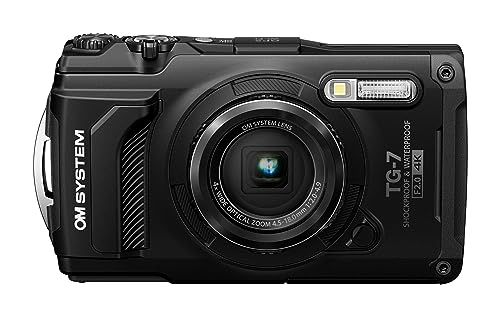
The TG-7 is the answer to a question action cameras cannot hear: what if the adventure is photographed, not filmed? It is a compact built like expedition equipment — waterproof well beyond snorkelling depth, shockproof against the drops that end other cameras, freezeproof for the ski tour and crushproof for the bottom of the pack — that takes real still photographs with a proper zoom, real close-focus ability and RAW files for the evening edit. It snorkels, it kayaks, it rides in a life-jacket pocket, and it never once asks its owner to wonder whether today is too wet for photography.
Its party trick is microscopic. The TG-7 focuses at distances that turn tide pools, frost crystals, alpine flowers and rock textures into legitimate expedition subjects — the small world that adventure itineraries walk past. Combined with underwater colour modes that correct the blue-green cast honestly, it produces a travel archive unlike any action camera’s: still, detailed, and taken from inside the environment rather than at it. Battery life is respectable, charging is by USB, and the whole instrument is small enough that carrying it requires no negotiation with the pack at all.
- Format: rugged compact, fully sealed construction
- Protection: waterproof, shockproof, freezeproof, crushproof
- Close-up: microscope mode for extreme close focusing
- Files: RAW stills for real editing
- Role: the adventure stills camera with no anxiety attached
Strengths
- Survives immersion, impact and frost as a design brief
- Stills quality and macro range no action camera approaches
- Small enough to be carried on the person, not in the pack
Trade-offs
- Small sensor limits deep low-light work and background blur
- Video is a supporting feature, not the headline
- Not a mounted POV camera; it is held, not worn
For the adventurer, its deepest value is psychological: it abolishes the weather decision. Every other camera in a traveller’s life imposes a daily judgement — is it too wet, too cold, too rough to bring the good camera? The TG-7’s owner never makes that judgement, so their archive includes the storm day, the river day and the summit whiteout that everyone else’s archive skips. Years later, those are disproportionately the photographs that matter, because they are the days the adventure was actually happening.
Choose it for water, winter and rough country travelled on foot, and for any adventurer whose instinct is to photograph rather than to film.
Best for: swimmers, paddlers, skiers and stills-first explorers. Not suited for: POV filmmakers or low-light portrait work

GoPro HERO13 Black — The mount-anything workhorse
The HERO13 Black is less a camera than a standard — the small waterproof brick that an entire civilisation of mounts, cages, filters and habits has grown around. For the adventurer, that ecosystem is the product: whatever the sport, someone makes the bracket; whatever the accident, someone sells the part; whatever the question, a thousand riders have answered it. The camera itself records stabilised, high-resolution footage that forgives mounting sins, shoots respectable stills and bursts, and accepts interchangeable lens modifications that widen or reshape its view for specific sports.
Fieldcraft details decide action cameras, and GoPro’s are mature. The battery swaps in seconds with cold fingers. The voice control works when hands are committed to bars, ropes or paddles. The screens survive being read in glare, and the body’s waterproofing needs no housing for the depths recreational adventurers actually reach. Its application ecosystem — editing, telemetry overlays, cloud offload — is the most developed in the category, which matters on trips where the evening’s job is to clear cards and charge everything before the tent goes dark.
- Format: action camera, waterproof body
- Lenses: interchangeable lens mods for different sports
- Stabilisation: mature electronic smoothing for rough mounts
- Ecosystem: the deepest mount and accessory catalogue available
- Role: the default POV and mounted camera
Strengths
- Mounts exist for every sport and vehicle imaginable
- Footage forgives vibration, angle errors and haste
- Community knowledge covers every failure you will meet
Trade-offs
- Stills are a side talent, not a reason to buy
- Small sensor struggles as light truly fails
- Battery life demands spares on long cold days
The HERO13’s particular adventure virtue is replaceability of everything around it. Adventures consume accessories — mounts crack, doors scuff, batteries age — and a camera whose entire support world is available in any coastal town or airport shop is a camera whose trip never ends over a ten-dollar part. Solo travellers far from home should weight that logistics argument heavily; it is the difference between a broken mount being a story and being the end of the filming.
Buy it when the adventure moves fast, mounts to things, and will be watched as footage. Photographers should keep reading; riders and divers can stop here with confidence.
Best for: riders, divers, skiers and POV storytellers. Not suited for: stills-led expeditions or print ambitions

DJI Osmo Action 5 Pro — The long-battery action pick
DJI’s Action 5 Pro attacks the action camera’s oldest weakness — endurance — and wins often enough to change trip planning. Its battery life is the class benchmark, which on a dawn-to-dusk route means fewer swaps with numb hands and less weight in spares; its larger sensor keeps footage coherent deeper into dusk than rivals manage; and its dual touchscreens let a chest-mounted or helmet-mounted camera be framed and adjusted from either side. For the adventurer whose days are long and whose light is unreliable, those are not specifications — they are the difference between filming the whole traverse and rationing the battery by noon.
The details show a maker who listens to field complaints. Magnetic mounting snaps the camera between chest, bar and tripod in a second — with the tether discipline this guide preaches, it is the fastest safe handling in the category. The colour profile options flatter skin and landscape without editing, onboard storage rescues the day a card fails, and the waterproofing is rated for the depths divers actually visit. Audio from DJI’s wireless microphones pairs directly, which matters to adventurers who narrate — the guide, the vlogger, the rider reviewing a line.
- Format: action camera, waterproof body
- Battery: class-leading endurance for long routes
- Sensor: larger format for stronger low-light footage
- Mounting: quick-release magnetic system, dual screens
- Role: the endurance-first action camera
Strengths
- Endurance that reshapes how a long day is filmed
- Dusk and dawn footage holds together impressively
- Handling speed: mounts and screens built for gloves and haste
Trade-offs
- Accessory world is younger than GoPro’s civilisation
- Stills remain secondary to the filming mission
- Magnetic mounts demand tether discipline on rough terrain
Considered as expedition equipment, the Action 5 Pro’s argument is about the shape of a day. Adventure light is best at its ends — the alpenglow start, the golden descent — and those are precisely the hours when weaker action cameras are rationing power or smearing noise. A camera whose battery and sensor both peak at the day’s edges aligns its strengths with the mountain’s schedule, and its owners’ footage shows it: complete days, honestly lit, rather than bright middays and missing evenings.
Choose it for long routes, cold starts and low sun — and for any adventurer who has ever watched a battery icon instead of a summit.
Best for: endurance routes and dawn-to-dusk filming. Not suited for: stills photographers or the deepest accessory tinkering

Insta360 X4 — The camera that misses nothing
The X4 reframes the adventure camera’s hardest problem. Every mounted camera points somewhere, and the moment — the whale, the crash, the eagle, the friend’s expression — routinely happens elsewhere. A 360 camera records the entire sphere, all the time, and lets the adventurer choose the framing later, at home, with warm hands: the descent becomes a tracking shot, the summit pan becomes a tiny planet, the kayak roll is watchable from inside and outside at once. For solo adventurers especially — nobody to film them, nobody to point the camera — it is the only design that guarantees the protagonist appears in their own expedition film.
The practicalities have matured around the idea. The X4 shoots high-resolution 360 footage, works as a conventional wide action camera when the sphere is unnecessary, and its invisible-selfie-stick trick — the pole erased by the stitch — produces drone-like trailing shots from a device that fits a bottle pocket. It is waterproof for the shallows adventures actually swim in, and its editing software, which is where 360 footage lives or dies, is the most approachable in the category: reframing on a phone, in the tent, is genuinely feasible rather than a desktop sentence.
- Format: 360 action camera, also shoots conventional wide video
- Capture: full sphere — framing chosen in the edit
- Signature: invisible selfie stick for drone-style shots
- Protection: waterproof for surface water adventures
- Role: the never-miss-the-moment camera
Strengths
- The moment cannot happen outside the frame
- Solo adventurers finally star in their own footage
- One recording yields many framings and formats
Trade-offs
- Exposed lenses demand guard discipline; scratches are forever
- Editing time is real — every clip is a small production
- Stills and ultimate per-direction resolution trail dedicated cameras
The X4’s honest cost is attention after the trip. Adventurers who return with forty hours of sphere footage own a documentary project, not a highlight reel, and the camera suits travellers who enjoy the edit as part of the expedition’s afterlife. Those who want footage that is finished when the day is should choose a pointing camera and accept its guesses. Those who would rather decide later — and who travel alone, or fast, or through scenes too wide for any single frame — will find the sphere addictive in the best way.
Buy it for solo epics, rides and journeys where the story surrounds you. Guard the lenses like the expedition depends on them, because the footage does.
Best for: solo adventurers and reframe-loving filmmakers. Not suited for: edit-averse travellers or stills purists

OM SYSTEM OM-5 Mark II — The expedition photographer’s system
When the adventure is a photographic expedition — when the journey exists to bring back stills — the OM-5 Mark II is the system camera that respects the pack. Its weather sealing is rated to a standard most rivals only gesture at, its body is compact, and the Micro Four Thirds lenses it mounts are so much smaller than full-frame equivalents that a three-lens expedition kit can weigh less than a rival’s body and standard zoom. For the trekker-photographer, that arithmetic is the whole argument: this is the interchangeable-lens camera that still gets carried on day six.
Its intelligence is field intelligence. Live composite and live long-exposure previews turn night skies, waterfalls and light trails into techniques a tired photographer can execute at altitude without arithmetic; focus stacking serves the macro world of alpine flowers and frost; and the crop of the smaller sensor stretches telephoto lenses further, so wildlife framing arrives on lighter glass. Stabilisation is strong enough to leave the tripod behind on most itineraries — another kilogram the knees never meet. This is a camera designed by people who appear to have carried cameras up things.
- Format: Micro Four Thirds mirrorless, compact lenses
- Sealing: high-rated weather resistance for expedition use
- Tools: live long-exposure preview, focus stacking, strong stabilisation
- Reach: crop factor stretches telephotos for wildlife
- Role: the trekking photographer’s system camera
Strengths
- Complete expedition kits at weights rivals cannot match
- Sealing that converts weather from threat to subject
- Computational tools that work where tripods cannot go
Trade-offs
- Smaller sensor concedes the deepest low-light and blur
- Video is capable, not class-leading
- Menus reward a learned familiarity over first-day intuition
Its particular expedition virtue is redundancy of capability in a single small bag: landscape at dawn, wildlife at distance, macro at noon, stars at night — four photographic disciplines that on other systems would mean four weights of glass. The adventurer-photographer who cannot predict the journey’s subjects, which is most of them, is buying exactly that spread. And when the weather closes in, the sealing means the OM-5 keeps working through the very conditions that produce the expedition’s most honest photographs.
Choose it when stills lead, distances are walked, and the forecast is a rumour. It is the thinking trekker’s camera, and its owners tend to keep it for exactly that reason.
Best for: trekking photographers and multi-subject expeditions. Not suited for: video-first creators or studio portraitists

Fujifilm X-T5 — The basecamp artist
Not every adventure is ultralight. The overlander, the basecamp trekker, the photographer travelling by vehicle, boat or hut-to-hut with porters has weight to spend — and the X-T5 is how to spend it on image quality. Its high-resolution APS-C sensor, in-body stabilisation and weather-resistant body produce stills with genuine print ambition, while Fujifilm’s film-inspired colour gives expedition files a finished, atmospheric character straight from the camera — a real mercy when the evening’s editing facilities are a headtorch and a tired brain.
The dials, so praised by learners elsewhere in this programme, earn their keep differently here: they are operable with gloves, readable at a glance, and they keep the camera’s state visible in the half-light of dawn starts. The X mount’s compact primes and zooms keep the kit civilised even if it never becomes minimal, and the resolution surplus means wildlife and landscape frames can be cropped in the edit without apology — a form of reach that costs no grams at all. Video is a respectable supporting talent rather than the headline, and this guide prices it accordingly.
- Format: APS-C mirrorless, Fujifilm X mount
- Controls: glove-friendly physical dials
- Sensor: high-resolution with in-body stabilisation
- Colour: film-inspired profiles for finished expedition files
- Role: the supported-travel and basecamp stills camera
Strengths
- Stills quality that justifies vehicle-supported weight
- Dials and sealing suit dawn starts and rough weather
- Files look finished without an editing suite
Trade-offs
- The heaviest commitment here — pack walkers should look above
- Not waterproof; sealing resists weather, not immersion
- Tracking autofocus trails the action specialists for sport
The X-T5’s adventure case rests on what the photographs are for. If the journey’s afterlife is a wall, a book or a printed portfolio — if the expedition is, in part, a harvest — then carrying the best stills instrument the itinerary allows is not indulgence but purpose. Its owners are the adventurers who plan camps around evening light and routes around viewpoints, and for them the camera is not luggage; it is the reason the luggage exists.
Choose it when the travel is supported, the stills are serious, and the pack is a vehicle, a hut system or a strong back on a short approach.
Best for: basecamp and overland photographers who print. Not suited for: ultralight trekkers or immersion sports
How Do the Six Adventure Cameras Compare?
| Camera | Element | Carry style | Primary harvest |
|---|---|---|---|
| OM SYSTEM Tough TG-7 | Water, ice, impact | Pocket or life-jacket | Stills from inside the action |
| GoPro HERO13 Black | Mounts and vibration | Helmet, bar, chest | POV footage |
| DJI Osmo Action 5 Pro | Long days, low light | Chest, bar, hand | All-day footage |
| Insta360 X4 | Every direction at once | Pole, mount, hand | Reframed stories |
| OM SYSTEM OM-5 Mark II | Weather on foot | Small pack kit | Expedition stills |
| Fujifilm X-T5 | Basecamp conditions | Vehicle or hut bag | Print-worthy stills |
Match the element column to your map first. Cameras are replaceable; the day the weather, the river or the light performed is not.
How Do You Keep an Adventure Camera Alive for a Whole Expedition?
Run a ritual, not a hope. Every evening: rinse salt and grit off with fresh water where the maker allows it, dry the body before opening any door, inspect seals for sand and hair, charge in rotation, and copy the day’s files to two places before sleep. Every morning: check the battery against the day’s ambition, confirm the mount’s screws and the tether’s integrity, and set the camera before the gloves go on. Expeditions do not usually kill cameras in their dramatic moments; they kill them in tired evenings and hurried mornings, which is why the ritual outranks the rating.
Carry the small armoury: a blower, a microfibre cloth kept in its own sealed bag (a cloth that has met sand is sandpaper), spare cards in a hard case, silica gel sachets refreshed at every town, and a dry bag sized for the camera alone. Add gaffer tape — it has sealed light leaks, splinted mounts and repaired straps on every continent — and the knowledge of your camera’s reset procedure, because a setting changed by a gloved fumble at altitude should cost thirty seconds, not the summit.
Finally, rehearse failure at home. Practise changing a battery and a card with your expedition gloves on, in the dark, timed. Practise the mount swap, the tether, the dry-bag drill in the rain of a garden hose. The adventurers whose footage survives expeditions are not luckier than other people; they are the ones who made the boring procedures automatic before the mountain made them urgent.
What Does Cold Do to a Camera, and How Do You Beat It?
Cold attacks on three fronts. Batteries fade chemically, delivering a fraction of their charge and recovering it suspiciously in a warm pocket — plan rotations, not replacements. Lubricants and plastics stiffen, so zoom rings and dials grow reluctant; the dial-led Fujifilm and the fixed-lens Tough suffer least, and every camera prefers being kept at a steady cold to being cycled between pocket warmth and ridge wind. And condensation waits at the door of every warm tent and hut: the sealed-bag ritual — camera bagged before entering warmth, allowed to equalise slowly — is the difference between a fogged evening and a ruined sensor.
The photographer’s own interface fails next: touchscreens ignore gloved fingers, and small buttons vanish under mittens. Choose gloves with a capacitive fingertip or a fold-back mitt, learn your camera’s physical controls by touch at home, and set exposure compensation — the control winter light demands most — onto the most glove-friendly dial your body offers. The picks above were partly scored on exactly this: big dials, prominent buttons, voice control and dual screens are winter features wearing ordinary clothes.
And keep the camera cold-adapted company: metal bodies chill hands through thin gloves, so a simple neoprene wrap or the habit of carrying by the strap rather than the grip preserves the fingers for the work that needs them. Winter rewards the prepared with the year’s clearest air and lowest, richest light. The cameras here can all take that reward; the ritual decides whether their owners collect it.
How Should Adventurers Handle Power Far From Sockets?
Treat power as fuel and plan it like water. Begin with the honest consumption of your style: action cameras filming all day eat batteries in a rhythm every owner learns; stills cameras sip by comparison but spend on screens, stabilisation and cold. Carry the count the route demands plus one — the plus-one is not pessimism, it is the margin that lets you film the unexpected evening instead of rationing against tomorrow. Number the batteries, rotate them in order, and let the numbering expose a fading cell at home rather than at altitude.
Unify the charging economy. A single high-capacity power bank feeding camera, phone, torch and watch by USB simplifies the expedition’s whole electrical life, and the picks here increasingly speak USB natively. Solar belongs on vehicle and basecamp itineraries, where panels can ride all day; on foot, carried batteries almost always beat carried panels on watt-hours per gram. In villages and huts, a multi-port charger and the social skill of asking politely for socket time are worth more than any gadget.
Protect the economy with habits: aeroplane mode on paired devices, screens dimmed, cameras off between subjects rather than idling, and files reviewed in the evening on one device rather than three. Power discipline sounds like deprivation and functions as freedom — it is what lets the last day of the route be filmed as fully as the first, which is precisely where most adventure archives, unplanned, quietly end.
How Does Water Change the Rules for Each Kind of Camera?
Water is not one hazard but four, and each pick in this guide answers a different subset. Rain is the gentlest: vertical, brief and survivable by any weather-sealed body under a cover, and by the action cameras without noticing it happened. Spray is rain with momentum — waterfalls, boat wakes, surf — and it finds seams that rain politely misses, which is why sealed system cameras wear rain covers in serious spray while the Tough and the action cameras simply get rinsed afterwards. Immersion is the third country, entered only by the cameras built for it, and entered under discipline: seals inspected, doors closed on clean gaskets, depth limits treated as cliffs rather than suggestions.
The fourth water is the one nobody photographs: humidity. Tropical and coastal air carries moisture into every bag and body, and the expedition that survives the river can still lose a lens to fungus in a damp hotel room three weeks later. The countermeasures travel light — silica gel in the camera bag, airing kit whenever the sun allows, never storing a damp camera sealed — and they matter most for the system cameras whose interchangeable lenses give moisture somewhere to go. Adventure veterans judge a trip’s success partly by what the kit looks like a month afterwards; the photographs are only half the harvest.
Salt deserves its own sentence because it is chemically ambitious: it corrodes contacts, creeps into dials and dries into crystals that grind. Every camera that meets the sea — sealed or not — earns a fresh-water rinse or wipe the same evening, battery doors opened only once the exterior is dry. It is the least glamorous ritual in this guide and the one that most reliably separates ten-year adventure cameras from two-year ones.
What Should an Adventure Camera Kit List Actually Contain?
Write it as the expedition services do: by function, not by product. Capture — the camera and the lens or mount it truly travels with, not the ones it owns. Carry — the strap, chest harness, hip solution or pole that keeps it on the body. Power — batteries counted against the route, one unified charging path, cables that fit. Protection — tether, dry bag, rain cover, hard case for cards. Maintenance — blower, cloth in its own bag, silica gel, gaffer tape, the small tool your mounts demand. Memory — cards enough that no evening requires deleting in the field to make room, because field deletion under fatigue is how expeditions lose their best day.
Weigh the list as written, then walk it around the neighbourhood for an hour. The walk is the audit no spreadsheet can run: it reveals the strap that saws, the mount that rattles, the pouch that cannot be opened with gloves. Fix those discoveries at home, where fixes are free. Then photograph the packed kit and save the picture with the trip documents — the kit list, proven once, becomes the packing list for every future journey, and the adventurer stops re-solving a solved problem at midnight before departures.
One discipline governs the list’s growth: nothing joins it without displacing something or justifying its grams in the trip’s own terms. Filters, cages and second bodies all audition against the same question the cameras faced — will you still be carrying this, gladly, on the last day? Adventure kit lists fail by accumulation, not by selection, and the camera at the centre of the list deserves a support cast as honest as itself.
How Do You Handle Files and Stories While Still Out There?
The expedition’s archive is being written twice: once in files, once in memory, and the two need each other. The field habit that saves both is the two-minute voice note or notebook entry at the moment of the photograph — the place name spelled, the person’s name, the reason this frame mattered. Six months later that scrap of context is worth more than another megapixel, because it is the difference between a beautiful image and a story. Cameras record light faithfully and meaning not at all; the adventurer supplies the meaning while it is still warm.
Offloading follows the rhythm the power section set: nightly, to two homes, with the day’s cards never formatted until both copies verify. On connected itineraries a third copy can climb to the cloud from a village connection, but treat it as a bonus rather than a leg of the stool. Resist editing in the field beyond a quick cull of the hopeless — the screen is small, the light is wrong, and fatigue is a ruthless curator. The one exception is the daily single frame shared home, which does morale work out of all proportion to its cost in battery and bandwidth.
Back home, let the archive rest a week before the real edit. Distance performs the same service for expedition files that it performs for the beginner’s: it converts the editor from a participant defending memories into a curator serving an audience. The stories told from a rested edit are leaner, truer and — this surprises people — more affectionate, because the hardship has finished being sore and started being funny. The camera’s work ended at the trailhead; the storytelling is the traveller’s, and it deserves the same preparation as the journey.
Why Do Some Adventurers Carry Two Cameras — and Should You?
Look at expedition photographs of expeditions and you will often spot two cameras: the mounted action camera and something with a lens, the rugged compact in the life-jacket and the system body in the dry bag. The pairing is not indecision; it is division of labour. The action camera owns the moments when hands, attention and safety are fully committed — the descent, the rapid, the climb — while the stills camera owns the moments when the adventurer can stop, breathe and compose: the camp, the summit, the portrait of a companion against the whole journey. Each covers the other’s blindness, and the combined archive has both the adrenaline and the stillness that a real expedition contains.
The costs are equally real: double the charging, double the cards, double the rituals, and a combined weight that must re-pass the pack audit as a pair rather than as individuals. The pairings that work are asymmetric — one camera tiny, the other serious. The TG-7 plus any action camera here is the classic amphibious couple; the OM-5 plus the X4 covers the trekking film-and-stills brief; the GoPro plus the X-T5 serves the vehicle-supported storyteller. What rarely works is two serious systems, whose combined demands quietly convert the adventurer into a porter for their own archive.
The deciding question is honest and singular: which harvest would you grieve if it failed? If the answer is the footage, weight the pair toward film and let stills ride on the rugged compact. If the answer is the photographs, reverse it. And if the honest answer is that one harvest matters and the other is habit, save the grams, carry the single right camera from this guide’s six, and spend the savings on the journey itself — which is, after all, the subject.
What Mistakes Do Adventurers Keep Making With Their Cameras?
Trusting the rating instead of the ritual. A waterproof camera drowned by a seal closed on sand, a shockproof camera lost to an untethered mount, a freezeproof camera fogged by a warm tent — the expedition graveyard is filled with well-rated cameras killed by skipped procedures. The rating buys margin; only the ritual spends it wisely.
Packing the camera for the trip they imagined instead of the one they booked. The heavy system left in the tent on summit day, the action camera bought for a trek that is actually a photography expedition, the 360 whose edit never happens — each is a mismatch between harvest and tool that this guide’s comparison table exists to prevent. Decide what the journey must bring home, in files, before deciding what it carries.
And neglecting the boring rehearsal: the mount untested, the gloves untried, the new camera’s menus first opened at altitude. Adventure is a poor classroom for equipment and a magnificent one for photography. Arrive with the equipment already boring, and the mountain will supply all the excitement the curriculum requires.
A last word on buying order, because adventure kit is often bought in the wrong sequence. Camera first, then the carry system, then power, then protection — in that order, tested together before any of it is trusted. The adventurer who buys a camera in spring and a mount the night before the expedition has not bought a kit; they have bought a hope. Every pick in this guide is available through mainstream retailers with its ecosystem around it, and the few weeks of rehearsal the kit deserves are the cheapest insurance in the whole purchase. The mountain will test everything you bring. Arrive having tested it first.
Final Recommendation
Most adventurers should start with the DJI Osmo Action 5 Pro if their harvest is footage — its endurance and low-light strength fit the real shape of adventure days — or the OM SYSTEM Tough TG-7 if their harvest is photographs, since it alone removes weather from the decision entirely. Choose the GoPro HERO13 Black when mounting versatility and the deepest accessory world matter most, the Insta360 X4 when you travel solo or through scenes too wide to point at, the OM-5 Mark II when a walked expedition needs serious stills in a small sealed kit, and the Fujifilm X-T5 when supported travel lets image quality lead.
Whichever you carry, remember the arithmetic this guide began with: a camera’s value outdoors is its survival multiplied by its presence. Buy the one that will still be working, charged and in your hand on the worst day of the trip — because the worst day, photographed, is usually the story you tell for the rest of your life.
And if the budget forces a single compromise, compromise on resolution before resilience. Adventure history is not made of the sharpest files; it is made of the files that exist — taken in the storm, at the summit, inside the river — by the camera that was alive, charged and present. Every purchasing decision in this guide can be checked against that sentence, and the adventurer who keeps it in view will rarely buy wrong.
Frequently Asked Questions
Can one camera really do both the trek and the snorkelling?
The Tough TG-7 is the honest yes: it treks in a pocket and snorkels without a housing, taking stills in both worlds. System cameras trek superbly but do not swim; action cameras swim and film superbly but photograph modestly. Most mixed itineraries are best served by the TG-7 as the constant companion, with an action camera added only if POV footage is a stated goal.
How many batteries does a week without sockets require?
Work backwards from your style: count a heavy filming day per action-camera battery rotation, a stills day as a fraction of one system battery, then add the cold tax — up to a third more in winter — and one spare beyond the arithmetic. A shared USB power bank usually closes the remaining gap more weight-efficiently than extra proprietary batteries alone.
Is a phone not enough for adventure photography now?
Phones are sealed, light and astonishing — until the mount, the immersion, the cold or the zoom matters, or the battery must also navigate and communicate. Adventurers keep cameras for the same reason they keep dedicated boots: the generalist tool is admirable, and the specialist survives the day the generalist cannot. Many travellers carry both and let each do what it does best.
How do I protect a camera that is not waterproof?
Layers: a rain cover or even a well-fitted bag with a lens hole for shooting in weather, a dry bag for transport, silica gel for the tent, and the discipline of changing lenses only in shelter with the body pointed down. Weather-sealed bodies like the OM-5 and X-T5 tolerate rain and spray under that regime indefinitely; what they must never meet is immersion or a lens change in a dust storm.
What is the single most valuable accessory for adventure work?
The tether, followed closely by the carrying system that keeps the camera on your body rather than in your pack. More adventure cameras are lost to mount failures and left behind in bags than to any electronic fault. After those two, a second battery outperforms every filter, cage and gadget in the catalogue.
Should I insure adventure camera kit?
For system cameras and multi-camera expeditions, yes — the environments in this guide are precisely the ones household policies exclude or expeditions punish. Photograph serial numbers, keep receipts in cloud storage, and confirm the policy covers accidental damage away from home. For a single action camera, many owners self-insure and simply budget its replacement as expedition consumable; either way, decide before the trip, not after the river.
Related Guides
Adventurers building a wider kit should read our one-camera guide for travellers who refuse to carry a second body, compare the best digital cameras for a beginner photographer if this expedition camera is also a first camera, and browse cameras chosen for thirteen-year-old explorers and their families when the youngest member of the expedition needs a camera of their own.


