Disclosure: this article contains affiliate links, and the site may earn an affiliate commission when you buy through them, at no extra cost to you.
A man shopping for a watch today faces a strange problem: there has never been more choice, and most of it is noise. Fashion brands sell the same inexpensive quartz movement in a hundred different cases. Microbrands launch a new limited edition every month. Smartwatches promise to do everything and end up doing the one thing a watch must do — tell the time at a glance, for years, without nagging you for a charger — worse than a twenty-year-old Seiko. This guide cuts through all of that. The six watches below are not the most hyped, the most advertised, or the most expensive. They are the ones that experienced owners keep recommending to friends because they work, they wear well, and they hold up.
We have deliberately spread the list across the real decision points. Two of the picks run on quartz movements, one of them solar-powered. Three are mechanical automatics that wind themselves from the motion of your wrist. One is a digital watch so tough it has become a genuine design icon. Case sizes run from a slim 36 mm dress piece to a chunky 45 mm resin tool watch, because the right diameter depends on your wrist, not on fashion. And every pick is a watch you can wear daily without babying it, which matters more than any spec on a product page.
Before the individual reviews, it helps to understand the four questions that actually decide whether a watch suits you: what powers it, how big it is, how much water it can honestly handle, and what you will be doing while you wear it. Get those four right and almost any well-made watch will make you happy. Get them wrong and even a beautiful watch ends up in a drawer.
What to look for in a men’s watch
Movement: quartz, solar, or automatic
The movement is the engine, and it shapes everything about ownership. A quartz watch runs on a battery and a vibrating crystal. It is accurate to within a few seconds a month, shrugs off knocks that would upset a mechanical movement, and asks for a fresh battery every two to three years. A solar quartz watch — Citizen’s Eco-Drive is the famous example — replaces the disposable battery with a rechargeable cell fed by light through the dial, so it can run for a decade or more without being opened. An automatic watch contains a tiny mechanical engine of gears and springs, wound by a rotor that spins as your arm moves. It needs no battery at all, but it is less accurate (expect it to gain or lose somewhere between five and twenty seconds a day), it stops after a day or two off the wrist, and it will eventually need a service. None of these is objectively best. Quartz is the rational choice. Automatic is the romantic one. Solar is the set-and-forget compromise. The list below includes all three philosophies so you can pick your own.
Case size and your wrist
Diameter is the number everyone quotes, but lug-to-lug length — the distance from the tip of one lug to the tip of the other — is what decides whether a watch overhangs your wrist. As a working rule, measure your wrist with a soft tape. Under 6.5 inches, look at 36–40 mm cases with a lug-to-lug under 47 mm. Between 6.5 and 7.25 inches, the modern sweet spot of 38–42 mm will almost always work. Above 7.25 inches, you can carry 42–45 mm comfortably. Thickness matters too: a watch under 12 mm slides under a shirt cuff, while a 15 mm tool watch announces itself. When in doubt, size down. A slightly small watch looks classic; a slightly large one looks borrowed.
Water resistance, translated honestly
The numbers printed on watch dials are laboratory ratings, not real-world permissions, and this is the single most misunderstood spec in the category. A watch marked 30 m or 3 ATM is splash-proof only — rain and hand-washing, nothing more, despite what the number suggests. At 50 m you can shower and swim briefly in a pool. At 100 m you can swim and snorkel with confidence. At 200 m, especially with a screw-down crown, you have a genuine dive-capable watch. Two further warnings: never operate the crown or pushers underwater unless the watch is specifically built for it, and have the seals checked every few years, because gaskets age whether you swim or not. Several picks below carry 100 m ratings, which is the honest threshold for a worry-free daily watch.
Occasion and wardrobe fit
Think about where the watch spends its life. A dress watch is thin, simple, and small, with a clean dial and a leather strap, made to disappear under a cuff until someone looks closely. A field watch is legible, rugged, and matte, built for outdoors and casual wear. A diver adds a rotating bezel and serious water resistance. A digital sports watch trades elegance for alarms, timers, and near-indestructibility. Most men are best served by one versatile watch in the field/casual family that can dress up slightly, plus, eventually, one true dress piece. The six picks below map onto those roles so you can see which gap in your own rotation each one fills.
Materials and finishing
Stainless steel is the default case material for good reason: it resists corrosion, takes a polish, and can be refinished. Resin cases, as on the G-Shock below, are lighter and absorb impacts better than any metal. Crystal choice matters more than most buyers realize. Acrylic scratches easily but can be polished back to clear in minutes. Mineral glass is harder and common at lower prices. Sapphire is the premium standard — virtually scratch-proof in normal use — and its presence is one of the clearest signals that a maker spent money where it counts. Strap quality is the other quiet tell: a watch on a flimsy strap feels cheap no matter how good the head is, and budget picks often improve dramatically with a strap swap.
The tiers, in plain words
This guide positions every pick by tier rather than by price, because prices move and tiers explain what your money actually buys. At the budget tier, represented by the Timex and the Casio, you are paying for a reliable movement and honest function, and accepting plated cases, mineral crystals, and modest finishing. The mid-range tier — the Seiko, the Citizen, and the Orient — is where value peaks: real stainless cases, in-house movements, proper water resistance, and finishing that survives a close look, with sapphire glass the main luxury still missing. At the premium tier, the Hamilton shows what the extra money buys: a sapphire crystal, a longer power reserve, tighter accuracy, and finer casework. Above this list sits a luxury tier where hand-finishing and brand heritage multiply cost faster than function. For a first or only watch, the mid-range tier is the sweet spot, and it is no accident that half this list lives there.
Ownership costs nobody mentions
The purchase is the start, not the end. Quartz watches need battery changes, and each opening is a chance for the seals to be disturbed, so budget for a pressure test if you swim. Automatics need a full service roughly every five to seven years, which on an entry-level watch can approach the cost of the watch itself — a real argument for buying automatics from makers with efficient, widely serviced movements, as all three mechanical picks below have. Solar watches need light and little else. Digital watches need a battery every several years and a new resin strap when the old one eventually cracks. None of these costs should scare you off; they should simply be part of the decision.
In this guide
The six picks at a glance
| Watch | Movement | Case size | Water resistance | Tier | Best for |
|---|---|---|---|---|---|
| Timex Weekender | Quartz | 38 mm | 30 m | Budget | A first watch and easy gifting |
| Casio G-Shock DW5600 | Digital quartz | 43 mm resin | 200 m | Budget | Work, sport, and zero worry |
| Seiko 5 Sports | Automatic | 40 mm | 100 m | Mid-range | An everyday mechanical all-rounder |
| Timex Expedition Field Chronograph | Quartz chronograph | 43 mm | 100 m | Mid-range | Field style with stopwatch timing |
| Orient Bambino | Automatic | 40.5 mm | 30 m | Mid-range | Dress wear on a sensible budget |
| Hamilton Khaki Field Automatic | Automatic | 38 mm | 100 m | Premium | A heritage one-watch collection |
Read the table as a map, not a ranking. The cheapest watch here is the right answer for plenty of men, and the most expensive one is wrong for anyone whose life involves ladders, engines, or toddlers with jam on their hands. None of the six requires an app, an account, or a software update to keep doing its one job well. The reviews below explain who each watch genuinely suits — and, just as importantly, who should skip it.

Timex Weekender: the friendly first watch
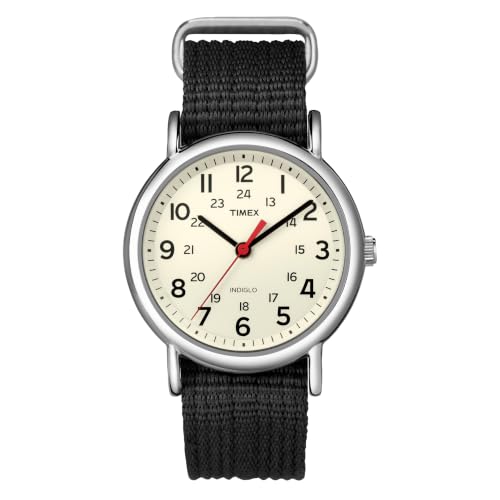
The Weekender has been the default answer to “what watch should I buy first?” for over a decade, and it survives every attempt to replace it because it gets the fundamentals quietly right. The 38 mm polished case is slim enough for smaller wrists and formal enough, on the right strap, to pass under a cuff. The dial is a model of clarity — full Arabic numerals, slim hands, and nothing else competing for your attention. Most versions include Timex’s Indiglo backlight, which lights the whole dial at the press of the crown and remains, all these years later, one of the most useful features ever put on an inexpensive watch.
The strap deserves special mention because it is the Weekender’s real party trick. It ships on a slip-through fabric or leather strap that swaps in seconds with no tools, which turns one watch into a small rotation: olive fabric for the weekend, brown leather for the office, navy for everything else. For a man building a wardrobe, that flexibility is worth more than a spec-sheet upgrade. It also makes the Weekender an unusually safe gift — the size suits most wrists, the style offends nobody, and the recipient can restyle it for the price of a coffee.
Strengths. Genuinely versatile sizing at 38 mm; Indiglo backlight that is still best-in-class at this tier; tool-free strap changes that multiply its wardrobe range; a dial a child could read at arm’s length; and a price position — firmly at the budget end of the market — that makes it a no-regret experiment for anyone unsure whether they even like wearing a watch.
Trade-offs. The quartz movement ticks loudly. In a quiet bedroom, a Weekender on the nightstand can be audible, and light sleepers should know it. Water resistance is 30 m, which means splashes only; take it off before swimming. The crystal is mineral glass rather than sapphire, so it will collect scratches over years of hard use. And the case is plated brass alloy rather than solid stainless steel on many versions, which keeps cost down but means the finish can wear at the edges over a long life.
Who it suits. Students, first-time watch buyers, and anyone who wants one inoffensive watch that works with shorts and a blazer alike. It is also the pick for men who lose things: misplacing a Weekender stings for an afternoon, not a season. If your wrist is large — over 7.5 inches — the 38 mm case may look small, and the 40 mm versions or the Citizen below will suit you better. For everyone else, this is the lowest-risk way into wearing a watch every day, and a surprising number of men with far more expensive collections still keep one in the drawer. To see the current version and strap options, check price on Amazon.

Casio G-Shock DW5600: the watch that cannot be killed
The DW5600 is the direct descendant of the original 1983 G-Shock, and its square resin case has become one of the most recognizable silhouettes in all of watchmaking. Astronauts have worn its relatives in orbit. Soldiers, firefighters, mechanics, and surfers wear it because it treats abuse as a rounding error: the hollow case structure suspends the movement in resin, so drops onto concrete that would stop a mechanical watch are simply Tuesday. It is rated to 200 m of water resistance, which makes it the most water-capable watch on this list by a wide margin, and it adds a stopwatch, countdown timer, alarm, and backlight that no analog pick here can match.
What surprises new owners is how wearable it is. The resin case is nominally about 43 mm across, but it is light, the strap is flexible, and the square shape sits flatter than the dimensions suggest. It disappears under a work glove and shrugs off the knocks that happen exactly because you forgot you were wearing it. Battery life runs to years rather than months, and when the battery finally does die, any competent watch shop can change it cheaply. The resin strap and bezel will eventually age and crack after many years of sun and sweat — replacements are inexpensive and widely available, which is more than can be said for most fashion watches at any price.
Strengths. Legitimate 200 m water resistance; shock resistance that is proven rather than promised; a full suite of timing functions; featherweight comfort despite the chunky looks; and an ownership cost over a decade that is close to zero beyond a battery and eventually a strap set.
Trade-offs. It is unapologetically a digital sports watch, and no strap change will make it a dress watch — with a suit it reads as a deliberate statement, which may or may not be your intent. The buttons are small and recessed, so adjusting settings with gloves or large fingers takes practice. The display’s negative (dark) variants look sharp but are harder to read in low light than the standard positive display. And while the case wears smaller than expected, genuinely slim wrists under 6 inches may still find it broad.
Who it suits. Tradesmen, gym-goers, swimmers, travelers heading somewhere rough, and any man who has cracked a watch crystal before and intends never to do it again. It is also the ideal second watch for owners of nicer pieces: the one you grab for the garage, the beach, and the flight. If you want exactly one watch for a physically demanding life and do not care about dressing it up, the search can honestly stop here. To compare the standard and solar/Bluetooth variants, check price on Amazon.

Seiko 5 Sports: the automatic most men should start with
If the Weekender is the first watch, the Seiko 5 Sports is the first real watch — the one that turns a practical purchase into a hobby. Inside the 40 mm stainless case beats Seiko’s 4R36 automatic movement: twenty-four jewels, a day-date display, hacking seconds (the second hand stops when you set the time), and hand-winding, all features that were once reserved for watches costing several times more. Turn the watch over and many versions show the movement through an exhibition case back, which is how a generation of enthusiasts got hooked: you can watch the balance wheel oscillate and understand, viscerally, that there is no battery in there at all.
On the wrist, the Seiko 5 Sports wears like a tool watch should. The 100 m water resistance means swimming is fine. The unidirectional bezel on the diver-styled versions — a design lineage borrowed from Seiko’s beloved SKX series — times everything from parking meters to pasta. Lume is a Seiko specialty, and the hands and markers glow brightly and last through the night in a way that embarrasses watches at triple the price. The stock bracelet or strap is the one mediocre element; the bracelet’s pressed clasp feels tinny, and most owners eventually fit a better strap, which the standard lug width makes easy.
Strengths. A genuine in-house automatic movement with hacking and hand-winding; 100 m water resistance and a real timing bezel; outstanding lume; a 40 mm case that fits the widest range of wrists on this list; and a global service network, because Seiko movements are understood by watchmakers everywhere.
Trade-offs. Accuracy is honest mechanical accuracy — expect it to drift several seconds a day, and if that will bother you, buy quartz and be happy. The crystal is Seiko’s proprietary Hardlex rather than sapphire, tougher than plain mineral glass but not scratch-proof. The crown does not screw down, so while swimming is fine, this is not a saturation-diving instrument. And like all automatics, it stops after roughly forty hours off the wrist, so Monday morning means a reset if it sat all weekend.
Who it suits. The man who wants to understand why people love mechanical watches, without paying for the lesson twice. It dresses down perfectly and dresses up adequately, swims, travels, and survives daily wear, which is why it anchors so many collections as the permanent beater even after pricier pieces arrive. If you are choosing between this and the Hamilton below, the honest answer is that the Seiko is the smarter buy and the Hamilton is the finer object; which of those matters more is a question only your own taste can settle. To see the current dial colors and strap options, check price on Amazon.
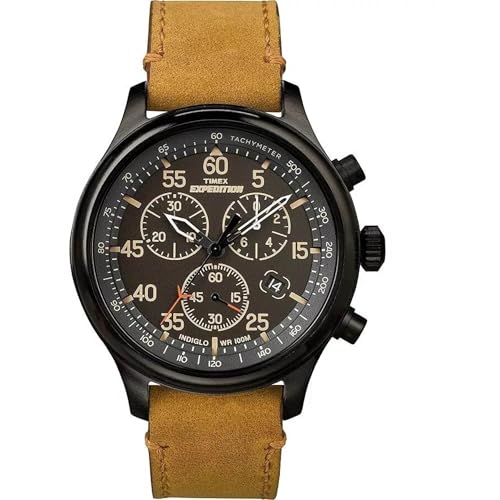
Timex Expedition Field Chronograph: field style with a working stopwatch
The Expedition Field Chronograph takes the classic military field watch formula — matte case, big legible numerals, a strap built for outdoors — and adds the one complication field watches keep circling back to: a proper chronograph. Three subdials time events up to thirty minutes, the kind of interval that covers a training run, a grill timer’s second opinion or a parking meter’s slow betrayal, and a date window sits at four o’clock where it stays out of the subdials’ way. Where the solar pick this section replaces asked you to give up battery changes, the Timex asks nothing at all: it is an honest quartz watch with a battery that lasts for years and costs very little to replace anywhere on earth. For the man who wants a watch to be a tool rather than a hobby, this is close to the ideal technology.
The watch itself is a handsome execution of the field pattern. The 43 mm case wears brushed and dark rather than polished, the dial is black with bold Arabic numerals, and the hands and markers carry lume for dusk legibility — backed up by Timex’s Indiglo night-light, which lights the whole dial at a press of the crown and remains the most practical after-dark trick in this price class. Water resistance is 100 m, so it swims, showers, and kayaks without discussion. The standard strap is tan leather that suits the design and softens quickly; the lug width is standard, so fabric or silicone alternatives are easy to find once you know your taste.
Strengths. A real chronograph and date in a field-watch layout that stays legible; Indiglo backlighting that beats lume alone after dark; proper 100 m water resistance; excellent legibility day and night; and a case finish that hides the scratches of daily wear far better than polished steel.
Trade-offs. At 43 mm it is the largest analog watch on this list, and on wrists under about 6.5 inches it will look and feel big — try the size honestly before committing. The chronograph subdials, however well drawn, cost a little of the plain field dial’s instant readability, and the quartz second hand ticks once per second rather than sweeping. The leather strap, while handsome, is the wrong partner for daily swimming; swap to fabric or silicone if the watch will live in the water. And purists should note the romance of a mechanical movement is absent by design.
Who it suits. Outdoor-leaning men who want one watch for work, weekends, water, and travel, and who will actually use a stopwatch more than twice a year. It is also a superb choice for a son’s first serious watch or for anyone posted somewhere a watchmaker is not. If the size works for your wrist, the Expedition is arguably the most rational purchase on this page: buy it, wear it for ten years, and think about it approximately never. To check the current dial and strap variants, check price on Amazon.

Orient Bambino: the dress watch that respects your budget
Every other watch on this list leans casual, which leaves the question of what to wear when the occasion turns formal. The Bambino is the long-standing answer. Orient — a Japanese maker owned by the same group as Seiko, building its own in-house movements since 1950 — produces in the Bambino a watch with the proportions and restraint of a mid-century dress piece: a slim case a touch over 40 mm, a domed crystal that catches light the way vintage acrylic did, elegant dauphine hands, and dials that range from clean white to deep sunburst tones depending on the version. Under a cuff it looks, without exaggeration, like a watch from a tier well above its own.
The movement is Orient’s own automatic caliber with hand-winding and hacking — features the Bambino’s price rivals often omit — and it keeps the case thin enough to behave properly with a shirt. The domed mineral crystal is the deliberate vintage touch: it will not match sapphire for scratch resistance, but its distortion at oblique angles is exactly the charm buyers are paying for. The stock leather strap is serviceable rather than luxurious, and many owners upgrade it; doing so lifts the whole watch noticeably. Version choice matters with the Bambino line: smaller 38 mm variants exist for slim wrists, and the open-heart and small-seconds versions trade some formality for visual interest, so pick the dial that matches how formal your life actually is.
Strengths. Genuinely elegant proportions and finishing for the tier; an in-house automatic movement with modern conveniences; a slim profile that slides under any cuff; and a range of dial versions that lets you tune it from boardroom-conservative to quietly distinctive.
Trade-offs. Water resistance is 30 m — this is a watch for weather, not water, and it should come off before anything wetter than rain. The domed mineral crystal can scratch and cannot be polished as forgivingly as acrylic. The leather strap, while attractive when new, is the first component to show age. And as a dedicated dress watch, it will look out of its depth with gym clothes or on a building site; it is a specialist, proudly.
Who it suits. Office workers, grooms and groomsmen, graduates entering formal professions, and any man whose current rotation is all sport and no ceremony. It is also the ideal complement to the G-Shock above: between those two watches, a man is correctly dressed for essentially every situation life presents, at a combined outlay that stays firmly sensible. If you attend weddings, interviews, or dinners where details are noticed, this is the pick that punches furthest above its weight. To compare dial versions and sizes, check price on Amazon.

Hamilton Khaki Field Automatic: the premium heritage pick
Hamilton supplied watches to the American military through both world wars, and the Khaki Field Automatic is the modern descendant of those issued pieces — not a costume, but a continuation. The 38 mm version recommended here gets the proportions exactly right: compact, slim, and light, with a matte dial whose printed numerals and syringe hands have barely changed in spirit for decades. It is the rare watch that looks correct with a field jacket, a flannel shirt, an unstructured blazer, and — strap swapped to leather — something close to formal wear. Owners call this a one-watch collection candidate, and after a week on the wrist it is easy to see why.
The movement justifies the step up in tier. Hamilton’s H-10 automatic, built on a proven Swiss architecture, runs for up to eighty hours on a full wind — put it down on Friday and it is still running on Monday, a convenience no other mechanical pick here matches. Accuracy is a step above entry-level automatics as well, and the finishing, from the brushed case to the signed crown, is visibly more careful than the mid-range picks. Water resistance is 100 m, the crystal is sapphire, and the whole package feels like the point where spending more starts buying refinement rather than features.
Strengths. An eighty-hour power reserve that changes daily life with an automatic; sapphire crystal and 100 m water resistance; authentic military heritage rather than marketing mythology; a 38 mm case that suits smaller wrists beautifully; and finishing that rewards a close look instead of disappointing one.
Trade-offs. It sits at the premium end of this list, and the honest buyer should acknowledge that the Seiko 5 does eighty percent of this job for far less money. The stock strap — canvas or leather depending on version — is good rather than great, and many owners upgrade it. Lume is tasteful rather than torch-like; the Seiko out-glows it. And the 38 mm case, perfect for many, will look small to men with wrists above 7.5 inches, who should look at the larger Khaki variants instead.
Who it suits. The man buying one serious watch to wear for a decade: for work, travel, weekends, and the better class of evening. It is the pick for someone who has already owned a budget watch, knows he enjoys the ritual of a mechanical movement, and wants the version of that experience with the fewest compromises. Graduations, promotions, and milestone birthdays are its natural habitat as a gift, too — it carries the weight of an occasion without shouting about it. To see the current case sizes and strap options, check price on Amazon.
Quartz vs automatic: settling the argument honestly
Almost every first-time buyer agonizes over this choice, so here is the unvarnished version. Quartz wins on accuracy, toughness, thinness, and cost of ownership. An automatic wins on craft, longevity of design, and the simple pleasure of a machine that lives off your own motion — a pleasure that is real, but which you should confirm you actually feel before paying for it. The practical test: if the idea of a watch stopping over a lazy weekend irritates you, buy quartz or solar and never think about it again. If the idea of a tiny engine on your wrist delights you, buy the automatic and accept its drift as character. Neither answer is wrong. The wrong answer is buying the movement you think you should want rather than the one matched to your temperament — that is how watches end up unworn. This is also why the list deliberately mixes both: a collection with a solar field watch for weekdays and an automatic for weekends is not indecision, it is good sense.
Getting the size right before you order
Because most watches are now bought online, sizing mistakes are the number one cause of returns in this category. Do three things before ordering any watch on this page. First, measure your wrist circumference with a tape or a strip of paper — do not guess, because most men guess half an inch high. Second, compare the watch’s lug-to-lug measurement, usually listed in full specifications, against the flat top of your wrist; if the lugs overhang, the watch will wear large regardless of its diameter. Third, look at photographs of the watch on a wrist close to your own size rather than studio shots, which flatter everything. Remember too that strap material changes perceived size: a watch on a bracelet wears larger than the same watch on fabric or leather. When genuinely torn between two sizes, choose the smaller — wrists have not grown as fast as watch cases have, and the industry’s drift toward 42 mm and beyond has left smaller-wristed men better served by the classics, which is one reason the 38–40 mm picks dominate this list.
Water resistance: the rules that keep watches alive
Since two of the costliest watch mistakes involve water, the essentials bear repeating in plain form. Treat 30 m as splash-proof, whatever the dial implies. Treat 50 m as the minimum for regular swimming, and 100 m as the rating that lets you stop thinking about it. Never press pushers or unscrew a crown while wet. Rinse salt water off with fresh water after the sea, because salt attacks seals and straps alike. Keep leather straps out of the water entirely; they absorb, stiffen, and rot. And if a watch is more than five years old and you swim in it, have a watchmaker pressure-test it — a small fee that verifies the gaskets still do their job. Follow those rules and even the modestly rated picks here will serve for decades; ignore them and no rating printed on any dial will save the watch.
Straps: the cheapest way to own three watches
New owners consistently underestimate the strap, and it is the easiest mistake to fix. The strap decides half of how a watch looks and most of how it feels, yet it is the one component you can change in a minute for the cost of a modest lunch. A field watch on its factory fabric strap reads as outdoor gear; the same watch on a brown leather strap reads as smart casual; on a steel bracelet it reads as an everyday professional piece. Before concluding that you need a second watch, spend a fraction of its price on two alternative straps for the watch you already own — the Weekender’s entire popularity rests on this trick, and it works just as well for the Seiko and the Hamilton.
The practical details matter. Measure the lug width in millimetres before ordering; it is stamped on the underside of most straps and listed in every full specification sheet. Buy a spring bar tool while you are at it, and practise the swap over a soft surface, because spring bars are small, springy, and apparently capable of teleporting into carpet. Leather suits cooler weather and formal settings but hates water and summer sweat. Fabric NATO-style straps are washable, nearly indestructible, and add a layer of security — if one spring bar fails, the watch stays on the other. Rubber and silicone own the summer and the sea. A steel bracelet is the most durable and the most formal of the casual options, but it adds weight and shows scratches that fabric hides. Build a small strap library around one good watch head and you have, functionally, a collection.
best gaming routers for parents that watch netflix
Care and maintenance, by movement type
Watches die of neglect far more often than of defects, and the neglect is usually simple. All watches benefit from the same basics: keep them away from strong magnets, which can disturb both mechanical movements and quartz accuracy and are hiding in tablet covers, bag clasps, and speakers; rinse off salt and sweat, which corrode and rot; and store them dry, out of constant direct sun, which fades dials and dries leather. Beyond the basics, each movement type asks for something slightly different.
Quartz watches ask for timely battery changes. A battery left dead in the case for years can leak and destroy the movement, turning a small service into a write-off, so change it promptly when the watch stops — many quartz models warn you with a jumping second hand that skips several seconds at a time. Automatics ask to be worn or wound: a watch worn in rotation stays lubricated and honest, while one left stopped for years benefits from a gentle wind and a day of wrist time before being judged faulty. When an automatic does go in for its five-to-seven-year service, use a watchmaker who will replace seals and pressure-test the case, not merely oil the movement. Solar watches ask only for light — a windowsill hour a week keeps an Eco-Drive in rude health — and for mercy from dark drawers. Digital watches ask for a battery every several years and, eventually, fresh resin. None of this is burdensome. It is simply the difference between a watch that lasts five years and one that gets handed down.
Should you skip all this and buy a smartwatch?
It is a fair question, and the honest answer is: buy one if you want a wrist computer, not if you want a watch. A smartwatch is a superb fitness tracker, notification filter, and contactless payment device. But it asks for charging every day or two, its screen is blank until you raise your wrist, its software support ends within the decade, and it is unwelcome in exactly the formal and professional settings where a good watch earns its keep. The traditional watch does one job, silently, for years, and then keeps doing it for whoever owns it next. The two are not really competitors — plenty of men wear a smartwatch for training and a real watch for the rest of life, which is precisely the rotation logic this guide is built on. If forced to choose one device for the next ten years, though, every pick above will still be telling the time long after today’s smartwatches have been recycled.
Buying a watch as a gift
Watches are among the most given and most missed gifts for men, because the giver usually shops by appearance while the wearer lives with size, weight, and upkeep. Three rules fix most of it. First, size conservatively: 38–40 mm suits the widest range of wrists, and a slightly small watch is worn while a slightly large one is returned. Second, match the movement to the man’s habits, not his image — a fellow who will never wind or service anything is happier with the Citizen’s solar quartz than with the finest automatic. Third, prefer the versatile pick over the statement pick: the Seiko 5 or the Weekender will be worn weekly, while the bold fashion piece is worn twice. If the occasion is significant — a graduation, a wedding, a retirement — the Hamilton carries that weight best on this list, and an engraved case back turns it into an heirloom for the cost of a dinner. When in doubt, a watch given with a spare strap and a handwritten note about why you chose it beats a more expensive watch chosen at random, every single time.
best cameras for everyday use yahoo
Accuracy in real life: what the numbers feel like
Specifications quote accuracy in ways that mean little until you live with them. A typical quartz watch drifts a few seconds a month — set it in January and it is still essentially correct at Easter. An entry-level automatic like the Seiko’s 4R36 is rated anywhere from twenty seconds slow to forty seconds fast per day on paper, though most real examples settle within ten to fifteen seconds a day once worn regularly, because a movement’s rate varies with position, temperature, and how fully it is wound. The Hamilton’s H-10 generally runs tighter. What does that mean at the wrist? It means the automatic owner develops a small ritual — checking against a phone on a Sunday, nudging the minute hand forward — that quartz owners simply never think about. Some men find that ritual charming; others find it faintly absurd in a world of atomic-clock phones. Both reactions are correct, and knowing yours in advance is worth more than any accuracy figure. It is also worth knowing that a mechanical watch running consistently fast or slow by the same amount every day is healthy and can be regulated cheaply by a watchmaker, while one that gains an hour or stops intermittently is asking for a service, not an adjustment.
Why fashion watches are a false economy
Walk through any department store and you will find racks of handsome watches from clothing brands at prices overlapping the Seiko and Citizen on this list. They look the part in the box. The problem is what is inside and what happens later: an unbranded quartz movement that no one services, a plated case whose finish wears through at the edges within a couple of years, a mineral crystal, a strap bonded rather than stitched, and water resistance that is nominal at best. When the movement dies — and it will, years before a Seiko or Citizen movement would — the watch is landfill, because repair costs more than replacement and parts do not exist. The six watches here were chosen as the antidote. Every one comes from a maker whose business is watches, whose movements are known quantities, and whose products have a resale and repair ecosystem. That is the real difference between cheap and inexpensive: the inexpensive watch costs little and lasts; the cheap watch costs little, repeatedly. The same logic applies to homage watches that copy famous designs. A well-made original design from Seiko, Orient, or Timex will age with more dignity than a copy of someone else’s idea, and its maker will still exist when you need a part.
Building a rotation: which picks pair best
Most men do not need six watches; they need two that do not overlap. The strongest pairings from this list cover the widest ground for the least money. The G-Shock plus the Bambino is the extremes pairing — total toughness and total formality — and leaves only the smart-casual middle slightly thin, which a strap change on the Bambino’s more casual dial versions mostly fixes. The Seiko 5 plus the Weekender is the value pairing: a mechanical all-rounder for most days and a light, backlit, strap-swapping casual piece for the rest, with change left over for straps. The Citizen plus the Hamilton is the connoisseur’s shortcut — solar quartz precision for travel and rough weeks, Swiss automatic charm for everything else, and no battery or winding anxiety anywhere in the system. Think in terms of roles rather than objects: something waterproof, something presentable, something you would not mourn. If one watch covers two roles honestly, as the Seiko and Hamilton do, a one-watch life is perfectly respectable — the rotation is a pleasure, not an obligation.
Legibility, lume, and complications that earn their place
A watch’s first job is to be read in a fraction of a second, in bad light, at an angle, and the picks here succeed or fail at it in instructive ways. High contrast is the foundation: the Expedition’s bold numerals against a matte dial, and the G-Shock’s unambiguous digits, can be read across a room. Applied markers and polished hands look luxurious in a showroom but can vanish in glare, which is why tool watches favor printed dials and matte hands. Lume — the glow material on hands and markers — separates the serious from the decorative after dark. Seiko’s proprietary compound is the benchmark at this level, charging quickly and glowing for hours; the Expedition and Hamilton use respectable lume in smaller doses; the Weekender cheats brilliantly with its full-dial Indiglo backlight; and the Bambino, as a dress watch, largely opts out, which is correct for its role. As for complications, be honest about which you will use. A day-date window earns its space on a daily watch. A timing bezel earns its space if you time anything at all. A chronograph’s subdials, by contrast, mostly cost legibility to serve a function most owners use twice a year. The clean dials dominating this list are not a lack of ambition; they are the accumulated wisdom of what men actually read at 7 a.m.
A brief note on buying used
Every watch on this list is also findable secondhand, and the used market rewards patience. Mechanical Seikos, Orients, and Hamiltons appear constantly as enthusiasts trade up, often barely worn. The rules are simple. Buy the seller before the watch: an established dealer or a seller with deep, specific feedback beats a stranger with a bargain. Ask when the watch was last serviced, and treat “unknown” as “never” — price a service into any automatic more than seven years old. Check that the crown winds smoothly, the day and date change near midnight rather than noon, and the bezel action matches the description. For quartz and solar pieces, a watch that arrives stopped may simply need light or a battery, but agree the return terms before paying. And avoid used fashion watches entirely; the economics that make them poor value new make them worthless used. Bought carefully, a used Hamilton or Seiko is one of the great value plays in men’s accessories — a watch with decades of life left, at a fraction of its first owner’s outlay.
Frequently asked questions
What is the best watch size for an average man’s wrist?
For the average wrist of roughly 6.75 to 7.25 inches, a case between 38 and 42 mm with a lug-to-lug under 50 mm suits almost everyone. That is why the Seiko 5 Sports at 40 mm is such a safe recommendation. Men with wrists under 6.5 inches should favor the 38 mm Hamilton or the smaller Bambino versions, while wrists over 7.25 inches can wear the 43 mm Citizen comfortably.
Is an automatic watch worth it over quartz?
It is worth it if you value the mechanics themselves: no battery, a sweeping second hand, and a movement that can be serviced and kept running for generations. It is not worth it if you want maximum accuracy and minimum fuss — a quartz or solar watch like the Citizen will be more accurate, cheaper to own, and always ready. Buy for your temperament, not for prestige.
Can I swim with a 100 m watch?
Yes. A genuine 100 m rating covers swimming, snorkeling, and showering comfortably, provided the crown is pushed or screwed fully in and the seals are not ancient. The Seiko, Citizen, and Hamilton on this list all qualify. For actual scuba diving, choose a dedicated 200 m dive watch — or the G-Shock here, which carries that rating.
How long will these watches last?
With basic care, decades. Quartz and solar models run until their electronics eventually age out, typically well past ten years. Mechanical watches like the Seiko, Orient, and Hamilton can run indefinitely with periodic servicing every five to seven years. The G-Shock’s movement is famously long-lived; its resin exterior parts are the wear items, and they are replaceable.
What should a man buy as his only watch?
One versatile piece in the 38–42 mm range with at least 100 m of water resistance and a dial that works with both casual and smart clothes. On this list that points to the Seiko 5 Sports for value, the Timex Expedition for field-watch versatility, or the Hamilton Khaki Field if the budget stretches to a finer object. Add a strap or two and a single watch covers nearly everything.
Whichever of these six ends up on your wrist, you will own something rarer than an expensive watch: a well-chosen one, bought for reasons you can explain — and that quiet confidence, noticed across a table, is the entire point of wearing a watch at all.