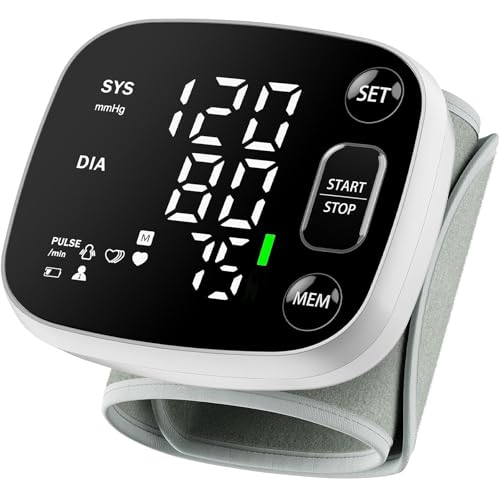
The best wrist bp monitors are the blood pressure monitors that fit on the wrist and make a home reading simple: a cuff that adjusts to the wrist, a large display that is easy to read, memory that keeps past readings for two people, and a design that packs away in a case when it is not in use. The eight monitors below are all wrist monitors for home use, and every one is a real wrist device with a named cuff size and a named memory, not an upper-arm monitor in the wrong list.
The list covers six makers, from Oklar, OMRON, BENECEN, iHealth, PARAMED and MBUPAI, and it covers the features that matter most at home: rechargeable batteries or standard batteries, a voice broadcast that reads the result aloud, an app that stores the readings on a phone, and a display with a colour indicator. Two OMRON picks and two iHealth picks appear, because both makers offer a wireless model and a simpler model, and the guide compares them directly.
A wrist monitor is bought for convenience, and the guide is honest about what that means: the wrist must be held at heart level during a reading, the cuff must fit the wrist, and the reading is a record to track over time. The guide below explains what each monitor offers, where it falls short, and who should buy it, with the cuff sizes and the memory named exactly, so the buyer can match the monitor to the wrist and the household that will use it. Anyone with questions about their blood pressure should talk to a clinician, because a home monitor records readings, it does not diagnose.
In this guide
Quick picks: best wrist bp monitors
| # | Product | Where to buy |
|---|---|---|
| 1 | Oklar Wrist Blood Pressure Monitor, FDA Cleared, Rechargeable | Check on Amazon |
| 2 | OMRON Gold Wireless Wrist Blood Pressure Monitor | Check on Amazon |
| 3 | BENECEN Blood Pressure Monitor, FDA-Cleared, Wrist | Check on Amazon |
| 4 | iHealth Pulse Bluetooth Wrist Blood Pressure Monitor | Check on Amazon |
| 5 | PARAMED Automatic Wrist Blood Pressure Monitor | Check on Amazon |
| 6 | MBUPAI FDA Cleared Wrist Blood Pressure Monitor | Check on Amazon |
| 7 | OMRON 3 Series Wrist Blood Pressure Monitor | Check on Amazon |
| 8 | iHealth Push Wrist Blood Pressure Monitor, with App | Check on Amazon |
How the picks were chosen
The picks were chosen from the site's own product search, looking only at genuine wrist blood pressure monitors sold as complete devices: a wrist cuff with a named size, a display, and memory for past readings. A listing was dropped if it was an upper-arm monitor, a cuff sold on its own, a different colour of a model already picked, or a monitor whose listing did not name it as a wrist device. Two Konquest monitors were dropped because they are upper-arm monitors, not wrist monitors, and one Oklar listing was dropped because it was the same model under a second listing.
Cuff size was checked first, because it decides whether a monitor fits: a cuff that is too small will not close, and a cuff that is too big will not sit properly. The picks here cover wrists from around 5.3 inches to 8.46 inches, and the guide names the cuff size of each monitor where the listing states it, so the buyer can measure the wrist before ordering. Memory came next, because a monitor that keeps past readings lets a household track changes over time, and the guide names the memory of each pick.
Finally, each monitor was checked for the practical things that decide whether a home monitor gets used: a large display, a voice broadcast, an app connection, and a rechargeable battery or standard batteries. The eight picks below cover all of those, in different combinations, and the guide notes which monitor does each thing best, so the buyer can spend on the feature that matters most to them and skip the ones that do not.
Quick comparison
| Product | Standout detail |
|---|---|
| Oklar Wrist Blood Pressure Monitor, FDA Cleared, Rechargeable | Oklar, cuff 4.92-8.46 inch, 240 readings |
| OMRON Gold Wireless Wrist Blood Pressure Monitor | OMRON Gold, wireless, app sync |
| BENECEN Blood Pressure Monitor, FDA-Cleared, Wrist | BENECEN, large backlit LCD, 199 memory |
| iHealth Pulse Bluetooth Wrist Blood Pressure Monitor | iHealth Pulse, Bluetooth, 2×199 memory |
| PARAMED Automatic Wrist Blood Pressure Monitor | PARAMED, kit with batteries, 90 memory |
| MBUPAI FDA Cleared Wrist Blood Pressure Monitor | MBUPAI, cuff 5.3-7.7 inch, rechargeable |
| OMRON 3 Series Wrist Blood Pressure Monitor | OMRON 3 Series, simple OMRON |
| iHealth Push Wrist Blood Pressure Monitor, with App | iHealth Push, gentle inflation, app |

1. Oklar Wrist Blood Pressure Monitor, FDA Cleared, Rechargeable
Key specs
Oklar wrist blood pressure monitor, FDA Cleared, rechargeable BP machine, for home use, adjustable cuff 4.92 to 8.46 inches, 240 reading memory for 2 users, voice broadcast, storage case included.
Strengths
- The adjustable cuff covers wrists from 4.92 to 8.46 inches, which is the widest range in this guide.
- The 240-reading memory for two users keeps a long record for a household.
- The voice broadcast reads the result aloud, which suits a buyer who prefers listening to reading.
Trade-offs
- The listing describes the monitor as FDA Cleared, which is a listing fact the buyer should confirm on the listing itself.
- The rechargeable battery needs charging, so the monitor should be kept charged between uses.
- The wide cuff range means the cuff is larger than the smallest picks here.
Who it fits
A buyer who wants the widest cuff range and a voice broadcast, with a rechargeable battery.
Best for: A household where two people share one monitor and want a spoken result.
Not suited for: Buyers who want the smallest cuff, who should take the MBUPAI pick.
In daily use
Measure the wrist before ordering, because the cuff covers 4.92 to 8.46 inches and a wrist outside that range needs a different monitor. Hold the wrist at heart level during a reading, as the instructions describe, and keep the monitor in its storage case between uses so the cuff stays clean.
The Oklar wrist monitor is the default pick in this guide: the widest cuff range, with a voice broadcast.
Check price on Amazon: Oklar Wrist Blood Pressure Monitor, FDA Cleared, Rechargeable

2. OMRON Gold Wireless Wrist Blood Pressure Monitor
Key specs
OMRON Gold wireless wrist blood pressure monitor for home use, connects to an app.
Strengths
- The OMRON name is the best-known maker of home blood pressure monitors in this guide.
- The wireless connection sends readings to an app, so the record is kept on a phone.
- The wrist design is compact, so the monitor packs away easily.
Trade-offs
- The listing does not state a cuff size or a memory count, so the buyer should check the listing for them.
- The app connection needs a phone, so a buyer without one should take a simpler pick.
- The Gold model is a premium OMRON, so it is the most established name here rather than the most featured.
Who it fits
A buyer who wants the OMRON name with a wireless app connection.
Best for: Home use with readings stored in an app.
Not suited for: Buyers who want the cuff size and memory stated in the listing, who should take the Oklar pick.
In daily use
Set the app up once when the monitor is new, so readings are stored from the first use, and keep the monitor charged or supplied with batteries as its design requires. Hold the wrist at heart level during a reading, and take readings at the same time of day for a consistent record.
The OMRON Gold is the trusted pick: the best-known maker, with a wireless app.
Check price on Amazon: OMRON Gold Wireless Wrist Blood Pressure Monitor

3. BENECEN Blood Pressure Monitor, FDA-Cleared, Wrist
Key specs
BENECEN blood pressure monitor, FDA-Cleared, automatic BP cuff for home use, wrist BP machine, large backlit LCD display, 199 memory, batteries included with carrying case, grey.
Strengths
- The large backlit LCD display is easy to read in a dim room.
- The 199-reading memory keeps a long record, and batteries are included.
- The carrying case keeps the monitor and its batteries together.
Trade-offs
- The listing describes the monitor as FDA-Cleared, which is a listing fact the buyer should confirm on the listing itself.
- The monitor uses batteries rather than a rechargeable cell, so spares are needed.
- The grey finish is plain, so a buyer who wants a brighter look should look elsewhere.
Who it fits
A buyer who wants a large backlit display and a long memory, with batteries included.
Best for: Home use in a dim room, with a clear display.
Not suited for: Buyers who want a rechargeable monitor, who should take the Oklar pick.
In daily use
Keep spare batteries in the carrying case, so the monitor is never caught without power. Read the large backlit display at arm's length, and hold the wrist at heart level during a reading, as the instructions describe.
The BENECEN monitor is the display pick: the large backlit screen with a long memory.
Check price on Amazon: BENECEN Blood Pressure Monitor, FDA-Cleared, Wrist

4. iHealth Pulse Bluetooth Wrist Blood Pressure Monitor
Key specs
iHealth Pulse Bluetooth wrist blood pressure monitor for home use, 2 times 199 memory, 4-colour indicator, smart app sync for iOS and Android, BP machine with portable case, irregular heartbeat alert.
Strengths
- The 2-times-199 memory keeps a long record for two users.
- The 4-colour indicator gives a quick visual guide to the reading.
- The Bluetooth app sync works with both iOS and Android phones.
Trade-offs
- The app sync needs a phone, so a buyer without one should take a simpler pick.
- The irregular heartbeat alert is a feature of the device, not a diagnosis, and the buyer should talk to a clinician about any alert.
- The monitor is a Bluetooth device, so the phone must be nearby for syncing.
Who it fits
A buyer who wants app sync with a colour indicator, for two users.
Best for: Home use with readings stored in an app and a quick colour guide.
Not suited for: Buyers who do not use a phone app, who should take the PARAMED pick.
In daily use
Set the app up once and let it sync after each reading, so the record builds itself. The 4-colour indicator is a quick guide, and the full reading is on the display and in the app, so read both rather than the colour alone.
The iHealth Pulse is the app pick: the Bluetooth monitor with a colour indicator.
Check price on Amazon: iHealth Pulse Bluetooth Wrist Blood Pressure Monitor

5. PARAMED Automatic Wrist Blood Pressure Monitor
Key specs
PARAMED automatic wrist blood pressure monitor, blood-pressure kit of BP cuff plus 2 AAA batteries and carrying case, irregular heartbeat detector and 90 readings memory function and large display.
Strengths
- The kit includes the cuff, two AAA batteries and a carrying case, so it is ready to use.
- The 90-reading memory keeps a useful record, and the large display is easy to read.
- The irregular heartbeat detector is a feature of the device, not a diagnosis.
Trade-offs
- The 90-reading memory is shorter than the 199 and 240-reading picks here.
- The monitor uses AAA batteries, so spares are needed.
- There is no app connection, so readings are kept on the device only.
Who it fits
A buyer who wants a complete kit with batteries and a case, without an app.
Best for: Simple home use with everything included in the box.
Not suited for: Buyers who want app sync, who should take the iHealth Pulse pick.
In daily use
Put the two AAA batteries in and the monitor is ready, with the carrying case keeping the cuff and the batteries together. Hold the wrist at heart level during a reading, and read the large display at arm's length, because the display is the whole record on this monitor.
The PARAMED monitor is the simple pick: the complete kit, ready to use.
Check price on Amazon: PARAMED Automatic Wrist Blood Pressure Monitor

6. MBUPAI FDA Cleared Wrist Blood Pressure Monitor
Key specs
MBUPAI FDA Cleared blood pressure monitor, wrist BP machine for home use, 5.3 to 7.7-inch adjustable wrist cuff, portable and rechargeable, 2 users times 90 memory, LCD screen, voice prompt, carrying case.
Strengths
- The 5.3-to-7.7-inch cuff suits smaller wrists, which the wider picks do not cover as well.
- The rechargeable battery means no spare batteries are needed.
- The voice prompt and the 2-users-times-90 memory cover a household that wants a spoken result.
Trade-offs
- The listing describes the monitor as FDA Cleared, which is a listing fact the buyer should confirm on the listing itself.
- The 90-reading memory per user is shorter than the 199 and 240-reading picks here.
- The cuff range tops out at 7.7 inches, so a larger wrist needs a wider pick.
Who it fits
A buyer with a smaller wrist who wants a rechargeable monitor with a voice prompt.
Best for: A smaller wrist in a household of two, with a spoken result.
Not suited for: Buyers with a wrist over 7.7 inches, who should take the Oklar pick.
In daily use
Measure the wrist before ordering, because the cuff covers 5.3 to 7.7 inches and a wrist outside that range needs the Oklar pick. Keep the monitor charged between uses, and use the voice prompt when the display is hard to read.
The MBUPAI monitor is the small-wrist pick: the rechargeable monitor for smaller wrists.
Check price on Amazon: MBUPAI FDA Cleared Wrist Blood Pressure Monitor

7. OMRON 3 Series Wrist Blood Pressure Monitor
Key specs
OMRON 3 Series wrist blood pressure monitor for home use.
Strengths
- The OMRON name is the best-known maker of home blood pressure monitors in this guide.
- The 3 Series is the simpler OMRON in this guide, so it is straightforward to use.
- The wrist design is compact, so the monitor packs away easily.
Trade-offs
- The listing states no cuff size, memory or display details, so the buyer should check the listing for them.
- There is no app connection stated in the listing, so readings are kept on the device.
- The 3 Series has fewer features than the OMRON Gold pick.
Who it fits
A buyer who wants the OMRON name in its simplest form.
Best for: Simple home use with a trusted maker.
Not suited for: Buyers who want the features stated in the listing, who should take the Oklar or BENECEN pick.
In daily use
Check the listing for the cuff size and the memory before ordering, because the listing title does not state them. Use the monitor as the instructions describe, with the wrist at heart level, and keep it in a case between uses.
The OMRON 3 Series is the simple OMRON pick: the trusted name, without extras.
Check price on Amazon: OMRON 3 Series Wrist Blood Pressure Monitor
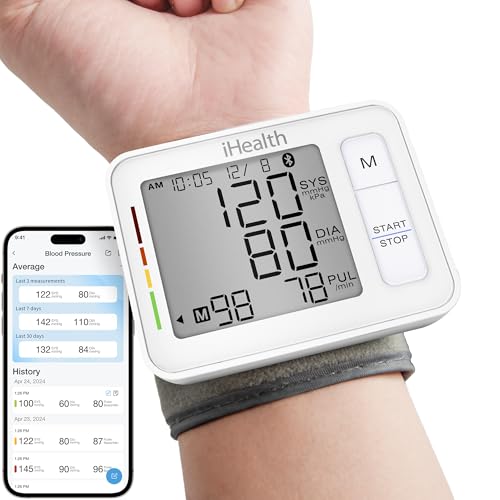
8. iHealth Push Wrist Blood Pressure Monitor, with App
Key specs
iHealth Push wrist blood pressure monitor, portable BP machine with app, gentle inflation, effortless data syncing, compatible with iOS and Android.
Strengths
- The gentle inflation is designed to be comfortable during a reading.
- The app syncs data with both iOS and Android phones.
- The portable design suits a monitor that travels as well as one that stays at home.
Trade-offs
- The listing states no cuff size or memory count, so the buyer should check the listing for them.
- The app sync needs a phone, so a buyer without one should take a simpler pick.
- The gentle inflation is a comfort feature, not a measurement feature.
Who it fits
A buyer who wants a portable iHealth monitor with gentle inflation and app sync.
Best for: Home and travel use with readings stored in an app.
Not suited for: Buyers who want the cuff size stated in the listing, who should take the Oklar pick.
In daily use
Set the app up once and let it sync after each reading, so the record builds itself. The gentle inflation makes the reading more comfortable, and the portable design means the monitor can travel in its case.
The iHealth Push is the portable pick: the gentle, portable monitor with an app.
Check price on Amazon: iHealth Push Wrist Blood Pressure Monitor, with App
Buying guide: best wrist bp monitors
Cuff size: measure the wrist first
The cuff size decides whether a monitor fits, and the picks here cover wrists from around 5.3 inches to 8.46 inches. Measure the wrist with a tape before ordering, and match it to the monitor's cuff range, because a cuff that is too small will not close and a cuff that is too big will not sit properly. The Oklar pick covers the widest range, from 4.92 to 8.46 inches, while the MBUPAI pick covers 5.3 to 7.7 inches and suits smaller wrists. Some listings do not state a cuff size, and the buyer should check the listing for it before ordering, because the cuff is the part that has to fit.
Wrist position: heart level matters
A wrist monitor must be held at heart level during a reading, and the instructions with every monitor describe how. Sit down, rest the arm on a table, and raise the wrist until it is level with the heart, then stay still while the monitor works. A wrist held too low or too high gives a different reading, and the guide says so plainly because it is the most common mistake with a wrist monitor. Take readings at the same time of day, and sit quietly for a few minutes first, so the record is consistent.
Memory: one user or two
A monitor that keeps past readings lets a household track changes over time, and the picks here keep from 90 to 240 readings, for one or two users. The Oklar pick keeps 240 readings for two users, the iHealth Pulse keeps 2 times 199, and the PARAMED pick keeps 90. A household where two people share one monitor should choose a two-user memory, so each person's record stays separate. A monitor without a stated memory should be checked on its listing, because the memory is the record, and a monitor that keeps no record is a monitor that shows only the moment.
Display and voice: reading the result
The display is how the result is read, and the picks here offer large displays, backlit displays, a 4-colour indicator, and voice broadcasts that read the result aloud. The BENECEN pick has a large backlit LCD that is easy to read in a dim room, the iHealth Pulse has a 4-colour indicator for a quick guide, and the Oklar and MBUPAI picks speak the result. A buyer who finds a small display hard to read should choose a large display or a voice broadcast, because a result that cannot be read is a result that cannot be used.
App sync: the record on a phone
Three monitors here connect to an app: the OMRON Gold, the iHealth Pulse and the iHealth Push. The app stores the readings on a phone, so the record is kept without writing anything down, and it can be shown to a clinician at a visit. An app needs a phone, and a buyer without one should take a simpler monitor that keeps its record on the device. The app is a convenience, not a requirement, and the monitor works without it.
Power: rechargeable or batteries
The monitors here use either a rechargeable battery or standard batteries, and the choice is practical. A rechargeable monitor, like the Oklar and MBUPAI picks, needs charging between uses, so it should be kept charged. A battery monitor, like the BENECEN and PARAMED picks, needs spare batteries, and the PARAMED kit includes two AAA batteries to start. Keep spare batteries or a charging cable at hand, because a monitor without power is a monitor that cannot take a reading.
What a home monitor does, and does not do
A home monitor records readings, and it does not diagnose. The irregular heartbeat alert on the iHealth Pulse and the PARAMED monitor is a feature of the device, not a diagnosis, and anyone who sees an alert, or who has questions about their blood pressure, should talk to a clinician. The readings are a record to track over time, and the record is most useful when it is taken regularly, at the same time of day, and shown to a clinician at a visit.
Upper-arm against wrist
An upper-arm monitor is the traditional choice, and a wrist monitor is the convenient one, and the two are different purchases. A wrist monitor is smaller, lighter and easier to carry, and it suits a traveller or a buyer who finds an upper-arm cuff uncomfortable. An upper-arm monitor suits a buyer who wants the traditional placement. This guide covers wrist monitors only, and the two upper-arm Konquest monitors that appeared in the search were left out for that reason.
Usage and care
Sit down and rest for a few minutes before a reading, then fit the cuff on the bare wrist, snug but not tight, with the display on the inside of the wrist as the instructions describe. Hold the wrist at heart level, stay still and quiet while the monitor works, and read the result from the display or listen to the voice broadcast. Take readings at the same time of day, and keep a note of them, or let the app keep the record where the monitor connects to one.
Clean the cuff with a damp cloth once a week, and let it dry fully before the next use, because a damp cuff is uncomfortable and can affect the fit. Keep the monitor in its storage case between uses, with the batteries or the charging cable at hand, so it is ready when it is needed. Check the cuff for wear every month, because a worn cuff does not fit properly, and a monitor with a worn cuff should have the cuff replaced rather than used as it is.
Do not take a reading straight after exercise, a meal, coffee or a bath, because the reading will not reflect a resting state. Do not talk during a reading, and do not move the wrist, because movement affects the result. A monitor looked after this way, used regularly and at the same time of day, gives a consistent record that is useful to track over time and to show to a clinician.
Common mistakes
The most common mistake is holding the wrist at the wrong height: too low or too high, rather than at heart level. The reading changes with the height, so the monitor's instructions should be followed every time, with the arm rested on a table and the wrist raised to the heart. A reading taken with the wrist in the lap is not the same as a reading taken at heart level, and the record will be inconsistent.
The second mistake is buying a cuff that does not fit the wrist. A cuff that is too small will not close, and a cuff that is too big will not sit properly, and both give a poor reading. Measure the wrist with a tape before ordering, and match it to the monitor's cuff range, because the cuff is the part that has to fit, and no feature makes up for a wrong size.
The third mistake is treating a single reading as the whole story. Blood pressure changes through the day, and one reading on its own says little. Take readings regularly, at the same time of day, and track them over weeks, because the trend is what matters, and a single high or low reading is not a reason to change anything without talking to a clinician.
Wrist monitors for two people
A household where two people share one monitor needs a two-user memory, and the Oklar, iHealth Pulse and MBUPAI picks offer it, keeping each person's readings separate. Each person should use the monitor at their own time of day, and the record should be kept separate, whether on the device or in the app. A single-user memory in a two-person household mixes the records, and the trend becomes meaningless, so the two-user feature is worth choosing when it is needed.
Wrist monitors for travel
A wrist monitor travels better than an upper-arm monitor, because it is smaller and lighter, and the iHealth Push and the MBUPAI picks are the most portable here. Pack the monitor in its storage case, with the charging cable or spare batteries, and take readings at the same time of day as at home, because the record stays consistent when the routine does. A travel monitor is still a home monitor that happens to be away, and it should be used the same way.
Wrist monitors for older users
An older user wants a large display, a voice broadcast and a simple operation, and the Oklar, BENECEN and PARAMED picks cover those between them. The voice broadcast reads the result aloud, the large display is easy to read, and the PARAMED kit includes everything needed to start. An app is not required, and the monitor that is simplest to use is the monitor that gets used, which is the point that matters most.
Final recommendation
If one monitor has to win this guide, it is the Oklar Wrist Blood Pressure Monitor, because it covers the widest cuff range, from 4.92 to 8.46 inches, keeps 240 readings for two users, speaks the result aloud, and recharges rather than needing batteries. The iHealth Pulse is the pick for buyers who want app sync with a colour indicator, and the MBUPAI monitor is the pick for buyers with a smaller wrist.
For most buyers, the choice comes down to three questions. How big is the wrist? Measure it, and match it to the cuff range, with the Oklar for the widest range and the MBUPAI for smaller wrists. Is an app wanted? If yes, the OMRON Gold, the iHealth Pulse and the iHealth Push are the answers. Is a voice broadcast wanted? If yes, the Oklar and the MBUPAI are the ones to compare. Answer those three, and the right monitor in this guide picks itself. A monitor that is used regularly is worth more than a monitor with more features that stays in its case.
Whatever monitor is chosen, measure the wrist, hold it at heart level during a reading, and take readings regularly at the same time of day. A wrist blood pressure monitor bought carefully is a monitor that gives a consistent record over time, and the eight monitors in this guide are all monitors that can do that, in different sizes and with different features, for different households. Anyone with questions about their blood pressure should talk to a clinician.
Frequently asked questions
How do I use a wrist blood pressure monitor?
Fit the cuff on the bare wrist, snug but not tight, hold the wrist at heart level, and stay still and quiet while the monitor works. Sit down and rest for a few minutes first, take readings at the same time of day, and keep a record of them, or let the app keep it where the monitor connects to one.
What size wrist cuff do I need?
Measure the wrist with a tape before ordering, and match it to the monitor's cuff range. The Oklar pick covers 4.92 to 8.46 inches, the MBUPAI pick covers 5.3 to 7.7 inches, and some listings do not state a cuff size, so the buyer should check the listing for it before ordering.
Are wrist blood pressure monitors as good as upper-arm ones?
A wrist monitor is convenient and portable, while an upper-arm monitor is the traditional choice, and the two are different purchases. A wrist monitor gives a consistent record when the wrist is held at heart level every time, and the buyer who wants the traditional placement should choose an upper-arm monitor instead. This guide covers wrist monitors only.
Do wrist blood pressure monitors need an app?
No, a wrist blood pressure monitor works without an app, and the PARAMED and OMRON 3 Series picks in this guide keep their readings on the device. The OMRON Gold, iHealth Pulse and iHealth Push connect to an app, which stores the readings on a phone, but the app is a convenience, not a requirement.
How many readings can a wrist monitor store?
The monitors in this guide store from 90 to 240 readings, with the Oklar keeping 240 for two users, the iHealth Pulse keeping 2 times 199, and the PARAMED keeping 90. A household where two people share one monitor should choose a two-user memory, so each person's record stays separate.
What does the irregular heartbeat alert mean?
The irregular heartbeat alert on the iHealth Pulse and the PARAMED monitors is a feature of the device that flags an irregular rhythm during a reading. It is not a diagnosis, and anyone who sees an alert, or who has questions about their blood pressure, should talk to a clinician.
How often should I take my blood pressure at home?
How often to take readings is a question for a clinician, because it depends on the person and their health. In general, a home monitor is most useful when readings are taken regularly, at the same time of day, and tracked over weeks, because the trend matters more than any single reading. The monitors in this guide store from 90 to 240 readings, so the record builds over time, and it can be shown to a clinician at a visit. A single reading on its own says little, and it is not a reason to change anything without talking to a clinician.
More from ilcastellomenu.com
Best 1ms monitors for gaming: fast monitors for gaming
Best monitors for PS5 HDMI 2.1: monitors for the PlayStation 5
Best smart watches for teenagers: smartwatches for younger users