Where to buy
These are the three picks from our black friday monitor deals 2026 shortlist we would check first. Check the latest price, availability and delivery on Amazon. Orders are placed on Amazon, and prices during Black Friday Week can change by the hour, so the figure on the live listing is the one that counts. We may earn a commission from qualifying purchases.
- Best overall: LG 27GR83Q-B 27-inch UltraGear QHD 240Hz IPS Gaming Monitor
- Best 4K: LG 27G810A-B 27-inch UltraGear 4K UHD Dual Mode Gaming Monitor
- Best 32-inch value: Samsung 32-inch Odyssey G5 G50F QHD 180Hz Gaming Monitor
Disclosure: As an Amazon Associate, ilcastellomenu.com earns from qualifying purchases. Links to Amazon on this page are affiliate links; they cost you nothing extra. Listing details such as price and availability change often — during this event they can change several times a day — so check the current Amazon listing before you buy.
Black Friday Monitor Deals 2026: The Screens Worth Your Money
Amazon Black Friday Week runs from November 19 to November 30, 2026. Black Friday itself is November 27, and Cyber Monday closes the event on November 30. Monitors are the single best category in the whole sale for one simple reason: panel technology improves every year, which means last year’s flagship specifications — 240Hz QHD IPS, dual-mode 4K, 34-inch ultrawide at 240Hz — cascade down into prices that would have been impossible twelve months ago. These black friday monitor deals 2026 are the six we would actually spend money on: a 240Hz QHD all-rounder, a dual-mode 4K screen that is really two monitors in one, a 32-inch value pick, a 4K USB-C screen for people who work more than they play, a 240Hz ultrawide, and a curved QHD gaming monitor at the lowest verified price in the guide.
Every price in this guide was checked against Amazon’s own catalogue data on November 20, 2026, and every price is written as a dated sighting: “seen at $269.99 on November 20, 2026” means exactly that, no more. Monitor prices move hourly during Black Friday Week. A screen can be one figure at breakfast and another by dinner, and a lightning deal can expire while it sits in your cart. Where the catalogue also returned a list price for the same monitor, we show the percentage that pair of numbers represents; where no list price came back, we print no percentage at all, because an invented discount is worse than none. Always check the live price on the listing before you buy.
One decision matters more than any single discount here, and it is the resolution-and-size decision, because it is the one you cannot change later with a setting. A 27-inch QHD screen is the current sweet spot for gaming and general use: sharp enough that individual pixels disappear at desk distance, light enough that ordinary graphics cards can drive it at high frame rates. A 27-inch 4K screen is sharper still and wonderful for work and story games, but it asks far more of your GPU in fast titles — unless, like pick two, it can drop to Full HD and trade resolution for speed. A 32-inch QHD spreads the same pixels wider, trading a little sharpness for immersion and readable text. And an ultrawide replaces two monitors with one curved expanse, which some desks will never go back from. Five of the six picks below are gaming-leaning because that is where this year’s discounts are deepest; pick four is the deliberate exception, a work-first 4K screen with USB-C docking that happens to play games respectably too.
It also helps to read a monitor deal the way a panel engineer would. The headline numbers are refresh rate and resolution, but the lasting numbers are the panel type (IPS, in every pick here, for its colour and viewing angles), the colour gamut, whether the stand adjusts in height or merely tilts, and whether the inputs include HDMI 2.1 if a console shares your desk. Every review below states those plainly, because a monitor is the part of a setup you look at for every minute of every session — the sale is simply the cheapest week to upgrade the thing you stare at most.
In this guide
Quick Picks
Short on time? These are the six deals, the buyer each one suits, and the price we verified on November 20, 2026. Every price is a dated sighting — check the live price before you buy.
| Best for | Deal | Spotted price | Link |
|---|---|---|---|
| Best overall | LG 27GR83Q-B 27-inch UltraGear QHD 240Hz IPS Gaming Monitor | seen at $269.99 on November 20, 2026 (list $499.99) | Check on Amazon |
| Best 4K | LG 27G810A-B 27-inch UltraGear 4K UHD Dual Mode Gaming Monitor | seen at $346.99 on November 20, 2026 (list $599.99) | Check on Amazon |
| Best 32-inch value | Samsung 32-inch Odyssey G5 G50F QHD 180Hz Gaming Monitor | seen at $209.99 on November 20, 2026 (list $349.99) | Check on Amazon |
| Best for work | Dell S2725QC 27-inch 4K UHD IPS USB-C Monitor | seen at $249.99 on November 20, 2026 (list $349.99) | Check on Amazon |
| Best ultrawide | LG 34G630A-B 34-inch UltraGear WQHD Curved 240Hz Gaming Monitor | seen at $349.99 on November 20, 2026 (list $449.99) | Check on Amazon |
| Best budget | LG 27GS60QC-B 27-inch UltraGear Curved QHD 180Hz Gaming Monitor | seen at $149.99 on November 20, 2026 (list $199.99) | Check on Amazon |
How These Deals Were Chosen
We verified every pick in this guide the slow way: by searching Amazon’s own catalogue data for the exact brand and model, matching the returned listing title word for word against the monitor we intended to recommend, and recording the price and list price the catalogue returned on November 20, 2026. That process sounds basic, but it eliminates the two failure modes that fill most Black Friday roundups — links that land on a different model than the headline promises, and “deals” whose prices were copied from a roundup of a roundup until nobody knows which year they belong to. Monitor ranges are especially treacherous here: a single letter in an LG or Samsung model code can change the refresh rate, the stand or the panel, so if a search did not return a listing we could match with confidence, the screen did not get a link, however good it looked.
A deal then had to clear three further bars. First, the product had to be a current, genuine monitor from its maker’s present range — no marketplace lookalikes trading on a famous name, no renewed panels dressed as new, and no quietly discontinued model being cleared under a Black Friday banner. Second, the specification had to be honest at the price: IPS panels throughout this guide, adaptive sync from both camps where gaming is the point, and no screen whose headline refresh rate is only reachable through a connection the box does not support. Third, the price had to be a price worth printing. A token few dollars off a screen that sits at that figure all year is not a deal, so we favoured listings where the verified price sat meaningfully below the list price returned alongside it — in five of the six cases here, by a fifth or more, and in three cases by two-fifths or more.
We also weighted what the discount buys in practice. A percentage off a tilt-only screen is worth less to someone who works at the same desk all day than the same percentage off a height-adjustable one, which is why stand ergonomics appear in every review and why the work pick’s USB-C docking earns its slot. Where a figure in a review comes from the maker’s own specifications — refresh rate, response time, gamut coverage — it is presented as the maker’s figure, not as an independent test result. And where two near-identical models sit a few dollars apart, we chose the one whose specification we could verify completely rather than the one with the bigger headline.
The Six Deals, In Detail

1. LG 27GR83Q-B 27-inch UltraGear QHD Gaming Monitor — Best Overall
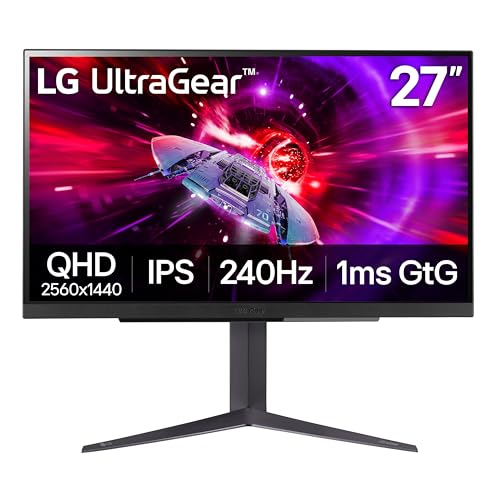
Badge: Best Overall. If one specification defines the modern gaming monitor, it is this one: 27 inches, 2560×1440, IPS, and fast. The 27GR83Q-B runs that panel at 240Hz with a 1ms GtG response per the verified listing, over both DisplayPort 1.4 and HDMI 2.1 — the latter matters if a current console shares your desk, because it means full refresh without compromises. Colour is covered to up to 95% of DCI-P3 with VESA DisplayHDR 400, adaptive sync is validated on both sides (NVIDIA G-Sync Compatible and AMD FreeSync Premium), and the stand tilts, lifts and pivots, so the screen can go portrait for a second-monitor life later. It is the complete package at the deepest verified percentage in this guide, which is what the best-overall slot is for.
Spec snapshot: 27-inch QHD (2560×1440) IPS; 240Hz; 1ms GtG (maker’s figures); DisplayHDR 400, up to 95% DCI-P3; G-Sync Compatible and FreeSync Premium; HDMI 2.1 and DisplayPort 1.4; tilt/height/pivot stand.
Who it suits: Gamers who play everything — competitive titles that use the 240Hz, story games that use the colour — and anyone upgrading from a 1080p or 60Hz screen who wants the one purchase that ends the upgrade cycle for years.
Deal details: Seen at $269.99 on November 20, 2026, against a $499.99 list price returned by the same catalogue check — 46% below list on the verified figures. Screens with this exact specification headlined premium line-ups very recently; at this figure it is the value centre of the entire event for gamers. Check the live price before you buy, and check your graphics card’s outputs — you want DisplayPort or HDMI 2.1 to see the full 240Hz.
Strengths
- 240Hz QHD IPS with both sync standards: the sweet-spot spec, complete.
- HDMI 2.1 as well as DisplayPort — consoles get the full refresh too.
- Fully adjustable stand, including pivot to portrait.
Trade-offs
- DisplayHDR 400 is entry-level HDR: nice highlights, not OLED drama.
- 240Hz needs a graphics card that can feed it; weak GPUs will idle the panel’s talent.
- No USB-C input — laptop users should look at picks four and five.
Verdict — Best for: gamers wanting the definitive 27-inch QHD upgrade. Not suited for: 4K purists or single-cable laptop desks. Check on Amazon · See the 27GR83Q-B listing · View full specs and the live price

2. LG 27G810A-B 27-inch UltraGear 4K UHD Dual Mode Gaming Monitor — Best 4K
Badge: Best 4K. The argument against 4K gaming monitors has always been the same: glorious for story games, too heavy for competitive ones. Dual Mode is LG’s answer, and this screen is its current showcase — a 27-inch 4K UHD IPS panel that runs at up to 180Hz in native 4K, then switches by hotkey to Full HD at up to 360Hz when the game values frames over pixels. Both modes carry a 1ms GtG response per the verified listing, colour runs to up to 95% DCI-P3 with DisplayHDR 400, sync covers FreeSync Premium and G-Sync compatibility, and HDMI 2.1 keeps consoles honest. In effect it is the pick-one monitor and a dedicated esports screen sharing one stand, and the verified price is closer to either than to both.
Spec snapshot: 27-inch 4K UHD (3840×2160) IPS; Dual Mode — UHD 180Hz or FHD 360Hz; 1ms GtG (maker’s figures); DisplayHDR 400, up to 95% DCI-P3; FreeSync Premium and G-Sync Compatible; HDMI 2.1.
Who it suits: Players who split their time between cinematic single-player games and competitive titles, creators who want 4K desktop clarity by day, and anyone who has ever priced two monitors and wished they were one.
Deal details: Seen at $346.99 on November 20, 2026, against a $599.99 list price from the same catalogue check — 42% below list on the verified figures. Dual-mode panels are a current-generation technology, not clearance stock, which makes a cut of this depth the second-strongest value story in the guide. Check the live price before you buy, and be honest about your GPU: native 4K at high refresh is the most demanding mainstream load there is.
Strengths
- Two monitors in one: 4K 180Hz for beauty, FHD 360Hz for speed.
- Full 4K desktop clarity for work, editing and media between games.
- Current-generation panel at a clearance-class discount.
Trade-offs
- Driving 4K properly needs a strong graphics card — budget for both or neither.
- FHD mode on a 27-inch screen is visibly softer; it is a competitive tool, not a pretty one.
- Premium price against the QHD picks if you never use the second mode.
Verdict — Best for: gamers who refuse to choose between resolution and refresh rate. Not suited for: modest GPUs, or players who only ever play one kind of game. Check on Amazon · See the 27G810A-B listing · View dual-mode specs and the live price

3. Samsung 32-inch Odyssey G5 (G50F) QHD Gaming Monitor — Best 32-Inch Value
Badge: Best 32-Inch Value. Bigger is its own feature. A 32-inch screen fills more of your field of view, makes text readable without scaling, and turns strategy games, flight sims and open worlds into places rather than pictures. This generation of Odyssey G5 does it with a Fast IPS panel at QHD resolution — the combination earlier G5 generations, built on VA, could not offer — running 180Hz with a 1ms GtG response per the verified listing, HDR10, G-Sync compatibility and FreeSync, and an adjustable stand. Samsung’s gaming extras are present too: Black Equalizer for shadow detail and a Virtual Aim Point overlay. At the verified price it undercuts every other route to a 32-inch IPS gaming screen in this guide by a wide margin.
Spec snapshot: 32-inch QHD (2560×1440) Fast IPS; 180Hz; 1ms GtG (maker’s figures); HDR10; G-Sync Compatible and AMD FreeSync; adjustable stand; model LS32FG502ENXZA.
Who it suits: Gamers who sit a little further back, sim and strategy players, and anyone whose eyes prefer large text — plus mixed users who want one big screen for games by night and spreadsheets by day, where 32-inch QHD’s readable pixels are a genuine comfort.
Deal details: Seen at $209.99 on November 20, 2026, against a $349.99 list price returned by the same catalogue check — 40% below list on the verified figures, and the lowest cost per inch of quality panel in this guide. Check the live price before you buy, and measure your desk depth: a 32-inch screen wants roughly an arm’s length of viewing distance to be comfortable.
Strengths
- 32 inches of Fast IPS at a 27-inch price: the value story of the guide.
- 180Hz and 1ms keep it a real gaming panel, not a TV in disguise.
- Adjustable stand — not a given at this price.
Trade-offs
- QHD at 32 inches is less pixel-dense than at 27: sharp, but not Retina-crisp.
- Flat panel — buyers who love the curved G5 wrap should check the listing’s variant carefully.
- Needs desk depth; on a shallow desk it will feel like it is leaning over you.
Verdict — Best for: big-screen gaming and mixed use on a mid budget. Not suited for: small desks or buyers chasing maximum pixel density. Check on Amazon · See the Odyssey G5 G50F listing · View size and specs and the live price

4. Dell S2725QC 27-inch 4K UHD USB-C Monitor — Best for Work
Badge: Best for Work. Not every screen in this sale is bought for games. The S2725QC is Dell’s work-first 27-inch 4K: an IPS panel at 3840×2160 and 163 PPI per the verified listing, so text renders with the crispness that makes eight hours of documents measurably less tiring, colour covering 99% sRGB for honest photo and design work, and a 120Hz refresh rate with FreeSync Premium that keeps scrolling smooth and games respectable after hours. The desk-friendly details are the real argument: a single USB-C cable connects a laptop and delivers up to 65W of power, ComfortView Plus keeps low-blue-light emissions down for all-day comfort, and built-in speakers — re-engineered in this generation for greater output and depth — clear two more boxes off the desk.
Spec snapshot: 27-inch 4K UHD (3840×2160) IPS, 163 PPI; 120Hz; 4ms response (maker’s figures); 99% sRGB; FreeSync Premium; USB-C with up to 65W power delivery, HDMI, DisplayPort; ComfortView Plus low blue light; integrated speakers.
Who it suits: Laptop-based home workers, writers, analysts, designers and students — anyone whose screen time is mostly text and windows, who wants one cable on the desk, and who plays lighter games where 120Hz is plenty.
Deal details: Seen at $249.99 on November 20, 2026, against a $349.99 list price returned by the same catalogue check — 29% below list on the verified figures. Work monitors discount less flamboyantly than gaming ones, and a 4K USB-C screen at this figure undercuts most of its direct rivals while including the power delivery they often charge extra for. Check the live price before you buy, and confirm your laptop’s USB-C port carries video — most modern ones do, but it is the one compatibility question this pick depends on.
Strengths
- One-cable laptop docking with 65W charging: the cleanest desk in this guide.
- 4K at 163 PPI makes text genuinely crisp for long workdays.
- 120Hz and FreeSync Premium keep it capable after hours, too.
Trade-offs
- 120Hz and 4ms are work-grade, not esports-grade — competitive players should take pick one or two.
- 99% sRGB, not wide-gamut DCI-P3: colour professionals should check their requirements.
- Built-in speakers are tidy, not hi-fi; media desks will still want separate audio.
Verdict — Best for: laptop home offices and text-heavy work with light gaming. Not suited for: competitive gaming or colour-critical studio work. Check on Amazon · See the S2725QC listing · View connectivity and the live price

5. LG 34G630A-B 34-inch UltraGear WQHD Curved Gaming Monitor — Best Ultrawide
Badge: Best Ultrawide. An ultrawide is not a bigger monitor; it is a different shape of working and playing. The 21:9 expanse of this 34-inch curved UltraGear — 3440×1440, per the verified listing — puts a game’s periphery where your peripheral vision expects it, and puts a spreadsheet’s columns, a timeline’s tracks or three documents side by side without a bezel in the middle. LG has not made it choose between that shape and speed: the panel runs 240Hz with a 1ms response, FreeSync Premium, DisplayHDR 400 and up to 95% DCI-P3 colour, with a built-in speaker, USB-C among its inputs, and a tilt/height/swivel stand. Ultrawides at 240Hz were flagship exotica recently; the verified price is what earns this one its slot.
Spec snapshot: 34-inch WQHD (3440×1440) curved 21:9; 240Hz; 1ms GtG (maker’s figures); FreeSync Premium; DisplayHDR 400, up to 95% DCI-P3; built-in speaker; HDMI, DisplayPort, USB-C; tilt/height/swivel stand.
Who it suits: Sim racers and flight simmers, immersive single-player gamers, streamers who want game plus chat on one panel, and productivity users replacing a dual-monitor setup with one clean screen.
Deal details: Seen at $349.99 on November 20, 2026, against a $449.99 list price returned by the same catalogue check — 22% below list on the verified figures, the shallowest percentage in this guide. We include it anyway because the comparison that matters is against other 240Hz ultrawides, where this figure is aggressive, and because replacing two monitors with one has a value no percentage captures. Check the live price before you buy, and check your favourite games support 21:9 — most modern titles do, some older ones letterbox.
Strengths
- 240Hz at ultrawide width: immersion and speed in the same panel.
- Replaces dual monitors for work — timelines and documents gain real room.
- USB-C input and height adjustment keep desks and posture happy.
Trade-offs
- Demands desk width and a capable GPU — 3440×1440 at 240Hz is a heavy load.
- Not every game or video fills 21:9; expect occasional black bars.
- Curved screens are a taste — some users never stop noticing the bend in spreadsheets.
Verdict — Best for: immersion-first gamers and dual-monitor replacers. Not suited for: narrow desks, modest GPUs, or buyers who dislike curves. Check on Amazon · See the 34G630A-B listing · View ultrawide specs and the live price

6. LG 27GS60QC-B 27-inch UltraGear Curved QHD Gaming Monitor — Best Budget
Badge: Best Budget. Every guide needs the pick that proves the floor has risen, and this is it: a 27-inch QHD gaming monitor with a dramatic 1000R curve, 180Hz refresh and 1ms GtG response per the verified listing, at the lowest verified price here. The curve is the talking point — 1000R is a tight wrap that pulls the screen’s edges into your peripheral vision, which suits racing and open-world games particularly well — but the supporting specification is complete rather than cut down: HDR10 with up to 99% sRGB colour, AMD FreeSync, two HDMI ports plus DisplayPort for a PC-and-console desk, and LG’s gamer extras including Black Stabilizer, Dynamic Action Sync, a crosshair overlay and an FPS counter, all in a three-side borderless design.
Spec snapshot: 27-inch QHD (2560×1440) curved 1000R; 180Hz; 1ms GtG (maker’s figures); HDR10, up to 99% sRGB; AMD FreeSync; 2× HDMI and DisplayPort; tilt stand.
Who it suits: First-time gaming-monitor buyers, console-plus-PC desks, and anyone upgrading from an old 1080p 60Hz panel who wants the largest possible jump for the smallest possible cheque.
Deal details: Seen at $149.99 on November 20, 2026, against a $199.99 list price returned by the same catalogue check — 25% below list on the verified figures. The honest framing is not the percentage but the specification it buys: QHD resolution and 180Hz at a figure that used to mean 1080p and 144Hz on a good day. Check the live price before you buy; budget monitors are the most volatile listings of the event.
Strengths
- QHD, 180Hz and a 1000R curve at the guide’s lowest price — the floor has risen.
- Two HDMI ports plus DisplayPort: PC and console without cable swapping.
- Useful gamer features (crosshair, FPS counter, Black Stabilizer) included, not upsold.
Trade-offs
- Tilt-only stand — budget for a monitor arm if you work at it all day (see the guide linked below).
- FreeSync only; NVIDIA users get basic adaptive sync rather than validated G-Sync.
- The steep 1000R curve divides opinion for office work and shared viewing.
Verdict — Best for: budget gaming upgrades and first gaming monitors. Not suited for: all-day office ergonomics without an arm, or colour-critical work. Check on Amazon · See the 27GS60QC-B listing · View budget specs and the live price
Deals We Left Out, and Why
A guide is defined as much by what it excludes. Our catalogue checks surfaced plenty of other monitor listings on November 20, 2026, and several tempting ones did not make the cut. The 1080p high-refresh screens are the clearest example: 240Hz and even faster Full HD panels appear at startling prices, and they are the right tool for a narrow group of professional esports players — but for everyone else, resolution is the upgrade you see in every minute of every game and document, and QHD at 180–240Hz is now cheap enough that settling for 1080p on a 27-inch screen is a false economy. Those picks live or die on a use case most buyers do not have.
At the other extreme, the giant 49-inch super-ultrawides and the OLED flagships were passed over on value arithmetic rather than quality: they are magnificent, and their sale prices remain multiples of every pick here, for gains that show mainly in HDR gaming — a wonderful luxury, honestly labelled as one, and a poor use of a finite Black Friday budget for most desks. Budget no-name panels with tempting specifications were excluded for the standing reason: a monitor’s specification sheet cannot tell you about uniformity, dead pixels or the warranty experience, and the six picks here come from ranges where those things are known quantities. Finally, several listings carried prices identical to the figures those same screens wear outside the event. A Black Friday banner on an everyday price is marketing, not a deal, and this guide exists to tell the two apart.
Comparison Table
| Pick | Size / resolution | Refresh / panel | Seen Nov 20, 2026 | Watch out for |
|---|---|---|---|---|
| LG 27GR83Q-B | 27-inch QHD | 240Hz IPS, HDR400 | $269.99 (list $499.99) | No USB-C input |
| LG 27G810A-B | 27-inch 4K UHD | Dual mode 180Hz / FHD 360Hz IPS | $346.99 (list $599.99) | Needs a strong GPU for 4K |
| Samsung Odyssey G5 G50F | 32-inch QHD | 180Hz Fast IPS, HDR10 | $209.99 (list $349.99) | Needs desk depth |
| Dell S2725QC | 27-inch 4K UHD | 120Hz IPS, USB-C 65W | $249.99 (list $349.99) | Work-grade response for gaming |
| LG 34G630A-B | 34-inch WQHD ultrawide | 240Hz curved, HDR400 | $349.99 (list $449.99) | Heavy GPU load; 21:9 support varies |
| LG 27GS60QC-B | 27-inch QHD curved | 180Hz, 1000R, HDR10 | $149.99 (list $199.99) | Tilt-only stand |
Resolution, Refresh and Panel: A Plain-English Primer
Three numbers decide how a monitor feels, and they are worth one clear pass. Resolution is how many pixels draw the picture: at desk distances, QHD (2560×1440) on a 27-inch screen is the point where pixels stop being visible in games while text stays easy, and 4K (3840×2160) is the point where text becomes print-like and editing timelines gain room. Refresh rate is how many times per second the picture redraws: 60Hz to 144Hz is the jump everyone feels, 144Hz to 240Hz is a refinement competitive players swear by, and beyond that the returns belong to specialists. Panel type is the physics underneath: IPS — every pick in this guide — gives the best colour and viewing angles; VA gives deeper contrast with slower dark transitions; OLED gives perfect blacks at flagship prices.
The practical rules follow from those three. Match the monitor to the graphics card you own, not the one you dream about: a QHD 240Hz screen fed by a card that manages 90 frames per second is a 90Hz experience with a nicer spec sheet. Consoles cap at 120Hz and speak HDMI, which is why HDMI 2.1 appears in the gaming picks. Colour gamut figures — 95% DCI-P3 on the LG gaming picks, 99% sRGB on the Dell and the budget LG — describe how wide a range of colours the panel can show; wider matters for HDR games and media, while accurate sRGB matters for work. And the stand is not a footnote: height adjustment is the difference between a screen that fits your posture and a stack of books under a tilt-only base, which is why it is named in every review above.
How to Choose the Right Monitor Deal for Your Desk
Start with the graphics card, honestly. List what you play and what your GPU sustains. If it lives at QHD and high frame rates, pick one or three is your screen. If it is a flagship card bored at QHD, pick two’s 4K mode finally employs it. If it is a modest card or a console, the budget pick’s 180Hz QHD is already generous — and the Dell at pick four, at 120Hz, is the honest ceiling for most laptops.
Decide the shape of your desk. One screen or two? Pick five’s ultrawide replaces a pair with a single curve and no bezel gap, and for timelines, code and spreadsheets many users never go back. But it wants width, depth and 21:9 support in your games; a conventional 27-inch at pick one or two fits every desk and every title ever made.
Work first or play first? If the screen earns its keep in documents, pick four’s 4K text, USB-C docking and eye-comfort engineering are the correct priorities, and its 120Hz keeps evenings respectable. If it earns its keep in games, the gaming picks’ response times, sync validation and HDR gamuts are worth more than any docking cable.
Three example shopping lists. For a competitive player: pick one, plus a monitor arm from the guide linked below for perfect placement. For a creator-gamer: pick two, which is a 4K work screen by day and two kinds of gaming screen by night. For a home office that games lightly: pick four for the desk, or pick three if the same screen must do family media duty at 32 inches. And for the strictest budget: pick six now, and put the arm and the second screen on next year’s list — the panel is the part you cannot upgrade later.
How to Check a Monitor Deal Is Real — and Keep It
Compare the sale price with the screen’s own history. The most useful habit in this event is checking what a monitor sold for before the banners went up. Free price-history trackers keep years of Amazon data for most listings; thirty seconds there tells you whether a discount is a genuine event low or a list price nobody has paid since spring. Every pick in this guide was verified against live catalogue data on November 20, 2026 — do the same check on anything else you add to the cart.
Read the model number letter by letter. Monitor ranges are the worst offenders in all of tech for near-identical model codes: one character can change the refresh rate, remove the height adjustment or swap the panel type. The model code is the product: check it, then check the inputs and stand on the listing, before you pay — especially on marketplace listings during big events.
Check the price at checkout, not just on the page. Prices move hourly during Black Friday Week, and the price in the cart is the price you pay. If a figure jumps between the deal page and checkout, back out and re-check the listing — either the deal ended, or a marketplace seller’s offer has replaced the one you chose. Confirm the seller and the exact model suffix are still what you selected.
Inspect it properly when it arrives. Monitors are the one category where the first ten minutes matter: display a full black screen and a full white screen in a dim room, check for dead pixels and backlight bleed at the edges, and confirm the advertised refresh rate in your system settings — many screens ship set to 60Hz until told otherwise. Save the order confirmation and the box until the return window closes; holiday windows are longer than usual, which quietly makes this the safest week of the year to buy a screen you are ninety percent sure about.
Cables, Ports and Settings: Getting the Advertised Refresh Rate
The most common disappointment with a new gaming monitor is not a faulty panel — it is a fast screen quietly running at 60Hz because nobody told it not to. Out of the box, many systems default to a safe refresh rate, and the advertised figure only appears once you open the display settings and select it. Make that your first job with any pick in this guide: connect with the right cable, open your operating system’s advanced display settings, set the refresh rate to the panel’s maximum, and then enable adaptive sync in your graphics driver’s control panel so G-Sync or FreeSync can actually do its work. Five minutes of setup is the difference between the monitor you bought and the monitor you think you bought.
The cable is the second half of the same lesson. DisplayPort is the reliable route to the full refresh rate on every gaming pick here; HDMI reaches the same figures only where the port is HDMI 2.1, as it is on picks one and two, and older HDMI cables in a drawer may not carry the bandwidth even when the ports can. Consoles speak HDMI exclusively and cap at 120Hz, which every gaming pick here exceeds — but only over a cable rated for it. If a screen’s on-screen display reports a lower rate than the box promised, swap the cable before you blame the panel; it is the culprit far more often than the hardware is.
Finally, set the response-time or overdrive option to its middle setting, not its maximum. The fastest overdrive modes on fast IPS panels can introduce inverse ghosting — pale halos behind moving objects — that looks worse than the blur it was meant to cure. The middle setting on the LG and Samsung picks here is the one their 1ms figures are built around in spirit: clean motion without artefacts. Combined with the refresh-rate setting and the right cable, it completes the short ritual that turns a specification sheet into the experience you paid for.
Common Mistakes
Buying refresh rate your GPU cannot feed. A 240Hz panel displaying 80 frames per second is an 80Hz experience. Match the screen to the card, or budget for both in the same sale.
Ignoring the stand. Tilt-only bases cause more returned monitors and more sore necks than any panel flaw. If your pick tilts only — the budget pick here — price a VESA monitor arm into the same order.
Forgetting the cable question. Full refresh rates often need DisplayPort or HDMI 2.1, and the cable in the box is not always the one that unlocks them. Check what your card outputs and what the screen accepts before the screen arrives.
Chasing size over density. A 32-inch QHD and a 27-inch QHD draw the same picture; the bigger screen spreads it thinner. Sit closer or work with text? Smaller and denser wins. Sit back or immerse? Bigger wins. Choose by viewing distance, not by the diagonal’s bragging rights.
Waiting for Black Friday itself. The event runs November 19–30, and the early days carry full stock at full discount. Waiting for November 27 out of tradition mostly buys sold-out listings and marketplace markups. If the price is at its low today, today is the day.
Final Recommendation
If you buy one monitor this Black Friday Week, make it the LG 27GR83Q-B, seen at $269.99 on November 20, 2026: 46% below its verified list price, with the 240Hz QHD IPS specification that suits more gamers than any other. If your GPU and your games span both worlds, the dual-mode 27G810A-B at a seen $346.99 is the cleverest screen in the guide. Home workers should take the Dell S2725QC at a seen $249.99 and enjoy the one-cable desk, immersion seekers the 34-inch ultrawide at a seen $349.99, and strict budgets the curved 27GS60QC-B at a seen $149.99 — a QHD 180Hz price that would have been unthinkable a year ago. If your shortlist leans ultrawide, read our dedicated roundup of Ultrawide Monitor Black Friday Deals Ultrawidemonitorblackfridaydeals before deciding, and check the live price before you buy — during this event, the listing is the only price that is real.
Frequently Asked Questions
When do monitor deals run on Amazon in 2026?
Amazon Black Friday Week runs November 19–30, 2026, with Black Friday on November 27 and Cyber Monday on November 30. Monitor deals appear throughout the window rather than all at once, and popular models can sell through early — the prices in this guide were verified on November 20, 2026.
Are the prices in this guide guaranteed?
No. Every price here is a dated sighting verified against Amazon catalogue data on November 20, 2026, and prices move hourly during the event. Treat a sighting as evidence of what the deal has cost, then check the live price on the listing before you buy.
Is QHD or 4K better for gaming?
It depends on your graphics card and your games. QHD at 240Hz (pick one) is the sweet spot for most players — sharp and fast without demanding a flagship GPU. 4K suits story games and strong cards, and the dual-mode screen at pick two exists precisely for players who want both, dropping to Full HD at 360Hz for competitive titles.
What refresh rate do I actually need?
For general use and console gaming, 120–144Hz already feels transformative over 60Hz. For PC gaming, 180–240Hz is the current sweet spot the picks here cluster around. Beyond 240Hz, gains belong to competitive specialists — and only if your system can produce those frame rates in the first place.
Does HDMI 2.1 matter for a monitor?
Yes if a current console shares your desk or your graphics card lacks DisplayPort: HDMI 2.1 is what carries high refresh rates at QHD and 4K over HDMI. Picks one and two include it. For a DisplayPort-only PC desk, it is a nice extra rather than a requirement.
Should I wait for Cyber Monday instead?
Cyber Monday (November 30, 2026) usually repeats some Black Friday pricing and adds a few fresh offers, but stock is the risk: models that sell out during Black Friday Week do not reliably come back for Monday. If a price matches the level you were waiting for now, buying now is the safer play.
Related Guides
- Ultrawide Monitor Black Friday Deals Ultrawidemonitorblackfridaydeals
- 4k Monitor Black Friday Deals 4kmonitorblackfridaydeals
- Monitor Arm Black Friday Deals Monitorarmblackfridaydeals
- Mechanical Keyboard Black Friday Deals Mechanicalkeyboardblackfridaydeals
- Wireless Gaming Mouse Black Friday Deals Wirelessgamingmouseblackfridaydeals