Disclosure: As an Amazon Associate, ilcastellomenu.com earns from qualifying purchases. Prices and availability change; check Amazon for the latest.
Where to buy
This shortlist covers the best l desks for gaming reviewed in full below. Check the latest price, availability and delivery on Amazon. Orders are placed on Amazon.
- SEVEN WARRIOR L-Shaped Gaming Desk 63 Inch, Reversible (Best Overall) – Check on Amazon
- CubiCubi L-Shaped Desk 59.1 Inch with Side Table (Best Main Run for Dual Monitors) – Check on Amazon
- Mr IRONSTONE L-Shaped Gaming Desk 51 Inch, Black (Best Classic Corner Pick) – Check on Amazon
- SEVEN WARRIOR L-Shaped Gaming Desk 50.4 Inch with LED and Power Outlets (Best With Lighting and Power) – Check on Amazon
- Bestier 51 Inch Corner Desk with Power Outlets and LED Lights (Best for Storage) – Check on Amazon
- Mr Ironstone L-Shaped Desk 47 Inch with Outlets and USB Ports (Best Compact L-Shape) – Check on Amazon
Read the full guide ↓
If you are comparing the best l desks for gaming available right now, the honest answer is that the right choice depends less on gaming branding than on fit: fit for your room, your screens and the way you actually play. An L-shaped desk earns its place by splitting one surface into two jobs: a main run where the screens and keyboard live, and a wing that absorbs everything else – a laptop, a console, a notebook, a second machine. That split is what makes corner rooms work. Instead of a straight desk pushed into a corner with dead space beside it, the L uses the corner itself as floor space, and the six picks below were chosen for how honestly they handle that split: main-run width, wing depth, and whether the layout can reverse when the room changes.
Two filters did most of the work. The first was honesty of fit: does this desk genuinely serve the keyword’s lens, at the size and shape the lens demands? The second was ownership reality: assembly sanity, replacement-part logic, and whether the desk still makes sense after the first month. Desks that failed either filter were cut, even when their marketing was louder than the survivors’. That discipline produced the six picks below. None of them is here because of a logo or a light strip; each earns its badge by doing a specific job in this lens better than the alternatives that were cut. If your situation sits at the edge of this lens, it is worth reading Best Pc Desks For Gaming before you order, because the boundary cases are where desk purchases usually go wrong.
What success looks like in this lens is unglamorous: a surface that is clear before you sit down, screens at the distance your eyes prefer, cables you never think about, and a frame that stays silent when the game gets physical. Every pick below was judged against that picture, and the badges name the specific way each desk gets you there.
In this guide
Quick Picks
| Badge | Pick | Why it stands out | Link |
|---|---|---|---|
| Best Overall | SEVEN WARRIOR L-Shaped Gaming Desk 63 Inch, Reversible | A 63-inch reversible L-shaped desk with a storage shelf, monitor stand, LED lighting, built-in outlets, a cup holder and hooks | Check on Amazon |
| Best Main Run for Dual Monitors | CubiCubi L-Shaped Desk 59.1 Inch with Side Table | A 59.1-inch L-shaped layout with a small side table section, giving a long main run plus genuine side storage | Check on Amazon |
| Best Classic Corner Pick | Mr IRONSTONE L-Shaped Gaming Desk 51 Inch, Black | A 51-inch L-shaped top with a large monitor stand, turning a corner into a main screen zone plus a side wing | Check on Amazon |
| Best With Lighting and Power | SEVEN WARRIOR L-Shaped Gaming Desk 50.4 Inch with LED and Power Outlets | A 50.4-inch L-shaped desk with LED lighting, built-in power outlets, a monitor stand, hooks and a carbon fibre surface | Check on Amazon |
| Best for Storage | Bestier 51 Inch Corner Desk with Power Outlets and LED Lights | A reversible 51-inch corner desk with four tiers of shelving, built-in outlets and LED lighting, a headphone hook and a foldable cup holder | Check on Amazon |
| Best Compact L-Shape | Mr Ironstone L-Shaped Desk 47 Inch with Outlets and USB Ports | A reversible 47-inch L-shaped desk with built-in outlets and USB ports, a storage bag and a hook, in a rustic brown finish | Check on Amazon |
How These Picks Were Chosen
Every desk in this guide was compared on the same axes: usable surface (the clear area after stands, shelves and legs take their share), frame stability under a realistic load, depth against the screen sizes the lens implies, and how the desk handles cables and power. Products were rejected for headline sizes that shrank in the fine print, for frames that rely on the desktop alone for rigidity, and for gaming styling applied to desks too small or too shallow for the job in the keyword.
For an L-shape, judge the two runs separately. The main run needs the width and depth of a good straight desk; the wing needs enough depth for a laptop or console but does not need keyboard depth. Reversibility matters more than most buyers expect, because the first room a corner desk lives in is rarely the last. The companion guide Best Desks For Desktop Gaming covers the measuring method in more depth, and it is worth ten minutes before any desk in this guide is ordered.
Specifications quoted in the spec boxes come from the verified product data gathered for this guide – manufacturer and retailer listings and, for the linked pool, Amazon’s own catalogue data. Where a specification could not be verified, it was left out rather than guessed. Prices are never printed here, because they move; every linked pick says check price on Amazon, and that is deliberate.
The 6 Best Best L Desks For Gaming

SEVEN WARRIOR L-Shaped Gaming Desk 63 Inch, Reversible (Best Overall)
For this lens, this is the pick that gets the fundamentals right before it gets anything else right. The SEVEN WARRIOR L-Shaped Gaming Desk 63 Inch, Reversible is built around a 63-inch reversible L-shaped desk with a storage shelf, monitor stand, LED lighting, built-in outlets, a cup holder and hooks. That combination is what the Best Overall badge recognises, and it is why this desk sits at number 1 in this particular lens rather than in a generic ranking.
Strengths
- 63-inch class is the biggest corner footprint among these picks
- Reversible layout plus a storage shelf makes it flexible as the setup grows
- Full accessory set included: stand, shelf, cup holder and hooks
Trade-offs
- Needs a genuinely large corner; measure both walls twice
- More parts means a longer assembly than a straight desk
- Fixed height only
Key specs
- L-shaped top: 63 in class
- Reversible layout
- LED lighting and power outlets built in
- Storage shelf included
- Monitor stand included
- Cup holder and hooks included
- Colour: Black
The honest test is a month later: is the surface still clear, the frame still silent, the layout still the one you planned? Desks in this class pass that test when they are zoned and cabled properly from day one. For this lens specifically, its fit is strongest for players building a long-term corner battlestation with room to grow. Set against the other five picks, it trades breadth for that specific strength, which is the right trade when your situation matches it.
Living with an L-shape, the wing develops its own gravity: it attracts the laptop, the mail, the second controller, the notebook. That is the design working as intended, provided the main run stays sacred. The corner itself is best treated as infrastructure – tower, dock, or the managed power strip – rather than as a display shelf, because everything placed in the corner is awkward to reach and dusty within a month.
Setup notes: assemble the two runs flat, join them loosely, and level the corner joint before any final tightening; an L tightened out of level will rock on one foot forever. Test the chair’s full swivel inside the taped footprint before loading the tops, and run the power strip into the corner first, because the corner is where every cable in an L-shaped setup eventually wants to live.
Best for: players building a long-term corner battlestation with room to grow / Not suited for: small rooms or anyone renting with uncertain layouts

CubiCubi L-Shaped Desk 59.1 Inch with Side Table (Best Main Run for Dual Monitors)
This pick earns its place because it treats the brief as the main event rather than a marketing line. The CubiCubi L-Shaped Desk 59.1 Inch with Side Table is built around a 59.1-inch L-shaped layout with a small side table section, giving a long main run plus genuine side storage. That combination is what the Best Main Run for Dual Monitors badge recognises, and it is why this desk sits at number 2 in this particular lens rather than in a generic ranking.
Strengths
- 59-inch class main run is honest dual-monitor territory
- Side table section works as a printer, console or tower stand
- Straightforward design keeps the price of entry into L-desks low
Trade-offs
- No gaming extras: no outlets, hooks or cable system included
- Side section depth suits storage better than a second keyboard position
- Fixed height only
Key specs
- L-shaped top: 59.1 in class
- Small side table included in the layout
- Space-saving corner design
- Simple assembly
In daily use, the pattern is consistent: set it up once, zone it properly, and it disappears under the game, which is exactly what a desk should do. Players who outgrow it usually do so by adding screens, not by finding faults in the desk itself. For this lens specifically, its fit is strongest for dual-monitor players who want corner space without gamer styling. Set against the other five picks, it trades breadth for that specific strength, which is the right trade when your situation matches it.
An L-shaped desk teaches you its geography within a week: the main run becomes reflex territory, the wing becomes the project zone. Keep the boundary honest – chargers and storage on the wing, nothing but controls on the run – and the layout keeps paying you back in clear surface every single session.
Setup notes: decide which run is primary before a single bolt is turned, and build that run first. If the layout is reversible, dry-fit both orientations with the tops resting in place; five minutes of experiment beats a rebuild, and the room will usually tell you which orientation it wants.
Best for: dual-monitor players who want corner space without gamer styling / Not suited for: players who want powered, lit, accessorised desks

Mr IRONSTONE L-Shaped Gaming Desk 51 Inch, Black (Best Classic Corner Pick)
Start with the basics: a desk for this kind of setup lives or dies on its surface, its frame and how honestly its size matches the job. The Mr IRONSTONE L-Shaped Gaming Desk 51 Inch, Black is built around a 51-inch L-shaped top with a large monitor stand, turning a corner into a main screen zone plus a side wing. That combination is what the Best Classic Corner Pick badge recognises, and it is why this desk sits at number 3 in this particular lens rather than in a generic ranking.
Strengths
- Corner layout separates the gaming zone from a work or homework wing
- Large monitor stand raises the screen and returns the desk space beneath it
- Black finish hides cable runs and scuffs well
Trade-offs
- The wing is shallower than the main run; check depth before planning a second tower there
- Corner desks commit you to one room layout
- Fixed height only
Key specs
- L-shaped top: 51 in class
- Large monitor stand included
- Colour: Black
- Corner layout
Treat it as the anchor of the setup and build outward – screen position first, then peripherals, then storage – and it will carry a growing rig further than its price or size suggests. For this lens specifically, its fit is strongest for players with a free corner who want game and work zones on one desk. Set against the other five picks, it trades breadth for that specific strength, which is the right trade when your situation matches it.
The corner of an L is where dust goes to retire, so plan a monthly reach-in clean when you buy one, and keep the corner’s contents to things that tolerate dust: a tower with filtered intakes, the power strip, a dock. Anything you handle daily belongs on a run, not in the corner.
Setup notes: with the frame built, stand the screens on the main run and sit in the corner before fixing anything else. The correct wing depth and monitor angle are obvious from the chair and invisible from anywhere else in the room, so let the seated test drive the final tightening and cable runs.
Best for: players with a free corner who want game and work zones on one desk / Not suited for: rooms where the desk must sit mid-wall or be moved often

SEVEN WARRIOR L-Shaped Gaming Desk 50.4 Inch with LED and Power Outlets (Best With Lighting and Power)
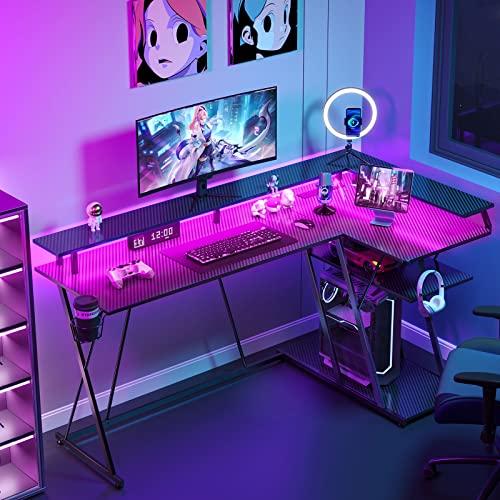
For this lens, this is the pick that gets the fundamentals right before it gets anything else right. The SEVEN WARRIOR L-Shaped Gaming Desk 50.4 Inch with LED and Power Outlets is built around a 50.4-inch L-shaped desk with LED lighting, built-in power outlets, a monitor stand, hooks and a carbon fibre surface. That combination is what the Best With Lighting and Power badge recognises, and it is why this desk sits at number 4 in this particular lens rather than in a generic ranking.
Strengths
- Monitor stand plus wing gives screens, laptop and peripherals separate zones
- Outlets and hooks handle power and headsets without extra purchases
- Carbon fibre surface shrugs off mouse and keyboard wear
Trade-offs
- LED and styling push it visually; not a stealth office look
- Wing depth is for a laptop or console rather than a second full rig
- Fixed height only
Key specs
- L-shaped top: 50.4 in class
- LED lighting built in
- Power outlets built in
- Monitor stand included
- Carbon fibre surface
- Hooks included
- Colour: Black
Treat it as the anchor of the setup and build outward – screen position first, then peripherals, then storage – and it will carry a growing rig further than its price or size suggests. For this lens specifically, its fit is strongest for corner streamers who want lighting, power and a monitor stand in one box. Set against the other five picks, it trades breadth for that specific strength, which is the right trade when your situation matches it.
Living with an L-shape, the wing develops its own gravity: it attracts the laptop, the mail, the second controller, the notebook. That is the design working as intended, provided the main run stays sacred. The corner itself is best treated as infrastructure – tower, dock, or the managed power strip – rather than as a display shelf, because everything placed in the corner is awkward to reach and dusty within a month.
Setup notes: assemble the two runs flat, join them loosely, and level the corner joint before any final tightening; an L tightened out of level will rock on one foot forever. Test the chair’s full swivel inside the taped footprint before loading the tops, and run the power strip into the corner first, because the corner is where every cable in an L-shaped setup eventually wants to live.
Best for: corner streamers who want lighting, power and a monitor stand in one box / Not suited for: shared offices where gaming styling is unwelcome

Bestier 51 Inch Corner Desk with Power Outlets and LED Lights (Best for Storage)
This pick earns its place because it treats the brief as the main event rather than a marketing line. The Bestier 51 Inch Corner Desk with Power Outlets and LED Lights is built around a reversible 51-inch corner desk with four tiers of shelving, built-in outlets and LED lighting, a headphone hook and a foldable cup holder. That combination is what the Best for Storage badge recognises, and it is why this desk sits at number 5 in this particular lens rather than in a generic ranking.
Strengths
- Four shelf tiers swallow a game library, drives and a console stack
- Foldable cup holder deploys for drinks and disappears for space
- Reversible design keeps it useful if the room changes
Trade-offs
- Shelves occupy one side, which fixes where a tower can go
- Black marble finish is a strong look that will not suit every room
- Fixed height only
Key specs
- Corner top: 51 in class
- Reversible design
- Power outlets and LED lighting built in
- 4-tier storage shelves
- Headphone hook and foldable cup holder
- Colour: Black Marble finish
The honest test is a month later: is the surface still clear, the frame still silent, the layout still the one you planned? Desks in this class pass that test when they are zoned and cabled properly from day one. For this lens specifically, its fit is strongest for corner players whose real problem is storage for games and gear. Set against the other five picks, it trades breadth for that specific strength, which is the right trade when your situation matches it.
An L-shaped desk teaches you its geography within a week: the main run becomes reflex territory, the wing becomes the project zone. Keep the boundary honest – chargers and storage on the wing, nothing but controls on the run – and the layout keeps paying you back in clear surface every single session.
Setup notes: decide which run is primary before a single bolt is turned, and build that run first. If the layout is reversible, dry-fit both orientations with the tops resting in place; five minutes of experiment beats a rebuild, and the room will usually tell you which orientation it wants.
Best for: corner players whose real problem is storage for games and gear / Not suited for: players who want a plain, undecorated desk

Mr Ironstone L-Shaped Desk 47 Inch with Outlets and USB Ports (Best Compact L-Shape)
Start with the basics: a desk for this kind of setup lives or dies on its surface, its frame and how honestly its size matches the job. The Mr Ironstone L-Shaped Desk 47 Inch with Outlets and USB Ports is built around a reversible 47-inch L-shaped desk with built-in outlets and USB ports, a storage bag and a hook, in a rustic brown finish. That combination is what the Best Compact L-Shape badge recognises, and it is why this desk sits at number 6 in this particular lens rather than in a generic ranking.
Strengths
- Reversible design lets the wing sit left or right to suit the room
- Built-in outlets and USB end trailing extension leads
- Rustic brown finish reads as furniture, which helps in shared rooms
Trade-offs
- 47-inch class is compact for an L; measure both walls before ordering
- Storage bag is light-duty, for cables and controllers rather than books
- Fixed height only
Key specs
- L-shaped top: 47 in class
- Power outlets and USB ports built in
- Reversible layout
- Storage bag and hook included
- Colour: Rustic Brown
The honest test is a month later: is the surface still clear, the frame still silent, the layout still the one you planned? Desks in this class pass that test when they are zoned and cabled properly from day one. For this lens specifically, its fit is strongest for corner players in shared rooms who need power at the desk, not under it. Set against the other five picks, it trades breadth for that specific strength, which is the right trade when your situation matches it.
The corner of an L is where dust goes to retire, so plan a monthly reach-in clean when you buy one, and keep the corner’s contents to things that tolerate dust: a tower with filtered intakes, the power strip, a dock. Anything you handle daily belongs on a run, not in the corner.
Setup notes: with the frame built, stand the screens on the main run and sit in the corner before fixing anything else. The correct wing depth and monitor angle are obvious from the chair and invisible from anywhere else in the room, so let the seated test drive the final tightening and cable runs.
Best for: corner players in shared rooms who need power at the desk, not under it / Not suited for: players planning three monitors across the main run
Comparison Table
| Pick | Shape / type | Standout feature | Best for | Price |
|---|---|---|---|---|
| SEVEN WARRIOR L-Shaped Gaming Desk 63 Inch, Reversible | lshape | Reversible layout | players building a long-term corner battlestation with room to grow | Check price on Amazon |
| CubiCubi L-Shaped Desk 59.1 Inch with Side Table | lshape | Small side table included in the layout | dual-monitor players who want corner space without gamer styling | Check price on Amazon |
| Mr IRONSTONE L-Shaped Gaming Desk 51 Inch, Black | lshape | Large monitor stand included | players with a free corner who want game and work zones on one desk | Check price on Amazon |
| SEVEN WARRIOR L-Shaped Gaming Desk 50.4 Inch with LED and Power Outlets | lshape | LED lighting built in | corner streamers who want lighting, power and a monitor stand in one box | Check price on Amazon |
| Bestier 51 Inch Corner Desk with Power Outlets and LED Lights | lshape | Reversible design | corner players whose real problem is storage for games and gear | Check price on Amazon |
| Mr Ironstone L-Shaped Desk 47 Inch with Outlets and USB Ports | lshape | Power outlets and USB ports built in | corner players in shared rooms who need power at the desk, not under it | Check price on Amazon |
How to Choose the Right L-Shaped Gaming Desk
Choosing well in this category is mostly measuring honestly and ranking your own constraints. The sections below take the deciding factors in the order they should be decided. Measure both walls from the corner, then subtract skirting and radiator depth. Mark the footprint on the floor with tape and sit a chair inside it: an L that fits the walls can still trap the chair if the wing is too deep.
Width: count screens, then add margin
Width decides how many screens fit and how much elbow room survives. Work from your real panels: a 24-inch screen occupies roughly 22 inches of width, a 27-inch roughly 24 to 25, and angled side screens trade width for depth. Add the tower if it lives on the top, add speakers if they do, and then add a margin – a desk that exactly fits the arithmetic feels crowded within a week of cables, a headset stand and daily life arriving.
Depth: the number that decides comfort
Depth sets your viewing distance and your mouse room, and it is the specification buyers most often under-buy. Around 24 inches is the working minimum for a monitor on its stand; 28 to 30 inches transforms comfort with larger screens and gives arm-aiming players a real sweep. If a desk you love is shallower than your screen wants, a monitor arm is the legitimate fix, because it lets the panel float over the back edge.
Frame and load: stability is a feature
A gaming desk carries a dynamic load: you lean on it, the chair bumps it, screens on arms lever against it. Steel frames, cross-bracing and – on long tops – centre support are what keep that load silent. Where a load capacity is listed, compare it with everything you plan to place on the desk, including the tower if it rides on top, and keep a margin rather than living at the limit.
Surface: glide, wear and the front edge
The surface is where your hands live. Full-desk pads give the most consistent glide and protect the top; carbon-fibre-look laminates are hard-wearing and wipe clean; wood finishes look better in shared rooms and ask for coasters. For a worked example of how surface choices play out in a full build, see Best Lap Desks For Gaming and note how much of the result is surface discipline rather than budget. Whatever you choose, check the front edge: a sharp edge under your forearms will be remembered long after the specification sheet is forgotten.
Cables and power: plan them as part of the desk
Every setup in this category runs at least six leads. Desks with built-in outlets, grommets or trays start ahead; desks without them need a tray and one managed power strip added to the plan and the budget. Route power and data separately where you can, leave service loops at anything that moves, and never let a cable’s only route be across your mouse zone or your footwell.
Height and ergonomics: the third dimension
Most gaming desks sit at a fixed height near 29 to 30 inches, and your chair, not the desk, does the adjusting. Elbows should rest roughly level with the surface, feet supported, and the screen top near eye level; if any of those three fails, change the cheapest variable first. Sit-stand desks remove the compromise entirely, which is why they appear in so many lenses in this guide – but a fixed desk with a good chair and a foot rest, when needed, is a perfectly sound ergonomic system.
Storage: shelves, drawers and the second life of the desk
Storage decides whether a gaming desk stays a gaming desk. Games, drives, controllers, chargers and the inevitable notebook all need a home that is not the mouse zone: a shelf tier, a drawer unit, a hutch or the wing of an L. When you compare picks, count the storage you will actually use weekly, and be suspicious of storage you cannot reach from the chair – it becomes an archive, not a tool.
Assembly, delivery and the ownership costs nobody lists
Ownership begins before the desk arrives: large tops need a route into the room and sometimes a second person, and flat-pack panels need a clear floor to build on. Budget an hour for a straight desk, more for corners and standing frames, and keep the packaging until the desk has survived a week – returns without packaging are a misery. Ongoing costs are small but real: replacement pads, a cable tray for desks without one, and the occasional set of feet or fixings. None of this should decide the purchase, but all of it belongs in the plan.
Which buyer should prioritise what
Competitive players should spend on depth and stability first. Multi-screen and streaming players should spend on width, load capacity and cable order. Shared-room and work-and-play buyers should spend on finish, storage and cable discipline, because those decide whether the desk is welcomed or merely tolerated. For an L-shape, judge the two runs separately. The main run needs the width and depth of a good straight desk; the wing needs enough depth for a laptop or console but does not need keyboard depth. Reversibility matters more than most buyers expect, because the first room a corner desk lives in is rarely the last.
When the room changes
Desks outlast room layouts. Reversible corners, standard sizes and neutral finishes are what let a desk move house or change walls without becoming the wrong desk. If a move is likely in the next year or two, weight that flexibility heavily when you choose.
The one-hour deep clean and reset
Once a month, a full reset pays for itself: everything off, surfaces wiped, cables re-dressed, bolts checked, pads washed or replaced. Setups drift a few millimetres and a few cables at a time; the reset is how you notice drift while it is still free to fix.
Sound and the desk
Desks are sounding boards. Speakers on foam pads or stands stop bass turning the top into a drum, a headset hook ends the desk-edge clatter of a set put down in the dark, and a tower on a board rather than bare floor keeps fan hum out of the floorboards.
Measuring like a skeptic
Manufacturer dimensions are honest but incomplete: they rarely include the space taken by cable trays, the swing of a monitor arm, or the depth a chair needs to recline. Measure the desk’s footprint, then add your own margins for the things the spec sheet cannot know about – your chair, your legs, your tower’s side intake, and the door that opens behind you.
The upgrade path test
Before buying, name the next two upgrades you are most likely to make – a second screen, a bigger tower, a streaming light – and check the desk against them. A desk that passes the upgrade path test rarely needs replacing; a desk bought only for today’s setup often becomes the bottleneck that makes every later upgrade awkward.
Renting, moving and desks
If you move often, weight, reversibility and standard sizes become primary features. Desks that break into flat, carryable pieces and fit standard room layouts survive moves; monolithic corner builds and oversized tops are the ones that get sold at a loss on moving week. Choose with your next two years in mind, not just your next two months.
Gaming desks and household peace
A setup that shares a home has stakeholders. Cable discipline, a finish that does not fight the room, and a desk that can look tidy in thirty seconds are what turn a tolerated battlestation into a welcome one. Several picks in this guide earn their badges partly on exactly this ground.
Why the second month matters more than the first day
Day-one impressions are dominated by novelty and assembly fatigue. The second month is when you learn whether the surface marks, whether the frame creaks, whether the layout still matches how you play. That is why this guide weights ownership factors – bolts, finishes, cable systems – as heavily as first impressions.
A note on gaming styling
LED strips, carbon-look finishes and aggressive leg shapes are styling, and styling is a legitimate preference – it is your room. Just buy it knowingly: styling should be the tiebreaker between desks that already fit, never the reason a too-small or too-shallow desk gets chosen.
Power planning for the whole setup
Count your plugs before the desk arrives: PC, screens, speakers, chargers, lights, console, dock. Most setups land between six and ten. One managed strip sized for that count, mounted where you can reach its switch, is the difference between a power system and a power accident waiting under the desk.
The desk as the last upgrade
Players upgrade GPUs, screens and chairs constantly, and desks almost never – which argues for buying the desk one notch above today’s need. The cost difference between the adequate desk and the right desk is small against the years both would serve, and the right one quietly enables every upgrade that follows.
Planning the second screen before you buy it
Even if a second screen is a year away, decide now where it would go and what it would plug into. Desks that survive upgrades are the ones whose owners left a screen’s width of slack, a spare outlet in the managed strip and a cable route with room in it. That foresight costs nothing at setup time and saves a full re-cabling later.
The tournament-week test
Competitive weeks expose desks: long sessions magnify a slightly wrong screen height, a wobble that only appears when you lean in, a cable that brushes your mouse hand at full stretch. Before any big event, spend one session deliberately hunting for these small frictions and fix them while they are still small.
Sharing the desk with life
Most gaming desks also host homework, work calls, crafts or a partner’s laptop at some point in the week. A setup that can absorb a guest session – a clearable zone, a spare surface corner, cables that are not a trip hazard – will be tolerated by the household, and tolerated setups are the ones that get to stay and grow.
How Do You Set Up an L-Shaped Gaming Desk in a Corner?
Setup is where a good desk becomes a good station. Work through these steps in order; most take minutes, and together they prevent nearly every complaint that appears in desk reviews a month after purchase.
- Measure from the corner along both walls and tape the full L footprint, including chair space.
- Build the two runs separately, join them loosely, and only tighten the corner joint once both runs sit level.
- Decide the corner’s job – screens wrapped in, or tower and storage bay – before placing anything.
- Connect power last: run one managed strip, plug in screens and machine, and only then tidy the data leads.
- Set the screen so its top sits at or just below eye level, at a distance where you can read comfortably without leaning in.
- Place the keyboard so your elbows sit near a right angle, and centre the mouse zone on your dominant side with the full sweep area clear.
- Dress every cable into its route, leaving service loops at anything that moves, and label both ends of each lead.
- Play a full session, then adjust: chair height first, screen second, layout third. Small changes after real use beat perfect guesses before it.
- After the first week, re-check every frame bolt and foot; new desks settle, and a quarter-turn restores silence.
- Wipe the surface weekly, wash or replace pads as they wear, and vacuum dust from vents and the floor zone monthly.
Troubleshooting
- Problem: Desk wobbles at one corner – fix: a foot is short or the floor dips there. Adjust that foot first; only shim as a last resort.
- Problem: Screen sits too low – fix: the stand or arm is at its limit. Raise it on the desk’s monitor stand, a riser, or remount the arm higher on its pole.
- Problem: Cables pull tight or unplug – fix: a lead is routed without a service loop. Re-route with slack at the moving or reaching points.
- Problem: Mouse runs out of room – fix: the sweep zone has been colonised. Move storage to the edges, consider a monitor arm, and re-centre the keyboard on your body.
- Problem: Tower is loud or hot – fix: its intake or exhaust is blocked, or it sits in a closed space. Give it open air on both sides and clear its filters.
Common Mistakes
Buying the L for a wall it will never touch. An L-shaped desk against a straight wall wastes its main advantage and eats floor space. If the desk will not sit in a corner, a long straight desk is usually the better buy.
Placing the desk before painting the tape outline. Tape the footprint, live with it for a day, open every door and drawer it affects. Ten minutes of tape has saved more returns than any review.
Cabling last, as an afterthought. Cables routed after everything is placed will always look like it. Route power and data while the desk is still empty enough to reach the back edge comfortably.
Overloading one side of the desk. Towers, screen stacks and storage all drift to one end, and long tops sag toward the load. Spread weight over supports and keep the heaviest items near legs.
Skipping the floor check. Uneven floors make good desks wobble. Check the floor with a level or a phone app, use the adjustable feet most desks include, and never diagnose a desk as faulty before the floor is cleared of blame.
Final Recommendation
If you take one thing from this guide, take the badge that matches your situation rather than the ranking order: Best Overall: the SEVEN WARRIOR L-Shaped Gaming Desk 63 Inch, Reversible; Best Main Run for Dual Monitors: the CubiCubi L-Shaped Desk 59.1 Inch with Side Table; Best Classic Corner Pick: the Mr IRONSTONE L-Shaped Gaming Desk 51 Inch, Black; Best With Lighting and Power: the SEVEN WARRIOR L-Shaped Gaming Desk 50.4 Inch with LED and Power Outlets; Best for Storage: the Bestier 51 Inch Corner Desk with Power Outlets and LED Lights; Best Compact L-Shape: the Mr Ironstone L-Shaped Desk 47 Inch with Outlets and USB Ports. The ranking reflects this lens; your room and your gear get the final vote. When you are ready to compare the neighbouring lenses, start with Best Desks From Ikea For Gaming and work outward from the pick that matches your room.
Every linked pick above can be checked on Amazon for the current price, availability and delivery picture, and that check – not a printed number here – is the one to trust on the day you buy. Measure twice, cable once, and the desk will repay the care every session.
Whichever pick you land on, photograph the finished setup – cable routes included – before the first session. That photograph is your maintenance manual: when something is unplugged, moved or upgraded months later, it shows exactly what the working state looked like, and it makes the monthly reset a ten-minute job instead of an archaeological dig.
Frequently Asked Questions
Can an L-shaped gaming desk sit against a flat wall?
It can, but you give up the corner efficiency that justifies the shape. One run will jut into the room. If the desk must live mid-wall, a long straight desk normally serves you better.
Which side should the wing go on?
Put the wing on the side of your non-mouse hand if you use it for a laptop or notebook, so your mouse arm keeps the full main run. Reversible models let you test both before committing.
How long should a gaming desk last?
A steel-frame or quality panel desk used within its load rating should last many years. Wear shows first in surface finishes and pads, which are replaceable, rather than in the frame.
Is assembly difficult on desks like these?
Most are one-person jobs with basic tools and clear manuals; larger corner and standing desks are genuinely easier with a second pair of hands for the flip from upside-down assembly to upright.