Disclosure: As an Amazon Associate, ilcastellomenu.com earns from qualifying purchases. Prices and availability change; check Amazon for the latest.
Where to buy
Shopping for the best motherboards for 8th gen intel? Check the latest price, availability and delivery on Amazon for the linked picks below. Orders are placed on Amazon.
- ASUS ROG Strix Z370-E Gaming — Best Overall — prose-only pick (premium tier, discontinued or specialist model; see the review below)
- MSI Z370 Gaming M5 — Best Gaming Pick — prose-only pick (mid tier, discontinued or specialist model; see the review below)
- GIGABYTE Z370 AORUS Gaming 7 — Best Splurge — prose-only pick (premium tier, discontinued or specialist model; see the review below)
- ASRock Z370 Extreme4 — Best Value — prose-only pick (mid tier, discontinued or specialist model; see the review below)
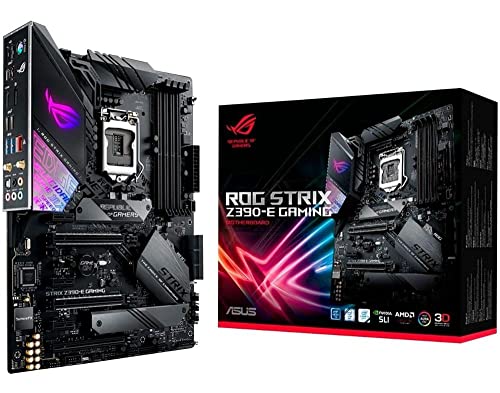
- ASUS ROG Strix Z390-E Gaming — Best Z390 Pick — Check on Amazon
- GIGABYTE Z390 AORUS PRO Wi-Fi — Best Wi-Fi Pick — Check on Amazon
Read the full guide ↓
Searching for the best motherboards for 8th gen intel usually starts with a processor and a budget and ends in a thicket of near-identical spec sheets. This guide cuts through it for an 8th Gen Intel processor: six boards (or, for this keyword, the six products that genuinely fit the brief) were shortlisted, compared on power delivery, storage, networking and build experience, and ranked by the kind of buyer each one serves best. 8th Gen chips fit only 300-series boards even though the socket looks identical to 6th and 7th Gen boards.
One more thing before the picks: motherboard marketing leans heavily on phase counts, lighting zones and military adjectives. Some of that signals real engineering and some of it is decoration. This guide separates the two wherever it matters, calls out the places where a cheaper board is genuinely enough, and flags the one or two specifications that actually change daily life with each pick, such as a second M.2 slot, a BIOS flash button, or networking that saves you buying an add-in card later. Readers comparing neighbouring platforms may also find Best Gaming Motherboards For I7 9700k useful.
A motherboard rarely makes a build faster on a spec sheet, yet it decides almost everything around the processor: how much power the chip can draw and for how long, how fast storage can run, how many drives and cards you can add later, and how painful the build feels at midnight with a screwdriver in your teeth. Choosing well means matching the board to the chip you actually own, the case you actually have, and the upgrades you will realistically make in the next three years, rather than paying for a spec list written for somebody else’s PC.
In this guide
Quick Picks
| Badge | Pick | Why it stands out | Link |
|---|---|---|---|
| Best Overall | ASUS ROG Strix Z370-E Gaming | The natural home for an 8700k with real overclocking headroom | Prose-only |
| Best Gaming Pick | MSI Z370 Gaming M5 | 11-phase class power design for coffee lake flagships | Prose-only |
| Best Splurge | GIGABYTE Z370 AORUS Gaming 7 | Three m.2 slots and a server-grade digital vrm | Prose-only |
| Best Value | ASRock Z370 Extreme4 | 12-phase power at a mid-tier position | Prose-only |
| Best Z390 Pick | ASUS ROG Strix Z390-E Gaming | Ai overclocking and 5-way optimization for k-series chips | Check on Amazon |
| Best Wi-Fi Pick | GIGABYTE Z390 AORUS PRO Wi-Fi | 12+1 phase digital vrm suited to 8-core coffee lake chips | Check on Amazon |
How These Picks Were Chosen
The shortlist started from the full field of boards that genuinely support the target processor, then applied four filters. First, power delivery: boards with unheatsinked, undersized VRMs were cut for any chip above the entry tier, because a board that throttles a processor under sustained load has failed at its one job. Second, storage and expansion: a modern board needs at least one fast M.2 slot and enough fan and USB headers for a normal case. Third, build experience: BIOS flashback or a guaranteed-ready BIOS, a clear manual and sensible header placement all counted. Fourth, honesty of tier: a board had to offer something its price neighbours do not, whether that is networking, audio, an extra slot or simply a lower position in its range.
Several familiar names were rejected, and the reasons are worth knowing. Boards from the wrong chipset generation appear in search results constantly for older processors, and they were excluded even when the socket physically matched, because a PC that cannot boot is not a bargain. Ultra-budget boards with two DIMM slots and no VRM heatsink were cut for higher-core chips. A few premium boards were also dropped: when a flagship’s extra features are limited to lighting and a bundled sticker pack, a mid-range board serves the same processor identically for noticeably less commitment, and this guide would rather tell you that than fill a slot. The wider context in Best Motherboards For Amd Ryzen 5 2600x shaped several of those calls.
Availability shaped the final list too. For current platforms, every linked pick is a board you can actually order today. For discontinued platforms, the guide is explicit that you are shopping the used and remaining-stock market, and each review notes what to check before paying: bent socket pins on Intel boards, the included I/O shield and accessories, and whether the seller can confirm the BIOS version. A great board with a dead CMOS battery and no accessories is a worse buy than a slightly lesser board that arrives complete.
The 6 Best Motherboards For 8Th Gen Intel
ASUS ROG Strix Z370-E Gaming (Best Overall)
Choose the ASUS ROG Strix Z370-E Gaming if you want the board to disappear into the background of the build in the best possible way. Built on the Z370 chipset in ATX form, it pairs 4x DDR4, up to 64GB with 2x M.2 (PCIe 3.0), and it is the kind of board that rewards a careful first setup with years of unremarkable, reliable service for an 8th Gen Intel processor. This board is covered as a prose-only pick: it is a discontinued or specialist model that the verified link pool does not cover, so shop it through reputable used and remaining-stock sellers and use the checks in the buying guide before paying.
Strengths
- The natural home for an 8700K with real overclocking headroom
- Dual M.2 and USB 3.1 Gen 2 front and rear
- SupremeFX audio and Aura Sync lighting
Trade-offs
- BIOS updates matter on this platform, and skipping them can leave CPU support behind
- Fewer rear USB ports than flagship boards, so count your peripherals before buying
- RGB and fan-header placement varies; check your case layout against the manual
- Socket / Fit: LGA1151
- Chipset / Style: Z370
- Form factor: ATX
- Memory: 4x DDR4, up to 64GB
- Storage: 2x M.2 (PCIe 3.0)
- Networking: Wi-Fi 5 (802.11ac) · Gigabit LAN
Where this board really earns its keep is the second year of ownership. The first upgrade, whether that is a larger NVMe drive, more memory or a faster network, lands on a platform with room for it, and the BIOS support behind a major maker means processor and memory compatibility keeps improving after purchase. That longevity, more than any single feature, is the argument for choosing it.
Best for: 8th Gen Intel processor builders who prioritise the natural home for an 8700K with real overclocking headroom / Not suited for: builders whose desks already overflow a modest rear panel and who refuse to use a hub
MSI Z370 Gaming M5 (Best Gaming Pick)
The MSI Z370 Gaming M5 is the pick that makes sense when you read the whole spec sheet rather than the headline. Z370 platform, ATX footprint, 2x M.2 (PCIe 3.0) and 4x DDR4, up to 64GB: nothing on that list is exotic, but the combination is exactly what an 8th Gen Intel processor needs, and the board spends its budget on power delivery, cooling and the ports you will use weekly. This board is covered as a prose-only pick: it is a discontinued or specialist model that the verified link pool does not cover, so shop it through reputable used and remaining-stock sellers and use the checks in the buying guide before paying.
Strengths
- 11-phase class power design for Coffee Lake flagships
- M.2 Shield heatsinks on both NVMe slots
- Killer Ethernet tuned for gaming traffic
Trade-offs
- Fewer rear USB ports than flagship boards, so count your peripherals before buying
- RGB and fan-header placement varies; check your case layout against the manual
- BIOS updates matter on this platform, and skipping them can leave CPU support behind
- Socket / Fit: LGA1151
- Chipset / Style: Z370
- Form factor: ATX
- Memory: 4x DDR4, up to 64GB
- Storage: 2x M.2 (PCIe 3.0)
- Networking: No Wi-Fi · Gigabit LAN (Killer)
Treat this board as the sensible centre of the build and spend the money it saves on the parts that decide frame rates and load times. It will not be the component you brag about, and that is precisely the point: the best motherboards are the ones you stop thinking about a week after the build, because everything attached to them simply works at full speed.
Best for: 8th Gen Intel processor builders who prioritise 11-phase class power design for Coffee Lake flagships / Not suited for: builders who want a current-production board with a full manufacturer warranty
GIGABYTE Z370 AORUS Gaming 7 (Best Splurge)
The GIGABYTE Z370 AORUS Gaming 7 earns its place here because it gets the fundamentals right for an 8th Gen Intel processor without charging for theatre. Its Z370 chipset and ATX layout give you 3x M.2 (PCIe 3.0) storage and 4x DDR4, up to 64GB, and the board’s power delivery is honestly matched to what this processor asks of it under real, sustained loads rather than a thirty-second benchmark. This board is covered as a prose-only pick: it is a discontinued or specialist model that the verified link pool does not cover, so shop it through reputable used and remaining-stock sellers and use the checks in the buying guide before paying.
Strengths
- Three M.2 slots and a server-grade digital VRM
- ESS Sabre DAC audio with swappable op-amps
- Dual LAN for redundancy or teaming
Trade-offs
- Fewer rear USB ports than flagship boards, so count your peripherals before buying
- RGB and fan-header placement varies; check your case layout against the manual
- No onboard Wi-Fi, so plan on Ethernet or a USB/PCIe adapter
- Socket / Fit: LGA1151
- Chipset / Style: Z370
- Form factor: ATX
- Memory: 4x DDR4, up to 64GB
- Storage: 3x M.2 (PCIe 3.0)
- Networking: No Wi-Fi · Dual LAN (Intel + Killer)
In daily use the difference this board makes is quiet competence: boots are predictable, fan behaviour is tunable until the machine fades from attention, and there is enough expansion headroom that the next storage or networking upgrade does not start with replacing the motherboard. If your build matches the buyer described above, this is the board against which the others in this guide should be measured.
Best for: 8th Gen Intel processor builders who prioritise three M.2 slots and a server-grade digital VRM / Not suited for: builders on a strict budget who would rather put the difference toward the graphics card
ASRock Z370 Extreme4 (Best Value)
Choose the ASRock Z370 Extreme4 if you want the board to disappear into the background of the build in the best possible way. Built on the Z370 chipset in ATX form, it pairs 4x DDR4, up to 64GB with 2x M.2 (PCIe 3.0), and it is the kind of board that rewards a careful first setup with years of unremarkable, reliable service for an 8th Gen Intel processor. This board is covered as a prose-only pick: it is a discontinued or specialist model that the verified link pool does not cover, so shop it through reputable used and remaining-stock sellers and use the checks in the buying guide before paying.
Strengths
- 12-phase power at a mid-tier position
- Dual Ultra M.2 and USB-C front header
- Purity Sound 4 audio above its class
Trade-offs
- A discontinued platform, so you are buying used or old stock and should check condition carefully
- BIOS updates matter on this platform, and skipping them can leave CPU support behind
- No onboard Wi-Fi, so plan on Ethernet or a USB/PCIe adapter
- Socket / Fit: LGA1151
- Chipset / Style: Z370
- Form factor: ATX
- Memory: 4x DDR4, up to 64GB
- Storage: 2x M.2 (PCIe 3.0)
- Networking: No Wi-Fi · Gigabit LAN
Where this board really earns its keep is the second year of ownership. The first upgrade, whether that is a larger NVMe drive, more memory or a faster network, lands on a platform with room for it, and the BIOS support behind a major maker means processor and memory compatibility keeps improving after purchase. That longevity, more than any single feature, is the argument for choosing it.
Best for: 8th Gen Intel processor builders who prioritise 12-phase power at a mid-tier position / Not suited for: builders who need onboard Wi-Fi without adding an adapter or a cable run

ASUS ROG Strix Z390-E Gaming (Best Z390 Pick)
The ASUS ROG Strix Z390-E Gaming is the pick that makes sense when you read the whole spec sheet rather than the headline. Z390 platform, ATX footprint, 2x M.2 (PCIe 3.0) and 4x DDR4, up to 64GB: nothing on that list is exotic, but the combination is exactly what an 8th Gen Intel processor needs, and the board spends its budget on power delivery, cooling and the ports you will use weekly. You can check the current listing on Amazon while you compare it against the rest of this shortlist.
Strengths
- AI overclocking and 5-Way Optimization for K-series chips
- Dual M.2 and USB 3.1 Gen 2 connectivity
- SupremeFX audio and ROG build quality
Trade-offs
- DDR4 platform, so it cannot follow you to a DDR5 build later
- BIOS updates matter on this platform, and skipping them can leave CPU support behind
- You pay for headroom and features that a locked, stock-clock build will never use
- Socket / Fit: LGA1151
- Chipset / Style: Z390
- Form factor: ATX
- Memory: 4x DDR4, up to 64GB
- Storage: 2x M.2 (PCIe 3.0)
- Networking: Wi-Fi 5 (802.11ac) · Gigabit LAN
Treat this board as the sensible centre of the build and spend the money it saves on the parts that decide frame rates and load times. It will not be the component you brag about, and that is precisely the point: the best motherboards are the ones you stop thinking about a week after the build, because everything attached to them simply works at full speed.
Best for: 8th Gen Intel processor builders who prioritise AI overclocking and 5-Way Optimization for K-series chips / Not suited for: builders whose desks already overflow a modest rear panel and who refuse to use a hub

GIGABYTE Z390 AORUS PRO Wi-Fi (Best Wi-Fi Pick)
The GIGABYTE Z390 AORUS PRO Wi-Fi earns its place here because it gets the fundamentals right for an 8th Gen Intel processor without charging for theatre. Its Z390 chipset and ATX layout give you 2x M.2 (PCIe 3.0) storage and 4x DDR4, up to 128GB, and the board’s power delivery is honestly matched to what this processor asks of it under real, sustained loads rather than a thirty-second benchmark. You can check the current listing on Amazon while you compare it against the rest of this shortlist.
Strengths
- 12+1 phase digital VRM suited to 8-core Coffee Lake chips
- Dual M.2 with Thermal Guard heatsinks
- Onboard Wi-Fi and ALC1220 audio
Trade-offs
- Fewer rear USB ports than flagship boards, so count your peripherals before buying
- RGB and fan-header placement varies; check your case layout against the manual
- BIOS updates matter on this platform, and skipping them can leave CPU support behind
- Socket / Fit: LGA1151
- Chipset / Style: Z390
- Form factor: ATX
- Memory: 4x DDR4, up to 128GB
- Storage: 2x M.2 (PCIe 3.0)
- Networking: Wi-Fi 5 (802.11ac) · Gigabit LAN
In daily use the difference this board makes is quiet competence: boots are predictable, fan behaviour is tunable until the machine fades from attention, and there is enough expansion headroom that the next storage or networking upgrade does not start with replacing the motherboard. If your build matches the buyer described above, this is the board against which the others in this guide should be measured.
Best for: 8th Gen Intel processor builders who prioritise 12+1 phase digital VRM suited to 8-core Coffee Lake chips / Not suited for: builders whose priorities point at a different pick in this shortlist
Comparison Table
| Pick | Chipset / Style | Form Factor | Memory / Fit | Storage | Networking | Price |
|---|---|---|---|---|---|---|
| ASUS ROG Strix Z370-E Gaming | Z370 | ATX | 4x DDR4, up to 64GB | 2x M.2 (PCIe 3.0) | Wi-Fi 5 (802.11ac) / Gigabit LAN | Prose-only (see listing sources) |
| MSI Z370 Gaming M5 | Z370 | ATX | 4x DDR4, up to 64GB | 2x M.2 (PCIe 3.0) | No Wi-Fi / Gigabit LAN (Killer) | Prose-only (see listing sources) |
| GIGABYTE Z370 AORUS Gaming 7 | Z370 | ATX | 4x DDR4, up to 64GB | 3x M.2 (PCIe 3.0) | No Wi-Fi / Dual LAN (Intel + Killer) | Prose-only (see listing sources) |
| ASRock Z370 Extreme4 | Z370 | ATX | 4x DDR4, up to 64GB | 2x M.2 (PCIe 3.0) | No Wi-Fi / Gigabit LAN | Prose-only (see listing sources) |
| ASUS ROG Strix Z390-E Gaming | Z390 | ATX | 4x DDR4, up to 64GB | 2x M.2 (PCIe 3.0) | Wi-Fi 5 (802.11ac) / Gigabit LAN | Check price on Amazon |
| GIGABYTE Z390 AORUS PRO Wi-Fi | Z390 | ATX | 4x DDR4, up to 128GB | 2x M.2 (PCIe 3.0) | Wi-Fi 5 (802.11ac) / Gigabit LAN | Check price on Amazon |
How to Choose the Right Motherboard for An 8Th Gen Intel Processor
Form factor and headers decide how the build feels
ATX boards give you working room, more slots and usually more fan and USB headers; micro-ATX trades a little expansion for smaller, cheaper cases; mini-ITX demands planning around two memory slots and tight cable runs. Whichever size you choose, count the headers against your case before ordering: front USB-C needs a specific internal header that budget boards often omit, each case fan wants a header or a splitter, and RGB devices multiply connectors quickly. Ten minutes with the board’s manual and your case’s spec page prevents the most common build-day disappointment in this entire category.
Storage: count the M.2 slots, then check what they share
NVMe drives are cheap enough that most builders now want at least two M.2 slots: one for the system drive and one for a game or project library. Read the fine print in the manual, because populating a second or third M.2 slot sometimes disables a SATA port or reduces the graphics slot’s lane count on certain chipsets. Heatsinks on M.2 slots matter for sustained transfers on fast drives, though for ordinary gaming loads a bare slot is acceptable. If your work involves large media files, prioritise slot count; if it does not, one fast slot and several SATA ports for bulk drives is a perfectly rational layout.
Socket and chipset come first, and they are not the same thing
The socket is the physical and electrical interface between board and processor; the chipset decides which features the platform enables, from overclocking to the number of fast storage lanes. Two boards can share a socket and still support completely different processors, which is the single most common buying mistake in this category. Always confirm your exact CPU model on the board maker’s CPU support list for that specific board, and note the BIOS version that support begins at. If the board needs a newer BIOS than it ships with, you need either an older supported CPU to perform the update or a board with a CPU-less flash feature.
Power delivery (the VRM) decides sustained performance
The voltage regulator module converts your power supply’s output into the precise, high-current feed the processor runs on. Under a short benchmark almost any board looks fine; under a twenty-minute render, a game compile or a long VR session, a weak VRM heats up and the board quietly reduces the power available, and the processor slows down. Heatsinks over the VRM are the easiest visual proxy for quality, followed by the number and current capability of the power stages. Match the board to the chip: an entry processor is happy on a modest design, while high-core and K-series chips deserve the strongest VRM you can justify.
Memory support is a compatibility list, not just a speed number
Every board states a maximum memory speed, but stability at that speed depends on the processor’s memory controller, the number of sticks installed and whether your exact kit appears on the board’s qualified vendor list. Two sticks are almost always easier to run fast than four. Buy memory rated for the platform generation the board uses, enable the XMP or EXPO profile after the first successful boot rather than before it, and if a fast kit refuses to train, update the BIOS before blaming the RAM, because memory support improves measurably across a board’s BIOS lifetime.
Networking and audio are the features you feel every day
A board with onboard Wi-Fi saves a slot, a cable run and an adapter purchase, and modern Wi-Fi 6 and 6E implementations are fast enough for gaming and large downloads in most homes. Wired Ethernet at 2.5 gigabits is worth having if you use a NAS or a fast local network. Audio is the other daily feature: higher-end codecs with proper amplification make a clear difference to wired headphones, while basic implementations are fine for speakers and USB headsets, which bypass the board’s audio entirely. Buy the networking you will actually use and let the audio tier follow your headphones, not the marketing.
Before you order, it is worth reading Best Motherboards For Alder Lake alongside this guide, because the two platforms are compared constantly and the right answer depends on which processor you already own.
Going Deeper: Ownership Details That Matter Later
Rear panel planning sounds trivial and saves real money. Count the USB ports your desk actually fills (keyboard, mouse, headset dongle, external drive, phone cable, printer, controller receiver) and compare that count with the board’s rear panel rather than its headline USB total, which includes internal headers. A board that is two ports short forces a hub purchase and a messier desk; a board with the right ports built in is quietly cheaper. The same logic applies to display outputs for APU builds and to optical audio for anyone feeding a receiver or a desktop DAC.
Consider how the board ages, because a motherboard is usually the least-swapped part of a PC. The graphics card will likely change once or twice, storage will grow, and memory may double, all on the same board. That is why this guide weights spare slots, headers and BIOS support so heavily: a board that accepts your next upgrade without a rebuild quietly repays a modest premium, while a board bought at the absolute floor often forces a full platform change a year earlier than planned.
Thermals deserve a paragraph of their own. A board does not exist in isolation: its VRM heatsinks rely on case airflow, and a sealed glass case with a single exhaust fan can undo the advantage of a well-designed board. If your case runs warm, prioritise boards with substantial heatsinks and give them a front intake fan pointed across the board’s surface. In a well-ventilated case, by contrast, mid-range power delivery performs indistinguishably from flagship designs for all but the most extreme processors.
A final ownership point concerns warranty and returns, because motherboards are the most-handled component in a build and the one most often damaged by a slip during installation. Buy from a retailer whose returns process you have actually read, photograph the socket and the board’s serial label when it arrives, and keep the box and anti-static bag until the system has run for a week. On discontinued platforms bought used, prefer sellers who show the board posting with memory and a drive recognised; that single screenshot is worth more than any description of condition, and it is the difference between a bargain and a project.
BIOS recovery features deserve more respect than they get at purchase time. A board with a CPU-less flash button (called BIOS Flashback, Q-Flash Plus or Flash BIOS Button depending on the maker) can recover from a failed update and can be updated to support a newer processor before that processor is ever installed. A clear-CMOS button and debug LEDs or a small code display turn the worst build-day faults from guesswork into a short checklist. None of these features appears in a benchmark, yet over a five-year ownership span they are the features most likely to save you a weekend, which is why several picks in this guide earn credit for them explicitly.
Lane sharing is best understood with a concrete example. A mid-range chipset has a fixed pool of high-speed lanes shared between the second M.2 slot, some SATA ports and the lower PCIe slots. Fit a drive in the second M.2 slot and two SATA ports may switch off; fit a capture card in the bottom slot and the second M.2 may drop to half speed. The board is not broken and nothing is faulty: the manual’s configuration table describes exactly this behaviour. The buying habit that follows is to write down your final device list first, then check that exact combination in the manual of any board you are seriously considering.
Cooler compatibility is a motherboard question as much as a cooler question. Large air coolers overhang the top PCIe slot or the memory slots on some layouts, liquid-cooling radiators need clearance above the board’s top edge and its VRM heatsinks, and some platforms changed their mounting pattern between generations, so an older cooler may need a new bracket kit. Before ordering, check the cooler’s clearance diagrams against the board layout, confirm the mounting kit supports your socket, and remember that the tallest memory kits are the first casualty of an oversized air cooler in a compact case.
Expansion planning cuts the other way too: be honest about the add-in cards you will never fit. Most builders use the graphics slot and nothing else, ever. If that is you, a micro-ATX board is not a compromise at all, and the money saved buys a better case or a quieter cooler. The full ATX layout earns its premium only when capture cards, extra storage controllers, sound cards or a second network adapter are genuinely on your roadmap.
Noise is an underrated board-level concern. Fan control lives in the BIOS, and boards differ in how granular that control is: the best let you tie each fan header to a chosen temperature sensor, set hysteresis so fans do not hunt up and down, and define a true silent curve for idle. If you work or play in a quiet room, those BIOS pages matter more than any lighting feature, and they are worth ten minutes of research in reviews before you commit to a board.
For builders keeping a machine for many years, the humble CMOS battery and the maker’s support page are the long game. The battery is a standard coin cell that takes minutes to replace when BIOS settings start forgetting themselves, and the support page is where BIOS updates, drivers and the CPU support list live for the life of the board. Download and archive the manual and the final BIOS for discontinued boards while they are still published; support pages for older platforms do eventually disappear, and your own archive becomes the only copy you can rely on.
There is also a software dimension that spec sheets hide. The BIOS interface, the quality of the maker’s driver page and the fan-control software shape how the board feels for years. Makers differ here more than they differ in hardware at the same tier. If you adjust fan curves, update BIOS versions and tune memory, favour the ecosystem you find clearest; if you set a PC up once and never open the settings again, every major maker’s board will serve you and the hardware differences in these reviews should decide it.
Memory compatibility has a paper trail worth using: the qualified vendor list, or QVL, published for each board. A kit on the QVL has been tested by the maker in that board at its rated speed, while an unlisted kit will usually work but carries a small extra risk, especially at the fastest speeds and with four sticks installed. If your build plan depends on a high memory speed or a large capacity, spend five minutes on the QVL before ordering. It is the cheapest insurance in the entire parts list, and it converts the most common post-build complaint (memory that will not run at its rated profile) into a problem you never meet.
How Do You Install and Set Up a Motherboard for An 8Th Gen Intel Processor?
A motherboard swap or first install follows the same rhythm on every platform: prepare outside the case, seat the parts that are hard to reach later, then move the assembly into the chassis and cable it methodically.
- Prepare the bench and the board. Work on a non-conductive surface with the board on its anti-static bag or box. Fit the processor first, aligning the marker triangle with the socket marking and never forcing the lever. Install the memory in the slots the manual specifies for a two-stick kit, which is usually the second and fourth slots from the CPU. Fit the M.2 system drive now, while the slot is fully accessible, and mount the CPU cooler’s backplate or brackets before the board goes into the case.
- Install the I/O shield and standoffs. If the board does not have an integrated shield, press the separate shield into the case from inside until every edge clicks. Check that a standoff sits under every mounting hole the board uses and that no extra standoff hides under the board where it could short a trace; cases often ship with standoffs pre-fitted for a different form factor. This two-minute check prevents the most mysterious no-boot fault in PC building.
- Seat the board and connect power first. Lower the board onto the standoffs at a slight angle so the rear ports pass through the shield, then fit the screws finger-tight in a cross pattern before snugging them down. Connect the 24-pin main power cable and the CPU power cable in the top corner immediately, because the CPU cable becomes nearly unreachable once a large air cooler or top radiator is installed. Route both cables behind the motherboard tray where the case allows.
- Connect the small cables with the manual open. Front-panel connectors are the fiddliest part of any build: the power switch, reset switch and LEDs are individual pins documented in a diagram in the manual. Fit those, the HD Audio cable, the front USB cables and the fan connectors next. Take a phone photo of the front-panel block before you close the case; it saves real time the first time you troubleshoot a no-power symptom.
- First boot outside the final configuration. Before tidying cables, power the system with the side panel off and enter the BIOS. Confirm the processor model, memory capacity and drive list all read correctly. Update the BIOS if the board shipped with an older version than your processor wants, using the maker’s instructions exactly and never interrupting power mid-flash. Only then enable the memory’s XMP or EXPO profile, set the boot order, and install the operating system.
- Finish, then maintain on a schedule. Once the system runs, fit the remaining drives and the graphics card, tidy cables away from fan blades, and install the chipset, network and audio drivers from the board maker’s page rather than relying on generic ones. Twice a year, blow dust from the VRM heatsinks and chipset area, check that fan curves still match your noise tolerance, and glance at the BIOS download page: on platforms still receiving updates, later BIOS versions often improve memory stability and add processor support you may want for a future upgrade.
Troubleshooting quick list
- Problem: the PC does not power on at all → check the CPU power cable in the top corner, the front-panel power switch pins against the manual diagram, and that no extra standoff sits under the board.
- Problem: it powers on but shows no display → reseat the memory firmly until both clips engage, try one stick in the slot the manual names for single-stick use, and confirm the monitor cable is in the graphics card rather than the motherboard unless you are using integrated graphics.
- Problem: the memory runs slower than its rating → enable the XMP or EXPO profile in the BIOS, and confirm the sticks are in the paired slots rather than adjacent ones.
- Problem: a new processor will not boot on an older board → check the CPU support list for the minimum BIOS version; the board may need an update performed with an older supported chip or a CPU-less flash feature.
- Problem: an M.2 drive does not appear → confirm the slot supports NVMe rather than SATA-only drives (or the reverse), reseat the drive at its shallow insertion angle, and check whether using that slot disables the SATA port your other drive uses.
Builders moving between generations often ask about Best Motherboards For I7 10700k as well; the same bench-first method applies there unchanged.
Common Mistakes
Ignoring the BIOS version on older platforms
On mature platforms the same board model shipped for years with different BIOS versions, and support for later processors arrived partway through. A used board with an early BIOS can refuse a newer chip until updated, and updating may require a processor you do not own. Ask the seller, or choose a board with CPU-less flashing.
Installing the CPU cooler after the board is in the case
Large air coolers block the CPU power connector, the top memory slot clips and sometimes an M.2 screw. Fit the processor, memory, M.2 drive and cooler hardware while the board is still on its box, and the in-case work shrinks to cabling and screws.
Buying by socket alone
The most expensive mistake in this category is assuming a matching socket means a matching board. Chipset generation and BIOS version decide compatibility, and they have stranded many builders with a board and a processor that physically fit and electronically ignore each other. The maker’s CPU support list, checked before purchase, is the whole cure.
Starving a strong processor with a weak board
Pairing a high-core or K-series chip with the cheapest board that boots it wastes the processor you paid for. Under sustained load the VRM overheats and performance falls away exactly when you need it. Spend in proportion: the board should be a considered fraction of the processor’s cost, not an afterthought.
Skipping the standoff check
One misplaced case standoff under the board can short traces and produce faults that mimic a dead board or dead memory. Count standoffs against the board’s holes every single build; it takes two minutes and eliminates an entire category of ghost faults.
Final Recommendation
For best overall, the ASUS ROG Strix Z370-E Gaming is the board to beat; For best gaming pick, the MSI Z370 Gaming M5 is the board to beat; For best splurge, the GIGABYTE Z370 AORUS Gaming 7 is the board to beat; For best value, the ASRock Z370 Extreme4 is the board to beat. The remaining picks serve narrower briefs, and their reviews above say plainly who those briefs belong to. If you take one sentence from this guide, take this one: match the board to the processor’s real power and feature needs, confirm compatibility on the maker’s support list, and spend the savings on storage, cooling or the graphics card, where they will be felt every single day.
Still deciding between platforms? Best Motherboards For Intel I7 9700k covers the neighbouring case in the same depth.
Frequently Asked Questions
Will this processor work in any board with the same socket?
No, and this is the trap that catches more builders than any other. Chipset generation and BIOS version both gate compatibility, and physically identical sockets have spanned mutually incompatible processor generations. The board maker’s CPU support list for the exact board model is the only authority worth trusting, and every pick in this guide was checked against that principle.
Do I need a Z-series board, or is a B-series board enough?
A Z-series board is required only if you intend to overclock a K-series processor or need its extra connectivity. A good B-series board runs the same chips at stock settings with identical real-world performance in games and applications, unlocks memory overclocking on recent generations, and usually costs less. Buy Z for overclocking plans you genuinely have, not for ones that sound fun in the abstract.
Should I update the BIOS as soon as I build?
Update it once, early, to the latest stable version your board maker offers, because early BIOS versions on any platform carry the roughest memory and processor support. After that, update when a newer version adds something you need, such as support for a processor upgrade, rather than chasing every release. Never interrupt power during a flash, and follow the maker’s method exactly, whether that is the in-BIOS tool or a CPU-less flash button.
Does a more expensive motherboard make games faster?
Not directly, and any guide claiming otherwise should be distrusted. With the same processor, memory and graphics card, frame rates across boards with adequate power delivery sit within a margin you cannot feel. What a better board buys is consistency under sustained load, faster storage and networking, quieter fan behaviour and upgrade room. Spend on the board to protect the parts that do make games faster, not as a performance part in itself.
Can I reuse my old memory and drives?
Drives almost always carry over: SATA devices work on any modern board and NVMe drives work in any M.2 slot of the right key and protocol. Memory carries over only within the same generation, so DDR4 fits DDR4 boards and DDR5 fits DDR5 boards, with no cross-compatibility despite the similar-looking slots. Check the board’s memory list in this guide’s spec boxes before assuming your kit follows you to a new platform.