Disclosure: As an Amazon Associate, ilcastellomenu.com earns from qualifying purchases. Prices and availability change; check Amazon for the latest.
Where to buy
The shortlist for best pc cases for aio:
Check the latest price, availability and delivery on Amazon. Orders are placed on Amazon.
- Corsair 4000D Airflow (Best Overall For AIO) — Check on Amazon
- Lian Li Lancool 216 RGB Black (Best For 360mm AIO) — Check on Amazon
- NZXT H5 Flow White (Best Compact AIO Build) — Check on Amazon
- ASUS Prime AP201 (Best Small Case, Big Radiator) — prose-only pick, mid-range micro-ATX tier; see the review below
- Corsair 5000D Airflow (Best For Dual Radiators) — prose-only pick, upper mid-range ATX tier; see the review below
- Lian Li O11 Dynamic EVO (Best Showcase AIO Build) — prose-only pick, premium ATX tier; see the review below
Read the full guide ↓
Choosing best pc cases for aio is really choosing where the radiator lives. A case can claim liquid-cooling support and still force a 280mm radiator into a front mount that strangles GPU clearance, or a roof mount that collides with your memory — so this guide checks the actual radiator positions, sizes and the clearances left over, from verified specifications.
An AIO build has three non-negotiables: the radiator must fit where you want it, the graphics card must still fit after it is installed, and the pump must end up below the radiator’s highest point so air stays out of the pump. Every pick below satisfies those for at least one sensible layout, and each review states plainly which layout it suits.
We included cases at several sizes and tiers rather than six versions of the same mid-tower, because AIO builds range from compact micro-ATX rigs to dual-radiator desktops. The spec boxes give the verified radiator support for each; the buying guide explains how to read them.
In this guide
Quick Picks
| Badge | Pick | Why it stands out | Link |
|---|---|---|---|
| Best Overall For AIO | Corsair 4000D Airflow | Proven mesh-front airflow with a proper cable channel | Check on Amazon |
| Best For 360mm AIO | Lian Li Lancool 216 RGB Black | Two 160mm front fans that move serious air quietly | Check on Amazon |
| Best Compact AIO Build | NZXT H5 Flow White | Perforated panels and the tidiest cable channels in its class | Check on Amazon |
| Best Small Case, Big Radiator | ASUS Prime AP201 | A 360mm radiator and 338mm GPU in a 33-litre mesh box | See review below |
| Best For Dual Radiators | Corsair 5000D Airflow | Three 360mm radiator positions and 420mm of GPU room | See review below |
| Best Showcase AIO Build | Lian Li O11 Dynamic EVO | Three 360mm radiator positions behind panoramic glass | See review below |
How These Picks Were Chosen
Selection began with radiator support verified from manufacturer specifications — not ‘liquid cooling ready’ marketing, but listed sizes per position. Cases that only fit a 120mm rear radiator were excluded. We then checked what each radiator position costs: GPU clearance with a front radiator fitted, RAM height limits under a roof radiator, and PSU length limits where the layout is shared.
We also weighted the rest of the AIO experience: grommeted routing for pump cables, fan headers reach, and whether the case gives the radiator fresh air or recycled exhaust. A roof exhaust layout and a front intake layout behave differently, and the reviews note which each case does best.
The final six split into roof-mount champions, front-mount all-rounders and compact cases that fit bigger radiators than their size suggests. If your AIO is already bought, filter by its size first; if not, the guide’s advice is to let the case choose the radiator, not the other way round. If your brief leans slightly differently, the neighbouring shortlists at Best Pc Cases Under $80 and Best Cases For Pc Under $100 cover the closest alternatives.
The 6 Best Best PC Cases For AIO

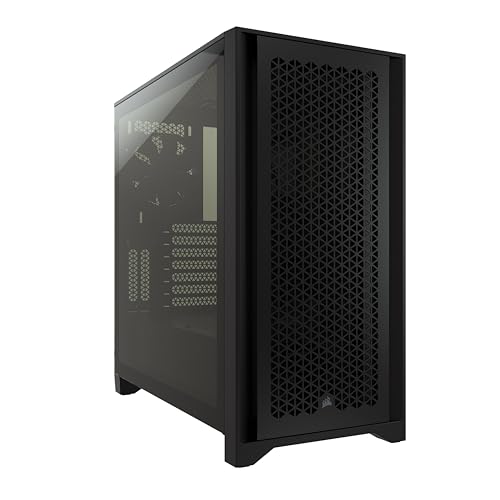
Corsair 4000D Airflow (Best Overall For AIO)
The Corsair 4000D Airflow is the case that turned mesh fronts into the default choice for mainstream builds, and it still earns its place on shortlists years after launch. Corsair built it around a simple idea: a perforated steel front panel, a clean interior with a proper cable-management channel, and enough radiator room for the AIO coolers most builders actually buy.
For an AIO build, Corsair 4000D Airflow earns its badge on proven mesh-front airflow with a proper cable channel — the radiator story is told in full in its spec box below.
Strengths
- Perforated steel front panel delivers genuine intake airflow instead of the choked intake of glass-front rivals
- Dedicated cable-management channel with a cover keeps the main chamber tidy without hours of routing work
- Flexible cooling layout: 360mm front radiator, up to 280mm in the roof, and room for six 120mm fans
Trade-offs
- Only two fans included, so high-power builds should budget for at least one extra intake or exhaust fan
- Top 280mm radiator support depends on low-profile RAM; tall memory kits limit the roof to 240mm
- No front USB-C on the original version, which feels dated next to newer rivals
Key specs
- Form factor: Mid-tower ATX (also fits Micro-ATX and Mini-ITX boards)
- Fans included: 2 x 120mm AirGuide fans (front and rear)
- Maximum GPU length: 360mm
- Maximum CPU cooler height: 170mm
- Radiator support: up to 360mm front, up to 280mm top, 120mm rear
- Side panel: Tempered glass
- Maximum PSU length: 220mm
What keeps the 4000D relevant is how few compromises it asks for at its tier. The front panel flows air properly rather than choking intake behind glass, the two included AirGuide fans move a sensible amount of air out of the box, and the interior layout — PSU shroud, vertical cable channel with cover, and tool-free side panels — makes a first build feel organised instead of improvised. Graphics cards up to 360mm cover the overwhelming majority of current models, and 170mm of cooler clearance swallows every mainstream tower cooler worth buying.
It is also a case that grows with a build. Start with the stock fans and a tower cooler, and the chassis is quiet and cool; add a 360mm AIO in the front or a 280mm unit in the roof later and nothing needs to be replaced. The trade-offs are real but predictable: the roof radiator only reaches its full 280mm size with low-profile memory, and the stock fan count of two is a starting point rather than a finished cooling setup for a high-wattage GPU.
Best for: mainstream ATX gaming and creator builds that want proven airflow and an easy build experience / Not suited for: builders who need more than 360mm of GPU clearance or a front USB-C port as standard

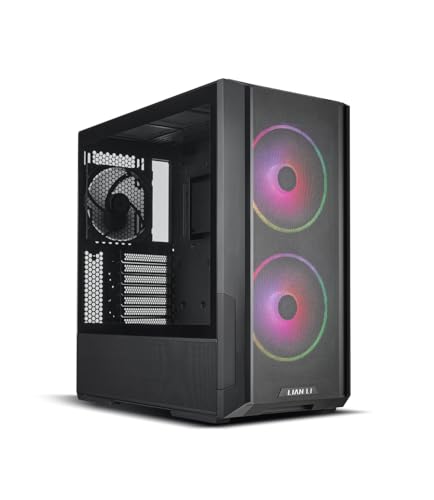
Lian Li Lancool 216 RGB Black (Best For 360mm AIO)
The Lian Li Lancool 216 RGB is the airflow case for people who read fan specifications for fun. Its two enormous 160mm front fans move serious air at low speeds — which means quietly — and Lian Li wrapped them in a chassis full of thoughtful touches, from the relocatable front I/O to a layout that can be rearranged to favour GPU cooling.
For an AIO build, Lian Li Lancool 216 RGB Black earns its badge on two 160mm front fans that move serious air quietly — the radiator story is told in full in its spec box below.
Strengths
- Two 160mm ARGB front fans deliver high airflow at low, quiet speeds
- 392mm GPU clearance and 360mm radiator support fit flagship hardware
- Reconfigurable layout with a GPU-focused cooling mode and movable front I/O
Trade-offs
- Large and heavy for a mid-tower, so check desk space and shelf strength
- Reconfigurable parts add build time compared with fixed-layout cases
- Mesh front shows dust build-up sooner, so filters need regular cleaning
Key specs
- Form factor: Mid-tower ATX
- Fans included: 2 x 160mm ARGB front fans and 1 x 140mm rear fan
- Maximum GPU length: 392mm
- Radiator support: up to 360mm
- Front panel: Fine mesh for high airflow
- Cooling modes: Relocatable front I/O and airflow/GPU-focused layout options
Big fans are the whole story here, and it is a good one. A 160mm fan pushes comparable air to a 140mm at noticeably lower rotational speed, so the Lancool 216 cools a hot gaming rig without the fan roar that makes smaller-fan cases unpleasant to sit beside. With 392mm of GPU clearance and 360mm radiator support, it also swallows hardware that embarrasses most mid-towers, and the addressable RGB on the front fans syncs with the rest of a build’s lighting.
The case rewards builders who read the manual: the motherboard tray and I/O can be reconfigured, the rear fan bracket adjusts, and cable routing behind the tray is generous. The costs of all that metal and glass are size and weight — this is a substantial mid-tower — and the movable parts add a little build time. For an air-cooled or AIO gaming build that will host several generations of hardware, it is arguably the most future-proof pick in this guide.
Best for: high-performance gaming builds that want quiet, serious airflow and room to grow / Not suited for: small desks or builders who want the lightest, simplest case possible

NZXT H5 Flow White (Best Compact AIO Build)
The NZXT H5 Flow White is what happened when NZXT finally listened to the airflow complaints about its earlier H-series cases. The front panel is perforated across its surface, the interior keeps the brand’s famously tidy cable channels, and the white finish makes it a natural centrepiece for the white builds that dominate desk setups right now.
For an AIO build, NZXT H5 Flow White earns its badge on perforated panels and the tidiest cable channels in its class — the radiator story is told in full in its spec box below.
Strengths
- Perforated front and top panels fix the airflow weakness of older NZXT designs
- Best-in-class cable channels and straps make a tidy build almost automatic
- Compact footprint for a full ATX case, suiting smaller desks
Trade-offs
- Only two fans included, so hotter builds should plan on adding intake fans
- Modest drive capacity compared with storage-focused cases
- Compact interior leaves less working room for very large components
Key specs
- Form factor: Compact mid-tower ATX
- Fans included: 2 x 120mm fans
- Radiator support: up to 280mm
- Front panel: Perforated high-airflow design
- Side panel: Tempered glass
- Cable management: NZXT’s routed channel system with straps
Compact is the operative word. The H5 Flow trims the fat from a mid-tower without shrinking into the compromises of a small-form-factor case: a full ATX board fits, the cable channels and straps behind the tray make tidy routing almost automatic, and the perforated panels front and top let the two included fans — and any you add — actually move air. Radiator support up to 280mm covers the AIO sizes most gaming builds use.
The honest limitations are expansion headroom and stock fan count. Two fans is a starting point; a high-wattage GPU build will want the front filled out. Drive capacity is modest next to storage-focused cases, and the compact shell leaves less slack for oversized components than a full-size tower. As a balanced, good-looking home for a mainstream white gaming build, though, it is one of the most complete packages in this guide.
Best for: white ATX gaming builds that prize tidy cables and a compact footprint / Not suited for: storage-heavy builds or anyone wanting a full fan set included
ASUS Prime AP201 (Best Small Case, Big Radiator)
The ASUS Prime AP201 squeezes the spec sheet of a much bigger case into 33 litres. A 360mm radiator in the roof, graphics cards up to 338mm, tower coolers up to 170mm and a standard ATX power supply — in a micro-ATX box wrapped in fine mesh on nearly every side.
For an AIO build, ASUS Prime AP201 earns its badge on a 360mm radiator and 338mm GPU in a 33-litre mesh box — the radiator story is told in full in its spec box below.
Strengths
- 360mm top radiator and 338mm GPU support in a 33-litre case
- Full-mesh quasi-filter panels give big-case airflow in a small footprint
- Takes standard ATX power supplies, avoiding SFX price premiums
Trade-offs
- Limited drive mounts compared with larger micro-ATX cases
- Cable space fills fast, so a modular PSU is strongly advised
- Maximum radiator, GPU and PSU sizes cannot all be used at once
Key specs
- Form factor: Micro-ATX mini tower, 33-litre volume (also fits Mini-ITX)
- Maximum GPU length: 338mm
- Maximum CPU cooler height: 170mm
- Radiator support: up to 360mm top, 120mm rear
- PSU support: Standard ATX, up to 180mm, front-mounted
- Cable management: 32mm of space behind the extended motherboard tray
The mesh is the design. Tens of thousands of small holes across the panels act as a quasi-filter, so the AP201 breathes from the front, sides and bottom without separate filter layers choking it, and the result is a small case that cools like a big one. The front-mounted PSU layout is the space-saving trick that makes it work, freeing the full height of the case for the motherboard and that long graphics card.
Small cases always collect compromises somewhere, and here they are storage and tidiness under load: drive mounts are limited, the 32mm cable space fills quickly with a non-modular PSU, and a top 360mm radiator plus a long GPU plus a long PSU is a combination that needs measuring before ordering. Planned carefully, it is the strongest argument in this guide that micro-ATX does not mean giving anything up.
Best for: compact micro-ATX builds that refuse to compromise on cooling or GPU size / Not suited for: multi-drive storage builds or first-timers wanting a roomy interior
Corsair 5000D Airflow (Best For Dual Radiators)
The Corsair 5000D Airflow is the 4000D’s bigger, more serious sibling: the same perforated-front philosophy stretched into a chassis that can host multiple 360mm radiators, E-ATX boards and the longest graphics cards made, while keeping Corsair’s tidy cable routing intact.
For an AIO build, Corsair 5000D Airflow earns its badge on three 360mm radiator positions and 420mm of GPU room — the radiator story is told in full in its spec box below.
Strengths
- Three 360mm radiator positions, including a motherboard-tray mount
- 420mm GPU clearance and E-ATX support remove component-size worries
- 25mm cable-routing depth keeps big, complex builds tidy
Trade-offs
- Front and tray radiators cannot be fitted simultaneously
- Only two fans included despite ten fan mounts
- Large, heavy chassis that needs a big desk and a strong shelf
Key specs
- Form factor: Mid-tower ATX (also fits E-ATX up to 305 x 277mm)
- Fans included: 2 x 120mm AirGuide fans
- Maximum GPU length: 420mm
- Maximum CPU cooler height: 170mm
- Radiator support: up to 360mm front, 360mm top and 360mm motherboard tray
- Cable routing: 25mm of space behind the motherboard tray
Space is the product here. A 360mm radiator fits in the front, another in the roof, and a third on the motherboard tray — a layout custom-loop and high-end AIO builders usually have to buy a full tower to get. Ten 120mm fan positions, 420mm of GPU clearance and 170mm of cooler height mean component choice is effectively unrestricted, and the extra width behind the tray makes the resulting cable mass manageable rather than a fight.
It asks for commitment in return. The 5000D is a large, heavy case that dominates a desk, only two fans are included despite the ten mounts, and the tray radiator and front radiator cannot be used at the same time, which trims the wildest loop plans. For a high-end build meant to survive several hardware generations, though, few cases at any price offer this much cooling headroom in a mainstream footprint.
Best for: high-end and custom-loop builds that need maximum radiator and GPU room / Not suited for: small desks or buyers who want a complete fan set in the box
Lian Li O11 Dynamic EVO (Best Showcase AIO Build)
The Lian Li O11 Dynamic EVO is the case custom-loop builders sketch their builds around. Its dual-chamber layout hides the power supply and cables behind the motherboard, wraps the main chamber in glass on two sides, and offers something almost nothing else does: room for three 360mm radiators at once.
For an AIO build, Lian Li O11 Dynamic EVO earns its badge on three 360mm radiator positions behind panoramic glass — the radiator story is told in full in its spec box below.
Strengths
- Three simultaneous 360mm radiator mounts — the custom-loop benchmark
- Dual-chamber layout hides PSU and cables for a spotless display build
- Reversible design and 425mm GPU clearance suit unusual, high-end builds
Trade-offs
- No fans included at all, so cooling hardware is entirely an extra cost
- Glass front restricts air-cooling intake without the optional mesh kit
- Wide dual-chamber body needs a deep, sturdy desk
Key specs
- Form factor: Dual-chamber mid-tower, E-ATX / ATX / Micro-ATX / Mini-ITX
- Radiator support: up to 360mm top, 360mm side and 360mm bottom simultaneously
- Maximum GPU length: 425mm
- Maximum CPU cooler height: 167mm
- Fans included: none — up to 10 fan positions
- Panels: Tempered glass front and side, reversible layout
That radiator capacity defines it. A CPU-plus-GPU loop with a 360mm radiator per component, thick radiators on the side mount, a distribution plate where the side fans would go — the EVO accommodates the full vocabulary of custom water cooling while the glass keeps the result on display. The reversible design even lets the whole case be flipped for a left-side desk setup, and 425mm of GPU clearance with 167mm of cooler height means air-cooled builds are not second-class citizens either.
The catch is that the EVO is a canvas, not a kit. It ships with no fans at all, its glass front does nothing for air cooling until the optional mesh kit is added, and the dual-chamber width makes it one of the widest mid-towers on a desk. Budget for fans or a full loop, and it is one of the most capable and best-looking chassis money can buy; buy it expecting a finished product out of the box and it will disappoint.
Best for: custom water-cooling loops and showcase builds planned around big radiators / Not suited for: buyers who want fans included or a narrow, lightweight case
Comparison Table
| Pick | Form factor | Fans included | Max GPU | Max radiator | Panel / colour | Price |
|---|---|---|---|---|---|---|
| Corsair 4000D Airflow | ATX mid-tower | 2 x 120mm | 360mm | 360mm front | Tempered glass, black | Check price on Amazon |
| Lian Li Lancool 216 RGB Black | ATX mid-tower | 2 x 160mm ARGB + 1 x 140mm | 392mm | 360mm | Mesh front, black | Check price on Amazon |
| NZXT H5 Flow White | ATX compact mid-tower | 2 x 120mm | See spec box | 280mm | Tempered glass, white | Check price on Amazon |
| ASUS Prime AP201 | Micro-ATX, 33L | See spec box | 338mm | 360mm top | Full mesh panels | Prose-only pick |
| Corsair 5000D Airflow | ATX mid-tower | 2 x 120mm | 420mm | 360mm x 3 positions | Tempered glass | Prose-only pick |
| Lian Li O11 Dynamic EVO | ATX dual-chamber | None included | 425mm | 3 x 360mm | Glass front and side | Prose-only pick |
How to Choose the Right PC Case For An AIO Cooler
Radiator size, honestly assessed: a 240mm AIO handles most CPUs, a 280mm adds quieter fans and a little headroom, and a 360mm is for flagship processors, sustained rendering loads, or builders who simply want the fans turning slowly. The performance gap between 280mm and 360mm is smaller than the marketing suggests; the gap between 240mm and either is bigger.
Position decides behaviour. A roof-mounted radiator exhausts CPU heat straight out of the case and keeps GPU clearance intact, but needs RAM and VRM clearance above the board — check the case’s stated limits. A front-mounted radiator gets the coolest air and the best CPU temperatures, at the cost of warming the air the GPU breathes and eating card length.
Thickness is the forgotten dimension. Standard AIOs are about 27mm thick plus 25mm fans; a case that ‘fits 360mm’ may fit it only in one position or only with slim fans. The verified spec boxes here list positions; if you are planning push-pull fans or a thick custom radiator, treat this guide’s AIO-focused picks as a starting point and check the manufacturer’s clearance drawings.
Pump orientation is a reliability issue, not a preference: the pump (usually in the CPU block) should not be the highest point of the loop, so trapped air collects in the radiator instead of the pump. Every layout recommended in this guide satisfies that with the radiator mounted as described.
Finally, plan the fan story as one system. The radiator fans are part of the case’s airflow, not separate from it: front radiator means your intakes are spoken for, so exhaust capacity at the rear and roof is what keeps the GPU fed and the case balanced. Builders comparing the neighbouring briefs should also see Best Pc Cases For Dust and Best White Pc Cases Under $100.
Tempered glass care is simple and worth stating once: remove panels over a soft surface, lay them flat, clean with a microfibre cloth and nothing abrasive, and tighten screws in a cross pattern to gentle snugness. Treated that way, a glass panel is a decade-long part; treated carelessly, it is the only component in the build that can fail from handling alone.
Finally, a note on buying timing: cases are bulky, heavy and frequently discounted because shipping them back is nobody’s idea of fun. If two picks in this guide are tied for your build, the one on promotion this week is the rational choice — the differences that matter are in the spec boxes, and both already passed them.
Motherboard sizes, decoded once: Mini-ITX is a 170mm square with one expansion slot; Micro-ATX is up to 244mm square with up to four slots; ATX is 305 x 244mm with up to seven; E-ATX is ATX’s length with extra width that varies by brand. Every case in this guide states the sizes it fits, and the golden rule is that a case fits its own size and everything smaller — never the reverse.
Fan bearings sound like trivia until a fan starts clicking at 2am. Sleeve-bearing fans are cheapest and happiest mounted vertically; ball and fluid-dynamic bearings cost more and tolerate any orientation, including the horizontal roof mounts that kill cheap sleeve fans early. The included fans in this guide’s premium picks use the better bearings, which is part of what their price buys.
PWM versus DC fan control decides how a build sounds at idle. PWM (four-pin) fans can typically spin down to a few hundred RPM and follow precise curves; DC (three-pin) fans are controlled by voltage and stall earlier. If silence matters, check that both your motherboard headers and the case’s included fans speak PWM — the spec sources for each pick here note the fan types where the manufacturer publishes them.
Static pressure and airflow are the two fan personalities: pressure-optimised blades push air through radiators and dense filters, airflow-optimised blades move maximum air through open space. Case intakes behind fine mesh or filters behave like mild radiators, which is why the strongest stock setups in this guide pair open panels with fans that can hold pressure.
AIO radiator orientation has one rule that outranks all aesthetics: the pump must not be the loop’s highest point. Roof and front-high radiator mounts satisfy this automatically in every case here; a bottom-mounted radiator with the pump in the CPU block above it is the one layout to avoid, whatever the product photos suggest.
Steel thickness is the spec nobody advertises and everybody feels. Premium cases use thicker panels that resist flex, close with a machined feel and do not drum at certain fan speeds; budget cases use thinner steel that is lighter and needs its bends and folds for stiffness. Neither affects temperatures — it is purely an ownership-quality difference, priced accordingly.
Front I/O speeds are worth one check: a USB 3.0 port moves files at a fraction of a USB-C 3.2 Gen 2 port’s speed, and on a case you will keep for a decade that difference compounds. If fast external drives are part of your life, weight the picks with native USB-C; if the front panel serves a keyboard dongle and a headset, save the money.
Power-supply length interacts with case layout more than any other PSU dimension. Long, high-wattage units can foul drive cages, bottom fans and front radiators in compact cases; the spec boxes here list PSU limits wherever the manufacturer states them. Modular cables help twice over — fewer cables to hide, and shorter effective cable mass at the PSU’s exit.
Drive vibration is a real phenomenon in multi-disk builds: spinning drives excite each other through a shared cage, raising noise and, in the worst cases, error rates. Rubber-grommeted trays — standard on the Fractal picks here — are the cheap, complete fix, and one more reason storage-led builds should read the mounting details, not just the bay counts.
RGB ecosystems deserve a cold eye. Addressable lighting that follows the open 3-pin ARGB standard syncs with any major motherboard and survives a board swap; proprietary ecosystems lock your fans, strips and controllers to one brand’s software. Several picks here deliberately use the open standard, and the fixed-RGB budget picks are honest about offering no control at all.
Warranty and spares are part of a case purchase: established brands stock replacement panels, filters and fan brackets for years, which matters when a glass panel meets a tiled floor in year three. It will not appear in any spec box, but it is a rational tiebreaker between two otherwise-equal picks in this guide.
Returns are the tax on guessing, and cases are the worst component to return — bulky, heavy and easy to damage in repacking. The defence is measurement: GPU length and thickness, cooler height, radiator size and position, PSU length, desk depth. Every one of those numbers appears in this guide’s spec boxes precisely so the case you order is the case you keep.
Thermals testing methodology explains most disagreements between reviews: ambient temperature, fan speed normalisation and workload choice move results by more than the difference between good cases. Use reviews — and this guide — for the structure of a case’s cooling (intake design, fan set, radiator options) and treat any single degree figure as weather, not climate.
A word on tinted glass: darker tints look superb with lit interiors and hide unlit ones completely. If your build has no lighting and you choose a dark-tint panel, you have bought a black box with extra steps. The solid-panel and mesh picks in this guide exist for builders who would rather have the airflow or the understatement.
Cable extensions deserve their warning: cheap extension sets with thin conductors can drop voltage on GPU power runs. Buy extensions from reputable makers, keep the PSU’s own cables for at least part of the GPU run where the case allows, and never extend a cable that already runs hot to the touch.
Altitude and environment matter more than marketing admits: a case that cools beautifully in an air-conditioned room works harder in a hot, dusty one, and its filters clog faster. If your room is warm, weight the picks with the most intake capacity and the easiest filter access — both are called out in the reviews above.
A word on GPU sag, because modern graphics cards are long, heavy and expensive: any case in this guide will hold one safely, but a card over 300mm benefits from the support bracket some of these cases include, or from a simple pillar support added later. Sag is not just cosmetic — over years it stresses the PCIe slot — and the time to plan for it is when the case is chosen, not when the card starts to droop.
Fan headers are a quiet planning point. A typical motherboard offers three to five case-fan headers; a case with six fitted fans needs a hub, a splitter strategy within the header’s amp limit, or both. Several picks here include hubs or pre-wired looms for exactly this reason. Check your board’s header count against the fan count in the spec boxes before the build, not during it.
Dust management decides how a case ages. Filtered intakes and positive pressure keep a build clean for months; unfiltered mesh fronts trade a little dust for maximum airflow and ask for a monthly wipe. Neither is wrong, but be honest about which owner you are — the best filter is the one that matches the cleaning you will actually do.
Power-supply shrouds changed case design for the better, and every pick in this guide has one or an equivalent layout. Beyond hiding cables, a shroud separates the PSU’s heat from the GPU’s air supply and gives drives or a pump a home. When comparing two otherwise-equal cases, the better shroud design is a legitimate tiebreaker.
Vertical GPU mounting deserves a sentence of its own: it looks superb in glass cases and two picks here support it natively or via an included riser. It also moves the card’s fans close to the glass, which costs cooling on thick cards. Treat vertical mounting as a display choice with a thermal price, and check the card-thickness notes in the reviews before committing.
E-ATX support is the most misread line on any spec sheet. It always comes with a maximum width, and a board at that width can cover the cable grommets or a side radiator mount. If your board is E-ATX, compare its actual width in millimetres against the case’s stated figure — the reviews here surface that figure wherever the manufacturer publishes it.
Noise is worth planning like a specification. Fan noise rises steeply with speed, so the quiet build is the one whose fans never need to hurry: big fans, open intakes and radiators with headroom. If the PC lives in a bedroom or lounge, weight the picks with 140mm and 160mm fans and solid-panel options more heavily than raw fan counts.
A case is also a second-hand asset. Mainstream cases from recognised brands, with their accessory boxes kept, resell remarkably well when you upgrade; obscure cases with missing brackets do not. It is a minor point next to fit and cooling, but over two or three upgrade cycles it quietly refunds part of every purchase in this guide.
Measure your desk before falling in love. Case dimensions in the spec sources are honest, but remember to add cable bend room behind the rear panel — HDMI, power and USB leads need roughly 80mm — and check that a tempered-glass side can actually be slid or swung clear in the space the PC will live in.
The front-panel USB-C question deserves a straight answer: it matters if you move large files to external SSDs, use a modern capture device or headset, or simply hate adapters. It does not matter to temperatures or frame rates. Two older designs in this guide make it optional or absent, and their reviews say so — let your peripherals, not fashion, decide how much that counts.
Radiator thickness is the specification nobody lists in headlines. A standard AIO radiator is about 27mm thick; add 25mm fans and the assembly needs roughly 52mm of clear space in its mount, more for push-pull. Where a review in this guide gives a thickness-sensitive warning — RAM height in a roof mount is the classic — it comes from the manufacturer’s own clearance notes.
Cable extensions and sleeved kits are the finishing touch many builders add later. They need slack: a case with 25mm or more behind the tray swallows the extra connectors gracefully, while a tight compact case may not. If a fully dressed cable kit is part of your plan, that is a genuine reason to favour the deeper picks in this guide.
Airflow testing at home is easier than it sounds: a stick of incense or a strip of tissue at the seams shows the pressure direction, and any game’s built-in benchmark gives repeatable temperatures. Ten minutes of this after a build tells you more about your specific case, fans and room than any review — including this one — can.
How Do You Install an AIO Cooler in a New Case?
- Decide the radiator position before building: roof if the case lists your radiator size there and your RAM is not extreme-height, front if CPU temperature is the priority and GPU clearance still works.
- Build the motherboard outside the case — CPU, RAM and the AIO’s backplate and mounting hardware fitted — because AIO brackets are miserable to install in a crowded chassis.
- Fit the radiator’s fans to the radiator on the bench, in the orientation your layout needs (pulling air through as exhaust at the roof, pushing through as intake at the front).
- Install the PSU and motherboard, then offer the radiator up and check tube reach to the CPU socket before screwing anything down; AIO tubes are shorter than they look.
- Mount the radiator, then the block on the CPU with fresh thermal paste, tightening the four mounts in a cross pattern a little at a time.
- Route the pump power and fan cables to their headers — pump to the AIO_PUMP or CPU_FAN header as your board’s manual directs — and set that header to full speed in the BIOS if the manual requires it.
- Fit the graphics card last and re-check its clearance against the radiator and fans with everything in place.
- First boot: listen for pump operation, watch CPU temperature at idle, and after a heat cycle check for any weeping at the fittings before closing the panels.
Troubleshooting quick list
- Problem: CPU temperature spikes within minutes → the pump is not running or its header is set to a variable mode; check the pump cable and set the header as the AIO manual specifies.
- Problem: gurgling or trickling sounds → air is sitting in the pump; tilt the case gently so bubbles migrate to the radiator, and confirm the radiator top is above the pump.
- Problem: radiator will not sit flush in the roof → tall RAM or VRM heatsinks are fouling it; move the radiator to the front or use the case’s offset mounts if provided.
- Problem: GPU temperature rose after fitting a front radiator → the GPU is breathing radiator exhaust; raise rear/roof exhaust speed and consider one extra intake below the card.
Common Mistakes
- Buying the AIO first and the case second, then discovering the radiator only fits in the position that deletes your GPU clearance.
- Mounting the radiator at the bottom of the case with the pump above it — the one layout that reliably shortens AIO life by trapping air in the pump.
- Assuming ‘360mm support’ means every position; most cases fit the largest radiator in one or two named positions only.
- Forgetting that radiator fans are case fans: a front radiator with no other intake leaves the GPU starved, no matter how good the CPU temperature looks.
- Crushing tubes against sharp tray edges or bending them at the block fittings; gentle curves keep both the flow and the warranty intact.
Final Recommendation
The badges, restated: Corsair 4000D Airflow — Best Overall For AIO; Lian Li Lancool 216 RGB Black — Best For 360mm AIO; NZXT H5 Flow White — Best Compact AIO Build; ASUS Prime AP201 — Best Small Case, Big Radiator; Corsair 5000D Airflow — Best For Dual Radiators; Lian Li O11 Dynamic EVO — Best Showcase AIO Build.
If your AIO is 280mm or smaller, almost every pick here works and the choice becomes about size and looks. For a 360mm build, narrow to the cases that list 360mm in the position you want — roof for balance, front for CPU temperatures — and let the spec boxes settle it.
The Lancool 216 and the compact AP201 are the two that surprise people: one for doing everything at once, the other for fitting a 360mm radiator where no 360mm radiator should fit. Check live prices, confirm your radiator size against the verified specs, and the build will go together the first time. For the adjacent questions this guide does not cover, start with Best Pc Cases For Custom Water Cooling and Best Atx Gaming Pc Cases Under $100.
Frequently Asked Questions
Is a roof or front radiator mount better?
Roof mounting is the safer default: it preserves GPU clearance, exhausts CPU heat directly and keeps the pump below the radiator. Front mounting wins a few degrees on the CPU and is the right choice when the roof cannot fit your radiator — provided the GPU still fits and gets enough exhaust help.
What AIO size should I buy for a modern gaming CPU?
A 240mm or 280mm unit is the sweet spot for gaming processors; step to 360mm for flagship chips, heavy overclocking or sustained all-core workloads like rendering. The cases here are grouped by the sizes they genuinely fit.
Can a compact case handle an AIO build?
Yes — two picks in this guide fit 280mm or even 360mm radiators in micro-ATX footprints. The trade-offs are GPU length and working room, both stated in their reviews, not cooling capability.
Do I still need case fans with an AIO?
Yes. The AIO cools the CPU only; the GPU, VRMs and drives still need case airflow. Count the radiator fans as part of the layout and make sure exhaust capacity roughly matches intake.
How long does an AIO last, and does the case matter?
A quality AIO typically serves five years or more. The case matters because correct radiator placement — radiator high point above the pump — is the single biggest factor in keeping air out of the pump and the unit quiet over its life.