Disclosure: As an Amazon Associate, ilcastellomenu.com earns from qualifying purchases. Links on this page are affiliate links; they cost you nothing extra. Prices and availability change often, so check the current Amazon listing before you buy.
This guide is built around one search: is a graphics card support bracket worth it. This article answers the value question directly, profile by profile, because in this category worth is not a property of the product — it is a property of the build it goes into. The same bracket is cheap insurance in one machine and pure decoration in the next. Everything that follows works from the same honest core. A support bracket prevents and corrects sag; it does not repair an already-damaged PCIe slot or a cracked PCB. Fitting is always done with the PC off and unplugged. The support point belongs under the far corner of the card, on something solid, never pressing on fans or shroud vents, and the setting is level — never cranked upward against the board. Keep those four facts in view and every style, tier and brand name in this article falls into its proper place.
Is a Graphics Card Support Bracket Worth It? The Short Answer
Worth it if your card is long and heavy, visibly droops, or rides in a PC that travels: a modest, one-time purchase in the entry or mid tier protects the most valuable component in the build and finishes its look. Not worth it if your card is short, light and level, if it is vertically mounted with support in its kit, or if your case honestly has no room. And never worth it as a cure: asked is a graphics card support bracket worth it for a slot or board that is already damaged, the answer is no — that money belongs to repair. The rest of this article earns that short answer properly.
In this guide
Key Takeaways
- Worth is decided by your card and case, not by the bracket.
- Heavy, drooping or travelling cards: yes, in the entry or mid tier.
- Short, light, level cards and most vertical builds: no, and that is fine.
- A bracket is prevention; damaged hardware needs repair money instead.
- The premium tier buys looks and integration, not extra protection.
What You Actually Get
You get three things, in descending order of importance. First, load relief: a second support point under the far corner, taking the constant flex off the slot and the board for the whole life of the card. Second, stability in motion: a card that stays seated and calm when the PC is carried, cleaned or shipped. Third, a finished look: a level line through the glass panel that makes the whole build read as deliberate. Notice what is not on the list — performance, cooling and quiet. A bracket changes none of those, and any value case built on them is built on air. The honest trio is enough: protection, stability and tidiness, bought once and kept for years, often across more than one graphics card.
Case-Mounted and Motherboard-Mounted Brackets Explained
The second family solves the footing problem by attaching to the build itself. Case-mounted brackets screw to expansion slot covers or to points inside the chassis, while motherboard-mounted designs such as the Lian Li approach use the motherboard mounting area to hold an arm out under the card. Because they are fixed rather than free-standing, they cannot be knocked over when you move the PC, they stay exactly where you set them, and they tend to look more integrated — almost like part of the original build. The trade-off is compatibility homework. Mounting points differ between cases and boards, standoff positions and slot spacing have to line up, and a bracket that fits one build beautifully may have nowhere sensible to attach in the next. These designs reward builders who measure first and who expect to keep the same case and board for a long time.
Horizontal Brace Arms and What They Do Differently
A third approach runs a brace along the length of the card rather than propping it from below at one point. Horizontal braces and support arms attach near the rear of the case and extend forward, holding the card along its edge or at its far end from a structure that is itself screwed down. Done well, this spreads the support and can look very deliberate, especially in a showcase build. Done badly, it can foul cables, clash with tall memory or a large air cooler, or press along a part of the shroud that was never meant to take load. The lesson is the same as with every type: support belongs under a solid structural point near the far corner, applied gently. Whichever family you choose, judge it by where it touches the card and how securely its other end is anchored, not by how elaborate it looks in a listing photograph.
Materials, Feet and Pads: the Small Parts That Decide Quality
Two brackets that look alike in photographs can feel completely different in the hand, and the difference is in the small parts. A metal post or arm flexes far less than a thin plastic one, and flex in the support simply hands the sag back to the card. The foot matters too: a wide foot with a grippy, non-slip pad stands calmly on a smooth shroud, while a narrow or hard foot can skate when the case is moved. At the top, the rest that touches your card should be padded — rubber or a similar forgiving material — so the contact is firm without marking the shroud or transmitting vibration. Threads and locking rings should turn smoothly and hold their setting; a support that slowly winds itself down over a month is decoration, not support. None of this requires exotic engineering. It requires ordinary parts made properly, which is exactly what separates the good examples in this category from the forgettable ones.
The Real Costs Beyond Money
The purchase itself, positioned by tier in words, is among the smaller costs in PC building — but money is not the whole bill. There is the measuring: ten honest minutes with the side panel off before you order. There is the space: the room below your card may already belong to fans or cables, and the bracket will have to negotiate for it. There is the small, recurring attention: a glance at the pad and the setting whenever you clean the build, and a fresh fitting at every card swap. And there is the discipline cost, the one nobody lists: fitting it gently, to level and no further, resisting the very human urge to wind it up and defeat gravity completely. None of these costs is large. Together they explain why the worth-it answer depends on whether the benefit is real in your build — where it is, the costs are trivial; where it is not, even trivial costs buy nothing.
Who It Pays Off For
The Flagship Card Owner
The clearest yes in this article. Your card is long, heavy and valuable, its cooler is exactly the kind that droops, and the part protecting it costs a small fraction of its worth, once. Fit a sound mid-tier support and stop thinking about it.
The Travelling Builder
LAN trips, moves, a PC that shuttles between home and elsewhere: your card’s riskiest hours are on the road, and a fixed bracket that cannot topple is priced like the insurance it is. For you the question answers itself.
The Showcase Builder
You paid for glass, lighting and a composed interior; a drooping card undermines all of it daily. A support — discreet or styled — is worth it to you on looks alone, and the mechanical benefit rides along free. Buy fit first, then the finish you actually want.
Who Should Skip It
The Compact and Small-Card Builder
Your card sits level, your case has no spare room, and the category was never aimed at you. Skipping is not missing out; it is the correct read of your own build.
The Vertical-Mount Builder
Your mount already answers the sag question in its own way. Spend on the mount’s quality and the riser’s, not on a pillar with no job to do.
The Owner of Already-Damaged Hardware
If the slot is loose, the board cracked or the system unstable when the card moves, a bracket is the wrong purchase at any tier. Put the money toward diagnosis and repair; a level-looking card over damaged hardware is the worst outcome in this article.
Strengths and Trade-Offs
Strengths
- One modest purchase protects the build’s most valuable part for years
- Transfers between cards and removes without a trace
- Pays off most exactly where risk is highest: heavy cards and travel
Trade-Offs
- Buys nothing at all in builds with no droop and no room
- Demands measuring, gentle fitting and occasional checks
- Premium tiers charge for looks while protection stays the same
Alternatives to Consider
Doing nothing is a legitimate alternative wherever the card sits level — it is the default state of most PCs on earth. A case with a built-in GPU support is the elegant alternative at your next case purchase, folding the function into hardware you were replacing anyway. Cable discipline is the free alternative everyone should take regardless: power cables routed so they support rather than drag the card can visibly improve its line before a penny is spent. Judge each alternative against your build the same way you judged the bracket.
Lian Li GB-001 Anti-Sag Bracket
The Lian Li GB-001 Anti-Sag Bracket represents a case and motherboard-mounted approach rather than a free-standing pillar. In prose terms it sits in the mid tier of this category: judge it by the tests this article keeps returning to — a secure footing or fixing, a padded rest, adjustment that locks once set, and a support point that can land on a solid part of your card, well away from any fan or vent. Fitted that way, with the PC off and unplugged and the height set until the card sits level rather than lifted, it does the one job this category exists for: it holds the far corner of a heavy card so the slot and the board no longer carry the whole lever alone. It will not repair a slot or a board that is already damaged, and no honest support should claim otherwise. Check the current listing for exactly what is included before you buy, and measure your own build first, because fit in this category is decided by your case and your card, not by any listing photograph.
Value here is measured in years of a level card and one less thing to worry about when the PC travels, not in features.
Best for: builders whose measured clearances suit this style of support and who want the card held level with a padded, locked rest. Not suited for: builds where its footing or fixing has nowhere sound to go, or where its rest would land on a fan, a vent or a fragile part of the shroud.

nkomax GPU Support Bracket
The nkomax GPU Support Bracket represents an upright support sold on straightforward adjustment and a tidy footprint. In prose terms it sits in the mid tier of this category: judge it by the tests this article keeps returning to — a secure footing or fixing, a padded rest, adjustment that locks once set, and a support point that can land on a solid part of your card, well away from any fan or vent. Fitted that way, with the PC off and unplugged and the height set until the card sits level rather than lifted, it does the one job this category exists for: it holds the far corner of a heavy card so the slot and the board no longer carry the whole lever alone. It will not repair a slot or a board that is already damaged, and no honest support should claim otherwise. Check the current listing for exactly what is included before you buy, and measure your own build first, because fit in this category is decided by your case and your card, not by any listing photograph.
For the worth-it question, a support in this tier is the easiest kind to justify when your card is long and heavy, and the hardest to justify when your card is short and light — the product barely changes; the build decides.
Best for: builders whose measured clearances suit this style of support and who want the card held level with a padded, locked rest. Not suited for: builds where its footing or fixing has nowhere sound to go, or where its rest would land on a fan, a vent or a fragile part of the shroud.

EZDIY-FAB GPU Holder
The EZDIY-FAB GPU Holder represents a holder aimed at builders who want the support to match a styled, lit interior. In prose terms it sits in the mid tier of this category: judge it by the tests this article keeps returning to — a secure footing or fixing, a padded rest, adjustment that locks once set, and a support point that can land on a solid part of your card, well away from any fan or vent. Fitted that way, with the PC off and unplugged and the height set until the card sits level rather than lifted, it does the one job this category exists for: it holds the far corner of a heavy card so the slot and the board no longer carry the whole lever alone. It will not repair a slot or a board that is already damaged, and no honest support should claim otherwise. Check the current listing for exactly what is included before you buy, and measure your own build first, because fit in this category is decided by your case and your card, not by any listing photograph.
Value here is measured in years of a level card and one less thing to worry about when the PC travels, not in features.
Best for: builders whose measured clearances suit this style of support and who want the card held level with a padded, locked rest. Not suited for: builds where its footing or fixing has nowhere sound to go, or where its rest would land on a fan, a vent or a fragile part of the shroud.
Power Cables and the Hidden Clash Nobody Mentions
The most common fitting surprise has nothing to do with the bracket itself. Modern graphics cards draw their power through connectors on the top or the end of the card, and the cables leaving those connectors need room to bend without strain. A support arm positioned carelessly can end up exactly where a power cable wants to route, pushing the cable into a tighter bend or resting against its connector. When you plan the support point, trace the whole neighbourhood: where the power cables run, where the front-panel audio and USB leads pass, and whether a side panel bulge or cable channel will press on anything once the case is closed. Rerouting a cable to make room is normal and harmless; forcing one is not. A few minutes spent looking before you buy saves the particular frustration of a bracket that fits the card perfectly and the build not at all.
Vertical GPU Mounts Change the Question Entirely
If your card is mounted vertically — facing the side panel on a riser cable, as many showcase cases allow — the sag question changes shape. A vertical card hangs from its mount rather than cantilevering out of the slot, so the classic droop is largely gone, and a conventional pillar support usually has nothing useful to do. What vertical mounting introduces instead is its own set of concerns: the riser cable and its connectors carry the card, the bracket of the mount itself must be secure, and the card sits close to the glass, which affects its breathing room. Some vertical kits and cases include their own small supports or rests, and those matched parts are the right answer where they exist. Do not buy a horizontal-build support bracket for a vertical build out of habit. Check what your mount already provides, and only add support that the layout actually calls for.
How to Get the Most Value If You Buy
Buy once, in the tier your build justifies, and buy the mounting style your measurements dictate — a bracket that fits serves for years, while a bargain in the wrong style is worth nothing at all. Fit it properly the first time: PC off and unplugged, support point on solid shroud, height set to level. Keep the spare pads. Recheck after a week, then fold it into your cleaning routine. And when you upgrade the card, refit rather than assume — five minutes that keeps a good purchase good across its whole working life.
The Decision Checklist
- Does the far corner of your card visibly droop?
- Is the card long and heavy, with a large cooler?
- Does the PC travel, even occasionally?
- Have you done the free fixes — card seated, screws snug, cables not dragging?
- Is there measured room and a solid support point, clear of fans and vents?
- Is the slot and board undamaged, so prevention is the right purchase?
Three or more yes answers, including the last one: buy, in the entry or mid tier, without further agonising. Mostly no answers: skip it with a clear conscience. A no on the final question overrides everything else — repair first, and revisit this category afterwards.
Doing the Honest Maths on Use, Lifespan and Alternatives
Lifespan changes the whole calculation
A graphics card support bracket that serves for many years spreads its cost across thousands of uses; one that wears out, dates quickly or loses its supporting ecosystem does not. Judge lifespan by construction, consumable availability and how actively the maker still supports the line, rather than by optimism. This is where the picks discussed earlier differ most meaningfully for value: the model with the longer realistic service life can be the better value even when it is not the cheapest route in, because the cost per year of service is what your household actually pays.
The resale and hand-me-down exit
Value calculations usually assume you keep a graphics card support bracket forever, but a healthy second-hand market changes the risk. Products in the Graphics Cards category that hold their appeal tend to resell or hand down easily, which means a wrong decision is recoverable rather than total. That exit value argues for buying the respected model over the obscure bargain: if your circumstances change, the known graphics card support bracket finds a new home quickly. An ultra-cheap alternative with no following is the one that becomes pure sunk cost in a cupboard.
When waiting is the right answer
Sometimes the correct verdict is not no, but not yet. If your space, routine or budget is about to change — a move, a new job pattern, a renovation — the graphics card support bracket that suits today’s setup may be wrong for next season’s. Waiting costs nothing and buys information: you learn whether the need survives the change. The exception is when the need is already costing you weekly in time or frustration; then waiting is itself the expensive option, and the analysis earlier in this piece applies with full force. Distinguish a stable recurring need from a temporary itch before deciding.
The one-question shortcut
If the full analysis still leaves you undecided, ask the question that cuts through it: if this graphics card support bracket disappeared from your home after a month of use, would you replace it immediately, eventually, or not at all? People answer honestly when the purchase is framed as a loss. Immediate replacers should buy with confidence and choose the better model; eventual replacers should buy modestly; the not-at-all group has its answer too. In a household where the gear gets used hard on weekends and barely touched midweek, that instinct, checked against the use-frequency count, settles the worth-it question more reliably than any feature comparison.
Count the uses, honestly
The worth-it question for a graphics card support bracket is mostly a frequency question. Estimate how many times a month the product would genuinely be used in your routine — not the enthusiastic first fortnight, but month four, when the novelty has worn off. In a household where the gear gets used hard on weekends and barely touched midweek, a graphics card support bracket used weekly almost always justifies itself through saved time, avoided workarounds or better results, while the same product used twice a year is usually an expensive storage obligation. If your honest count is low, borrowing, hiring or using a service is the mathematically sound answer, and there is no shame in it.
Five honest minutes at this stage is worth more than five hours of comparison browsing.
Frequently Asked Questions
Do all graphics cards need a support bracket?
No. Short, light cards with modest coolers sit happily in their slot for years with no visible droop and no help. The case for a bracket grows with the card: the longer and heavier the cooler, the longer the lever working on the slot, and the more a gentle second support point makes sense. Look at your own card first. If the far corner visibly droops, or the card is among the large, heavy designs of recent generations, a bracket is a proportionate answer. If the card sits level on its own, a bracket is jewellery, and you should buy it only if you want the look.
Can a support bracket fix a card that already sags badly?
It can hold a sagging card level again, which is usually what owners actually want, but it cannot undo damage that sag may already have done. If the slot has loosened, the board has cracked, or the system has become unstable when the card moves, a bracket is not a repair and should not be trusted as one. Straighten the card gently with support, by all means — but if there are symptoms beyond droop, have the hardware assessed. Prevention bought early is the honest promise of this category; resurrection is not on the menu.
Where exactly should the support touch the card?
Under the far corner, on a solid, structural part of the card — the edge of the shroud, its frame or a reinforced corner — as far from the slot as your layout allows. Never on a fan blade, fan hub, fan opening or shroud vent, and never against bare board components. The contact should be padded and gentle: enough to take the droop out and hold the card level with its slot, never enough to push the corner above that line. If the only available contact point is a fan or a vent, that bracket style does not fit your build.
Is it safe to install a bracket with the PC switched on?
No. Always shut the PC down, switch the power supply off and unplug it before opening the case and fitting anything that will sit inside it, close to a powered board. Installation is a two-handed, close-quarters job around connectors and fans, and it should be done on a still, unpowered machine, taking your time. The same rule applies every time you adjust, clean around or remove the bracket later. It costs a minute and removes the only real risk in an otherwise gentle job.
What about vertical GPU mounts and multi-GPU builds?
Treat both as separate questions. A vertically mounted card hangs from its mount on a riser rather than cantilevering from the slot, so classic sag largely disappears and a normal pillar usually has no job to do; use any support the mount kit itself provides. In a multi-GPU build, support each card at its own far corner if you support it at all, expect floor space for a pillar to be scarce, and look to case-mounted or motherboard-mounted designs — taking great care that one card’s support never presses on the fans of the card beneath it.
How do I know if a bracket will fit my case?
Measure, in this order: the gap between the underside of your installed card and the surface below it; the flat, clear area where a foot could stand or the mounting points a fixed bracket could use; and the position of a solid support point on the card, clear of fans and vents. Compare those three facts with the style you are considering — pillar, case-mounted or motherboard-mounted — before comparing brands or finishes. Fit in this category is physical and specific to your build, and no listing can settle it for you.
Related Guides
Keep reading within this cluster and the wider build guides on this site. See also the graphics card support bracket review guide. See also the graphics card support bracket reviews guide. See also the graphics card support bracket buying guide guide. See also the graphics card support bracket pros and cons guide. See also graphics cards for multiple monitors. See also graphics cards for three-monitor setups. See also cases with strong airflow for gaming builds. See also choosing a case that actually fits a long graphics card. Each of those guides follows the same rule as this one: measure your own build first, and let fit — not marketing — make the final decision.
Looks, Lighting and the Glass Panel Effect
A support bracket is one of the few PC parts bought partly to be looked at. Through a tempered glass panel, a drooping card reads as untidy no matter how fast it is, and a level card with a discreet support reads as finished. That is why the category spans plain black pillars that try to disappear, machined designs that present themselves as jewellery for the build, and lit models whose addressable lighting syncs with the rest of the system. None of these is the wrong answer; they serve different builders. The caution is ordering. Lighting and finish should be the last filter you apply, after type, fit and support point are settled, because a beautiful bracket standing in the wrong place is still standing in the wrong place. Buy the support first and the ornament second, even when both come in the same box.
Transport, LAN Trips and Moving House
A PC that never moves asks little of its support bracket. A PC that travels — to a friend’s house, to a LAN event, or simply in the back of a car on moving day — asks much more. Every bump on the road works the graphics card in its slot, and a heavy card with no support is at its most vulnerable exactly then. A bracket earns its keep on the journey even if you barely notice sag at your desk. For regular travellers, fixed case-mounted or motherboard-mounted brackets have a real advantage: they cannot fall over in transit and end up rattling around against the card they were meant to protect, which a loose pillar genuinely can if it is knocked off its foot. The simplest travel routine is to lay the case on its side, motherboard down, so the card rests rather than hangs — and to check the support is still seated correctly when the machine is set up again.
Dust, Cleaning and Living With a Bracket Long Term
A bracket is not fit-and-forget forever; it becomes part of the machine you maintain. Dust settles on its top surfaces and around its foot just as it settles everywhere else in the case, and the support point itself deserves a look whenever you clean the build: check that the pad is still in place, that the post has not slowly settled, and that the card still sits level. Cleaning around an installed bracket is easy — a soft brush and short bursts of air, with the PC off and unplugged, and a hand keeping any nearby fan from spinning freely while you work near it. If you remove the card for a deep clean or an upgrade, remove the bracket first and refit it last, setting the height fresh rather than assuming the old setting suits a different card. Thirty seconds of attention twice a year is the entire maintenance burden of this product category.
Temperature and Airflow: What a Bracket Does Not Change
A support bracket is a mechanical part, and it is worth saying plainly what it does not do: it does not cool your card, quieten its fans or improve its performance in any measurable way. A slim pillar in open space has a negligible effect on airflow, and claims beyond that belong to marketing, not engineering. There is one airflow-adjacent caution, and it runs the other way. A badly placed support — or the cable rerouting done to accommodate one — can obstruct an intake fan below the card or press cables into the card’s own intake path. Keep the space under the card as clear as you found it, keep the support out of fan blades and fan openings, and your temperatures will be exactly what they were before, which is the correct outcome. Buy this product for level cards and peace of mind, and judge cooling products separately, on their own merits.
The Riser Cable and Bracket Cases Nobody Warns About
Some builds complicate the picture in ways listings never mention. Cases with a separate GPU bracket chamber, half-height expansion areas, or pre-installed vertical mounts may leave a standard bracket with nowhere sensible to go. Cards with unusually thick coolers can sit so close to the shroud that only the shortest supports fit beneath them, while cards in the top slot of a board with a large chipset cover or armour can leave an awkward, uneven surface below. None of these situations is rare, and none is a dead end — but each one is a reason the measuring step in this guide is written the way it is. You are not measuring to confirm a purchase; you are measuring to discover which family of bracket, if any, your build can accept. That discovery is the actual product knowledge in this category, and it is free.
How Long a Bracket Lasts and When to Replace It
There is very little to wear out. A metal support with a sound pad and a locking adjustment should last through several graphics cards, which is part of the category’s value: bought once, correctly, it quietly serves build after build. Replace or retire a bracket when its pad has perished or gone missing, when its threads no longer hold a setting, when it has been bent, or when a new case or card leaves it without a proper footing or support point. Hand-me-down brackets deserve the same measuring routine as new ones, because the new build’s clearances — not the bracket’s history — decide whether it can do its job. If you upgrade to a much shorter, lighter card, you may find the bracket has no job left to do, and the tidy answer is to take it out rather than leave it standing under nothing.
Buying Used, Bundled and Case-Included Supports
Support brackets turn up in more places than their own listings. Some cases include a simple support in the box, some graphics cards ship with a basic holder or a support accessory, and the used market is full of pillars removed from upgraded builds. A bundled or included support that fits your build properly is genuinely good value — the job is simple, and a simple tool that does it well is not improved by being bought separately. Judge any of them by the same tests as a new purchase: a solid footing or fixing, a padded rest, adjustment that locks, and a support point that lands somewhere sensible on your card. What bundled options usually lack is range — they fit the case or card they came with, and may not adapt when you change hardware. That is the honest dividing line between using what you have and buying a dedicated bracket.
Reading Your Own Build Before You Read Any Listing
Start with the machine in front of you, powered down, side panel off, and simply look. Note which way the card droops and by how much — sight along the top edge of the card toward the back of the case and the droop, if there is any, shows itself against the straight lines of the case and motherboard. Note what sits below the far corner of the card, what the underside of the shroud looks like, and whether the surface there is flat, perforated or occupied. Look at where a support could stand or attach, and at what it would have to avoid. This five-minute inspection tells you more about which bracket will work than any amount of listing comparison, because compatibility in this category is physical and specific. Every recommendation in this article assumes you have done this looking first; the builders who skip it are the ones writing the frustrated reviews about parts that nearly fit.
Level Is the Goal, Not Lifted
It is worth repeating the single most useful sentence in this category: the goal is a level card, not a lifted one. New owners routinely wind a support up until the far corner sits visibly higher than the slot end, pleased to have defeated gravity so completely. They have not defeated anything — they have swapped a downward flex for an upward one, and the slot and board are now stressed in the opposite direction, around the clock. Set the height in small turns, step back, and sight along the card each time. Stop the moment the card’s line matches the line of the slot and the motherboard. If you cannot judge it by eye, a small spirit level resting on the backplate — with the PC off — settles the question in seconds. This restraint is not fussiness; it is the entire difference between supporting a card and bending one slowly.
Why the Cheapest Fix Sometimes Is Not a Bracket at All
Before spending anything, check the free fixes, because a surprising share of visible droop is not the card’s fault. Confirm the card is fully seated in its slot — a card that never quite clicked home sits at an angle that looks exactly like sag. Confirm both bracket screws at the back of the case are present and snug, since a single loose screw lets the whole card rotate slightly. Reroute the power cables so they are not pulling down on the end of the card; a stiff cable bundle hanging off the connectors adds real weight at the worst possible point, and supporting the cables or approaching from above can visibly improve the line of the card. If, after all that, the far corner still droops under the cooler’s own weight, then you have true sag, and a bracket is the right and proportionate answer to it.
Support Brackets and Warranty Peace of Mind
Builders reasonably ask whether adding a support affects anything official. A properly fitted bracket — padded, gentle, pressing on a solid part of the shroud — is a normal accessory of the kind card makers themselves sometimes bundle, and it asks nothing of the card beyond holding it level. The risks to hardware in this category come from misuse, not from the product: pressing on fans, forcing a card upward, wedging a bracket where it does not fit, or letting a loose metal part wander inside a powered system. Fit it with the PC off and unplugged, set it gently, and close the case with everything secure, and a support bracket is among the lowest-risk additions you can make to a build. Keep the packaging and any spare pads until you have lived with the fit for a few weeks, as you would with any part.
A Note on Aesthetics for Open and Showcase Builds
In an open-frame or showcase build, every component is on display and the support becomes part of the composition whether you planned it or not. Builders in this world tend to prefer case-mounted arms and machined designs that read as intentional, and to route the support where its line echoes the lines of the build. The discipline is the same as in a closed case — solid support point, gentle pressure, nothing touching a fan — but the tolerance for visual compromise is lower, so measuring matters even more. If the build is themed or colour-matched, settle the bracket’s finish at the same time as the rest of the visible hardware rather than as an afterthought. And if no bracket you find suits the look, remember that a level card achieved with a discreet black pillar in shadow looks better than a drooping card with nothing at all.
When a New Case or Card Changes the Answer
Support brackets are bought for a build, not for life in the abstract, and two upgrades routinely change the answer. A new case changes every surface the bracket depends on — shroud height, mounting points, the space below the card — so a bracket that was perfect may have no footing in its new home. A new graphics card changes the other half of the equation: length, cooler thickness, and where a solid support point exists along its underside. Treat both upgrades as a fresh fitting. Measure again, set the height again, and check the support point against the new card’s fans and vents rather than assuming the old position carries over. Builders who build this check into their upgrade routine never discover a misfit support by the sound it makes against a fan.
Why Graphics Cards Sag in the First Place
Sag is simple leverage, and understanding it makes every later decision easier. A modern graphics card is a long, heavy board held firmly at only one end: the bracket screwed to the back of the case and the connector seated in the PCIe slot. Everything beyond that fixing point — the cooler, the fans, the shroud and the backplate — hangs in the air. Coolers have grown much larger than the boards they cool, because quieter, cooler operation demands more metal and more fan area, so the far end of a flagship card can carry real weight at the end of a long lever. Gravity pulls that corner down a little, the board flexes a little, and over months the droop becomes visible even to someone who never opens the case. A support bracket does not change the card or the slot; it simply adds a second, gentle point of support under that far corner so the lever is no longer working alone.
What Sag Can and Cannot Do to Your Hardware
Honesty matters here, because support brackets are sometimes sold with fear. Visible sag is mostly a cosmetic problem, and plenty of cards have run drooped for years without failing. The real concerns are slower and quieter: constant flex puts steady stress on the PCIe slot and on the solder joints and traces near it, and a card that moves when the case is bumped or carried is a card whose connector is being worked back and forth. What a bracket cannot do is just as important. It cannot repair a PCIe slot that is already damaged, it cannot mend a cracked PCB, and it cannot fix a card that was bent by being dropped or forced. If your slot is already loose, your system crashes when the card is touched, or you can see damage to the board, the answer is repair or replacement, not a prop. A bracket is prevention and tidiness, bought early and cheaply — not a cure.
The Support Point: Where a Bracket Should Actually Touch
Almost everything about using one of these products well comes down to a single detail: the support point. The padded top of the support should sit under the far corner of the card, as close to the unsupported end as your case layout allows, because that is where the leverage is greatest and where a small lift does the most good. It should press against a solid part of the card — the edge of the shroud, the frame or the backplate structure — and it should never press on a fan blade, a fan hub, an exposed fan opening or a vent in the shroud. Pushing up into a spinning fan is the one genuinely harmful mistake in this whole category. The contact should also be gentle: you are taking the droop out and holding the card level, not jacking it upward past level. A card pushed above its natural line is under stress in the opposite direction, which defeats the entire purpose.
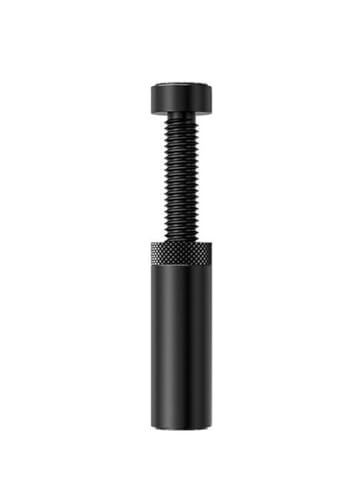
Upright Pillar Supports Explained
The most common design is the upright pillar: a vertical post that stands on the power supply shroud or the floor of the case, with an adjustable arm or a sliding, padded rest that rises to meet the underside of the card. Pillars are popular because they fit the widest range of cases and cards, need no permanent modification, and can be removed in seconds when you swap hardware. Their weakness is the surface they stand on. A pillar needs a flat, solid place to stand, and in cases with a perforated shroud, a fan mounted below the card, or a very short gap between card and shroud, finding that footing can be awkward. Pillars also become part of the view through a glass side panel, so their finish and proportions matter more than their simple job suggests. For most single-card builds in a conventional tower, though, this is the default answer.