Disclosure: As an Amazon Associate, ilcastellomenu.com earns from qualifying purchases. Links on this page are affiliate links; they cost you nothing extra. Prices and availability change often, so check the current Amazon listing before you buy.
Key Takeaways
These thermal pad reviews exist because choosing a pad looks simple until you are standing over an opened graphics card with five thicknesses to replace and a shelf of near-identical packets in front of you. The short version: buy from a reputable range, match the original thickness exactly, favour the brand that actually stocks every thickness your job needs, and treat headline performance figures as marketing weather rather than climate. The differences that matter in real cards are consistency, handling and longevity, and they are the differences this roundup is organised around.
The verdict across the ranges reviewed here is reassuringly undramatic. The premium tier from the established cooling brands is consistently good, the mid tier contains the cleverest solution to odd thicknesses, and the entry tier is fine for small jobs and practice. What separates a successful repad from a disappointing one is almost never the packet you chose; it is whether you measured the originals, kept the work clean, and gave each zone of the card the thickness it was designed around. Choose any of the serious ranges below with that discipline and the result will be a cooler, steadier card.
- Best overall pattern: one premium range covering every thickness on your card, bought once, with a spare sheet of the memory thickness.
- Best for odd jobs: a stackable mid-tier pad that builds in-between thicknesses layer by layer.
- Best for learning: entry-tier sheets for practice cuts and low-heat electronics before you open anything valuable.
- Universal warning: wrong thickness is worse than old pads, in both directions, on every brand in this roundup.
In this guide
What Thermal Pads Do and Why Reviews Differ
Every set of thermal pad reviews you read will rank the same packets differently, and understanding why teaches you more than any ranking. A pad’s job is to fill the gap between a hot component and its heatsink with a soft, conductive material, replacing insulating air with a continuous thermal path. How well it does that job in your hardware depends on contact quality, compression, component height variation and clamping pressure, none of which a reviewer can reproduce exactly on different hardware. A pad that wins on one card by a whisker can trail on another with a flatter cold plate, which is why experienced repadders talk about ranges and handling far more than about single-degree victories.
The components under pads are the supporting cast of a graphics card: the memory chips that surround the core, and the voltage regulators that feed everything power. They matter enormously. Memory that runs too hot throttles or errors under sustained load, and regulators that cook in silence shorten the life of the whole card. Neither has the glamour of the core, and neither gets the paste, the marketing or the attention. Pads are their only thermal path, and when factory pads dry out over years of heat cycles, that path narrows until a repad becomes the highest-value maintenance a card can receive. The single-product deep dive sits in our thermal pad review.
Reviews also differ because pads age. A pad is a silicone carrier loaded with conductive filler, and the carrier slowly dries, hardens and can weep a clear oily residue as the material separates with age. A review of a fresh pad tells you about day one; what you are buying is day one thousand. Established ranges have a track record across those years, which is a genuine, if unglamorous, reason they dominate recommendation lists. Newer bargain ranges may test identically when fresh and still be the worse purchase if their material hardens sooner. Longevity is the specification no packet prints, and the one this roundup weighs heavily.
Finally, reviews differ because thickness is destiny. Cards use several thicknesses at once, and a range that omits the one your backplate needs forces compromises. Our approach in these thermal pad reviews is therefore practical: for each range, what thicknesses and formats it offers, how it handles under scissors and tweezers, where it suits best, and where it should be avoided. If you are mid-decision, the framework companion is how to choose a thermal pad.
How We Judge a Thermal Pad
Four criteria drive every assessment below. First, range: the span of thicknesses and sheet sizes, because a repad is a shopping list, not a single item. Second, handling: how the material cuts, peels, stretches and survives repositioning, because a pad you cannot place neatly cannot perform as specified. Third, conformity: how willingly the material settles onto components of slightly uneven height, which is the entire mechanical point of a pad. Fourth, honesty and consistency: whether sheet after sheet matches its stated thickness and whether the maker’s claims stay within the bounds of what the test conditions can support.
Two things are deliberately not criteria. Headline conductivity numbers are not compared across brands, because makers measure them under different pressures, thicknesses and methods, and treating those figures as a league table misleads more than it informs. Price ladders are not criteria either; tiers are stated in words, because the right question is whether a range’s consistency justifies its tier for your job, not the figure on a listing that will have changed by the time you read this. What remains after those exclusions is what actually decides outcomes on real cards: fit, contact and time.
Thermal Pad Reviews: The Ranges in Detail
Thermalright Odyssey — The Default Recommendation
If a repad guide names one range, it is usually this one, and the Odyssey earns the position through completeness. The thickness span is wide and finely stepped, the sheets are sized for full cards rather than token repairs, and the material has a firmness that makes it the easiest premium pad to learn on: it cuts cleanly, holds its shape on tweezers, and tolerates being lifted and reseated during a careful dry fit. On the card it behaves exactly as a premium pad should, with consistent compression across a memory field and no surprises at the screw-down stage.
The criticisms are real but minor. The premium tier pricing position means a full multi-thickness shopping list costs noticeably more than the entry alternatives, and the firmness that aids handling makes it less forgiving than a soft pad when a component field is genuinely uneven. For a backplate that must swallow varied heights, a softer companion sheet is the better tool. Best for: the main event, a full graphics card repad done once and done properly. Not suited for: squeezing maximum conformity out of a very uneven backplate. Tier: premium.
Gelid Solutions GP-Extreme — The Conformist
The GP-Extreme is the soft heart of this roundup. It yields under fingertip pressure, settles over memory chips of slightly varying height without argument, and is the range experienced repadders reach for when a cold plate is not perfectly flat or a backplate must do real thermal work. In zones where conformity is the whole game, it is arguably the strongest material here, and its reputation among small-form-factor builders, whose cards and boards are rarely flat, reflects that.
Softness bills you in handling. The material stretches if pulled, tears if rushed, and rewards a technique of cutting generously, lifting with tweezers from beneath, and lowering pieces into place rather than sliding them. A first-timer who treats it like the firmer ranges will waste material and quietly thin the pieces they stretch. None of this is a defect; it is the price of the property you bought it for. Best for: uneven fields, backplates, and builders with a patient hand. Not suited for: rushed work or a first-ever repad without practice offcuts first. Tier: mid to premium.
Arctic TP-3 — The Problem Solver
The TP-3 answers the question every repadder eventually asks: what do you do when the original pad is a thickness nobody sells? Arctic’s answer is a soft pad designed to be stacked, layer on layer, until the built-up height matches the gap, with the layers bonding into a single working pad. It sounds like a workaround and behaves like a feature, turning an impossible shopping problem into a ten-minute bench task. The material is soft and conforming in the Gelid direction, with the same handling courtesies required.
Purists will note, correctly, that a single sheet of exactly the right thickness is the cleaner engineering answer, and where that sheet exists it should be used. The TP-3’s case is for everywhere it does not exist, which in the long tail of card models and revisions is a great deal of the real world. Arctic’s accessible tier positioning makes it doubly attractive as the spare stock in a workbench drawer. Best for: in-between thicknesses, mixed shopping lists, and pragmatic repairs. Not suited for: builders who want one exact sheet per zone on a mainstream card, where the premium ranges serve better. Tier: accessible.
Thermal Grizzly Minus Pad 8 — The Enthusiast Standard
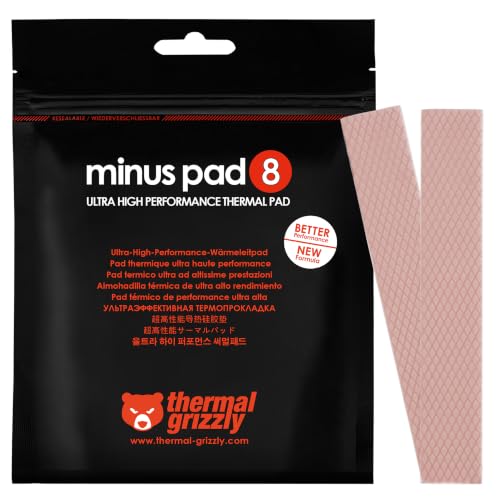
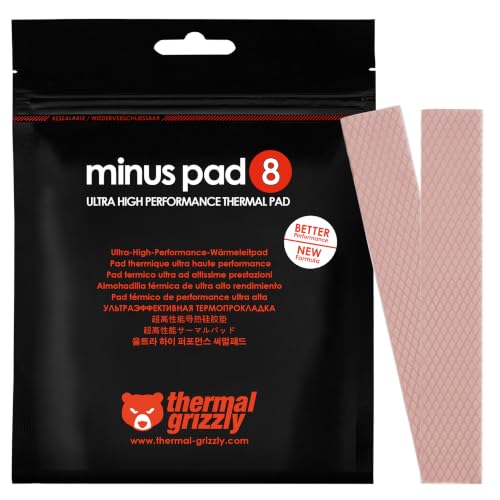
Thermal Grizzly’s Minus Pad 8 has been the enthusiast default long enough to be a known quantity in every sense: firm, clean-cutting, consistently made, and specified by a company whose entire reputation rests on thermal materials. It handles like the Odyssey, performs like a premium pad should, and the honest summary is that the two ranges are peers, with the choice between them usually settled by which one lists your card’s exact thicknesses in stock on the day you order.
The premium tier positioning is the only real objection, and it is an objection about value rather than quality: on an elderly card of modest worth, the mid tier may be the proportionate spend, while on a flagship you intend to keep for years, the premium is easily defended. Best for: enthusiasts standardising on one trusted ecosystem across paste and pads. Not suited for: strict budgets on low-value hardware. Tier: premium. The category framework behind these verdicts is laid out in our thermal pad buying guide.
OwlTree — The Practice and Spares Sheet
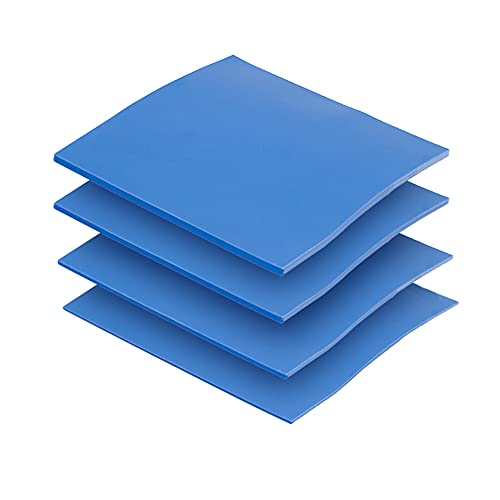
Every roundup needs its honest workhorse, and OwlTree is this one: generous sheets at the entry tier, material that is perfectly serviceable for the long list of low-heat jobs around a PC and a home lab, and a price position that makes it the correct answer for learning. Cut your first ever pieces from an OwlTree sheet, ruin two, and you have bought experience cheaply. Routers, single-board computers, drive enclosures and chipset duties are all well within its ability.
What it is not is the pad for the memory field of a flagship graphics card, where consistency and longevity at high heat are the entire purchase. Thickness tolerance and long-term behaviour at sustained temperature are where entry sheets earn their tier, and pretending otherwise would do the range a disservice. Best for: practice, spares, small electronics and low-heat duties. Not suited for: flagship card memory and regulators. Tier: entry.
Performance in Real Use, Across the Ranges
On Graphics Cards
Fitted at the correct thickness, every serious range in this roundup restores a card’s memory and regulator cooling to its designed behaviour, and the differences between them in that state are small compared with the difference between any of them and a dried-out factory pad. Where the ranges separate is at the edges: uneven fields reward the soft pads, exact-fit mainstream cards reward the firm premium sheets, and odd thicknesses reward the stackable. The practical advice follows directly: diagnose your card’s needs first, then let the diagnosis pick the range, rather than buying a brand and hoping the card agrees.
On Laptops, Consoles and Compact Builds
Thinner duties amplify handling differences. Soft pads shine where a shared heat plate must settle over many small components, while firm pads shine where a precise, thin gap leaves no room for squash. Consoles add one more consideration: they are opened rarely and serviced reluctantly, so longevity argues for the established ranges even at small sizes. The storage side of compact builds is covered in the best internal SSDs for PS5 and our guide to installing an NVMe SSD heatsink.
On Storage and Networking Gear
Drive enclosures, routers and hobby boards are the forgiving end of the category, and the place where entry and mid tiers are entirely sufficient. The jobs are small, the heat is modest, and the main risk is not performance but tidiness: pads cut oversize can foul screw posts and case seams. These jobs are also the ideal rehearsal for a graphics card, teaching cutting, placement and the feel of correct compression at a scale where a mistake costs a small square of sheet rather than a stressful afternoon.
Strengths and Trade-Offs of the Category
- Strength — the fix is the component itself: no fans, firmware or software; a fitted pad restores a designed thermal path directly.
- Strength — the market is mature: several reputable ranges cover every realistic thickness, so no job needs an exotic source.
- Strength — skills transfer: the same craft services cards, laptops, consoles, drives and boards, so learning it once pays repeatedly.
- Trade-off — reviews cannot fully predict your card: contact variables dominate, so rankings are guidance, not guarantees.
- Trade-off — consumable economics: pads age out over years, and a multi-thickness repad is a recurring, if infrequent, cost.
- Trade-off — the buyer’s burden of measurement: no range can save a job built on a guessed thickness.
Who Each Range Suits
Match the range to the job, not to a ranking. A mainstream graphics card with documented thicknesses: Odyssey or Minus Pad 8, whichever stocks your list. An uneven field, a working backplate, or a small-form-factor build: GP-Extreme, with patience. An in-between thickness or a mixed list with one odd zone: TP-3 as the problem solver, alone or alongside a premium main sheet. Learning, spares and low-heat electronics: OwlTree, without apology. A card still under a warranty you value: none of them, until you have checked the maker’s terms, because opening some cards voids coverage and no pad is worth a flagship’s warranty. That caution, and the others around static care and power isolation, are detailed in thermal pad pros and cons.
Setup, Care and Maintenance Essentials
Reviews end at purchase; ownership continues on the workbench. Store sheets sealed, flat and cool, labelled by thickness the moment they arrive, because an unlabelled pad is a future measurement error. Keep offcuts; a labelled envelope of spares has saved many jobs. During fitting, work with the machine fully powered off and unplugged, observe basic static care, and keep films on the pads until placement. Afterwards, record your temperatures under a familiar load and keep the note with the card’s paperwork; that baseline is how you will recognise, years from now, that the pads have aged and the job is due again. The full procedure is in how to install a thermal pad.
Final Verdict
These thermal pad reviews conclude with the least dramatic verdict in PC hardware: the serious ranges are all good, the differences are about fit and handling rather than magic, and the outcome of your repad will be decided by your measurements far more than by your shopping. Buy a reputable range in exactly the thicknesses your hardware needs, handle it like the precision material it is, and an ageing card gets its designed cooling back. That is the whole secret, and it is enough.
Head-to-Head: Where the Ranges Actually Separate
Stack the five ranges in this roundup against real jobs and a pattern emerges that no single ranking captures. On a mainstream card with documented thicknesses and flat plates, the two firm premium ranges are effectively interchangeable, and the choice collapses to stock and habit. Introduce an uneven backplate and the soft Gelid pulls ahead of both, not by degrees on a chart but by contact where the firm sheets bridge and miss. Introduce an in-between thickness and the stackable Arctic stops being the budget option and becomes the only option, which is a category of victory rankings never show. Introduce a nervous first-timer and the winner is whichever sheet they practised on, because confidence is a thermal property too. Reviews that crown one pad for all seasons are reviewing a simpler world than the one your card lives in.
Longevity is the second separator, and the hardest to review honestly because it can only be assessed across years. The established ranges have that history behind them: their materials are known quantities in cards that were repadded long ago and are still behaving. Newer and cheaper sheets may match them when fresh; the reviewer’s honest position is that nobody yet knows, and the price difference is partly a payment for that knowledge. On hardware you intend to keep, known ageing is a feature. On hardware passing through your hands, it matters less, and the mid and entry tiers come into their own.
The Thickness Test Every Review Should Run
If this roundup could impose one test on the whole genre, it would be a thickness audit: buy the same range twice, months apart, and measure both. Consistency across batches is what a repadder actually depends on, because the card was designed around a dimension, not around a brand’s intentions. The premium ranges pass this audit as a matter of reputation; it is the quiet reason professionals standardise on them. Shoppers can run a home version with a caliper on arrival: a sheet that measures true to its stated size, evenly across its area, has told you something real about its maker before it ever touches a chip.
The audit matters because thickness error compounds. A memory field sits under one plate with the core, so a pad error in the memory zone is simultaneously an error in the core’s contact, which is why a single wrong sheet can make a whole card worse in two directions at once. Reviews that treat thickness as a shopping detail rather than the central specification are burying the lede, and readers should weight their trust accordingly.
What Owners Report After Switching Ranges
Patterns in owner experience are consistent enough to be useful. Owners who move from entry sheets to a premium range on a valuable card report the difference less in peak temperatures than in behaviour: steadier memory temperatures across long sessions, and a card that feels finished rather than patched. Owners who add a soft sheet for the backplate after a firm-only first attempt report the classic second-teardown improvement, and usually a resolution to have measured the backplate’s needs the first time. Owners who discover the stackable option report the purest satisfaction in the category, because their problem had no other solution at any price.
The negative reports are equally patterned, and almost none of them indict a brand. They indict a guessed thickness, a stretched soft pad, a forgotten protective film, a reused compressed pad, a fan cable left off. Read across enough repad stories and the moral assembles itself: the material is rarely the variable that failed. That is why these thermal pad reviews spend their words on ranges, handling and fit rather than on crowning a champion, and why your reading should end not with a brand chosen but with a list measured.
Pads for Special Duties
Chipsets, Drives and the Small Jobs
Below the graphics card tier sits a population of small, honourable jobs: chipset heatsinks on motherboards, controllers in drive enclosures, power stages on single-board computers, the warm corners of routers that run for years without a reboot. These duties ask little of a pad beyond honest thickness and clean fitting, and they are where entry and mid-tier sheets fully justify themselves. They are also, not coincidentally, where a beginner should serve an apprenticeship, because the cutting, placing and compressing are identical in miniature and the cost of a clumsy first attempt is a small square of sheet rather than a stressful evening.
Consoles and Handhelds
Consoles concentrate every pad virtue and vice: they run for years, they are opened reluctantly, their pads are thin and numerous, and their fans make degraded cooling audible across a room. Owners who repad a console should weight longevity above all, choose established ranges, and document fanatically, because the machine may not be opened again for half a decade. The reward is a console that sounds like it did when new, which in a living room is not a small thing.
Workstations and Always-On Machines
Machines that compute around the clock age pads by hours rather than by sessions, and their owners should read pad life accordingly. The choosing implication is to fit the best-ageing material the first time and to keep temperature logs, because an always-on machine announces pad decline in its data long before it announces it in behaviour. For these owners the premium tier is not enthusiasm; it is scheduling.
How to Read Any Pad Review, Including This One
Finish with the reader’s toolkit. Trust reviews that name the hardware, state the thicknesses fitted, and report before-and-after temperatures under a named load. Discount reviews that rank by packet figures, promise dramatic drops as a property of a brand, or never mention measurement, warranty or the consumable nature of the material. Notice whether the reviewer distinguishes zones, because a card is several thermal jobs wearing one cooler. And hold every review, this one included, to the standard your own bench will apply: your measurements, your card, your temperatures afterwards are the only verdict that will ever actually govern your hardware.
Durability, Revisited: What Two Services Teach
The most instructive repad is the second one, performed on a card you serviced yourself years earlier, because it grades your first choices with complete honesty. The pads come off and testify: the premium sheet is firmer than it was but still coherent, the soft backplate material has taken the shape of its duties and kept them, the one experimental corner, where a bargain sheet went in because the good material ran short, has hardened into something closer to a coaster than a pad. Owners who have done a second service almost never economise on the main field again, and almost never apologise for the entry sheet on the router. Experience stratifies the tiers exactly the way this roundup does, which is some reassurance that the stratification is real.
The second service also teaches the value of the record. The owner who labelled offcuts and filed thicknesses opens the card already knowing the shopping list, the layout and the traps. The owner who did not spends the first hour doing archaeology on their own past work. Reviews cannot fit a product with that property, but it belongs in any honest account of ownership cost, because the difference between the two afternoons dwarfs the difference between any two ranges in this roundup.
A Word on Fitment Databases and Community Knowledge
Popular cards accumulate community knowledge: documented teardowns, measured pad maps, and hard-won notes about which revision changed what. This knowledge is a genuine asset to the category and a hidden variable in reviews, because a range can look brilliant on a card whose map is known to the millimetre and ordinary on an obscure model where every thickness is a research project. When a review names its hardware and its sources, it lets you discount accordingly; when it does not, assume the easy case. For your own card, the community map is a starting hypothesis and your removed originals are the experiment that confirms it, and the order of those two things should never be reversed.
The Ranges, Scored by Job Rather Than by Crown
Reduce this roundup to a pocket card and it reads as casting. Main field of a valuable card: Odyssey or Minus Pad 8, decided by stock. Uneven field or working backplate: GP-Extreme, handled like the soft material it is. Odd thickness, mixed list, or the spare that rescues other jobs: TP-3. Learning, spares and the long tail of small warm electronics: OwlTree. Nothing on that card is a ranking, and everything on it will still be true when next season’s packets arrive with larger figures printed on them, because it is organised by the properties that decide outcomes: dimension, conformity, consistency and time.
That is also the standard to hold the next roundup to, whoever writes it. The category does not need another champion; it needs accurate casting, honest ageing notes, and reviewers who measure the sheets they praise. Until then, the five ranges here cover the realistic jobs between them, and the choice among them is, in the best sense, a pleasant one: several right answers, differentiated by fit rather than by quality of character.
Ownership Costs Nobody Prints
Close the roundup with the ledger nobody publishes. A pad range costs its purchase price, plus the spare sheet wisdom insists on, plus the service consumables that accompany it through life, plus the afternoon of its fitting, minus the years of designed temperatures it returns. Against that ledger, the differences between the serious ranges are small and the difference between a measured job and a guessed one is enormous. Reviews exist to optimise the small term; this one has tried, throughout, to keep the large term in view, because that is where your card’s next five years are actually decided.
Testing Notes: How These Reviews Weigh Evidence
A note on method, because roundup readers deserve to know how the judgements were weighted. Handling assessments come first in these thermal pad reviews, because they are the property a reviewer can assess directly and repeatably: cutting, peeling, stretching, reseating. Range assessments come second, because a maker’s thickness table is a public, checkable fact. Longevity assessments come third and are labelled as what they are, judgements from track record rather than measurements, because no honest reviewer can compress five years of heat cycles into a review cycle. Performance claims come last and are treated with the most suspicion, including our own, because contact variables make them the least portable findings in the genre. A roundup that inverts that order, leading with dramatic temperature claims and burying handling in a footnote, has told you how to read it.
The Mid-Tier Question
Readers often ask why this roundup’s middle is so sparsely populated, with the stackable Arctic holding an unusual amount of ground alone. The honest answer is that the mid tier in this category is where ranges go to be forgettable: adequate material, incomplete thickness tables, no special property to recommend them over either neighbour. The TP-3 escapes that fate by owning a genuine idea, the built-up thickness, which no premium range currently answers. Makers who want the middle of this market should learn from that example: a distinct capability earns a tier, while a smaller figure on the packet merely rents one. Until more arrive, shoppers lose little by treating the category as premium for critical zones, stackable for odd ones, and entry for everything light, with the middle absorbed into those three honest poles.
What Changes Between Card Generations
Pad requirements drift as cards evolve, and a roundup should say how. Memory generations run at different speeds and temperatures, power stages multiply and shrink, and backplates have grown from decoration into designed heatsinks on many current cards, which raises the value of the soft, conforming ranges and of taking the backplate’s pads as seriously as the memory’s. At the same time, published teardowns and community pad maps have become richer with each generation, quietly reducing the measurement burden that dominates older hardware. The ranges in this roundup span that drift comfortably, because their relevant properties, dimension, conformity, consistency, do not date the way performance figures do.
The forward-looking advice follows: buy for the card in front of you, not for the generation in the headlines, and expect the next card’s map to differ from this one’s even under a familiar name. The roundup’s casting approach survives generational change precisely because it was never a league table. When the new packets arrive, ask them the old questions: what thicknesses, how soft, how consistent, how honestly specified. The ranges that answer well will be recognisable, whatever their names turn out to be.
Roundup Method: The Jobs Behind the Judgements
Every range in this roundup was weighed against the same imaginary bench of jobs, and making that bench explicit helps readers re-run the judgements for hardware of their own. Job one is the mainstream gaming card, documented thicknesses, flat plates, out of warranty: the firm premium ranges win it on consistency and handling, and the soft and stackable options are respectable understudies. Job two is the same card with a working backplate and a slightly uneven field: the soft range takes it, because contact across irregular points is the whole assignment. Job three is the odd revision with one in-between thickness: the stackable takes it unopposed. Job four is the household long tail, routers, enclosures, boards and practice: the entry sheet takes it on value and adequacy. Four jobs, four different winners, and not one of them decided by a packet figure: that is the roundup’s method in miniature, and it is why the verdicts are stated as casting rather than as a crown.
Notice, too, what the bench excludes. No job on it rewards the absolute highest claimed conductivity, because no job on it is lost for want of a better figure once contact and thickness are right. No job rewards the cheapest sheet on a valuable card, because the saving is small against the hardware and the years at stake. And no job rewards loyalty, because the ranges are tools and tools are chosen per task. A reader who internalises that bench can review next year’s ranges unaided, which is a better outcome for a roundup to produce than any list of winners, since winners expire and methods do not.
If You Only Remember Three Sentences
First: thickness is the specification, and everything else is commentary, so measure the originals or do not start. Second: softness follows surfaces, so let the hardware’s geometry, not a ranking, choose between firm and soft. Third: pads are consumables with a long, honourable service life, so fit good material, keep the record, and let the temperature baseline tell you when the years have done their work. Those three sentences contain this entire roundup in embryo, and a repadder who holds them will choose well among the ranges reviewed here, and among ranges not yet sold, on cards not yet designed, which is as much as any review can honestly promise.
Why This Roundup Has No Scores
Deliberately, no range in these thermal pad reviews carries a numerical score, and the omission is a position rather than an oversight. A score implies that the distance between products is known and comparable, and in this category the honest distances are categorical, not numerical: fits or does not fit, conforms or does not conform, ages known or ages unknown. Numbers would lend those categories a precision they have not earned and would invite exactly the packet-figure thinking this roundup exists to correct. Readers who need a bottom line have one, stated as casting by job throughout, and it will still be usable when every score published this season has been revised, retracted or quietly forgotten. Methods outlive marks, in reviewing as in repadding, and this roundup has invested in the method.
One more pattern from the field deserves recording before the roundup closes. Owners consistently underestimate how much of a repad’s success is decided before the packet is opened, in the measuring and the listing, and overestimate how much is decided by the packet itself. The ranges reviewed here are good enough, all of them, that a careful owner can succeed with any and a careless one can fail with each. That is not a shrug; it is the most actionable finding a roundup can publish, because it redirects effort from the shop page, where it buys little, to the bench, where it buys everything. Read the casting, pick the range your job calls for, and then spend the attention you saved on the measurements. The temperatures will file the real review.
And when they do, consider filing it where others can find it, with the card model, the thicknesses and the before-and-after figures stated plainly. The commons of pad knowledge that this roundup drew on exists because owners published exactly that, and every careful account added to it makes the next stranger’s repad a little less of a gamble. Reviews, in the end, are a relay: the measured pass the baton to the measuring.
Finally, a note for readers comparing this roundup with the single-product deep dive elsewhere in the cluster: the two are designed to disagree in emphasis, and the disagreement is instructive. The deep dive follows one job closely enough to feel its textures; the roundup stands back far enough to cast five ranges across every job. Use the roundup to choose the material family your hardware calls for, and the deep dive to understand what fitting it well actually involves, and the pair will serve better than either alone. That division of labour, breadth here, depth there, is the honest shape of knowledge in a category where the right answer is always, in part, the shape of the card on your own bench.
Checking a Thermal Pad Listing Against Reality: Variant, Contents and First Use: Comparing the Field
A fair test repeats the same task at least twice, once while you are paying attention and once while you work normally, because concentration can hide clumsy design. Look closely at seams, edges, hinges, threads or contact points when the thermal pad arrives, because build quality is easiest to judge before everyday wear hides the evidence. Make one change at a time during the first days, so that when something improves or gets worse you know which change caused it. Notice how the thermal pad behaves when you are tired or in a hurry, since products that demand perfect technique tend to fail exactly when you have least patience.
As a concrete listing check, take the Thermalright Odyssey Thermal Pad and the Gelid Solutions GP-Extreme Thermal Pad named earlier in this article and confirm, line by line, that each variant offered matches the size, connection and contents described for it here. Plan where the cables or materials connected to this thermal pad will run when the room is tidy, not just while you are testing on an empty surface. Give a new thermal pad a fair trial in the position it was bought for before improvising workarounds, since many early complaints disappear once placement is corrected. Check that nothing you place on, under or beside the thermal pad blocks airflow, movement, visibility or access that the design quietly depends on. Judge the controls by whether you can use them without looking down or stopping your task, because that is how they will be used for most of their life.
Take a quick photo of the working setup before you change anything, so cable routes, positions and settings can be restored exactly if the new arrangement disappoints. When a specification is stated in unfamiliar terms, translate it into your own routine: how long, how often, how far, how loud in practice, before letting it sway you. Separate the features you will use in the first month from the ones that only sound reassuring, and let the first group carry far more weight in the decision. Recheck the return window and the condition requirements before you discard any packaging, especially for a thermal pad whose fit only becomes clear after several real sessions.
Picture the busiest version of your week and ask whether this thermal pad still fits when other people, other tasks and other equipment compete for the same space. Consider who else will use, move or clean around this thermal pad, because a choice that only works for one careful owner often frustrates everyone else in the household or team. The strongest sign in a hands-on check is consistency: the same input should produce the same result on the first attempt and on the twentieth. Write down the oldest and the newest device you expect this thermal pad to work alongside, because compatibility problems usually appear at the edges of a setup rather than in the middle of it. Think about the longest session you realistically run, not the average one, since heat, noise, clutter and small annoyances all grow more noticeable over time.
Ask what you would do on the day this thermal pad stops working as expected, and whether you could swap, reset, clean or return it without dismantling half your setup. Run one deliberately awkward task early on, the kind you usually avoid, and see whether this thermal pad handles your edge cases or only your easiest work. Check the connection points you rely on every day, and note which ones are already occupied, shared or awkward to reach once furniture is back in place.
Check the underside, back or hidden face of the thermal pad as part of your inspection, because labels, vents, switches and fasteners often live where first impressions never look. When you check a single thermal pad closely, work from the outside in: condition and finish first, then controls and connections, then behaviour during a real task from start to finish. Treat any accessory bundled in the box as a starting point, and check whether it suits your setup before assuming the maker has solved that part for you.
Frequently Asked Questions
Which thermal pad is best overall?
For most graphics card repads, a premium range with a wide, finely stepped thickness selection is the safest overall choice, because range and consistency decide more jobs than any single performance figure. In this roundup the Thermalright Odyssey and Thermal Grizzly Minus Pad 8 occupy that ground as peers. The honest qualifier is that best is job-shaped: soft pads win on uneven fields, a stackable pad wins on odd thicknesses, and entry sheets win for practice. Match the range to the card in front of you rather than to a universal crown.
Are expensive thermal pads worth it over cheap sheets?
For the memory and regulators of a valuable graphics card, yes: the premium buys thickness consistency, cleaner handling and materials with a known ageing record, and those are the properties that decide real temperatures years later. For routers, hobby boards, practice and spares, entry sheets are entirely sufficient and the premium buys nothing you will feel. The mistake is at the extremes: mystery material on a flagship card, or flagship material spent where a basic sheet would serve identically. Spend in proportion to the hardware and the heat.
Why do different reviews rank the same pads differently?
Because pad performance is contact performance, and contact depends on the specific card: its component heights, cold plate flatness, clamping pressure and the reviewer’s chosen thicknesses. Change the hardware and the same two pads can swap places by small margins. Makers’ headline figures are also measured under differing test conditions, so they cannot settle rankings either. Treat reviews, including this one, as guidance about range, handling and longevity, and treat your own measurements and post-repad temperatures as the verdict that actually counts.
Can I mix pad brands on one graphics card?
Yes, and it is often sensible: a firm premium sheet on the memory field, a soft pad on an uneven backplate, a stackable section where the thickness is odd. Each zone of a card is its own thermal job, and nothing requires the zones to share a brand. What mixing does demand is bookkeeping: record which material and thickness went where, keep the offcuts labelled, and the next service, years later, will start from knowledge instead of archaeology. Consistency of thickness within a zone matters; consistency of branding across zones does not.
How do I know a pad review is trustworthy?
Look for reviews that talk about thickness range, handling and fit on named hardware, and be wary of any that rank pads purely by headline conductivity figures or promise dramatic temperature drops as a property of the packet. A pad restores a designed thermal path; it does not redesign it. Trustworthy coverage also mentions the unglamorous truths: pads are consumables that dry out over years, wrong thickness is worse than old pads, and opening a card can affect warranty. Reviews that skip the cautions are selling; reviews that include them are informing.
Should I replace pads or just add more cooling instead?
They solve different problems. Case airflow, clean fins and working fans lower the temperature of the air and metal the pads deliver heat into, and they should be right first. But no amount of airflow repairs a broken thermal path between a memory chip and its cold plate; if memory temperatures are adrift while the core is cool and the case is clean, the pads are the fault line and replacing them is the direct fix. Diagnose first: pads for a contact problem, airflow for an environment problem, and both when an old card in a dusty case needs a full service.
Related Guides
Keep reading with the best NVMe SSDs for gaming, the best external SSDs for 4K video editing, and the companion deep dive, our thermal pad review.