Disclosure: As an Amazon Associate, ilcastellomenu.com earns from qualifying purchases. Links on this page are affiliate links; they cost you nothing extra. Prices and availability change often, so check the current Amazon listing before you buy.
This mini wireless keyboard review starts from an uncomfortable truth about the category: the phrase mini wireless keyboard describes two different tools that happen to share a shelf. One is a couch remote with keys, built around a touchpad for driving a screen across the room. The other is a genuine typing instrument that has shed its number pad and spare width. This review judges the category on both branches, names the models that define each one, and tells you plainly who should buy into either family and who should walk past both. If you only remember one sentence, make it this one: choose the branch first, and every later decision becomes easy.
Key Takeaways
- Mini wireless keyboards split into touchpad couch boards for home theater and compact typing boards for desks, and the branches barely overlap.
- Pointing quality decides couch boards; key feel and layout decide typing boards.
- Bluetooth suits tablets and modern TVs; a USB receiver suits media PCs and stubborn hosts.
- Backlighting is a working feature in dark living rooms, not decoration.
- Every pick in this review is prose-only: judge models by branch, feel and connection, then check the current listing.
Verdict in brief: worth it for media-centre households and small-desk typists who choose their branch honestly; not worth it for anyone expecting one small board to be both a remote and a full desk keyboard at once.
In this guide
Mini Wireless Keyboard Review: What This Category Is and Where It Fits
Every mini wireless keyboard belongs to one of two families, and confusing them is the single most common buying mistake in this category. The first family is the home-theater remote style: a small board, often with an integrated touchpad, designed to be held in two hands or rested on a lap while you drive a media PC, a smart TV box or a streaming stick from the couch. Typing on it means short bursts: a search term, a password, a URL, a message in a chat overlay. The second family is the typing-first mini: a compact desk keyboard, roughly sixty to seventy-five percent of a full-size layout, built for real sentences at a real desk. It may be a low-profile mechanical board or a slim scissor-switch board, and it exists to free desk space without giving up a genuine typing feel. The two families overlap in size and wireless technology and differ in almost everything else: key size, key travel, pointing method and the posture you use them in. Decide which family you are shopping for before you compare a single model, because a superb couch board makes a miserable desk keyboard, and an excellent desk mini is an awkward remote. Everything else in this guide hangs off that one decision.
Within the couch branch, size runs from palm-sized handhelds to lap-sized boards with full-ish letter keys, and the difference is really about who types and how much. Within the typing branch, the split is between slim scissor-switch boards that feel like good laptop keyboards and low-profile mechanical boards that feel like a hobby. Prices of attention differ too: couch boards ask almost nothing of you beyond charging and pairing, while typing minis ask for a fortnight of layout relearning in exchange for years of desk space. A fair review has to score each branch against its own job, because marking a handheld remote down for poor essay typing is as silly as marking a desk mini down for lacking a touchpad.
Design, Build and Setup
Build quality on a mini keyboard announces itself in the first minute of handling. Pick the board up the way you actually will, one-handed from a sofa arm or out of a bag, and notice whether the chassis flexes, creaks or feels hollow. Press a corner key and watch whether the whole unit rocks or stays planted; a board that sits steady invites confidence, while a wobbling one taxes every press with a tiny negotiation. On handheld models, check that the battery door, if there is one, closes with conviction, and that the touchpad surface feels smooth rather than gritty under a thumb. Key legends deserve a glance too: legends formed into the keycap age far more gracefully than printed ones, which matters on the handful of keys a couch board uses hundreds of times. None of this requires laboratory testing. It requires handling with intent during the return window, while changing your mind is still cheap. A mini keyboard is a tool your hands will meet daily, often in the dark, often one-handed, often in a hurry. Small physical honesty, compounded over that many meetings, is the difference between a device that disappears into the evening and one that keeps reminding you it is there.
A wireless USB receiver creates a different kind of link from Bluetooth, and home-theater veterans often prefer it. The receiver gives the host a dedicated connection that wakes instantly, works before the operating system loads, and sidesteps the pairing quirks of smart TVs whose Bluetooth support can be half-hearted. If you run a home-theater PC, a receiver also means the keyboard works in setup screens and boot menus where Bluetooth is silent. The costs are practical: the receiver occupies a USB port, it is small enough to lose in a sofa or a laptop bag, and a receiver-only board cannot talk to a tablet or phone without adapters. Many minis hedge the bet by offering both, receiver for the TV box and Bluetooth for everything else, which is the most flexible arrangement in the category. If you buy a receiver model, check whether the chassis has a storage slot for the receiver and use it every single time; the lost-receiver problem ends more mini keyboards’ careers than any electronic failure. Also note where the receiver will sit: plugged into the back of a TV box inside a wooden cabinet, its signal has furniture to cross, and a short USB extension lead that brings it into the open can transform a flaky connection into a solid one.
Setup across the category follows the same honest pattern: charge or fit batteries, pair or plug in the receiver, test in a plain search box, then test in the real apps. The boards that earn their keep make this a ten-minute, once-only ritual. Pay attention during setup to the details you will live with: where the power switch sits, whether the receiver stores inside the chassis, how the board announces a low battery, and whether the pairing process is documented in plain language. Small boards live hard lives in bags and sofa cushions, so a power switch that prevents pocket-presses and a case that does not creak are working features, not luxuries. Judge the unboxing less than the first week: a board that still feels solid and obvious after seven days of real handling has passed the only build test that matters.
Performance in Real Use
Driving a Home Theater from the Couch
The classic home for a mini wireless keyboard is the home-theater setup: a PC, media box or console under the TV, controlled from the couch. In that room the keyboard’s job description is specific. It must wake the moment a search box appears, type a title accurately enough that autocomplete can help, move a cursor or focus highlight without drama, adjust volume, pause, and then disappear onto the arm of the sofa or the coffee table without dominating it. It lives among remotes, drinks and blankets, gets used in the dark, gets sat on occasionally, and is handled by guests who have never seen it before. That last point matters more than enthusiasts admit: a couch keyboard that a visitor can pick up and use without instruction is a better household tool than a cleverer one that needs explaining. Storage is part of the design brief too. A board that lives in a drawer across the room will not be fetched for a thirty-second search; a board that lives within arm’s reach will be used daily. When you evaluate a couch mini, evaluate the whole loop: where it sleeps, how fast it wakes, how it feels in the dark, and how it behaves in a guest’s hands. The best home-theater keyboard is the one the whole household actually reaches for.
The touchpad is what turns a mini keyboard into a remote control, and its quality decides whether a home-theater board feels clever or frustrating. A good pad tracks smoothly at couch distance, supports simple gestures such as two-finger scrolling, and places its click buttons where your thumbs naturally land. A poor pad feels jumpy, registers palm touches while you type, or forces you to aim like you are threading a needle across the room. Size matters here in a way it does not on a laptop: the pad shares a small chassis with the keys, so it will always be modest, and your expectations should be modest with it. It is a pointing device for menus, timelines and play buttons, not for photo editing or spreadsheet surgery. Some handheld minis replace the pad with an air-mouse style pointer or a small trackball, which some people love for couch use because the cursor moves with a thumb roll rather than a slide. Try to judge the pointing method by the job: navigating a streaming interface is forgiving, while hitting small targets in a desktop operating system from three metres away is not. If your media setup runs a proper desktop interface rather than a ten-foot TV interface, pointing quality moves from a footnote to a headline feature.
Typing at a Small Desk
The typing-first branch of the mini category exists because full-size keyboards carry a lot of desk furniture that many people never use. Drop the number pad, compress the function row and navigation cluster into a layer, and a keyboard shrinks to the width of the letter keys alone. Your mouse hand gains a shorter journey, your shoulders sit squarer, and a laptop-style minimal desk becomes possible without surrendering to a laptop keyboard. What you give up is dedicated keys. Arrows may live on a layer, the function row may need a modifier, and delete or home keys can move to unfamiliar places. Typists adapt to layers at very different speeds, which is why honest reviews of compact boards talk about the first fortnight as much as the first hour. Low-profile mechanical switches suit this branch well because they keep a distinct, learnable actuation in a thin chassis, while quality scissor switches suit people who want the board to feel like a good laptop keyboard, only better placed. Neither feel is objectively superior. The right question is which one your fingers already trust, because a mini keyboard asks your hands to relearn geography, and familiar key feel is the one comfort you can keep while everything else moves.
Key feel divides the mini category into three camps, and none of them is wrong. Handheld couch boards use small membrane or scissor keys with short travel; they are quiet, light and entirely adequate for typing a film title, and nobody should ask more of them. Slim desk minis use refined scissor switches that feel like a good laptop keyboard: low, quick and even, with a soft landing that suits long quiet sessions in shared spaces. Low-profile mechanical minis use individual switches with a distinct actuation point, giving your fingers a clear signal that a press registered, which many touch-typists find keeps their speed and accuracy up while the layout around the letters changes. Sound follows feel. Membrane and scissor boards are the quiet neighbours; mechanical boards range from discreet to cheerful depending on switch choice, and in a living room during a quiet film scene even a discreet board is audible. Judge feel in the room where the keyboard will live, at the hour it will be used. A board that delights you at a bright desk at noon may annoy a sleeping household at midnight, and the reverse is equally true for a soft couch board asked to produce a morning of email.
Tablets, Travel and Second Rooms
Travel and small-space living are the desk mini’s natural territory. A compact wireless board turns a hotel desk, a kitchen table or a narrow student desk into a credible workstation, pairs with a tablet to make a genuine writing machine, and slips into a bag that a full-size keyboard would dominate. It also serves the increasingly common second-desk life: the laptop at home on a stand, the shared family computer, the spare room setup assembled for a project and dismantled after. In all of these the mini’s virtues are the same: it appears when needed, vanishes when not, and asks for no cable management at all. The travel-specific tests are worth doing before a trip that matters. Pair the board with your tablet or laptop at home, not in the departure lounge. Check that your bag’s pocket does not press keys for hours, which can wake the board and drain it; a hard sleeve or a power switch you actually use solves this. And confirm that the layout survives your real work, not a demo: a full email, a document edit, the shortcuts you lean on. A mini that passes an ordinary working week at home will pass on the road; one that merely charms in the shop may not.
The Picks That Define Each Branch
Six models map the category honestly: three couch boards built around touchpads, and three typing boards that trade the pad for key feel. Read your branch’s three closely and skim the others to confirm they are not your tool.

Logitech K400 Plus
Positioning: mainstream home-theater tier, prose-only; described in prose only in this draft, so check the current listing for live details before you buy.
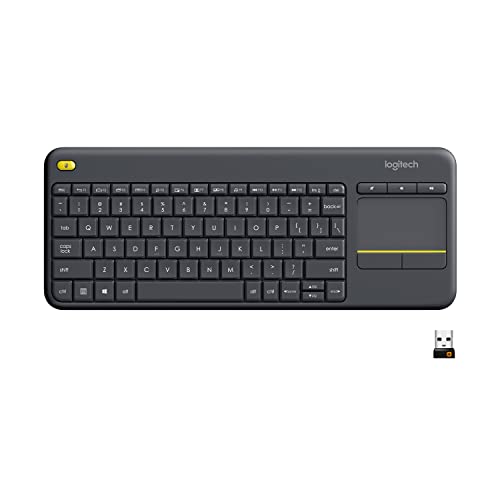
The Logitech K400 Plus is the reference design for the couch branch of this category: a full-width-but-compact board with an integrated touchpad, shaped for two-handed use on a lap and aimed squarely at the media PC or smart TV household. In prose terms its appeal is completeness and familiarity. The keys are large enough for real search terms and passwords, the touchpad removes any need for a separate mouse on the coffee table, and the layout includes the media controls a living room actually uses. Guests understand it on sight, which in a shared living room is a genuine feature. It connects by wireless receiver, which suits TV boxes and home-theater PCs that wake inconsistently over Bluetooth. The honest limitations are those of its branch: the keys are quiet, short-travel units made for bursts rather than paragraphs, the touchpad is modest in size, and nobody should plan to write essays or work a spreadsheet on it from the sofa. Choose it if your mini exists to run a screen across the room and your household values a board everyone can use without instruction. Skip it if your real need is a desk keyboard that happens to be small.
Best for: home-theater PCs, media boxes and family living rooms that want one familiar board with a touchpad. Not suited for: long typing sessions, mechanical-key feel, or compact travel kits.

Rii i8+
Positioning: entry handheld tier, prose-only; described in prose only in this draft, so check the current listing for live details before you buy.
The Rii i8+ represents the true handheld end of the category: a palm-sized board you hold like a game controller, with a small touchpad and a layout designed for thumbs rather than fingers. In prose terms, its job is to be the remote that can type. For entering search terms, passwords and short messages on a TV box or mini PC, it is quick, light and easy to store in the smallest drawer of a TV stand, and its backlit keys suit dark rooms where a full board would be overkill. It is the kind of device that makes a streaming stick feel complete. The limitations are equally clear and should be embraced rather than discovered: the keys are small, punctuation requires patience, and anything longer than a sentence or two becomes a chore. The touchpad serves menus and simple cursor work, not detailed pointing. Choose it if your typing is measured in search terms per evening and space is at a genuine premium. Skip it if several people will type longer messages, if you want a board that also serves a desk, or if small keys frustrate you on a phone, because the experience is closer to a phone keyboard than to a desk one.
Best for: streaming boxes, mini PCs and single-viewer setups where typing means searches and passwords. Not suited for: shared family typing, longer messages, or anyone who dislikes thumb-typing.

Fosmon Mini Bluetooth Keyboard
Positioning: entry-to-mid handheld tier, prose-only; described in prose only in this draft, so check the current listing for live details before you buy.
The Fosmon Mini Bluetooth Keyboard sits in the same handheld family as other palm-sized remotes but leans on Bluetooth rather than a receiver, which changes the households it suits. In prose terms, it is a board for ecosystems: tablets, phones, smart TVs and boxes that pair over Bluetooth and have no spare USB port to offer, or no accessible one. The integrated touchpad keeps the remote-style experience complete, and the compact shape stores anywhere a remote stores. For a bedroom TV, a tablet-based media setup or a presentation clicker that can also type, that port-free pairing is the whole argument, and it is a good one. The trade-offs mirror its family: small keys for short bursts only, a modest touchpad, and the usual Bluetooth manners, including a moment’s wake-up and the occasional need to re-pair after a host updates itself. It also asks you to keep it charged, since a handheld that lives in a drawer is exactly the device people forget to feed. Choose it if your hosts are Bluetooth-first and port-poor. Skip it if your main host is a home-theater PC that behaves better with a receiver, or if your typing regularly exceeds a search box.
Best for: Bluetooth-first TVs, tablets and bedroom setups with no free ports. Not suited for: receiver-preferring media PCs or longer typing tasks.
Arteck HB030B
Positioning: entry-to-mid slim typing tier, prose-only; described in prose only in this draft, so check the current listing for live details before you buy.
The Arteck HB030B represents the slim typing branch at an accessible tier: a flat, light, backlit board in the laptop-key tradition, made to pair with tablets and laptops and to vanish into a bag. In prose terms its story is portability with manners. The backlight makes it usable in dim rooms and evening spaces, the scissor-style keys feel familiar to anyone coming from a laptop, and the whole board is thin enough to share a sleeve with the tablet it serves. For students, travellers and kitchen-table workers it turns a tablet into a plausible writing machine without turning a bag into luggage. The honest limitations are those of slim boards generally: short key travel gives your fingers less feedback than a mechanical board, the flat profile offers little angle for long sessions unless you add a stand, and the compact layout asks for a short relearning period around the edges. It is a board for sessions measured in pages, not in working days. Choose it if your mini must travel constantly and feel instantly familiar. Skip it if you want mechanical feel, a couch touchpad, or a board built primarily for a fixed desk.
Best for: tablet writers, students and travellers who want a slim, backlit, familiar-feeling board. Not suited for: touchpad couch control or mechanical-key enthusiasts.

Logitech MX Keys Mini
Positioning: premium slim typing tier, prose-only; described in prose only in this draft, so check the current listing for live details before you buy.
The Logitech MX Keys Mini is the premium statement of the slim typing branch: a compact board that keeps the refined, quiet, sculpted key feel of a high-end laptop-style keyboard while cutting away the number pad and excess width. In prose terms it is aimed at desk workers who want their small keyboard to feel like their main keyboard, because it is their main keyboard. The keys are designed for long, accurate sessions, the backlighting behaves intelligently in changing light, and multi-device pairing suits the common modern arrangement of a work laptop, a personal machine and a tablet sharing one desk. It is the mini for people who type for a living and refuse to feel that they compromised. The limitations are about fit rather than quality: there is no touchpad, so couch duty needs a separate pointer; the slim profile will not satisfy anyone who wants mechanical tactility; and its premium tier only makes sense if your hands are on it for hours daily. Choose it if typing quality at a tidy desk is the entire point. Skip it if your mini is mainly a TV remote, or if your budget of attention belongs to the mechanical branch instead.
Best for: writers, professionals and multi-device desks that want premium laptop-style keys in a compact board. Not suited for: couch touchpad use or mechanical-switch seekers.

Keychron K3
Positioning: mid-to-premium low-profile mechanical tier, prose-only; described in prose only in this draft, so check the current listing for live details before you buy.
The Keychron K3 represents the low-profile mechanical branch: a compact board with genuine mechanical switches in a slim chassis, made for typists who want feedback and character without returning to a tall, full-size keyboard. In prose terms its appeal is the combination that used to be impossible: mechanical feel, wireless freedom across more than one host, and a footprint that leaves a desk feeling open. It suits the writer or coder who has gone number-pad-free on purpose, enjoys a distinct actuation under each finger, and moves between a computer and a tablet in the same session. The layout is a compact one, so the usual relearning around layers and edge keys applies, and low-profile mechanical switches feel different from both laptop keys and full-height mechanical switches; most people need a few days before they can say honestly whether the feel is theirs. Sound also needs a thought in shared or evening spaces. Choose it if you want your mini to be a hobbyist-grade typing instrument that travels well. Skip it if you need a touchpad for the couch, prefer the soft landing of scissor keys, or want the absolute quietest board in the house.
Best for: touch-typists, coders and mechanical fans who want a slim, compact main keyboard. Not suited for: couch control, silent shared rooms, or buyers who dislike relearning layouts.
Strengths and Trade-Offs of the Category
Strengths
- Frees the living room and the desk at once: one small board replaces a keyboard-plus-mouse sprawl on the coffee table or a full-size board on a narrow desk.
- Wireless freedom means the board lives where you use it, wakes for a thirty-second search, and stores in a drawer, sleeve or sofa arm.
- Real choice of feel and form, from thumb-typed handhelds to genuine low-profile mechanical typing boards.
Trade-offs
- No mini serves both branches well; a touchpad couch board is a poor essay tool and a typing mini is an awkward remote.
- Compact layouts move or layer keys, so every buyer pays a relearning cost in the first fortnight.
- Wireless manners need managing: batteries fade, Bluetooth sleeps, and receivers get lost.
Who Should Buy a Mini and Who Should Skip It
The people who get the most from a mini wireless keyboard share a pattern rather than a job title. Their typing arrives in two distinct shapes: short control bursts aimed at a screen across the room, or full working sessions in spaces too small, temporary or tidy for a full-size board. Media-centre households, streaming-first families, presenters, students in small rooms, tablet writers, and desk workers who have deliberately gone number-pad-free all recognise one of those shapes. Naming your own pattern honestly is the highest-value step in the whole purchase, because it decides the branch, the connection type, the pointing method and the tier in one stroke. Mixed households should name the dominant pattern and let it win: a board bought mainly for the couch that also handles the odd email is a couch board, and judging it as a desk keyboard will only disappoint. If two patterns are both daily and both serious, the honest answer may be two inexpensive specialists rather than one compromised all-rounder, because the category is affordable enough that specialisation is a realistic strategy. Buy for the pattern you have, not the pattern in the product photographs, and the small keyboard will feel like it was designed for your rooms rather than adapted to them.
Buy with a checklist, not a mood. Confirm your branch, your host’s preferred connection, whether you need a touchpad or true typing feel, how the board will be charged, and where it will live when idle. Then use the return window as a trial: one full film night with the household’s least technical person, or one full morning of real writing, will tell you more than any review, including this one. Skip the category entirely if your desk has room and your work needs a number pad daily, if your living room is happily served by a voice remote alone, or if you know from experience that layered keys irritate you beyond adapting. A mini keyboard is a deliberate trade of keys for freedom; it delights buyers who wanted the freedom and annoys buyers who only wanted a bargain.
Setup, Care and Maintenance Essentials
Mini keyboards collect the evidence of their environments. Couch boards gather crumbs, dust and the occasional splash from coffee-table life; desk minis gather the usual desk grit in a smaller, tighter chassis where debris has nowhere to hide. Care is simple and mostly sufficient. Shake the board gently over a bin, work a soft brush between the keys, and wipe the case with a barely damp cloth. On mechanical minis many keycaps pull off for a deeper clean; work over a tray, photograph the layout first, and let everything dry fully before reassembly. Handheld boards deserve a specific habit: wipe the touchpad with a soft, dry cloth, because a film of living-room life on the pad is the most common cause of the jumpy cursor people blame on wireless interference. Keep drinks on a different surface from the keyboard where you reasonably can, and store a travelling mini in its own sleeve so keys are not held down by bag contents for hours. None of this needs special products or expertise. It needs only the recognition that a small, simple device rewards small, regular attention, and that most mini keyboards retired as faulty were, on inspection, simply dirty, flat or paired to the wrong host.
Battery life shapes daily satisfaction with a mini keyboard more than any headline feature, because a wireless board that is often flat is worse than a wired board that is always ready. Two power systems dominate: built-in rechargeable cells charged over USB, and replaceable batteries you swap when they fade. Rechargeable designs suit people with a tidy charging ritual, perhaps a cable kept at the desk or beside the TV stand, while replaceable cells suit people who want a dead keyboard revived in seconds with spares from a drawer. Either system fails the same way when neglected, usually at the start of a film night or a work session. Build the smallest possible habit: learn what your board’s low-battery warning looks like before you urgently need to recognise it, charge or swap at the warning rather than after it, and keep the cable or spare cells with the keyboard rather than across the house. Practical safety matters too: charge on a clear, hard surface, use an undamaged cable, and retire any device whose battery swells, overheats or behaves strangely instead of coaxing it along. Sensible, ordinary care of this kind turns power from a specification into a non-issue, which is exactly what you want from a device bought to remove friction.
Games deserve an honest paragraph, because mini keyboards brush against gaming from two directions. On the couch, a mini board is an excellent companion to a living-room PC or console for everything around the game: logging in, searching a store, typing chat messages, entering names and codes, and managing a media library between sessions. Inside fast competitive games, a small couch board on a lap is the wrong tool, and no honest review should pretend otherwise; that job belongs to a desk, a full layout and often a mechanical board. Desk minis are a different story: compact mechanical layouts are genuinely popular with players whose games need the letter cluster, movement keys and plenty of mouse room, and who rarely touch a number pad. If your gaming is of that kind, a typing-first mini is not a compromise at all but a deliberate choice many players make. The buying mistake is expecting one mini to cover both patterns at once. Decide whether your gaming needs a remote-style helper for the living room or a space-saving main board for a desk, buy that one properly, and let the other pattern be served by the equipment you already own.
Presenting, teaching and shared-screen work form a quiet third use case that suits minis surprisingly well. A compact wireless board lets a presenter stand, move and type away from the lectern, advance material, annotate and answer questions typed live, all while the audience watches the screen rather than the performer’s back. In classrooms and meeting rooms the same freedom lets a teacher or facilitator work from among the audience, which changes the energy of a session more than most technology does. The requirements are specific: pairing must be boringly reliable in a room full of other people’s devices, the board must wake instantly after long pauses while others are talking, and the layout must survive being handed to a colleague without a briefing. A small board also travels between rooms and buildings without the ceremony of packing a full keyboard, which is why so many presenters quietly own one even when their desk has a full-size board. If this is your pattern, prioritise connection reliability and a familiar layout over exotic features, test in an empty version of the actual room, and keep your pairing ritual practised. The audience should remember your material, not your keyboard, and a well-chosen mini is very good at being forgotten.
Multi-device switching sounds like a luxury until your keyboard genuinely serves more than one host, which for minis is remarkably common: the TV box and the tablet, the work laptop and the home PC, the console and the streaming stick. Boards handle switching with a small dial, a slider or a key combination, and what matters is not the method on paper but how discoverable it feels in the dark, half-watching a screen, when the board has connected itself to the wrong host and the search box is waiting. A switch you can find by touch, and a host indicator you can read at a glance, keep the moment minor. Test switching during your first week with real tasks, not with a stopwatch: start a film on one host, answer a message on another, come back, and see whether the board returns to the machine you expect, every time. Also learn each host’s wake behaviour, because a board can be faithfully connected to a sleeping host and look broken when it is merely waiting. Households that master this small ritual describe their mini as the universal remote for screens; households that skip it describe the same device as temperamental. The difference is rarely the hardware.
Value in this category is measured in friction removed per week, not in features per coin. A modest couch board that wakes instantly, types a search term cleanly and survives family handling will repay its cost in calm within a month of film nights, while an elaborate board that confuses its pairing or dies at awkward moments charges you attention every day you own it. The same arithmetic governs desk minis: a board whose layout you stop noticing after a week is worth more than a feature-rich one whose layers you still curse in month three. This is why experienced buyers read return policies as carefully as specifications and test with real workloads during the first week: a full film night with guests, a full morning of writing, the exact apps and hosts of your household. It is also why the second-hand market in mini keyboards is quietly healthy; the devices are simple, durable and easy to evaluate. Think of the purchase as hiring a small, specialised helper. You would not hire on a dazzling interview alone; you would set a trial week of real tasks. Do the same here, and let the trial, not the listing, have the final word on whether the keyboard has earned its place.
One More Consideration Worth Weighing
Small living spaces deserve a specific mention, because they are where mini keyboards stop being a preference and become a strategy. In a studio flat, a dorm room or a spare-room office that must dismantle on Friday, every object is asked to justify its footprint daily. A compact wireless board passes that audit easily: it works at the table that is also the dining table, pairs with the screen that is also the television, and stores in the drawer that is also the wardrobe. Owners in small spaces consistently report the same secondary benefit, which is psychological rather than physical: a workspace that assembles in a minute and vanishes in a minute makes work feel chosen rather than permanent, and the room returns to being a home each evening. If your space is generous, this paragraph will sound precious. If your space is not, it may be the most relevant one in the article, and you should weight size and storability accordingly when you choose.
Families add a testing dimension that solo buyers never meet: other people’s hands. A living-room mini will be used by children, grandparents and guests, in the dark, with varying patience and no interest in your pairing rituals. That reality argues for boring virtues: a familiar layout, legends that survive, a chassis that tolerates being dropped onto a sofa or slid across a coffee table, and a wake behaviour that forgives being picked up and typed on instantly. It also argues for keeping the setup simple enough that the board still works when you are not home to explain it. When you trial a couch board, hand it to the least technical person in the household during the first week and watch silently. Whatever they cannot do unaided is a feature your household does not have, whatever the listing says, and it is far better to learn that inside the return window than across a year of being summoned to the living room to type a password.
What a Careful First Week With a Mini Wireless Keyboard Reveals
Judge the controls by whether you can use them without looking down or stopping your task, because that is how they will be used for most of their life. When you compare notes with other owners, match their comments to setups like yours, because advice from a very different room, workload or routine can mislead. Ask what you would do on the day this mini wireless keyboard stops working as expected, and whether you could swap, reset, clean or return it without dismantling half your setup. If two options look identical on paper, choose the one whose controls, layout or handling you understood fastest, since clarity in daily use beats a longer feature list you never touch.
As a concrete listing check, take the Logitech K400 Plus and the Rii i8+ named earlier in this article and confirm, line by line, that each variant offered matches the size, connection and contents described for it here. Think about the longest session you realistically run, not the average one, since heat, noise, clutter and small annoyances all grow more noticeable over time. Make one change at a time during the first days, so that when something improves or gets worse you know which change caused it. Run one deliberately awkward task early on, the kind you usually avoid, and see whether this mini wireless keyboard handles your edge cases or only your easiest work. Note the moment you first had to think about the mini wireless keyboard instead of your work, since that moment usually reveals more than any summary of features can.
Check the underside, back or hidden face of the mini wireless keyboard as part of your inspection, because labels, vents, switches and fasteners often live where first impressions never look. Measure the place where a mini wireless keyboard will actually live, including the clearance you need to reach cables, doors, trays, vents or controls without moving everything else first. Keep a short note of what worked, what annoyed you and what you adjusted, because that note is more useful than memory when you later replace or add another mini wireless keyboard. Start this final check away from the listings, with the space, the equipment and the routine you already have written down in plain terms.
Clean and inspect the area around a mini wireless keyboard on a simple schedule, since dust, loose fasteners and tangled leads cause many problems that get blamed on the product itself. Look for the failure you would notice first if you chose badly: a port you cannot reach, a part that will not fit, a control you cannot see, or a routine that becomes slower instead of easier. The strongest sign in a hands-on check is consistency: the same input should produce the same result on the first attempt and on the twentieth. Revisit the decision after the novelty fades: the right mini wireless keyboard should feel almost boring in use, doing its job without negotiation every single time. Leave a little headroom in every direction that matters, whether that means physical space, connection capacity, adjustment range or simply time to do a task properly.
Plan where the cables or materials connected to this mini wireless keyboard will run when the room is tidy, not just while you are testing on an empty surface. Avoid forcing a connector, bracket or moving part that resists you, because resistance is usually information about alignment or fit rather than an invitation to push harder.
Frequently Asked Questions
What is the difference between a couch mini keyboard and a typing mini keyboard?
A couch mini is a remote with keys: it centres on a touchpad, is held in two hands or rested on a lap, and is built for search terms, passwords and media control across a room. A typing mini is a compact desk keyboard with real letter keys and no touchpad, built for sentences at a desk or with a tablet. They share wireless technology and little else, so decide which job you have before comparing models.
Is a mini wireless keyboard good for working from home?
A typing-branch mini can be an excellent work keyboard if you rarely use a number pad and are willing to relearn a few layered keys during the first fortnight. Many people prefer the extra mouse room a compact board creates. A couch-branch board with a touchpad is not a work keyboard, however good it is in the living room, because its small keys and short travel punish long sessions.
Bluetooth or USB receiver: which connection is better?
Neither wins outright. Bluetooth needs no port and suits tablets, phones and modern TVs, but it can sleep and occasionally needs re-pairing. A receiver wakes instantly, works in setup screens and suits media PCs and stubborn hosts, at the cost of a USB port and a small part that can be lost. Many boards offer both, which is the most flexible answer.
Can one mini keyboard serve my TV and my laptop?
Yes, if it offers multi-device switching and both hosts accept its connection type. Test the switch with real tasks in the first week: start a film, answer a message on the second host, then return. A switch you can find by touch and a clear host indicator make the difference between a universal remote for screens and a board that always seems connected to the wrong machine.
Do mini keyboards work with smart TVs and streaming sticks?
Usually, for typing in search boxes and the TV’s own apps, but support varies by brand of TV and by app, and media keys are the first thing to behave inconsistently. A receiver-based board often suits a media PC best, while Bluetooth suits TVs and boxes that pair directly. Test your exact TV and your most-used apps during the return window rather than trusting a compatibility list.
How long does it take to get used to a compact layout?
Most typists feel clumsy for several days and settled within about two weeks of regular use, with the layered or moved keys causing nearly all of the friction. Coming from a laptop keyboard shortens the process for slim boards. If a particular moved key still irritates you after a fortnight of daily use, believe the evidence and choose a different layout rather than hoping month three will differ.
Related Guides
Related reading: mini wireless keyboard buying guide; mini wireless keyboard pros and cons; how to choose a mini wireless keyboard; wireless keyboard and mouse setups for couch gaming; aluminium wireless keyboards with a touchpad for a TV; portable keyboards for iPad; quiet keyboards for typing.