Disclosure: As an Amazon Associate, ilcastellomenu.com earns from qualifying purchases. Links on this page are affiliate links; they cost you nothing extra. Prices and availability change often, so check the current Amazon listing before you buy.
So, is a wireless numpad worth it? The short answer is that a wireless numpad is worth it if figures recur in your week often enough that the number row’s awkwardness has become a tax you notice, and it is not worth it if figures are rare enough that you had to think before answering that. This article earns that answer properly. It looks at what you actually get, the real costs beyond money, the people for whom the purchase pays off quickly, the people who should skip it, and the alternatives that might serve better. Models are mentioned only in prose, with pick slots where a model stands as an example, because this judgement needs no prices and no verified listings to be sound. It needs an honest description of your own working week.
Is a Wireless Numpad Worth It? The Short Answer and Key Takeaways
Worth it if: you enter, audit or correct figures in recurring bursts; your laptop or compact keyboard has no grid; you work across more than one desk or machine; or you keep catching your hand reaching for keys that are not there. Not worth it if: your figures fit in the occasional invoice, you resent maintaining any extra device, or your repetitive work is commands and shortcuts rather than digits.
- The value is friction removed per week, compounded across every figure session for years.
- The costs are mostly not money: they are charging, pairing, carrying and keeping track.
- Bursty figure work is the pattern that pays; rare figure work is the pattern that does not.
- A one-week trial with real work settles the question better than any argument, including this one.
In this guide
What You Actually Get
Strip away the marketing and a wireless numpad buys you four concrete things. First, rhythm: one-hand, eyes-up entry on a familiar grid, with operators where your fingers expect them, which shows up as fewer errors before it shows up as speed. Second, position: the grid sits where the task wants it, including the left side, and leaves when the task leaves. Third, consistency: the same grid on every machine and at every desk you work at, so the skill never has to be relearned per location. Fourth, the freedom to choose your main keyboard on its own merits, because the grid no longer vetoes compact boards. None of these is glamorous. All four are the kind of unglamorous gain that working people feel daily and would struggle to surrender once accustomed. If those four gains describe holes in your current setup, the pad is not an indulgence; it is a repair.
Spreadsheet work is where a wireless numpad stops being an accessory and becomes the main instrument. Entering a column of figures on a number row means stretching, shifting and hunting; on a proper pad your hand stays in one small neighbourhood while your eyes stay on the source document. Build the supporting habits and the speed compounds: Enter configured to move down a cell, Tab to step across a row, and a consistent rhythm of read, type, confirm. Many spreadsheet users find the pad most valuable not for raw entry but for auditing, stepping through existing figures and correcting them in place, because corrections cluster around the digit keys and Backspace. If your pad places Backspace or Delete within the grid, auditing becomes a one-hand job. Keep the source figures on the side of your entering hand so your gaze travels in one direction, and resist the urge to look at the pad: the whole point of the familiar layout is that your fingers can be trusted, and checking them slows the very rhythm you bought the pad to create.
Where a wireless numpad earns its keep is placement, because the cable that used to dictate position is gone. Right-handed mouse users who keep the pad on the right gain a familiar calculator position but push the mouse further out, which some shoulders notice by mid-afternoon. Moving the pad to the left of the keyboard is the quiet revelation of the category: the mouse stays close, the dominant hand keeps mousing, and the other hand learns number entry faster than most people expect, especially for review-and-enter work where one hand turns pages or points at source figures. A pad can also live above the keyboard, below a monitor, or on a pull-out tray, and it can leave the desk entirely when you switch to writing or gaming. Treat the first fortnight as an experiment. Try each position for at least two real work sessions, notice where your hand travels by instinct, and let that instinct vote. The best position is the one your hand finds without a search party.
The natural partner of a wireless numpad is a compact keyboard. Tenkeyless and smaller boards free a generous strip of desk, pull the mouse closer to the body’s centre line, and feel cleaner for writing, browsing and gaming, which is most of what most people do most days. What they surrender is the digit grid, and they surrender it permanently, whether or not today involves figures. A separate pad restores the grid only when the work calls for it, and removes it when it does not. This modular arrangement is the real product being sold across this whole category: not a smaller keyboard or a spare set of keys, but the freedom to assemble your desk per task. Writers add nothing. Analysts add the pad. Travellers take the pad and leave the big board, or the reverse. Once you think of input devices as a kit rather than a fixed installation, the wireless numpad stops looking like a compromise for people who bought the wrong keyboard and starts looking like the most flexible piece of the kit, precisely because it is the piece that comes and goes.
The Real Costs Beyond Money
The purchase price, whatever tier you choose, is the smallest cost and the only one this article will not discuss, because tiers are a listing detail and value is not. The real costs are these. Space: even a slim pad needs a home on the desk and in the bag, and on a genuinely tiny desk that home competes with paper, notebooks and coffee. Attention: a battery to keep alive, a connection to keep healthy, a receiver to keep found. Learning: small but nonzero, mostly the placement experiment and, for left-side converts, a fortnight of patience. Clutter risk: every device added to a setup is a small vote against simplicity, and some people’s productivity genuinely lives in minimalism. Add these costs honestly for your own temperament. For most figure-workers they total far less than the gains. For device-weary minimalists they can total more, and recognising that in advance is the difference between a tool and a regret.
Battery habits matter more than battery headlines, and they are the part of ownership you actually control. Pads that recharge over USB ask for an occasional cable session, which most people fold into a Friday tidy-up or a monthly desk reset; pads that take replaceable cells ask instead for a spare set kept in a known drawer. Either system fails the same way when neglected: a pad that dies mid-morning during the one task it exists for. Build the smallest possible ritual. Note roughly how your pad behaves in its first month, learn what its low-battery indication looks like before you urgently need to recognise it, and keep the charging cable or spare cells with the pad rather than in a general cable box across the room. When a rechargeable pad will sit unused for a long stretch, follow the maker’s guidance on storage charge rather than leaving it flat or forgotten in a hot car. Sensible, ordinary care of this kind is what turns a battery from a specification into a non-issue, and it is also basic electrical safety: charge on a clear, hard surface, use an undamaged cable, and retire any battery or device that swells, overheats or smells unusual instead of coaxing it along.
When a wireless numpad misbehaves, work through the boring causes in order before assuming the worst. First, power: charge it or swap the cells, because a fading battery produces exactly the missed and doubled keystrokes people blame on interference. Second, the connection: re-pair Bluetooth devices rather than toggling them, move a receiver to a front or hub port away from metal enclosures, and remove and reinsert it so the host notices it afresh. Third, distance and obstacles: a pad that works beside the laptop may sulk when the machine is docked behind a monitor. Fourth, the software layer: test in a plain text document to separate a pad problem from an application problem, because spreadsheets and remote-desktop sessions each add their own key handling. Keep notes on what fixed it. Wireless faults are intermittent by nature, and the person best placed to spot the pattern is the one who wrote down that the pad only drops out when the dock is connected or the microwave of office life, the shared printer, wakes up. Method beats frustration, in troubleshooting as in bookkeeping.
Who It Pays Off For
The Burst-Work Professional
Accountants at month-end, teachers at term-end, researchers after fieldwork, managers after inventory: their figures arrive in waves, and the pad meets the wave with the right tool and then leaves the desk clear for the rest of the month. For this profile the worth-it calculation is not close. The pad pays during the first serious wave and keeps paying for years, because waves recur on a calendar you can predict. If your diary shows figure waves, stop deliberating and buy the family that matches your desk.
The Compact-Keyboard Owner
Anyone who chose a tenkeyless or smaller board for sound reasons and then discovered their spreadsheet life was larger than they admitted lives with a daily, low-grade wrongness. The pad corrects it without surrendering the original choice. For this profile the question is not whether but which family, and the buying guide in this cluster exists for them.
The Hybrid and Travelling Worker
Workers split across home, office and road gain consistency: one grid, every desk, no renegotiation. The pad’s worth here is measured in sameness, which sounds dull until you have entered figures on three different improvised setups in one week. A slim pad in the laptop bag quietly deletes that whole category of friction.
Who Should Skip It
Skip it if your figures are genuinely occasional: a monthly invoice entered without irritation does not justify a device, however charming. Skip it if you know, from experience with other gadgets, that an uncharged or unpaired tool at the critical moment will cost you more temper than the tool ever saved you time; temperament is data. Skip it if your repetitive work is not digits at all but commands, text expansions and application shortcuts, because a macro keypad serves that pattern and a numpad will sit beside it, correct and useless. Finally, skip it as a response to persistent physical discomfort. A pad offers positioning options that many people find more comfortable, and that is a fair reason to try one, but persistent pain or numbness deserves professional assessment rather than a peripheral purchase dressed as a remedy.
Comfort claims around numpads deserve calm language. A separate pad can help you arrange your desk so your hands, wrists and shoulders rest in positions that feel natural to you: the mouse closer in, the entering hand relaxed beside the keyboard rather than stretched across it, the pad angled or flat as you prefer. Many users report that this freedom simply feels more comfortable over a long session, and that subjective report is a legitimate reason to buy one. What a numpad cannot honestly promise is medical outcomes. It does not diagnose, treat or prevent any condition, and if you have persistent pain, numbness or tingling, the right next step is a qualified professional, not a peripheral. Use the pad as one adjustable element among several: chair height, screen position, breaks, and variation in posture across the day all matter at least as much. The pad’s contribution is options. Arrange them kindly, change them when they stop feeling kind, and let comfort, honestly assessed at the end of real workdays, be the measure.
The people who get the most from a wireless numpad share a pattern rather than a job title. Their work arrives in bursts of figures: month-end accounts, term grades, inventory counts, lab measurements, expense cycles, tournament scores, survey results. Between bursts, the figures vanish and the desk returns to words, images or code. That rhythm is exactly what a detachable, wireless grid serves. Steady, all-day data entry is a different pattern and may justify a full-size keyboard where the grid never leaves; occasional figures are a third pattern, served by almost any slim pad. Naming your own pattern honestly is the highest-value step in this entire purchase, because it decides size, switch type, connection and budget tier in one stroke. If you are buying for a team, watch the work for a week before ordering: shared pads in an office migrate towards the people with the bursty pattern, and they are the ones who will guard the receiver with their lives. Buy for the pattern you have, not the pattern the product photographs suggest.
Strengths and Trade-Offs of Owning One
Strengths
- Rhythm and accuracy on the work that most punishes their absence.
- Placement and portability that let one tool serve every desk and machine you use.
- A modular setup in which keyboard choice and number entry stop constraining each other.
Trade-offs
- A permanent, if small, maintenance ritual for battery and connection.
- One more object to carry, store and occasionally misplace.
- Value that depends entirely on your pattern; the wrong pattern makes even a good pad pointless.
Alternatives to Consider
A full-size keyboard is the alternative of permanence: no battery, no pairing, the grid always present, paid for in desk width and mouse distance every day including the days without figures. The number row plus patience is the alternative of zero cost, and it is the right answer more often than enthusiasts admit, whenever figure work is light. A macro keypad is the alternative for a different problem: programmable keys for commands and workflows, powerful exactly where a numpad is deliberately dumb. A phone or tablet calculator is the alternative for standalone sums, and it fails only when figures must land inside documents, which is most office work. Each alternative is somebody’s correct answer. The decision checklist below exists to find out whether one of them is yours.
Value in this category is measured in friction removed per week, not in features per coin. A modest pad that wakes instantly, stays connected, and sits exactly where your hand expects it will repay its cost in calm within a single busy season, while an elaborate pad that confuses its channels or dies at awkward moments charges you attention every day you own it. This is why experienced buyers in this category read return policies as carefully as specifications, and why they test with real workloads during the first week rather than admiring the device on a tidy desk. It is also why the second-hand and hand-me-down market in numpads is quietly healthy: the devices are simple, durable, and easy to evaluate. Think of the purchase as hiring a small, specialised colleague. You would not hire on a dazzling interview alone; you would set a trial week of real tasks. Do the same here, and let the trial, not the listing, have the final word on value.
How to Get the Most Value If You Buy
Multi-device switching sounds like a luxury until your work genuinely spans two machines. Accountants reviewing figures on a desktop while entering them on a laptop, streamers controlling a second PC, and support staff juggling a work machine and a personal one all feel the benefit immediately. Pads handle switching in different ways: a physical toggle, a key combination, or dedicated channel keys. What matters is not the method on paper but how discoverable it feels under pressure. A switch you can find by touch, without looking down and hunting, keeps your eyes on the figures where they belong. Test the switching during your first week with real work, not with a stopwatch and a blank document. Move between machines mid-task, wake both from sleep, and see whether the pad reconnects to the machine you expect. A pad that remembers its channels calmly is worth more than a long feature list, because confusion at the switching step is the kind of small friction that makes people abandon a tool they otherwise like.
Care for a numpad is unglamorous and almost entirely sufficient. Crumbs and dust are the natural enemies of any key grid, and a pad that lives beside coffee and paperwork collects both. A weekly shake over a bin, a pass with a soft brush, and an occasional wipe of the case with a barely damp cloth keep most pads honest for years. Keycaps on many mechanical models pull off for a deeper clean; do it over a tray, photograph the layout first, and let everything dry fully before reassembly. Keep liquids in a different postcode from the pad where you can, because a spill that a full-size keyboard might survive can bridge the tight internals of a small pad. Store a travelling pad in its own pouch or sleeve so the keys are not pressed for hours by bag contents, which also protects the pad beneath it in the bag. None of this requires products or expertise. It requires only the recognition that a small, simple device rewards small, regular attention, and that most numpad failures blamed on electronics are, on inspection, failures of housekeeping.
Extra keys are where numpad makers express personality, and where buyers should apply the most scepticism. A calculator shortcut that opens your system’s calculator sounds trivial until you use it forty times a day; then it is the feature you would defend in an argument. Tab and Backspace inside the grid quietly transform correction work. Media controls, by contrast, often duplicate keys already near your other hand. The test for any extra key is a honest week of your own work: count how often the task it serves actually occurs, and whether the key’s position keeps your entering hand in its neighbourhood. Beware extras that displace the sacred geometry of the digit grid itself; a clever function bought with a shrunken zero key is a bad trade for most typists. The best extra keys feel inevitable after a month, to the point where you reach for them on other keyboards and feel briefly betrayed. Choose a layout whose extras serve your recurring tasks, and let the rest of the feature list entertain somebody else.
Numpad layouts look identical from across the room and differ in ways that matter at your fingertips. The classic arrangement mirrors a calculator: three columns of digits, a tall Enter key, and a double-width zero that your thumb learns to find without looking. Variations add a fourth column or an extra row carrying Tab, Backspace, Escape, a calculator shortcut or media controls. Those extras earn their space when they replace a reach to the main keyboard; a Backspace beside the digits, for example, quietly saves hundreds of small hand journeys during correction-heavy work. They cost space when they push the digit grid into unfamiliar positions. Before buying, compare a photograph of the layout against the pad or keyboard you already know. If the zero key shrinks, if the plus key moves, or if Enter changes shape, expect a relearning period and budget your patience accordingly. Familiar geometry is a feature, even though it never appears in a headline specification, because number entry is muscle memory before it is anything else.
Living With the Decision: Connection, Travel and Build
Bluetooth is the connection most people picture first, and for good reason: almost every modern laptop, tablet and many desktop machines already speak it, so a Bluetooth numpad pairs without giving up a port. Pairing is a one-time job through the operating system settings, after which the pad reconnects when it wakes. The honest trade-off is behaviour at the edges. A Bluetooth pad may take a moment to wake from sleep, and in a crowded wireless environment with many devices competing, the first keystroke after a pause can occasionally lag behind your fingers. For number entry at human typing speeds that pause is a minor annoyance rather than a deal-breaker, but it is worth knowing about before you blame your spreadsheet. If your work is steady data entry at a fixed desk, Bluetooth convenience usually wins. If you move the pad between machines all day, read the multi-device section of any listing carefully, because switching behaviour differs more between models than almost any other feature.
A 2.4 GHz wireless connection through a small USB receiver behaves differently from Bluetooth, and many data-entry veterans prefer it. The receiver creates a dedicated link that tends to wake instantly and feel consistent, and it works from the moment the machine boots, which matters if you ever type passwords or navigate setup screens before the operating system loads. The costs are practical rather than technical. The receiver occupies a USB port, it is easy to lose in a laptop bag, and a pad that only offers a receiver cannot talk to a tablet that lacks the right port without an adapter. Some pads offer both connection types, which is the most flexible arrangement: receiver at the desk where reliability matters most, Bluetooth for the tablet or the spare laptop. Whichever route you choose, keep the receiver stored in the pad itself if it has a storage slot, and photograph where you put it the first time you tidy your desk. Lost receivers are the single most common reason an otherwise healthy wireless numpad ends up in a drawer.
Travel exposes what a numpad really is to you. If figures follow you to hotel desks, client offices and trains, a slim wireless pad turns any laptop into a credible data-entry station, and the absence of a cable means one less thing to untangle in front of a client. Pair it before you leave, not in the meeting room, and carry the receiver or charging cable in the same pouch as the pad so the kit cannot separate. At security and in cafés the pad draws no attention; it is simply part of a working setup. The travellers who abandon their pads usually do so for one of two reasons: the pad was too bulky for the bag they actually carry, or its battery ritual did not survive the road. Both are knowable in advance. Weigh the pad against your real bag, not your ideal one, and run one full trip with it before a trip that matters. A numpad that survives an ordinary week of travel without being cursed has earned its permanent place in the kit.
Build quality on a small pad announces itself in the first minute of use. Press a corner key and watch whether the case flexes or the whole unit rocks on an uneven desk; a pad that stays planted invites speed, while a pad that wobbles taxes every press with a tiny negotiation. Feet and pads underneath matter more than shell materials: a grippy base keeps the unit where your hand expects it, which is a genuine accuracy feature disguised as a detail. Key legends deserve a glance too, because worn legends on the most-used digits are the visible end of many cheap pads’ lives; legends formed in the cap rather than printed on it age far more gracefully. None of this requires laboratory testing. It requires pressing, sliding and looking with intent during the return window, while changing your mind is still cheap. A numpad is a tool you will touch thousands of times a week in busy seasons. Small physical honesty, compounded over that many touches, is the difference between a tool that disappears into the work and one that keeps reminding you it is there.
macOS deserves a specific warning, because its handling of external keypads has quirks that surprise Windows switchers. Most wireless numpads work on a Mac for straightforward digit entry in spreadsheets and calculators, but some applications treat the pad’s keys differently, and certain extra keys such as a comma in place of a decimal point, or a dedicated calculator key, may do nothing at all. The digits themselves are standard; it is the garnish that varies. Before committing, check the maker’s compatibility notes for macOS explicitly rather than assuming, and plan a short test in the exact applications you use: your spreadsheet, your accounting package, your point-of-sale or grading tool. If you work across both platforms, a pad with a platform switch or clearly documented dual support saves you from maintaining two mental maps of what each extra key does. None of this makes a numpad a poor Mac accessory; thousands of Mac users rely on one daily beside a compact keyboard. It simply rewards ten minutes of verification before purchase instead of ten days of mild confusion afterwards.
Backlighting on a numpad divides buyers neatly. For dim rooms, evening work and shared media setups, a gentle backlight makes the grid findable at a glance and matches a lit main keyboard aesthetically, which some people simply enjoy and enjoyment is a fair criterion for a personal desk. Against it stand battery and simplicity: lights draw power, add settings to manage, and on a device whose whole appeal is thoughtless reliability, every extra system is a small tax. A middle path exists in pads whose lighting can be turned fully off and stays off, giving you the option without the obligation. Decide by environment rather than fashion. If your desk is lit well enough to read paper, you will rarely miss a backlight. If your work happens in studios, control rooms, theatres or late-night home offices, treat lighting as a working feature and prioritise even, adjustable output over elaborate effects. On a number pad, effects are decoration; even illumination is equipment.
Examples at Each Tier, in Prose
Worth, in the end, is judged against a specific alternative at a specific tier, so here are the four prose-only reference points used throughout this cluster, each with its pick slot. The slim pair test whether portability is worth it to you; the mechanical pair test whether feel is. Your answer to the checklist below will usually point at one of these families, and that pointing, not any headline, is the verdict.
Microsoft Number Pad
Positioning: premium slim tier. Prose-only in this draft; check the current listing for live details before you buy.
The Microsoft Number Pad represents the slim, quiet end of this category: a low-profile pad in the scissor-switch tradition, built to disappear into a laptop bag and reappear on any desk without ceremony. In prose terms, because no verified listing data is attached to this draft, treat it as the reference design for travellers and minimalists. Its appeal is restraint. It does one job, in a familiar layout, with the kind of understated finish that suits client-facing desks. Number entry feels light and quiet, which suits shared spaces and evening work, and the whole unit asks almost nothing of your bag or your attention. The honest limitation is feedback: short travel gives your fingers less information than a mechanical switch, so very heavy entry sessions may feel less certain, and anyone who types numbers by rhythm should test their error rate during the return window. Choose it if portability and quiet are your headline needs. Skip it if you want mechanical feel, hot-swappable switches or a pad that doubles as a statement piece on a gaming desk.
Best for: travellers, hot-deskers and laptop users who want a quiet, familiar grid that travels invisibly. Not suited for: mechanical-switch enthusiasts or all-day data-entry specialists who rely on deep tactile feedback.
Jelly Comb Wireless Numeric Keypad
Positioning: entry tier. Prose-only in this draft; check the current listing for live details before you buy.
The Jelly Comb wireless numeric keypad stands for the accessible, slim end of the market: the kind of pad people buy to solve a laptop problem this week rather than to complete a dream desk. That is a respectable ambition, and in prose-only terms this family of pads earns its place by being light, simple and easy to live with. The layout follows the familiar calculator pattern, the connection story is aimed at ordinary laptops, and the whole experience is designed to require no hobbyist knowledge at all. For students, occasional invoicing, home budgets and shared family desks, that simplicity is the feature. The trade-offs are the predictable ones for the tier: key feel is functional rather than delightful, case materials prioritise lightness over heft, and long, intense entry seasons will reveal the limits of a membrane-style design sooner than a mechanical board. Judge it against its job. As a first numpad, a spare, or a travel companion, it makes a sensible case. As the main instrument of a professional data-entry desk, it is a starting point you may outgrow, and outgrowing a tool that taught you your own preferences is not a failure of the tool.
Best for: first-time buyers, students and occasional users who want a simple, light pad for figures that arrive in bursts. Not suited for: heavy daily entry work or buyers who want mechanical switches and premium materials.

Epomaker EK21 Wireless Number Pad
Positioning: mid-to-premium mechanical tier. Prose-only in this draft; check the current listing for live details before you buy.
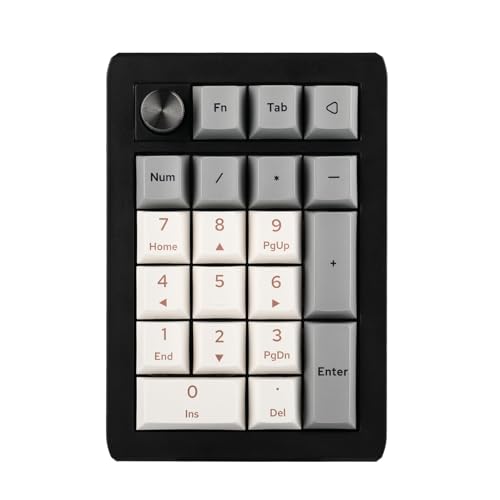
The Epomaker EK21 represents the enthusiast mechanical branch of the family: a gasket-minded, switch-driven pad for people who already care how their main keyboard feels and want the numpad to speak the same language. In prose-only terms, its story is customisation and feel. Mechanical switches give each digit a distinct, learnable character, and a pad in this class typically invites experimentation with switch types and keycaps, turning the humble number grid into part of a considered setup rather than an afterthought. On the desk it suits analysts who game, gamers who budget, and anyone whose tenkeyless board needs a mechanical sibling rather than a plastic apology. The limitations travel with the class: mechanical pads are thicker and heavier than slim travel pads, key sound needs managing in shared spaces, and the enthusiast feature set is wasted on someone who enters figures twice a month. Choose it if feel, matching aesthetics and tinkering room matter to you. Skip it if your pad must vanish into a slim laptop sleeve or stay silent in a library-quiet office.
Best for: mechanical keyboard users who want a matching, customisable grid for a tenkeyless setup. Not suited for: minimalists who prize thinness and silence above key feel.
Keychron K0 Max Wireless Number Pad
Positioning: premium mechanical tier. Prose-only in this draft; check the current listing for live details before you buy.
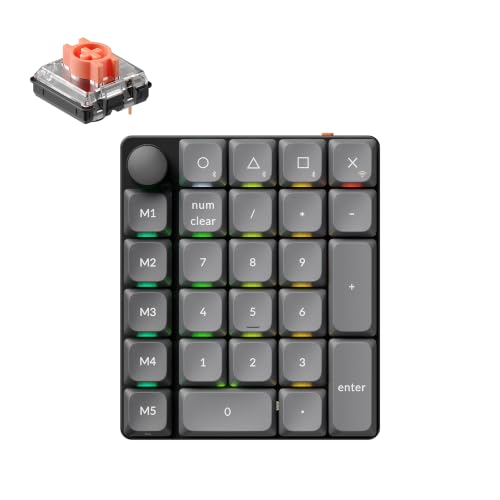
The Keychron K0 Max stands at the deliberate, desk-first end of the category: a mechanical wireless numpad from a maker whose reputation rests on keyboards that serve both office and enthusiast audiences. In prose-only terms, think of it as the pad for people who have already decided that number entry is a permanent, serious part of their week and want the tool to feel permanent and serious too. The appeal is completeness: a mechanical typing character, a layout that respects the classic grid while adding useful extras, and a presence on the desk that pairs naturally with a quality compact keyboard. It is the pad you stop thinking about upgrading. The costs of that completeness are size and commitment. It is not the pad to toss casually into a crowded bag, and its tier asks you to be sure about your pattern of work before you buy. Choose it if your spreadsheet seasons are long, your desk is your office, and you value buying once. Skip it if your numpad needs are occasional, mobile or experimental, because a humbler pad will teach you the same lessons for less commitment.
Best for: committed spreadsheet and finance users building a long-term desk around a compact keyboard. Not suited for: occasional users or travellers who need the slimmest possible kit.
The Decision Checklist
Answer honestly, counting actual weeks rather than intentions. Do figures occupy at least a few focused sessions in a typical month? Does your current keyboard lack a grid, or does its grid cost you desk space you resent? Do you audit or correct figures, not just enter them? Do you work at more than one desk or machine? Have you caught yourself reaching for a missing grid? Would a small charging ritual genuinely fit your habits? Five or more yes answers: buy, and choose the family by the buying guide. Three or four: borrow, trial or buy a modest pad with a friendly return policy. Two or fewer: keep your money and your minimalism; the number row has your measure and you have its.
Is the Payoff Real? Testing Whether a Wireless Numpad Earns Its Place
Set a review date a month after buying, and judge the wireless numpad by whether you would choose it again knowing exactly how your routine actually uses it. Test in the order you actually work: power on, connect, adjust, run a real task, then tidy up, rather than judging the wireless numpad on a single impressive first impression. If two options look identical on paper, choose the one whose controls, layout or handling you understood fastest, since clarity in daily use beats a longer feature list you never touch. Revisit the decision after the novelty fades: the right wireless numpad should feel almost boring in use, doing its job without negotiation every single time.
As a concrete listing check, take the Microsoft Number Pad and the Jelly Comb Wireless Numeric Keypad named earlier in this article and confirm, line by line, that each variant offered matches the size, connection and contents described for it here. Run one deliberately awkward task early on, the kind you usually avoid, and see whether this wireless numpad handles your edge cases or only your easiest work. Plan where the cables or materials connected to this wireless numpad will run when the room is tidy, not just while you are testing on an empty surface. Start this final check away from the listings, with the space, the equipment and the routine you already have written down in plain terms. A wireless numpad is worth it when it removes a recurring frustration completely, and much harder to justify when it only makes an occasional minor annoyance slightly smaller.
Ask what you would do on the day this wireless numpad stops working as expected, and whether you could swap, reset, clean or return it without dismantling half your setup. Think about the next purchase this one commits you to, whether that is matching accessories, consumables, a bigger surface or a different connection, and count that commitment honestly. Check that nothing you place on, under or beside the wireless numpad blocks airflow, movement, visibility or access that the design quietly depends on. Keep a short note of what worked, what annoyed you and what you adjusted, because that note is more useful than memory when you later replace or add another wireless numpad.
Keep the instructions somewhere you can find them months later, since the setting or step you skip today is often the one a future problem sends you hunting for. Ask whether the benefit you want survives your least favourite conditions, such as low light, a crowded desk, a warm room or a rushed start to the day. The value question for a wireless numpad is answered by your calendar more than by any feature list: count how often the problem it solves actually interrupts your week. Avoid forcing a connector, bracket or moving part that resists you, because resistance is usually information about alignment or fit rather than an invitation to push harder. When something behaves oddly, return to the basics first: power, connection, position, cleanliness and the last setting you changed, in that order, before assuming a fault.
Look closely at seams, edges, hinges, threads or contact points when the wireless numpad arrives, because build quality is easiest to judge before everyday wear hides the evidence. Check the underside, back or hidden face of the wireless numpad as part of your inspection, because labels, vents, switches and fasteners often live where first impressions never look. Allow a short settling period for your own habits to adapt, but set a firm date to decide, well inside the return window, whether this wireless numpad has earned its place.
Keep the packaging and any small adapters, feet, brackets or fasteners together until the wireless numpad has survived a full week of ordinary use in its final position. Compare it honestly with the workaround you use now, describing that workaround in the same detail, because vague dissatisfaction makes almost any purchase look worthwhile. Notice the small sounds, lights and movements during normal use, because those everyday details decide whether a wireless numpad feels settled or constantly demands attention.
Frequently Asked Questions
Will a wireless numpad work with my laptop?
In almost every ordinary case, yes. Laptops with Bluetooth can pair with a Bluetooth pad through the normal device settings, and laptops with a suitable USB port can use a pad that connects through its own receiver. The checks worth making are specific rather than general: confirm the connection type your chosen pad uses, confirm your machine has that connection available, and, if you use a dock, test the pad through the dock as well as directly. Once paired, the pad behaves like any other keyboard, so it works across spreadsheets, calculators, browsers and accounting tools without special software for basic digit entry.
Can I use a wireless numpad on the left side of my keyboard?
Yes, and many people find it is the best seat in the house. Placing the pad on the left keeps your mouse closer to your body on the right, while your other hand handles figures. Expect a learning curve of a few real work sessions rather than a few minutes; your non-dominant hand knows more about number patterns than you might expect, especially if you review source figures with that hand already. Start with low-stakes work, keep the pad in the same left-side spot so the habit can form, and judge the experiment after a fortnight. If your hand starts travelling left by instinct when figures appear, the experiment has succeeded.
Does a wireless numpad work with spreadsheets and accounting software?
Yes. To your computer, the pad is a keyboard, and its digit, operator, Enter and Tab keys send the same signals as the corresponding keys anywhere else. That means it works in spreadsheets, accounting packages, point-of-sale tools, grading systems and web forms without drivers for the core grid. The caveats live at the edges: a few applications handle unusual extra keys in their own way, and macOS users should test their exact applications because some extra keys behave differently there. The fastest verification is a five-minute trial in your real files during the return window, entering, correcting and totalling a representative column of figures.
How do I stop my wireless numpad from disconnecting or lagging?
Work through the causes in order of likelihood. Charge the pad or replace its cells first, because a fading battery imitates almost every other wireless fault. Then re-pair the Bluetooth connection rather than simply toggling it, or move the receiver to a clearer port away from metal cases and docks. Shorten the distance and clear obstacles between pad and machine for a test session to see whether the fault follows the position. Finally, test in a plain text document: if the pad behaves there, the problem lives in an application’s key handling rather than in the pad. Note what changed when the fault cleared, because intermittent problems reward written evidence.
Is a mechanical or a slim numpad better for long sessions?
Neither wins in the abstract; they suit different hands and rooms. Mechanical switches give clearer feedback per press, which many heavy users find helps rhythm and confidence across a long entry session, and switch choice lets you tune sound and feel. Slim scissor or membrane pads are quieter, lighter and kinder to travel bags, but their shorter travel gives less confirmation per keystroke. For occasional figures, choose by portability. For daily, hours-long entry, choose by feedback, and if possible test your error rate on each style with real work. Your fingers, given a week of honest use, will settle the argument more reliably than any specification sheet.
How should I charge and store a wireless numpad safely?
Follow the maker’s instructions first, and apply ordinary battery common sense throughout. Charge on a clear, hard surface away from soft furnishings, use a cable that is undamaged, and unplug once charging is complete rather than leaving the pad on charge indefinitely. If a pad or battery ever swells, overheats, or develops an unusual smell, stop using it and follow local guidance for safe disposal instead of trying to nurse it back. For storage, keep the pad in a pouch or drawer where keys are not held down for weeks, keep spare cells in a known place, and avoid leaving any battery device in a hot car. These are small habits, but they are the whole of battery safety for a device like this.
Related Guides
Related reading: wireless numpad pros and cons; wireless numpad buying guide; wireless numpad review; wireless numpad vs macro keypad; keyboards built for financial modelling; ten-key keyboards for billing work; keyboards for office typing.