Disclosure: As an Amazon Associate, ilcastellomenu.com earns from qualifying purchases. Links on this page are affiliate links; they cost you nothing extra. Prices and availability change often, so check the current Amazon listing before you buy.
Weighing coiled keyboard cable pros and cons honestly means resisting the two lazy verdicts: the enthusiast’s claim that every serious desk needs one, and the sceptic’s claim that it is jewellery pretending to be a cable. Both contain a fragment of the truth, and this page separates the fragments. Below, the genuine coiled keyboard cable pros and cons are each given their own space and their own evidence — the advantages explained rather than asserted, the drawbacks stated without softening — followed by what the trade-offs mean for different users, how the cable compares with the realistic alternatives, how to buy smart within the category, and the setup and care habits that shrink the cons you cannot eliminate. The bottom line, when it comes, will have been earned on both sides of the ledger.
Key Takeaways
- The pros are real but specific: order at rest, give in motion, fast keyboard swaps at the detachable connector, and a desk presence no plain cable offers.
- The cons are equally real: weight at the keyboard’s corner, dust kept in grooves, a shape that punishes habitual overstretch, and money spent on expression rather than function.
- Almost every con is a fit problem in disguise — the wrong coil for the desk, board or route — which means most are avoidable before purchase.
- The pros accrue daily and quietly; the cons announce themselves at unboxing. Judge the balance over a year of desk life, not a first impression.
- Handle the metal detachable connector by its body with a firm grip, and the most mechanical con on the list largely disappears.
Best for: desk-proud users, keyboard swappers and build finishers. Not suited for: buyers who need their spending to buy function, owners of very light keyboards on small desks, and anyone who will stretch a coil across a long run and call it fitted.
In this guide
Coiled Keyboard Cable Pros and Cons: The Pros
Pro: Order at Rest
The headline advantage, and the one owners mention first, is what the cable does when nothing is happening: it holds a compact, deliberate run across the desk’s most visible edge. A straight cable rests in a loose curve that migrates, catches on desk objects and reads as unfinished; the coil rests in engineered loops that stay where they were arranged. The effect on a whole setup is disproportionate to the object’s size — one tidy run makes neighbouring objects look tidier too, which is why the format photographs so well and why desk-proud owners describe the change in the language of calm rather than of features.
Pro: Forgiveness in Motion
The coil is a working spring. Pull the keyboard closer for a long document, slide it aside for a notebook, angle it for a game — the loops open and close through the middle of their range and the run returns to its arranged shape when you let go. A straight cable handles the same movements by dragging, draping or sitting taut. Over a working week of dozens of small repositionings, the coiled cable’s quiet self-restoration is a genuine functional advantage, not a cosmetic one: the desk you arranged on Monday is still the desk you have on Friday, without a single moment spent re-dressing cables.
Pro: The Detachable Connector’s Daily Convenience
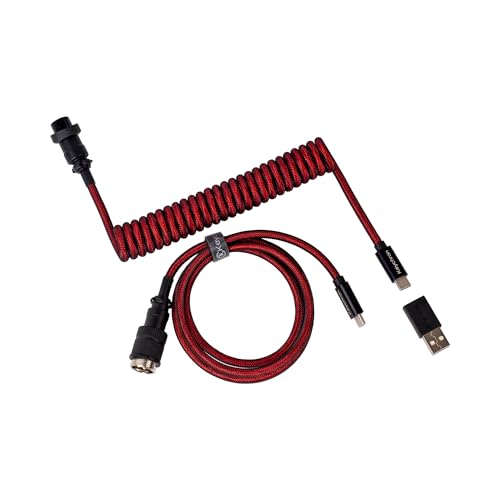
On models fitted with the metal aviator-style connector, swapping keyboards becomes a ten-second gesture: separate the halves, exchange boards, reconnect. The coil, the routing and the computer-side connection never move. Multi-keyboard households, shared desks, hobbyists testing boards and anyone who lifts the keyboard away to clean or to reclaim desk space uses this constantly, and for them it converts the cable from an accessory into infrastructure. Even single-board owners gain a subtler benefit: the keyboard can travel while the dressed desk stays dressed.
Pro: Expression in a Single Object
No comparably priced object changes a setup’s character as completely. Colour, coil diameter and sleeving texture let one purchase carry the whole palette of a build — matching keycaps, echoing a desk mat, providing the single deliberate accent in a neutral room. This is not a trivial benefit dressed up as one: people work at these desks for thousands of hours, and the small, repeated pleasure of a setup that looks intended is a real return on a modest outlay, provided it is bought knowingly as expression rather than mistaken for performance.
Pro: It Stays Put and Stays Quiet
A coiled run is the calmest cable on the desk. It does not slither off edges, click against the desk when the keyboard moves, or slowly migrate into the mouse’s territory. In quiet rooms — a bedroom desk at night, a shared office, a studio — that stillness is a quality-of-life detail owners come to value out of proportion to its size. The coil’s slight anchoring effect also keeps an actively used keyboard planted where its owner set it, which gamers in particular count as a working advantage.
Pro: Longevity Is in Your Hands
Unlike most desk technology, a coiled cable has no countdown inside it. Its electrical job is gentle, and its ageing is governed almost entirely by handling — which the owner controls. Routed with slack, disconnected by the connector body, cleaned occasionally, it has no obvious reason to be replaced for years. In a product landscape of batteries and planned obsolescence, an object whose lifespan is determined by its owner’s habits rather than its chemistry is a quiet, genuine pro.
The Cons
Con: It Buys No Performance Whatsoever
The most important con is a truth about the whole category: the typing experience is identical to the cable in the box. Key feel, responsiveness and reliability belong to the keyboard; the cable merely carries the connection, and every competently made cable carries it equally. A buyer whose budget is tight, or whose satisfaction comes from measurable improvement, is spending on the wrong object — the money would do more in switches, keycaps or the board itself. This con does not make the product bad; it makes the purchase wrong for a specific, common expectation, and any honest account of coiled keyboard cable pros and cons must put it first among the drawbacks.
Con: Weight Where You Can Feel It
A coil is heavier than a plain cable, and the weight hangs at the keyboard’s corner — exactly where a light board can least afford it. On compact plastic keyboards the result can be a board that slowly walks out of position, sits subtly tugged askew, or feels anchored when its owner tries to slide it. Heavy boards make this con vanish, which is why it is a fit problem rather than a flaw — but for owners of light keyboards it is the con most likely to be felt every single day, and no routing trick fully repeals physics.
Con: The Coil Punishes Overstretch — Permanently
Ask a coil to live near its full extension and it will comply, briefly, then begin forgetting its shape: the hardest-worked loops relax first, the winding goes uneven, and the cable that was bought for its looks now advertises its mistreatment. There is no care routine that restores stretched memory. Desks with long routes are therefore a genuine mismatch for the format unless the connector point is repositioned or a longer run is chosen. This is the category’s least forgiving con, because it is irreversible and entirely created at setup.
Con: Dust Lives in the Grooves
Every loop is a small shelf, and shelves collect dust. A straight cable can be kept presentable with an occasional swipe; a coil — especially a pale, braided one — asks for deliberate cleaning worked into its grooves, with a cloth and sometimes a soft brush, every month or two. Neglected, it holds grime that no quick wipe lifts. The burden is small in minutes and large in principle: this is an object that requires a maintenance habit its plain alternative never asks for, and buyers who know they will not keep the habit should count this con at full weight.
Con: Connector Care Is a Real Requirement
The detachable metal connector is a pro with a condition attached. It is solid, precise hardware — and it expects to be handled like hardware: a firm grip on the metal body when joining or separating the halves, straight pulls, no levering, and never a tug on the cable behind it. Owners who treat it casually create the category’s classic failure, a loosening, intermittent connection. The requirement is not onerous, but it is real, and in households where several people handle the desk — children included — it is a con to weigh honestly.
Con: Colour Is a Gamble Taken from Photographs
Listings are photographed under studio light on styled desks; your cable will live under your lamp on yours. Shades shift, screens lie, and a colour bought to match keycaps exactly can land as a visible near-miss — the worst outcome in colour matching, worse than an honest contrast. The gamble can be managed by matching families rather than tones, but it cannot be eliminated from a purchase made by photograph, and vivid statement colours raise the stakes because they commit the whole setup’s palette to the guess.
What the Trade-Offs Mean for You
If you finish builds: the pros dominate. Expression, order and connector convenience are precisely what your desk is for, and the cons are habits you already keep. Buy the tier your build justifies.
If you work at a shared or family desk: the ledger tightens. The connector will be handled by other hands, the colour will be judged by other eyes, and the dust will be everyone’s. A neutral, mid-tier, detachable model is the diplomatic optimum — and the connector-handling rule needs to become a household rule, stated once: grip the metal, never the cable.
If your keyboard is light and your desk is small: the cons lead. Weight and proportion work against you twice. A tight, light coil can still succeed, but go in with the routing planned and expectations set, or keep the plain cable and spend elsewhere.
If you rotate keyboards: the single biggest pro is aimed at you, and it outweighs the upkeep cons comfortably. Prioritise connector quality above colour, above sleeving, above everything.
It is worth being honest about who actually benefits from a coiled cable, because the answer is narrower than marketing suggests. The person who benefits is the person who looks at their desk: who notices a tidy run, enjoys a colour that ties a setup together, and takes small daily pleasure in objects that feel deliberate. A user who pushes the keyboard aside without looking, works on a cluttered desk, or genuinely cannot see the front edge of their own setup gains the function of a cable and nothing more — a good plain cable serves them identically for less money and less upkeep. Neither person is wrong. The mistake is buying the expressive object while being the indifferent user, or denying yourself a small daily pleasure you would genuinely have noticed, out of a puritanism nobody asked for.
Going Deeper: Living With the Cable
A coil is not decoration first and function second; it is a spring that happens to look good. Each loop stores a little elastic energy, which is why a coiled keyboard cable can sit in a short, tidy run across the front of a desk and still stretch when you pull the keyboard toward you to clear space for a notebook or a drawing tablet. That give is the whole point. A straight cable of the same working length would either drape in a loose curve that catches on everything, or sit taut and drag against the desk edge. The coil keeps the run compact at rest and forgiving in motion, and it returns to shape when you let go, which is why the front of the desk stays visually calm even on days when the keyboard moves a dozen times.
Routing decides whether a coiled cable looks composed or chaotic, and it takes five unhurried minutes to get right. The usual arrangement runs the coil from the keyboard’s port across the front or side of the desk to where the detachable connector sits, with the straight device-side lead continuing to the computer or hub from there. Keep the coil’s run clear of mug territory, mouse sweep and the path of chair armrests, and let it rest on the desk surface rather than hang off an edge, where its own weight will stretch the nearest loops all day. Once routed, live with it for a week before judging: small annoyances like a loop catching on a desk mat edge are fixed by shifting the run slightly, not by replacing the cable.
Judging value in this category means separating three things buyers often merge. First is function: every cable here moves data and power between computer and keyboard, and a basic one does that job completely. Second is build: connector quality, sleeving, coil consistency and finishing decide how the cable feels and how long it stays handsome. Third is expression: colour, diameter and presence turn a utility into part of the room. Money spent on the first tier buys nothing extra; money on the second buys longevity and tactility; money on the third buys pleasure, which is real but should be spent knowingly. The buyers who regret purchases are usually those who paid third-tier prices expecting first-tier differences, or bought first-tier plainness and then felt the daily itch of a desk that looks unfinished.
In shared spaces — a family desk, a hot-desking office, a studio others photograph — the coiled cable does quiet diplomatic work. A dressed, deliberate cable run signals that the setup is finished and cared for, which changes how other people treat the space around it. It also photographs exceptionally well, which matters more than many admit in an era of setup posts and video calls framed over the desk. The counterweight is taste: a vivid coil is a strong visual opinion, and in a minimalist shared room it can be the one loud object everyone notices. Neutral coils thread this needle — visibly intentional, rarely divisive — while statement colours belong in spaces that are unambiguously your own.
Set expectations correctly and a coiled cable is a long-lived object. The electrical job it does is gentle, the connectors are its main wear points, and the coil itself ages mainly through how it is handled: stretching, hanging loads, rough packing and yanking at connectors. A cable routed once, kept in its comfortable range, disconnected by its connector bodies and cleaned occasionally has no obvious reason to be replaced for years. The realistic failure stories are almost all handling stories. That is good news, because handling is entirely within your control — unlike, say, a battery’s chemistry, nothing inside a coiled cable is counting down against you. Buy decent build quality once, treat it as the semi-permanent desk fixture it is, and the cost spreads itself thin across a very long service life.
Desk size quietly governs which coiled cable will make you happy. On a compact desk, the coil competes for front-edge space with the mouse, a wrist rest and your own forearms; a tight coil in a short run is the difference between composed and crowded. On a wide desk, the same tight coil can look lost, and a fuller coil with a longer run gives the setup its proportion. Measure the actual route the cable will take — from keyboard port, around whatever lives on the desk, to the connector point — rather than the straight-line distance, and remember the coil needs to work in the middle of its stretch range along that route. Ten honest minutes with a tape measure prevents the single most common disappointment in this category.
What covers the coil changes both how it looks and how it behaves on the desk. A bare or lightly finished cable shows the coil geometry cleanly and slides easily, but picks up dust in the grooves and can look plain next to a carefully built keyboard. Braided and fabric-style sleeving adds texture and colour, protects the surface underneath from scuffs, and gives the coil a slightly stiffer, more deliberate hand feel when you move it. Double-sleeved and premium finishes push further toward jewellery than utility, with tighter weaves and richer colour, at the cost of extra weight the coil has to carry. None of these choices changes what the cable does electrically; all of them change how the desk feels to sit at, which for an object you look at all day is a legitimate thing to pay for — within reason.
Coils are wound in different diameters, and the difference is visible from across the room. A tight, narrow coil reads as crisp and technical, hugs its run closely, and suits smaller desks where every object has to justify its footprint. A wider, looser coil is the statement piece: rounder loops, more shadow and movement, and a presence that can anchor a whole setup’s colour scheme — or overwhelm a modest keyboard on a small desk. Proportion is the honest test. Hold the keyboard you actually own in mind, picture the coil running from its corner across your real desk, and choose the diameter that looks balanced at that scale rather than the one that looked dramatic in a photograph taken on someone else’s much larger desk.
Although these cables are sold for keyboards, buyers reasonably ask what else they can serve. The honest answer is: treat them as keyboard cables. The connectors may physically fit other small USB devices, but the coil’s weight, the connector placement and the cable’s whole design assume a keyboard at a desk. Using one to charge a phone from a wall adapter invites exactly the stretched, dangling loads that ruin coils, and data behaviour with other devices is outside what the maker designed or tested for. Keep the coiled cable in the job it is good at, keep a plain cable for everything else, and both will last longer. Specialisation is not a limitation here; it is why the product exists at all.
As a gift, a coiled cable sits in a sweet spot: personal enough to show thought, safe enough not to demand the recipient share your taste in switches or layouts. The conditions are compatibility and colour discipline. You must know the recipient’s keyboard port for certain — guessing wrong converts a thoughtful gift into an adapter hunt — and you should choose a colour that matches the setup they have, not the one you think they should build. Neutral and metal-toned coils are the low-risk classics; a colour matched to their existing keycaps is the high-delight option when you know the setup well. Include the quiet advice that comes free with experience: grip the connector body, never stretch the coil to its limit, and it will look this good for years.
A coiled cable travels better than its looks suggest, with one condition: pack it as a coil, not as a bundle. Wrapped loosely in its natural loops inside a case or a soft pouch, it arrives with its shape intact and deploys in seconds. Jammed into a bag corner, wound tightly around itself, or trapped under a laptop, it arrives with kinks and stretched sections that take days to relax, if they fully do. The detachable connector helps here too — the keyboard-side section can stay with the board while the coil rides separately. For people who work between home and office with the same keyboard, a second coiled cable left at the second desk is often the smarter spend than daily packing, because coils age through handling more than through use.
Knowing when a coiled cable is done saves both money and frustration. Replace it when the coil has permanently lost its shape in the working section — loops hanging open and uneven despite gentle rest — because no care routine restores stretched memory. Replace it when the connection becomes intermittent: a keyboard that drops out when the cable moves is telling you a contact or a conductor is failing, and no amount of re-seating fixes that for long. And replace it when connector bodies loosen, crack or stop seating with that solid, finished feel. Cosmetic tiredness alone — slight dust shadowing on pale sleeving — is a cleaning problem, not a replacement trigger. A cable retired for shape or connection reasons has usually served long enough to justify its successor.
The detachable connector earns its keep in households and offices where one desk serves several keyboards. Swapping boards becomes a ten-second job: separate the connector, lift one keyboard away, set the next down, reconnect. The coil, the routing and the computer-side connection all stay exactly where they were. The same convenience helps with cleaning, with packing a keyboard for travel while leaving the desk dressed, and with lending a board to a family member without unpicking your whole setup. If you own exactly one keyboard and never move it, this feature is a pleasant luxury. If you rotate boards, test switches for friends, or share a desk, it quietly becomes the reason you would not go back to a fixed cable.
Coiled cables come from the custom keyboard hobby, where every visible component of a build is a choice, and that origin explains their character. In that world the cable is specified alongside the case, plate, switches and keycaps, and makers compete on sleeving, colour accuracy and connector finishing rather than on raw function. Mainstream brands have since brought the format to ordinary desks, which is good for prices and availability, but the enthusiast lens remains the right way to judge these products: as crafted objects with a job to do, not as performance upgrades. Buyers who adopt that lens tend to choose well — they check the craft details, respect the object’s limits, and enjoy it for exactly what it is.
A small, rarely discussed pleasure of a good coiled cable is how quietly it behaves. A straight cable dragged across a desk edge clicks, slaps and migrates; a coil resting in its run mostly stays where it was put, moving in small, damped increments when the keyboard shifts. On shared desks and in quiet rooms — a bedroom desk at night, a library corner, an open office — that stillness is a genuine quality-of-life detail. It is not absolute: a very stiff coil can tap against a hard desk when the keyboard is moved briskly, and metal connectors should never be dropped onto glass desktops. But day to day, the coiled run is the calmest cable on the desk, and people who work in quiet take to it quickly.
The surface under the coil changes how it behaves more than buyers expect. On a bare hard desk the loops rest with a faint tactile crispness and can tap audibly when the keyboard is moved briskly. On a desk mat — the setup most coiled cables are photographed on — the loops settle into the surface, move silently, and hold their arranged position with a little friendly friction. Neither is better, but the pairing is worth a thought: a very smooth, glossy desk lets a light coil creep slowly out of its arranged run over a week, while a mat keeps it composed. If your desk is bare and hard, a slightly heavier coil or a mat under the run are both honest fixes, and either beats re-arranging the cable every morning.
There is a small ergonomic dividend to the coil’s give that rarely gets mentioned. Because the cable stretches gently instead of dragging, the keyboard can live exactly where your hands want it — closer for long writing, further for reading, angled for games — without the subtle resistance and slow migration a taut straight cable imposes. Nobody should buy a cable as an ergonomic intervention, and this page does not sell it as one. But owners who reposition their keyboard through the day consistently report that the board simply stays where they put it, and a keyboard that stays put is one less small friction in a working posture that has enough frictions already.
Coiled cables hold a small, healthy second-hand market inside the keyboard hobby, and that fact is useful even to buyers who never sell anything: it tells you the objects are durable enough to change hands. When buying used, inspect exactly what ownership wears — the evenness of the loops, the connector’s seating action, the sleeving at the transitions — and discount any cable whose coil hangs unevenly, because stretched memory does not recover and no photograph fully admits it. When selling, the same list is your description. Either way, the category’s craft objects circulate for years, which is more than can be said for most small electronics at this price level.
The Alternatives in Context
Against the stock straight cable, the coiled cable trades money, weight and upkeep for order, convenience and expression — a trade this page scores as worth it for the desk-proud and pointless for the indifferent. Against going wireless, it trades the charging ritual and a bare desk for a dressed one and an always-ready board; neither wins in the abstract. Against spending the same money elsewhere in the setup, the comparison is sharpest: switches and keycaps change what your fingers feel, the cable changes what your eyes see, and honest buyers fund whichever sense they actually live through. The other cables on the desk make their own, more specification-led trade-offs, weighed in our hdmi cable pros and cons, displayport cable pros and cons and thunderbolt cable pros and cons pages — the keyboard run is the one cable where the aesthetic side of the ledger legitimately leads.
How to Buy Smart Within the Category
The picks below are the category’s reference points, presented prose-only with markers where verified listing details attach at publication. Buying smart means matching one of them to your ledger above — and running the checks in our coiled keyboard cable buying guide and the step-by-step how to choose a coiled keyboard cable before ordering.
Epomaker Coiled Keyboard Cable — the balanced default
Epomaker’s coiled cables are the enthusiast-community entry point many buyers meet first, sold alongside the brand’s keyboards and aimed squarely at builders who want the dressed-desk look in the brand’s colour language. Treat this as the mid-tier reference point: braided-style sleeving, a metal detachable connector on the aviator-style models, and colours chosen to sit with popular keycap sets. Check the current listing carefully for the exact connector ends and the variant you are ordering, because the range spans several configurations under similar names.
Best for: buyers whose setup and habits match the description above. Not suited for: anyone whose port, desk size or colour plan conflicts with it — check the listing details before ordering, and check price on Amazon at the time you buy.

Keychron Coiled Aviator Cable — the coherent-desk pick
Keychron brings its usual restraint to the format: the coiled aviator cable is designed to match the brand’s keyboards visually and to suit buyers who want one tidy, brand-coherent run rather than a hobbyist mix-and-match. Position it as a mid-tier, design-led option whose strongest argument is how naturally it sits with a Keychron board on the desk. As with every pick here, confirm the keyboard-end connector and the variant on the listing before ordering, and judge the colour against your own lighting rather than the product photography.
Best for: buyers whose setup and habits match the description above. Not suited for: anyone whose port, desk size or colour plan conflicts with it — check the listing details before ordering, and check price on Amazon at the time you buy.

Glorious Coiled Cable — the presence pick
Glorious aims its coiled cable at gaming desks, with tight, crisp coils and colours chosen for the high-contrast setups its keyboards and mice live in. It reads as the gamer-leaning pick of this group: visually assertive, happiest next to a gaming board, and finished to be looked at. The detachable connector makes it friendly for players who swap between a gaming board and a work board at the same desk. Verify the exact ends and colourway on the current listing, and weigh its visual volume honestly against your desk size before choosing it.
Best for: buyers whose setup and habits match the description above. Not suited for: anyone whose port, desk size or colour plan conflicts with it — check the listing details before ordering, and check price on Amazon at the time you buy.
CableMod Coiled Keyboard Cable — the craft pick
CableMod comes to this category from custom PC cabling, and its coiled keyboard cables carry that bespoke, made-to-be-seen character: premium positioning, careful sleeving work and the kind of finishing that custom-build people inspect closely. This is the premium-tier pick for buyers whose whole setup is a deliberate build and who want the keyboard run to match that standard. Because configurations vary, the listing check matters most here of all — confirm connector ends, coil style and colour precisely, and expect to pay for craft and customisation rather than for any difference in basic function.
Best for: buyers whose setup and habits match the description above. Not suited for: anyone whose port, desk size or colour plan conflicts with it — check the listing details before ordering, and check price on Amazon at the time you buy.
Akko Coiled Cable — the colour pick
Akko’s coiled cables lean playful, with colourways that echo the brand’s famously characterful keycap sets, making this the pick for themed builds and desks that treat colour as the main event. Position it in the entry-to-mid tier: an accessible way to test whether the coiled look suits your desk before committing to premium craft. It suits Akko board owners most obviously, but the designs travel well to any setup built around the same palette. Confirm the connector ends on the listing, and choose the colourway against the keycaps you own today, not a future set.
Best for: buyers whose setup and habits match the description above. Not suited for: anyone whose port, desk size or colour plan conflicts with it — check the listing details before ordering, and check price on Amazon at the time you buy.
Whichever you choose, the pre-order checks are the same: keyboard-end connector confirmed from the board itself, routed distance measured along its real path, coil diameter pictured against your keyboard’s footprint, colour chosen by family under your lighting, and tier set by how finished the rest of the setup is. The single-product deep dive is our coiled keyboard cable review and the owner consensus is gathered in our coiled keyboard cable reviews.
Setup and Care That Reduce the Cons
The detachable metal connector fitted to many coiled cables — most buyers know it as an aviator-style connector — exists so the coil section can be separated from the device-side lead without unplugging anything from the computer. It rewards a firm, deliberate hand. Grip the metal body of the connector itself, never the cable behind it, align the two halves without forcing them, and push or twist them together exactly as the design intends until the connection seats with a solid, finished feel. When separating the halves, hold that same metal body and pull straight apart rather than levering sideways. A metal connector handled this way feels reassuringly mechanical for years; the same connector yanked by its cable or wrenched at an angle is where bent contacts and intermittent connections begin.
The same spring that makes a coil useful is also its main vulnerability, and treating it gently is the single habit that decides how long the cable stays beautiful. A coil stretched close to its limit again and again slowly loses its memory: the loops open unevenly, the tightest section near the connector relaxes first, and the cable starts to look tired long before it fails electrically. The fix is simple discipline. Route the cable so its resting length already reaches the keyboard with slack to spare, let the coil work in the middle of its range rather than at the end of it, and never hang anything from it or use it as a handle to drag the keyboard across the desk. Treated that way, a well-made coil keeps its shape for years of daily repositioning.
Coils collect dust in a way straight cables never do, because every loop is a small shelf. Care is easy but has to be deliberate. Unplug the cable, separate it at the detachable connector if it has one, and wipe along the coil with a soft, slightly damp cloth, working into the grooves rather than skimming the surface. A soft brush lifts what the cloth misses, especially on braided sleeving. Let everything dry fully before reconnecting, keep solvents and harsh cleaners away from coloured sleeving, and never submerge the connectors. Five minutes every month or two keeps a light-coloured coil looking bought-yesterday; neglected for a year, the same coil holds grime in its grooves that no quick wipe will fully lift.
Safety, once more, because it is the con-killer that costs nothing: keep a firm grip on the metal body of the detachable connector whenever you connect or disconnect it — the hardware is solid and satisfying in the hand precisely so it can be held properly — seat the halves fully without forcing, and separate them with a straight pull. That habit, slack in the run, weight rested on the desk rather than the port, and a monthly pass with a cloth convert most of this page’s cons from lived annoyances into fine print.
Bottom Line
The coiled keyboard cable pros and cons resolve into a single sentence: it is a modestly priced piece of desk craft whose benefits are daily and aesthetic, whose costs are money, a little weight and a little discipline, and whose value depends entirely on whether you are the kind of person who looks at their desk. If you are, the pros win clearly and the cons shrink to habits. If you are not, the cons win by default and the plain cable in the box was already the right answer. Neither verdict is a judgement of the product — it is a description of the buyer, which is what an honest pros-and-cons page is for.
Where the Strengths Stop Helping: Honest Edge Cases
The compromise candidate
Many buyers end up choosing neither the strongest nor the cheapest coiled keyboard cable but the one whose weaknesses fall where they personally care least. That is a rational strategy, not a failure of research. List the cons of your final two candidates side by side and ask which set you would rather live with daily in a home where children, pets and visitors all interact with the setup. The product whose drawbacks sit in your blind spots will feel like the better product for years, even if a comparison table scores the other one higher on paper.
The advantage that depends on your habits
The headline advantage of a coiled keyboard cable is real, but it is not automatic: it only pays out if your habits match it. Used the way it was designed, in a home where children, pets and visitors all interact with the setup, the strengths described earlier compound quietly — less friction, fewer workarounds, a smoother routine. Used against its grain, the same design choices become the source of the complaints in the cons column. Before deciding, be honest about which user you are on an ordinary tired weekday, not the organised version of yourself you plan to become next month.
Where the drawbacks bite hardest
The disadvantages of a coiled keyboard cable are not evenly distributed across owners. They concentrate in specific situations: tight spaces, shared rooms, heavy daily loads, or workflows that change direction mid-task. If your routine involves any of those, the cons deserve double weight in your decision, because you will meet them weekly rather than rarely. Conversely, an owner whose setup avoids those situations entirely may never encounter the most-criticised weakness at all, which is why verdicts on the same coiled keyboard cable can sound like descriptions of two different products.
The maintenance trade-off nobody advertises
Almost every coiled keyboard cable trades purchase-day simplicity for a small ongoing maintenance obligation: cleaning, recalibrating, replacing a wear part, updating firmware or simply keeping accessories together. The trade is usually worth it, but it is not free, and it scales with how hard you use the product. In a home where children, pets and visitors all interact with the setup, skipped maintenance shows up first as small annoyances — a control that feels off, a result that drifts, a noise that was not there before — long before it causes a real failure. Budget the minutes, not just the money.
When the alternative is genuinely better
There are owners for whom skipping the coiled keyboard cable altogether is the right call, and naming them is part of an honest pros-and-cons account. If your need is occasional, borrowed or built into something you already own, or if your space cannot give the product the conditions it needs, the alternative route avoids both the cost and the clutter. The pros only outweigh the cons when the problem the coiled keyboard cable solves is a recurring one in your week. A problem you meet twice a year rarely justifies a permanent new resident in the Keyboards category.
How the balance shifts over a year of ownership
The pros-and-cons ledger of a coiled keyboard cable is not static. In the first month, novelty inflates the pros; by the sixth month, the honest picture is about reliability, running costs and whether the product has earned a permanent place in your routine. Wear parts, consumable availability and the maker’s support responsiveness all matter more at month ten than at day ten. When you read owner feedback, weight the long-term reports accordingly: a complaint about a part that failed after a year tells you more than a first-week rave about unboxing.
Frequently Asked Questions
What is the biggest pro of a coiled keyboard cable?
Order that maintains itself. The coil holds a compact, deliberate run on the desk’s most visible edge and absorbs the day’s small keyboard movements inside its spring, returning to shape on its own — so the setup you arranged stays arranged without effort. For people who swap keyboards, the detachable metal connector rivals it: board changes become a ten-second job while the dressed coil never moves. Both pros are about daily life at the desk rather than specifications, which is exactly the category’s character.
What is the biggest con of a coiled keyboard cable?
For most buyers, that it buys no performance: the typing experience is identical to the stock cable, so the money purchases order, convenience and expression only. Buyers expecting a functional upgrade will be disappointed regardless of tier. The most practical con is different — a coil stretched near its limit at setup permanently loses its shape, loop by loop, with no remedy. Measure the routed run and keep the coil mid-range, and that con never happens.
Do coiled cables damage keyboards or ports?
Not when fitted and handled sensibly. Two habits protect everything: route the coil so its weight rests on the desk rather than dangling from the keyboard’s port, especially with light keyboards, and handle the detachable connector by its metal body — firm grip, straight pulls, no levering, never tugging the cable behind it. Damage stories in this category trace back to dangling weight or connector mishandling, both of which are owner choices rather than product behaviour.
Are coiled cables worth it for gaming?
For the right reasons, yes: the coil keeps the keyboard run out of the mouse’s sweep, anchors the board’s position during animated play, and lets gaming and work boards swap at the connector in seconds. For the wrong reason — any expectation of responsiveness gains — no; the connection performs identically to a plain cable. Gamers with very light keyboards should choose a lighter, tighter coil and rest its weight on the desk to avoid tugging at extreme board angles.
How long does a coiled cable last?
Years, under ordinary care, because its ageing is governed by handling rather than by any internal countdown. The lifespan habits are simple: keep the coil working in the middle of its stretch range, disconnect at the connector body rather than by the cable, and wipe the grooves clean every month or two. The realistic end-of-life triggers are a coil that has permanently relaxed from chronic overstretch, or a connection gone intermittent — both are the end of a handling story, not a timer.
Who should definitely skip a coiled keyboard cable?
Three buyers. Anyone whose satisfaction must come from measurable performance, since the category offers none. Owners of very light keyboards on small desks, where coil weight and proportion fight the setup daily — unless they deliberately choose a tight, light coil and plan the routing. And anyone whose desk route is long and fixed, where a coil would live stretched at its limit and lose its shape; a plain cable serves that desk better and asks nothing.
Related Reading
Keep exploring with these guides from the same desk and cable shelf: best quiet keyboards for gaming; best keyboards for gaming and work; best cable management options for desks; best keyboards for office typing.