Disclosure: As an Amazon Associate, ilcastellomenu.com earns from qualifying purchases. Links on this page are affiliate links; they cost you nothing extra. Prices and availability change often, so check the current Amazon listing before you buy.
The wireless numpad vs macro keypad choice confuses buyers because the two devices look like siblings: small grids of keys that sit beside a keyboard and promise to make repetitive work faster. They are not siblings. A wireless numpad offers fixed, labelled keys for entering numbers, the same grid as a calculator, ready for anyone the moment it connects. A macro keypad offers programmable keys that can send commands, shortcuts, text or sequences, powerful exactly in proportion to the setup you invest in it. This comparison walks the two side by side, criterion by criterion, so you can buy the tool your repetitive work actually is: digits, or commands. The macro side is described in prose by product family, with a placeholder towards the macro keypad cluster that a later batch will cover in full, and numpad models appear as prose-only picks with pick slots.
Quick Verdict: Wireless Numpad Pros and Cons in Brief
Choose a wireless numpad if your repetitive work is entering, auditing or correcting numbers: it works instantly, for anyone, with no configuration, and its skill transfers from every calculator you have ever touched. Choose a macro keypad if your repetitive work is triggering commands, shortcuts and sequences in creative, streaming, gaming or specialist software, and you are willing to program and maintain those assignments. Choose both if your week genuinely contains both kinds of repetition, as many hybrid desks do.
- Fixed versus programmable is the whole argument: certainty and familiarity against flexibility and power.
- A numpad’s keys mean the same thing on every machine and to every colleague; a macro pad’s keys mean what you told them to mean, on the setup you told them on.
- Setup time inverts: the numpad is finished in minutes, the macro pad is never entirely finished, which its owners count as a feature.
- Number-heavy work gains nothing from programmability; command-heavy work gains nothing from printed digits.
In this guide
Wireless Numpad vs Macro Keypad at a Glance
Purpose: numpad, entering numbers and basic operators; macro keypad, triggering programmed commands and shortcuts. Keys: numpad, fixed legends with fixed meanings; macro keypad, blank or relegendable keys whose meanings you assign. Setup: numpad, pair and type; macro keypad, pair, install or open configuration tools, design a layout, test, revise. Learning curve: numpad, effectively none; macro keypad, your own layout must be memorised, because you invented it. Sharing: numpad, anyone can use it instantly; macro keypad, personal by nature. Best environment: numpad, spreadsheets, accounting, grading, inventory and forms; macro keypad, editing suites, streaming, design tools, games and specialist software. Failure mode: numpad, a flat battery; macro keypad, a forgotten assignment or a profile lost in a software update. Neither device is the premium version of the other; they are answers to different questions that happen to share a silhouette.
Criterion: What the Keys Actually Do
Press a numpad key and a digit arrives, on any machine, in any application, for any user, forever. That fixedness is not a limitation to apologise for; it is the product. Number work is standardised across the whole world, so a standard tool serves it perfectly. Press a macro key and whatever you assigned arrives: a shortcut chord, a menu command, a string of text, a sequence of actions, different per application if you maintain profiles. That programmability is equally the product, serving work that is personal and unstandardised. Judge this criterion by asking which kind of repetition fills your day. If the honest answer is figures, programmability buys you nothing you will use. If the answer is commands, fixed digits buy you a paperweight with excellent switches. Verdict: numpad for digit work, macro keypad for command work, with no overlap worth arguing about.
Criterion: Setup, Configuration and Upkeep
The numpad’s setup is measured in minutes and then forgotten: pair, test, work. Its upkeep is a battery ritual and an occasional clean. The macro keypad’s setup is a design project: deciding what deserves a key, assigning it, labelling or memorising it, testing it in the real application, and revising after the first week reveals which assignments were fantasies. Its upkeep continues as software updates, new applications and evolving habits invite revisions. Owners of macro pads often enjoy this tinkering and count it as part of the hobby or the craft. Buyers who want a tool that vanishes should hear the warning plainly: a macro pad never fully vanishes, because its value lives in your ongoing attention to it. Verdict: numpad, decisively, for anyone whose goal is to think about the work rather than the tool.
Criterion: Learning Curve and Sharing
A numpad can be handed to a colleague, a student or a family member and used competently in the same minute, because its interface is a cultural standard. Training cost is zero and will remain zero for every future user. A macro keypad’s interface is a private language. Its owner must learn it, and anyone else faces a grid of mysteries; even the owner, returning after a month away, may need to relearn assignments that once felt obvious. Labels, layers and profiles mitigate this, at the cost of more configuration. For shared desks, classrooms, counters and teams, this criterion alone can settle the purchase. For a purely personal desk where the same hands return daily, it barely matters. Verdict: numpad for shared and occasional use; a draw for dedicated personal desks.
Criterion: Fit With Spreadsheets and Figure Work
Spreadsheet work is where a wireless numpad stops being an accessory and becomes the main instrument. Entering a column of figures on a number row means stretching, shifting and hunting; on a proper pad your hand stays in one small neighbourhood while your eyes stay on the source document. Build the supporting habits and the speed compounds: Enter configured to move down a cell, Tab to step across a row, and a consistent rhythm of read, type, confirm. Many spreadsheet users find the pad most valuable not for raw entry but for auditing, stepping through existing figures and correcting them in place, because corrections cluster around the digit keys and Backspace. If your pad places Backspace or Delete within the grid, auditing becomes a one-hand job. Keep the source figures on the side of your entering hand so your gaze travels in one direction, and resist the urge to look at the pad: the whole point of the familiar layout is that your fingers can be trusted, and checking them slows the very rhythm you bought the pad to create.
Against that home fixture, the macro keypad’s honest offering is peripheral: it can host spreadsheet shortcuts beside the grid work, and some analysts do exactly that, pairing the two devices. But as a replacement for the grid it fails structurally, because entering figures through programmed keys discards the standard layout that makes entry fast and transferable. Verdict: numpad, outright, whenever figures are the work.
Criterion: Fit With Creative and Command Workflows
Now reverse the fixture. In video editing, audio production, illustration, streaming and gaming, the repetitive units are commands: tools, effects, scene changes, clips, emotes, build orders. A macro keypad puts those commands under one hand in a grid you designed around your own habits, and for heavy users the gain is as real as the numpad’s gain in a ledger. A wireless numpad, in that room, offers a calculator grid to people who need a control surface; its digits may serve the occasional numeric parameter, but the tool is miscast. The macro side of this comparison is a rich category of its own, spanning simple programmable pads to layered control decks, and it deserves treatment in its own right: macro keypad guides. Verdict: macro keypad, outright, whenever commands are the work.
Criterion: Desk Placement and Daily Life
Where a wireless numpad earns its keep is placement, because the cable that used to dictate position is gone. Right-handed mouse users who keep the pad on the right gain a familiar calculator position but push the mouse further out, which some shoulders notice by mid-afternoon. Moving the pad to the left of the keyboard is the quiet revelation of the category: the mouse stays close, the dominant hand keeps mousing, and the other hand learns number entry faster than most people expect, especially for review-and-enter work where one hand turns pages or points at source figures. A pad can also live above the keyboard, below a monitor, or on a pull-out tray, and it can leave the desk entirely when you switch to writing or gaming. Treat the first fortnight as an experiment. Try each position for at least two real work sessions, notice where your hand travels by instinct, and let that instinct vote. The best position is the one your hand finds without a search party.
The natural partner of a wireless numpad is a compact keyboard. Tenkeyless and smaller boards free a generous strip of desk, pull the mouse closer to the body’s centre line, and feel cleaner for writing, browsing and gaming, which is most of what most people do most days. What they surrender is the digit grid, and they surrender it permanently, whether or not today involves figures. A separate pad restores the grid only when the work calls for it, and removes it when it does not. This modular arrangement is the real product being sold across this whole category: not a smaller keyboard or a spare set of keys, but the freedom to assemble your desk per task. Writers add nothing. Analysts add the pad. Travellers take the pad and leave the big board, or the reverse. Once you think of input devices as a kit rather than a fixed installation, the wireless numpad stops looking like a compromise for people who bought the wrong keyboard and starts looking like the most flexible piece of the kit, precisely because it is the piece that comes and goes.
Both devices enjoy the wireless placement freedom described there, and both pair naturally with compact keyboards. The difference is gravitational: a numpad is summoned by tasks and dismissed afterwards, while a macro pad tends to claim a permanent post, because its owner’s applications are open all day. Plan desk space accordingly. Verdict: a draw on freedom, with the numpad easier to store and the macro pad easier to justify leaving out.
Strengths and Trade-Offs of Each Side
Wireless numpad strengths: instant, universal number entry; zero configuration and zero training; a skill that transfers across machines, applications and people. Wireless numpad trade-offs: it does digits and their immediate neighbours, and nothing else; its keys cannot be reassigned to your personal shortcuts; it adds a battery ritual to your desk. Macro keypad strengths: programmable power matched to your exact software and habits; layered profiles that multiply a small grid; a control surface for work no standard layout anticipates. Macro keypad trade-offs: configuration and maintenance that never entirely end; a private interface that resists sharing and fades from memory when unused; value that collapses if your software or habits change faster than your willingness to reprogram.
Who Each Option Suits, and Who Should Skip Each
The numpad suits analysts, bookkeepers, teachers, researchers, retail and inventory workers, and every compact-keyboard owner whose spreadsheets outgrew the number row. Skip it if your repetitive work contains almost no figures. The macro keypad suits editors, streamers, designers, gamers and specialists whose applications reward custom control, and who enjoy shaping their tools. Skip it if you want the tool to disappear, if the desk is shared, or if your honest repetitive unit is the digit. The overlap buyer is real and common: the analyst who edits video, the streamer who keeps books. For them the answer is not a compromise device but both devices, each doing the job it is honest at, summoned by different tasks on different days.
How to Decide: Questions That Branch
Ask, in order: When I repeat myself at this desk, what am I repeating: numbers, or commands? If numbers, stop here and buy the numpad by the buying guide in this cluster. If commands, stop here and explore the macro category. If both, ask which one fills more hours this month, buy that one first, and let a season of use argue for the second. Then ask: is this desk shared? Sharing votes numpad, twice. Then ask: do I enjoy configuring tools, or do I resent it? Resentment votes numpad even for some command workers, who may be better served by learning their software’s built-in shortcuts. Answer those three honestly and the decision, unusually for technology, simply makes itself.
Where Each Side Is Represented
On the numpad side, these prose-only picks span the slim and mechanical families, each with its pick slot for publishing. On the macro side, this draft deliberately names no specific models: macro keypads vary so widely in size, layers and software that they are introduced by family here, slim programmable pads for a few shortcuts, mid-size pads with dials and layers for creative suites, and larger control decks for streaming, with the dedicated macro keypad cluster to follow in a later batch carrying its own verified picks.
Microsoft Number Pad
Positioning: premium slim tier. Prose-only in this draft; check the current listing for live details before you buy.
The Microsoft Number Pad represents the slim, quiet end of this category: a low-profile pad in the scissor-switch tradition, built to disappear into a laptop bag and reappear on any desk without ceremony. In prose terms, because no verified listing data is attached to this draft, treat it as the reference design for travellers and minimalists. Its appeal is restraint. It does one job, in a familiar layout, with the kind of understated finish that suits client-facing desks. Number entry feels light and quiet, which suits shared spaces and evening work, and the whole unit asks almost nothing of your bag or your attention. The honest limitation is feedback: short travel gives your fingers less information than a mechanical switch, so very heavy entry sessions may feel less certain, and anyone who types numbers by rhythm should test their error rate during the return window. Choose it if portability and quiet are your headline needs. Skip it if you want mechanical feel, hot-swappable switches or a pad that doubles as a statement piece on a gaming desk.
Best for: travellers, hot-deskers and laptop users who want a quiet, familiar grid that travels invisibly. Not suited for: mechanical-switch enthusiasts or all-day data-entry specialists who rely on deep tactile feedback.

Epomaker EK21 Wireless Number Pad
Positioning: mid-to-premium mechanical tier. Prose-only in this draft; check the current listing for live details before you buy.
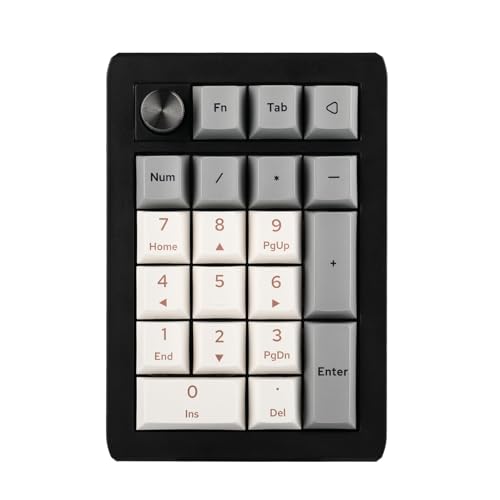
The Epomaker EK21 represents the enthusiast mechanical branch of the family: a gasket-minded, switch-driven pad for people who already care how their main keyboard feels and want the numpad to speak the same language. In prose-only terms, its story is customisation and feel. Mechanical switches give each digit a distinct, learnable character, and a pad in this class typically invites experimentation with switch types and keycaps, turning the humble number grid into part of a considered setup rather than an afterthought. On the desk it suits analysts who game, gamers who budget, and anyone whose tenkeyless board needs a mechanical sibling rather than a plastic apology. The limitations travel with the class: mechanical pads are thicker and heavier than slim travel pads, key sound needs managing in shared spaces, and the enthusiast feature set is wasted on someone who enters figures twice a month. Choose it if feel, matching aesthetics and tinkering room matter to you. Skip it if your pad must vanish into a slim laptop sleeve or stay silent in a library-quiet office.
Best for: mechanical keyboard users who want a matching, customisable grid for a tenkeyless setup. Not suited for: minimalists who prize thinness and silence above key feel.
Keychron K0 Max Wireless Number Pad
Positioning: premium mechanical tier. Prose-only in this draft; check the current listing for live details before you buy.
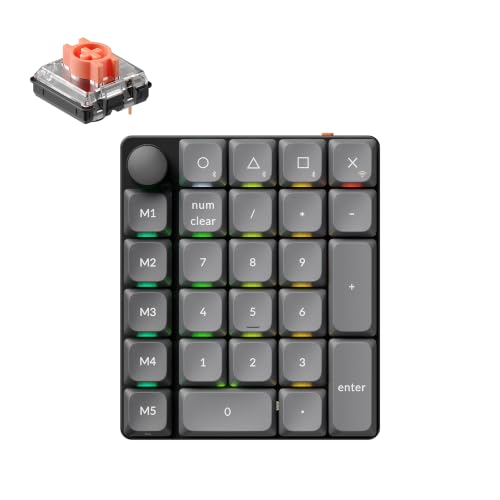
The Keychron K0 Max stands at the deliberate, desk-first end of the category: a mechanical wireless numpad from a maker whose reputation rests on keyboards that serve both office and enthusiast audiences. In prose-only terms, think of it as the pad for people who have already decided that number entry is a permanent, serious part of their week and want the tool to feel permanent and serious too. The appeal is completeness: a mechanical typing character, a layout that respects the classic grid while adding useful extras, and a presence on the desk that pairs naturally with a quality compact keyboard. It is the pad you stop thinking about upgrading. The costs of that completeness are size and commitment. It is not the pad to toss casually into a crowded bag, and its tier asks you to be sure about your pattern of work before you buy. Choose it if your spreadsheet seasons are long, your desk is your office, and you value buying once. Skip it if your numpad needs are occasional, mobile or experimental, because a humbler pad will teach you the same lessons for less commitment.
Best for: committed spreadsheet and finance users building a long-term desk around a compact keyboard. Not suited for: occasional users or travellers who need the slimmest possible kit.
Value in this category is measured in friction removed per week, not in features per coin. A modest pad that wakes instantly, stays connected, and sits exactly where your hand expects it will repay its cost in calm within a single busy season, while an elaborate pad that confuses its channels or dies at awkward moments charges you attention every day you own it. This is why experienced buyers in this category read return policies as carefully as specifications, and why they test with real workloads during the first week rather than admiring the device on a tidy desk. It is also why the second-hand and hand-me-down market in numpads is quietly healthy: the devices are simple, durable, and easy to evaluate. Think of the purchase as hiring a small, specialised colleague. You would not hire on a dazzling interview alone; you would set a trial week of real tasks. Do the same here, and let the trial, not the listing, have the final word on value.
Comfort claims around numpads deserve calm language. A separate pad can help you arrange your desk so your hands, wrists and shoulders rest in positions that feel natural to you: the mouse closer in, the entering hand relaxed beside the keyboard rather than stretched across it, the pad angled or flat as you prefer. Many users report that this freedom simply feels more comfortable over a long session, and that subjective report is a legitimate reason to buy one. What a numpad cannot honestly promise is medical outcomes. It does not diagnose, treat or prevent any condition, and if you have persistent pain, numbness or tingling, the right next step is a qualified professional, not a peripheral. Use the pad as one adjustable element among several: chair height, screen position, breaks, and variation in posture across the day all matter at least as much. The pad’s contribution is options. Arrange them kindly, change them when they stop feeling kind, and let comfort, honestly assessed at the end of real workdays, be the measure.
Criterion: Connection and Daily Reliability
Bluetooth is the connection most people picture first, and for good reason: almost every modern laptop, tablet and many desktop machines already speak it, so a Bluetooth numpad pairs without giving up a port. Pairing is a one-time job through the operating system settings, after which the pad reconnects when it wakes. The honest trade-off is behaviour at the edges. A Bluetooth pad may take a moment to wake from sleep, and in a crowded wireless environment with many devices competing, the first keystroke after a pause can occasionally lag behind your fingers. For number entry at human typing speeds that pause is a minor annoyance rather than a deal-breaker, but it is worth knowing about before you blame your spreadsheet. If your work is steady data entry at a fixed desk, Bluetooth convenience usually wins. If you move the pad between machines all day, read the multi-device section of any listing carefully, because switching behaviour differs more between models than almost any other feature.
A 2.4 GHz wireless connection through a small USB receiver behaves differently from Bluetooth, and many data-entry veterans prefer it. The receiver creates a dedicated link that tends to wake instantly and feel consistent, and it works from the moment the machine boots, which matters if you ever type passwords or navigate setup screens before the operating system loads. The costs are practical rather than technical. The receiver occupies a USB port, it is easy to lose in a laptop bag, and a pad that only offers a receiver cannot talk to a tablet that lacks the right port without an adapter. Some pads offer both connection types, which is the most flexible arrangement: receiver at the desk where reliability matters most, Bluetooth for the tablet or the spare laptop. Whichever route you choose, keep the receiver stored in the pad itself if it has a storage slot, and photograph where you put it the first time you tidy your desk. Lost receivers are the single most common reason an otherwise healthy wireless numpad ends up in a drawer.
Multi-device switching sounds like a luxury until your work genuinely spans two machines. Accountants reviewing figures on a desktop while entering them on a laptop, streamers controlling a second PC, and support staff juggling a work machine and a personal one all feel the benefit immediately. Pads handle switching in different ways: a physical toggle, a key combination, or dedicated channel keys. What matters is not the method on paper but how discoverable it feels under pressure. A switch you can find by touch, without looking down and hunting, keeps your eyes on the figures where they belong. Test the switching during your first week with real work, not with a stopwatch and a blank document. Move between machines mid-task, wake both from sleep, and see whether the pad reconnects to the machine you expect. A pad that remembers its channels calmly is worth more than a long feature list, because confusion at the switching step is the kind of small friction that makes people abandon a tool they otherwise like.
Battery habits matter more than battery headlines, and they are the part of ownership you actually control. Pads that recharge over USB ask for an occasional cable session, which most people fold into a Friday tidy-up or a monthly desk reset; pads that take replaceable cells ask instead for a spare set kept in a known drawer. Either system fails the same way when neglected: a pad that dies mid-morning during the one task it exists for. Build the smallest possible ritual. Note roughly how your pad behaves in its first month, learn what its low-battery indication looks like before you urgently need to recognise it, and keep the charging cable or spare cells with the pad rather than in a general cable box across the room. When a rechargeable pad will sit unused for a long stretch, follow the maker’s guidance on storage charge rather than leaving it flat or forgotten in a hot car. Sensible, ordinary care of this kind is what turns a battery from a specification into a non-issue, and it is also basic electrical safety: charge on a clear, hard surface, use an undamaged cable, and retire any battery or device that swells, overheats or smells unusual instead of coaxing it along.
Criterion: Feel, Build and Long-Term Living
Mechanical switches give each key its own individual mechanism, and on a numpad that individuality is easy to feel. Number entry is repetitive, rhythmic work, and a switch with a clear actuation point lets your fingers learn the rhythm and trust it: press, register, move on, without bottoming out hard on every digit. Tactile and clicky switch styles give feedback you can feel or hear; linear styles travel smoothly and quietly. None is objectively correct. What matters is matching the feedback to your environment and your hands. A shared office rewards restraint, a home desk at midnight rewards quiet, and a busy accounts office may not notice either way. If a pad offers hot-swappable switches, you can change the feel later without replacing the whole unit, which turns a gamble into an experiment. If it does not, choose conservatively: a moderate tactile feel suits the widest range of typists, because it confirms each press without demanding force or announcing itself across the room.
Scissor-switch and membrane numpads take the opposite approach to mechanical designs: they sit low, type quietly, and travel in bags without complaint. The key travel is shorter, the profile is slimmer, and the whole pad can weigh so little that you forget it is in your laptop sleeve until you need it. For travellers, hot-deskers and anyone whose numpad appears for one task and disappears afterwards, that invisibility is the point. The trade-offs show up over long sessions. Short travel gives less feedback to learn from, so heavy data-entry users sometimes find their error rate creeps up because a missed press feels much like a made one. Membrane designs in particular can feel uneven as they age. None of this disqualifies the style; it simply defines its home ground. Occasional invoices, expense claims, grades, measurements and travel work suit a slim pad perfectly. Eight hours a day of ledger work deserves the fuller feedback of a mechanical board, and your fingers will tell you so within the first week if you choose wrong.
Numpad layouts look identical from across the room and differ in ways that matter at your fingertips. The classic arrangement mirrors a calculator: three columns of digits, a tall Enter key, and a double-width zero that your thumb learns to find without looking. Variations add a fourth column or an extra row carrying Tab, Backspace, Escape, a calculator shortcut or media controls. Those extras earn their space when they replace a reach to the main keyboard; a Backspace beside the digits, for example, quietly saves hundreds of small hand journeys during correction-heavy work. They cost space when they push the digit grid into unfamiliar positions. Before buying, compare a photograph of the layout against the pad or keyboard you already know. If the zero key shrinks, if the plus key moves, or if Enter changes shape, expect a relearning period and budget your patience accordingly. Familiar geometry is a feature, even though it never appears in a headline specification, because number entry is muscle memory before it is anything else.
Build quality on a small pad announces itself in the first minute of use. Press a corner key and watch whether the case flexes or the whole unit rocks on an uneven desk; a pad that stays planted invites speed, while a pad that wobbles taxes every press with a tiny negotiation. Feet and pads underneath matter more than shell materials: a grippy base keeps the unit where your hand expects it, which is a genuine accuracy feature disguised as a detail. Key legends deserve a glance too, because worn legends on the most-used digits are the visible end of many cheap pads’ lives; legends formed in the cap rather than printed on it age far more gracefully. None of this requires laboratory testing. It requires pressing, sliding and looking with intent during the return window, while changing your mind is still cheap. A numpad is a tool you will touch thousands of times a week in busy seasons. Small physical honesty, compounded over that many touches, is the difference between a tool that disappears into the work and one that keeps reminding you it is there.
Travel exposes what a numpad really is to you. If figures follow you to hotel desks, client offices and trains, a slim wireless pad turns any laptop into a credible data-entry station, and the absence of a cable means one less thing to untangle in front of a client. Pair it before you leave, not in the meeting room, and carry the receiver or charging cable in the same pouch as the pad so the kit cannot separate. At security and in cafés the pad draws no attention; it is simply part of a working setup. The travellers who abandon their pads usually do so for one of two reasons: the pad was too bulky for the bag they actually carry, or its battery ritual did not survive the road. Both are knowable in advance. Weigh the pad against your real bag, not your ideal one, and run one full trip with it before a trip that matters. A numpad that survives an ordinary week of travel without being cursed has earned its permanent place in the kit.
Extra keys are where numpad makers express personality, and where buyers should apply the most scepticism. A calculator shortcut that opens your system’s calculator sounds trivial until you use it forty times a day; then it is the feature you would defend in an argument. Tab and Backspace inside the grid quietly transform correction work. Media controls, by contrast, often duplicate keys already near your other hand. The test for any extra key is a honest week of your own work: count how often the task it serves actually occurs, and whether the key’s position keeps your entering hand in its neighbourhood. Beware extras that displace the sacred geometry of the digit grid itself; a clever function bought with a shrunken zero key is a bad trade for most typists. The best extra keys feel inevitable after a month, to the point where you reach for them on other keyboards and feel briefly betrayed. Choose a layout whose extras serve your recurring tasks, and let the rest of the feature list entertain somebody else.
The people who get the most from a wireless numpad share a pattern rather than a job title. Their work arrives in bursts of figures: month-end accounts, term grades, inventory counts, lab measurements, expense cycles, tournament scores, survey results. Between bursts, the figures vanish and the desk returns to words, images or code. That rhythm is exactly what a detachable, wireless grid serves. Steady, all-day data entry is a different pattern and may justify a full-size keyboard where the grid never leaves; occasional figures are a third pattern, served by almost any slim pad. Naming your own pattern honestly is the highest-value step in this entire purchase, because it decides size, switch type, connection and budget tier in one stroke. If you are buying for a team, watch the work for a week before ordering: shared pads in an office migrate towards the people with the bursty pattern, and they are the ones who will guard the receiver with their lives. Buy for the pattern you have, not the pattern the product photographs suggest.
macOS deserves a specific warning, because its handling of external keypads has quirks that surprise Windows switchers. Most wireless numpads work on a Mac for straightforward digit entry in spreadsheets and calculators, but some applications treat the pad’s keys differently, and certain extra keys such as a comma in place of a decimal point, or a dedicated calculator key, may do nothing at all. The digits themselves are standard; it is the garnish that varies. Before committing, check the maker’s compatibility notes for macOS explicitly rather than assuming, and plan a short test in the exact applications you use: your spreadsheet, your accounting package, your point-of-sale or grading tool. If you work across both platforms, a pad with a platform switch or clearly documented dual support saves you from maintaining two mental maps of what each extra key does. None of this makes a numpad a poor Mac accessory; thousands of Mac users rely on one daily beside a compact keyboard. It simply rewards ten minutes of verification before purchase instead of ten days of mild confusion afterwards.
Final Recommendation by Use Case
For spreadsheets, accounting, grading, inventory and forms: the wireless numpad, without a contest. For editing, streaming, design and command-heavy gaming: the macro keypad, without a contest. For mixed professional lives: the numpad first if figures pay the bills, the macro pad first if content does, and both when the budget and the desk allow, because the pair covers the two kinds of repetition a modern desk actually contains. What neither buyer should do is purchase one device hoping it will grow into the other. Fixed and programmable are philosophies, not settings, and the right philosophy, matched to your real repetition, is the whole of this decision.
Drawing the Line: Which Side of This Wireless Numpad Comparison Fits Your Setup
To choose between the two sides of this comparison, name the task where they genuinely differ and ignore the many jobs where either would perform perfectly well. Notice the small sounds, lights and movements during normal use, because those everyday details decide whether a wireless numpad feels settled or constantly demands attention. Think about the next purchase this one commits you to, whether that is matching accessories, consumables, a bigger surface or a different connection, and count that commitment honestly. Picture the busiest version of your week and ask whether this wireless numpad still fits when other people, other tasks and other equipment compete for the same space.
As a concrete listing check, take the Microsoft Number Pad and the Epomaker EK21 Wireless Number Pad named earlier in this article and confirm, line by line, that each variant offered matches the size, connection and contents described for it here. If you work in more than one place, decide whether this wireless numpad stays fixed in one spot or travels, and judge its size, weight and setup time accordingly. Measure the place where a wireless numpad will actually live, including the clearance you need to reach cables, doors, trays, vents or controls without moving everything else first. Write the exact model name and variant from the packaging into your notes, so replacement parts, accessories and support conversations start from certainty rather than guesswork. Either choice should be tested against your least flexible constraint first, whether that is space, an existing connection or a fixed routine, because that constraint cannot be negotiated away.
Keep a short note of what worked, what annoyed you and what you adjusted, because that note is more useful than memory when you later replace or add another wireless numpad. Treat any accessory bundled in the box as a starting point, and check whether it suits your setup before assuming the maker has solved that part for you. Allow a short settling period for your own habits to adapt, but set a firm date to decide, well inside the return window, whether this wireless numpad has earned its place. Consider who else will use, move or clean around this wireless numpad, because a choice that only works for one careful owner often frustrates everyone else in the household or team.
Separate the features you will use in the first month from the ones that only sound reassuring, and let the first group carry far more weight in the decision. Leave a little headroom in every direction that matters, whether that means physical space, connection capacity, adjustment range or simply time to do a task properly. Look at what each choice makes easier next month, not just today, because the better option is usually the one that leaves fewer awkward compromises behind it. Check that nothing you place on, under or beside the wireless numpad blocks airflow, movement, visibility or access that the design quietly depends on. Avoid forcing a connector, bracket or moving part that resists you, because resistance is usually information about alignment or fit rather than an invitation to push harder.
Revisit the decision after the novelty fades: the right wireless numpad should feel almost boring in use, doing its job without negotiation every single time. Think about storage for the accessories this wireless numpad brings with it, so spare parts and tools end up in one known place instead of scattered across drawers. When a specification is stated in unfamiliar terms, translate it into your own routine: how long, how often, how far, how loud in practice, before letting it sway you.
If the wireless numpad will be shared, agree on one home position and one simple reset routine, so each person does not undo the previous person’s adjustments. If you keep switching your preference, the deciding factor is probably a practical detail such as size, connection or handling rather than headline performance, so go and settle that detail directly. Keep liquids, loose papers and anything that sheds dust or fibres at a sensible distance, unless the wireless numpad was clearly designed to work right beside them. A calm final test is to walk away mid-task, come back later, and see whether the setup still makes sense at a glance without reconstructing what you were doing. Keep the packaging and any small adapters, feet, brackets or fasteners together until the wireless numpad has survived a full week of ordinary use in its final position.
If two options look identical on paper, choose the one whose controls, layout or handling you understood fastest, since clarity in daily use beats a longer feature list you never touch. Clean and inspect the area around a wireless numpad on a simple schedule, since dust, loose fasteners and tangled leads cause many problems that get blamed on the product itself. Run one deliberately awkward task early on, the kind you usually avoid, and see whether this wireless numpad handles your edge cases or only your easiest work.
Frequently Asked Questions
Can a macro keypad replace a numpad for spreadsheet work?
Not sensibly. You could program a macro pad’s keys to send digits, and some owners do for a handful of shortcuts, but you would be rebuilding a standard layout by hand, at configuration cost, while surrendering the printed legends, the familiar geometry and the instant usability that make a numpad fast. The numpad’s value is precisely that its layout is a world standard requiring no invention. If figures are the work, buy the tool that was born doing figures, and let a macro pad, if you own one, do the command work it was born for beside it.
Will a wireless numpad work with my laptop?
In almost every ordinary case, yes. Laptops with Bluetooth can pair with a Bluetooth pad through the normal device settings, and laptops with a suitable USB port can use a pad that connects through its own receiver. The checks worth making are specific rather than general: confirm the connection type your chosen pad uses, confirm your machine has that connection available, and, if you use a dock, test the pad through the dock as well as directly. Once paired, the pad behaves like any other keyboard, so it works across spreadsheets, calculators, browsers and accounting tools without special software for basic digit entry.
Can I use a wireless numpad on the left side of my keyboard?
Yes, and many people find it is the best seat in the house. Placing the pad on the left keeps your mouse closer to your body on the right, while your other hand handles figures. Expect a learning curve of a few real work sessions rather than a few minutes; your non-dominant hand knows more about number patterns than you might expect, especially if you review source figures with that hand already. Start with low-stakes work, keep the pad in the same left-side spot so the habit can form, and judge the experiment after a fortnight. If your hand starts travelling left by instinct when figures appear, the experiment has succeeded.
Does a wireless numpad work with spreadsheets and accounting software?
Yes. To your computer, the pad is a keyboard, and its digit, operator, Enter and Tab keys send the same signals as the corresponding keys anywhere else. That means it works in spreadsheets, accounting packages, point-of-sale tools, grading systems and web forms without drivers for the core grid. The caveats live at the edges: a few applications handle unusual extra keys in their own way, and macOS users should test their exact applications because some extra keys behave differently there. The fastest verification is a five-minute trial in your real files during the return window, entering, correcting and totalling a representative column of figures.
How do I stop my wireless numpad from disconnecting or lagging?
Work through the causes in order of likelihood. Charge the pad or replace its cells first, because a fading battery imitates almost every other wireless fault. Then re-pair the Bluetooth connection rather than simply toggling it, or move the receiver to a clearer port away from metal cases and docks. Shorten the distance and clear obstacles between pad and machine for a test session to see whether the fault follows the position. Finally, test in a plain text document: if the pad behaves there, the problem lives in an application’s key handling rather than in the pad. Note what changed when the fault cleared, because intermittent problems reward written evidence.
Is a mechanical or a slim numpad better for long sessions?
Neither wins in the abstract; they suit different hands and rooms. Mechanical switches give clearer feedback per press, which many heavy users find helps rhythm and confidence across a long entry session, and switch choice lets you tune sound and feel. Slim scissor or membrane pads are quieter, lighter and kinder to travel bags, but their shorter travel gives less confirmation per keystroke. For occasional figures, choose by portability. For daily, hours-long entry, choose by feedback, and if possible test your error rate on each style with real work. Your fingers, given a week of honest use, will settle the argument more reliably than any specification sheet.
Related Guides
Related reading: wireless numpad review; wireless numpad buying guide; is a wireless numpad worth it; how to use wireless numpad; ten-key keyboards for billing work; keyboards for trading; quiet keyboards for work.