Disclosure: As an Amazon Associate, ilcastellomenu.com earns from qualifying purchases. Links on this page are affiliate links; they cost you nothing extra. Prices and availability change often, so check the current Amazon listing before you buy.
This computer tower stand buying guide is built around a simple truth: a tower stand is a fit purchase, not a feature purchase. The right stand is the one whose width meets your case feet, whose rails miss your intakes, whose wheels suit your floor, and whose style matches how often the machine actually moves. Work through the types, the questions, and the shortlist below in that order, and the buying decision becomes almost mechanical, in the best possible way.
Key Takeaways
- Start with your floor: carpet makes airflow the priority, hard floors make access and protection the priority.
- Measure the case at its feet and map its intakes before looking at any product page.
- Choose the style by habit: rolling for frequent service, platform for carpet, holder for permanent setups.
- Locking casters and cable slack are part of the purchase, not afterthoughts.
In this guide
Computer Tower Stand Buying Guide: What a Stand Does and the Main Types
Rolling adjustable frames
The default design: a frame whose sides slide to grip the case, riding on four casters. It maximises access, serves successive computers as cases change, and suits anyone who pulls the tower out for cleaning or cable work. Its demands are a level floor, locked wheels when parked, and honest width fitting at the case feet.
Ventilated platforms
A low platform, often with an open or mesh surface, that exists to let a bottom-mounted power supply breathe above carpet. It spreads weight beautifully, feels planted, and gives up some mobility in exchange. For a carpeted room and a tower that mostly stays put, this is frequently the smartest money in the category.
Under-desk holders
A mount that suspends the tower beneath or beside the desk, freeing the floor completely. It asks for a solid desk, a settled setup, and planned cable management, and repays them with the cleanest floor and the least dust exposure of any option. Renters and frequent upgraders should think twice; permanent workstations should think hard.
Two-tier carts and compact stands
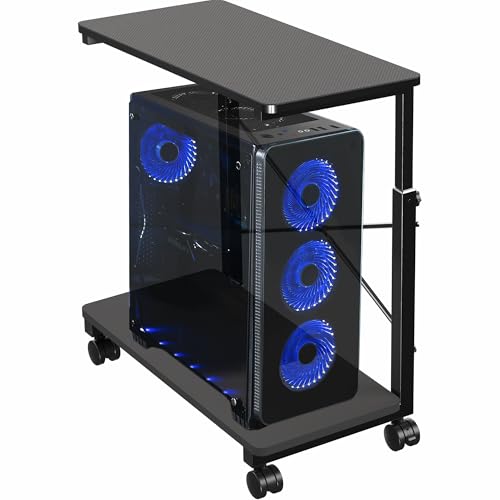
Carts add a second shelf for a printer, a UPS, or storage, turning the tower’s footprint into vertical utility in a small room. Compact stands serve smaller cases and tighter corners with the same lift-and-breathe logic at a smaller scale. Both are legitimate answers to space problems; both need their limits respected on case width and total load behaviour.
The carpet problem is physics, not fussiness
Most modern towers draw their power supply air from underneath. The PSU sits at the bottom of the case, its fan facing down, pulling cool air through a filtered intake on the case floor. Set that case directly on carpet and the pile rises into the intake, the filter mats with fibres, and the fan works against a half-closed door every hour the machine runs. The result is not instant failure; it is a slow tax of higher temperatures, louder fans, and dust paste baked onto a filter you cannot reach without tipping the machine. A stand breaks that cycle with the simplest possible intervention: distance. Even a modest lift restores a clear air gap under the case, lets the intake breathe room air instead of carpet fibres, and turns filter cleaning into a slide-out job instead of a furniture-moving event.
Dust lives at floor level
The dirtiest air in any room is the air nearest the floor. Foot traffic kicks up fibres, pet hair drifts and settles there, and every door swing pushes a slow current of grit along the skirting board exactly where a floor-standing tower breathes. Raising the case even a short distance moves its intakes out of that sediment layer, and the difference shows up months later when you open the side panel and find grey felt on the fans of a floor machine but only a light film on a raised one. A stand will not make a dusty room clean, and it does not replace filter maintenance, but it changes the rate at which the machine eats the room. For allergy-sensitive households and homes with shedding pets, that slower rate is often the single most practical reason to buy one.
Top Picks at a Glance
Best Overall rolling frame: the Eureka Ergonomic CPU Stand, for its adjustability across case sizes. Best for Carpet: the BESIGN Computer Tower Stand, a ventilated platform aimed squarely at bottom intakes. Best for a Permanent Desk: the HUANUO CPU Holder, which removes the tower from the floor entirely. Best for Small Rooms: the LORYERGO Computer Tower Stand, whose second shelf earns its footprint. Best Simple Default: the VIVO CPU Stand, plain, adjustable, and easy to live with. All five are prose-only shortlist entries in this guide while verification is pending, so confirm the current listing details before buying.
Eureka Ergonomic CPU Stand
Best for: best overall rolling frame. This is a prose-only recommendation while verification is pending, so treat it as a shortlist entry to check against the current listing before you buy.
an adjustable-width rolling stand built around a steel frame and four caster wheels, two of which lock. The width adjusts by sliding the side rails, so one stand can follow you from a slim office case to a wider gaming tower, and the open frame leaves the sides of the case largely exposed to room air. In daily use its personality is practical rather than pretty: it rolls smoothly on hard floors, shrugs off the bumps of weekly cleaning, and keeps the bottom of the case far enough off the ground that a vacuum nozzle passes underneath without moving the machine. The trade-off is that the open rails demand an honest width check, because a case whose feet sit wider than the rail span will perch instead of settle.
Whichever stand you choose from this shortlist, run the same three checks before the return window closes: settle the case and shake-test it at shoulder height, confirm no rail or lip covers an intake on your specific case, and roll the tower to its fully serviced position to prove every cable has slack to spare. A stand that passes those three tests in your room is the right stand, whatever any review says.

VIVO CPU Stand
Best for: best simple default. This is a prose-only recommendation while verification is pending, so treat it as a shortlist entry to check against the current listing before you buy.
a straightforward adjustable floor stand from a brand better known for monitor arms, built with the same plain, functional approach. The width adjusts to grip the case, the casters roll without drama, and the frame keeps a low profile that disappears under a desk. It does nothing exotic, and that is the point: it is the sensible default for someone who wants the tower off carpet, wants to roll it out for cleaning, and does not want a piece of furniture doing it. Check the rail position against your case feet before ordering, and plan on locking the wheels once the tower is parked, because an unlocked stand turns every cable tug into slow drift.
Whichever stand you choose from this shortlist, run the same three checks before the return window closes: settle the case and shake-test it at shoulder height, confirm no rail or lip covers an intake on your specific case, and roll the tower to its fully serviced position to prove every cable has slack to spare. A stand that passes those three tests in your room is the right stand, whatever any review says.
HUANUO CPU Holder
Best for: best for a permanent desk. This is a prose-only recommendation while verification is pending, so treat it as a shortlist entry to check against the current listing before you buy.
an under-desk mount that suspends the tower from the underside or side of the desk instead of standing it on the floor. Hanging the case frees the entire floor area for your feet, a footrest, or a subwoofer, and it lifts the machine completely out of the dust layer that lives at carpet level. The design asks more of the installer: the desk must be solid enough to carry the weight, the mount must be adjusted so the case hangs level, and cable slack has to be planned because a hanging tower still needs to slide or swing for rear-panel access. For a permanent setup that rarely moves, it is one of the cleanest solutions in this category.
Whichever stand you choose from this shortlist, run the same three checks before the return window closes: settle the case and shake-test it at shoulder height, confirm no rail or lip covers an intake on your specific case, and roll the tower to its fully serviced position to prove every cable has slack to spare. A stand that passes those three tests in your room is the right stand, whatever any review says.
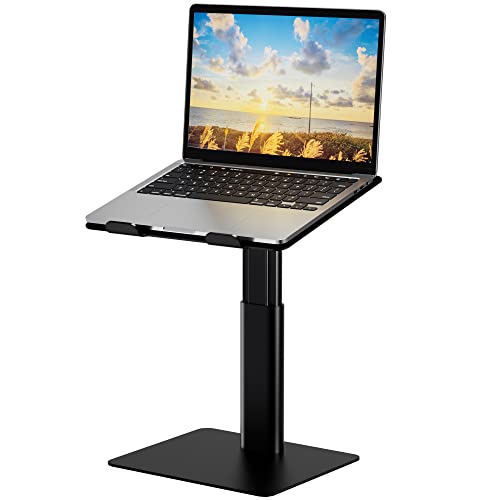
BESIGN Computer Tower Stand
Best for: best for carpet airflow. This is a prose-only recommendation while verification is pending, so treat it as a shortlist entry to check against the current listing before you buy.
a ventilated platform style stand that leans into airflow, with an open or mesh surface intended to let a bottom-mounted power supply breathe. That focus makes it a natural recommendation for towers that live on carpet, where the PSU intake faces down into pile that chokes it. The platform approach also spreads the load, which helps stability, and the modest lift still makes a real difference to dust and to mopping around the machine. What it gives up is drama in mobility: platform stands roll or slide less eagerly than tall caster carts, so if you pull your tower out every week to swap cables, a wheeled frame may serve you better.
Whichever stand you choose from this shortlist, run the same three checks before the return window closes: settle the case and shake-test it at shoulder height, confirm no rail or lip covers an intake on your specific case, and roll the tower to its fully serviced position to prove every cable has slack to spare. A stand that passes those three tests in your room is the right stand, whatever any review says.
LORYERGO Computer Tower Stand
Best for: best for small-room storage. This is a prose-only recommendation while verification is pending, so treat it as a shortlist entry to check against the current listing before you buy.
a two-tier mobile cart style stand that pairs a tower shelf with a lower platform often used for a printer, a small UPS, or storage boxes. That second shelf is the reason people choose it: in a cramped desk corner it turns dead vertical space into working storage while the tower rides above floor level. The casters make the whole stack movable for cleaning or cable work, and the raised edges help the case stay put during a roll. Its weakness is footprint and temptation, because a loaded second shelf raises the centre of gravity, so it suits calm rooms and deliberate pushes rather than fast drags across thresholds.
Whichever stand you choose from this shortlist, run the same three checks before the return window closes: settle the case and shake-test it at shoulder height, confirm no rail or lip covers an intake on your specific case, and roll the tower to its fully serviced position to prove every cable has slack to spare. A stand that passes those three tests in your room is the right stand, whatever any review says.
How Wide Is Your Case at Its Feet?
Width adjustability versus case feet
Adjustable width is the headline feature of most stands, and the detail that decides whether it works is not the case body but the case feet. Towers rest on feet or rails that may sit narrower than the decorative side panels, or wider than the main shell on designs with outrigger feet. A stand grips or cradles the case at its base, so measure the footprint at the feet, including any rubber pads, and compare that with the stand’s adjustment range described in plain terms by the maker. If the feet land outside the stand’s rails, the case perches on panel edges, rocks under cable pressure, and can walk itself off during a roll. A stand that truly fits feels boring: the case settles, a firm two-handed shake produces no rattle, and nothing shifts when you lock the wheels.
Never let rails block an intake
Side and front intakes are easy to overlook when a stand’s rails or lips wrap the bottom edges of a case. Some towers breathe through low front vents, perforated side panels near the base, or a bottom-front intake that a tall stand lip can quietly cover. Before committing, crouch down and map where your case actually inhales. Then picture the stand around it. Rails should contact the case at structural points, below or beside vents, never across them. This is the one fitting mistake that can make a stand worse than the floor it replaced, because a blocked side intake starves components that the floor never threatened. Five minutes with a torch and a tape measure prevents the only genuinely harmful outcome in this whole category.
What Floor Does the Tower Live On?
Hard floors change the calculation, not the verdict
On hardwood, tile, or laminate, the airflow emergency disappears, because a hard surface does not rise into a bottom intake. The case for a stand becomes about protection and access instead. Stands keep case feet off surfaces that mop water can reach, stop the slow grinding of grit trapped under a heavy tower every time it is nudged, and prevent the ring of compacted dust that forms around a static machine. Rolling access still matters in a tight desk bay. What changes is urgency and style: a low platform or a simple riser may serve a hard-floor setup perfectly, while the full locking-caster cart earns its keep where the tower must move often. Match the stand to the floor and the habit, not to the most dramatic sales pitch.
The carpet problem is physics, not fussiness
Most modern towers draw their power supply air from underneath. The PSU sits at the bottom of the case, its fan facing down, pulling cool air through a filtered intake on the case floor. Set that case directly on carpet and the pile rises into the intake, the filter mats with fibres, and the fan works against a half-closed door every hour the machine runs. The result is not instant failure; it is a slow tax of higher temperatures, louder fans, and dust paste baked onto a filter you cannot reach without tipping the machine. A stand breaks that cycle with the simplest possible intervention: distance. Even a modest lift restores a clear air gap under the case, lets the intake breathe room air instead of carpet fibres, and turns filter cleaning into a slide-out job instead of a furniture-moving event.
How Often Will the Tower Actually Move?
Cleaning access is the quiet headline benefit
Ask long-term stand owners what changed and most will not mention temperatures first; they mention cleaning. A tower on casters or a raised platform can be rolled or slid out in seconds, the floor beneath it vacuumed, the filters pulled, the rear cables inspected, and the whole machine returned before the kettle boils. Compare that with a floor tower in a tight corner, which effectively gets cleaned when something goes wrong. Regular, easy cleaning compounds: filters stay effective, fans stay quieter, and small problems like a fraying cable or a dusty GPU intake get spotted during routine passes instead of during a failure. A stand converts maintenance from a project into a habit, and habits are what actually keep machines healthy over years.
The rear panel is where stands prove themselves
Every meaningful interaction with a tower happens at the back: display cables, network, power, USB hubs, audio. A good stand makes the rear panel reachable without a wrestling match, either by rolling the machine out and turning it, or by holding it at a height where connectors can be seen rather than felt. Judge a stand by imagining your most common rear-panel task at midnight, tired, with a torch in your teeth. If the picture involves dragging a heavy case across carpet by its front panel, the current setup is failing you and a stand fixes a real problem. If your tower already lives somewhere accessible, the same stand is a mild convenience, and your money may do more elsewhere in the setup.
Lock the casters before you lean on the cables
A rolling stand introduces a failure mode that a static tower never has: the machine can move when you do not want it to. The classic accident is leaning across the desk, bumping the tower with a knee, and watching it roll just far enough to tension every cable at the back. Locking casters exist precisely for this. Once the tower is parked in its working position, lock every lockable wheel, and treat unlocking as part of a deliberate move, like unplugging a cable. If a stand offers only two locking wheels, park those at the front where your knee arrives first. A stand that cannot be locked at all belongs in a calm corner, not beside a chair that spins, a standing desk that travels, or a toddler with ambitions.
How Much Cable Slack Can You Give It?
Cable slack is part of the product
The moment a tower can roll, its cables become a system you have to design. Power, display, network, and USB leads all need enough slack to let the tower travel from its parked spot to a fully accessible position, turned so the rear panel faces you, without any connector taking the strain. Too little slack and the first cleaning session yanks a display cable at an angle its port will not forgive. Too much and the excess pools behind the desk collecting dust. The sweet spot is a gentle service loop: enough spare cable, loosely bundled, to roll the tower out, work on it, and roll it back. When you read any computer tower stand review, weigh this honestly, because the stand is only half the purchase; the cable plan is the other half.
Stability is a system, not a spec
A tower is tall, heavy, and top-biased once drives, coolers, and a large graphics card are aboard. On a stand, stability comes from the whole system: a footprint at least as wide as the case base, casters that do not wobble in their sockets, rails that contact the case evenly, and a floor that is level enough not to invite rolling. Test any new setup with intent. Park the tower, lock the wheels, then push the case gently at shoulder height from the side, the way a chair arm or a hip would. It should flex as one unit and settle, not rock, skate, or twist. If it does any of those, the fix is fit, not hope: re-seat the case, widen or narrow the rails, move the stand to level ground, and test again before cables go on.
How to Prioritise by Use Case
The carpeted gaming setup should rank airflow first, fit second, and mobility third: a ventilated platform or a wide rolling frame, filters on a monthly rhythm. The tidy home office on hard floors should rank access and looks first, because airflow is already adequate; a plain rolling stand or an under-desk holder keeps the floor clear and the machine serviceable. The small shared room should rank footprint and stability first, considering the two-tier cart or a compact stand, with locks treated as mandatory. The workshop or test bench, where machines swap constantly, should rank adjustability above all, because the stand will meet a new case every few months.
Small rooms and shared spaces
In a bedroom-office, a dorm, or a shared flat, a tower on the floor is furniture everyone trips over and nobody owns. A stand tidies that social contract. The machine gains a defined parking spot, rolls aside for vacuuming the room properly, and stops migrating slowly across the floor on cable tension, as floor towers mysteriously do. For shared machines, the ability to roll the tower to whoever is upgrading or troubleshooting it is worth more than any thermal argument. Just agree the parking spot and the lock habit with everyone who uses the room, because a rolling tower in a shared space will be rolled, and the person who finds out the casters were unlocked will find out with their knee.
Heat sources and sunlight still matter
A stand lifts a tower; it does not choose where the tower lives. Keep the raised machine out of the same bad neighbourhoods as any tower: hard against a radiator, in a sunbeam through south-facing glass, inside a closed cabinet with the door shut, or with its exhaust blowing straight into a wall two inches away. Exhaust air needs somewhere to go and intake air needs to arrive at room temperature, not pre-heated by a heater. The stand’s contribution is that it makes repositioning easy, so when you notice the tower baking beside a heat source in winter, moving it to a sane spot is a two-minute job instead of an afternoon of cable archaeology.
First Setup and Care Essentials
Set the width before loading the case, settle the tower with two hands, shake-test at shoulder height, lock every lockable wheel, and route cables with a service loop long enough for a full roll-out and turn. In the first month, do one full clean so the routine exists before it is needed. After that, a monthly filter check and a twice-yearly interior pass will keep a raised tower visibly cleaner than its floor-bound past, and an annual check of casters, rails, and locks keeps the stand itself honest.
Mistakes to Avoid
Do not measure the case at its widest decorative panel and order to that number; the feet decide fit. Do not let a rail or lip cross any intake, however minor it looks. Do not skip the locks because the room feels calm; the one bump that matters has not happened yet. Do not strangle the cables to keep the back of the desk pretty; slack is a safety feature. And do not buy a stand to fix a tower that lives beside a radiator or inside a closed cabinet, because placement problems outrank stand problems every time.
Going Deeper: Living With a Raised Tower
Weight deserves a calm word. A loaded gaming tower is heavier than it looks, and it will be lifted rarely but moved often once it can roll. Spread that weight across four sound casters or a full platform, never across a frame that flexes visibly when the case settles. Flex is information: it tells you the stand is working at the edge of its comfort, and edges are where slow failures live. A frame that sits flat, silent, and unmoved under the machine is the entire goal, and it is achievable at every tier of this market when the fit is right.
Consider the life of the machine, not just its first month. Towers get opened for storage upgrades, graphics card swaps, deep cleans, and the occasional mystery rattle. Every one of those jobs starts with moving the machine to where you can work. A stand turns that start from a deadlift into a roll, which matters more with each passing year and each heavier component. People keep stands through two or three successive computers, adjusting the width for each new case, which is why buying for adjustability and build honesty beats buying for a single case’s exact silhouette.
Noise is an underrated part of this decision. A tower sitting directly on a hard floor couples its vibration into that floor, and a resonant floorboard or desk leg can turn a mild hum into a room-filling drone. A stand with sound feet or casters breaks some of that coupling, and lifting the machine off carpet stops the muffled, strained fan note of a suffocated intake. None of this replaces quiet components, but many owners are surprised how much of their machine’s voice was the floor’s, and how much calmer the room feels once the tower rides on a proper base.
If you rent, a stand quietly protects your deposit. Towers on carpet crush pile into a permanent-looking rectangle, trap grit that grinds finishes on hard floors, and can rust-stain or scuff when a heavy case is dragged rather than lifted. A stand keeps the machine’s whole footprint on its own wheels or feet, concentrates contact into small replaceable points, and makes the difference between a room that shows a computer lived there and one that does not. It is the least exciting reason on this page and, for some households, the one that pays back most concretely.
Children and pets rewrite the risk table. A floor tower is at exactly the height for a toddler’s exploratory fingers near intake fans and a cat’s preferred warm sleeping spot on top, shedding hair directly into every vent. Raising and defining the machine’s place does not make it childproof, and cables still need respect, but a locked stand removes the slow creep of a tower being nudged, climbed, and used as a step. In homes where the floor is a thoroughfare for small feet and paws, stability and locks stop being features and become the whole decision.
Finally, buy the stand for the room you have. Measure the desk bay, the gap beside the desk, the route the tower will roll when it comes out, and the door swing or chair path that crosses that route. A stand that fits the case but not the room will spend its life half-parked at an angle, casters unlocked because locking them is awkward, cables taut because the parking spot is a compromise. The right stand disappears into the room’s routines: parked square, locked without thought, rolled out along a clear path, and back again in under a minute.
Think of the stand as part of the case’s environment rather than an accessory bolted onto it. Cases are designed assuming they sit on a flat, hard, clear surface with room to breathe on every side the designer vented. Floors in real homes offer carpet pile, dust, mop water, kicked grit, and the occasional spilled drink. The stand is the adapter between the designer’s assumption and your actual room, and like any adapter it should be invisible when it works: the machine sits level, breathes freely, and moves only when you decide it moves.
There is a simple test for whether your current setup needs help. Run the machine under a normal load for twenty minutes, then slide a hand under the case and feel the intake area and the floor beneath. Warm, still, dusty air and a matted filter tell you the bottom of the case is living in a microclimate of its own making. A stand changes that microclimate more than any other single change at this scale, because it attacks the cause, restricted and dirty air at the intake, rather than the symptoms inside the case.
Weight deserves a calm word. A loaded gaming tower is heavier than it looks, and it will be lifted rarely but moved often once it can roll. Spread that weight across four sound casters or a full platform, never across a frame that flexes visibly when the case settles. Flex is information: it tells you the stand is working at the edge of its comfort, and edges are where slow failures live. A frame that sits flat, silent, and unmoved under the machine is the entire goal, and it is achievable at every tier of this market when the fit is right.
Consider the life of the machine, not just its first month. Towers get opened for storage upgrades, graphics card swaps, deep cleans, and the occasional mystery rattle. Every one of those jobs starts with moving the machine to where you can work. A stand turns that start from a deadlift into a roll, which matters more with each passing year and each heavier component. People keep stands through two or three successive computers, adjusting the width for each new case, which is why buying for adjustability and build honesty beats buying for a single case’s exact silhouette.
Noise is an underrated part of this decision. A tower sitting directly on a hard floor couples its vibration into that floor, and a resonant floorboard or desk leg can turn a mild hum into a room-filling drone. A stand with sound feet or casters breaks some of that coupling, and lifting the machine off carpet stops the muffled, strained fan note of a suffocated intake. None of this replaces quiet components, but many owners are surprised how much of their machine’s voice was the floor’s, and how much calmer the room feels once the tower rides on a proper base.
Sizing and Compatibility Checks to Run Before You Decide
Plan the consumables and spares shelf
Ownership of a computer tower stand usually involves a small ecosystem of consumables, refills, replacement parts or spares, and availability matters as much as the unit itself. Check that the refills your shortlisted models need are standard, stocked by more than one seller, and replaceable without tools you do not own. A model tied to a single obscure consumable becomes a liability the moment that line is discontinued, whereas a computer tower stand built around common refills stays useful for years. Keep one spare of the fastest-wearing part from day one.
Run the two-week test on paper
Imagine the computer tower stand arriving today and simulate the next two weeks of use in detail: where it sits, what you do with it on a normal weekday, what happens on the busiest day, and where it goes when guests arrive or the room is cleaned. This simple rehearsal exposes storage gaps, missing accessories and workflow clashes that specification tables never show. If the simulation produces friction in a busy shared workspace where several people use the same setup across the day, adjust the shortlist now, while the fix is a different model rather than a return label and a refund wait.
Decide your return-risk tolerance in advance
Some computer tower stand choices are easy to judge from a listing and some only reveal themselves in the hand, in the room, or in your software. If your shortlist includes a model you are judging on feel, fit or noise, buy from a seller whose returns process you have actually read, and keep the packaging intact until the first full week of use is done. Knowing your exit route in advance lets you choose the bolder option on the shortlist without gambling, and it removes the pressure to keep a computer tower stand that is merely acceptable.
Start with the space, not the shortlist
Before comparing a single computer tower stand, measure the space it has to live and work in, and write the numbers down. Footprint is only the start: allow for cables, ventilation, doors or lids that swing open, and the room your hands need to load, adjust or clean it. In a busy shared workspace where several people use the same setup across the day, a model that fits on paper can still fail in practice because access is blocked or a cable run has nowhere tidy to go. Measuring first turns the Desks shortlist from a wish list into a filtered list where every remaining option is physically plausible.
Check compatibility against what you already own
A computer tower stand rarely works alone, so list the devices, mounts, media, software or accessories it must cooperate with, and check each pairing against the listing details rather than assuming standards guarantee harmony. Connector versions, physical clearances, supported formats and control apps are the usual friction points. When picks such as VIVO CPU Stand, HUANUO CPU Holder and BESIGN Computer Tower Stand are on your shortlist, run this check against each listing in turn. Where a listing is vague about a pairing you depend on, treat that silence as a risk to resolve before ordering, not a detail to discover afterwards. Compatibility failures are the most common reason a well-reviewed computer tower stand gets returned.
Keep the notes with the product’s paperwork; they become the baseline every later adjustment is judged against.
Write the conclusion of that check down before you order, so the decision survives contact with a tempting listing.
That single habit separates owners who stay pleased with their choice from owners who quietly start shopping again within a season.
Frequently Asked Questions
Does a computer tower stand actually help cooling?
It helps only by removing an obstruction. If your tower sits on carpet with a bottom-mounted power supply intake pressed into the pile, lifting it restores the airflow the case was designed for, and temperatures and fan noise usually settle back to normal. If the tower already sits on a hard floor with clear intakes, a stand will not meaningfully change component temperatures. Its reliable benefits in that case are cleaner filters, easier cleaning access, and protection from mop water and grit. Think of it as restoring design conditions, not as an active cooling upgrade.
Will any stand fit my case?
No, and fit is the one thing to verify before ordering. Measure your case at its feet, including rubber pads or outrigger feet, because that footprint is what the stand actually holds. Compare it with the stand’s adjustment range and picture where the rails will touch the case. The rails must contact structure, not vents, and the case should settle without rocking. Very wide gaming cases, cases with decorative side bulges, and small-form-factor machines are the usual exceptions that need a specific style, such as a platform or an under-desk holder, rather than a generic adjustable frame.
Are caster stands safe for an expensive gaming PC?
They are, provided three habits hold. First, the fit must be honest, with the case settled on its feet inside the rails. Second, the locking wheels must actually be locked whenever the tower is parked, so a knee bump cannot start it rolling. Third, the cables need a service loop with enough slack for the tower to roll out fully without tension on any connector. Break any one of those and a caster stand becomes a risk; honour all three and it is one of the most practical upgrades a desk setup can get, because service and cleaning become effortless.
Is an under-desk holder better than a floor stand?
It depends on how settled your setup is. A holder frees the entire floor, lifts the tower completely out of the dust layer, and looks exceptionally tidy, which makes it ideal for a permanent workstation on a solid desk. A floor stand wins on flexibility: it moves between desks and rooms, needs no installation into furniture, and lets the tower roll out for quick cable work. Renters, frequent upgraders, and anyone whose desk is thin or hollow should lean toward the floor stand. Settled owners with a sturdy desk can enjoy the holder’s clean result.
How often should I clean a tower that sits on a stand?
The stand makes cleaning easy enough that a light routine sticks. A sensible rhythm is a quick filter check every month or two, pulling the tower out, sliding the bottom filter free, and tapping or rinsing it as the maker allows, plus a deeper interior dust pass a couple of times a year. Homes with shedding pets or carpeted rooms should lean toward the shorter interval. The real change a stand brings is that each session takes minutes, so the schedule survives contact with real life instead of slipping until the fans announce the problem.
Can a stand damage my floor or carpet?
A good stand is kinder to floors than the tower itself. It concentrates contact into small caster or foot points that can be fitted with pads, stops the grit-grinding that happens when a heavy case is dragged, and prevents the crushed rectangle a static tower presses into carpet pile. Casters should be chosen for the surface: softer wheels for hard floors, and a check that locked wheels do not creep. The one caution is point load on very soft flooring, where a platform style that spreads weight over a wider area is the safer choice.
Related Guides
Keep exploring this cluster and the surrounding setup topics: computer tower stand review; computer tower stand reviews; computer tower stand pros and cons; is a computer tower stand worth it; how to choose a computer tower stand; desks built for a desktop and tower; cable management options for desks; PC cases suited to liquid cooling; CPU coolers for desktops; desks for PC setups.