ilcastellomenu.com is reader-supported. When you buy through links on our site, we may earn an affiliate commission.
Where to Buy
A blog lives or dies on its pictures, and the best cameras for blog pictures are not necessarily the best cameras full stop. A blogger shoots flat-lays on a kitchen table, portraits in a café window, products against a bedroom wall, street scenes on a trip — usually alone, usually quickly, and usually in light nobody chose. The six cameras below are all current models from our verified pool, and each one earned its place by being good at that specific, unglamorous, everyday work rather than at impressing a spec sheet.
Consider what blog photography actually asks of a camera. It asks for colour that looks right the moment the file lands on your phone, because a blogger editing thirty images before lunch has no time to rescue bad skin tones. It asks for a screen that flips, because half the pictures are of the blogger. It asks for files that move to a phone in seconds, because the post goes out today. And it asks for a camera small enough to be carried on the days when nothing was planned, because the unplanned photograph — the market stall, the sudden light in an alley — is usually the one readers remember. Resolution beyond a sensible point barely matters; the blog will shrink the file anyway. Consistency, speed and charm matter enormously.
The six picks divide by temperament. The Canon EOS R50 and Sony ZV-E10 II are the sensible system cameras: interchangeable lenses, proper controls, room to grow. The Fujifilm X100VI is the beautiful fixed-lens instrument that makes ordinary streets look like film stills. Canon’s PowerShot G7 X Mark III and Sony’s ZV-1F are the pocket companions, one with a real zoom and enthusiast controls, the other pared down to joyful simplicity. And the Fujifilm Instax Mini 12 is the wildcard — an instant camera whose physical prints give a blog something no screen can: objects to photograph, scan, pin and give away. We will match each to its blogger, then work through the craft: light in ordinary rooms, flat-lay discipline, self-portrait technique, and the workflow that keeps a blog fed without eating the blogger’s week.
Key Takeaways
- For blog pictures, colour straight from the camera beats resolution: your readers see the file at screen size, but they feel the colour immediately.
- A fully flipping screen is close to essential — the blogger is usually also the model, the stylist and the tripod carrier.
- Fast, painless transfer to a phone decides whether a camera gets used daily; the best blog camera is the one whose pictures reach the post today.
- Small and carried beats large and perfect: two pocket picks and one fixed-lens camera are here because unplanned pictures are a blog’s lifeblood.
- One good lens used constantly teaches you more than a bag of lenses used rarely — the system picks shine with a single fast prime.
In this guide
Quick Picks
| Pick | Badge | Why it is here |
|---|---|---|
| Canon EOS R50 | Best all-round blog camera | Friendly controls, lovely colour, a flip screen and a lens system to grow into — the complete starter package. |
| Sony ZV-E10 II | Best for photo-and-video blogs | Built for creators who shoot stills and clips in the same hour, with the deepest lens shelf to grow on. |
| Fujifilm X100VI | Best for a signature look | Film-style colour and a fixed lens that gives a whole blog one unmistakable visual voice. |
| Canon PowerShot G7 X Mark III | Best pocket camera | A real zoom, a tilting screen and enthusiast bones in a camera that lives in a coat pocket. |
| Sony ZV-1F | Best simple selfie camera | Wide fixed lens, flip screen and almost nothing to learn — point, smile, post. |
| Fujifilm Instax Mini 12 | Best for tangible charm | Instant prints to scan, style and give away — a blog texture no digital file imitates. |
How Did We Choose These Picks?
We judged these cameras the way a blog actually uses them. Each was carried for ordinary days — market runs, café working sessions, a walk with no photographic intention — and used for the four staple blog shots: the flat-lay, the self-portrait, the product close-up and the street scene. We timed the path from shutter to phone, because a camera whose app fights you will quietly stop being carried. We looked hard at skin tones in mixed indoor light, the single most common failure in blog photography, and at how the cameras behave at the wide apertures bloggers love for background blur.
Three filters did most of the work. First, the flip test: can the blogger frame a self-portrait at arm’s length or on a mini tripod without guesswork? Every pick here passes, though the Instax passes by its own rules — you compose loosely and embrace the surprise. Second, the lunch test: can a set of pictures be shot, transferred, lightly edited and posted inside a lunch break? The system cameras and the G7 X pass comfortably; the X100VI’s film-style files often need no editing at all. Third, the growth test: does the camera still serve the blog in two years? For the system cameras the answer is lenses; for the fixed-lens picks it is the discipline and identity they impose, which many bloggers come to value more.
Everything listed is a current model we could verify in our pool, and we describe price only in tiers — this category’s prices wander too much for printed numbers to stay honest. Check the current price on Amazon from the links as you narrow your choice.
What Do Blog Pictures Actually Need from a Camera?
Less than camera marketing suggests, and different things than it emphasises. A blog displays images at a few hundred to a couple of thousand pixels wide; every camera here exceeds that so completely that resolution should be the last thing you compare. What readers actually respond to is light and colour: a bright, clean, warmly coloured image of a breakfast table outperforms a technically mighty but dull one every time. That is why this guide keeps returning to colour science, to lenses that open wide enough to soften a messy background, and to screens and apps that shorten the road from moment to post.
The second real need is repeatability. A blog is a visual serial: readers return partly because the world of the blog looks like itself. A camera with a consistent colour character — Fujifilm’s film simulations are the famous example, Canon’s portrait colour another — gives you that identity for free, while a camera you process differently every week never settles. Bloggers who shoot on phones often drift into filter-of-the-month inconsistency; a dedicated camera with a look you commit to is the quiet cure. Choose the character you can live with for a year, then let the camera’s consistency do your branding for you.

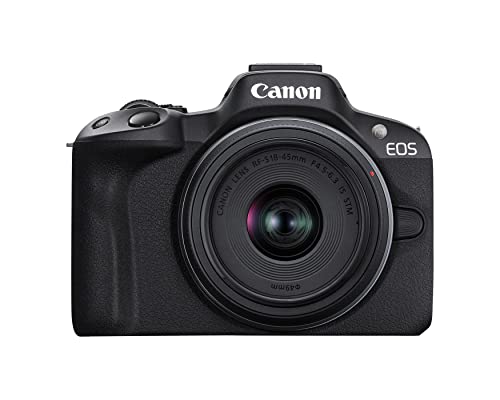
Canon EOS R50 — Best all-round blog camera
If a new blogger asked us for one camera and no further conversation, this is the one we would hand over. The R50 gets the fundamentals of blog life right in a way that feels considered rather than accidental: Canon’s colour — the rendering of skin that has made the brand the default choice for people photography for decades — a fully articulating screen for self-portraits and overhead flat-lays, an electronic viewfinder for bright days, and a menu system that a beginner can genuinely learn in a weekend. Its autofocus finds eyes and holds them, which quietly rescues the self-timer portraits every blogger shoots alone in a kitchen.
Paired with its kit zoom it covers the blog staples competently; paired later with a small fast prime it becomes a genuinely lovely portrait and product camera, and that upgrade path is the R50’s long game — the RF lens shelf behind it stretches from pocketable primes to serious professional glass, so the blog can grow without a change of system. The body is light enough to carry daily, the grip is secure for one-handed overhead shots, and the phone app transfer is painless enough to use at a café table. Its compromises are the honest ones of its class: the kit lens is a fair-weather friend in dim rooms, battery life asks for a spare on a full shooting day, and keen video makers may eventually want more. As a stills-first blog camera that also shoots perfectly good clips, it is the most complete answer here.
- Format: interchangeable-lens mirrorless, APS-C class sensor
- Screen: fully articulating touchscreen for selfies and overheads
- Colour: Canon portrait rendering, pleasing straight from camera
- Growth: full RF lens system behind it
Strengths
- Skin tones that flatter with no editing — the blogger’s shortcut.
- Eye autofocus that makes solo self-portraits routine.
- A lens system the blog can grow into for years.
Trade-offs
- Kit lens struggles in dim cafés; budget for a fast prime later.
- A spare battery is a wise companion on long days.
- Enthusiast video features are good rather than class-leading.
Best for: the new blogger who wants one camera to learn on and keep. Not suited for: the blogger who needs a pocket camera above all else.
One working habit suits the R50 particularly well: shoot your flat-lays tethered to your own eye via the flipped screen, standing on a chair over the table like every food blogger before you, and let the eye autofocus worry about the subject while you worry about the styling. Bloggers consistently tell us the R50 is the camera that finally made overhead shots stop being a lottery, and after a month of lunches shot from above, we believe them.

Sony ZV-E10 II — Best for photo-and-video blogs
Many blogs are quietly becoming video channels with a written archive, and the ZV-E10 II is built for exactly that hybrid life. It shoots stills with the competence of Sony’s well-proven APS-C line — fast, certain autofocus, a huge lens catalogue — and then turns around and records creator-focused video with the same lens, the same screen, the same bag. For the blogger whose post includes a recipe photograph at nine and a sixty-second clip of the same dish at ten, that seamlessness is the whole argument.
The details lean creator-ward: a flip screen, product-showcase focusing that snaps to an item held up to the lens, background-defocus control for the talking-to-camera pieces, and microphone options that grow from the built-in array to proper external audio. Stills photographers get Sony’s colour, which runs cooler and crisper than Canon’s warmth — some bloggers prefer exactly that editorial clarity, especially for product and tech subjects. The compromises: there is no viewfinder, which bright-day stills shooters will miss; the body prioritises video ergonomics, so stills purists find the handling less classic; and the lens you choose matters enormously, since the kit options are merely adequate. Buy it with a good prime and it is a two-medium studio that fits in a tote bag.
- Format: interchangeable-lens mirrorless, creator-focused
- Screen: flip-out touchscreen, no viewfinder
- Focus: eye tracking plus product-showcase mode
- Lenses: the deepest mirrorless catalogue available
Strengths
- Stills and video in one body with no workflow seam.
- Product-showcase focus was designed for bloggers’ hands.
- Enormous lens choice at every budget tier.
Trade-offs
- No viewfinder for bright-day composition.
- Kit lenses undersell what the sensor can do.
- Handling favours video shooters over stills traditionalists.
Best for: the hybrid blogger publishing pictures and clips together. Not suited for: the stills-only purist who lives through a viewfinder.
Bloggers running a shop alongside the blog should look twice at this one: the product-showcase focus and the clean HDMI-friendly video make it the natural camera for the desk where the photographing, the filming and the livestream selling all happen within the same square metre. It is less a camera than a small content department, and for a one-person business that is precisely the point.

Fujifilm X100VI — Best for a signature look
The X100VI is the camera bloggers fall in love with, and unusually, the love is rational. Its fixed lens — a moderate wide angle that flatters tables, streets, rooms and faces in roughly that order — forces a visual consistency that becomes a blog’s identity. Its film simulations give straight-from-camera colour with a character readers recognise across a feed the way they recognise a typeface. Its hybrid viewfinder, dials and leaf-quiet shutter make the act of photographing feel deliberate, which slows a blogger down just enough to compose rather than spray.
In blog service it is the everyday-carry ideal: jacket-pocket slim, silent, unobtrusive in cafés, with a built-in flash for evening tables and image quality from its large sensor that embarrasses bigger cameras. The self-portrait workflow is its one friction — the screen tilts rather than fully flipping, so solo framing takes a little practice and a phone-as-monitor workaround for the perfectionist. You also accept the fixed lens as a discipline: no zooming with glass, only with feet. Bloggers who thrive on that discipline produce the most recognisable bodies of work in this entire guide; bloggers who photograph products at many distances will chafe. Know which you are, because this camera rewards commitment and punishes ambivalence — and holds its value and its charm longer than anything else here.
- Format: fixed-lens premium compact, large APS-C class sensor
- Lens: moderate wide prime, leaf-quiet shutter
- Colour: film simulations with a devoted following
- Screen: tilting, with hybrid optical-electronic viewfinder
Strengths
- A built-in visual identity for the whole blog.
- Carried daily because it is small, quiet and beautiful to use.
- Files that frequently need no editing at all.
Trade-offs
- Fixed lens: you zoom with your feet or not at all.
- Tilting screen makes solo self-portraits a learned skill.
- Demand keeps it scarce and firmly premium-tier.
Best for: the blogger building a recognisable visual world. Not suited for: product shooters who need many focal lengths daily.
A note on availability, because it shapes real decisions: this camera is famously hard to buy at short notice. Bloggers who decide it is the one should order patiently and keep shooting with whatever they have meanwhile — the look can be approximated, the habit cannot be postponed. When it arrives, its first month of daily carry will teach you more about your own seeing than a year of interchangeable-lens indecision.

Canon PowerShot G7 X Mark III — Best pocket camera
The G7 X Mark III is the camera that disappears into a coat and reappears at the exact moment a blog post is born: the unexpected bakery, the friend’s new studio, the light doing something brief and unrepeatable in a side street. Its one-inch-class sensor and real zoom lens cover the blogger’s working range — wide for interiors and tables, short telephoto for portraits and details — and its tilting screen flips up for the selfie check that pocket cameras used to make impossible.
It behaves like a small enthusiast camera rather than a toy: proper exposure controls, raw files if you want them, Canon colour if you shoot JPEG and go. The app path to the phone is quick, and the whole package asks so little of its owner that it gets carried on days when a system camera would stay home — which, for blog material, is the decisive statistic. Compromises are those of size: the small sensor works harder in dim rooms, autofocus is a step behind the system cameras, and battery life is a pocket camera’s, so a spare in the other pocket is the seasoned move. For the blogger whose best material is found rather than staged, it remains the pocket benchmark in this guide.
- Format: premium compact, one-inch-class sensor, real zoom
- Screen: tilts up for selfies and down for overheads
- Controls: enthusiast dials and raw capture
- Carry: genuinely pocketable, everyday weight
Strengths
- The zoom range covers tables, streets and portraits.
- Canon colour and quick phone transfer keep posts moving.
- Small enough to be present for unplanned material.
Trade-offs
- Dim interiors test the smaller sensor.
- Autofocus trails the mirrorless picks.
- Carry a spare battery on long days out.
Best for: the roving blogger whose posts begin as found moments. Not suited for: studio product work needing interchangeable lenses.
Street-market bloggers swear by one specific trick with this camera: the screen tilted to waist level, the camera held low and unobtrusive, framing by feel after a week of practice. It produces the candid, immersed photographs that make travel and city blogs feel alive rather than observed, and the little Canon’s quiet shutter and innocent looks keep it welcome where a big camera would change the room.

Sony ZV-1F — Best simple selfie camera
The ZV-1F asks a fair question: what if a blog camera removed everything except the selfie and the snapshot, and did those two things with total reliability? Its lens is a fixed wide angle — wide enough that an arm’s-length self-portrait includes you, your friend and a meaningful slice of wherever you are — its screen flips fully, its face and eye detection simply works, and its controls have been pared to the point where a complete beginner is shooting confidently within the hour.
That simplicity is a feature with a real constituency: the blogger who writes beautifully, photographs reluctantly, and needs the camera to be the least interesting problem in the process. Colour is bright and social-ready, the defocus switch blurs a background with one touch for the talking-to-camera pieces, and the whole thing is light enough to live on a mini tripod in a handbag. The honest limits follow from the same design: a fixed lens means your feet do the zooming, the smaller sensor is a daylight-and-good-light tool, and there is no viewfinder or much manual depth for the blogger who later falls in love with photography itself. As a first rung it is perfectly placed; some will climb from it to the ZV-E10 II within the same brand’s logic, and the ZV-1F will still serve as the spare that lives in the car.
- Format: fixed wide-lens compact, creator-simplified
- Screen: fully flipping for self-portraits
- Focus: face and eye detection, one-touch background blur
- Learning curve: the gentlest in this guide
Strengths
- Arm’s-length selfies framed right, first try, every try.
- Almost nothing to learn — writing stays the main job.
- Featherweight on a mini tripod or in a bag.
Trade-offs
- Fixed lens and smaller sensor cap its ambitions.
- Low light is not its home territory.
- Little room to grow if photography hooks you.
Best for: the writer-first blogger who needs pictures without a new hobby. Not suited for: anyone planning serious product or low-light work.
Beauty and lifestyle bloggers in particular have adopted this little camera for a reason worth naming: its wide lens at arm’s length shows the outfit, the room and the face in one honest frame, which is the exact grammar of the genre. It flatters by context rather than by trickery, and its owners tend to describe it the way people describe a good assistant — unglamorous, indispensable, never the bottleneck.

Fujifilm Instax Mini 12 — Best for tangible charm
Every other camera here makes files. The Instax Mini 12 makes objects — small glossy prints that slide out of the camera and develop in your hand — and a certain kind of blog runs on exactly that tactility. The prints get pinned above desks, taped into notebooks, laid on flat-lays as props, scanned for a lo-fi post texture, and handed to the people in them, which no digital camera in this guide can do. Its own operation could not be simpler: twist the lens to wake it, let the auto exposure and the selfie mirror do their work, press the button.
As an image-maker it plays by instant rules: soft, bright, forgiving pictures with a nostalgic palette, best in decent light, with a close-up mode for the tabletop details. The per-print cost of film is the discipline — you compose because each frame is a small purchase — and bloggers who shoot it alongside a digital camera find the constraint sharpens both. It will not do your product photography, your low-light work or your archive; it is not trying to. It is the blog’s box of confetti: not the structure, but the thing readers remember and mention. Travel bloggers tucking a print into a café’s wall of travellers’ photos understand its economy perfectly — it buys belonging.
- Format: instant camera, credit-card-sized prints
- Exposure: fully automatic with selfie mirror and close-up mode
- Output: physical prints to scan, style and give away
- Skill needed: none — point, shoot, watch it develop
Strengths
- Produces props, gifts and textures no file can imitate.
- Absolute simplicity; anyone can use it at an event.
- The film cost teaches deliberate composition.
Trade-offs
- Film is a running cost per photograph.
- Image quality is charming, not exact — no product work.
- Dim rooms defeat its small flash quickly.
Best for: the blogger whose world includes paper, desks and people to give prints to. Not suited for: anyone needing it as their only camera.
One workflow worth stealing: photograph each finished blog project twice — once digitally for the post, once on the Instax for the wall above the desk. Over a year the wall becomes the blog’s true archive, the one visitors photograph when they visit, and more than one blogger has told us the little prints, not the posts, are what finally made the work feel real.
How Do the Six Compare Side by Side?
| Camera | Blog style it suits | Self-portrait help | Carry | Watch out for |
|---|---|---|---|---|
| Canon EOS R50 | General-purpose, growing blogs | Full flip screen, eye autofocus | Small bag | Kit lens in dim light |
| Sony ZV-E10 II | Photo-plus-video publishing | Flip screen, product showcase focus | Small bag | No viewfinder |
| Fujifilm X100VI | Signature-look storytelling | Tilting screen, takes practice | Jacket pocket | Fixed lens discipline |
| Canon PowerShot G7 X Mark III | Found-moment travel and city blogs | Tilt-up screen | Coat pocket | Dim-room limits |
| Sony ZV-1F | Writer-first, selfie-led blogs | Full flip screen, foolproof focus | Handbag | Fixed lens, daylight tool |
| Fujifilm Instax Mini 12 | Tactile, craft and journal blogs | Selfie mirror | Desk or tote | Film running cost |
How Do You Light Blog Pictures in Ordinary Rooms?
Start by turning off the ceiling light and moving the subject to the window; that single swap improves more blog photographs than any camera upgrade in this guide. Window light from the side gives shape and softness for free, and a white bedsheet or a large sheet of foam board opposite the window bounces fill into the shadows for the price of a coffee. Shoot your tables and portraits within two metres of that window and every camera here — even the little ZV-1F — will look a class above its price tier.
For evening and winter work, one inexpensive LED panel with a softening diffuser covers a desk, a product setup and a talking-to-camera frame; place it at forty-five degrees, raise it slightly above eye level, and resist mixing it with warm room bulbs, which split your colour into two arguments. Consistency again: the bloggers whose pictures look expensive have usually not bought more light, they have standardised the light they have — same window, same panel, same time of day — until their readers could recognise the room blindfolded.
What Makes a Flat-Lay Worth Stopping For?
The flat-lay is the blog’s signature dish, and its recipe is restraint. Choose a background with one texture — linen, weathered wood, a plain painted board — and let everything in the frame argue for its place: a hero object, two supporting objects, one living thing if the blog allows it, and negative space doing quiet work around them. Shoot directly overhead with the screen flipped so you can style without climbing down between frames, and nudge objects in small moves, checking the frame after each; the difference between cluttered and composed is usually three removals.
Light it from one side, never from directly above with a ceiling bulb, and watch the shadows — in a good flat-lay the shadows are part of the design, raking across the texture and giving the objects weight. The system cameras earn their keep here with their screens and their close-focusing primes, but the G7 X’s tilt-down screen was practically designed for the chair-standing blogger, and even the Instax contributes: its prints, scattered into the lay as props, are the genre’s favourite inside joke.
How Should a Blogger Shoot Self-Portraits Alone?
Build the ritual once and reuse it forever: a mini tripod that lives in your bag, a spot in your home with the good window, and the camera’s self-timer or phone remote set before you step into frame. Compose for the crop you will publish, leave space at the edges, and shoot in relaxed bursts — the frame after the laugh, not the laugh itself, is usually the keeper. Eye autofocus on the Canon and Sony picks has quietly abolished the old focus lottery; use it, and spend your attention on expression and hands, the two things that still betray a stiff self-portrait.
Wardrobe and background deserve thirty seconds of thought: a plain wall beats a busy room, a colour that separates you from that wall beats blending into it, and moving one distracting object out of frame beats editing it out later. Bloggers who post self-portraits weekly tell us the same secret in different words — the session is fifteen unhurried minutes, never three snatched frames, and the camera that makes those fifteen minutes pleasant is the camera that built their audience.
What Mistakes Make Blog Pictures Look Amateur?
The overhead ceiling light is the first: it hollows eyes, yellows food and flattens products, and it is switched on in more disappointing blog photographs than every other cause combined. Second is the mixed feed — a blog that changes filters, cameras and colour moods monthly never accumulates a recognisable world; pick a look and let repetition turn it into identity. Third is the horizon and the verticals: rooms shot with converging door frames and tilted tables read as careless even to readers who cannot name the fault, and every camera here has a grid and a level to prevent it.
Fourth, bloggers under-shoot the ordinary: they photograph the finished cake but not the floury hands, the tidy desk but not the working mess, and the blog loses the texture that made readers trust it. The cameras in this guide are all small enough to be present for the in-between moments — that presence is the entire point of choosing them. And fifth, the archive sin: pictures living only on a card or a phone, one accident from vanishing. A weekly offload to two places takes ten minutes and is the difference between a body of work and a rumour of one.
Final Recommendation
For most bloggers starting or restarting their picture habit, the Canon EOS R50 is the recommendation: it flatters people, forgives beginners, grows with the blog and asks the least compromise of any system camera here. If your blog is becoming a channel, step sideways to the Sony ZV-E10 II and let one body carry both media. Bloggers with an established voice who want it made visible should save for the X100VI and commit to its discipline. The G7 X Mark III serves the roving, found-moment blogger best, the ZV-1F removes every excuse for the writer who only needs honest selfies and snapshots, and the Instax Mini 12 belongs on the desk of any blogger whose world is made of paper and people. Choose by the blog you actually publish, and the pictures will start pulling their weight.
Related guides
Frequently Asked Questions
Do I really need a dedicated camera if my phone is good?
A good phone covers more than it used to, and for a text-led blog it may be enough. A dedicated camera earns its place through the flip screen and self-portrait workflow, consistent colour across years of posts, wide-aperture lenses that soften backgrounds, and the simple psychology of a tool whose only job is the blog’s pictures. Bloggers who shoot daily almost always end up preferring one. There is also the matter of the phone being your everything else — messages, maps, notes, the call you are expecting — and a photograph session that cannot be interrupted by a notification is worth more to a working blogger than any specification either device carries.
Which single lens should a system-camera blogger buy first?
A small fast prime in the moderate range — the classic nifty fifty equivalent for your sensor. It transforms dim cafés and portraits, teaches composition better than any zoom, and costs less than most accessories. Both the Canon and Sony picks here become visibly better cameras the day that lens arrives.
How many megapixels do blog pictures need?
Far fewer than any camera here offers. Blogs display at screen sizes, and even a future redesign with large hero images sits comfortably inside what the smallest sensor in this guide produces. Spend your comparison energy on colour, screens, lenses and transfer speed instead — those are the specifications your readers will actually perceive.
Can one camera handle both the blog and family life?
Happily — and it is a good test of a choice. The R50 and the G7 X in particular cross over without friction: quick enough for children, kind to skin tones, small enough for a day bag. A camera that serves both lives gets carried twice as often, and carried cameras are the whole thesis of this guide.
Is the Instax a serious tool or a toy?
It is a serious tool for a specific job: making physical photographs that become props, gifts, wall archives and a texture readers recognise. It will not replace a digital camera for a blog’s main photography, and judged as a replacement it disappoints; judged as an addition, it is the cheapest personality upgrade on this page. Bloggers who run workshops, markets or any real-world gathering find a second use for it too: a print handed to a stranger is a business card nobody throws away, and the small ritual of watching it develop together starts conversations that a screen never has.
What Does a Sustainable Weekly Blog-Photo Routine Look Like?
The bloggers who never run dry shoot in two modes. There is the session — one planned hour a week at the good window, tripod up, where the flat-lays, product shots and self-portraits for several posts are made in a batch while the light and the setup are already right. And there is the carry — the camera in the bag every day, harvesting the unplanned frames that give the blog its pulse. Batching kills the daily scramble; carrying kills the staged stiffness. Every camera in this guide was chosen to serve one mode superbly and the other adequately, and the routine matters more than the choice: a modest camera inside a real routine outproduces a superb camera waiting for inspiration, every single week of the year.
How Do You Choose Between a System Camera and a Fixed-Lens Camera?
Ask what your blog photographs most weeks, not on its best week. If the honest list spans products at arm’s length, portraits across a room and interiors of whole spaces, a system camera’s lenses will serve that range and the fixed-lens picks will frustrate you monthly. If the honest list is one table, one street, one face — the same subjects returning like characters — a fixed lens stops being a limitation and becomes the editorial discipline that makes the blog recognisable. Budget plays its part in tiers: a system camera is a first payment on a shelf of glass, while the X100VI and the compacts are complete purchases. Neither route is the grown-up one; both are simply different contracts with your future self, and the bloggers who choose deliberately almost never regret either.
What About Shooting Products for a Blog Shop?
Small commerce has its own photographic grammar: the product centred and honest, the scale made clear by a hand or a familiar object, the texture close enough to trust. The system cameras with a prime lens own this work in our list — focus close, open the aperture, let the background fall away — while the ZV-E10 II adds its product-showcase habits for the accompanying clips. Keep the light identical across the whole catalogue, shoot the set in one session against the same background, and your shop page acquires the calm uniformity that readers unconsciously read as professionalism. The Instax, again, plays the supporting role: a print of the product tucked into each parcel is the kind of unboxing detail customers photograph and share for you.
How Should You Handle Colour So a Whole Blog Feels Cohesive?
Decide your palette at the camera, not in the edit. Pick one picture profile — a Fujifilm simulation, Canon’s portrait style, Sony’s standard look — and shoot everything on it for a season, resisting the weekly temptation of a new filter. Edit with a light, consistent hand: exposure and white balance corrected to match, everything else left to the profile’s character. Where two cameras serve one blog, shoot a grey card or simply the same table scene on both and nudge their profiles toward each other once; that ten-minute calibration saves a year of mismatched posts. Cohesion is the cheapest production value in blogging, and it is almost entirely a matter of refusing variety.
What Accessories Do Bloggers Actually Use After the First Month?
The survivors are unglamorous: a mini tripod that lives in the bag, a spare battery, a card reader that makes the phone transfer a habit rather than a chore, and one background board in the blog’s signature texture. The casualties are equally predictable — elaborate lighting rigs, lens collections bought for posts never written, gimbals for a video habit that never formed. Buy accessories in response to a repeated frustration, never in anticipation of an imagined one, and let each camera in this guide prove its own shopping list over its first month of real posts. The exception is the spare battery, which every pick here except the Instax will eventually thank you for.
How Do You Keep Photographing When the Blog Feels Stale?
Every long-running blog hits the flat season, and the cameras here offer three honest remedies. Change the constraint, not the camera: a week of only the Instax, a week of only overhead shots, a week where every picture includes a hand. Change the hour: the same street and table at dawn instead of noon will look like a new location you did not have to travel to. And change the assignment: photograph the making of the blog itself — the drafts, the mess, the walk you think on — which readers consistently receive as the most human material a blog publishes. The gear was never the stale part; it was the routine, and routines are free to revise.
How Do You Photograph Food Without a Food Budget?
Food is the blog genre where light matters most and gear matters least, which makes it the fairest test of this whole list. Shoot beside the window within an hour of the dish finishing, with the plate turned so the light rakes across its texture rather than flattening it from above. A dark background makes breakfast look moody and expensive; a pale one makes it look fresh and morning-like — choose per dish, and keep hands, cutlery and a crumb or two in frame to give the food a life beyond the plate. Every camera here handles this work; the system cameras with a prime lens add the shallow focus that separates the hero dish from the table, while the G7 X at its wider settings is the café-table natural. Steam, gloss and crumb are the three textures that sell a food photograph, and all three are lighting decisions, not camera ones.
What Should Travel Bloggers Prioritise Differently?
Weight and welcome. A travel blog’s camera crosses borders, rides in day bags and gets produced in markets, monasteries and family kitchens where a large professional body changes how people behave toward you. The X100VI and G7 X earn their travel keep by looking like keepsakes rather than equipment, while the ZV-1F disappears into a pocket entirely. Prioritise the camera you will carry into the unplanned hour — the dawn walk before the itinerary starts — because travel blogs are built from those hours far more than from the famous viewpoints everyone else photographs identically. One body, one lens, a spare battery and a card a day is the seasoned kit; everything else is luggage cosplaying as preparedness.
How Do You Back Up and Organise a Blog’s Photo Archive?
Treat the archive as the blog’s pension: unglamorous, automatic, priceless later. Offload every card the week it is shot, into folders named by date and post slug, with one copy on the computer and one elsewhere — a drive at a relative’s house or a cloud folder both count. Rename nothing elaborately; the date-plus-slug folder is findable forever. Keep the camera’s own copies until the post is published, then let the card be formatted and the cycle repeat. Bloggers who adopt this in year one can re-illustrate old posts, build retrospectives and answer picture requests in minutes; bloggers who postpone it own a drawer of anonymous cards and a quiet dread. Ten minutes a week is the entire cost, and no camera purchase in this guide pays a better return.
Which Tier Should a Blogger Actually Buy Into?
Think in tiers and in cost-per-post, the only currency a blog really spends. The friendly tier — the ZV-1F, the G7 X on offer, the Instax as an addition — covers a text-led blog’s entire photographic life for less than a season of stock imagery would, and pays for itself the first time a post goes out with pictures that are unmistakably yours. The middle tier, the R50 and ZV-E10 II with a prime, is where picture-led blogs belong: it buys the low-light grace, the background blur and the growth path that a growing audience quietly demands. The premium tier is the X100VI, bought not for capability but for identity — a rational purchase the day your blog’s look becomes part of its name. Buy one tier below your ambition and one above your current frustration, and the camera will fit the blog you actually have. Then stop shopping for a year; the second season with one camera teaches more than the second camera ever would.
How Do Seasons and Weather Change Blog Photography?
A blog photographed across a full year teaches its owner the light calendar of their own home: the month the kitchen window turns golden at breakfast, the weeks when the desk needs the LED panel by three in the afternoon, the first spring morning when everything can move outside again. Lean into it rather than fighting for a false consistency of brightness — readers feel the seasons in a blog the way they feel them in a street, and the winter posts’ lamplight is part of the serial’s charm. The cameras with the larger sensors forgive the dark months most, which is a real argument for the system picks in northern latitudes; the little compacts simply ask you to move closer to the window, which bloggers have done since long before any of this technology existed.
How Do You Direct Other People in Blog Photographs?
Most blog subjects are not models; they are partners, makers, café owners and friends doing you a favour, and the camera work is half social work. Give people something to do with their hands — hold the cup, turn the page, work the craft the post is about — because occupied hands and a real task dissolve the frozen grin that ruins amateur portraits. Talk while you shoot, shoot while they talk, and let the eye autofocus of the Canon and Sony picks hold the technical end while you hold the conversation. Show them a good frame early; nothing relaxes a subject like evidence that they look fine. And send the photographs afterwards, promptly, with thanks — the Instax print in the thank-you note is this guide’s recurring trick because it keeps working. A blog’s portrait archive is really a map of its relationships, and it is built with courtesy as much as with cameras.
A Final Thought on Taste: Your Blog’s Pictures Are Its Handwriting
Readers forgive a blog almost any technical shortcoming except anonymity. The cameras in this guide were not chosen to make your pictures impressive; they were chosen to make them yours — consistent in colour, honest in light, present at the unplanned moments where a blog’s real life happens. Whichever you pick, commit for a season: same camera, same profile, same window light, same weekly routine. Taste is mostly repetition with attention, and a year of it will give your blog a visual handwriting no redesign can buy. That, in the end, is what the best cameras for blog pictures actually sell — not sharper files, but a recognisable way of seeing, repeated kindly until readers feel at home in it.
How Do You Review Your Own Pictures Like an Editor?
Once a month, spread a month’s pictures out — on a screen in grid view is fine — and read them as a stranger would. Which frames would make you stop scrolling? Which three look like they belong to a different blog? The exercise teaches faster than any tutorial, because your own archive is the only textbook written in your exact circumstances: your rooms, your light, your subjects. Keep a small folder of the month’s best and watch what repeats — a distance, a colour, a kind of moment — because that repetition is your style announcing itself. Then shoot next month leaning toward it. Every camera in this guide is capable of a body of work; the editor’s hour is how a pile of pictures becomes one.
Related Guides
Building out your creator kit? See our guides to the best cameras for beauty tutorials, the best affordable cameras for creatives and the best cameras for website blogs next.


