ilcastellomenu.com is reader-supported. When you buy through links on our site, we may earn an affiliate commission.
Where to Buy
Distance changes everything about action photography, and the best cameras for distance action shots are built around that single uncomfortable fact: your subject is small, fast, far away, and completely uninterested in posing closer for your convenience. A surfer at the break, a striker at the far touchline, a hawk stooping over a marsh — all of them demand reach first, autofocus that can hold a speck-sized target second, and burst speed third, in exactly that order.
This guide therefore ranks glass before glamour. Every pick below either carries serious built-in zoom, sits in a lens system with affordable long telephotos, or tracks moving subjects with the kind of sticky subject detection that turns a distant dot into a sequence of usable frames. Sensor size still matters, because distance shots get cropped, and cropped files forgive nothing.
We have also been honest about the two failure modes of this genre. The first is buying a wonderful camera whose longest sensible lens still leaves the action postage-stamp small. The second is buying enormous reach on a sensor so small that the cropped result dissolves. The six cameras here thread between those failures in different ways, at different sizes and budgets, and the right one depends on how far your action really is.
Key Takeaways
- Reach is the first specification in distance action work; autofocus brilliance cannot rescue a subject that fills forty pixels.
- Cropped files punish small sensors, so balance zoom range against the sensor behind the lens.
- Subject-detection autofocus earns its keep most at distance, where a human eye cannot judge focus on a tiny target.
- Burst depth matters because the decisive distant moment rarely arrives inside the first three frames.
- Image stabilisation works twice as hard at long focal lengths, where every tremor is magnified.
- A camera you can carry to the far venue beats a heavier rig left at home on match day.
In this guide
Quick Picks
| Pick | Badge | Why it is here |
|---|---|---|
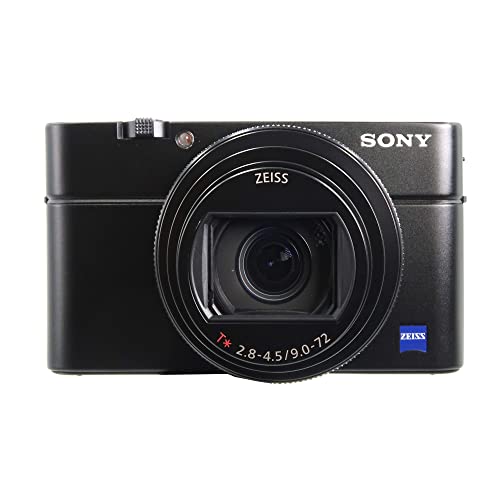
| Sony RX100 VII | Best pocketable long zoom | A genuinely pocketable camera whose zoom reaches far enough for pitch-side and shoreline action, with tracking autofocus borrowed from Sony’s flagship sports bodies. |
| OM SYSTEM OM-5 Mark II | Best reach per kilo | The Micro Four Thirds mount doubles every lens’s effective reach, so modest, affordable telephotos become serious distance tools on a body built for outdoor days. |
| Canon EOS R10 | Best sports-day value in the Canon system | A fast, light APS-C body with Canon’s subject-tracking autofocus and access to long RF telephotos, aimed squarely at sideline action. |
| Nikon Z50 II | Best tracking brain in a small Nikon | Nikon’s newest APS-C body brings flagship subject detection and a bright viewfinder to distance work, with DX lenses that stretch reach without stretching budgets. |
| Sony Alpha 7 IV | Best full-frame cropper | A high-resolution full-frame sensor with elite tracking lets distant action be cropped hard in editing while the files still hold together for print and publication. |
| GoPro HERO13 Black | Best place-it-and-forget-it action witness | It does not zoom, and this guide will not pretend otherwise — but mounted near the action or on the athlete, it captures distance events from inside them. |
How Did We Choose Cameras for Action That Happens Far Away?
Our first filter was honest reach. A pick had to offer either a built-in zoom stretching well past the portrait range, a native lens mount with proven long telephoto options, or a compact body whose telephoto end still resolves detail worth cropping. Cameras that are excellent up close but stranded at short focal lengths never made the shortlist, however fashionable they are, because this keyword is a promise about distance and we intended to keep it.
The second filter was tracking behaviour on small targets. At distance, autofocus stops being about finding an eye across a room and becomes a problem of holding a fast, erratically moving shape against cluttered backgrounds — crowds, waves, trees, advertising boards. We favoured systems with dedicated subject detection for people, animals and vehicles, customisable tracking sensitivity, and viewfinders that keep showing the subject during a burst rather than blacking out at the decisive instant.
Finally we weighed burst depth, buffer behaviour and stabilisation as one system, because distance action is shot in sequences, not singles. A camera that fires quickly but chokes after a second is a sprinter entered in a marathon. We also considered weather sealing and weight, since distant action usually happens outdoors, in weather, at the end of a walk. Price was deliberately ignored as a ranking force: the list mixes a pocketable zoom compact with full-frame bodies, and the verdicts explain which kind of shooter each one truly serves.
Which Six Cameras Actually Reach Distant Action?
The six split into three philosophies. Two are interchangeable-lens bodies whose lens systems deliver the longest honest reach. Two are compacts with zooms that embarrass larger cameras. One is a full-frame all-rounder for shooters who crop hard, and one is a fast APS-C body built for sports days. Read the trade-offs as carefully as the strengths; at distance, the wrong strength is just an expensive irrelevance.

Sony RX100 VII — Best pocketable long zoom
Nothing else in this guide disappears into a jacket pocket, and that fact alone earns the RX100 VII its place, because distance action often appears where a full camera bag cannot go: school matches with bag searches, coastal walks, stadium seats where long lenses are refused at the gate. Its zoom reaches a 200mm-equivalent view, which will not fill the frame with a distant winger, but it frames the near half of a pitch, a breaking wave from the pier, or a bird on the nearest posts with real authority, and the one-inch sensor behind it crops far more gracefully than any phone or budget compact.
The autofocus is the quiet marvel. Sony transplanted the tracking intelligence of its professional sports line into this small body, and the camera holds a moving subject with a tenacity that feels unfair at this size, following runners and cyclists through a burst while the photographer simply keeps the subject roughly centred. Fast continuous shooting with a viewfinder that stays live during the sequence makes timing a distant dive or header a learnable skill rather than a lottery.
Honesty demands the limits be stated plainly. Two hundred millimetres equivalent is the near edge of distance work, not its heartland, and beyond that the files rely on cropping that the small sensor tolerates rather than enjoys. The body is dense and slippery, the controls are miniature, and a long day of bursts will ask for spare batteries. Treat it as the camera that is present when action happens at moderate distance, and it is superb; ask it to replace a true telephoto system across a stadium and it will politely fail.
A word about how to run it on the day, because small cameras reward preparation. Charge and carry the spares, set the tracking area before the event rather than during it, and assign the zoom to the control ring so reach changes become reflex rather than menu work. Shoot a touch wider than instinct suggests and crop the surplus later; the stacked sensor’s clean files forgive the trim, and a slightly loose frame that contains the whole dive beats a tight frame that amputates it. Owners who treat the little Sony as a system — case, batteries, practised settings — rather than a toy are the ones whose pockets keep producing publishable distance frames season after season.
- Built-in zoom reaching 200mm equivalent
- One-inch stacked sensor for fast readout
- Real-time tracking autofocus with eye detection
- Fast burst shooting with blackout-free viewing
- Pop-up electronic viewfinder and tilting screen
Strengths
- Fits venues and pockets where telephoto rigs are impractical
- Tracking autofocus far beyond its size class
- Burst speed suits genuine action rather than posed sport
Trade-offs
- Zoom reach is moderate rather than true telephoto
- Small controls frustrate gloved or large hands
- Battery life shortens quickly on burst-heavy days
Best for: spectators, travelling fans and walkers who want real reach without carrying a lens system.
Not suited for: shooters covering far touchlines, distant wildlife or night matches under weak floodlights.

OM SYSTEM OM-5 Mark II — Best reach per kilo
If distance is the problem, the OM-5 Mark II attacks it with arithmetic. Its Micro Four Thirds sensor applies a two-times crop to every lens, so a compact and affordable 300mm telephoto behaves like a 600mm on full frame, at a fraction of the weight, cost and tripod anxiety. For the walker who photographs distant seabirds, the hiker who finds chamois across a valley, or the parent shooting from the far end of an athletics track, that arithmetic converts impossible subjects into routine ones while the whole kit still fits a small shoulder bag.
The body around that arithmetic is engineered for the outdoors where distant action lives. Weather sealing shrugs at spray and drizzle, the stabilisation is among the finest fitted to any camera at any price — a genuine gift at long focal lengths, where handshake is magnified cruelly — and computational features like high-resolution tripod modes reward the patient. Subject detection for birds and animals, added through the system’s modern autofocus, understands the shapes distance shooters actually chase.
The compromises are the format’s familiar ones. The smaller sensor gathers less light, so floodlit evening action pushes sensitivity higher than a full-frame rival would need, and very shallow background blur is not on the menu. The menu system rewards study rather than intuition. Yet judged purely on the question this article asks — how much distant action can I reach, how far can I carry the means, and how steady will the frame be when I get there — the OM-5 Mark II answers more completely than cameras costing far more.
Fieldcraft multiplies this camera’s advantage in ways specifications cannot show. The quiet shutter and small profile leave wildlife undisturbed at ranges where a flagship’s bulk and clatter would end the encounter, and the deep grip sustains a long lens through a hide session without the ache that shortens other photographers’ days. Learn the computational toolkit selectively: live neutral-density simulation steadies waterfalls behind a perched kingfisher’s portrait, while the high-resolution mode belongs to landscapes, not action. Above all, exploit the lens catalogue’s bargains — previous-generation telephotos, bought used, turn this body into the cheapest honest 600mm-equivalent outfit in serious photography, and distance shooters on real budgets should plan the whole purchase around that fact.
- Micro Four Thirds sensor, two-times effective reach
- Weather-sealed compact metal body
- Powerful in-body image stabilisation
- Subject detection for birds, animals and people
- Computational modes including high-resolution capture
Strengths
- Long effective reach from light, affordable lenses
- Stabilisation that transforms handheld telephoto work
- Sealed body made for weather and travel
Trade-offs
- Smaller sensor works harder under floodlights
- Menus take time to learn deeply
- Shallow depth of field is limited by the format
Best for: hikers, birders and travellers who measure reach against carrying weight.
Not suited for: night-sport specialists who live at the very highest sensitivities.

Canon EOS R10 — Best sports-day value in the Canon system
The EOS R10 is what happens when a manufacturer aims a camera precisely at the amateur sports photographer and declines to apologise for it. Its APS-C sensor adds a useful reach multiplier to every lens, its burst rate runs fast enough to dissect a goalkeeper’s dive or a sprinter’s lean, and its autofocus carries the subject-detection intelligence of Canon’s professional line — people, animals and vehicles recognised and tracked across the frame while the photographer concentrates on composition and timing from the far side of the action.
Paired with one of Canon’s affordable long RF zooms, the R10 becomes a complete distance-action outfit that a teenager can carry to training and a grandparent can lift all afternoon. That pairing matters: many cameras in this guide are only as good as lenses their owners never buy, whereas the R10’s natural telephoto partners are light, comparatively inexpensive and stabilised, so the system a buyer actually assembles is the system we are recommending. The electronic viewfinder is clear, the controls fall under the fingers, and the whole outfit feels designed rather than accumulated.
Its limits appear at the edges of the day. The buffer fills sooner than a professional body’s during very long bursts, the sensor’s crop that grants reach also asks more of lenses in dim light, and weather sealing is more hopeful than heroic. For Saturday sport, school athletics, airshows and zoo days — the calendar of most distance-action shooters — those limits rarely bite. The R10 is the recommendation we would hand a friend who said the words ‘my kid plays, and I am always too far away’ and meant it.
Coaching the R10 through a full season teaches its rhythms quickly. Its electronic burst is the sprinter’s tool for short, violent moments — the serve, the strike, the finish-line lean — while the mechanical rate serves longer passages of play where buffer depth matters more than peak speed. Set a custom mode for each of your regular venues, because floodlit astroturf and noon grass demand different ceilings on sensitivity and different tracking temperaments, and the body rewards that forethought by simply disappearing into the work. Pair it with a monopod for tournaments: the outfit is light enough that the support feels like insurance rather than burden, and by the final’s last minutes your arms will file the gratitude themselves.
- APS-C sensor adding reach to every lens
- Fast mechanical and electronic burst rates
- Subject detection for people, animals, vehicles
- Light body pairing well with long RF zooms
- Vari-angle screen and clear electronic viewfinder
Strengths
- Purpose-built feel for amateur sport
- Autofocus intelligence from Canon’s top tier
- Affordable long lenses complete the system
Trade-offs
- Buffer depth trails professional bodies
- Modest weather sealing
- Crop sensor asks more in very low light
Best for: parents, club photographers and airshow regulars shooting daytime action at range.
Not suited for: professionals filing long bursts from floodlit stadiums nightly.

Nikon Z50 II — Best tracking brain in a small Nikon
The Z50 II carries the most modern autofocus brain Nikon has put in a small body, and distance action is precisely where such brains prove themselves. Its subject detection — inherited from Nikon’s flagship Z9 generation — recognises people, animals, birds and vehicles, and, crucially for faraway subjects, it finds them when they occupy a discouragingly small patch of the frame. A goalkeeper rendered at thumbnail size in the finder is still identified, still tracked, and still the point the camera defends as backgrounds and other players sweep past.
Nikon’s DX lens line completes the argument with long zooms designed for exactly this sensor, light enough to handhold through a match and long enough to matter. The viewfinder deserves specific praise: bright, clear finders are not a luxury in distance work but the primary instrument, since the photographer judges timing, framing and focus through it for hours. The Z50 II’s finder and grip make long sessions feel sustainable, and its video credentials quietly serve shooters who alternate stills of the match with clips for the club page.
Against it: the DX lens catalogue, while well chosen, is narrower than the full-frame Z range above it, and the body lacks in-body stabilisation, leaning on lens-based correction instead — fine with its stabilised telephotos, worth knowing with adapted glass. Battery endurance on heavy burst days calls for a spare. None of this displaces it as the Nikon answer for distance shooters who want modern tracking without flagship weight; it is the body we would choose for a season of school sport shot from the rail.
What seasoned Nikon hands notice first is how the Z50 II handles the handover between stills and video during an event. A junior match report increasingly wants both, and this body switches personalities without the menu spelunking that breaks a photographer’s concentration at the rail. Its picture controls also produce pleasing files straight from the camera, which matters for club volunteers uploading from the touchline rather than editing at midnight. Invest early in the second battery and the fastest cards the body can exploit; the detection brain and burst appetite are only as dependable as the power and storage feeding them, and both are cheap insurance beside the cost of a missed final.
- APS-C sensor with reach advantage for DX lenses
- Subject detection derived from Nikon’s flagships
- Bright electronic viewfinder for long sessions
- Strong video tools alongside stills
- Compact body with a secure, deep grip
Strengths
- Finds and holds tiny subjects against clutter
- Excellent finder for hours of telephoto work
- Modern detection covers birds through vehicles
Trade-offs
- No in-body stabilisation; relies on lenses
- DX lens range smaller than full-frame Z
- Spare battery wise on burst-heavy days
Best for: Nikon shooters covering school sport, wildlife from hides and club events.
Not suited for: shooters wanting stabilisation with every adapted legacy lens.

Sony Alpha 7 IV — Best full-frame cropper
The Alpha 7 IV approaches distance from the opposite direction to the compacts: not by reaching further optically, but by surviving the crop. Its full-frame sensor packs enough resolution that a subject occupying the centre third of the frame — a surfer at the outer break, a fox at the field’s far hedge — can be cut out in editing and still yield a file with genuine detail, clean colour and room to print. For shooters whose distance problem is really a lens-budget problem, that crop tolerance is a form of reach that never needs carrying.
Sony’s autofocus is the other half of the case, and it is formidable: real-time tracking that locks and refuses to let go, eye detection for people and animals that works at ranges where the eye itself is a rumour, and a burst system with the buffer depth to keep shooting through a sequence rather than rationing frames. The E-mount lens range then offers every rung of the telephoto ladder, from travel zooms to professional long primes, so the camera grows with its owner’s ambitions and assignments.
The costs are literal and physical. Full-frame telephoto glass is heavy and priced like it knows it, the body is a serious object in the bag, and menus this deep reward configuration time before the event rather than discovery during it. Low-light performance, though, is where the big sensor collects its fee back: evening matches and dawn wildlife stay clean at sensitivities that would roughen the smaller formats in this guide. Choose it when distance action is your main pursuit and the files must serve editors, printers and posterity, not just the family chat.
Professionals who run this body for distance work tend to build a small ritual around it: two telephoto options rather than one, the converter in the pocket for the days the action retreats, and custom buttons that summon tracking, crop mode and sensitivity ceilings without the eye leaving the finder. The APS-C crop mode deserves deliberate use rather than apology — engaged knowingly, it trades resolution the file can spare for framing the finder shows honestly, and many working shooters live in it for far subjects. Treat the camera as the hub of that system, maintain the lenses as carefully as the body, and it will cover everything from dawn hides to floodlit finals without asking to be replaced.
- High-resolution full-frame sensor
- Real-time tracking with people and animal eye detection
- Deep buffer for sustained sequences
- Huge E-mount telephoto lens range
- Strong high-sensitivity performance for dusk action
Strengths
- Crop tolerance converts modest reach into usable frames
- Autofocus among the finest available anywhere
- Files serve print and publication comfortably
Trade-offs
- Telephoto lenses are heavy and costly
- Deep menus need setting up in advance
- Body and kit are a deliberate carry
Best for: serious enthusiasts and semi-professionals cropping distant action for print.
Not suited for: casual spectators wanting a camera that hides in a pocket.

GoPro HERO13 Black — Best place-it-and-forget-it action witness
Every other pick in this guide accepts the distance and fights it. The HERO13 Black refuses the premise: it goes to the action instead. Mounted on a helmet, a board, a goalpost, a boat rail or a dog, it records the distant event from inside the event, in stabilised, wide, waterproof footage that no telephoto can imitate. For the participant rather than the spectator — the surfer who is the distant speck in everyone else’s photographs — it is not an alternative to a distance camera but the answer to a different and better question.
As a stills tool for distant subjects it must be judged honestly and briefly: the fixed wide lens makes faraway subjects tiny, and no cropping rescues them beyond social-media size. Where it earns its row in this table is as the second camera of distance shooters — planted at the finish line, fixed to the far touchline fence where regulations allow, or carried by the athlete whose performance the telephoto is tracking. Its stabilisation is effectively a gimbal in software, its voice control suits gloved and wet hands, and modern models shoot bursts and high-resolution frames that serve perfectly as the close chapter of a story the long lens tells from afar.
Battery endurance under continuous recording, heat on still summer days, and the fisheye character that must be corrected or embraced are its standing caveats. So is permission: mounts and planted cameras need the venue’s blessing. Used as intended — the witness inside the action, paired with one of the reaching cameras above for the spectator’s view — the HERO13 turns distance from an enemy into a two-camera production, and that is why a camera with no zoom at all closes a guide about shooting from far away.
Getting value from the witness camera is a production skill in miniature. Scout the mount point as seriously as a telephoto position: chest height on the far post tells a different story from the crossbar, and the goalkeeper’s own mount, where rules and consent allow, tells the truest one of all. Set the narrower lens modes for planted positions so the action is not reduced to specks by the ultra-wide view, start recording early rather than trusting remote triggers in the noise of a crowd, and slate the footage with a clap or a whistle blast so the two cameras’ stories can be married in the edit. Reviewed afterwards beside the telephoto frames, the little camera’s footage routinely supplies the moment the whole sequence was actually about.
- Fixed ultra-wide lens, fully waterproof body
- Advanced electronic stabilisation
- High-resolution stills and burst modes
- Voice control for hands-busy moments
- Extensive mount ecosystem for athletes and venues
Strengths
- Captures the action from inside it
- Survives water, mud and impact
- Ideal second angle for distance shooters
Trade-offs
- No zoom; distant subjects stay tiny
- Battery and heat limits on long recordings
- Venue permission needed for planted mounts
Best for: athletes, coaches and creators pairing a telephoto with an insider angle.
Not suited for: spectators hoping a wide action camera will zoom like a telephoto.
What Focal Length Do You Really Need for Distant Action?
Focal length talk fails beginners because millimetres mean nothing until they are translated into subjects. Work backwards from your scene instead. A footballer at the far side of a full-size pitch, photographed from the opposite touchline, needs the long end of a serious telephoto zoom to fill even half the frame; the same player crossing your half is comfortable on a mid-range zoom. A surfer from a pier, a bird on a lake’s far shore, a rally car on the opposite hillside — each has a characteristic distance, and the honest exercise is to stand in your real spot, hold up your hands, and admit how small the subject truly is.
That admission sorts the market cleanly. Subjects that fill a modest patch of sky or water reward the maximum-reach systems here, the OM-5 Mark II with its multiplying mount or the R10 and Z50 II with their telephoto partners. Subjects at moderate range reward the RX100 VII’s convenience or the Alpha 7 IV’s cropping power. Photographers who routinely guess wrong should rent a long zoom for one real event before buying anything: a single afternoon teaches more about your distances than a month of specification tables, and rental houses exist precisely for this education.
Remember also that reach interacts with light. Long lenses gather their images through narrower maximum apertures as zooms extend, and distant action rarely waits for golden weather. A system whose long end still performs in flat, grey, late-afternoon light will out-shoot a nominally longer system that only sings at noon. This is why the guide weighs sensor and stabilisation alongside millimetres, and why several verdicts name the hour of day as firmly as the sport.
How Do You Set Up Autofocus for Subjects That Start as Specks?
Begin with the tracking mode, not the focus point. Every camera here offers a wide-area subject-detection mode, and for distant action that mode should be your default: the camera scans the whole frame, finds the player, bird or vehicle, and holds it while you compose. Reserve small single points for static distant subjects — a perched bird, a parked car — where precision beats intelligence. Then set tracking sensitivity with intent: a sticky setting forgives the posts, officials and rivals who cross your line of sight, while a responsive setting suits subjects that dart and change direction without crossing anything.
Back-button focus earns a special mention at distance, because it separates the decision to focus from the decision to fire. Hold tracking with your thumb while the subject is a speck, release it when a fence or official occludes the view so the camera does not lurch to the obstruction, and re-engage as the subject clears. Combined with a burst, this rhythm produces sequences in which the camera’s intelligence and the photographer’s judgement each handle the half they are good at.
Practise on traffic, gulls and passing trains before the event that matters. Distance autofocus is a skill with a learning curve measured in afternoons, and the photographers who make it look easy simply paid that tuition somewhere unimportant first. Review your sequences at full magnification, learn whether your system front-focuses on clutter or loses subjects against water, and adjust the one setting that addresses what you actually saw — not the five a forum told you to change.
How Should You Shoot the Sequence When the Moment Is Far Away?
Distant action compresses drama: the tackle, the take-off and the strike all shrink into small geometry, so timing and sequence discipline matter more than single-frame heroics. Shoot in bursts that begin before the moment — as the winger cuts inside, as the wave steepens — and continue a breath after it, because at distance your reaction time is a larger fraction of the event than the event itself. The frame you want is almost never the frame you reacted to; it is the one the burst caught while you were still reacting.
Stabilisation mode deserves a decision rather than a default. For subjects crossing your position, use the panning-friendly mode where offered, plant your feet, rotate from the hips, and keep the subject in the same part of the frame throughout the swing; a smooth pan at a moderate shutter speed blurs the background into speed lines and keeps the small subject legible. For subjects approaching head-on, maximum stabilisation and a faster shutter serve better. Either way, brace where you can — a monopod under a long lens transforms the last hour of a long event.
Finally, chimp less and shoot more. At distance, the finder is your only honest instrument; the rear screen lies about sharpness in sunshine. Check focus once, early, at full zoom on a static frame to prove the system is behaving, then trust the setup and work the event. The photographers who miss distant moments are usually found reviewing the previous one.
How Does Weather and Air Itself Fight You at Long Range?
Distance shooters wage a quiet war against the air between lens and subject, and beginners blame their equipment for casualties the atmosphere inflicted. Heat shimmer over sun-baked pitches and tarmac turns long frames to jelly by late morning; the same venue at dawn, with the ground cool, returns crisp files from identical settings. Water vapour does similar work along coasts and lakes, softening contrast in proportion to the metres of damp air the light must cross. Choosing the shaded side, the earlier hour and the shorter sightline is not superstition but applied physics, and it improves more distance photographs than any lens upgrade.
Rain and spray write their own rules. Sealed bodies like the OM-5 Mark II keep working, but the front element becomes the battlefield: a deep hood, a microfibre cloth in a dry pocket, and the discipline to wipe between sequences rather than during them preserve more frames than any coating. Cold drains batteries at exactly the venues — winter touchlines, mountain ridges — where spares are hardest to change with numb fingers, so keep the second battery inside your clothing, warm against the day it is needed.
Wind, finally, is the invisible tripod problem. At long focal lengths a gust moves the lens through angles that look like earthquakes in the finder, and no stabilisation fully forgives a flimsy stance. Stand out of the wind where the venue allows, weight the monopod with your own downward pressure, and time bursts for the lulls that even blustery days provide. The atmosphere always takes its tax on distance work; the craft lies in negotiating the rate down.
What Should a Distance Shooter’s Bag Actually Contain?
Build the bag backwards from the failures you have already suffered. The camera and its longest honest lens are merely the entry fee; the bag earns its keep with the second battery, the fast spare card, the lens cloth that lives in the same pocket every time, and the rain cover that has been practised at home rather than debuted in a storm. Add a monopod for any lens you cannot hold steady for an hour, gaffer tape for the mount points and hoods that loosen, and a small notebook — distances, settings and venues recorded after each event become the buying and positioning advice no reviewer can give you.
Weight discipline decides what attends. Every item must argue against the walk, the stairs and the security queue, which is why this guide’s lighter systems keep winning real-world arguments against theoretically superior heavy rigs. Weigh the loaded bag, honestly, and if the number makes you invent excuses to leave it behind, the bag — not your commitment — is what needs editing.
Last, pack for the edit as well as the shoot: the cable or reader that empties cards at the venue, the power bank that rescues a phone pressed into service as a second screen, and the habit of backing up the day’s sequences before the journey home. Distance action is unrepeatable by definition — the final, the migration, the record attempt happen once — and the professional’s bag is really a small insurance policy against losing the only copy of a moment that will not come again.
How Do You Improve at Distance Action Month by Month?
Improvement in this genre is mostly a matter of honest reviewing. After each event, sort your sequences into three piles without mercy: the sharp and well-timed, the sharp but late, and the frames the atmosphere or the autofocus quietly ruined. Each pile teaches a different lesson — timing, positioning, or settings — and conflating them produces the vague conclusion that you need a better camera, which is occasionally true and usually an expensive evasion. Count keepers per hundred frames and write the number down; distance photography improves in measurable percentages, and watching the keeper rate climb across a season is the truest encouragement the craft offers.
Position is the cheapest upgrade in the entire discipline, and the reviewing habit reveals it. The photographers whose distant subjects keep arriving small and backlit are often standing in the convenient place rather than the right one: the far corner instead of the sunlit touchline, the pier’s end instead of its windward side, the hide that faces the light instead of the one that faces the birds. Move twenty metres and the same camera becomes a different instrument. Before any purchase, audit your last three events for the shot a better position would have handed you, and spend the money only when the audit acquits your feet.
Finally, study the work of the photographers who own your venues — the club shooter whose sequences fill the local paper, the birder whose flight frames look effortless — and reverse-engineer their patience rather than their equipment. You will usually find modest gear, ruthless reviewing, and positions chosen with a local knowledge that took seasons to earn. That is the encouraging truth at the bottom of distance action photography: the far side of the field belongs, in the end, to the photographers who keep showing up to it, notebook in the bag and lessons from last week loaded into this week’s settings.
What Does a Sensible Upgrade Path Look Like From Here?
Most distance shooters should upgrade in the order the evidence dictates: position first, lens second, body third, and accessories woven through all three stages as failures demand them. A longer or faster lens transforms the files from your existing body more dramatically than a new body transforms the files from your existing lens, because glass decides how many pixels the subject receives while bodies mostly decide how cleverly those pixels are gathered. The exception proves the rule — if your reviewing shows focus, not size, as the recurring failure, then the modern detection bodies in this guide, the R10 and Z50 II especially, jump the queue and earn their money immediately.
Buy used without embarrassment at every stage. Telephoto lenses lead hard lives in specification sheets and gentle ones in reality, since many are bought for one safari or season and shelved; a inspected used telephoto from a reputable dealer carries most of a new lens’s performance at a friendlier price, and the savings fund the monopod, cards and second battery that complete the working outfit. Keep the receipts, keep the notebook, and let each purchase answer a failure your own frames have documented — that discipline, more than any single camera above, is what separates a distance kit that grows from a cupboard that merely fills.
How Do the Six Compare for Distance Work?
The table compresses the argument of the whole guide into one glance: how each pick solves distance, and what it asks in return. Reach, intelligence and portability trade against one another in every row, and no row wins all three.
| Pick | Badge | At a glance |
|---|---|---|
| Sony RX100 VII | Best pocketable long zoom | Pocket camera, long built-in zoom, flagship-derived tracking in a coat-pocket body. |
| OM SYSTEM OM-5 Mark II | Best reach per kilo | Compact weather-sealed body whose mount doubles telephoto reach with light lenses. |
| Canon EOS R10 | Best sports-day value in the Canon system | Light APS-C sports body with fast bursts and Canon’s long-lens ecosystem. |
| Nikon Z50 II | Best tracking brain in a small Nikon | Small Nikon with flagship-derived subject detection and a bright finder. |
| Sony Alpha 7 IV | Best full-frame cropper | Full-frame resolution and tracking for shooters who crop distant frames hard. |
| GoPro HERO13 Black | Best place-it-and-forget-it action witness | Rugged action camera that solves distance by being placed within it. |
What Mistakes Ruin Most Distance Action Photographs?
Buying reach on paper and leaving it at home is the classic error: the longest lens in the cupboard contributes nothing, which is why this guide keeps returning to carried weight. A related error is judging a telephoto by its performance on the near half of its range at a test event, then discovering at the real venue that the far subject needs the last, weakest portion of the zoom in the day’s worst light.
Trusting digital zoom and heroic cropping on small files is the second failure. Cropping is a legitimate technique on sensors with resolution to spare; on modest files it manufactures softness and noise, and no sharpening restores detail that was never recorded. If your subjects routinely occupy a sliver of the frame, the fix is optical — a longer lens, a multiplying format, or a better position — not another pass through the editing software.
The third mistake is neglecting the unglamorous kit: spare batteries for burst-hungry bodies, cards fast enough to clear buffers, a monopod, a rain cover, and permission where venues restrict lenses. Distance days are long, weather-exposed and far from shops. The photographers who come home with the sequence are usually not the ones with the finest camera; they are the ones whose camera was still working, permitted and pointed at the action when the distant moment finally happened.
Final Recommendation
If we had to send one camera to cover a season of other people’s distant action, it would be the Canon EOS R10 with its long zoom: the autofocus, burst and reach-per-cost equation is the most complete for the sideline reality most readers inhabit, and the outfit stays light enough to actually attend every match. Nikon loyalists should take the Z50 II for the same reasons in their own mount, and walkers who count grams as carefully as millimetres will find the OM-5 Mark II’s reach-per-kilo unmatched.
The specialists close the list honestly. The Alpha 7 IV is the professional’s cropper, the RX100 VII is the camera that gets into the ground at all, and the HERO13 Black reminds everyone that the boldest solution to distance is sometimes to be somewhere else — inside the action. Choose by your real distance, your real venue rules and the kit you will genuinely carry, and the far side of the field stops being far.
One last encouragement for the road: every photographer in this genre keeps a private archive of distant failures — the final shot soft, the bird cropped to a rumour, the wave that broke for somebody else’s lens. The six cameras above will not abolish that archive, because distance always collects its toll, but they change its exchange rate decisively. More of your far subjects will arrive large, tracked and sharp; more of your long afternoons will end with a sequence worth the walk. That, in the end, is all any honest buying guide can promise, and it is enough to build a season on.
Take the camera that fits your distance, learn its tracking temperament on unimportant afternoons, and be standing in the right place when the far moment finally arrives.
Frequently Asked Questions
Can a compact camera really handle distance action shots?
At moderate distances, yes — the RX100 VII in this guide pairs a 200mm-equivalent zoom with flagship-derived tracking and fast bursts, which covers the near half of a pitch, pier-side surfing and zoo enclosures convincingly. Its limits are honest ones: truly distant subjects across stadiums or lakes need optical reach beyond its zoom or a larger sensor’s cropping tolerance. Judge it as a moderate-distance tool that is always present, not as a telephoto system in disguise.
Why do my distant action photos look soft even in focus?
Usually the cause is a pile-up of small thieves rather than one failure: atmospheric haze and heat shimmer over long paths, a shutter speed that freezes the subject but not your magnified handshake, a zoom at its weakest extreme, and a heavy crop discarding most of the file. Work through them in order — faster shutter, stabilisation or a monopod, a position with cleaner air, and less cropping — and softness retreats faster than any single upgrade would achieve.
Is a bigger sensor or a longer lens more important at distance?
The lens, almost always. A longer focal length puts more pixels on the subject, which no sensor can substitute for after the fact. Sensor size becomes decisive second, when light falls or crops deepen: then the full-frame files in this guide hold together where smaller files roughen. The balanced answer is the longest lens you will carry, on the largest sensor you can afford to feed with glass — in that order.
What shutter speed freezes distant action?
Start around the reciprocal of your effective focal length merely to control your own shake, then go faster for the subject: runners and ball sports generally want a genuinely fast shutter, vehicles and aircraft in pans want the opposite — a deliberately moderate speed with a smooth swing. Distance itself changes little; what changes is that small errors are magnified, so err faster than you would for the same subject up close, and let stabilisation handle the rest.
Do I need subject-detection autofocus, or is it a gimmick?
For distant action it is close to a necessity disguised as a luxury. When the subject occupies a small patch of a cluttered frame, detection finds and holds it in situations where manual point placement fails repeatedly — across a pitch, against water, through a field of rivals. Skilled photographers can work without it, as they did for decades, but they will tell you the keeper rate, not the possibility, is what the technology changes.
Where am I allowed to use long lenses and planted cameras?
Rules vary sharply: many stadiums cap lens length for spectators, some venues ban planted or remote cameras outright, and wildlife sites may restrict hides and drones for the animals’ sake. Check the specific venue’s photography policy before travelling, carry a compact like the RX100 VII as the diplomatic fallback, and never let a mount or a position endanger players, animals or the public — the photograph is never the point of the event.
Related Guides
Shoot action closer to home, or take these skills to other subjects, with our companion guides: best action cameras for surfing best cameras for wildlife photography best cameras for sports beginners


