ilcastellomenu.com is reader-supported. When you buy through links on our site, we may earn an affiliate commission.
Where to Buy
All six cameras below are available through Amazon, where units, training organizations, and individual service members can check current stock and delivery options. If you are choosing among the best action cameras for military helmet mounting, order the mount hardware at the same time as the camera — the camera is the easy half of this purchase, and the rail adapter, arm, or adhesive system you pair it with decides whether the footage is worth reviewing afterward.
A helmet camera in a military setting is not a toy for highlight reels, whatever the internet has made of the genre. Its serious jobs are unglamorous and valuable: recording training so instructors can break down a room-clearing drill frame by frame, documenting a patrol or a convoy movement for after-action review, capturing a medic’s perspective during casualty-care exercises, and giving investigators and safety officers an honest record when something goes wrong. Footage like that only helps if the camera was actually running, pointed at something useful, and still attached to the helmet when the exercise ended — which is why this guide weighs mounting security, battery endurance, and one-button simplicity far above spec-sheet glamour.
The environment is brutal in specific ways. Helmets get tossed into vehicles, rained on, caked in range dust, and knocked against door frames and hatch edges. The wearer is busy — genuinely busy, hands occupied, attention elsewhere — so a camera that demands menu-diving or a phone app to start recording will simply not get used. Light discipline matters too: a camera with a glowing status light or a bright screen can be a liability during night training, so models that can go fully dark earn real points here. And because much of this footage is reviewed by people who were not there, a wide, stable, honest field of view beats a cinematic narrow one every time.
Six cameras survived those filters. Five are mainstream action cameras that happen to mount well and endure abuse; one is a purpose-built helmet camera designed from the start for this exact job, included so you can see what the specialists optimize for. They range from flagship all-rounders to a previous-generation model whose low replacement cost suits high-attrition training fleets. Read the verdicts closely: the best camera for an instructor building a training library is not automatically the best camera for a unit buying twenty at a time, and neither is necessarily the right choice for a soldier documenting a deployment for family back home.
Key Takeaways
- Mounting security is the whole ballgame — a camera that leaves the helmet mid-exercise records nothing that matters.
- The GoPro HERO13 Black leads on ecosystem: rail mounts, arms, and night-vision-adjacent helmet accessories all assume its footprint.
- The MOHOC is the specialist’s answer, shaped for helmets and built to run dark, but it is a documentation tool rather than a cinema camera.
- Battery endurance across a full training day matters more than maximum resolution for after-action review footage.
- One-button recording is a genuine requirement; if starting the camera takes two hands and a menu, it will not be running when it counts.
- Buy the mount, the spare batteries, and the retention lanyard with the camera, not after the first loss.
In this guide
Quick Picks
| Pick | Badge | Why it belongs on a helmet |
|---|---|---|
| GoPro HERO13 Black | Best Overall | The deepest helmet-mount ecosystem in existence, plus stabilization that keeps drill footage watchable. |
| MOHOC Elite Ops Camera | Best Purpose-Built | Shaped to the helmet’s curve, snag-free, and designed to operate without visible lights. |
| DJI Osmo Action 5 Pro | Best for Long Training Days | Endurance and cold tolerance that outlast a full exercise schedule on fewer battery swaps. |
| Insta360 Ace Pro 2 | Best for Night Training | A large sensor that keeps low-light footage — dawn patrols, darkened shoot houses — legible. |
| GoPro HERO12 Black | Best Fleet Value | Yesterday’s flagship at training-fleet prices, sharing mounts and batteries with its successor’s ecosystem. |
| Insta360 X4 | Best for After-Action Review | Records every direction at once, so reviewers can look where the wearer never did. |
How We Chose These Picks
We began by throwing out cameras that could not be mounted securely to a modern ballistic or bump helmet without improvisation. That sounds obvious, yet it eliminates a surprising share of the market: if there is no mature ecosystem of rail adapters, NVG-shroud mounts, counterweight-friendly arms, and adhesive bases rated for helmet shells, the camera is a hobbyist’s answer to a professional question. Every pick here can be attached two independent ways — a primary mount plus a retention lanyard — because any single point of attachment eventually fails in the field.
Durability screening came next, and we weighted it differently than a sports guide would. Waterproofing without a housing matters because housings muffle audio and fog at the worst moments, and training audio — commands, calls, the instructor’s corrections — is half the value of the footage. We favored cameras whose lenses can be protected or replaced, whose buttons can be operated with gloves, and whose recording can be started with a single press and confirmed by feel or a subdued beep rather than a glance at a screen the wearer cannot see anyway.
We also considered the review pipeline, because helmet footage is worthless if nobody can watch it. Cameras whose files drop straight into standard editing and review software, whose apps do not demand accounts or connections that a training environment may not allow, and whose batteries and cards swap in seconds between iterations of a drill scored higher. Finally, we deliberately included one previous-generation camera and one specialist design, because real procurement is a mix of capability and cost per unit, and a guide that only lists flagships fails the units actually buying these things.
A note on scope: this guide covers cameras for training documentation, exercises, official recording duties, and personal documentation where regulations permit. Local command policies govern when and where recording is allowed, full stop — no camera choice overrides a standing order, and the sections below assume the reader is operating inside their unit’s rules on recording, retention, and release of footage.
Why Does Helmet Mounting Punish Cameras Differently Than Other Sports?
A mountain biker’s helmet camera lives a charmed life by comparison: rides last hours, crashes are occasional, and the wearer can stop, fiddle, and restart at leisure. A soldier’s helmet camera rides through days. It bakes in a vehicle, freezes on a night movement, gets rained on during a range week, and absorbs the small impacts of a working life — hatch edges, door frames, the ground during prone drills, a rifle sling swinging past. The mount sees constant low-grade abuse rather than one dramatic crash, which is why adhesive fatigue and loosening hardware cause more losses than breakage.
The wearer’s attention is the other scarce resource. In most sports the camera is the point of the activity; here it is, at best, the fourth priority. That inverts the design brief: automatic behaviors win. Cameras that power on and record with one press, that loop-record so a forgotten card never means a missed exercise, and that signal their status with a vibration or a tone the wearer can perceive without looking, will collect ten times the useful footage of a technically superior camera that demands management. Instructors evaluating these picks should ask one question above all: will a tired nineteen-year-old actually have this running at 0500 in the rain? The cameras below were chosen because the answer is plausibly yes.
Weight placement matters more than weight itself. A camera perched high and forward on a shroud mount acts as a lever on the neck across a twelve-hour day, and the fatigue shows up as headaches and a helmet that will not sit straight. Side mounting on a rail, close to the shell, keeps the mass near the head’s center and plays better with counterweights and night-vision setups on the front. Several picks below are praised specifically for how many mounting positions their ecosystems support, because the freedom to move the camera six centimeters can matter more than a resolution bump ever will.
What Are the Best Action Cameras for Military Helmet Mounting? Six Picks in Detail

GoPro HERO13 Black — Best Overall
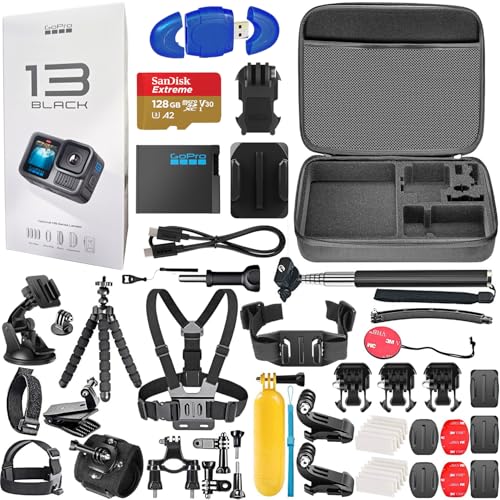
GoPro’s flagship earns the top spot here less for its sensor than for its surroundings: no camera on earth has a deeper bench of helmet hardware. Rail adapters, shroud mounts, articulated arms, low-profile side mounts, and counterweight solutions from a dozen makers all assume this camera’s footprint and folding mounting fingers, so whatever helmet and whatever position you need, the part exists and has been field-tested by someone. The camera itself brings HyperSmooth stabilization that turns jarring movement — bounding, climbing, vehicle rides — into footage a reviewer can actually watch without fatigue, and its one-press QuickCapture behavior, powering on and recording from a single button press, fits the attention economy of training perfectly.
Practical details stack up in its favor. The body is waterproof without a housing, the lens cover is replaceable after the inevitable scrape, voice control offers a hands-free start when policies and noise allow, and GPS data can anchor footage to a place and time for review. The debits are honest ones: it is a flagship-priced device to issue widely, its status lights and screen need deliberate darkening for night work (the settings exist — use them), and full-featured recording drains batteries at a pace that demands a swap discipline on long days. For instructors and documentation teams who can buy fewer, better cameras, this is the default answer.
- Mounting: folding fingers plus the largest third-party helmet hardware ecosystem available
- Recording: one-press capture from off; loop recording for set-and-forget duty
- Build: waterproof body, replaceable lens cover, glove-workable main button
- Extras: GPS logging, voice control, mature desktop and mobile review software
Strengths
- Any helmet position you can imagine has a proven mount waiting for it.
- Stabilization keeps chaotic drill footage genuinely reviewable.
- One-press recording respects a wearer whose hands and mind are elsewhere.
Trade-offs
- Fleet-wide issue at flagship prices gets expensive quickly.
- Lights and screen must be deliberately subdued for night exercises.
- Battery swaps need planning on dawn-to-dusk training days.
Best for: instructors, documentation teams, and individuals who want the best-supported helmet camera available. Not suited for: bulk issue on a tight budget or anyone unwilling to configure light settings for night work.
MOHOC Elite Ops Camera — Best Purpose-Built
The MOHOC is what happens when a camera is designed by people who started with the helmet rather than adapting to it. Its body is curved to sit flush against the shell, low and snag-free, so it neither catches on hatch edges and brush nor levers against the wearer’s neck — the profile difference versus a boxy action camera is something you feel within an hour of wearing both. Operation is built around a single large rotating switch that can be worked by feel, with gloves, without looking, and the design philosophy extends to light discipline: it is meant to run without advertising itself.
The footage tells you this is a documentation instrument rather than a cinema tool. Resolution and image processing trail the flagships, stabilization is modest, and there is no screen to review with — you frame by position and trust the wide lens. For its intended work, those are acceptable trades: after-action review needs legible, honest, correctly-aimed footage more than it needs beauty, and the MOHOC’s aim rarely wanders because the camera is the helmet’s shape rather than a box bolted to it. It is sold as a prose-only pick here — check the manufacturer’s channels and authorized sellers for current availability — and it earns its place as the benchmark for what “helmet camera” means when the helmet comes first.
- Form: curved, low-profile body shaped to the helmet shell
- Controls: single tactile switch designed for gloved, eyes-free operation
- Design intent: snag-free profile and subdued operation for tactical environments
- Footage: wide, documentation-grade video aimed at review rather than production
Strengths
- The only pick that truly disappears into the helmet’s profile.
- Eyes-free, glove-friendly operation that survives real working conditions.
- Purpose-built light discipline rather than settings-menu workarounds.
Trade-offs
- Image quality and stabilization trail the mainstream flagships clearly.
- No screen and a narrower accessory and software ecosystem.
- Specialist pricing for a single-purpose tool.
Best for: units and professionals whose priority is unobtrusive, reliable documentation on the helmet itself. Not suited for: anyone who also wants a general-purpose action camera for leave, family, or content creation.

DJI Osmo Action 5 Pro — Best for Long Training Days
Training days are marathons: a 0600 range start, iterations all morning, a field problem after lunch, and a night serial to finish. The Osmo Action 5 Pro is built for that shape of day. Its rated recording endurance is the strongest in this guide, its cold-weather performance keeps it alive on winter exercises that kill lesser batteries by mid-morning, and its quick-release magnetic mounting makes the constant on-off of helmet-to-tripod-to-helmet movement — instructor demonstrates, class records, instructor reviews — genuinely fast instead of fiddly.
On the helmet it is a composed performer: confident stabilization, a bright front screen that helps an instructor (not the wearer, who cannot see any screen) confirm framing at a glance before an iteration, and a body that shrugs off weather without a housing. DJI’s subject-tracking and app polish matter less here than its file reliability and the way its batteries charge quickly during a lunch break. The gaps versus the leader are ecosystem depth — helmet-specific hardware exists but the catalog is thinner — and the absence of GPS for time-and-place anchoring. If your constraint is hours rather than hardware variety, this is the pick.
- Endurance: class-leading rated recording time, strong cold-weather behavior
- Mounting: magnetic quick-release plus standard adapter compatibility
- Screens: bright dual OLED displays for instructor-side framing checks
- Build: waterproof without housing, fast-charging batteries
Strengths
- Outlasts full exercise schedules with fewer mid-day battery swaps.
- Quick-release mounting suits instructor-led record-review cycles.
- Cold tolerance keeps winter and high-altitude training documented.
Trade-offs
- Helmet-specific mount catalog is smaller than GoPro’s.
- No GPS for automatic location and time anchoring.
- Status lighting still needs attention before night serials.
Best for: training organizations running long, dense exercise days and cold-weather programs. Not suited for: buyers who need exotic helmet hardware or built-in location logging.

Insta360 Ace Pro 2 — Best for Night Training
A large share of serious training happens in bad light: shoot houses with the lights killed, dawn movements, night iterations under a moon that helps nobody’s camera. The Ace Pro 2’s large sensor and Leica co-engineered lens give it the cleanest low-light footage in this roundup, and in a darkened structure that difference is not cosmetic — it is the difference between a reviewer being able to read muzzle discipline, hand placement, and doorway procedure or staring at noise. Its AI-assisted noise reduction, tuned for exactly these conditions, keeps shadow detail usable without smearing motion into mush.
In daylight it is a full flagship: high-resolution capture, a flip screen that instructors love for brief-backs and ground-level demonstrations, and stabilization that handles vehicle and foot movement with ease. Helmet mounting uses the standard ecosystem with widely available adapters, though the catalog of military-helmet-specific parts is thinner than GoPro’s, and the flip screen is one more hinge to protect in a rough environment — most helmet users will keep it closed and treat it as an instructor-side tool. Battery life is respectable rather than class-leading. Choose it when the training calendar is heavy on darkness; the footage will justify you.
- Sensor: large-format sensor with AI-enhanced low-light processing
- Lens: Leica co-engineered optics with strong shadow detail
- Video: high-resolution recording with flexible cropping for review
- Screen: flip display for instructor demonstrations and ground use
Strengths
- Night and shoot-house footage stays legible where rivals dissolve into grain.
- Full flagship performance in daylight, not a one-trick specialist.
- Flip screen earns its keep during instruction and debriefs.
Trade-offs
- Helmet-specific accessory catalog is still growing.
- Flip hinge wants care in an environment that offers little.
- Battery endurance is good, not class-leading.
Best for: night-heavy training programs, shoot-house instruction, and dawn or dusk documentation. Not suited for: buyers wanting the deepest helmet hardware shelf or the longest single-charge days.

GoPro HERO12 Black — Best Fleet Value
Procurement reality: a unit that needs twenty helmet cameras this fiscal year is not buying twenty flagships. The HERO12 Black is the value answer that does not feel like a compromise — it is last generation’s flagship, with the same mounting footprint, the same accessory universe, and stabilization and image quality that remain entirely credible for training review. Because it shares the ecosystem, a fleet can standardize mounts, batteries, and cases across HERO12s and any HERO13s in the building, and trainers learn one system instead of three.
Its omissions are the ones a fleet can live with. There is no GPS, which matters for some review workflows and not at all for a shoot-house library. Heat behavior on very long static recordings is a notch behind its successor, though helmet use — moving air, intermittent recording — rarely exposes that. What you get instead is availability: the model is widely stocked, frequently discounted, and present on the used market in quantity, so replacing a destroyed unit is a purchase order rather than a budget meeting. For high-attrition environments — and training is exactly that — replaceability is a feature, arguably the feature.
- Compatibility: shares mounts, batteries, and cases with the wider GoPro ecosystem
- Recording: previous-generation flagship image quality and stabilization
- Availability: widely stocked new and used, easing fleet replacement
- Notable omission: no built-in GPS
Strengths
- Fleet economics that survive contact with a real training budget.
- Full access to the deepest helmet-mount ecosystem in the guide.
- Standardization: one training pipeline for mounts, media, and handling.
Trade-offs
- No GPS anchoring for footage.
- A step behind on endurance and heat in marathon static recording.
- Fewer headline features for the individual buyer chasing the best.
Best for: units equipping many helmets, training fleets, and budget-conscious individuals inside the GoPro ecosystem. Not suited for: buyers who need GPS or the newest low-light and lens features.

Insta360 X4 — Best for After-Action Review
Every instructor knows the flaw in helmet footage: the camera sees where the head pointed, and the teaching moment often happened thirty degrees to the left. The X4 abolishes that limitation by recording in every direction at once. In review, the instructor can look where the wearer looked, then look where the wearer should have looked — at the unchecked corner, the teammate’s signal, the door that opened behind them. For after-action review, that is not a gimmick; it is the closest thing to rewinding the exercise, and a single X4 on a team leader’s helmet can document an entire drill’s geometry.
The costs are the ones 360 cameras always charge. The twin bulging lenses are vulnerable in an environment full of hard edges, and lens guards are mandatory, not optional. The camera is the heaviest here and sits noticeably on the helmet. Files are large, and extracting review footage adds a software step that someone must own. It is also the wrong tool for discreet documentation — it looks like what it is. Deploy it deliberately: one per squad for training iterations, mounted high where its all-seeing view is the point, and it will change what your debriefs can teach. As an every-soldier camera, it is too much; as an instructor’s instrument, nothing else here does its job.
- Capture: full 360-degree recording up to 8K for post-exercise reframing
- Review: instructor can redirect the view anywhere during playback
- Protection: lens guards strongly recommended and widely available
- Mounting: standard adapters fit common helmet positions
Strengths
- Captures the teaching moments the wearer never faced.
- One camera documents a whole team’s movement geometry.
- Reframed exports drop into standard review workflows.
Trade-offs
- Exposed lenses in the least forgiving environment imaginable.
- Heaviest pick, with the largest files and an extra software step.
- Visually conspicuous — built for the training field, not discretion.
Best for: instructors and team leaders recording iterations for structured after-action review. Not suited for: general issue, discreet documentation, or anyone who will not run the reframing workflow.
How Do the Six Compare at a Glance?
| Camera | Badge | Standout trait | Watch out for |
|---|---|---|---|
| GoPro HERO13 Black | Best Overall | Mount ecosystem and stabilization | Fleet cost, light discipline setup |
| MOHOC Elite Ops Camera | Best Purpose-Built | Flush helmet profile, eyes-free switch | Documentation-grade image quality |
| DJI Osmo Action 5 Pro | Best for Long Training Days | Endurance and cold tolerance | Thinner helmet catalog, no GPS |
| Insta360 Ace Pro 2 | Best for Night Training | Low-light legibility | Hinge care, accessory depth |
| GoPro HERO12 Black | Best Fleet Value | Ecosystem at fleet prices | No GPS, older endurance |
| Insta360 X4 | Best for After-Action Review | Sees every direction at once | Lens exposure, weight, workflow |
What Should You Decide Before Choosing a Mount Position?
Three positions dominate, and each tells a different story. The front shroud mount gives the truest wearer’s-eye view and pairs naturally with night-vision setups, but it places the camera high and forward where neck fatigue and snag risk live. Side rail mounting keeps mass tight to the shell, balances well against a counterweight, and produces a slightly offset view that many reviewers actually prefer for judging body position and weapon handling — though you must check that the wearer’s peripheral gear and sling do not intrude. Top mounting maximizes clearance and suits 360 cameras, at the price of the highest snag profile and a view that can feel detached from the wearer’s perspective.
Do the fitting with the wearer in full kit, seated and standing, moving through a doorway and going prone if the training involves it. A mount that clears everything on a bench can still meet a door frame at head height or dig in when the wearer is prone behind cover, and the time to learn that is the fitting session, not the first iteration. Have the wearer shake, nod, and look to both extremes while a partner watches the camera — any wobble visible to the eye becomes jello on the recording, and it is far easier to shim or reposition a mount in the team room than to explain unusable footage in the debrief.
Whichever position you choose, standardize it within a team. Consistent camera placement makes footage comparable across iterations and soldiers, which is where its training value compounds: the instructor reviewing week three against week one needs the same angle, not a creative variety pack. Add a retention lanyard to every mount, thread it to the helmet rather than the mount itself, and institute a buddy check — the same hands-on inspection culture applied to straps and chin cups applies to the camera: mount seated, lanyard attached, lens clean, record light state as briefed.
How Do You Set Up a Helmet Camera Program That People Actually Use?
Start with the recording policy, not the hardware: who may record, during which activities, where footage is stored, who may view it, and when it is deleted. A camera program without those answers creates risk faster than it creates value, and the answers belong to the chain of command, not to this guide. With policy set, configure every camera identically before issue — same resolution and frame rate, same loop-recording behavior, lights and screens set to the unit standard, date and time synchronized — because footage from six differently-configured cameras is an archive nobody can search.
Then make the daily mechanics stupidly simple. Cameras live in one place, charged, with formatted cards, on a sign-out board. Starting and stopping recording is one press, taught in five minutes and rehearsed once with gloves on. After each exercise, one named person owns offload and backup before cards are wiped; footage that exists on a single card in a helmet bag does not exist for practical purposes. Review quickly — a debrief within a day, while participants remember what the camera cannot show, is worth five debriefs next week — and feed what the footage teaches back into the next iteration. Programs die when cameras become one more accountability item; they thrive when the first debrief visibly makes the team better, after which nobody has to be ordered to wear one.
Why Does the Audio Track Matter More Than Most Buyers Expect?
Ask an instructor what they actually use in a debrief and a surprising share of the answer is sound. The commands given, the calls made or missed, the moment a drill’s communication broke down — these live on the audio track, and a camera that records gorgeous video over muffled, wind-blasted audio has failed at half its job. Housings are the usual culprit: a waterproof case that the camera does not need, worn out of habit, seals the microphones behind plastic and turns speech into soup. Every mainstream pick in this guide is waterproof bare, so the first audio upgrade costs nothing — leave the housing in the bag unless the environment truly demands it.
Wind is the second enemy, and helmet position decides how much of it you get. A camera mounted high in the airstream during vehicle movement or exposed range work will roar; the same camera tucked at the side of the shell, or fitted with one of the small foam windscreens the accessory market sells for exactly this purpose, keeps voices forward and intelligible. Most cameras here also offer wind-reduction processing — test it during a vehicle movement before the exercise that matters, because the difference between settings is obvious on playback and invisible on a spec sheet. For dedicated documentation teams, an external microphone is possible on some models but rarely survives helmet practicality; the pragmatic answer is position, windscreen, and settings, in that order.
Finally, brief the wearer. A camera near the head hears the wearer’s breathing, muttering, and radio traffic beautifully and the rest of the team at a distance — which means the wearer narrating key moments (“door open,” “moving to second room,” “casualty at the wall”) transforms the footage’s review value at zero cost. Documentation programs that teach this one habit get archives that explain themselves; programs that do not get hours of silent geometry. It takes two minutes to teach and pays off on every single recording.
Helmet Camera or Chest Camera — Which View Serves Training Better?
Chest and body mounting is the obvious alternative, and for some documentation it is the better one. A chest-mounted camera shows hands, weapon handling, and medical procedure from an angle an instructor can critique in detail, and it stays stable and protected against the body. What it cannot show is attention: where the wearer looked, what they checked, what they missed. Helmet footage’s unique gift is the gaze record, and for room clearing, driving, and any task where scanning and checking are the skills being trained, that record is the lesson.
The helmet view has honest flaws the chest avoids. It moves constantly — every head turn whips the frame — and stabilization earns its keep precisely here, which is why the smoothest cameras scored so well in this guide. It also sits high, looking down on hands and equipment at an angle that can hide fine motor detail a medic instructor needs to see. Mature programs stop choosing: team leaders wear helmet cameras for the attention record, medics and breachers add a chest view for the hands record during specific evolutions, and the debrief cuts between them. If budget forces one choice, match it to the skill being trained — eyes or hands — and you will rarely regret it.
There is a comfort footnote that decides real-world compliance: a chest rig under body armor or load-bearing equipment ranges from awkward to impossible, while a helmet camera adds its burden to a helmet the wearer already has on. In units where armor is standard, that practicality quietly settles the debate, and it is one more reason the helmet ecosystem’s depth — rails, shrouds, counterweights — matters as much as any camera specification.
How Do You Maintain These Cameras Through a Training Cycle?
Field maintenance for a helmet camera is measured in minutes, and skipping it is measured in dead cameras. After dusty evolutions, blow out the battery door and port seals before opening them — grit on a seal is how a waterproof camera drowns in the next rain. Rinse salt and mud off with fresh water, dry the camera before it goes on charge, and inspect the lens cover the way you would inspect any sacrificial surface: scratches there are cheap, scratches on the lens beneath are not. Keep a microfiber cloth in the camera case and make lens-cleaning part of the buddy check, because a thumbprint filmed over a whole exercise is the most preventable waste in this entire guide.
Batteries deserve a system. Number them, rotate them, and retire the ones that swell, run short, or fail to hold a charge — a tired battery does not announce itself until the main effort. Store cameras with batteries at partial charge between training cycles rather than topped off for months, and keep one set of batteries warm in an inside pocket during winter exercises, swapping them in as the cold-soaked set fades; the endurance picks in this guide resist cold better than most, but physics still votes. Cards get the same discipline as the footage policy: formatted in-camera at issue, offloaded and verified at recovery, never trusted after a corruption error.
Once per cycle, do the unglamorous full check: mounts torqued and lanyards un-frayed, firmware current across the fleet (updated together, at base, never mid-exercise), settings re-verified against the unit standard, and one test recording per camera reviewed with sound up. Twenty minutes per camera, once a cycle, is the entire difference between a camera program and a drawer of expensive regrets — and it is the habit that separates the units whose footage instructors fight over from the units whose cameras stopped appearing on helmets by the second month.
How Do You Actually Run a Debrief From Helmet Footage?
The camera is only half the system; the debrief is where footage becomes training. Run it soon, while participants still remember what the lens cannot show — intentions, radio calls heard, the reason a decision made sense at the time. Start by letting the wearer narrate their own recording before the instructor speaks: self-diagnosis sticks in a way correction rarely does, and the wearer’s account often reveals that an apparent error was a reasonable response to something outside the frame. Then replay the two or three moments that carry the lesson, not the whole hour — attention is a training resource too, and a debrief that wanders teaches wandering.
Use the footage’s structure deliberately. Freeze on the doorway before entry and ask what was checked; play the movement at reduced speed to examine spacing and muzzle awareness; if an X4 was overhead in the team, cut to its reframed view to show the geometry nobody inside the drill could see. Keep the tone evidentiary rather than theatrical — the goal is a team that trusts the camera as a mirror, not one that performs for it or resents it. Archive the clips that teach, tagged by skill rather than by date, and within a few cycles you will own something no camera purchase can buy: a library of your own unit doing the task right and wrong, which is the most persuasive training aid that exists.
What Else Belongs in the Camera Kit Bag?
Budget for the system, because the camera alone is an unfinished purchase. Each helmet setup needs its primary mount plus a retention lanyard, and the bag needs what the day will consume: at minimum two spare batteries per camera in rotation, a multi-bay charger that runs from vehicle or mains power, two memory cards per camera so one can be offloading while the other records, and a small stock of the sacrificial parts — lens covers, adhesive pads, mount arms — that experience says will be needed at the least convenient moment. A hard case that keeps cameras, batteries, and cards separated and identifiable in the dark pays for itself the first time the kit is issued at 0400 by headlamp.
Add the review half of the system to the same bag: a laptop or tablet with the offload cables, a card reader faster than the cameras’ USB ports, and an external drive so footage exists in two places before anyone sleeps. Label everything with the camera’s number, and keep one printed card in the lid — the configuration standard, the issue checklist, the offload steps — because the program’s knowledge should live in the kit, not in one person’s memory. None of this is glamorous, and all of it together costs less than a single flagship camera. It is also, item for item, the difference between footage that exists and footage that was supposed to.
Should a Unit Buy New Flagships, Last Year’s Model, or a Mix?
The mixed fleet is usually the honest answer, and this guide’s picks are arranged to make it painless. Put the current flagship where its advantages compound: with instructors who record every iteration, with documentation teams whose footage leaves the unit, and on the helmets of team leaders whose recordings anchor the debrief. Fill the wider ranks with the previous generation, which shares the mounts, batteries, and handling, so training and logistics stay unified even though the purchase prices were not. The capability gap between the two GoPro generations in this guide is real but narrow — stabilization polish, endurance, the lens-mod system — while the price gap across twenty units buys the entire accessory and battery inventory several times over.
Buying used deserves a word, because the secondary market for last-generation action cameras is deep and tempting for fleet purchases. It can stretch a budget impressively, but inspect like a skeptic: check the lens and screen, run a full battery recording test, confirm the waterproof seals are intact and the doors close cleanly, and factor in that a used camera arrives with unknown battery health — budget replacement batteries into the true cost. For individual buyers documenting their own training or service, a warrantied new unit in the previous generation is usually the sweet spot; for units, a negotiated new fleet purchase with spares included tends to beat a patchwork of used bargains the first time three cameras fail in the same week.
Which Mistakes Ruin Helmet Camera Footage Most Often?
The champion is the un-aimed camera: mounted in a hurry, pointing at the sky during movement and the ground at the halt, recording hours of helmet brim. Thirty seconds of test footage reviewed before the exercise prevents it entirely. Second is the dead-battery discovery at the moment of the main effort, the natural result of treating camera batteries as an afterthought rather than part of the kit check. Third is forgetting light discipline — a camera cheerfully blinking through a night serial because nobody configured it, which is a settings failure and a leadership failure in equal measure.
Fourth is losing the camera itself to a failed adhesive pad or an unclipped mount that a two-dollar lanyard would have saved. Fifth is the archive failure: cards wiped before offload, footage scattered across personal laptops, the one recording that mattered unfindable inside a folder named by a date nobody remembers. And sixth is over-buying resolution and under-buying everything else — max settings that halve battery life and quadruple storage, chosen for footage whose destiny is a projector in a classroom. Set the cameras for the review you will actually conduct, and spend the savings on batteries, mounts, and spares.
Final Recommendation
For most buyers, the GoPro HERO13 Black is the right helmet camera: the mount ecosystem alone justifies it, and its stabilization and one-press recording fit training life. Units equipping many helmets should standardize on the HERO12 Black and spend the difference on mounts and batteries. Choose the MOHOC when the camera’s job is purely documentation and its profile must vanish into the helmet; choose the Osmo Action 5 Pro when training days are longest and coldest; choose the Ace Pro 2 when the calendar runs at night; and put one X4 in the instructor’s kit for after-action reviews that can finally look everywhere. Whatever you buy, configure it identically, mount it with a lanyard, and review the footage fast — the program matters more than the product.
Related guides
- Best Cameras for Holidays: Travel-Ready Picks for Sun, Cities, and Family Trips
- Best Cameras for HD: Sharp 1080p and HD-Ready Picks for Everyday Shooting
- Best Cameras for Hikes: Lightweight, Weather-Ready Picks for the Trail
- Best Cameras for Historians: Archive, Artifact, and Oral History Picks
- Best Cameras for Gated Entrance: 6 Picks for Driveways, Gatehouses and Entry Points
- Best Cameras for Focusing: 6 Picks Whose Autofocus You Can Trust Blind
- Best Cameras for Distance Action Shots: 6 Picks That Reach the Far Side of the Field
- Best Cameras for Event Videography: 6 Picks for Weddings, Conferences and Live Shows
- Best Cameras for Drone Videos: 6 Honest Picks for Aerial-Style Footage
- Best Cameras for Ethnography: 6 Discreet Picks for Fieldwork and Long Interviews
- Best Cameras for Cooking Streams: 6 Picks for Overhead Shots, Steam and Sizzle
- Best Cameras for Dash Cams: 6 Picks for Front, Cabin and Rear Coverage
- Best Cameras for Church Streaming: 6 Picks for a Small Media Team
- Best Cameras for Cinema Students: 6 Picks for Film School Shoots
- Best Cameras for Bodybuilding: 6 Cameras for Check-Ins, Form and Physique Content
- Best Cameras for Art Students: Documentation, Reference, and Sketchbook Tools
- Best Cameras for an Alaska Trip: Weatherproof, Wildlife, and Aurora Picks
- Best Bluetooth Trail Cameras for Birds: 6 App-Connected Picks for Feeders and Nest Boxes
- Best Bridge Cameras for Macro: 6 Close-Focus Picks for Flowers, Insects and Pond Life
- Best Camcorder Cameras for Baby Filming: 6 Picks for First Steps, Birthdays and the Ordinary Tuesdays
- Best Bullet Cameras for Racecars: 6 Onboard Picks From Data Cameras to Pit-Lane Storytellers
- Best Android PC Stick for WiFi Cameras: 6 Ways to Put Your Feeds on a Big Screen
- Best Android App for Viewing Security Cameras: 6 Everyday Windows Onto Your Home
- Best App for Dahua Cameras: 6 Ways to View, Play Back, and Manage a Dahua System
- Best Android App for IP Cameras: 6 Viewers for Mixed-Brand Systems
Frequently Asked Questions
Is it legal to record during military training?
It depends entirely on your command’s policies, the location, and the activity — which is why this guide treats policy as step one. Many units encourage helmet cameras for training review and run official documentation programs; some activities, facilities, and operations prohibit recording outright. When in doubt, ask before you mount. No footage is worth a security violation, and the chain of command’s answer overrides any product advice, including ours.
Front mount or side mount — which is better?
Neither is universally better; they answer different questions. Front mounting gives the closest approximation of the wearer’s view and suits point-of-view documentation, while side mounting keeps weight tight to the shell, balances better across a long day, and often reads better for judging posture and handling in review. Pick the position that matches your review goals, then standardize it across the team so footage stays comparable.
How do I keep a camera from giving away light at night?
Use models that let you disable status lights and turn screens fully off, configure those settings before the exercise rather than during it, and verify in a dark room — a camera that seems dark in a lit office can glow impressively at midnight. The MOHOC was designed around subdued operation from the start; mainstream cameras can get there through settings, but only if someone does the work in advance.
What resolution should training footage use?
Enough to read the details your reviews depend on — hands, muzzles, doorways, signals — and no more. Mid-range resolution settings with a moderate frame rate usually hit that mark while doubling battery life and quartering storage compared with maximum settings. Reserve the highest modes for specific evolutions where fine detail is the entire point, such as weapons-handling assessment, and return to the standard afterward.
How many spare batteries does a training day need?
Plan on at least one full swap per camera for a dawn-to-dusk schedule, two for the endurance trailers, and a charging rotation at the exercise control point so spent batteries return to service. Cold weather increases consumption sharply. The fleet-value picks in this guide shine here: standardizing on one battery type across cameras simplifies the whole logistics tail.
Do these cameras fit both ballistic helmets and bump helmets?
Yes — the mounting ecosystems in this guide cover both, through rail adapters on helmets that carry rails and adhesive or strap systems on those that do not. The fitting work is in the details: adhesive pads need a clean, fully cured bond before an exercise, strap systems need checking against the helmet’s retention hardware, and any mount should be test-fitted with the wearer’s other helmet gear — eye protection, hearing protection, night-vision mount — in place, because interference problems are always discovered by the full kit, never by the camera alone. When a unit fields both helmet types, standardize on the rail solution where possible and keep a small stock of adhesive kits for the rest.
Can these cameras handle being dropped, rained on, and frozen?
The mainstream picks are waterproof and shock-resistant by action-camera design, and they tolerate the ordinary violence of training life well — with two caveats. Lenses and lens covers are the sacrificial surface, so keep spares; and 360 lenses, as on the X4, need guards and extra care. No camera here is indestructible, which is why retention lanyards, sensible mounting, and the fleet-value option all feature so heavily in this guide.
Why does helmet camera footage shake more than chest or weapon-mounted footage?
Because a head is a restless platform. It scans, snaps toward sounds, nods through conversation and absorbs every footstep through the neck, and a camera bolted to the helmet faithfully records all of it at the end of the longest lever on the body. The mount itself adds a second problem: a camera on a night-vision shroud or a side rail sits offset from the helmet’s centre, so its weight pulls the shell slightly askew and introduces a slow rotational drift that viewers feel as seasickness. Counterweighting the rear of the helmet — originally done to balance night-vision devices — steadies both the shell and the footage, and a mount that clamps the camera tight against the shell beats a tall articulated arm every time. Electronic stabilisation smooths the result but cannot invent the frames a violent head snap skipped. Instructors reviewing training footage often prefer a little honest shake, because it preserves where the wearer’s attention actually went; for publication-quality video, though, the recipe is a low, tight, counterweighted mount, stabilisation left on, and a wearer who learns to move the head like a camera dolly — slowly, and only when the shot needs it.
Related Guides
Round out your camera knowledge with best action cameras for drones for the aerial side of documentation, best action cameras for surfing if your unit’s training or your own leave takes you into the water, and best action cameras for vlogging for the cameras service members reach for when the audience is family back home.


