ilcastellomenu.com is reader-supported. When you buy through links on our site, we may earn an affiliate commission.
Where to Buy
A hiking camera is judged at mile nine, not in the shop. The best cameras for hikes are the ones still on your strap when the light turns golden at the pass — light enough to forget, tough enough for the weather that mountains keep in reserve, and quick enough that a marmot’s curiosity or a break in the cloud does not expire while you are digging through menus. Every gram in this guide was weighed against that moment.
Where to buy your priorities depends on your walking. Day hikers roaming well-kept trails need portability and weather resistance more than ultimate durability. Backpackers counting grams for a week in the backcountry need battery economy and a kit that justifies its place against food and shelter. Photographers who hike to photograph — dawn at the lake, the ridge at last light — will carry a system and should choose the one whose weight they will still respect on the descent.
This list spans that honest range. A waterproof compact that treats a river crossing as a photo opportunity. A pocket gimbal that turns walking footage into something watchable. An action camera for the scrambles. A high-resolution compact and a beloved fixed-lens camera for walkers who print. And a sealed mirrorless system for the hiker-photographer who plans trips around the light. Each pick names its hiker; none pretends to be all of them.
Two trail truths shaped the ranking. First, weather sealing matters out of proportion to the forecast, because mountain weather is a local rumour and the camera on your chest takes the rain your jacket was bought for. Second, the best hiking camera is operated with cold fingers, gloves, and one hand while the other holds a pole — controls, screens, and straps were all judged by that standard, not by desk ergonomics.
Battery strategy runs through the guide as a quiet theme. Trails ration power: cold mornings, long days, no sockets in the bothy. Cameras that sip, charge from a power bank over USB, or stretch a battery across a weekend earned their places as surely as cameras with beautiful sensors. A dead camera at the summit is a paperweight with a lens, and this guide refuses to recommend paperweights.
Key Takeaways
- Weight is a feature: the camera still carried at the golden hour wins.
- Weather sealing matters more than forecasts suggest in mountain country.
- One-handed, gloved operation decides whether trail moments get captured.
- Battery economy and USB charging are backcountry features, not conveniences.
- A waterproof compact removes all hesitation at rivers, falls, and weather.
- Match the camera to your walking style, not to another hiker’s photographs.
In this guide
Quick Picks
| Pick | Badge | Why it is here |
|---|---|---|
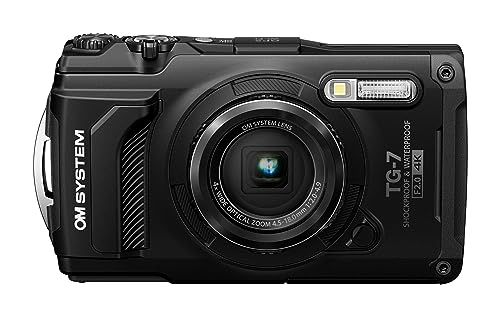
| OM SYSTEM Tough TG-7 | Best hiking camera for all weather and water | Waterproof, drop-resistant, and macro-capable — the camera that never needs to hide from a hiking day. |
| Sony RX100 VII | Best pocket camera for serious hiking photographs | A 1-inch sensor and a long zoom in a jacket-pocket body — real photographic range at negligible weight. |
| OM SYSTEM OM-5 Mark II | Best sealed system camera for hiking photographers | Weather-sealed mirrorless with stabilisation and compact lenses — the planned-photography hiking system. |
| DJI Osmo Pocket 3 | Best camera for hiking video and vlogs | A gimbal camera that turns walking footage into smooth, watchable trail films from a coat pocket. |
| GoPro HERO13 Black | Best camera for scrambles, summits, and POV trails | Waterproof, mountable, stabilised capture for the parts of the hike where hands are busy staying attached. |
| Fujifilm X100VI | Best fixed-lens camera for the walking photographer | A beloved, weather-resistant fixed-lens camera whose simplicity suits the contemplative end of hiking. |
How Did We Choose Cameras for Hikes?
We weighed everything — literally in judgement if not on a scale in this text. Each pick was assessed as a total carried system: body, lens if any, battery provision, case or strap, and the charger it implies. A light body that demands three batteries and a brick of a charger is not a light system, and the ranking reflects whole-kit honesty.
Weather behaviour came second. Sealing class, lens exposure to the elements, and how the camera behaves when its owner is caught in the rain an hour from the car all counted. So did recovery: a camera that can be rinsed, wiped, and dried at the tent door scored above one that must be nursed in a dry bag for the rest of the trip.
Trail handling was tested in imagination at the worst moments: gloves on, wind up, subject departing. Big record buttons, screens readable in glare, straps that keep the camera at the chest rather than in the pack — because the camera in the pack photographs nothing — all shaped the order. The best trail camera is the one already in your hand when the eagle crosses the valley.
Finally, image quality was judged at hiking subjects: vast landscapes that punish weak lenses at the corners, forest shade that punishes small sensors, and companions’ portraits at the summit that punish nothing but matter most. Each pick had to be genuinely good at its walker’s subjects, not merely light. Portability bought with disappointing pictures is a false economy the trail exposes within one trip.

OM SYSTEM Tough TG-7 — Best hiking camera for all weather and water
The TG-7 is the hiking camera for walkers who refuse to let weather edit their plans. It is waterproof for the river crossing and the waterfall pool, sealed against the dust of dry trails and the grit of scrambles, and resistant to the drop onto granite that ends other cameras’ trips. Carried on a chest strap, it is simply always available — rain, spray, or shine — and availability is the first virtue of a trail camera.
Its macro mode is the trail’s secret weapon. Alpine flowers, frost feathers on a morning tent fly, a beetle’s armour, the lichen maps on summit rock: hiking is full of small wonders at boot height, and the TG-7 photographs them at distances no other pick here can focus. The location logging draws the day’s route into the pictures’ data, so the walk home includes a mapped story of where each frame happened.
Image quality is a rugged compact’s — very good in daylight, mortal in deep shade — and the body is chunky beside the pocket cameras. Those are the terms. In exchange you get the only camera here that a hiker can drop in a stream, fish out, and keep shooting with, and on real trails that exchange is struck gladly by thousands of walkers every season.
- Build: waterproof, dustproof, drop- and crush-resistant
- Macro: close-focus modes for trail flora and detail
- Logging: location and conditions recorded with images
- Lens: fixed zoom, always ready, never extended into weather
- Power: rechargeable battery with USB charging
Strengths
- No weather on any trail makes it hide
- Macro turns boot-height nature into a subject
- Survives the drops that end other cameras’ trips
Trade-offs
- Daylight camera at heart; deep shade tests it
- Chunkier than the pocketable picks
- Fixed lens limits distant wildlife ambitions
Best for: all-weather hikers, river walkers, and anyone whose camera must survive the trip unconditionally.
Not suited for: large-print landscape purists.

Sony RX100 VII — Best pocket camera for serious hiking photographs
The RX100 VII is the hiker-photographer’s pocket miracle: a sensor large enough for prints, a zoom long enough to isolate a peak or a ptarmigan, and autofocus fast enough for the dog shaking off the lake — all in a body that vanishes into a jacket pocket and weighs less than the water you will drink before lunch. For walkers who measure a camera’s worth in pictures per gram, nothing else in this pool is close.
The zoom deserves emphasis because trails are full of unreachable subjects: the waterfall’s upper tier, the eagle’s ledge, the village in the valley that explains the whole walk. The RX100 VII reaches them optically rather than by cropping hope. Its lens is sharp, its colours are honest, and its burst speed covers the action a hiking day actually contains — weather arriving, companions laughing, wildlife departing.
It is a precision instrument, not a rugged one: no sealing worth the name, a lens that extends into the weather, and a battery that rewards a spare in the hip belt. Carry it in a small case, respect the rain with a cover, and it will repay the care with the best stills-per-gram on this list. Hikers who print their walks should start here and stop reading.
- Sensor: 1-inch class for printable trail photographs
- Lens: long zoom for distant peaks and wildlife
- Autofocus: fast tracking for animals and companions
- Size: jacket-pocket body, minimal carried weight
- Video: capable recording for trail clips
Strengths
- Best still-image quality per gram here
- Zoom reaches the subjects trails put at a distance
- Pocketable enough to be carried on every walk
Trade-offs
- No meaningful weather sealing
- Small battery — carry a spare
- Extending lens dislikes grit and drizzle
Best for: hiker-photographers who print, and walkers wanting real range without a system.
Not suited for: storm-proofing or careless handling.

OM SYSTEM OM-5 Mark II — Best sealed system camera for hiking photographers
For hikers who plan the walk around the photograph — the tarn at dawn, the ridge in storm light — the OM-5 Mark II is the system that respects both halves of the identity. It is weather-sealed to be rained on without flinching, stabilised for handheld work at waterfalls and in forests, and served by a lens range famous for small, sealed, sharp optics. The whole kit rides lighter than rival systems, which on a climb is not a detail but the argument.
Its computational talents suit trails specifically. High-resolution modes extract landscape detail when the tripod comes out at the lake; live composite-style long exposures turn streams silky without filter juggling; and the stabilisation stretches handheld shutter speeds in the green gloom under canopies where tripods are a faff. This is a camera designed by people who demonstrably walk in weather, and it shows in every decision.
Choose lenses sealed, carry the small tripod for the planned shots, and accept that the smaller sensor asks for care in the deepest shade. What you get in return is the most complete hiking photography system here — the one whose owner plans trips in a calendar marked with moon phases and tide times, and comes home with the pictures to justify it.
- Type: weather-sealed interchangeable-lens mirrorless
- Stabilisation: strong in-body system for handheld trails
- Modes: high-resolution and long-exposure assists
- Lenses: compact sealed optics across a deep range
- Build: sealing for rain and mountain weather
Strengths
- Complete hiking system at trail-friendly weight
- Stabilisation and modes serve waterfalls and forests
- Sealed lenses keep the weather out as a system
Trade-offs
- Smaller sensor needs care in deep shade
- Best results reward planning and a small tripod
- Lens collection is an investment over time
Best for: photographer-hikers planning walks around dawn, weather, and water.
Not suited for: ultralight backpackers counting every gram.

DJI Osmo Pocket 3 — Best camera for hiking video and vlogs
Walking is the hardest movement to film: every step is a bob, every glance a sway. The Pocket 3’s mechanical gimbal erases both, producing trail footage that glides like the memory of the walk rather than juddering like the fact of it. For hikers who film — route guides, family epics, the channel that documents a long-distance path — it is the difference between footage people watch and footage people endure, and it does this from a device the size of a chocolate bar.
The rotating screen and tracking make it a solo walker’s crew. Set it on a rock, walk the frame, let it follow; talk to it at the summit cairn with your face held in focus and the view arranged behind you. Its sensor handles the forest’s shade and the summit’s glare with more grace than action cameras manage, and the whole thing charges from the same power bank as the phone, which simplifies backcountry logistics beautifully.
It is not weatherproof, and its gimbal is a mechanism that deserves a case and a moment’s care at river crossings. Stills are a side function. But for the growing nation of hikers whose souvenir is a film — and whose families actually gather to watch it — the Pocket 3 is the most persuasive camera in this guide, because it makes the walking itself look the way walking felt.
- Stabilisation: mechanical 3-axis gimbal for walking footage
- Sensor: 1-inch class for shade and glare
- Screen: rotating display for solo filming
- Tracking: face and subject following for walk-and-talk
- Charging: USB from the same power bank as a phone
Strengths
- Walking footage becomes smooth and watchable
- Solo filming needs no companion crew
- Pocket size with serious image quality
Trade-offs
- Not weatherproof — needs care in rain
- Gimbal mechanism deserves its case
- Stills are secondary to its video purpose
Best for: hikers who film their walks for family, channels, or route guides.
Not suited for: storm-exposed stills photography.

GoPro HERO13 Black — Best camera for scrambles, summits, and POV trails
Some hiking is done with the hands: the scramble, the via ferrata, the ridge where the pole is stowed and the rock is the handrail. The HERO13 Black films those passages from a chest or helmet mount while the hiker concentrates on not becoming a statistic, and its stabilisation turns the footage into a watchable account rather than a shake reel. It is waterproof for the burn crossing and the summit squall alike, and it starts recording with one press of a big, glove-tolerant button.
The wide lens is the honest perspective of exposure — the drop beside the path rendered with the drama it deserves — and the tall capture lets one descent become both the television epic and the phone clip. Lens mods widen or correct the view as the route demands. For trail runners and fast-packers, its combination of weight, toughness, and startling steadiness is the entire argument, and it is enough.
As a stills camera it is a souvenir machine, its indoor and evening quality is ordinary, and the wide view distorts the gentle landscapes that other picks render faithfully. Assign it the mountain’s violent passages and the weather’s worst hours, and it is irreplaceable; assign it the family portrait at the bothy and you have chosen the wrong tool with great confidence.
- Build: waterproof, rugged, mountable anywhere
- Stabilisation: advanced smoothing for scrambling footage
- Lens: ultra-wide with interchangeable mods
- Capture: tall-format for wide and vertical edits
- Controls: large record button suited to gloves
Strengths
- Films the hands-busy passages no other pick can
- Weatherproof and knock-proof by design
- One-press recording with gloves on
Trade-offs
- Stills are mementos, not photographs
- Wide distortion flatters drama, not gentle scenery
- Evening and indoor quality is modest
Best for: scramblers, trail runners, and POV documentation of hard passages.
Not suited for: considered landscape stills.

Fujifilm X100VI — Best fixed-lens camera for the walking photographer
The X100VI serves the hiker for whom the walk is the point and the photograph is its punctuation. One fixed wide lens, a leaf shutter quiet enough for a dawn bothy, film-inspired colour that makes a valley look like the memory it will become, and a hybrid viewfinder that keeps the world visible while you frame it — the whole camera argues for slowness, attention, and a small number of considered pictures per day.
Weather resistance (with the adapter and filter fitted, a condition this guide states plainly) covers trail drizzle, and the compact body rides in a jacket or a hip-belt pouch without announcing itself. Its sensor is high-resolution and its lens is excellent, so the considered pictures are also technically superb — the print above the desk at home is this camera’s natural habitat. Walking photographers who shoot like this produce fewer frames and more keepers than any other tribe on the trail.
The fixed lens is the honest limitation: no zoom for the eagle, no wide sweep for the cirque, and the camera’s popularity means it can be hard to find and easy to overpay for through unofficial channels. It is a connoisseur’s instrument, not a family’s trail camera. For the hiker whose photography is a walking meditation, though, nothing else here — or almost anywhere — fits the hand and the philosophy so well.
- Lens: fixed wide prime, no zoom by design
- Sensor: high-resolution APS-C
- Viewfinder: hybrid optical and electronic
- Sealing: weather resistance with adapter and filter fitted
- Colour: film-inspired rendering for evocative trail images
Strengths
- Encourages slow, considered, excellent pictures
- Compact and quiet — a walker’s camera, not a burden
- Image quality serves large prints
Trade-offs
- Fixed lens cannot reach distant subjects
- Weather resistance needs the adapter fitted
- Popularity makes it scarce and sometimes overpriced
Best for: contemplative walkers who take few, deliberate, printable photographs.
Not suited for: families, wildlife watchers, or zoom-dependent subjects.
How Should You Carry a Camera on the Trail?
The golden rule is brutal: a camera in the pack is a camera at home. Whatever you buy, it must ride where a hand lands on it in two seconds — a chest strap, a hip-belt pouch, a capture clip on the shoulder strap. The eagle, the light break, and the companion’s unrepeatable expression all allow roughly that long. Hikers who accept this rule take ten times the photographs of hikers with better cameras buried under the waterproofs, and their pictures are better because the moments were alive when caught.
Protect the carried camera from its two trail enemies: sweat and knocks. A camera against the chest marinates in salt moisture all day; a thin barrier layer or a strap position slightly to the side keeps the worst off, and a wipe at every stop keeps the rest honest. Knocks come from gates, stiles, and the moment the pack swings off a shoulder — a small padded case for the pocket cameras, or the TG-7’s armour for the careless, settles the account.
At night, the camera’s place is inside the tent’s driest corner, battery warm in the sleeping bag on cold trips, lens cloth dry in its own small bag. Backcountry photography is mostly logistics performed at walking pace, and the hikers whose cameras work on day six are the ones who treated carrying and camping as part of the craft from day one.
How Do You Photograph Weather Instead of Hiding from It?
The finest hiking photographs are disproportionately made in the weather other walkers wait out: the cloud sea below a summit at dawn, rain shafts crossing the valley, the first light after a storm when the world is washed and the air is glass. Sealed cameras exist for these hours. The technique is mostly temperament — staying at the viewpoint while the squall passes over, keeping the lens wiped and pointed downwind, and shooting through the breaks rather than after them.
Manage the lens, not just the body. Rain on the front element is the visible enemy; a cloth in a pocket that stays dry, a hood where the camera allows one, and the habit of checking the glass before every frame keep weather pictures sharp instead of impressionistic. In cold conditions, the walk back into a warm hut fogs everything — bag the camera outside, as the humidity guide in this series explains, and let it warm sealed.
Above all, photograph companions in weather rather than despite it. The portrait at the summit in a tearing wind, laughing, hood up, is the picture the family will keep; the mild-day group shot is the one they will scroll past. Weather is not the obstacle to hiking photography. Weather, properly equipped for, is hiking photography.
Which Hikes Ask the Most of a Camera?
The multi-day backpacking trip is the sternest examiner: weight audited nightly, power rationed, weather guaranteed to audition every seal. Cameras pass it by being systems rather than objects — the TG-7 with its simple charging, the Pocket 3 sharing the phone’s power bank, the RX100 VII with a spare battery the size of a coin. Cameras fail it by demanding infrastructure the trail cannot provide, however beautiful their single-day photographs might be.
Winter walking examines differently: batteries sulk in the cold, screens slow, and gloves turn every control into a rumour. The picks that serve winter are the ones with big record buttons, viewfinders or bright screens, and batteries that can ride warm in an inside pocket between viewpoints. Condensation on the return to the hut — the humidity guide’s bag ritual — belongs to winter craft as much as to the tropics.
The long-distance trail, measured in weeks, examines the photographer more than the camera: charging opportunities become a route-planning input, card capacity a logistics problem, and the camera’s daily companionship a psychological one. The long trails’ veterans choose cameras they like holding at mile four hundred, which is why the X100VI’s devotees and the TG-7’s loyalists describe their choices in the language of temperament rather than specification. On a long enough walk, the camera is a companion species, and companionship is a specification.
How Do You Photograph Landscapes from a Trail?
Trail landscapes fail in predictable ways: the horizon through the middle, the foreground an apology of gravel, the vastness flattened into a postcard of itself. The cures are walking cures. Move until something near — a boulder, a pool, a companion’s pack — can anchor the foreground; let the path itself lead the eye, since paths are compositional gifts trails hand out freely; and wait, when the light is nearly right, because nearly-right light on a mountain is a promise the next ten minutes usually keep.
The cameras divide the labour by temperament. The OM-5’s high-resolution modes and stabilisation serve the deliberate tripod-at-the-lake school; the RX100 VII’s zoom isolates the layered ridges that are landscape photography’s favourite sentence; the X100VI’s fixed lens forces the oldest discipline of all — zooming with the feet, which on a trail simply means walking the composition into existence. All three schools produce prints; the trail does not care which you attend, only that you stop walking when the picture arrives.
Weather, again, is the co-author. The clearing storm, the cloud sea, the rain shaft crossing the sunlit valley — these are the landscape department’s masterpieces, and they are available only to walkers whose cameras are out, sealed, and ready when the sky performs. Landscape technique on a trail is therefore mostly the carrying and weather craft of the earlier sections, arriving at the viewpoint with a working camera and the patience to use it.
How Do You Keep Trail Photography Light Without Regretting It?
Audit the kit by asking what each item photographed on the last trip. The second lens that stayed in the pack, the tripod that served once, the filter set auditioning for a job it never got — the trail charges rent in grams for every passenger. Veterans cut ruthlessly and then, paradoxically, take better photographs, because a kit small enough to be carried without negotiation is a kit that is present for the unplanned frames that become the trip’s best.
The exceptions prove the audit’s honesty. A small tripod on a waterfall trip is not a passenger; it is the assignment. A spare battery in winter is not weight; it is the second half of the camera. The discipline is not minimalism as a religion but minimalism as an accounting practice: every gram must present its photographs at the audit, and the ones that cannot are left for the trip where they can.
Comfort is part of the accounting that pure weight tables miss. A strap that distributes kindly, a pouch that opens one-handed, a camera whose grip suits your gloves — these decide whether the light kit is also the used kit at mile nine. The lightest camera in this guide, carried in a system that fights its owner, loses to a heavier camera carried like a friend. Fit the carrying before the trip, at home, with the pack loaded and the boots on.
What Should a Hiking Camera Kit Contain Besides the Camera?
The cloth, the bag, and the battery: trail photography’s holy trinity of small things. A microfibre cloth in a sealed pouch — sealed, because a gritty cloth is a lens’s enemy wearing a friend’s face. A waterproof bag or cover sized for the camera, for the squall and the river crossing and the hut-door transition. A spare battery, warm in winter, plus the cable that lets the power bank serve every device you carry. Together they weigh less than lunch and decide more photographs than any lens.
Add the strap system as a deliberate purchase rather than an afterthought. Chest carry, hip-belt pouch, or shoulder-strap clip — the mechanism that puts the camera in the hand in two seconds is, functionally, part of the camera. The picks in this guide were partly ranked on how gracefully they accept being carried this way: the compacts and the Pocket 3 vanish into the role; the OM-5 system, with the right strap, rides like it was designed to, because it largely was.
Finally, the unphotographic essentials that keep the photographer functioning: the map that does not need a battery, the headtorch that makes the dawn viewpoint possible, and the patience — carried in the temperament — to wait for light. Kit lists end where craft begins, and the trail’s best photographers are distinguished less by their bags than by their willingness to stop, wait, and be rained on briefly for a picture.
How Do You Photograph People on a Hike?
Companions are the trail’s meaning and its most neglected subject. The summit group shot is obligatory and should be taken properly — camera on a rock or mini-tripod, everyone in, the view arranged behind rather than instead of the people. But the portraits that age best are the working ones: hands on a map, the laugh at the river crossing, the quiet face at the evening viewpoint. Photograph the hike’s labour and its rest, not only its arrival.
Scale is the portrait’s landscape job. A walker small against the cirque tells the mountain’s size in a way no empty frame can; a walker large against a blurred ridge tells the day’s mood. Both grammars belong in a hiking set, and the zoom picks — the RX100 VII above all — move between them without a lens change, which on a windy ridge is a genuine creative freedom.
Ask, include, and share. The companion photographed well becomes the companion who photographs you well in return, and the solo hiker’s absence from their own archive is the saddest gap in trail photography. Timers, tracking, and the Pocket 3’s follow modes exist to close it. A hiking album where the photographer appears — windblown, mid-laugh, unposed — is the only complete one, and completeness is what the future will ask of it.
How Do Trail Cameras Handle Altitude, Cold, and Heat?
Altitude itself is gentle on cameras; its companions are not. Intense ultraviolet flatters nothing and punishes screens’ readability, cold at the passes drains batteries mid-afternoon, and the day’s temperature swing — frost at dawn, shirtsleeves by noon — fogs lenses at every transition between tent, pocket, and open air. The mountain kit answers with the usual liturgy: batteries rotated through warm pockets, the camera kept at ambient temperature rather than coddled, and the bag ritual at the hut door.
Heat at the lowland end of a long trail brings its own taxes: batteries age faster, screens dim themselves protectively, and the photographer’s patience — the real consumable — evaporates. Shade breaks for the kit as much as the walker, and the TG-7’s indifference to being rinsed under a trailhead tap has ended many overheated afternoons happily. None of the picks here is fragile about temperature within any range a hiker survives, which is precisely why they are the picks.
The deeper truth is that trails test systems, not sensors. Every camera in this guide has photographed beautifully at altitude and in cold, in the hands of walkers whose batteries were warm and whose cloths were dry. Prepare the small things, and the environment becomes the subject rather than the adversary — which, on a mountain, is the whole ambition.
How Do You Photograph Wildlife on a Hike?
Trail wildlife is encountered, not stalked: the marmot at the col, the deer at the forest edge, the eagle using the valley’s wind. The technique is readiness — camera on the chest, zoom at a useful length, settings left where an animal’s ten seconds can be used rather than configured. The RX100 VII’s reach and speed were ranked for exactly these encounters, and the TG-7’s quiet manners serve the small, close wildlife that poses rather than flees.
Ethics set the frame before optics do: the animal’s behaviour is the boundary, and a photograph that costs a nesting bird its composure is overpriced at any resolution. Let the encounter happen at the animal’s distance, crop with the zoom rather than advancing with the feet, and leave the place as the animal’s home rather than your studio. Trail photographers who practise this restraint get the natural behaviour the pursuers frighten away, which is the trail’s usual justice.
How Do You Shoot Sunrise from a Summit Camp?
The work happens the night before: the viewpoint scouted at dusk, the composition argued with while the light is still honest about where the sun will rise, the camera’s battery warm and its lens at ambient temperature so the dawn’s cold glass does not fog at the crucial minute. Set the alarm for the blue hour, not the sunrise; the finest summit light is the half hour when the valleys are still sleeping in shadow and the peaks are already lit like lanterns.
At the moment itself, expose for the sky’s generosity and let the land hold what the sensor can — or bracket, as the HDR guide in this series teaches, and merge the mountain’s two worlds at home. The OM-5’s stabilisation and modes serve the tripod-less dawn; the X100VI’s quiet shutter respects the other sleepers in the bothy. Photograph the companions’ faces in that light too: dawn portraits at altitude are the ones families frame.
How Do You Keep Shooting in the Rain on a Trail?
Decide the camera’s rain plan at the trailhead, not at the squall. The TG-7 needs no plan, which is its entire charm. The sealed OM-5 system works under a cover with the lens chosen for the day. The pocket cameras retire to a dry bag until the breaks — and breaks, in mountain weather, are where the masterpieces live, so the retirement is tactical rather than defeatist.
Shoot through the weather’s drama rather than waiting it out: rain shafts, cloud seas, the first shaft of sun on wet rock. Keep the lens wiped and pointed downwind, shelter the body with your own, and dry everything at the first stop with moving air. The hikers whose albums contain weather are not braver than the others. They are drier in their systems and quicker in their rituals, and the photographs follow from the logistics as reliably as rivers follow valleys.
How Should Beginners Choose Their First Hiking Camera?
Begin with the walking, honestly described. A beginner whose hikes are weekend paths in kind weather needs the RX100 VII’s quality or the Pocket 3’s film-making, not armour. A beginner whose ambitions already include winter, rivers, and scrambles should buy the TG-7 first and let it survive the learning curve’s drops, because beginners drop cameras at a rate no insurance of care can prevent.
Resist the system temptation until the photographs demand it. A season with a compact teaches a hiker what they actually photograph — landscapes, companions, small things, moving water — and that knowledge chooses the system, the lenses, and the budget with an accuracy no shop can match. The OM-5 will still be there next season, and it will be bought by a photographer rather than a hopeful, which is the best foundation any system can have.
How Do You Make a Hiking Photograph Worth Printing?
Slow down at the chosen scene. The print-worthy trail photograph is almost always the one where the walker became a photographer for five full minutes: foreground found, light waited for, companion placed, horizon argued with. The cameras that serve printing — the RX100 VII’s files, the X100VI’s lens, the OM-5’s high-resolution modes — all assume this pause exists. A trail set shot entirely at walking pace contains snapshots; the print comes from the pause.
At home, print sooner and smaller than ambition suggests. A modest print on the wall teaches more about the next hike’s photography than a season of screen admiration: corners, colours, and sharpness all confess on paper. The hiking photographers whose walls are full are not the ones with the best cameras. They are the ones who stopped, waited, printed, and learned — in that order, repeatedly, at altitude.
How Do You Photograph a Long-Distance Trail as a Story?
Give the trail a structure before the first mile: the map on day one, the same boots at each hundred, the companion’s face at the stages where the walk changes them. Long trails are novels, and novels need recurring characters and markers of distance travelled. The camera that serves the story is the one still being carried in the final week — which returns the choice, as every section of this guide does, to weight, weather, and affection for the instrument.
Shoot the infrastructure of endurance as faithfully as the views: the water source, the bothy door, the evening ritual of boots and stove. Future readers of the set — including the walkers themselves at sixty — will find the story in those frames, because the views belong to everyone who walked there and the rituals belonged only to you. A long trail photographed this way becomes a document no other walker could have made.
How Do You Protect Photographs on a Multi-Day Trip?
Cards are the trail’s fragile cargo: small, silent, and carrying the whole expedition. Keep the current card in the camera, the finished cards in a hard case in a different part of the pack from the camera itself, and — where a phone or a companion’s device allows — a copy of the best frames travelling separately again. Rivers, theft, and simple loss all hunt single copies, and the trail is long enough to give them their chances.
At the bothy or the tent, the evening review doubles as the integrity check: the day’s frames open, the favourites are starred, and any card behaving strangely is retired before it takes a summit day with it. Data discipline feels urban until the first card fails at altitude, after which it feels like seamanship — which, on a long trail, is exactly what it is.
One Last Word on the Descent
Judge the kit once more on the way down, when knees argue and the light is doing its best work of the day at the worst possible angle. The camera still on the chest at that hour — light enough to have been forgotten, ready enough to catch the valley turning gold below — is the camera this guide was trying to sell you all along. Every specification in it was a proxy for that moment. Choose for the descent, and the ascent will look after itself.
How Do the Six Hiking Cameras Compare?
Choose by walking style first: the all-weather wanderer, the printing photographer, the planner, the filmmaker, the scrambler, and the contemplative each have a row waiting. Comparing a waterproof compact with a fixed-lens connoisseur camera on specifications is a category error the trail will punish.
| Pick | Role | What to know |
|---|---|---|
| OM SYSTEM Tough TG-7 | The trail-proof compact | Weather is its feature list, not its fear list. |
| Sony RX100 VII | The pocket rangefinder of trails | Maximum photograph, minimum burden. |
| OM SYSTEM OM-5 Mark II | The hiking system | For walks that are photo expeditions in disguise. |
| DJI Osmo Pocket 3 | The trail filmmaker | It makes walking look like gliding. |
| GoPro HERO13 Black | The summit-and-scramble camera | For the miles where holding a camera is impossible. |
| Fujifilm X100VI | The walking meditation | One lens, one walker, complete attention. |
If torn between two rows, decide by your worst typical day rather than your best: the camera that serves the wet Tuesday in November will be loved in June, while the camera bought for June’s perfect evening may spend November in the pack — where, as established, cameras photograph nothing.
How Do You Get More Photographs from Every Hike?
Habits, not gear, separate hikers with full memory cards from hikers with good intentions. These five are practised by every trail photographer whose archive you envy.
Photograph the walk, not just the summit
The summit is one frame of a day-long story. Shoot the trailhead sign, the companion lacing boots, the weather arriving, the bothy door. The story set is what families rewatch; the summit shot alone is a screensaver.
Stop for light, walk for distance
When the light breaks — the cloud gap, the shaft through the trees — stop walking and work the scene for two minutes. Distance can be recovered at a brisker pace; light, once walked past, does not repeat at the next viewpoint.
Use companions as scale
Mountains photograph small without a human reference. A walker in a coloured jacket at the frame’s third turns a big slope into an enormous one, and the picture into a memory of someone rather than a postcard of somewhere.
Shoot the small trail world
Boot-height flowers, boot prints in first snow, the map’s corner against the actual valley — close subjects give a hiking set its texture. The TG-7’s macro and every camera’s close focus exist for the album’s second half.
Review at the tent, delete at home
Evening review over the day’s frames — choosing three favourites with companions — is the trail’s best entertainment and its sharpest tuition. Delete nothing in the field; tired eyes delete keepers, and cards are cheaper than regrets.
Underneath all five sits the carrying rule: camera on the chest, cloth in the pocket, battery warm. Technique is what happens after access, and access is a decision made at the trailhead with the straps.
What Mistakes Do Hikers Make with Cameras?
Carrying the camera in the pack
The most common and most fatal. Every subject that matters on a trail is fleeting, and a camera under the rain cover and the lunch might as well be a camera in another county. Ride it on the chest or do not bring it.
Buying for the summit and ignoring the descent
Heavy kits are carried uphill on enthusiasm and downhill on resentment, and resentment leaves cameras in bags. Weigh the whole system honestly against your real legs, not your aspirational ones.
Ignoring the battery plan
Cold, altitude, and long days conspire against batteries. A spare kept warm, USB charging from the power bank, and screens dimmed by default are the difference between a camera and a souvenir of one at the final viewpoint.
Trusting the forecast over the mountain
Clear at the car park means nothing at the col. Unsealed cameras need their rain plan — cover, dry bag, or the discipline to stow early — decided at the trailhead, not negotiated with the squall.
Photographing only the famous viewpoint
The signed viewpoint’s photograph has been taken ten thousand times, once by everyone. Walk fifty metres, crouch, include your companion’s reaction — the personal frame beats the canonical one home every time.
Final Recommendation
For most hikers, the OM SYSTEM Tough TG-7 is the trail answer: always carried, never worried about, and quietly brilliant at the small world underfoot. Walkers who print should take the Sony RX100 VII’s quality-per-gram instead, and accept its need for a little shelter.
Filmmakers walk with the Pocket 3, scramblers with the HERO13, planners with the sealed OM-5 Mark II system, and contemplatives with the X100VI. Each is the best camera in this guide for its walker’s way of moving through mountains — which is the only comparison the trail itself recognises.
Whichever you choose, strap it to your chest, keep the cloth dry, and stop when the light breaks. Hiking photography is not a specification. It is a way of paying attention at walking pace, with a camera that is still there — and still working — when the mountain decides to show you something.
Frequently Asked Questions
How much camera weight is reasonable for hiking?
For day hikes, anything in this guide rides comfortably; the system picks ask for a deliberate decision rather than a default. For multi-day backpacking, count the whole kit against food and shelter honestly — most walkers settle happily at the compact end, with the TG-7 and Pocket 3 the classic choices.
Do I need weather sealing for hiking?
In mountain country, effectively yes — either the camera’s own sealing or a disciplined cover routine. Weather arrives faster than walkers descend, and the camera on your chest receives the rain your whole jacket was designed around.
How do I stop my lens fogging on cold mornings?
Keep the camera at outside temperature rather than in a warm tent overnight, and bag it before bringing it into warmth after the walk. Fog is condensation seeking the coldest surface; temperature patience, not wiping, is the cure.
Is a phone not enough for hiking photographs?
Phones photograph beautifully until weather, battery rationing, gloves, and drops enter the story — which on real trails is by lunchtime on day one. A dedicated camera keeps the phone sealed away for navigation and emergencies, which is where a phone earns its keep.
Which pick is best for a long-distance trail?
The TG-7 for its indifference to conditions and simple charging, or the Pocket 3 if the journey is being filmed. Both sip power respectably, survive the weeks, and ask for nothing the trail cannot provide.
Related Guides
Keep planning with our guides to travel cameras, humidity-proof gear, and backpacking kits: Best Cameras for Travel and Backpacking Best Cameras for High Humidity Best Cameras for Backpacking and Hiking


