ilcastellomenu.com is reader-supported. When you buy through links on our site, we may earn an affiliate commission.
Where to Buy
A quick note on the words you typed to get here: “phots” is a typo for “photos,” and we are treating your search exactly that way. You are looking for the best cameras for taking good photos — good ones straight away, without a semester of editing software, without a bag of lenses you are afraid to touch, and without the sinking feeling that the camera knew more than you did and kept it secret. That is the reader this guide was written for: the parent whose phone keeps missing the birthday candle moment, the traveller tired of flat holiday pictures, the new hobbyist who suspects, correctly, that a real camera would change things if only it would meet them halfway.
Here is the encouraging truth that camera marketing rarely mentions. Almost every modern camera can take a technically good photograph. What separates the cameras below is how little they ask of you before they hand one over. Some lean on friendly menus and guided modes that explain themselves in plain language. Some pour their effort into colour that looks finished the moment it leaves the sensor, so the picture on the screen already resembles the memory in your head. Others simply focus so reliably, on faces and eyes and moving children, that the keeper rate climbs and photography stops feeling like a lottery.
We have ranked six cameras for that specific promise: good photographs with the least friction. There is a compact you can carry in a coat pocket, an instant camera that prints its own evidence, and four mirrorless bodies at stepping-stone prices and sizes. None of them requires you to shoot in manual mode, learn a histogram, or apologise for using the automatic settings — although every one of them will still be useful on the day you decide you want to learn, which, fair warning, tends to arrive sooner than people expect.
Each pick is linked on Amazon in the Quick Picks table and again beside its full review, where you can check current availability and the kit options on offer. Read the sections on colour and focusing before you choose, because for a first good camera those two qualities will shape your happiness far more than any specification printed in large type.
Key Takeaways
- The Canon EOS R50 is the friendliest starting point here: guided menus, dependable eye autofocus and colour that flatters family life.
- Fujifilm’s X100VI produces the most finished-looking photographs straight from the camera, thanks to its celebrated film simulations.
- The Sony ZV-E10 II suits beginners who split their time between photographs and video for sharing online.
- Canon’s PowerShot G7 X Mark III proves a pocket compact can still out-photograph a phone at parties and on trips.
- The Nikon Z50 II brings a proper viewfinder and grown-up handling to the beginner class without a grown-up price of admission.
- Fujifilm’s Instax Mini 12 removes skill from the equation entirely and trades it for printed fun nobody regrets.
In this guide
Quick Picks
| Camera | Badge | Why it earns its place |
|---|---|---|
| Canon EOS R50 | Best first camera | Guided menus and eye autofocus that quietly rescue family photographs. |
| Fujifilm X100VI | Best colour out of camera | Film simulations make everyday scenes look finished without editing. |
| Sony ZV-E10 II | Best photo-video mix | Sharp stills, strong video tools and autofocus that tracks anything. |
| Canon PowerShot G7 X Mark III | Best pocket compact | A bright lens and one-inch sensor in a camera that goes anywhere. |
| Nikon Z50 II | Best handling for learners | A real viewfinder, twin dials and colour that rewards growing skill. |
| Fujifilm Instax Mini 12 | Best instant fun | Point, press, print: good photographs as party souvenirs in a minute. |
How Did We Choose Cameras for People Who Just Want Good Photos?
We started by defining “good” the way a beginner experiences it, not the way a laboratory measures it. A good photograph, for this reader, is sharp where it should be sharp, bright without being bleached, coloured the way the day actually felt, and — above all — it is the moment you meant to keep rather than the half-second after it. Cameras were scored first on how reliably they deliver that result in their automatic and semi-automatic modes, because a camera that only shines in expert hands fails this particular brief.
Autofocus carried unusual weight. Missed focus is the beginner’s most common heartbreak, and modern subject detection — faces, eyes, pets, vehicles — is the single technology that has most changed what a newcomer can expect. Every camera in this list detects eyes; the ranking reflects how gracefully each one does it when the subject is a wriggling toddler rather than a cooperative adult posing against a wall.
Colour science came next, judged on finished JPEG files rather than raw potential. Beginners overwhelmingly share the file the camera produces, so we favoured cameras whose default rendering flatters skin, keeps skies honest and resists the grey, washed look that makes people conclude they are “bad at photography” when the camera’s defaults were simply dull. Finally, we weighed forgiveness: how the camera behaves at dusk, indoors, and in the mixed lighting of real homes, where most treasured photographs are actually attempted.
Why Do Phone Photographs So Often Disappoint, and What Does a Camera Do Differently?
The phone in your pocket is a remarkable computer that happens to take pictures, and its disappointments follow from that order of priorities. Its sensor is small, so in dim rooms it must either brighten aggressively — painting noise into a watercolour smear — or merge many frames into a composite that can look strangely airless. Its lens cannot truly zoom, so distant subjects are crops wearing a zoom costume. And its eagerness to please, sharpening and saturating everything, can turn a gentle evening into a theme-park postcard.
A dedicated camera attacks each weakness with physics rather than cleverness. A larger sensor gathers more light per photograph, which is why the cameras below stay calm in restaurants and living rooms where phones begin to smudge. A real lens with a wide aperture lets backgrounds melt away from a face instead of being faked by software that occasionally eats an ear. Optical zoom reaches across a school hall honestly. None of this requires expertise to benefit from: the physics works in automatic mode too, quietly, on every frame.
There is also a behavioural difference nobody puts on a spec sheet. Holding a camera with both hands, raising a viewfinder or framing on a proper screen, slows most people down by the two seconds that separate a snapshot from a photograph. Beginners consistently report that their pictures improve simply because the tool invites intention. The cameras in this guide were chosen partly for how strongly they issue that invitation without intimidating the guest.
What Are the Best Cameras for Taking Good Photos?
Six routes to better pictures, ordered from the all-round beginner’s body to the pocket and instant alternatives — every one of them capable of photographs your phone would envy.

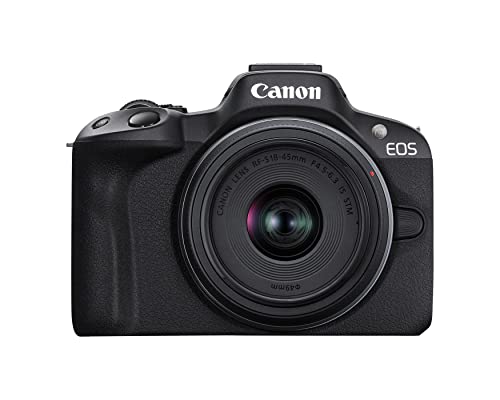
Canon EOS R50 — Best first camera
If this guide had to shrink to a single recommendation for a person buying their first real camera, the R50 would be the survivor. Canon designed it for exactly the reader described in our introduction: someone arriving from a phone, suspicious of menus, who wants the camera to explain itself. Its guided interface describes settings in everyday words and shows previews of what changing them will do, so the mysterious vocabulary of photography — aperture, shutter speed, depth of field — is translated at the moment it becomes relevant rather than in a manual nobody opens.
The autofocus is the quiet hero. The R50 finds faces and locks onto eyes with a confidence that transforms family photography: children crossing a garden, a dog reconsidering its obedience, a grandparent laughing mid-sentence all come back sharp at rates that make beginners think they have talent. They do, a little — but mostly they have a camera that refuses to focus on the fence behind the child. Canon’s colour, long the industry reference for pleasant skin tones, means the JPEGs look warm and finished without any editing at all.
For this article’s specific angle — good photographs with minimal post-processing — the R50’s Creative Assist mode deserves its paragraph. It replaces technical terms with sliders labelled in outcomes: background blur, brightness, contrast, saturation, all adjustable while you watch the scene respond. A beginner can develop taste here, learning what they like by choosing it, and the camera remembers nothing judgmental when they hand it to a relative and switch back to full automatic. It is teaching disguised as convenience.
- Format: APS-C mirrorless, RF-S mount
- Guidance: Creative Assist and plain-language menus
- Autofocus: face and eye detection for people and animals
- Colour: Canon JPEG rendering, flattering skin tones
- Growth path: full manual control available when wanted
Strengths
- Explains itself in words beginners actually use
- Eye autofocus rescues moving family subjects
- Photographs look finished straight from the camera
Trade-offs
- Kit lens is competent rather than exciting after dark
- No in-body stabilisation; the lens must provide it
- Small body can feel cramped for very large hands
Picture a school play photographed from row nine: the phone version is a bright smear of stage light, while the R50 version shows your child’s actual expression during the line they practised for a month. That gap, repeated across birthdays and holidays, is what this camera sells, and it sells it without demanding a hobbyist’s apprenticeship first.
Best for: first-time camera buyers, families and travellers upgrading from a phone. Not suited for: photographers who already shoot full manual and want twin card slots

Fujifilm X100VI — Best colour out of camera
The X100VI is the camera for the beginner who cares less about versatility than about how a photograph feels. Its fixed lens cannot zoom and cannot be changed, which sounds like a limitation until you watch what it does to a new photographer’s eye: with one honest focal length, you learn to move your feet, to notice frames within the street, and to stop fiddling. Generations of photographers learned exactly this way, and the X100VI wraps that old discipline in a body so beautiful that people carry it on days they might otherwise have left photography at home.
Its famous advantage is colour. Fujifilm’s film simulations are not filters in the social-media sense; they are careful recreations of the company’s photographic films, refined over decades, and they render a grey Tuesday in tones that look intentional. Skin stays human, greens stay believable, and the black-and-white modes have a grain and contrast that make beginners fall for monochrome. For a reader whose goal is photographs that look good with no editing, no camera in this guide starts further ahead at the moment of capture.
The fixed-lens purity has honest costs, and this guide’s angle makes one of them sharper: a beginner hoping to photograph a child’s football match or a distant landmark will feel the single focal length immediately. The X100VI is a camera for the life within a few metres of you — tables, streets, faces, journeys — and within that territory it is close to perfect. Buy it as a deliberate, joyful constraint, not as an only camera for every occasion, and it will teach you more about seeing than a suitcase of zooms.
- Format: fixed-lens compact, APS-C sensor
- Lens: fixed wide-normal prime, leaf shutter
- Colour: extensive film simulation library
- Controls: tactile dials for shutter speed and aperture
- Extras: built-in neutral-density filter for bright days
Strengths
- Photographs look styled the instant they are taken
- Carried daily because it is a pleasure to hold
- Teaches composition faster than any zoom
Trade-offs
- One focal length, forever — no zooming at all
- Demand keeps it scarce and firmly priced
- Not the tool for sport, wildlife or stage distance
A café table in Lisbon, late light through a window, a coffee going cold because the photograph came first: that is this camera’s natural habitat, and the picture it makes there — warm, grain-kissed, honest — is one most beginners could not coax from an editing program after an hour of trying.
Best for: everyday life, travel streets and anyone who hates editing. Not suited for: zoom-dependent subjects or buyers wanting one camera for everything

Sony ZV-E10 II — Best photo-video mix
Many beginners do not actually want to become photographers; they want their life to look good in both photographs and the short videos they post from it. The ZV-E10 II was built for that blended ambition. It is a stills camera with a serious sensor and interchangeable lenses, wrapped in a video-first design: a flip screen that faces the person filming themselves, product-showcase focusing that snaps to an object held up to the lens, and background-defocus controls that deliver the blurred-backdrop look without a lecture on aperture.
For photographs specifically, its inheritance is Sony’s autofocus, which tracks eyes — human and animal — with a tenacity that borders on stubborn. A beginner pointing this camera at a birthday party can concentrate entirely on timing and leave focus to a system that treats a wandering four-year-old as a solved problem. Sony’s colour has matured into a natural, modern rendering that needs little correction, and the JPEGs hold up well when shared directly, which is the entire point for this camera’s audience.
Judged through this guide’s lens — least effort, most keepers — the ZV-E10 II’s one friction is its personality. The menus are deep, the customisation endless, and the body lacks a viewfinder, so composing on a bright beach means trusting the screen. Beginners who mainly photograph outdoors in hard sun may prefer the Nikon’s finder below. Those whose photography lives indoors, online and in motion will find this the most capable servant in the list.
- Format: APS-C mirrorless, E mount
- Screen: fully articulating, forward-facing
- Autofocus: real-time eye tracking for people and animals
- Video: strong tools including product showcase focus
- Lenses: the largest affordable lens shelf here
Strengths
- Photographs and video from one small body
- Autofocus that forgives beginner technique
- Enormous choice of lenses as skills grow
Trade-offs
- No viewfinder for bright outdoor composing
- Menus reward patience more than the Canon’s
- Rolling-shutter quirks in fast-panning video
Consider the new parent filming a first-steps video in the morning and photographing the same child, cake-smeared, by afternoon: one camera, one lens, no mode of failure that a grandparent viewing the results would ever detect. Versatility this invisible is a genuine beginner feature.
Best for: creators, families who film as much as they photograph, and social sharing. Not suited for: viewfinder traditionalists or harsh midday sun specialists

Canon PowerShot G7 X Mark III — Best pocket compact
Every guide to beginner cameras should include one honest answer to the question nobody asks aloud: what if I do not want to carry a camera at all? The G7 X Mark III is that answer with a straight face. It slips into a jacket pocket, yet inside sits a one-inch sensor several times the area of a phone’s, married to a bright zoom lens that gathers light generously when restaurants and living rooms turn dim. The result is the photograph a phone attempts and a compact actually lands: faces lit by the evening rather than flattened by a flash algorithm.
Its manners suit the reluctant photographer. A touchscreen interface that behaves like the phone it replaces, a tilting screen for group shots and low angles, and automatic modes that rarely embarrass themselves mean the learning curve is measured in an afternoon. Canon’s colour keeps skin pleasant, and the lens’s wide maximum aperture at its short end produces gentle background separation for portraits of friends across a table — the single most requested trick in casual photography.
Within this article’s promise of good photographs with minimal effort, the G7 X’s boundary is reach and ambition. Its zoom is a traveller’s zoom, fine for streets and gatherings, short for wildlife or the far end of a pitch; and when its owner eventually wants interchangeable lenses, this camera becomes the beloved second body rather than the system. As the camera that is present for every occasion because carrying it costs nothing, though, it may produce more good photographs per year than any interchangeable-lens rival in this list.
- Format: pocket compact, one-inch sensor
- Lens: bright zoom covering everyday focal lengths
- Screen: tilts for selfies and low viewpoints
- Carry: jacket-pocket size, ready in seconds
- Colour: Canon rendering tuned for people
Strengths
- The camera you actually have with you
- Evening and indoor shots phones cannot match
- Familiar touchscreen handling from day one
Trade-offs
- Autofocus a step behind the mirrorless picks
- No viewfinder and no lens upgrades later
- Battery life demands a spare on long days
A wedding guest’s pocket is its proving ground: speeches in candlelight, dancing under coloured lights, a group photograph on the steps at midnight. The phone owners are deleting their attempts by dessert; the G7 X owner is being asked to send copies.
Best for: travellers, party-goers and minimalists who want one small camera. Not suited for: distant subjects or a long-term lens system

Nikon Z50 II — Best handling for learners
The Z50 II is the beginner camera for people who suspect they will not stay beginners. Nikon gave it the furniture of a serious photographer’s tool — a bright electronic viewfinder, two control dials, a deep grip — and then tuned its automatic behaviour to be as forgiving as any rival’s. A newcomer can shoot on full automatic at a family gathering in the morning and, by the following weekend, be experimenting with the dials at a landscape viewpoint, feeling the camera encourage rather than tolerate the curiosity.
Its viewfinder deserves emphasis in a guide about good photographs with little editing, because composing through a finder changes the photographs themselves. Shut out the glare and distraction of the scene behind the screen, and most people frame more carefully: horizons level, edges noticed, the subject given room. Nikon’s colour, rendered through its picture controls, offers looks from faithful to vivid that can be chosen in-camera and applied consistently, giving a learner a recognisable style without a single editing session.
Subject detection covers people, animals and vehicles, and the autofocus behaves with the calm reliability Nikon users expect. Against this guide’s angle, its only notable tax is that the Z lens range at beginner prices, while growing, trails Sony’s shelf, and the camera’s video ambitions are more modest than the ZV-E10 II’s. For stills-first learners who want to grow in public, it is arguably the most satisfying object in this list to hold.
- Format: APS-C mirrorless, Z mount
- Viewfinder: bright electronic finder for careful framing
- Controls: twin dials and a substantial grip
- Detection: people, animals and vehicles
- Colour: picture controls for in-camera styles
Strengths
- Handling that teaches good habits naturally
- Viewfinder composing improves framing discipline
- Automatic modes as capable as any rival’s
Trade-offs
- Beginner-priced Z lenses still catching up
- Video features trail the Sony pick
- Screen articulation less selfie-friendly
Watch a new owner at a viewpoint above a harbour: the first photographs come from the screen, phone-style, and then, almost experimentally, the eye goes to the finder — and stays there. The pictures from that second half of the morning are the ones that get printed.
Best for: learners who expect the hobby to grow and value a viewfinder. Not suited for: vloggers needing a forward-facing screen above all

Fujifilm Instax Mini 12 — Best instant fun
Every list needs its heretic, and ours prints. The Instax Mini 12 makes photographs the way a toaster makes toast: insert occasion, press button, receive warm result. There are no settings worth the name — automatic exposure handles the thinking, a twist of the lens readies close-ups and selfies — and the photograph that emerges, credit-card sized and developing in your hand, has a charm that no file on a phone has ever produced at a party. People queue to be photographed by it, which no other camera in this guide can claim.
Judged by laboratory standards it would finish last, and judged by the standard of photographs that actually get kept, displayed and laughed over, it wins weekends. Its pictures live on fridges and in wallets rather than in cloud folders, and its gentle imperfections — soft corners, pastel colour, the occasional heroic overexposure — read as style rather than failure. For a beginner whose true goal is remembering good times visibly, the Mini 12 is a legitimate answer, not a joke answer.
The ongoing cost is film: every press of the shutter is a small purchase, which disciplines some users beautifully and annoys others within a week. It will not grow with you, zoom for you, or photograph anything distant or dim with dignity. Buy it knowingly — as the camera for celebrations, guest books, dormitory walls and grandparents who distrust screens — and it returns its price in memorabilia with unusual reliability.
- Format: instant camera with built-in printer
- Exposure: fully automatic, selfie mode included
- Output: credit-card-sized prints in hand
- Operation: two steps, no menus to learn
- Running cost: film pack per set of photographs
Strengths
- Photographs become physical keepsakes instantly
- Zero learning curve for absolutely anyone
- Turns gatherings into shared entertainment
Trade-offs
- Film cost follows every single frame
- Small prints with deliberately soft detail
- Hopeless for distance, darkness or sport
Its natural document is the wedding guest book: a page of small, glowing faces, each one signed beneath in biro, each one technically imperfect and collectively priceless. No memory card in this guide will ever be treasured quite that way.
Best for: parties, guest books, gifts and instant keepsakes. Not suited for: anyone wanting files to enlarge, edit or share online
How Do the Six Beginner-Friendly Cameras Compare?
| Camera | Format | Effort level | Best use |
|---|---|---|---|
| Canon EOS R50 | APS-C mirrorless | Guided and gentle | First system camera for families |
| Fujifilm X100VI | Fixed-lens compact | Simple, deliberate | Everyday colour-rich photography |
| Sony ZV-E10 II | APS-C mirrorless | Automatic and versatile | Photos plus video for sharing |
| Canon PowerShot G7 X Mark III | Pocket compact | Point and shoot | Travel and evenings out |
| Nikon Z50 II | APS-C mirrorless | Automatic with room to grow | Learners who love a viewfinder |
| Fujifilm Instax Mini 12 | Instant camera | None whatsoever | Printed fun at gatherings |
Read the table by lifestyle rather than by specifications. The camera that matches your actual days — pockets or camera bag, parties or landscapes, files or prints — will produce the most good photographs, because it will be present, charged and understood when the moment arrives.
Which Settings Actually Matter When You Want Good Photos Without Editing?
Three choices do most of the work, and every camera above exposes all three kindly. First, the picture style or colour mode: choose the rendering you enjoy — Canon’s faithful warmth, Fujifilm’s simulations, Nikon’s picture controls — and leave it alone for a month so your results are consistent and your taste can form. Second, exposure compensation, the humble brightness dial: scenes with snow, beaches or bright windows fool automatic metering into dullness, and a nudge brighter restores the day as it felt. Third, the focus mode: leave subject detection switched on and let the camera hunt eyes; it is better at it than a beginner’s thumb on a touchscreen.
Beyond those, the highest-value habit costs nothing: photograph in the gentle hours. Morning and late-afternoon light flatters everything in this guide, while noon sun and bare ceiling bulbs defeat cameras at any price. A beginner who shoots birthdays near a window instead of under a downlight has already applied the most powerful “setting” in photography, and no menu contains it.
What Mistakes Do New Camera Owners Make in the First Month?
The classic error is buying the camera and photographing nothing but tests — brick walls, pets enduring flash at midnight, the same houseplant at every aperture — then concluding the upgrade was pointless. Cameras prove themselves at occasions, not at home alone; take the new body to the next gathering, trip or match and judge it there. Second comes menu tourism: changing every setting a video recommended, until nothing behaves predictably and every disappointment is un-diagnosable. Reset to defaults, change one thing at a time, and let weeks pass between experiments.
Two quieter mistakes deserve naming. Leaving the camera at home because it feels precious is the most expensive error of all — every body in this guide is a tool, insured by its usefulness, and a photograph taken beats a camera preserved. And judging photographs at full magnification on a monitor, hunting pixel flaws no print or share would ever reveal, has ended more beginner hobbies than bad weather. Look at the picture, not the pixels; if it moves you at arm’s length, it is a good photograph.
How Can a Beginner Compose Better Photographs in the First Week?
Start with the discipline of the edge. Before pressing the shutter, run your eye around the frame’s border: the stray elbow entering from the left, the lamp apparently growing from a head, the horizon tilting like a ship. Ten seconds of edge-checking removes the distractions that make otherwise good photographs feel amateur, and it works on every camera ever made. Then give your subject a direction to look or move into — space in front of a face rather than behind it — and the picture immediately breathes.
Height is the beginner’s secret weapon. Most snapshots are taken from the photographer’s standing eye level, which is why the world looks like a surveillance archive. Crouch for children and dogs, climb two steps for groups and tables, and ordinary scenes acquire the mild drama of a chosen viewpoint. Finally, take the second photograph: after the safe shot, move one pace closer or sideways and shoot again. Comparing pairs at home teaches composition faster than any course, because the lesson is written in your own pictures.
Why Does Light Matter More Than the Camera You Choose?
Photography is a recording of light before it is a test of equipment, and the six cameras here are close enough in capability that the light you offer them will decide between their results more often than their sensors will. A window-lit portrait from the little G7 X will embarrass a noon-sun portrait from the finest body in this list, every time, because soft directional light models a face while overhead sun carves shadows into eye sockets. Learning to see light — its direction, its softness, its colour — is the entire craft in one sentence, and it is free.
Practically: turn off the ceiling light and move the subject near a window; photograph the market in the morning rather than at midday; let the birthday candles be lit by the table lamp you moved closer. Each camera above rewards these kindnesses instantly and visibly, which is why beginners improve so quickly once light becomes their first thought and settings their second.
How Should You Care for a First Camera So It Keeps Taking Good Photos?
Gentleness and routine, mostly. Keep a soft cloth for the lens — a fingerprint on the front glass softens every photograph until somebody notices, usually after the holiday. Store the camera dry, out of steamy bathrooms and car boots, with the battery charged rather than flat. Use the strap; the single most common cause of camera death is a two-second lapse of grip above a hard floor, and the strap is the entire insurance policy.
Once a season, update the camera’s firmware if the maker offers one — autofocus and colour genuinely improve through these updates — and format the memory card in the camera after your photographs are safely copied elsewhere. None of this is glamorous, and all of it is the difference between a camera that serves a decade of family history and one that becomes a drawer monument by its second year.
How Do You Photograph Children Who Refuse to Sit Still?
Accept the terms of the negotiation: the child will move, and your job is to make movement harmless. Begin by choosing ground where the light is kind and the background simple — a garden wall, a sofa near a window, the shady side of a house — because a clean backdrop lets the autofocus and the viewer’s eye both find the small subject faster. Then raise the shutter speed beyond what instinct suggests, or select the camera’s sports or kids mode and let it do so, because a sharp photograph of a mid-laugh sprint is worth a dozen blurred portraits of attempted stillness.
Work at the child’s altitude. Photographs taken from adult height make children look like specimens; kneel, sit on the floor, lie on the grass, and the picture becomes a portrait of a person in their own world. Give them something to do rather than something to perform — bubbles, a watering can, a cardboard crown — and photograph the absorption rather than the smile. The cameras above with animal-and-people eye detection earn their price in exactly these minutes, holding focus on eyes that never once consult your plans.
Finally, shoot generously and edit ruthlessly afterwards. Movement means the perfect expression arrives between the frames you expected, so take short bursts during the peak of the game and delete without sentiment later. The beginner who keeps one magical frame from thirty attempts has not failed twenty-nine times; they have used the tool precisely as its designers hoped.
What Makes a Travel Photograph Worth Keeping When You Get Home?
The photographs that survive a journey are rarely the famous views, which postcards render better and which a thousand travellers captured from the same railing that morning. The keepers are the particular ones: your companion laughing under an umbrella in a sudden square in the rain, the baker’s hands through a morning window, the train carriage light at the hour the country changed colour. A beginner camera serves travel best when it is quick to wake, quiet in churches and cafés, and small enough that its presence does not rearrange the scene it came to witness.
Practically, build the habit of the morning review. Over breakfast, scroll yesterday’s photographs, delete the hopeless, and notice what you kept photographing — a colour, a kind of doorway, a recurring face. Then go out and photograph that, deliberately, for an hour. Travel photography improves at a speed no other kind matches, because every day offers a new city as a classroom and the homework is a pleasure.
And print something when you return. A single framed enlargement above a desk teaches more about your own eye than a folder of thousands, and it justifies the camera to every sceptic in the household. The Instax owners in this guide understood this instinctively; the rest of us have to schedule it.
How Do You Take Better Photographs Indoors Without a Flash?
Indoor light is usually kinder than beginners fear and dimmer than cameras admit, and the craft lies in borrowing light rather than manufacturing it. Move your subject toward the largest window and turn off the overhead lights that compete with it; window light arriving from one side models faces with a softness studios pay to imitate. Seat people so the window is beside them rather than behind, unless a deliberate silhouette is the picture you want, and watch backgrounds simplify as the room’s clutter falls into gentle shadow.
Technically, the cameras here help in two ways: their larger sensors stay composed at sensitivities where phones smear, and their lenses open wide enough to gather what light exists. Steady yourself as part of the technique — elbows on the table, camera braced, breath out as you press — because at indoor shutter speeds the photographer’s body is part of the tripod. Photograph the scene’s own light sources as features: the lamp’s pool, the candle’s circle, the television’s glow on a grandfather’s face during a film the grandchildren chose.
Resist the pop-up flash philosophy even where a camera offers flash. Direct flash flattens the very modelling you moved to the window to find. If a moment truly needs more light, raise the room’s lamps, open the curtains wider, or move the party six feet toward the window and call it seating strategy. Your photographs will look like the evening felt, which is the entire assignment.
When Should a Beginner Move Beyond Automatic Mode?
Later than the internet insists, and the moment a specific frustration repeats. Automatic mode on these cameras is not a training wheel; it is a competent professional handling exposure while you learn framing, timing and light. Graduate when you can name the thing that annoyed you: backgrounds not blurred enough in portraits, waterfalls rendered as frozen gravel when you wanted silk, night streets bleached by a camera that refused to believe the darkness was intentional. Each frustration has exactly one control waiting for it, and learning controls in that order — pulled by need — makes them stick.
Aperture priority is the usual first step, because it governs the portrait look beginners crave while the camera continues to manage the rest. Choose the widest aperture for a face against a garden and watch the background dissolve; choose a narrow one for a landscape and watch the whole valley sharpen. A month of that single dial teaches more than a weekend of full manual confusion, and nothing is lost: the automatic photographs you took meanwhile were good ones.
Keep one foot in the familiar even while experimenting. Many photographers in this guide’s audience settle permanently into a semi-automatic life, using aperture priority for portraits, shutter priority for their children’s sport, and full automatic for everything they refuse to think about. That is not a failure of ambition. It is the camera doing its job description: good photographs, minimal friction, expertise available on request.
How Should You Organise and Back Up Photographs Before Regret Teaches You?
Every photographer owns one story about the card that failed or the phone that drowned, and the moral is always learned a season too late. Build the boring system now, while your archive is small enough to tame in an evening. Photographs come off the camera weekly, into a folder named by date and place, with the camera’s card formatted only after the copies exist in two locations — the computer and either a portable drive or a cloud folder. Two copies is not paranoia; it is the difference between an inconvenience and a bereavement.
Then practise the gentle art of deletion. A beginner who keeps nine hundred photographs of a weekend keeps none of them in any meaningful sense, because nobody — including their future self — will ever look through nine hundred. Choose the twenty that tell the story, mark them clearly, and let the rest exist as uncurated archive rather than as the experience itself. Curation is where a pile of exposures becomes a family history, and it takes less time than the photographing did.
Print a handful each season and put them where life happens: the fridge, the hallway, the office wall. Prints close the loop that screens leave open, and they quietly set the standard for next season’s photographs. You will find yourself composing for the wall rather than the feed, which is to say, composing for memory — the assignment this entire guide has been circling since its first paragraph.
What Should a Beginner Photograph When Nothing Seems Worth Photographing?
The fallow week arrives for everyone: no trip planned, no celebration scheduled, weather grey, inspiration greyer. This is precisely when the craft grows, because photographing the unremarkable well is the skill underneath every remarkable photograph. Set yourself the small assignments the masters used. One colour for a day. Only reflections. The street you live on as if you were a visitor seeing it for the first and last time. Your kitchen at the hour the light does something brief and beautiful that it does every day and you have never once been present for.
Photograph your own people doing their ordinary things — the reading chair, the homework table, the dog’s patrol of the garden fence — with the seriousness usually reserved for occasions. In ten years these will be the most valuable photographs you own, worth more than every landmark, because occasions repeat their costumes while ordinary life changes its cast without announcing the fact. The cameras in this guide are good enough for all of it; what the fallow week trains is the eye that decides where to point them.
Keep a small notebook, paper or phone, of photographs you wish you had taken: the light on the station steps, the old man feeding pigeons in a shaft of sun. Reviewing the list on a grey Saturday converts regret into an itinerary. Beginners believe photographers wait for inspiration; photographers know they keep lists and go out anyway, camera in hand, on the chance the ordinary day is lying about being ordinary.
How Do You Photograph Pets So They Look Like Themselves?
Animals are the beginner’s most honest examiners: they will not pose, flatter your settings or wait while a menu is explored, and the photograph either catches their character or it catches nothing. Work where the animal already loves to be — the garden gate, the sunny rug, the walk’s familiar field — and let the session disguise itself as ordinary life. A favourite human should handle treats and conversation off to one side while the photographer, already lying at animal height with the camera ready, simply attends.
Focus belongs on the nearest eye, and this is where the subject detection in the Canon, Sony and Nikon picks above stops being a specification and becomes a collaborator, recognising animal eyes and holding them through the small chaos of ears and enthusiasm. Shoot in short, cheerful bursts during play rather than drilling a tired pet through repeated recalls; the expression you want lives in the unguarded second, and it rarely survives a fourth attempt.
Accept the animal’s terms about light and dignity too. Morning and evening suit fur of every colour; harsh noon sun turns black coats into silhouettes and white coats into chalk. Photograph the old dog slowly and often, the kitten at its brief comet speed, and the everyday creature simply being itself between adventures. Those are the frames that will matter, and every camera in this guide is capable of them the day its owner stops asking the animal to perform and starts asking the light to help.
Final Recommendation
Buy the Canon EOS R50 if you want one camera that will quietly make your family photographs better from the first weekend, and teach you photography only as fast as you ask it to. Choose the Fujifilm X100VI when the look of the photograph matters most and your subjects live within a few paces; the Sony ZV-E10 II when video shares your ambitions; the G7 X Mark III when pockets decide what you carry; the Nikon Z50 II when you want handling that grows up with you; and the Instax Mini 12 when the photograph is really an excuse for a keepsake. Every one of them takes good photos — the typo that brought you here included — provided you take it out of the house and point it at the people you love.
Frequently Asked Questions
Is a real camera still worth buying when phones are this good?
For photographs in kind light of nearby subjects, a good phone is genuinely fine. The camera earns its keep in dim rooms, at distances, with moving children, and whenever you want a photograph worth printing large — which is to say, at most of the occasions you will still care about in ten years.
Which of these cameras needs the least editing?
The Fujifilm X100VI, by design: its film simulations exist precisely to finish photographs in-camera. The Canon EOS R50 runs it close for family photography, where its skin tones and automatic exposure need the least correction of any interchangeable-lens body here.
Should a beginner buy a camera with a kit lens or a body only?
Buy the kit. The bundled zoom covers the focal lengths a beginner actually uses while taste forms, and it costs far less bought together than separately. Upgrade later with one bright prime lens chosen for the subjects you discovered you love.
How many megapixels does a good photograph need?
Far fewer than marketing suggests. Every interchangeable-lens camera in this guide resolves enough detail for large prints and confident cropping; composition, light and focus decide whether a photograph is good long before pixel counts enter the conversation.
Can these cameras photograph a school play or concert?
The mirrorless picks can, especially with a brighter lens fitted; the G7 X Mark III manages from nearer seats. Sit as close as tickets allow, use subject detection, and accept a little grain as the honest texture of a real evening.
What should I buy after the camera itself?
A second battery, a comfortable strap and a small bag you will actually carry — in that order. Accessories that increase the camera’s presence in your life outperform accessories that increase its specifications.
Why Should You Show Your Photographs to Other People?
Because a photograph finished in private is only half finished. Showing your work — to a partner over the table, to a local camera club, to the friend whose eye you trust — completes the circuit the camera started, and the responses teach lessons no solitary review can. You will learn which of your favourites only you can read, because you were there and the picture is riding on your memory, and which frames speak to a stranger cold. That second category is the beginning of a style.
Ask for specific mercy when you ask for criticism: not “is it good?” but “where did your eye go first?” and “what did you feel before you thought?” Answers to those questions are usable; verdicts are not. And return the favour for other beginners whenever you can, because explaining why someone else’s photograph works is the fastest known method of understanding your own. The camera started this; a small audience, kindly chosen, is how the photographs — and the photographer — actually finish growing.
One last encouragement belongs here at the end: every photographer whose work you admire owns a drawer of dreadful early photographs, and the only difference between them and the people who quit is that they kept the camera charged and the occasions coming. Your first hundred photographs are tuition. Pay it gladly, in good company, and let the cameras above handle everything they can while you learn the rest.
Related Guides
Keep learning with our guide to first lenses worth buying, our walkthrough of photographing children at home, and our introduction to printing your photographs properly.


