The best watches for CrossFit have a harder job than a running watch: a WOD mixes running, rowing, lifting, and gymnastics in a single session, often with chalk, sweat, and a barbell involved, and the watch has to track all of it without getting in the way. That means a screen you can read mid-burpee, buttons that work with sweaty hands, a battery that survives a week of two-a-days, and training features that cover strength as well as cardio. This roundup covers eight GPS sport watches that suit CrossFit, from an affordable Garmin starter to a titanium fēnix and a feather-light COROS. Every model below was checked against its current listing for its exact brand and model, and the notes stick to what the listing states about battery, display, and training features, so you can match the watch to the way you train. The watches below were chosen because they cover the whole of a CrossFit session, not just the running part — strength, gymnastics, rowing, and recovery all count, and a watch that only does one of them is the wrong tool for the box.
In this guide
Quick picks: best watches for crossfit
| # | Product | Where to buy |
|---|---|---|
| 1 | Garmin Forerunner 165 | Check on Amazon |
| 2 | Garmin Forerunner 265 | Check on Amazon |
| 3 | Garmin Forerunner 970 | Check on Amazon |
| 4 | Garmin fēnix 8 Sapphire 47mm | Check on Amazon |
| 5 | COROS PACE 4 | Check on Amazon |
| 6 | COROS PACE Pro | Check on Amazon |
| 7 | POLAR Vantage V3 | Check on Amazon |
| 8 | SUUNTO Race S | Check on Amazon |
How the picks were chosen
Each watch below was judged on the points that matter in a CrossFit box. First, the display and controls: an AMOLED touchscreen with physical buttons is the combination that works when hands are sweaty and chalky, because touch alone fails and buttons alone are slow. Second, battery life: a watch that needs charging every night is a watch that gets left on the charger on the morning of a WOD, so multi-day battery life is treated as essential. Third, training coverage: strength, HIIT, and multisport profiles matter as much as running, along with recovery and readiness features that say something useful the morning after a hard session. Fourth, durability and weight: a watch that is light enough to forget under a barbell and tough enough to survive a bump against a rig. Finally, GPS accuracy for the running parts of a workout. Models whose listings did not match the model named, or that were renewed listings, were left out.
Quick comparison
| Product | Best for |
|---|---|
| Garmin Forerunner 165 | Starting CrossFit with guided workouts |
| Garmin Forerunner 265 | Daily training with recovery guidance |
| Garmin Forerunner 970 | Mixed running and CrossFit, premium build |
| Garmin fēnix 8 Sapphire 47mm | Serious multisport with maximum battery |
| COROS PACE 4 | The lightest watch, maximum battery |
| COROS PACE Pro | Brightest display and fastest menus |
| POLAR Vantage V3 | Deep training and recovery analysis |
| SUUNTO Race S | Compact multisport with crown control |

1. Garmin Forerunner 165
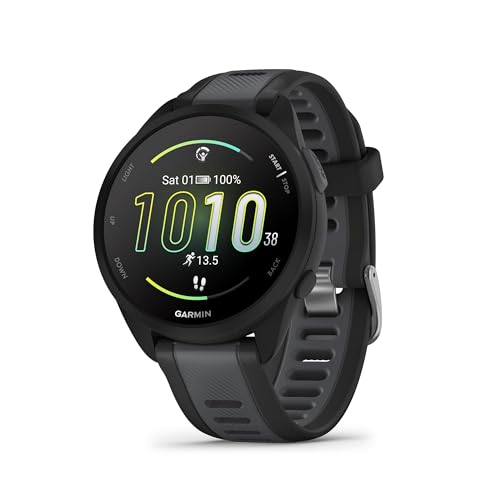
An easy-to-use running smartwatch with built-in GPS for pace and distance, wrist-based heart rate, a bright AMOLED touchscreen display with traditional button controls, and a lightweight 43mm design. Battery life is up to 11 days in smartwatch mode and up to 19 hours in GPS mode, with more than 25 built-in activity profiles including running, cycling, HIIT, and strength, plus personalised daily suggested workouts and Garmin Coach training plans.
Strengths
- An AMOLED touchscreen with buttons covers both quick glances and sweaty-handed control.
- More than 25 activity profiles include HIIT and strength, so a WOD is tracked as more than a run.
- Daily suggested workouts and Garmin Coach adapt training plans to performance and recovery.
Trade-offs
- The smallest battery here — 11 days in smartwatch mode and 19 hours of GPS is good, but the bigger models last longer.
- No built-in flashlight or multisport extras, which the premium models offer.
- A 43mm case suits most wrists but can look small on a very large wrist under a barbell.
Who it fits
Someone starting CrossFit who wants an affordable GPS watch with a bright screen, strength profiles, and training guidance, without paying for premium extras.
Best for: Starting CrossFit with guided workouts and a bright, readable screen.
Not suited for: Multi-week battery life or a flashlight for early-morning sessions.
In daily use
In daily use the Forerunner 165 is the watch you forget you are wearing until it buzzes with a suggested workout. The AMOLED screen is readable in a bright gym and in daylight on a run, and the buttons work when the touchscreen does not want to — which is most of the time in a sweaty WOD. The daily suggested workouts adapt to how recovered you are, so a hard Monday leads to a lighter Tuesday rather than another hammering, and the strength profile counts reps and sets without fuss.
Before you buy
Before buying the Forerunner 165, check the fit: a 43mm case is comfortable for most wrists, but try it against your wrist if you have very large hands or wear lifting straps. Charge it on a rest day rather than before a WOD, since the 11-day battery is generous but not infinite, and set up the strength profile before the first session — counting reps mid-WOD is not the time to learn the menus.
Check price on Amazon: Garmin Forerunner 165

2. Garmin Forerunner 265
A running smartwatch with a brilliant AMOLED touchscreen display and traditional button controls in a lightweight 46mm design. Battery life is up to 13 days in smartwatch mode and up to 20 hours in GPS mode, with a morning report covering sleep, recovery, training outlook, HRV status, and training readiness, plus personalised daily suggested workouts and race planning through the Garmin Connect app.
Strengths
- The morning report gives sleep, recovery, HRV, and readiness in one glance before training.
- Music on the wrist means a phone can stay in the locker during a WOD.
- A larger 46mm case and 13-day battery suit bigger wrists and longer training weeks.
Trade-offs
- No flashlight, titanium bezel, or sapphire lens — those arrive with the 970 and fēnix models.
- The 46mm case can catch on a barbell or a rig if worn loosely.
- Race planning features are built for runners, so a pure CrossFit athlete uses only part of them.
Who it fits
A regular CrossFit athlete who trains most days, wants recovery guidance every morning, and likes music on the wrist without a phone.
Best for: Daily CrossFit training with recovery guidance and wrist music.
Not suited for: A titanium build, a flashlight, or the longest possible battery life.
In daily use
Day to day the Forerunner 265 earns its place with the morning report. Wake up, glance at the watch, and the sleep, recovery, and readiness numbers say whether today is a heavy day or a technique day — which is exactly the decision a CrossFit athlete makes every morning. The music storage means the phone stays in the locker, the 13-day battery means charging is a weekly event rather than a daily one, and the buttons work through chalk and sweat without a second thought.
Before you buy
Before buying the Forerunner 265, decide whether the 46mm case suits your wrist and your lifting: a snug strap keeps it from sliding under a barbell, and a loose one lets it catch. Load music onto the watch before the first session rather than during it, and learn the morning report's layout on a rest day — it is most useful when you can read it at a glance before training.
Check price on Amazon: Garmin Forerunner 265

3. Garmin Forerunner 970
A premium GPS running and triathlon smartwatch with a 47mm carbon grey DLC titanium case, a black and whitestone band, an AMOLED display, a built-in LED flashlight, and enhanced navigation. Battery life is up to 15 days in smartwatch mode and up to 26 hours in GPS mode, with running economy, step speed loss, and running tolerance metrics stated in the listing.
Strengths
- A titanium bezel and sapphire lens survive knocks against barbells and rigs far better than a basic case.
- The built-in LED flashlight is genuinely useful for early-morning runs to the box.
- Running economy and step speed loss metrics give serious runners data the cheaper models do not.
Trade-offs
- The premium price buys features a pure CrossFit athlete may rarely use, such as triathlon modes.
- Some advanced running metrics need a separate heart-rate monitor, sold separately.
- A 47mm case is large, and it needs a snug strap to stay put during gymnastics movements.
Who it fits
A serious athlete who mixes CrossFit with running and wants a premium, durable watch with a flashlight and deep running data.
Best for: Mixed CrossFit and running training with premium durability.
Not suited for: A tight budget, or a wrist that finds 47mm too large.
In daily use
In daily use the Forerunner 970 feels like a tool rather than a gadget. The titanium bezel takes the knocks of a barbell without marking, the flashlight lights the path on a dark winter morning, and the 15-day battery means the charger is a weekly visitor rather than a daily one. The running metrics — economy, step speed loss, tolerance — are the kind of data that matters to someone who runs seriously alongside CrossFit, and the enhanced navigation keeps a long run on course when the route is unfamiliar.
Before you buy
Before buying the Forerunner 970, check which metrics need extra hardware: step speed loss requires a separate heart-rate monitor, so budget for it if that metric matters. Wear the 47mm case snugly during gymnastics work, since a loose watch catches on a rig, and confirm the titanium bezel and sapphire lens are worth the step up from the 265 for your training mix.
Check price on Amazon: Garmin Forerunner 970

4. Garmin fēnix 8 Sapphire 47mm
A premium multisport GPS smartwatch with a 47mm DLC titanium case, a sapphire lens, a bright 1.4-inch AMOLED display, a built-in LED flashlight, built-in speakers and microphone, and dive-rated construction. Battery life is up to 16 days in smartwatch mode and up to 47 hours in GPS mode, with targeted strength training plans, real-time stamina tracking, sport-specific workouts, and a training readiness score based on sleep, recovery, training load, and HRV.
Strengths
- Targeted strength training plans and real-time stamina tracking are built for the lifting half of CrossFit.
- A sapphire lens and titanium bezel are the toughest combination in this roundup.
- Up to 47 hours of GPS and 16 days of smartwatch battery cover the longest training weeks.
Trade-offs
- The most expensive watch here, with dive and multisport features many CrossFit athletes will never use.
- A 47mm case with a lot of features means a steeper learning curve than the simpler Forerunners.
- The built-in speaker and microphone add weight and complexity for a feature most athletes use rarely.
Who it fits
An athlete who wants the toughest, longest-lasting multisport watch available, with strength plans and stamina tracking built in.
Best for: Serious multisport training with maximum durability and battery life.
Not suited for: A budget buy, or a first GPS watch where simpler is better.
In daily use
Day to day the fēnix 8 is the watch for the athlete who trains twice a day and never wants to think about the watch itself. The strength training plans give structure to the lifting sessions, the stamina tracking says how much is left in the tank during a long WOD, and the 47-hour GPS battery means a weekend of training and a long run still leave charge to spare. The sapphire lens shrugs off a barbell, the flashlight handles dark mornings, and the display is readable in any light the gym or the trail provides.
Before you buy
Before buying the fēnix 8, be honest about whether the multisport and dive features will ever be used — they are a large part of the cost. Learn the strength plan setup on a rest day, since configuring it mid-WOD wastes training time, and wear the 47mm case snugly: a watch this size catches on equipment if it slides around the wrist.
Check price on Amazon: Garmin fēnix 8 Sapphire 47mm

5. COROS PACE 4
An ultralight sport GPS watch weighing 32g with the nylon band and 11.8mm thin, with a 1.2-inch AMOLED touchscreen, voice control, advanced training tools, accurate GPS, and a heart-rate monitor. Battery life is up to 19 days of daily use and 41 hours of continuous GPS, with a display resolution stated as 164% higher than the COROS PACE 3.
Strengths
- At 32g with the nylon band, it is the lightest watch here — it disappears under a barbell.
- Up to 19 days of daily use and 41 hours of GPS is outstanding battery life for the weight.
- Voice control and a sharp AMOLED touchscreen make it easy to operate mid-workout.
Trade-offs
- No built-in flashlight, and the feature set is slimmer than the Garmin multisport models.
- The 1.2-inch display is the smallest here, so dense data screens can feel cramped.
- COROS's app and training platform are less familiar to some athletes than Garmin's.
Who it fits
An athlete who hates feeling a watch during lifting and gymnastics, and wants maximum battery life at minimum weight.
Best for: Lightweight CrossFit training where the watch must disappear on the wrist.
Not suited for: A large display, a flashlight, or the deepest multisport feature set.
In daily use
In daily use the PACE 4's weight is the whole story: at 32 grams it is lighter than an energy gel, and under a barbell that matters more than any feature list. The battery is the other half of the appeal — 19 days of daily use means charging is something that happens every few weeks, not every few days, and 41 hours of GPS covers a training camp without a charger. The voice control is handy mid-WOD, when pressing a button with chalky hands is awkward and speaking is not.
Before you buy
Before buying the PACE 4, check the 1.2-inch display suits your eyes: it is sharp, but dense data screens are small. Try the nylon band against the silicone option, since the stated weight is with the nylon band, and spend a session learning the COROS app if you are coming from another brand — the training tools are strong, but the layout is different from Garmin's.
Check price on Amazon: COROS PACE 4

6. COROS PACE Pro
A GPS sport watch with a 1.3-inch AMOLED touchscreen, an always-on display with 1500-nit brightness, the fastest processor in its class with over twice the performance of its predecessors, global offline maps, sleep tracking, and running and cycling modes. Battery life is up to 20 days, with more than twice the processor performance and three times the zoom speed of earlier models.
Strengths
- A 1500-nit always-on AMOLED display stays readable in the brightest gym or the strongest sunlight.
- The fastest processor in its class makes maps and menus respond instantly, even mid-workout.
- Up to 20 days of battery life is the longest daily-use figure in this roundup.
Trade-offs
- No flashlight is stated, and the multisport depth is less than the fēnix 8's.
- The larger 1.3-inch display and pro positioning cost more than the standard PACE 4.
- Offline maps are a runner's feature that a pure gym athlete may rarely open.
Who it fits
An athlete who wants the brightest display and the fastest menus in a COROS watch, with the longest battery life here.
Best for: Outdoor training and running alongside CrossFit, with a display readable anywhere.
Not suited for: A minimal watch, or a tight budget where the standard PACE 4 suffices.
In daily use
Day to day the PACE Pro's display is what you notice first: at 1500 nits it is readable in direct sunlight on a run and under the harsh lights of a gym, and the always-on mode means the time and the workout data are visible without a wrist flick. The fast processor shows in the small moments — zooming a map, scrolling a menu, switching sports — which is when a slow watch is most frustrating. And the 20-day battery means the charger is forgotten for weeks at a time, which is how a training watch should behave.
Before you buy
Before buying the PACE Pro, decide whether the brighter display and faster processor justify the step up from the PACE 4 — for gym-only training, the standard model covers the same workouts. Check the 1.3-inch case against your wrist, since it is larger than the PACE 4's, and learn the offline maps before a trail run rather than during it.
Check price on Amazon: COROS PACE Pro

7. POLAR Vantage V3
A sport watch with GPS, a heart-rate monitor, and extended battery life, for men and women, with offline maps, running and triathlon modes, and more than 150 sports available. It has the sharpest AMOLED touchscreen display in the listing's description, dual-frequency GPS with detailed downloadable maps, and a comprehensive suite of training and recovery tools.
Strengths
- More than 150 sports cover every part of a CrossFit session, from lifting to rowing to running.
- Dual-frequency GPS with detailed offline maps is the most accurate positioning here for outdoor work.
- A comprehensive training and recovery suite gives guidance the morning after a hard session.
Trade-offs
- The training and recovery tools are deep, which means a longer learning curve than the simpler watches.
- No flashlight is stated, and the display, while sharp, is not the brightest here.
- POLAR's platform is less familiar to athletes coming from Garmin or COROS.
Who it fits
An athlete who wants the most complete training and recovery analysis, with accurate GPS for outdoor workouts.
Best for: Data-led training with deep recovery analysis and accurate outdoor GPS.
Not suited for: A simple watch, or a flashlight for dark-morning runs.
In daily use
In daily use the Vantage V3 is the analyst's watch. The training and recovery tools go deeper than a simple readiness score: they show how the body responded to yesterday's session and what that means for today's. The dual-frequency GPS is noticeably accurate on runs with tree cover or tall buildings, and the offline maps keep a trail run on course without a phone. With more than 150 sports available, there is a profile for every part of a WOD, and the watch switches between them without fuss.
Before you buy
Before buying the Vantage V3, spend time with the training and recovery tools on a rest day — they are powerful but they reward learning. Check the strap fit for lifting, since a watch that slides during a snatch gives poor heart-rate readings, and decide whether the offline maps matter to you: they are excellent, but a gym-only athlete may never open them.
Check price on Amazon: POLAR Vantage V3

8. SUUNTO Race S
A compact GPS sports watch with a 1.32-inch 466dpi AMOLED touchscreen, a digital crown, dual-GNSS, offline maps, and 95 or more sports modes, in black. It weighs 60g, is 11.4mm thin, and offers 30 hours in performance GPS mode or 13 days in daily use, with fast charging, training metrics, and recovery insights through the SUUNTO app.
Strengths
- A compact 60g case with a digital crown is easy to operate with sweaty hands.
- 95 or more sports modes cover strength, HIIT, running, and everything a WOD contains.
- Fast charging and 30 hours of performance GPS mean a flat battery is fixed quickly before a session.
Trade-offs
- 13 days of daily use is good but shorter than the COROS models' 19 and 20 days.
- No flashlight is stated, and the 1.32-inch display is smaller than the fēnix's 1.4-inch screen.
- The SUUNTO app and platform are less widely used than Garmin Connect, so community features are thinner.
Who it fits
An athlete who wants a compact, light multisport watch with a crown control and fast charging, for CrossFit and outdoor training.
Best for: Compact multisport training with a crown control and quick charging.
Not suited for: The longest battery life, or a flashlight for dark mornings.
In daily use
Day to day the Race S is the compact choice that does not feel like a compromise. The digital crown is the feature you will use most in a WOD: twist to scroll, press to select, all with chalky hands and without touching the screen. At 60 grams it is light enough to forget under a barbell, and the fast charging means a flat battery on the way to the box is a ten-minute problem rather than a missed session. The 95-plus sports modes cover the whole of a CrossFit session without switching watches.
Before you buy
Before buying the Race S, check the 13-day battery suits your routine — it is generous, but the COROS models last longer if charging is a chore. Learn the crown controls before the first WOD, since they are the fastest way to operate the watch mid-workout, and confirm the SUUNTO app covers the metrics you care about, since its community features are thinner than Garmin's.
Check price on Amazon: SUUNTO Race S
Buying guide: best watches for crossfit
Screen and controls: readable mid-WOD
A CrossFit watch is read in the middle of a workout, not studied at a desk. An AMOLED display stays readable under bright gym lights and in sunlight, and a screen of 1.2 inches or more shows the key numbers — time, heart rate, and reps — without squinting. Buttons matter as much as the screen: a touchscreen alone fails when hands are sweaty and chalky, so the watches here pair a touchscreen with physical buttons or a crown. Before buying, check that the watch can be operated with one hand and without looking closely, because that is how it will be used between sets.
Battery life: charge weekly, not daily
A watch that needs charging every night is a watch that gets left on the charger on the morning of a WOD. The models here offer between 11 and 20 days of daily use, and between 19 and 47 hours of GPS, which means charging is a weekly event at most. GPS mode is the battery hog: a long outdoor run drains far more than a gym session, so check the GPS figure as well as the daily-use figure. Fast charging is a useful bonus — a flat battery fixed in ten minutes before a session is a minor inconvenience, while a watch that needs hours on the charger is a missed workout.
Strength, HIIT, and recovery features
Running features are table stakes; what separates a CrossFit watch is how it handles the rest of the session. Look for strength profiles that count sets and reps, HIIT profiles for interval work, and multisport modes that switch between running, rowing, and lifting without stopping the workout. Recovery features matter just as much: a morning report covering sleep, recovery, and readiness says whether today is a heavy day or a technique day, and daily suggested workouts adapt to that answer. A watch that only counts steps and runs is a running watch, not a CrossFit watch.
Weight, durability, and fit
A CrossFit watch lives under a barbell, against a rig, and in chalk dust. Weight matters most: a 32-gram watch disappears on the wrist, while a heavy watch slides and catches. A sapphire lens and a titanium bezel survive knocks that mark a basic case, and a watch rated for swimming survives the sweat and the shower afterwards. Fit is the detail that decides accuracy: a loose watch slides during a snatch and gives poor heart-rate readings, while a snug strap stays put. Try the strap tightness that keeps the watch still without cutting off circulation, and check the case size against your wrist — a 47mm case is a lot of watch on a small wrist.
Music, maps, and the phone question
A watch that stores music lets the phone stay in the locker, which is worth more in a CrossFit box than anywhere else — there is nowhere safe for a phone during a WOD, and a phone in a pocket is a phone that gets sat on. Offline maps matter for the running parts of training, especially on trails, and they work without a phone signal. The broader question is how much the watch should do on its own: notifications, payments, and calls are convenient, but every extra feature costs battery and complexity. For CrossFit, the features that matter are the ones that work without a phone nearby — music, maps, and the workout itself — because the phone is usually somewhere else during training.
Using and caring for your pick
Wear the watch snugly for training and looser for the rest of the day: a snug fit gives accurate heart-rate readings during a WOD, while a looser fit is more comfortable overnight. Rinse the watch and strap under clean water after a sweaty session, since dried sweat and chalk stiffen straps and cloud sensors. Charge on a rest day rather than before a workout, and keep the charger in the same place so the routine sticks. Update the software when prompted, and review the recovery and readiness numbers each morning before deciding how hard to train — the watch's best feature is the advice it gives before the session, not the numbers it records during it.
Common mistakes to avoid
The most common mistake is buying a running watch and discovering it has no strength or HIIT profile — always check the activity list before buying. The second is wearing the watch loosely during lifting, which gives poor heart-rate readings and lets the watch catch on a barbell. The third is charging the night before a WOD and forgetting it on the charger in the morning. The fourth is ignoring the recovery numbers and training hard every day, which is how overuse builds up. And the fifth is choosing on looks alone: a watch that looks good on a wrist but cannot be read mid-burpee is the wrong watch for CrossFit.
Final recommendation
For most CrossFit athletes, the Garmin Forerunner 265 is the sweet spot: a bright AMOLED screen with buttons, a morning recovery report, music on the wrist, and 13 days of battery at a sensible size and cost. If weight matters above all, the COROS PACE 4 disappears on the wrist at 32 grams and lasts 19 days. If durability and depth matter most, the Garmin fēnix 8 brings a sapphire lens, a titanium bezel, strength plans, and 47 hours of GPS. And for data-led training, the POLAR Vantage V3 offers the deepest recovery analysis with the most accurate outdoor GPS. Whichever you choose, check the strength and HIIT profiles first, wear it snugly, and let the morning recovery numbers decide how hard today should be. A watch that fits the workout is a training partner, not just a gadget.
Frequently asked questions
Can a GPS watch track a CrossFit WOD?
Yes, if it has the right profiles. The watches here include strength, HIIT, and multisport modes that cover the lifting, gymnastics, and cardio parts of a session, along with GPS for the running parts. A watch with only a running profile will track the run and miss the rest, so check the activity list before buying.
Do I need a heart-rate monitor strap as well?
A wrist heart-rate sensor covers most training, but a chest strap is more accurate during heavy lifting and high-intensity intervals, when the wrist moves a lot. Some advanced metrics — such as step speed loss on the Forerunner 970 — require a separate monitor, as the listing states. For most athletes the wrist sensor is enough to start with.
How long should a CrossFit watch battery last?
For daily use, a week or more is a reasonable expectation — the watches here offer between 11 and 20 days. GPS mode drains the battery much faster, between 19 and 47 hours depending on the model, so check the GPS figure if long outdoor runs are part of training. A watch that needs charging every night is a watch that will be left behind one morning.
Are touchscreens usable with sweaty hands?
Barely, which is why the watches here pair a touchscreen with physical buttons or a crown. The buttons and crown work reliably with chalk and sweat, while the touchscreen is best for setup and review rather than mid-workout control. If a watch has a touchscreen only, it will frustrate you in the middle of a WOD.
Should I wear my watch during lifting?
Yes, with a snug strap. A snug fit keeps the watch still under a barbell and gives accurate heart-rate readings, while a loose watch slides, catches, and reads poorly. Some athletes turn the watch face inward during heavy barbell work to protect the screen, which is a reasonable precaution with a basic lens — less necessary with a sapphire lens.
Can I swim or shower with a CrossFit watch?
The watches here are built for sweat and water, and the multisport models are rated for swimming. Rinsing the watch under clean water after a sweaty session is good practice: it clears chalk and salt from the strap and the sensor. Avoid hot showers and saunas with the watch on, since sustained heat is harder on seals and batteries than a quick rinse, and let the strap dry fully before the next session to avoid skin irritation.