Where to buy
Check the latest price, availability and delivery on Amazon. Orders are placed on Amazon. We may earn a commission from qualifying purchases.
- Best Xbox One game drive: WD_BLACK P50 Game Drive SSD 1TB (WDBA3S0010BBK-WESN) — Check on Amazon
- Samsung T7 Shield Portable SSD 1TB (MU-PE1T0S/AM) — Check on Amazon
- Crucial X9 Pro Portable SSD 1TB (CT1000X9PROSSD902)
- SanDisk Extreme PRO Portable SSD 1TB (SDSSDE81-1T00-G25) — Check on Amazon
See 2 more Amazon options
- Crucial MX500 1TB 3D NAND SATA 2.5-inch SSD (CT1000MX500SSD1) — Check on Amazon
- Seagate Game Drive SSD for Xbox — listed without a link in this guide; see its review below for why
Read the full guide ↓
Disclosure: As an Amazon Associate, ilcastellomenu.com earns from qualifying purchases. Links to Amazon on this page are affiliate links; they cost you nothing extra. Listing details such as price and availability change often, so check the current Amazon listing before you buy.
The best ssds for xbox one work within rules Microsoft set clearly and this guide respects: the Xbox One plays its games from internal storage or from a USB external drive the console formats itself, its internal drive is not a practical owner upgrade, and its USB ports are USB 3.0-class — fast enough to transform a hard-drive-era console, incapable of using NVMe or 20 Gb/s headlines. So this guide ranks exactly what an Xbox One can use: bus-powered portable SSDs that become the console’s game library, plus the honest DIY route of a proven SATA SSD in a USB enclosure. Every linked pick is a verified listing, and every speed is stated as the console will experience it.
The transformation on offer is the same one the PS4 enjoys: an Xbox One on an SSD loads games faster, installs and copies between drives quickly, and stops feeling like a machine apologising for its storage. The console’s other hardware sets the ceiling — loads improve meaningfully rather than miraculously — which is why this guide’s picks compete on build, capacity, console manners and value rather than on interface figures the Xbox cannot spend. A portable SSD is also the library’s passport: format it on the console, fill it, and it travels between Xbox One consoles with its games ready to play under your account.
One clarification for households with newer hardware: the stricter storage rules you may have read about — games that must run from internal or expansion-card storage — belong to the newer generation’s optimised titles. For the Xbox One’s own library, external SSD storage is a first-class citizen: games install to it and play from it, full stop. That is the whole opportunity, and it is a good one.
In this guide
Quick Picks
Short on time, or comparing several options at once? Each row below names a buyer type and the drive that suits it, with a link to the listing where one is verified.
| Buyer type | Pick | Why it stands out | Link |
|---|---|---|---|
| Best Xbox One game drive | WD_BLACK P50 Game Drive SSD 1TB (WDBA3S0010BBK-WESN) | Built and sold as a game drive for Xbox and PlayStation libraries, in a shock-resistant shell | Check on Amazon |
| Best rugged library drive | Samsung T7 Shield Portable SSD 1TB (MU-PE1T0S/AM) | Up to 1,050 MB/s-class portable with IP65 armour for a library that moves house | Check on Amazon |
| Best value external drive | Crucial X9 Pro Portable SSD 1TB (CT1000X9PROSSD902) | Compact metal portable at the value tier — the console cannot use more speed than this class anyway | — |
| Best for a library shared with a fast PC | SanDisk Extreme PRO Portable SSD 1TB (SDSSDE81-1T00-G25) | A 2,000 MB/s-class portable whose extra speed waits for a PC, while the Xbox uses its build | Check on Amazon |
| Best DIY route: SATA SSD plus enclosure | Crucial MX500 1TB 3D NAND SATA 2.5-inch SSD (CT1000MX500SSD1) | The proven MX500 in a USB 3 enclosure you supply — a full-speed Xbox library you build yourself | Check on Amazon |
| The licensed Xbox option — listed without a link | Seagate Game Drive SSD for Xbox | Seagate’s Xbox-licensed game drive line: console-first setup and presentation | See the full review below |
How These Picks Were Chosen
Xbox One judging required three things of every pick: the console can power and use it over USB as sold, its real-world speed on the console’s ports is the class the console supports (headline modes beyond that were treated as irrelevant), and its build suits console life — behind a TV, in a bag between houses, plugged in for years. Licensed and game-first drives were credited for intent; neutral portables for value.
We did not use these drives ourselves. We read manufacturer specification pages and listing records, cross-checked the numbers that matter — interface, form factor, sequential figures, endurance ratings where published, and cooling arrangements — and favoured drives whose makers publish full specifications over those that hide behind marketing words. Every ASIN in this guide was verified against a live listing record during research, and every specification printed in the reviews traces to a manufacturer or retailer source recorded in the article’s source notes. Where a maker’s headline stretches a definition — a USB mode a host cannot use, a speed a console cannot spend — the review says so in plain language and judges the drive on its architecture instead.
The 6 Best SSDs for Xbox One
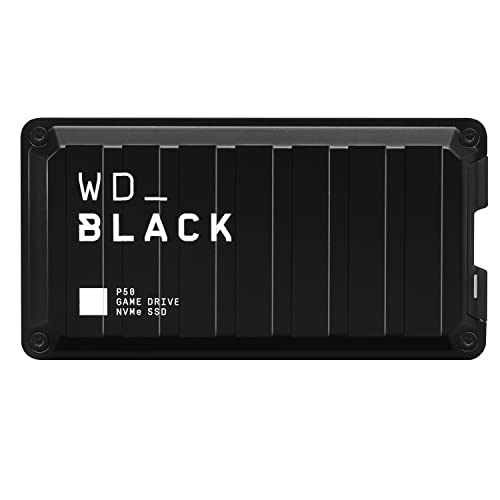
WD_BLACK P50 Game Drive SSD 1TB (WDBA3S0010BBK-WESN)
Who it suits: Best Xbox One game drive — built and sold as a game drive for Xbox and PlayStation libraries, in a shock-resistant shell.
The P50 was the first portable SSD built and sold specifically as a game drive: up to 2,000 MB/s over USB 3.2 Gen 2×2, in a shock-resistant metal enclosure with a gamer’s industrial design, marketed for PlayStation, Xbox, PC and Mac libraries. As external storage it does the jobs consoles actually allow an external drive to do — store and play last-generation titles, park current-generation games off the internal drive, and shuttle a library between machines — at speeds that make those transfers painless on a 20 Gb/s host.
Like the other 2×2 drive in this guide, its headline depends on the host: consoles and Macs talk to it at 10 Gb/s-class speeds, where it remains a fast, rugged library drive, while a 20 Gb/s Windows port unlocks the full figure. What you are buying beyond raw speed is intent — firmware, enclosure and support aimed at game libraries and long play sessions rather than office files — plus the WD_BLACK ecosystem’s dashboard tools on PC.
The P50 is the console-first pick: a WD_BLACK game drive marketed for Xbox, PlayStation, PC and Mac libraries, in an enclosure designed to live the console life and travel between machines. On the Xbox One its transfer speeds are set by the console’s ports — like every drive here — so its premium buys intent and build: gaming firmware manners, a tough shell, and a product whose support pages speak console. For an Xbox-centred shelf it is the tidiest one-drive answer in this guide.
- Purpose-built game drive: up to 2,000 MB/s on 20 Gb/s hosts.
- Shock-resistant metal enclosure made for bags and console shelves.
- Marketed and supported for PlayStation, Xbox, PC and Mac libraries.
Honest limitation: Consoles and Macs cap it at 10 Gb/s-class speeds; current-generation console games still cannot play from any external drive.
Choose it if you want a game-first drive designed around console libraries and built to travel. Skip it if you want the same job for the least money — the X9 Pro and the DIY route below undercut it.
Samsung T7 Shield Portable SSD 1TB (MU-PE1T0S/AM)
Who it suits: Best rugged library drive — up to 1,050 MB/s-class portable with IP65 armour for a library that moves house.
The T7 Shield is Samsung’s portable SSD in its working clothes: the T7 family’s up-to-1,050 MB/s USB 3.2 Gen2 performance wrapped in a ribbed rubber exterior with an IP65 dust-and-water-resistance rating and drop protection aimed at bags, desks and location work rather than a shelf. It is bus-powered over USB-C, pocketable, and compatible with the whole modern zoo — PC, Mac, Android, and games consoles for external game storage — which is why it keeps winning the ‘one portable drive’ argument.
Its honest ceiling is the interface: 10 Gb/s USB means roughly a gigabyte per second at best, and no portable drive in this class escapes that; machines with faster ports still talk to it at Gen2 speeds. Within that ceiling, the Shield’s sustained-write behaviour, thermal manners inside its rubber shell and Samsung’s portable-SSD software support make it the rugged default — the drive you throw in a camera bag, a console backpack or a laptop sleeve and stop thinking about.
The T7 Shield is the library drive for an Xbox One that travels — to a friend’s house, a dorm, a second home. Its rubber armour and IP65 rating suit a life in bags, its bus-powered USB-C connection (with the right cable for the console’s USB-A ports) needs no power brick, and its speed on the console matches the port-limited class while its transfers to and from a PC run at full portable pace. As a permanent fixture behind the TV it is equally happy; ruggedness is simply never wasted on a games library.
- Up to 1,050 MB/s over USB-C with broad PC/Mac/console compatibility.
- IP65 rating and rugged rubber exterior for real travel duty.
- Bus-powered and pocketable — no brick, no fuss.
Honest limitation: USB 3.2 Gen2 caps real transfers near a gigabyte per second; 20 Gb/s drives are faster on hosts that support them.
Choose it if your Xbox library travels, or you want one portable that also serves your PC and camera life. Skip it if the drive will sit behind one console forever — the X9 Pro’s value is the better spend there.
Crucial X9 Pro Portable SSD 1TB (CT1000X9PROSSD902)
Who it suits: Best value external drive — compact metal portable at the value tier — the console cannot use more speed than this class anyway.
The X9 Pro is Crucial’s answer to the T7 formula: up to 1,050 MB/s reads and writes over USB-C in an anodised aluminium enclosure barely bigger than a credit card’s footprint, with drop resistance and a lanyard loop that signal it was designed to live on a keyring-adjacent life rather than a desk. It is bus-powered, works across PC, Mac and consoles, and Crucial prices it to undercut the Samsung equivalent whenever listings move — which, in this class, is often.
The specification ceiling is the class ceiling: 10 Gb/s USB, so about a gigabyte per second on a good day, and no way around it. Within that, the X9 Pro’s sustained behaviour is honest, its enclosure handles travel heat well, and its size makes it the portable most likely to actually be in your bag when you need it. Buyers choosing between this and the T7 Shield are choosing ruggedness ratings and the day’s listing, not a different class of drive.
The X9 Pro is the value logic of this whole guide in one product: since the Xbox One’s ports cap every external drive at the same class, paying for higher headline modes buys nothing on this console — so buy the compact, well-built, keenly priced drive instead. The X9 Pro is exactly that, small enough to vanish behind the console and cheap enough in spirit to dedicate to the library permanently. Format it from the console’s settings and the Xbox treats it as home.
- Up to 1,050 MB/s read and write in a very compact metal body.
- Broad PC, Mac and console compatibility over USB-C.
- Aggressively positioned against the Samsung T7 class.
Honest limitation: 10 Gb/s USB ceiling, shared with its whole class; the Mac-specific version is the tidier buy for Apple-only kits.
Choose it if you want a dedicated Xbox One library drive at the sensible price. Skip it if you want licensed game-drive presentation or maximum ruggedness — the picks above sell those.
SanDisk Extreme PRO Portable SSD 1TB (SDSSDE81-1T00-G25)
Who it suits: Best for a library shared with a fast PC — a 2,000 MB/s-class portable whose extra speed waits for a PC, while the Xbox uses its build.
The Extreme PRO is the speed pick among portables: up to 2,000 MB/s reads and writes over USB 3.2 Gen 2×2, in a forged aluminium chassis with IP65 water and dust resistance and drop protection, from the brand professional photographers standardised on. On a host with a 20 Gb/s USB port it moves footage, game libraries and disk images at roughly double the rate of the 10 Gb/s class, and its metal body sheds the heat of those long transfers better than plastic rivals.
The asterisk is written on the interface, not the drive: USB 3.2 Gen 2×2 hosts are common on Windows desktops and rare elsewhere — Macs do not support 2×2 and fall back to 10 Gb/s speeds, and many laptops do the same. On the right host this is the fastest portable in this guide; on the wrong host it is a very well-built 10 Gb/s drive. Check your ports before paying for the headline, and the drive will do the rest.
The Extreme PRO is the two-machine pick, included with its logic stated plainly: on the Xbox One it performs at the console’s port class, indistinguishable from the drives above; on a Windows PC with a 20 Gb/s port it becomes the fastest portable in this guide for moving the library, captures and everything else. Households that shuttle one drive between an Xbox One and a serious PC get both behaviours from one purchase — console drive at the TV, speed merchant at the desk.
- Up to 2,000/2,000 MB/s on 20 Gb/s USB hosts — fastest portable class here.
- Forged aluminium chassis, IP65 rating, drop protection.
- Sustained-transfer thermals suit big footage and library moves.
Honest limitation: Full speed needs a USB 3.2 Gen 2×2 host; Macs and many laptops cap it at 10 Gb/s-class speeds.
Choose it if one drive must serve the Xbox One and a fast Windows PC, and you want it excellent at both. Skip it if the drive is for the console alone — its PC speed is a premium the Xbox cannot spend.
Crucial MX500 1TB 3D NAND SATA 2.5-inch SSD (CT1000MX500SSD1)
Who it suits: Best DIY route: SATA SSD plus enclosure — the proven MX500 in a USB 3 enclosure you supply — a full-speed Xbox library you build yourself.
The MX500 has been the value answer in SATA for years: up to 560 MB/s reads from a DRAM-equipped 3D NAND design that matches the interface’s ceiling and undercuts the 870 EVO’s usual pricing tier. Crucial builds in the ownership details that matter at this level — power-loss protection for data in flight, hardware encryption support, and the Acronis cloning software that makes a laptop or console drive swap a guided afternoon rather than a research project.
In practice the MX500 and the 870 EVO deliver the same experience to the machines that take them; the choice between them is about the day’s listings and your brand history, not about a performance gap you could feel. As a PS4 internal drive, an older-laptop resurrection, a NAS SATA tier or an enclosure build, it does the complete job with no asterisk — the asterisk belongs only to SATA itself, whose ceiling every drive in this form factor shares.
The DIY route deserves its place: an MX500 in a decent USB 3 enclosure delivers the same console-class performance as the ready-made portables, often for less, and teaches you exactly what your library drive is. The MX500’s record and cloning tools make it the right stick for the job. Two honest notes: the enclosure is a separate purchase this listing does not include, and the finished article is a cable-and-box arrangement rather than a sealed portable — behind a TV, nobody will ever know or care.
- Up to 560 MB/s — the full SATA experience at a value tier.
- DRAM-equipped design with power-loss protection.
- Acronis cloning software included for easy drive swaps.
Honest limitation: SATA ceiling applies, as with every 2.5-inch drive; Samsung’s rival is the more premium name if listings are ever equal.
Choose it if you enjoy a small project and want console-class SSD storage at the keenest total cost. Skip it if you want one sealed product in one box — the X9 Pro is the ready-made version of this idea.
Seagate Game Drive SSD for Xbox
Who it suits: The licensed Xbox option — listed without a link — seagate’s Xbox-licensed game drive line: console-first setup and presentation.
Seagate’s licensed Xbox game drives are the console-channel answer to external storage: Xbox branding, setup aimed at console owners rather than PC builders, and positioning as the official way to carry an Xbox One library. Functionally the job is the same one every drive in this guide does — USB storage the console formats and fills — with the licence and the onboarding as the product.
We list it prose-only because this pass did not pin a US Amazon ASIN for it to the batch standard. If you find it beside the P50 or T7 Shield, the decision is about the Xbox-specific presentation versus the faster, platform-neutral drives; the console itself will treat them alike.
Seagate’s licensed Xbox game drives are the console-channel alternative: Xbox branding, console-first onboarding, and positioning as the official library expansion. They are presented without a link because this pass did not pin a US Amazon ASIN for the line to the batch standard. Functionally the console treats them like every drive here — format, fill, play — so the decision against the P50 is presentation and channel preference, made with eyes open about the identical underlying job.
- Xbox-licensed presentation and console-first setup.
- Purpose-sold for Xbox game libraries.
- Portable, bus-powered design.
Honest limitation: Listed prose-only here — no verified US Amazon ASIN pinned in this pass.
Choose it if you prefer the Xbox-licensed product and find it through console retail channels. Skip it if you want to order from this page’s verified listings — the P50 covers the game-drive brief, linked above.
Comparison Table
| Product | Type | Key specifications | Link |
|---|---|---|---|
| WD_BLACK P50 Game Drive SSD 1TB (WDBA3S0010BBK-WESN) | External portable game drive, USB 3.2 Gen 2×2 USB-C | USB 3.2 Gen 2×2 (20 Gb/s) · USB-C · up to 2,000 MB/s read · 1TB · listed for PlayStation, Xbox, PC and Mac | Check on Amazon |
| Samsung T7 Shield Portable SSD 1TB (MU-PE1T0S/AM) | External portable, USB 3.2 Gen2 USB-C | USB 3.2 Gen2 (10 Gb/s) · USB-C · up to 1,050 MB/s · IP65 rated · rugged rubber exterior · 1TB | Check on Amazon |
| Crucial X9 Pro Portable SSD 1TB (CT1000X9PROSSD902) | External portable, USB 3.2 USB-C | USB 3.2 Gen2 (10 Gb/s) · USB-C · up to 1,050 MB/s read and write · 1TB | — |
| SanDisk Extreme PRO Portable SSD 1TB (SDSSDE81-1T00-G25) | External portable, USB 3.2 Gen 2×2 USB-C | USB 3.2 Gen 2×2 (20 Gb/s) · USB-C · up to 2,000 MB/s read · up to 2,000 MB/s write · IP65 rated · forged aluminium chassis · 1TB | Check on Amazon |
| Crucial MX500 1TB 3D NAND SATA 2.5-inch SSD (CT1000MX500SSD1) | Internal SATA, 2.5-inch 7mm | SATA 6 Gb/s · 2.5-inch · up to 560 MB/s read · 3D NAND · 1TB | Check on Amazon |
| Seagate Game Drive SSD for Xbox | External portable game drive, USB — prose-only | USB external · Xbox-licensed positioning · portable game-library drive | — |
On an Xbox One, every external drive in this table performs at the class the console’s USB ports define — so the rows are separated by what actually differs: build, intent, capacity value and whether the product is a sealed portable or the DIY enclosure route. The speed column records each drive’s class on a PC, where several of them have a second, faster life.
How Xbox One Storage Actually Works
The Xbox One’s storage model is refreshingly owner-friendly once stated plainly. The console supports USB external drives above a minimum capacity threshold, formats them itself as game storage, and then treats them as first-class library space: games install there, play from there, and can be set as the default install location. The internal drive is a standard component in theory but not a practical owner upgrade — the console’s software arrangement makes the external route the one Microsoft designed for you, and it is genuinely sufficient. An SSD on that USB connection removes the hard-drive bottleneck from loads, installs and library management, which is the entire upgrade on offer.
Portability is the underappreciated half of the model. A formatted library drive moved to another Xbox One carries its games with it; sign in with your account and the library plays. That makes the external SSD both an upgrade and a suitcase — a consideration that shapes this guide’s preference for rugged, bus-powered, single-cable drives. The neighbouring consoles draw their lines differently: the PS4’s story is in Best Ssds For Ps4, the PS5’s stricter internal rules in Best Ssds For Ps5, and the cross-platform external picture in Best External Ssds For Gaming.
Capacity Planning for a Finished Library
The Xbox One’s catalogue is complete — no new releases are inflating it — which makes capacity planning here uniquely satisfying: you can size the drive to the library, full stop. Count the games you genuinely rotate, add the handful of enormous titles every library accumulates, and buy the portable that holds that total with room to spare. For most owners that arithmetic lands at 1TB; for collectors it lands at the largest portable tier they can justify, bought once. A drive that holds everything ends the install-delete shuffle permanently, which on a hard-drive-era console is a quality-of-life upgrade second only to the SSD itself.
Two disciplines keep the arrangement happy for years. First, set the external SSD as the default install location in the console’s settings, so new games land on the fast drive without being told. Second, remember that the library drive is not a backup of anything — games re-download, but saves live with your account and the cloud, and captures deserve their own copy if they matter. Treat the portable as the library’s home rather than its vault, and it will serve until the console itself retires.
Moving the Library: Between Consoles, Houses and Generations
The Xbox One library drive’s finest feature is social: the games live on the drive, the licences live in your account, and the two meet on any console you sign into. A library built on one of these portables can spend Friday at home and Saturday at a friend’s house, can follow you from a base console to a Pro, and can survive the original console’s retirement entirely — the drive is the collection, the console is just its current player. That portability is worth buying deliberately: a rugged, bus-powered, single-cable drive is a library that travels; a fragile arrangement is a library that stays home out of anxiety.
The disciplines that keep the travelling library happy are few and learnable. Eject by shutting the console down or moving games properly rather than yanking cables mid-write. Keep the drive’s job exclusive — the console’s format is its whole world, and a PC that ‘fixes’ it erases the collection. And keep captures backed up separately, because the library itself is re-downloadable but your clips are autobiography. Observed, those three habits make an external SSD the most durable form a games collection has ever taken: no discs to scratch, no shelf to house, one small drive in a bag.
The Internal Hard Drive You Still Own
Adding an external SSD does not retire the Xbox One’s internal hard drive, and the two work best as a deliberate pair. The internal drive remains the console’s home — the system lives there regardless — and it makes a sensible annex for the games in lightest rotation, keeping the SSD’s space for the titles whose loads you feel weekly. The console’s own storage menus make moving titles between the two a quick, bookkeeping-safe operation, and setting the SSD as the default install location ensures new arrivals land on the fast drive without supervision.
There is also a diagnostic gift in the pairing: if the console itself becomes sluggish everywhere — menus, system screens, games on both drives — the internal hard drive may be ageing, and on a console of this vintage that is information worth having early, while saves and captures can still be copied calmly. The external SSD cannot fix a failing internal drive, but it can hold everything that matters while you decide what to do about it — one more way the library drive earns its place even in a single-console home.
The Living-Room Details: Noise, Heat and Where the Drive Lives
Console storage lives in furniture, and furniture imposes its own specifications. The Xbox One’s shelf or cabinet is warm, enclosed and intolerant of clutter; a portable SSD suits it almost perfectly — silent where the console’s original hard drive era was not, cool-running at console workloads, and small enough to disappear behind the machine it serves. The practical arrangements are few and worth stating: give the drive air rather than burying it in the cabinet’s warmest corner, route its cable so it is not pinched by the furniture it hides behind, and connect it directly to the console rather than through whatever hub the television’s other accessories have accumulated.
The longer view is about the library’s home becoming permanent. A drive installed behind a console tends to stay there for years, through console updates, house moves and the arrival of newer machines in the same cabinet — which argues for the boring virtues this guide keeps selecting for: a reputable maker, a sealed unit with no improvised parts, capacity bought generously once. The Xbox One’s catalogue deserves that permanence; it is a finished library, and a finished library on a good drive is one of gaming’s most satisfying objects — an entire era, silent in a cabinet, ready in seconds.
Two Consoles, One Account: The Household Shelf
Many Xbox One households quietly became two-console households — the living-room machine and the bedroom machine, the parents’ console and the children’s — and external library drives are what make that arrangement civilised. One library drive per console, each holding that room’s rotation, ends the era of the shared internal drive and its negotiations; a third, travelling drive is the diplomatic pouch between them. The account holds the licences, the drives hold the games, and any title can be re-homed in the time a console takes to copy it.
The shelf’s economics are kind: the drives in this guide cost less than a couple of the games they hold, and they convert a fixed catalogue into a household utility. Label each drive with its console and its contents’ theme, keep the captures backed up centrally, and the Xbox One stops being a single machine with a storage problem and becomes what its catalogue always wanted to be — a library with several reading rooms.
That household view also explains why this guide treats a fifty-dollar-class decision with such ceremony. The drive is small; the library is a decade. Consoles accumulate meaning the way bookshelves do — every title a phase, a friendship, a summer — and the storage that holds them inherits some of that weight. A good external SSD, chosen once and chosen properly, is how a finished catalogue stays alive and playable at full dignity: no shelf of cases, no dead internal drive standing between the collection and its next evening. For a console generation that gave its owners ten years of games, that is not an accessory purchase. It is archival work, done cheaply and done right — and it is the last storage decision the Xbox One will ever ask of you, which makes it worth the few minutes this page has spent on it.
Practical shoppers will also want the small print of the purchase itself gathered in one place, so here it is. Confirm the drive is bus-powered, because a library drive that needs a wall outlet behind the television is a library drive that gets unplugged. Confirm the cable situation in the box, because the console’s ports and the drive’s connector are different shapes and the right cable is part of the product, not an accessory to discover later. Confirm the capacity against the library one final time — not the library’s current size, but its size after the next sale, the next borrowed disc, the next rediscovered favourite. And keep the packaging until the console has formatted the drive and played from it once, because the only return that matters is the one inside the window. None of this is difficult, and all of it together is the difference between an upgrade that takes an evening and one that takes a fortnight of small frictions. The console is patient; the household’s enthusiasm is the perishable part, and a clean first evening is what converts a purchase into a permanent arrangement.
So the ceremony, such as it is, ends where all good upgrades end: with the equipment forgotten and the games remembered. A console that wakes quickly, a library that is simply there, a drive that asks nothing — that is the Xbox One’s best self, and it is available for the price of the small, silent box this guide has spent its length choosing carefully. Choose it once, choose it generously, and let the catalogue do the rest.
And if the household’s shelf holds both generations one day, the lesson transfers intact: know what the host permits, buy for the library’s real life, and let the drive disappear into the furniture and the years. The catalogue deserves nothing less, and neither does the household that built it, one game at a time, across a decade of evenings — evenings that deserve to be spent playing, not waiting.
How to Choose Best SSDs for Xbox One
Xbox One storage has one designed route — external, console-formatted — and these checks make the most of it:
- Buy USB storage the console formats itself. Any pick here qualifies: connect, let the Xbox format it as game storage, and set it as the default install location in settings.
- Ignore interface headlines beyond the console’s class. The Xbox One’s USB ports set the speed for every external drive. Pay for build, capacity and value — not 20 Gb/s modes.
- Mind the cable and port. The console uses USB-A ports; a drive with a USB-C connector needs the right cable or adapter, and a poor cable can cost real speed.
- Size to the whole library, once. The catalogue is finished. A drive that holds everything ends storage management on this console permanently.
- Keep the drive bus-powered and single-cable. Portables that need no power brick are the ones that travel and live happily behind a TV for years.
- Use the DIY route deliberately. A SATA SSD in a USB 3 enclosure matches ready-made performance for less — budget the enclosure, and buy a reputable one.
- Let the console manage the library. Move games between internal and external storage in the console’s own menus; transfers are quick and the bookkeeping stays correct.
- Label the drive’s job. A formatted Xbox library drive will be erased by any other device that ‘helpfully’ reformats it. Mark it, and keep it in console service.
Common Mistakes
- Buying an NVMe drive or an expansion product meant for newer consoles — the Xbox One cannot use either.
- Paying for 20 Gb/s portable speed the console’s USB 3.0-class ports cannot deliver.
- Formatting the drive on a PC first and wondering why the console insists on erasing it.
- Buying capacity for the library you wish you had instead of the one you own — or the reverse, and living on the delete screen.
- Using a bargain cable or a USB hub between the console and the drive.
- Assuming the internal drive is a sensible owner upgrade and opening the console for no benefit.
- Storing the only copy of precious captures on the library drive.
- Moving the drive between console and PC service weekly and reformatting your library away.
Final Recommendation
- Best Xbox One game drive: WD_BLACK P50 Game Drive SSD 1TB (WDBA3S0010BBK-WESN).
- Best rugged library drive: Samsung T7 Shield Portable SSD 1TB (MU-PE1T0S/AM).
- Best value external drive: Crucial X9 Pro Portable SSD 1TB (CT1000X9PROSSD902).
- Best for a library shared with a fast PC: SanDisk Extreme PRO Portable SSD 1TB (SDSSDE81-1T00-G25).
- Best DIY route: SATA SSD plus enclosure: Crucial MX500 1TB 3D NAND SATA 2.5-inch SSD (CT1000MX500SSD1).
- The licensed Xbox option — listed without a link: Seagate Game Drive SSD for Xbox.
Our top two here are the WD_BLACK P50 Game Drive SSD 1TB (WDBA3S0010BBK-WESN), for the buyer this article was written for, and the Samsung T7 Shield Portable SSD 1TB (MU-PE1T0S/AM), for the household whose priorities run the other way. Between them they cover the two shapes this search usually takes: the complete answer bought once, and the value answer that leaves budget for everything else. Readers weighing a neighbouring question should also see Best Ssds For Ps4. Give the Xbox One a fast, capacious library drive and let the console be what it always wanted to be — a great catalogue machine with no waiting — bought once, formatted once, and enjoyed for the rest of its long life.
Frequently Asked Questions
Can Xbox One games play from an external SSD?
Yes. The Xbox One installs games to and plays them from a USB external drive that the console has formatted as game storage. That is the foundation of this guide — an external SSD is a first-class library drive for the Xbox One’s own catalogue.
How much faster is an SSD on an Xbox One?
Meaningfully: loads, installs and library operations improve clearly over the internal hard drive, because storage was the console’s bottleneck for those jobs. The console’s CPU and USB ports set the ceiling, so expect a responsive, modern-feeling Xbox One — not newer-generation performance.
What size external drive should I buy?
Size it to your library with headroom. The Xbox One catalogue is complete and finite, so 1TB covers most owners’ full rotation, and enthusiasts can hold essentially everything on the largest portable tiers. Buying once, generously, ends the delete-and-redownload cycle.
Can I upgrade the Xbox One’s internal drive instead?
It is not the practical route: the console is designed around external expansion, its software arrangement makes internal swaps a specialist project, and the external SSD delivers the same gaming benefit with no opening and no risk. This guide’s picks are all external for that reason.
Can I use the same drive on my Xbox One and my PC?
A drive formatted by the Xbox as game storage is dedicated to that job — a PC will not read the library, and reformatting erases it. If you need a shuttle drive for files and captures, use a separate drive formatted for PC use, like the general portables in this guide’s other articles.
Does the drive need its own power supply?
No — every pick here is bus-powered from the console’s USB port. Prefer a direct connection to the console rather than through an unpowered hub, which can starve a drive at exactly the wrong moment.
Can I use an external SSD and keep games on the internal drive too?
Yes — the console treats both as library space, lets you move games between them in its storage menus, and lets you choose the default install location. A common arrangement keeps favourites on the SSD and the long tail on the internal drive.


